Case study · A tenant on Intelligent Operations
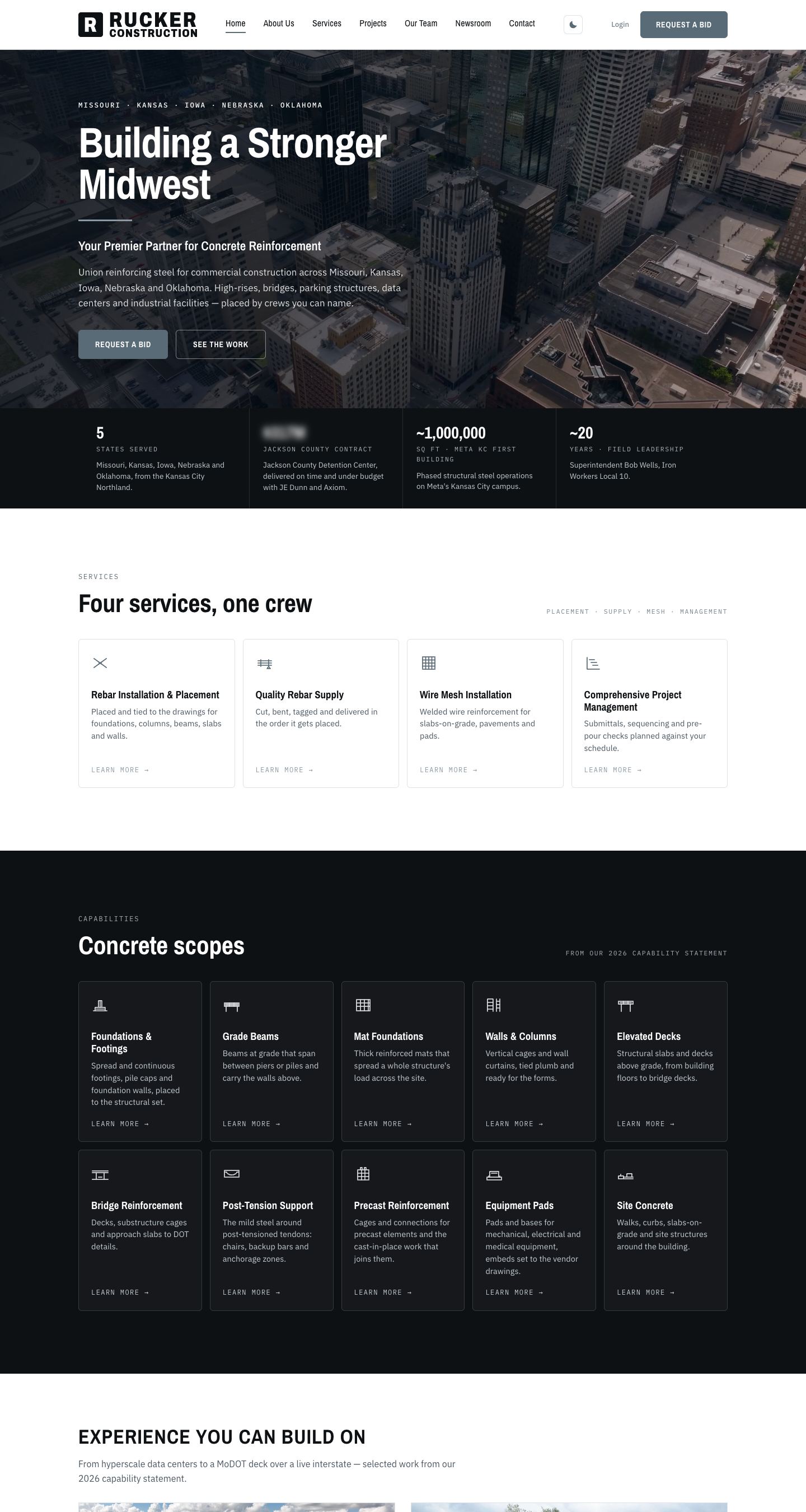
Rucker Construction
The reinforcing-steel subcontractor behind the Midwest's general contractors. We Build Trust.
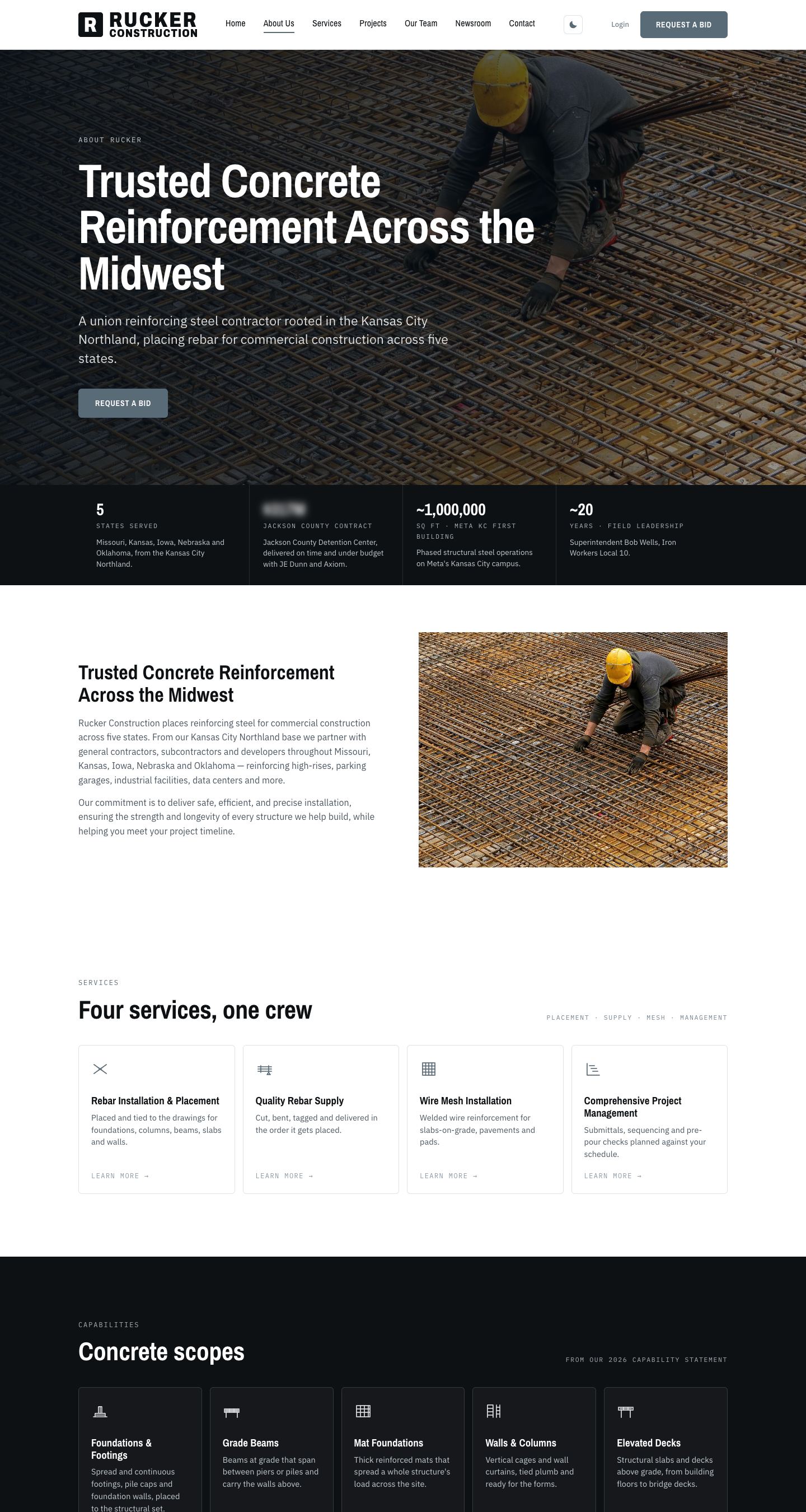
Rucker Construction Company is a union reinforcing-steel (rebar placement) subcontractor in Kansas City's Northland. On every project it is the rebar trade working under the general contractor, placing the reinforcing in foundations, walls, decks and bridges to the GC's schedule. Its tenant runs the site, the project pages, the newsroom and bid intake from general contractors.
- 51screens
- 19prompt libraries
- 236column prompts
- 1,012variables filled
The business
- Gene Field Road Bridge over I-29, St. Joseph (MoDOT Northwest District): reinforcing steel for Clarkson Construction Company, the general contractor, covering deck reinforcement, heavy civil, crane coordination and schedule-critical pours. The bridge reopened on 27 June 2026.
- Jackson County Detention Center, Kansas City: reinforcing steel for {{PROJECT_3_GC}} on the JE Dunn and Axiom Construction Group design-build, covering footings and foundation walls, columns and elevated slabs to tight tolerances and sequence.
- Surgery Center of the Northland, Platte City (NueHealth): reinforcing steel for {{PROJECT_4_GC}}. Scope: {{PROJECT_4_SCOPE}}.
- Rucker's customers are general contractors: their estimators, preconstruction and project managers, superintendents and prequalification teams.
- Trade scope: 14 capabilities, from foundations, grade beams, mat foundations, walls and columns to elevated decks, bridge reinforcement, post-tensioning support and precast, plus rebar supply and wire mesh.
- Markets across MO, KS, IA, NE and OK: data centers, manufacturing, distribution, healthcare, transportation, municipal, education and commercial.
- President Martin T. Rucker II; values Safety First, Do What You Say, Quality Without Compromise, Production Mindset, Partnership.
/
/about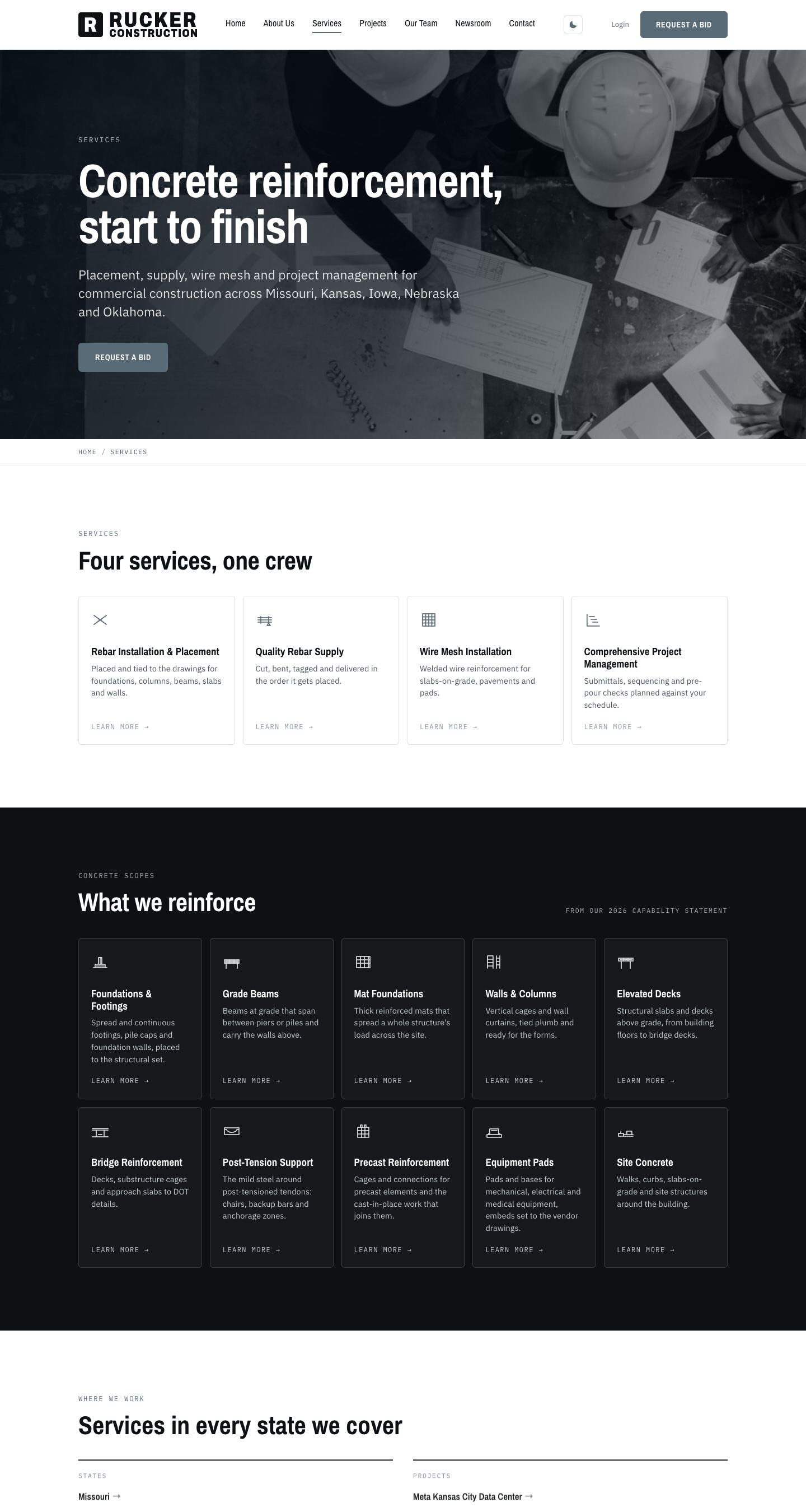
/services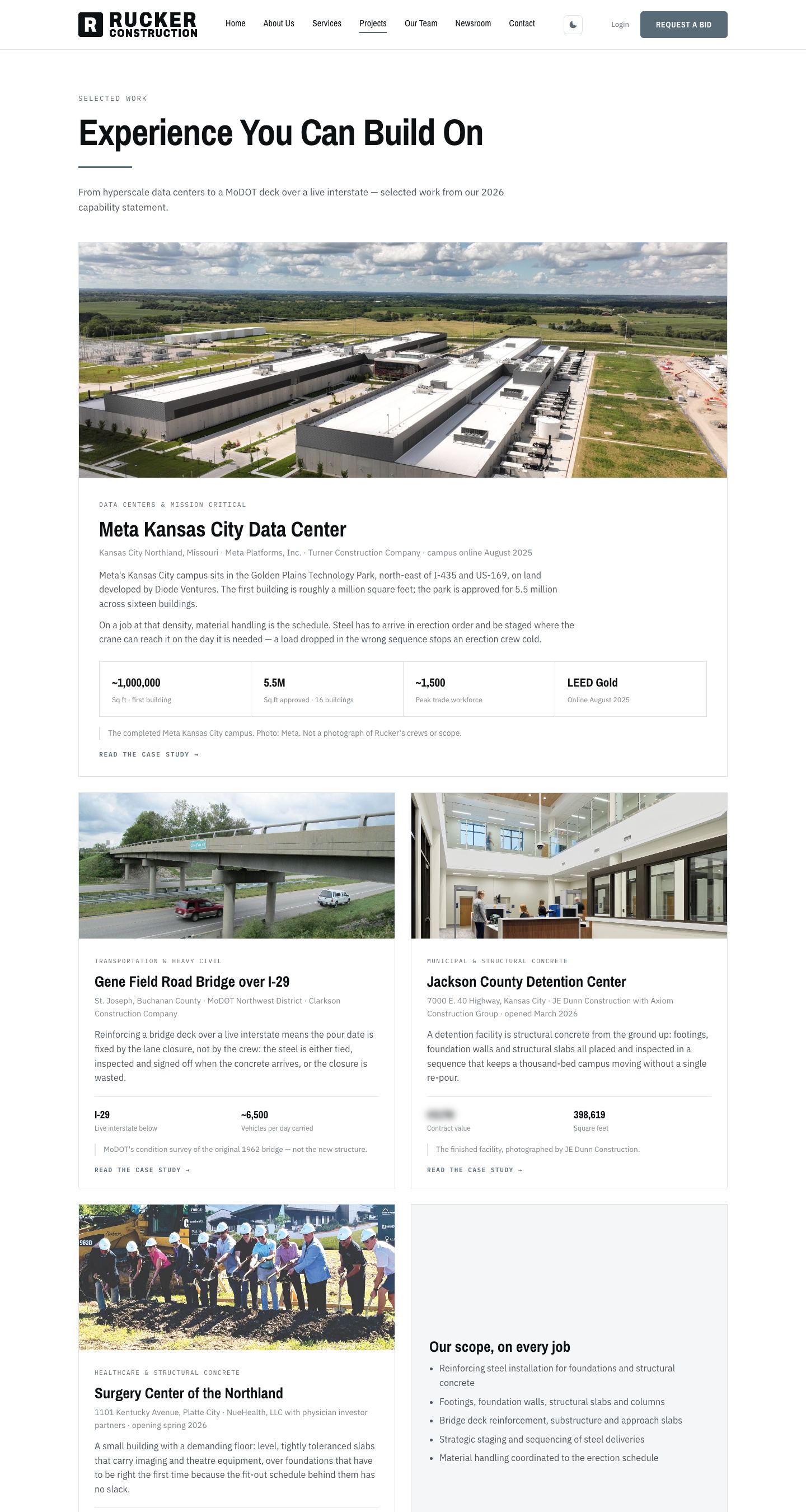
/projects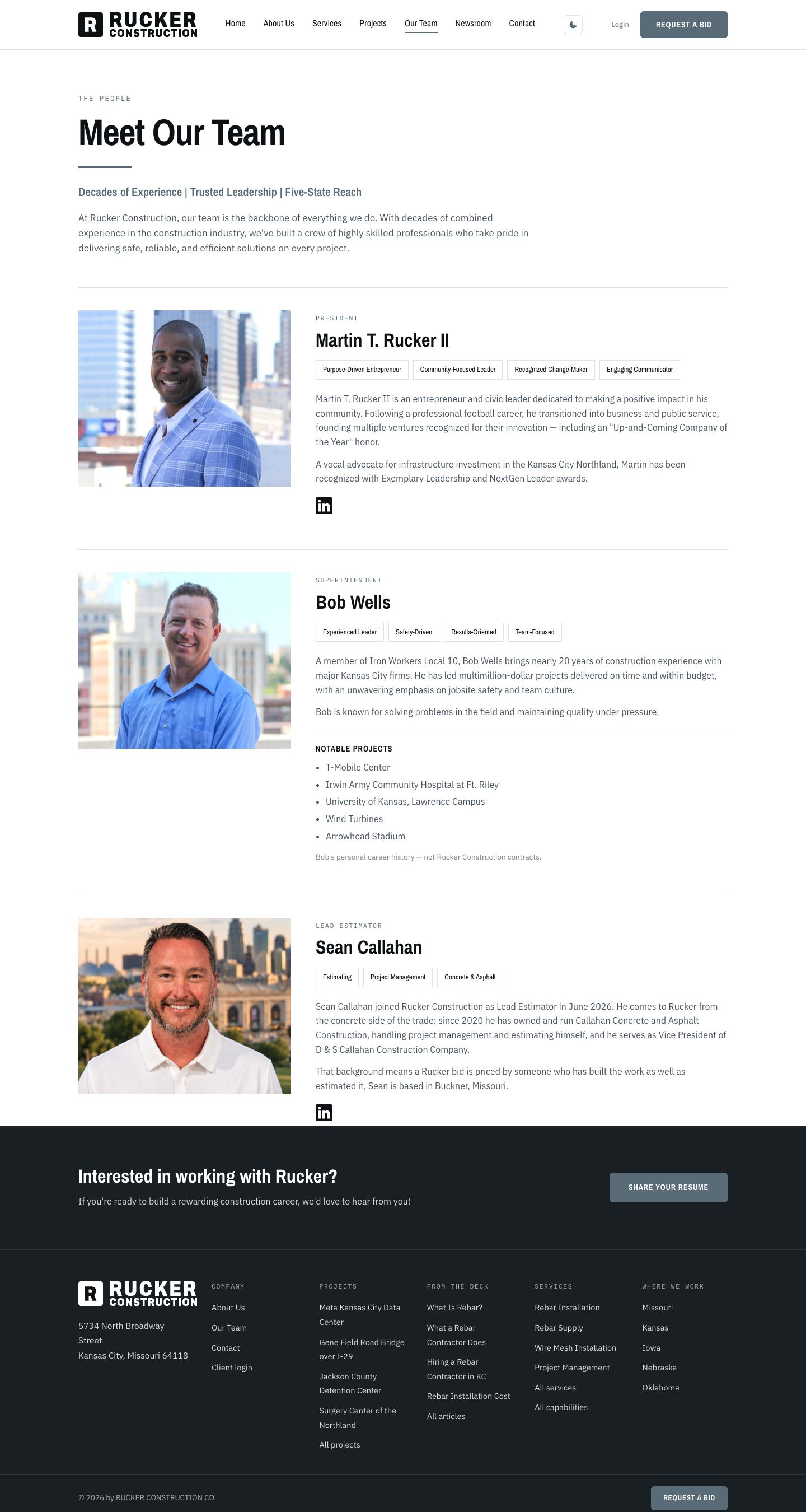
/team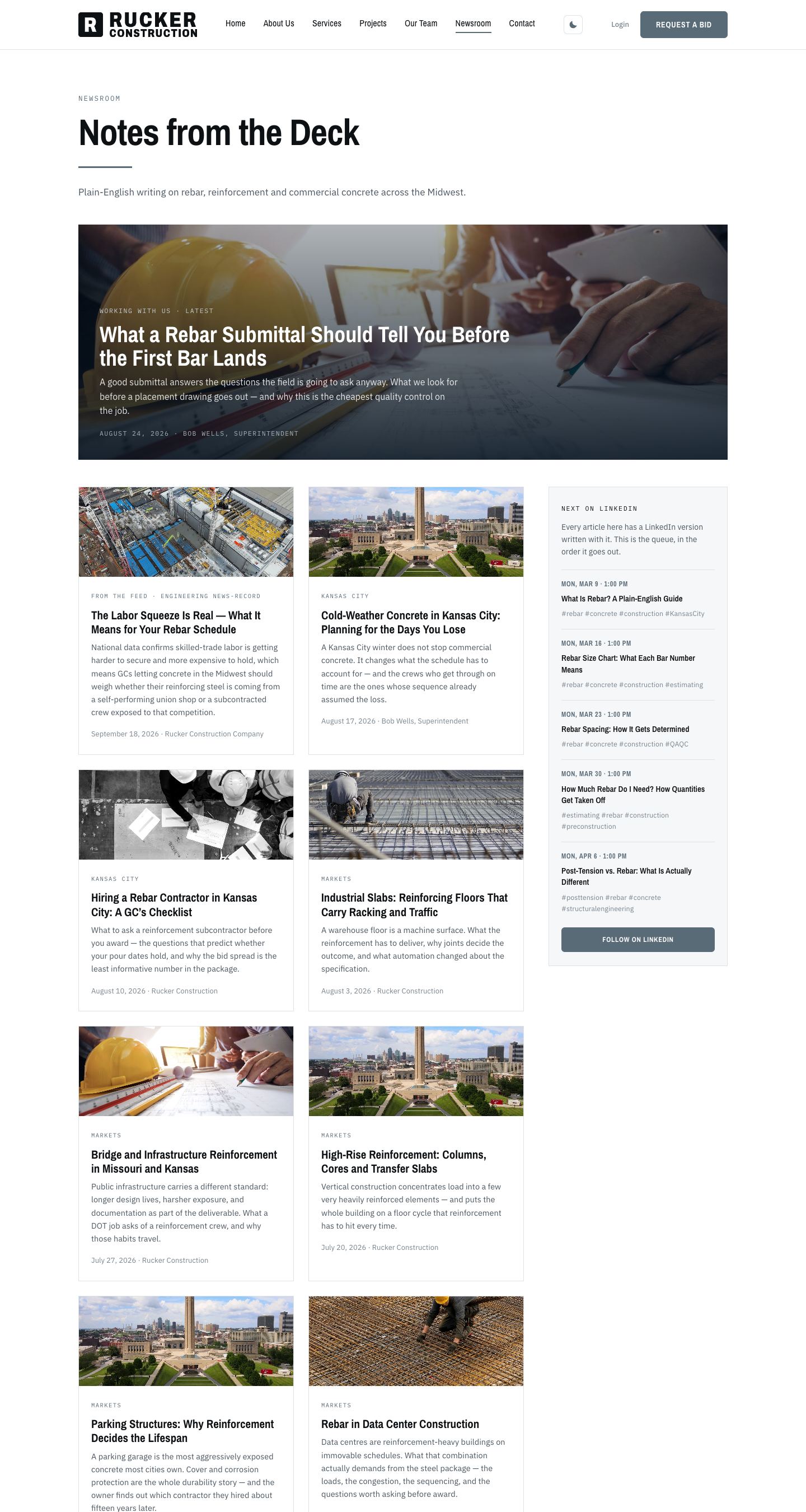
/newsroom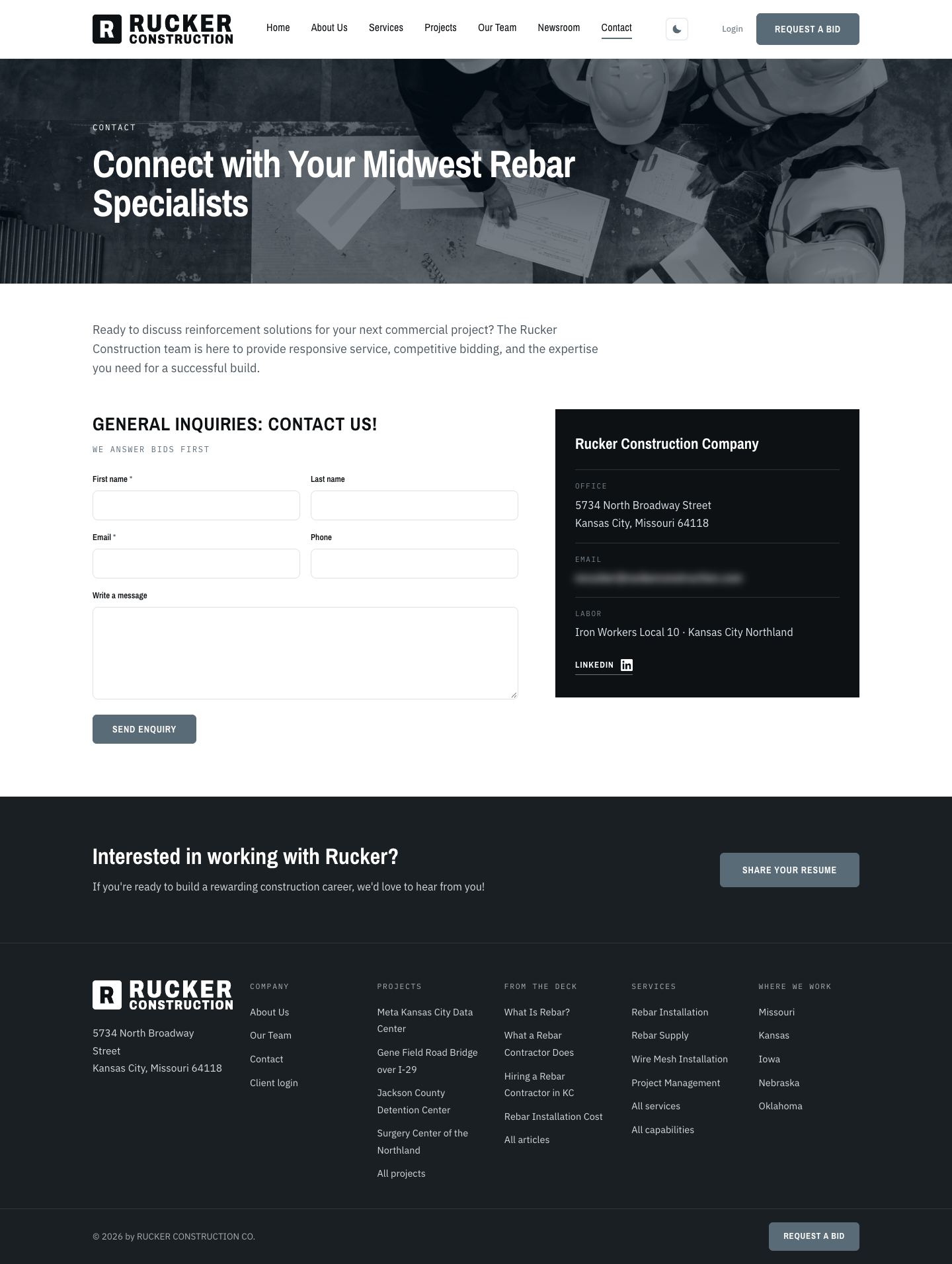
/contact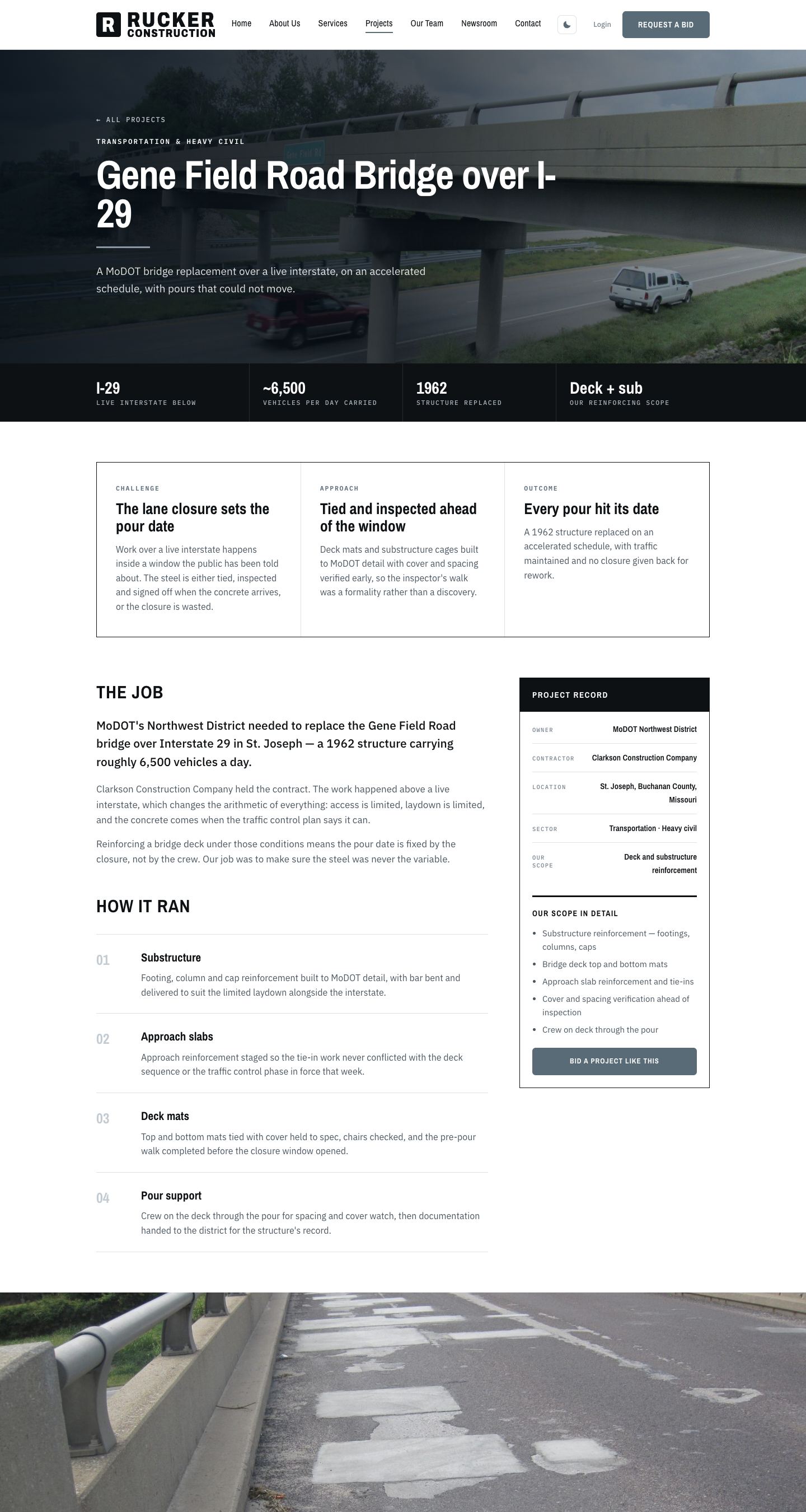
/projects/gene-field-road-bridge
/tenant/rucker-construction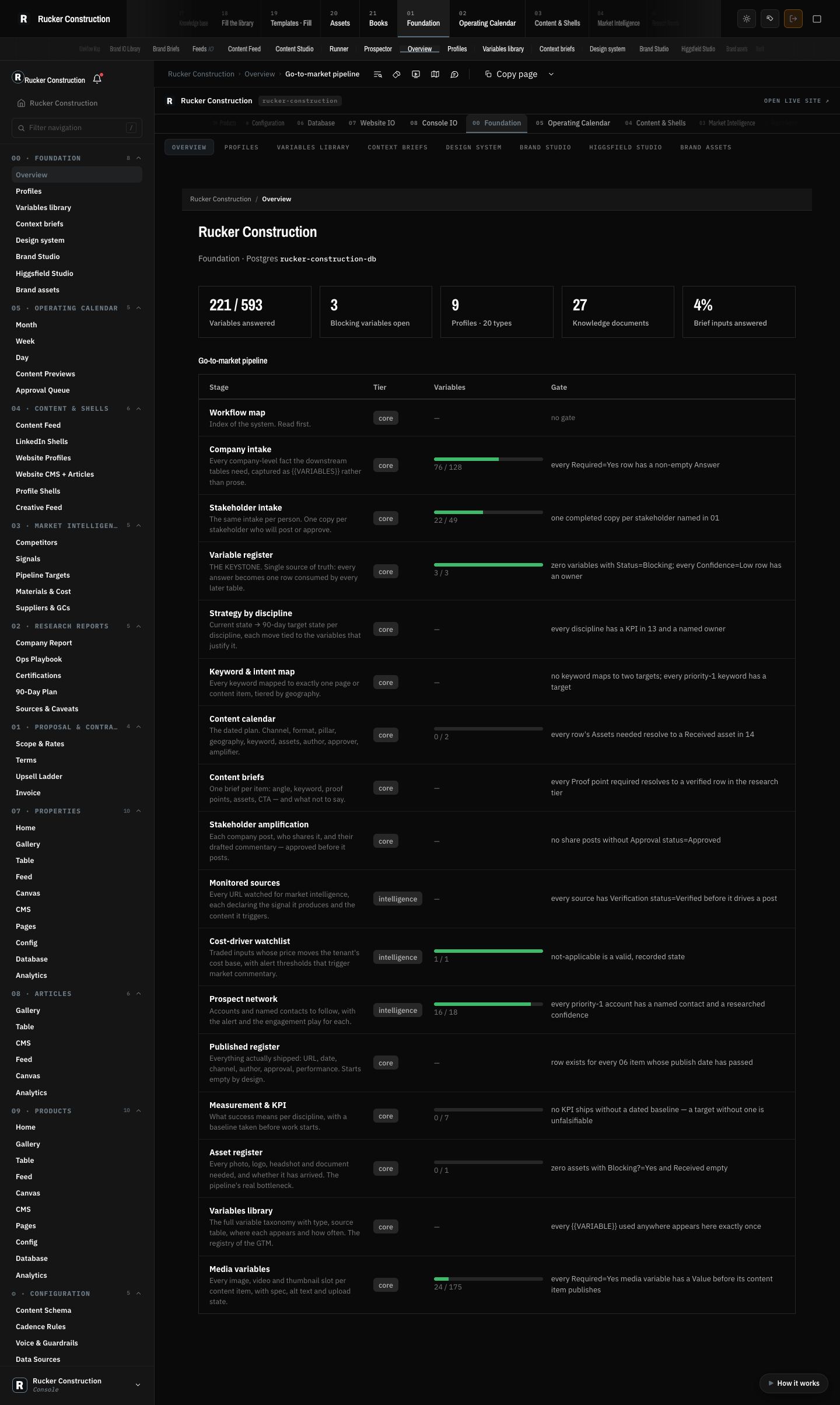
/tenant/rucker-construction/foundation/overview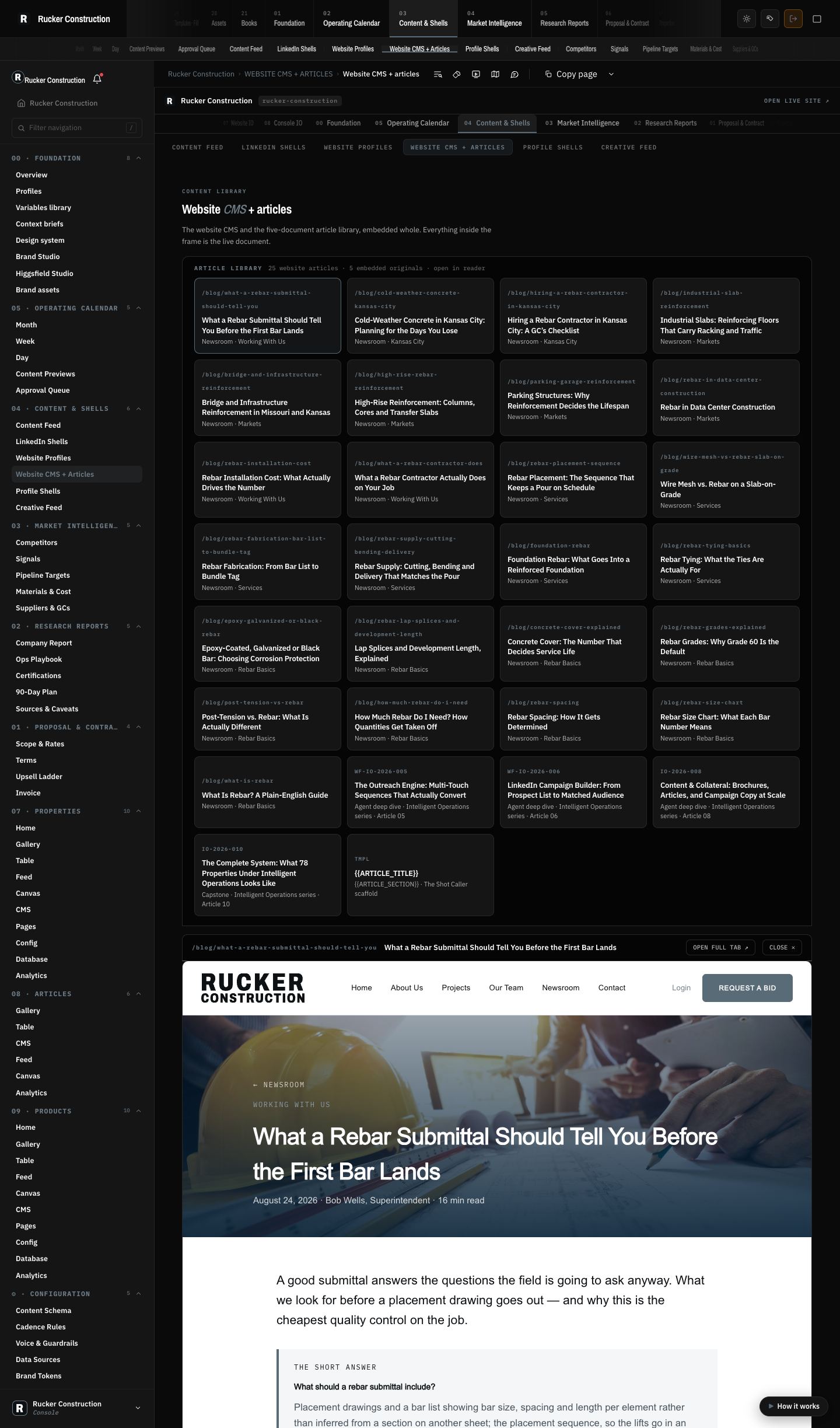
/tenant/rucker-construction/content/cms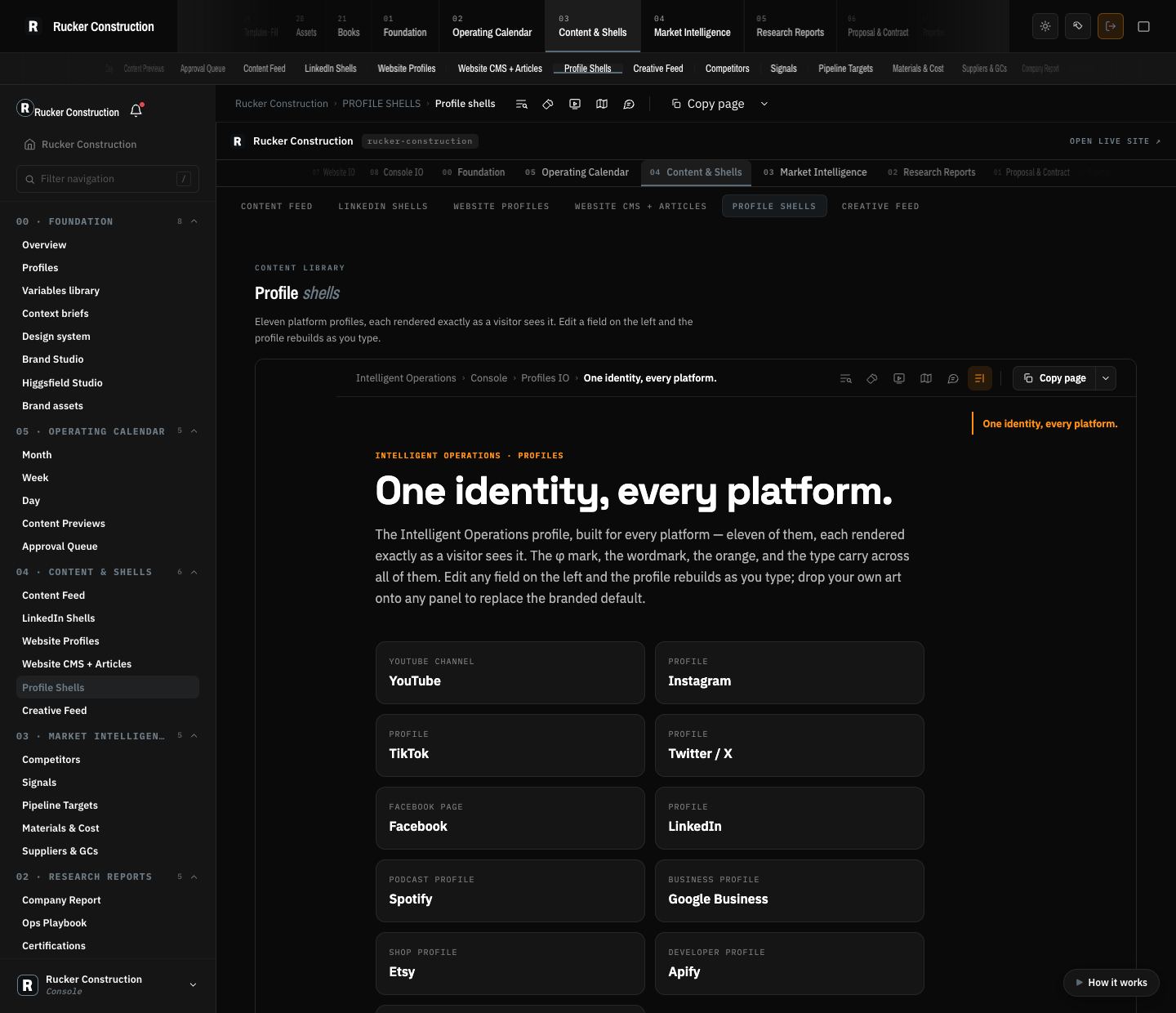
/tenant/rucker-construction/content/shells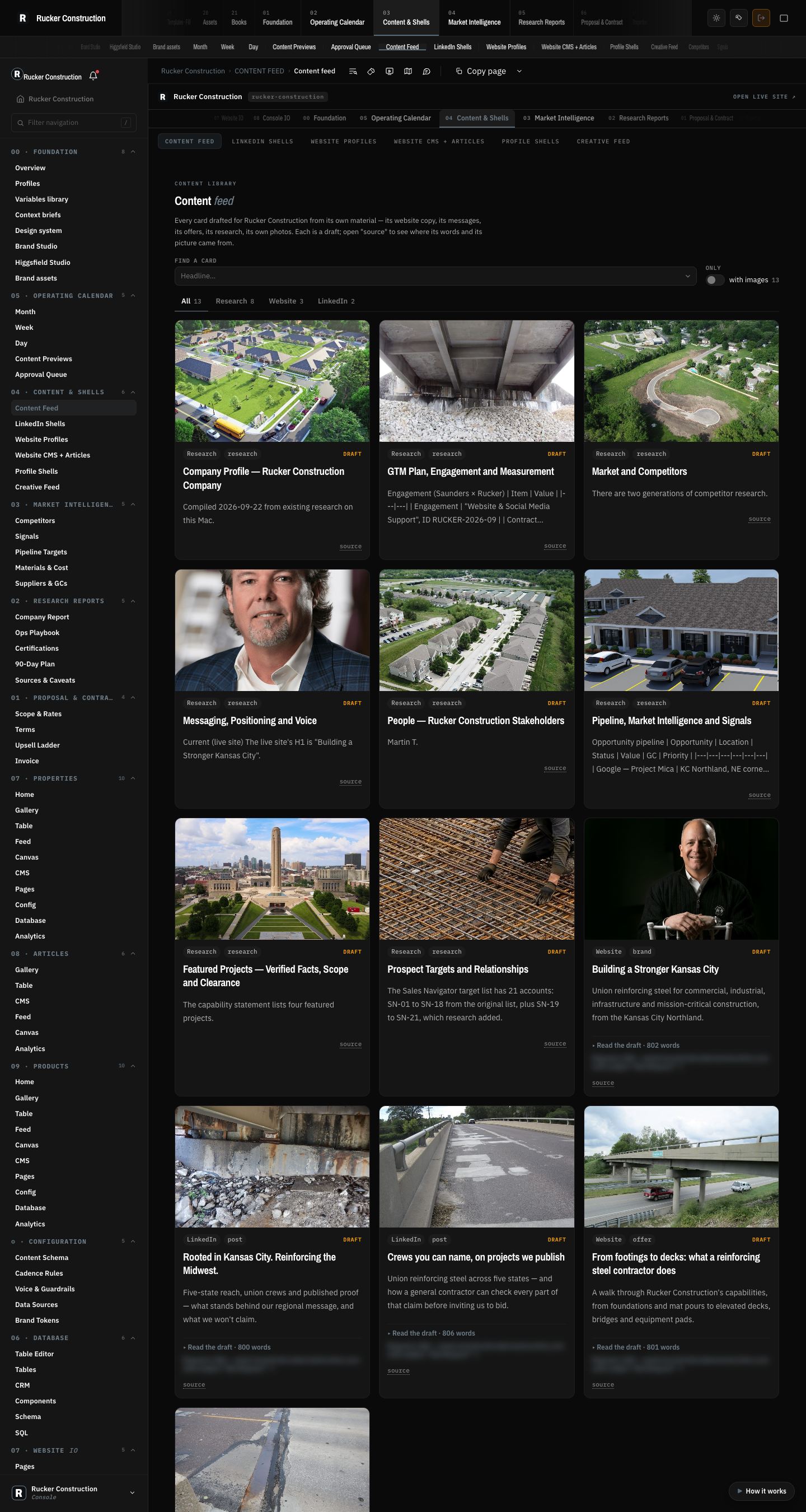
/tenant/rucker-construction/content/feed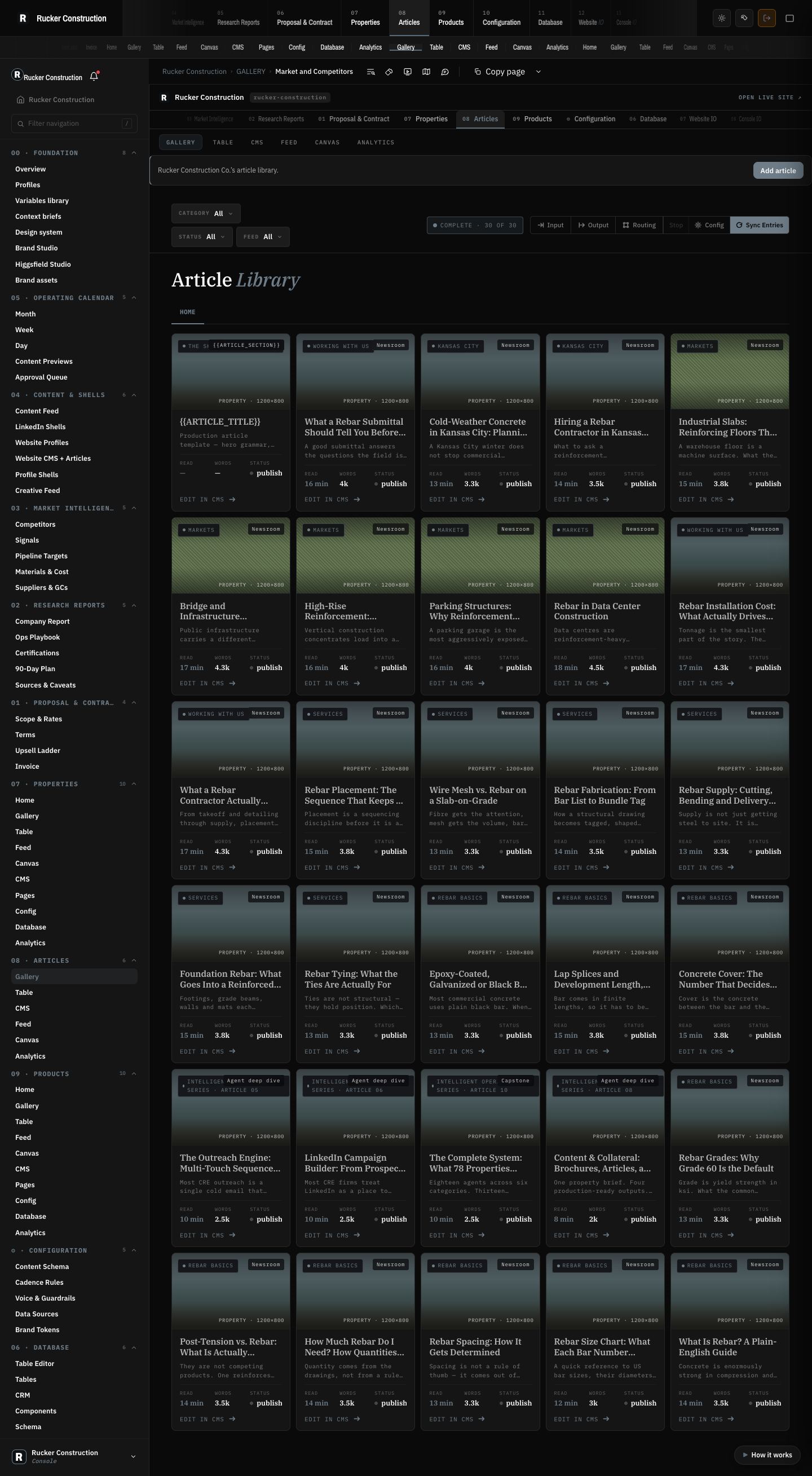
/tenant/rucker-construction/articles/gallery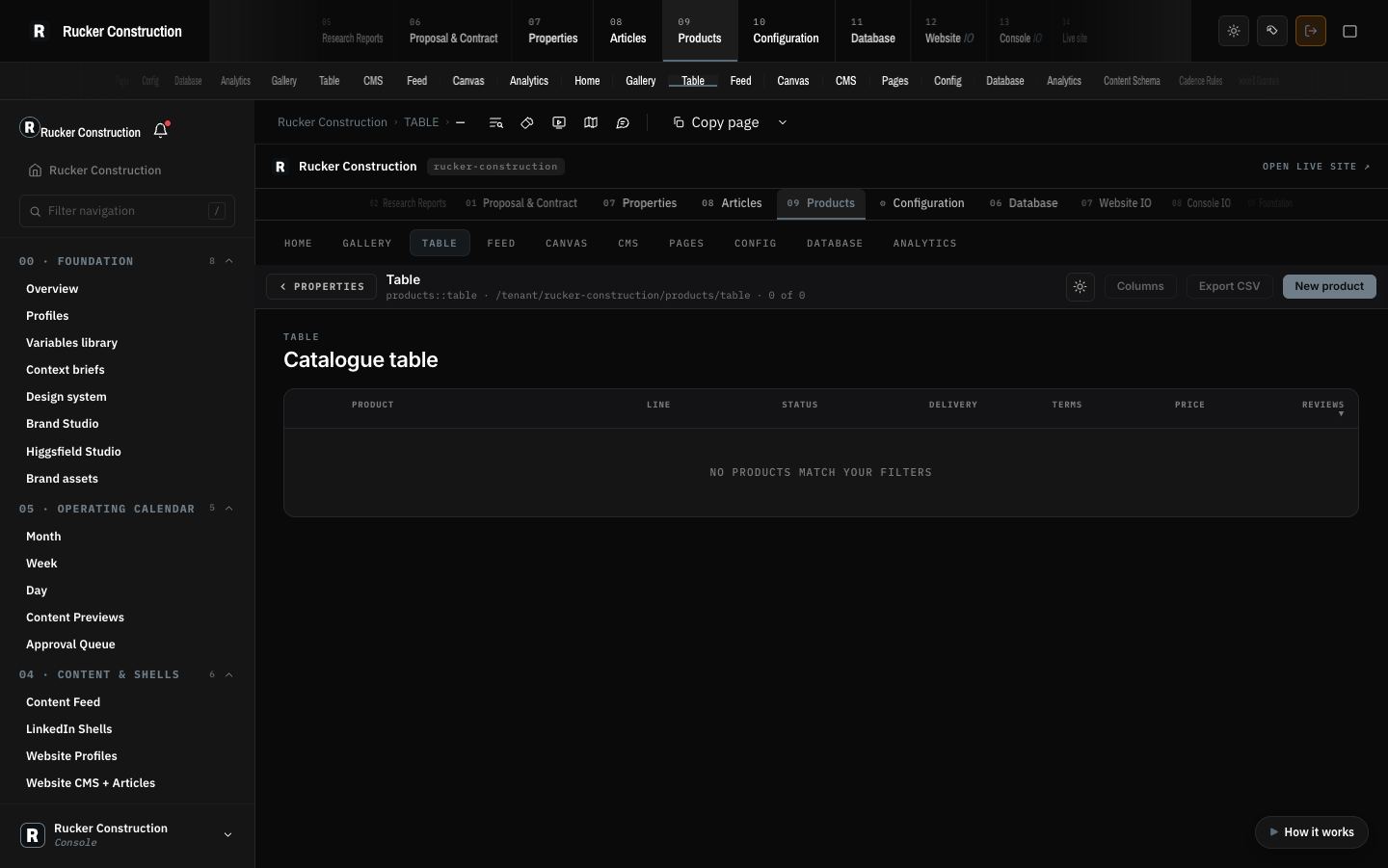
/tenant/rucker-construction/products/table
/tenant/rucker-construction/knowledge/all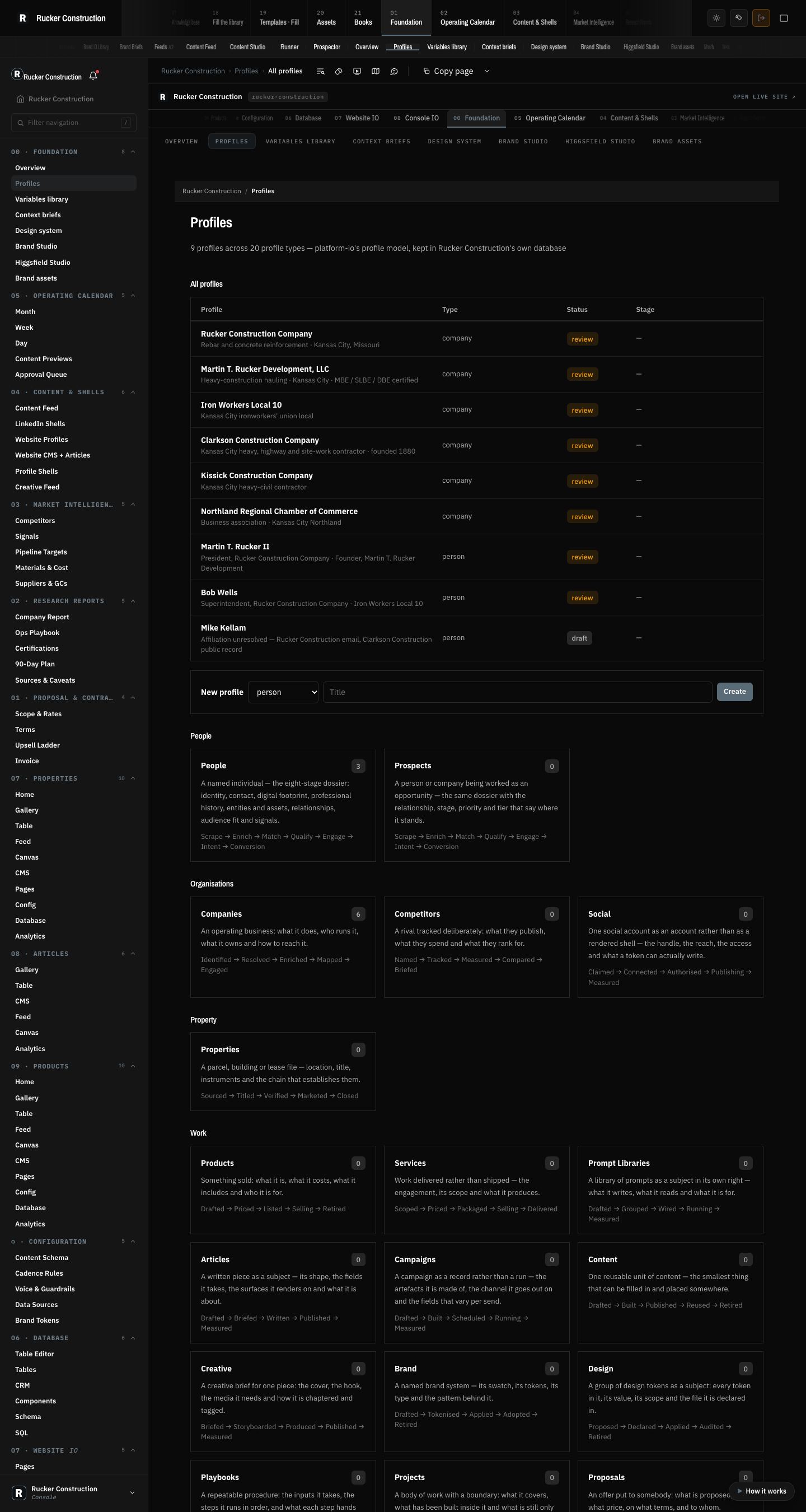
/tenant/rucker-construction/foundation/profiles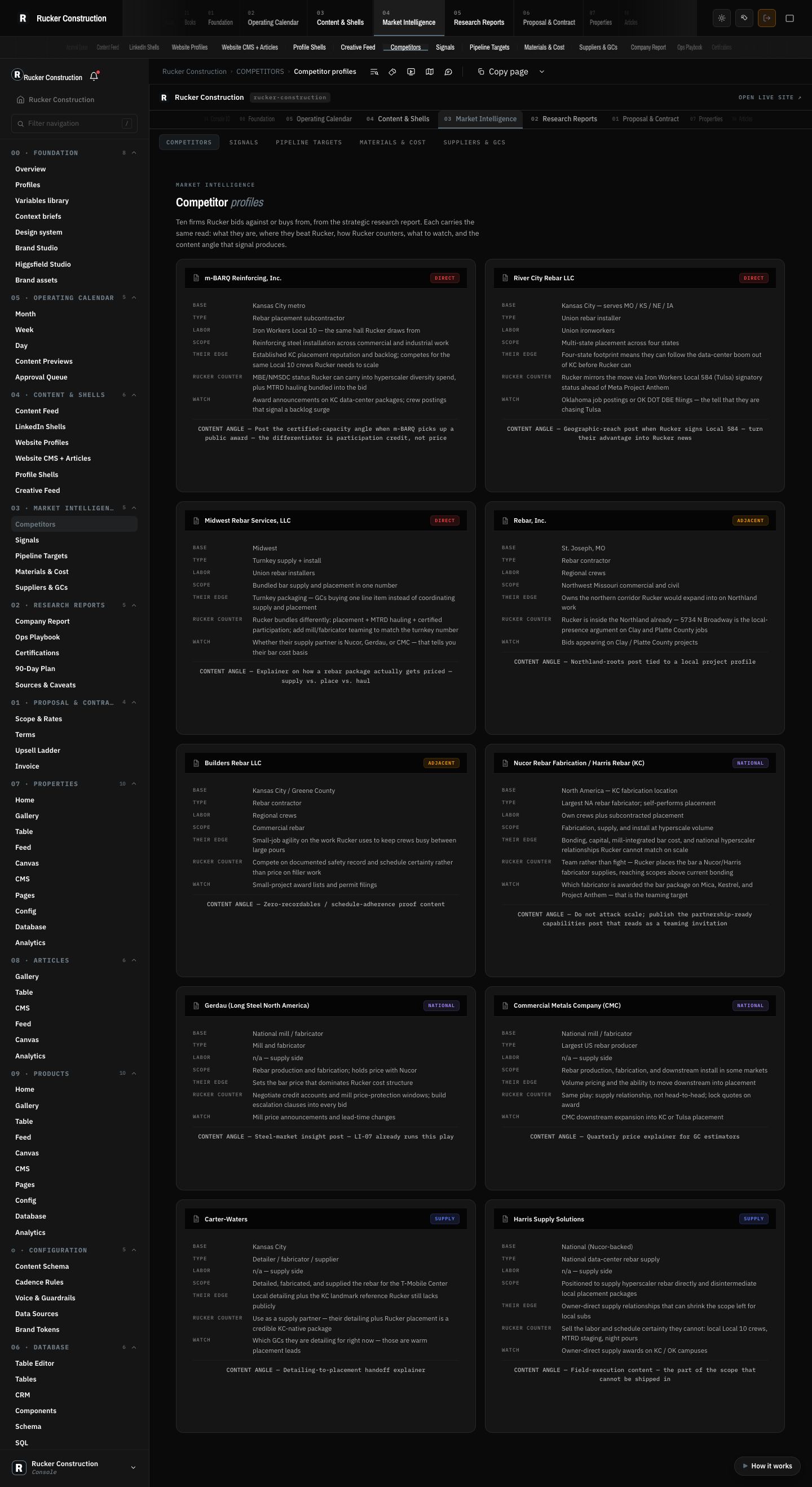
/tenant/rucker-construction/intel/competitors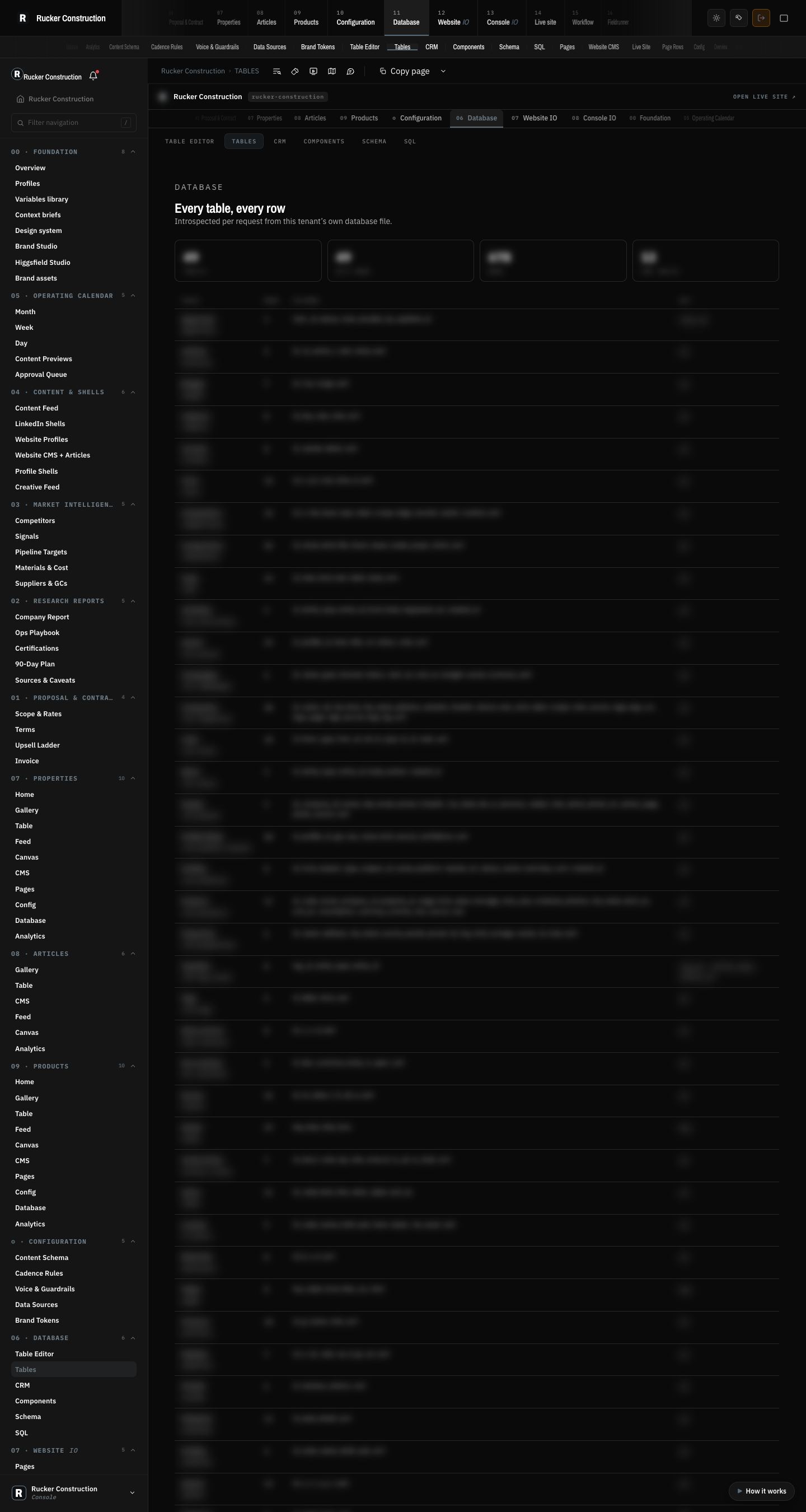
/tenant/rucker-construction/database/tables
/tenant/rucker-construction/database/schema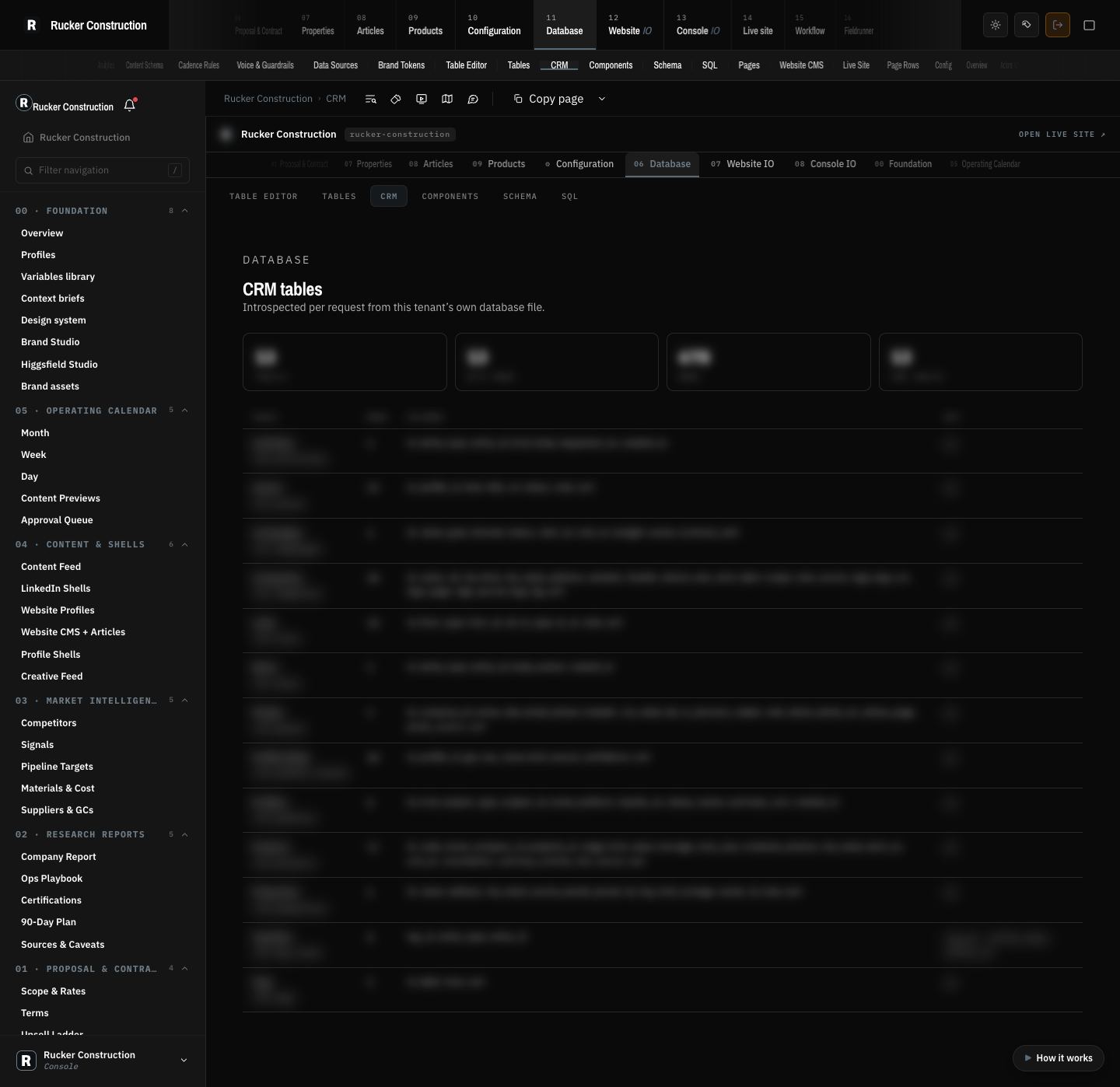
/tenant/rucker-construction/database/crm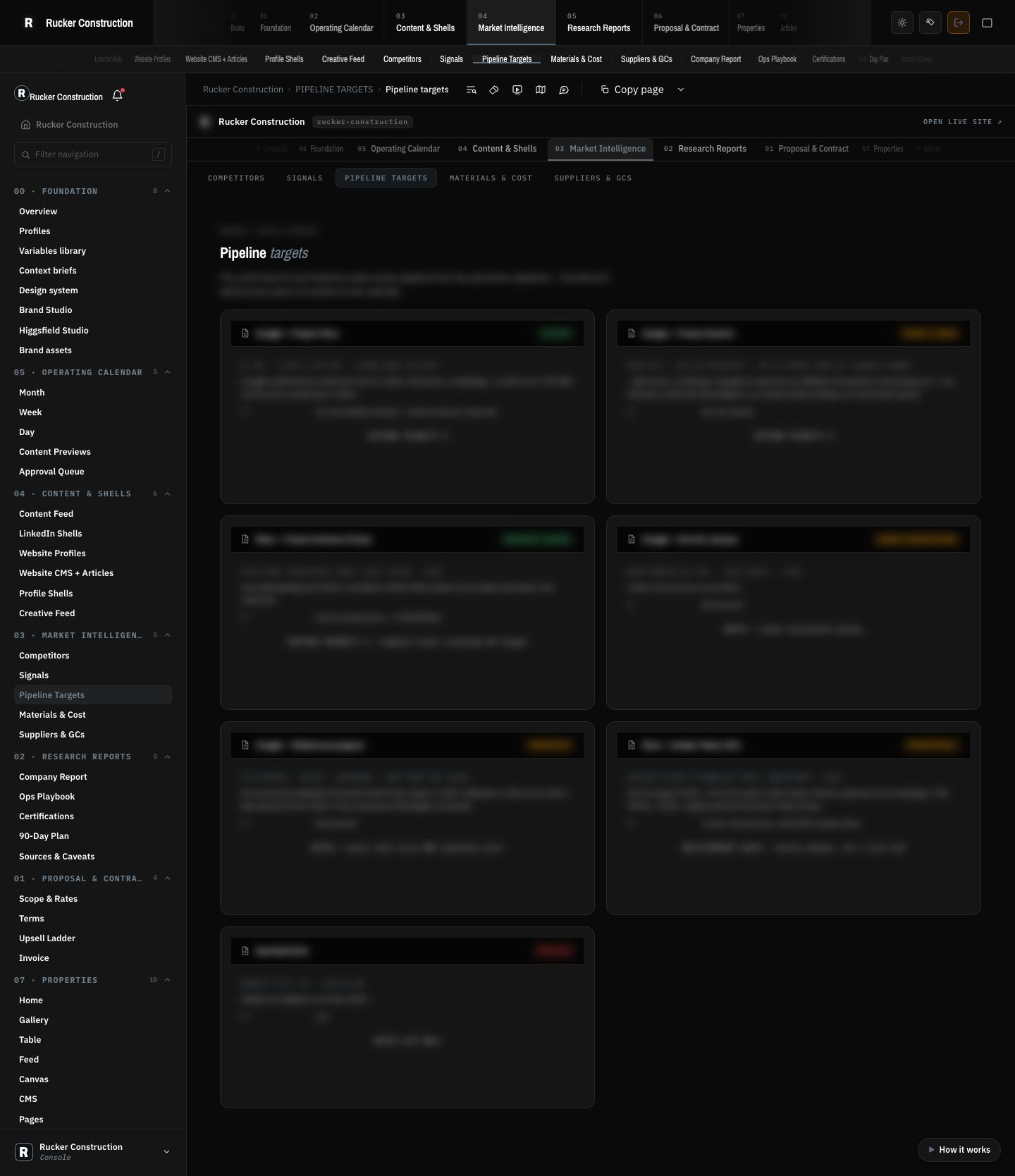
/tenant/rucker-construction/intel/pipeline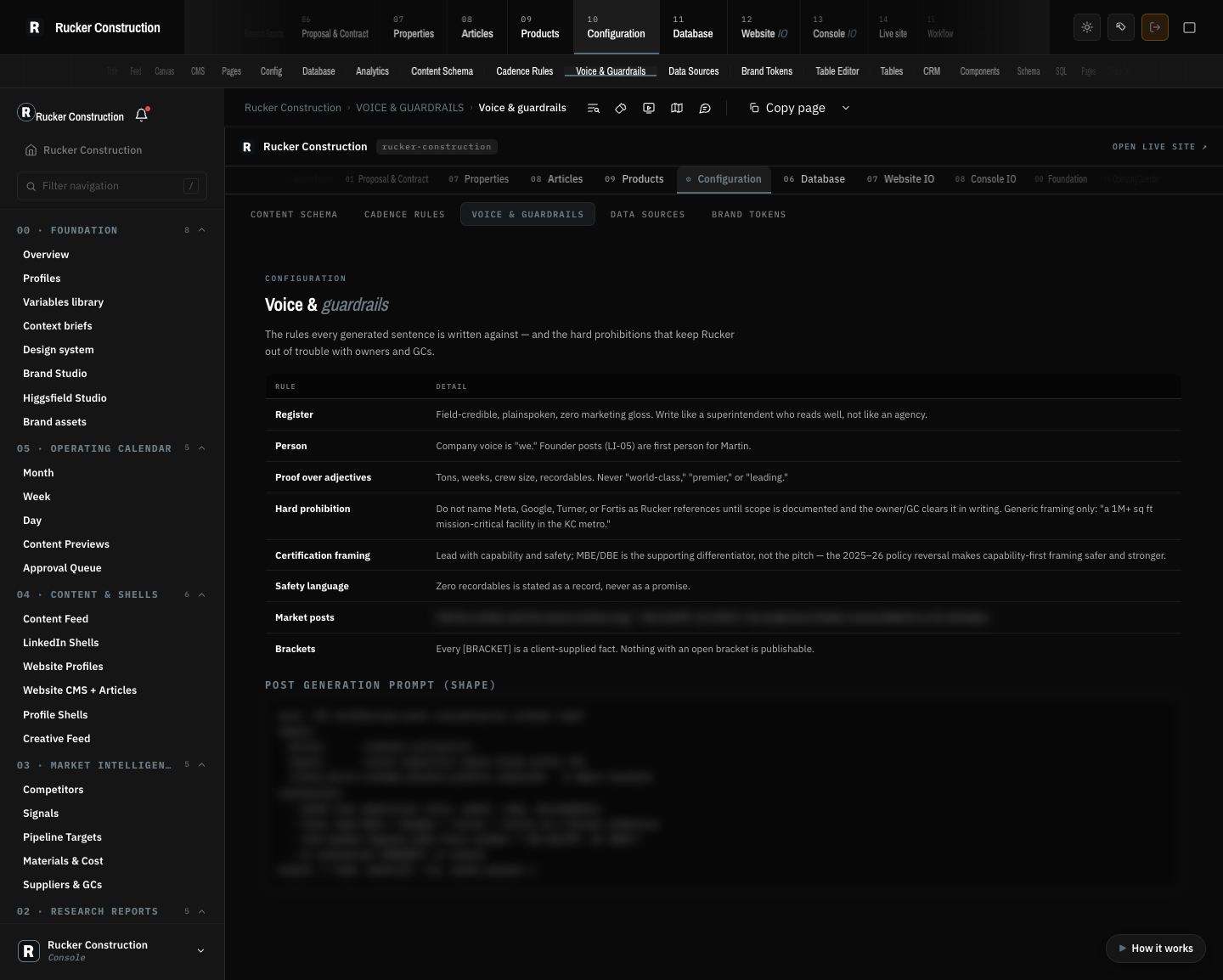
/tenant/rucker-construction/config/voice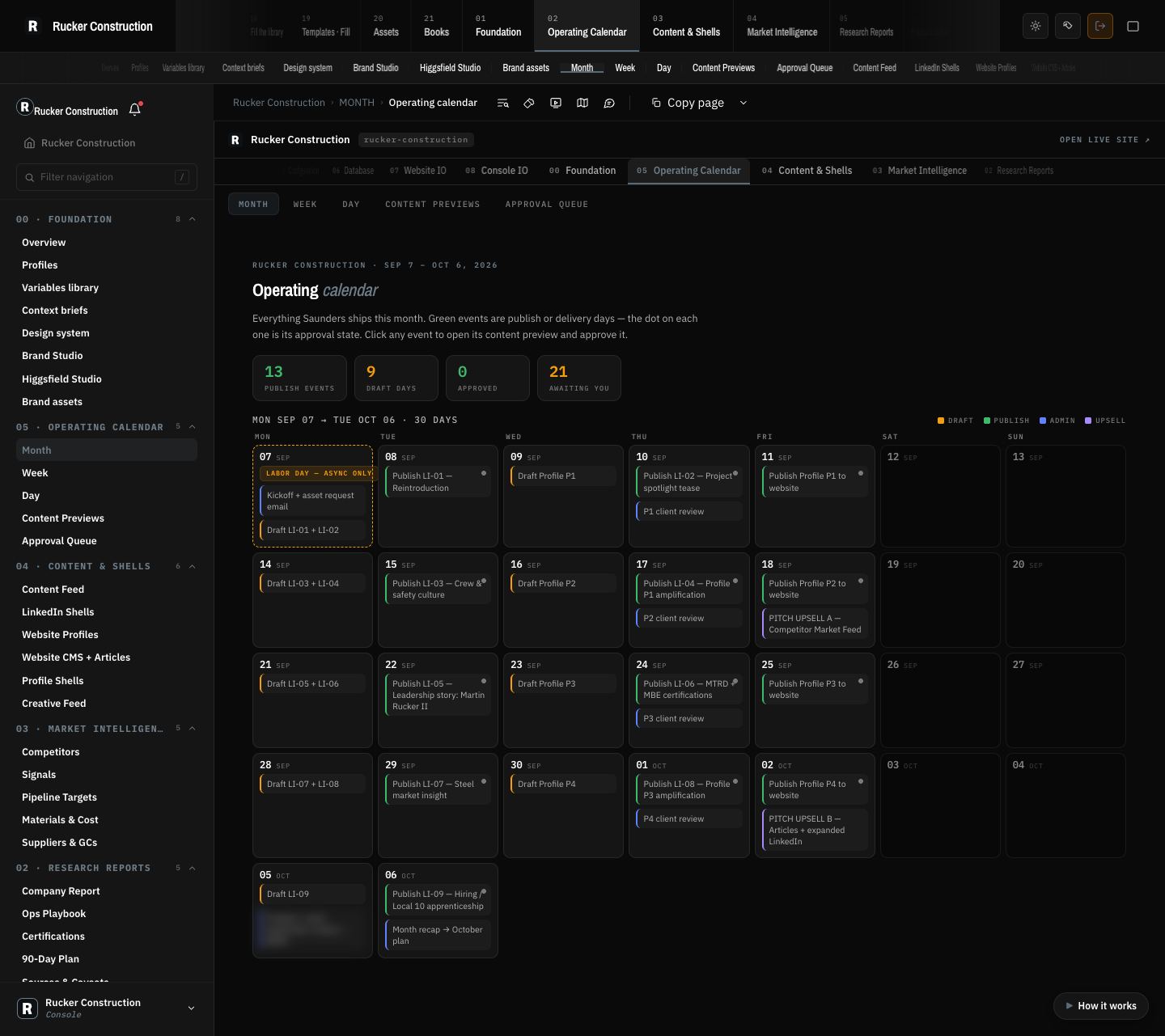
/tenant/rucker-construction/calendar/month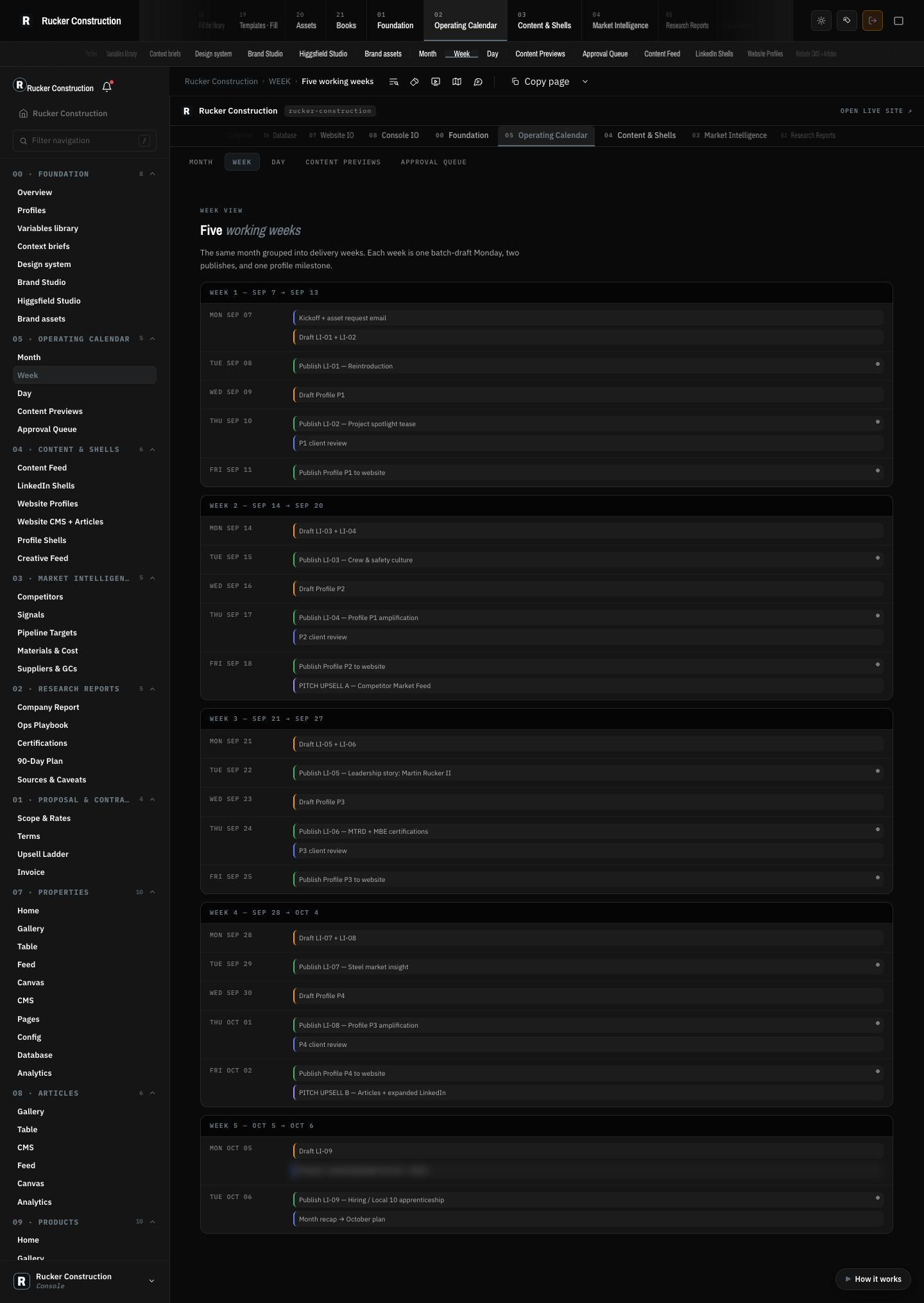
/tenant/rucker-construction/calendar/week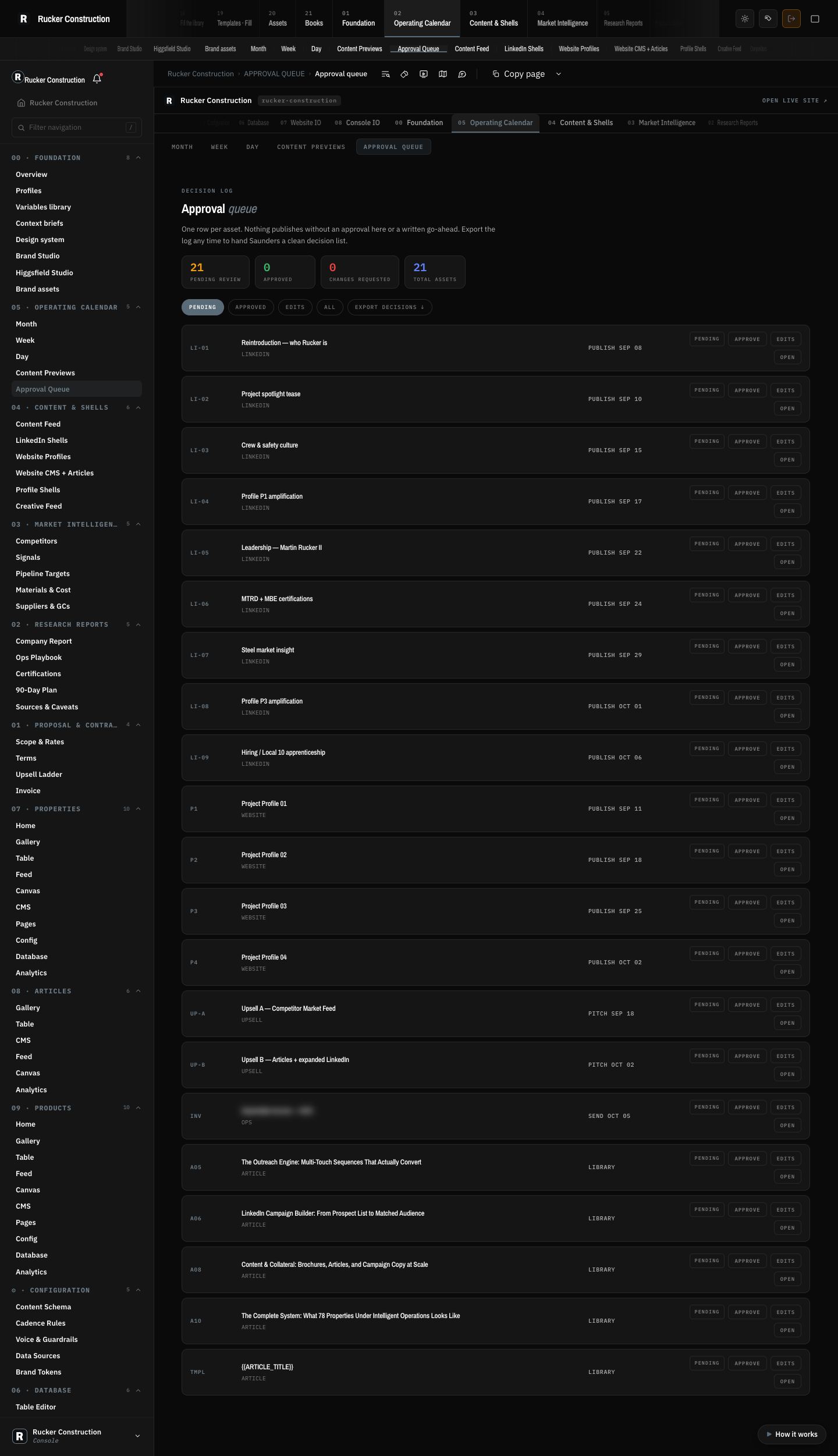
/tenant/rucker-construction/calendar/approvals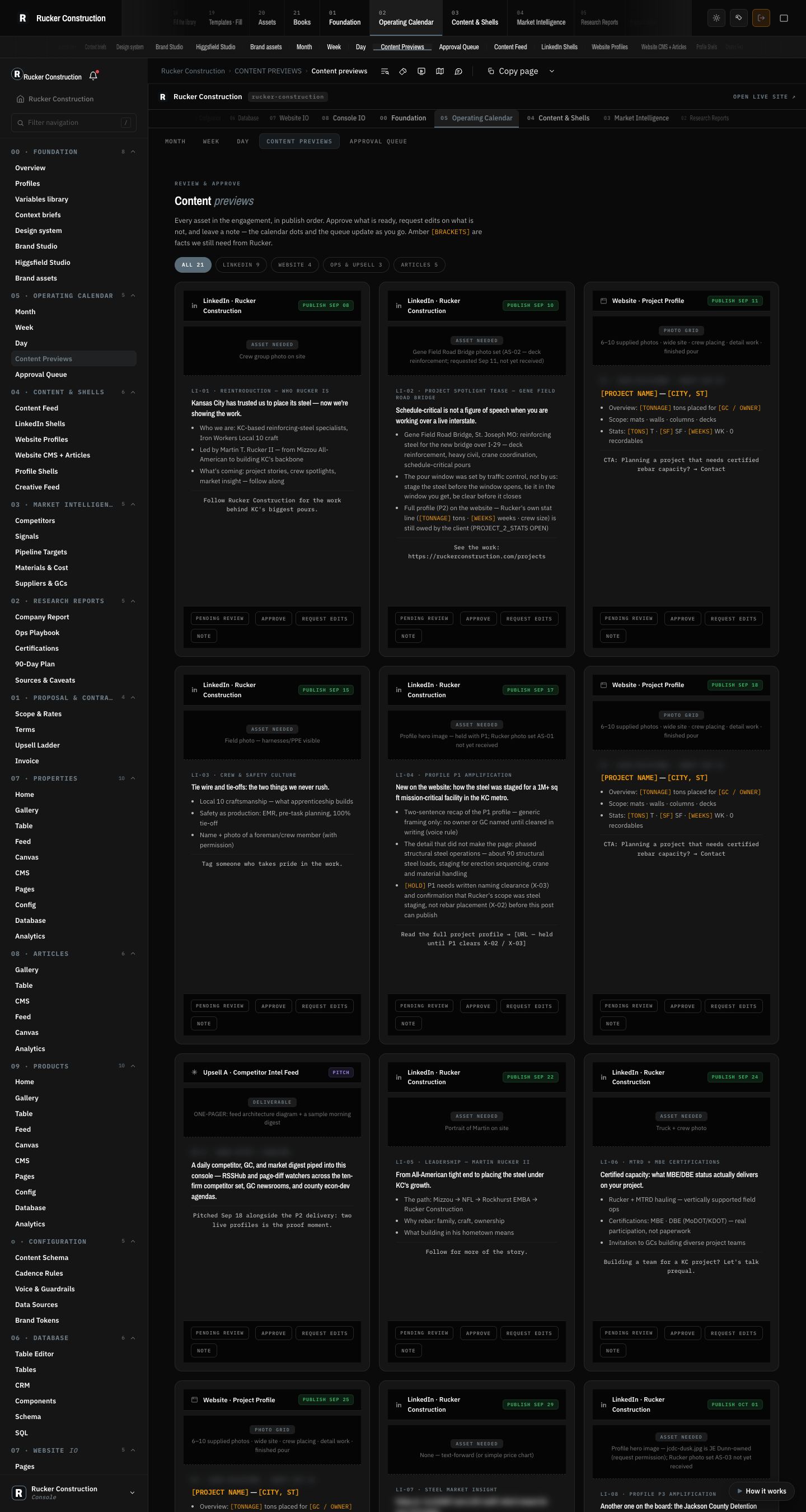
/tenant/rucker-construction/calendar/previews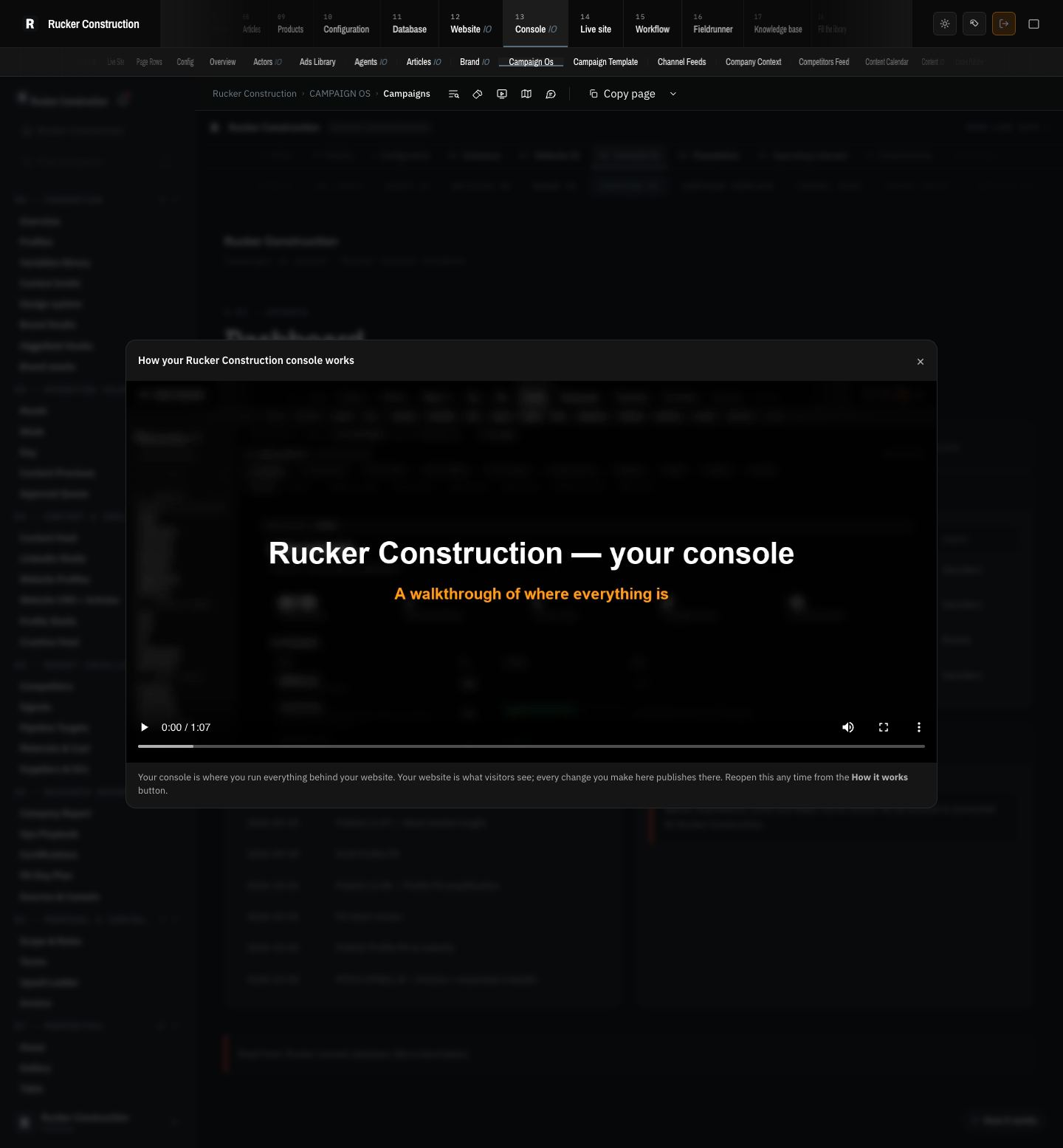
/tenant/rucker-construction/consoles/campaign-os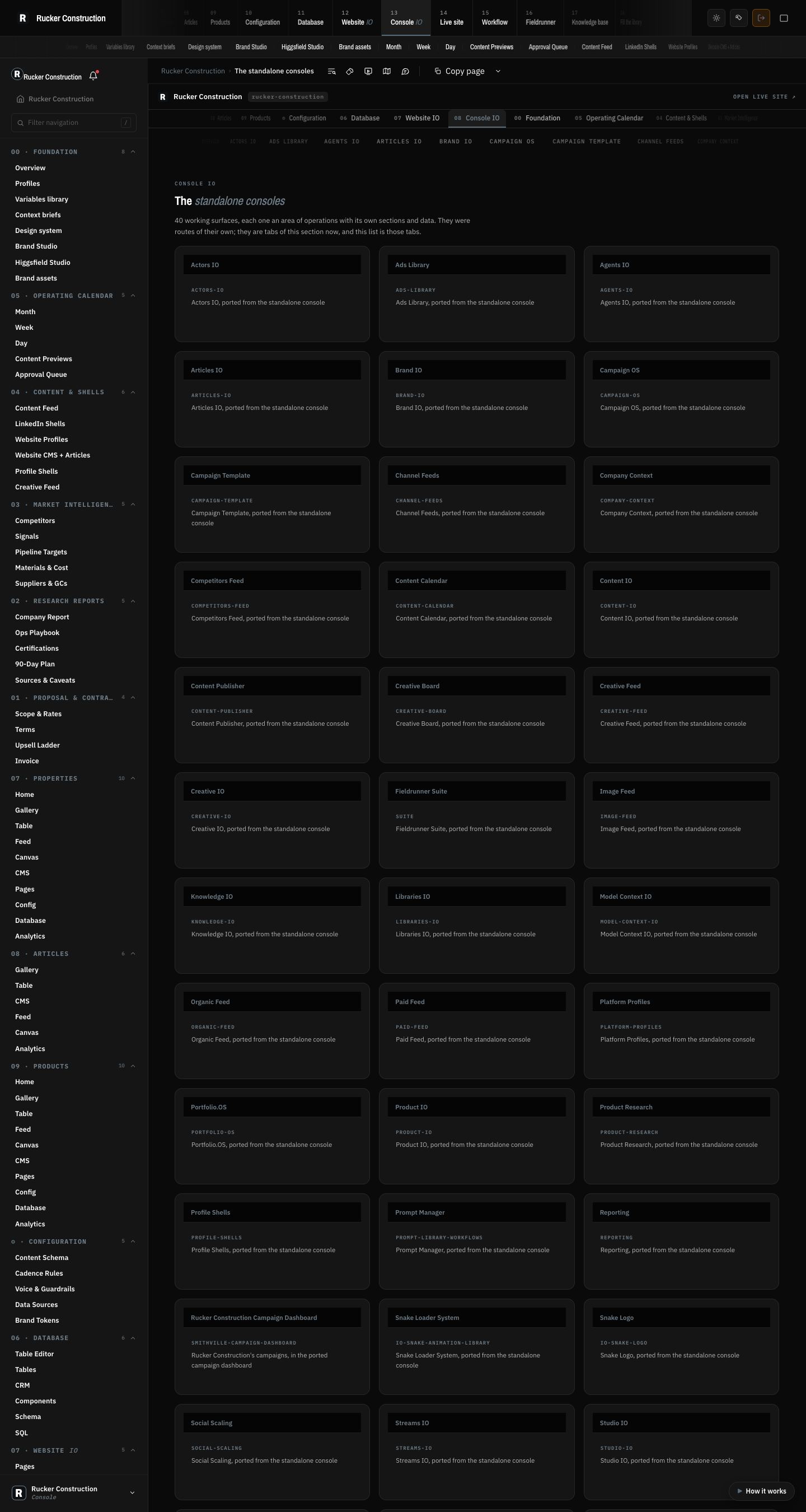
/tenant/rucker-construction/consoles/campaign-dashboard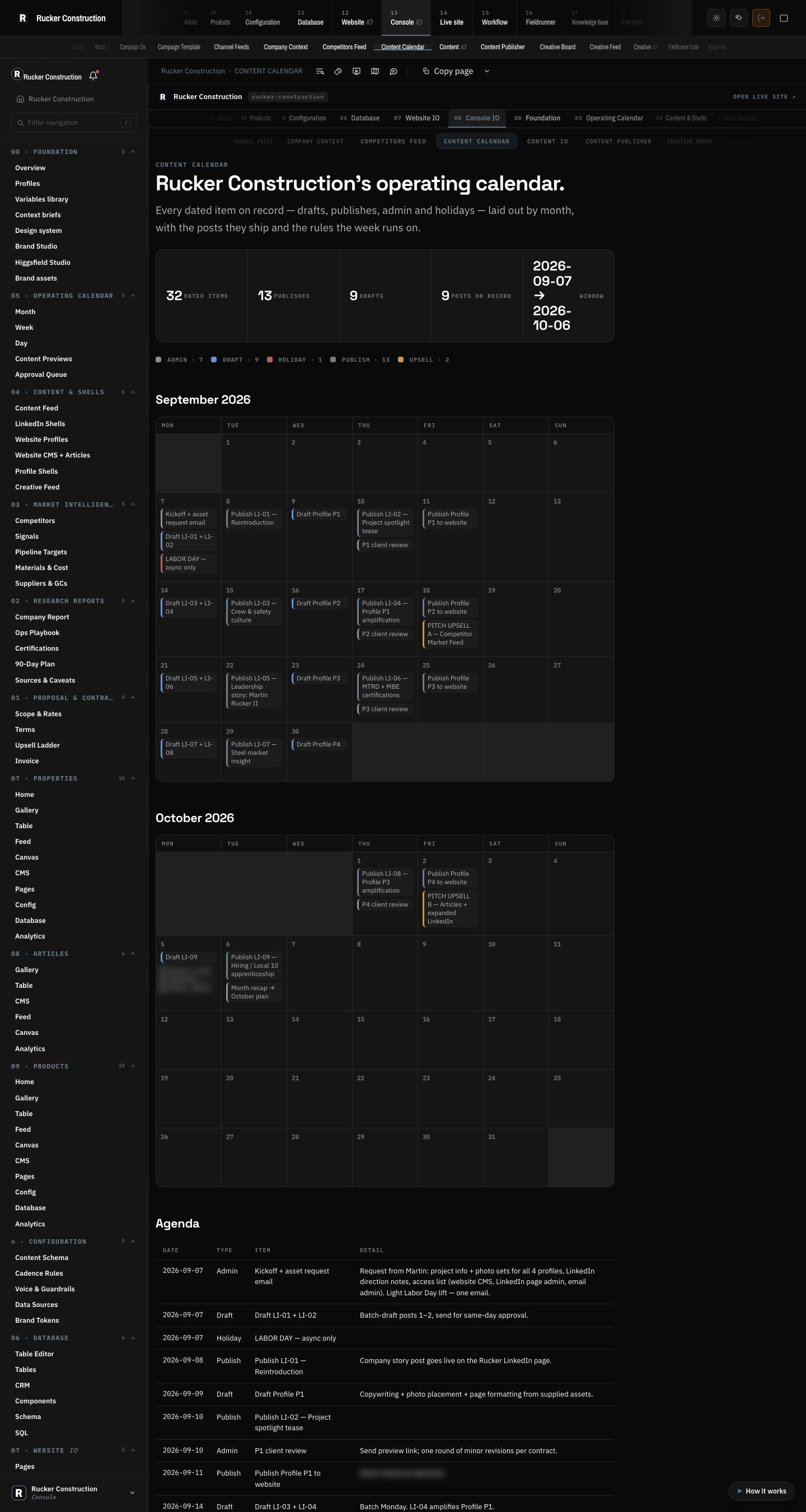
/tenant/rucker-construction/consoles/content-calendar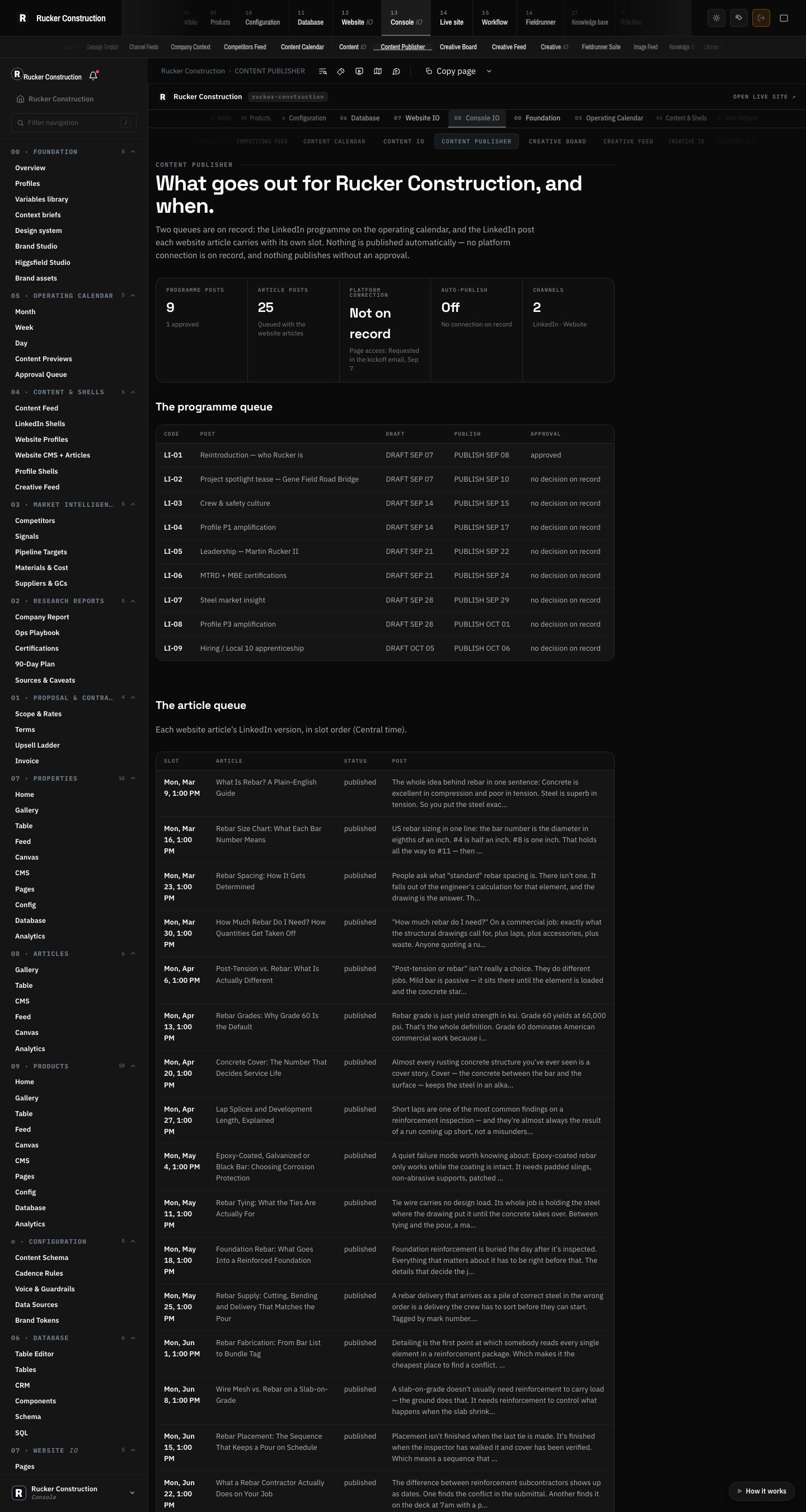
/tenant/rucker-construction/consoles/content-publisher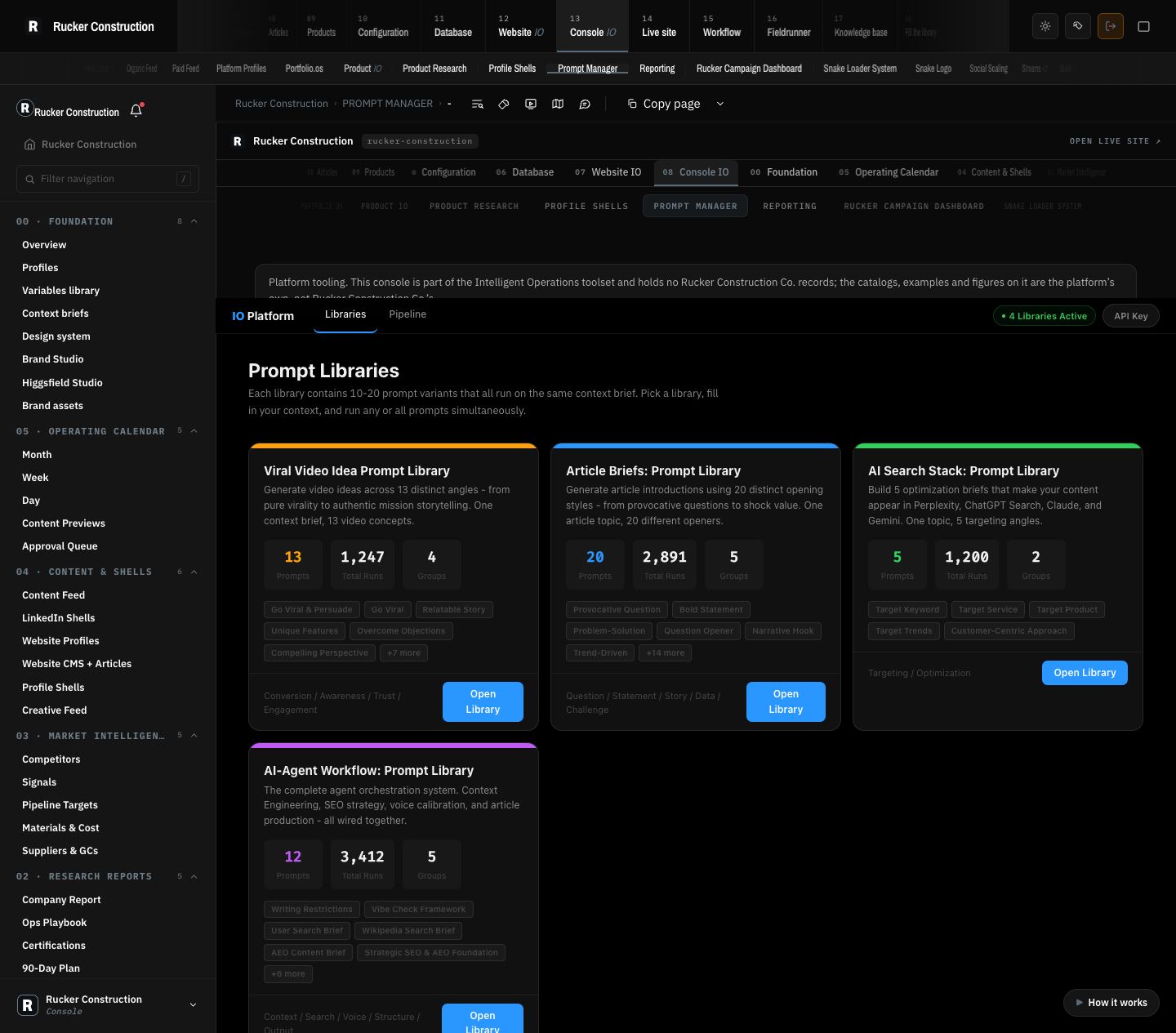
/tenant/rucker-construction/consoles/prompt-library-workflows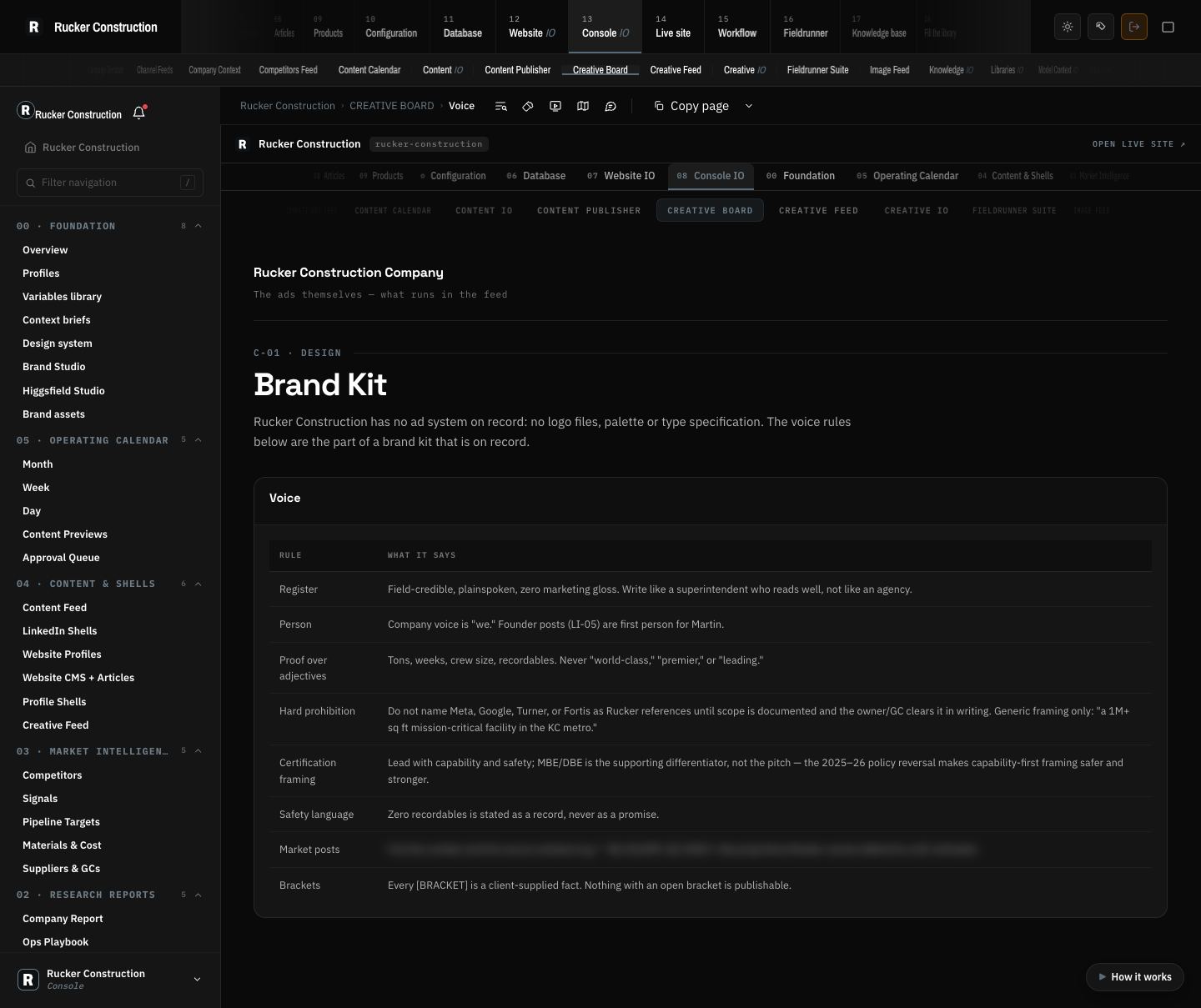
/tenant/rucker-construction/consoles/creative-board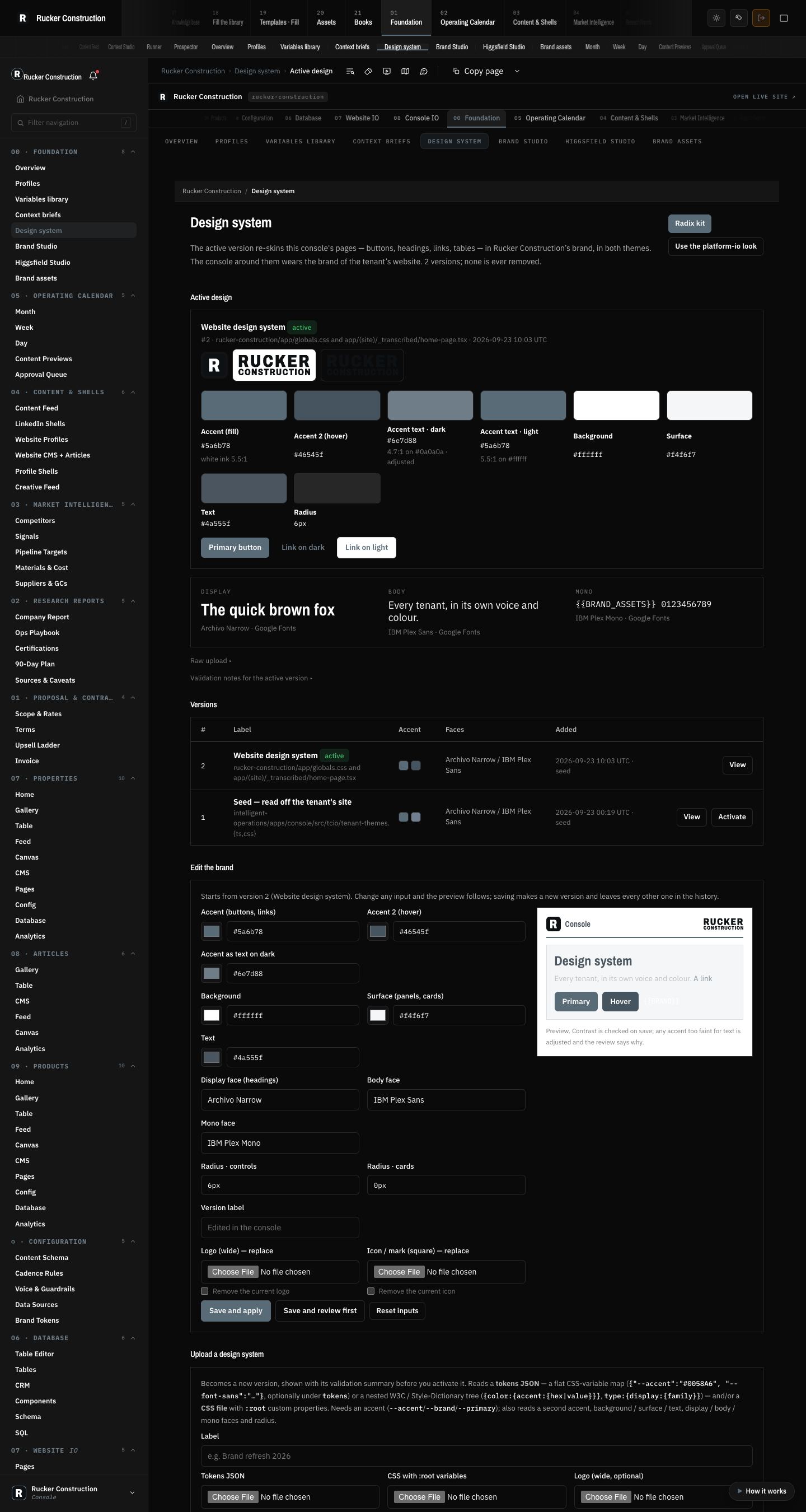
/tenant/rucker-construction/foundation/design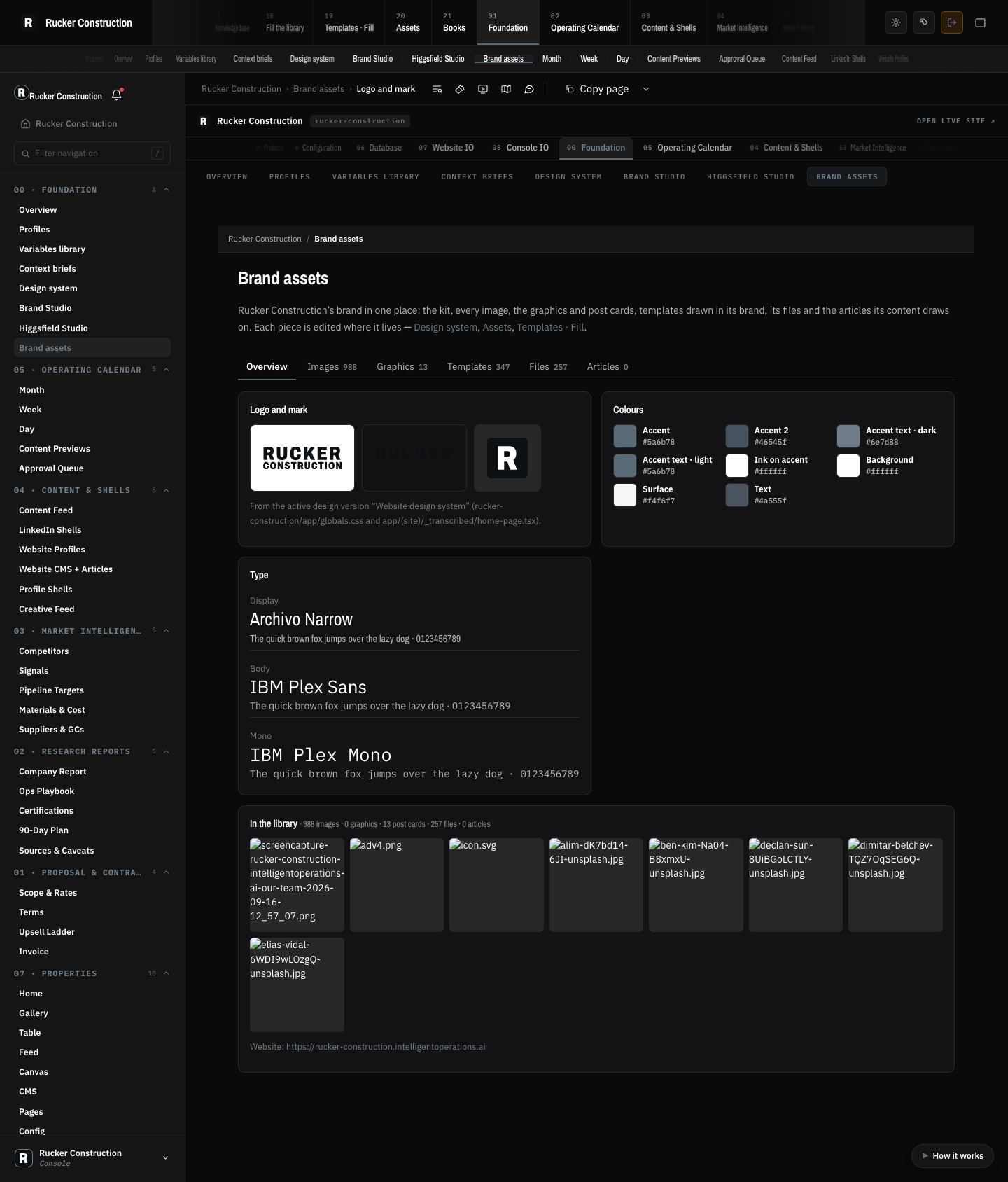
/tenant/rucker-construction/foundation/brand-assets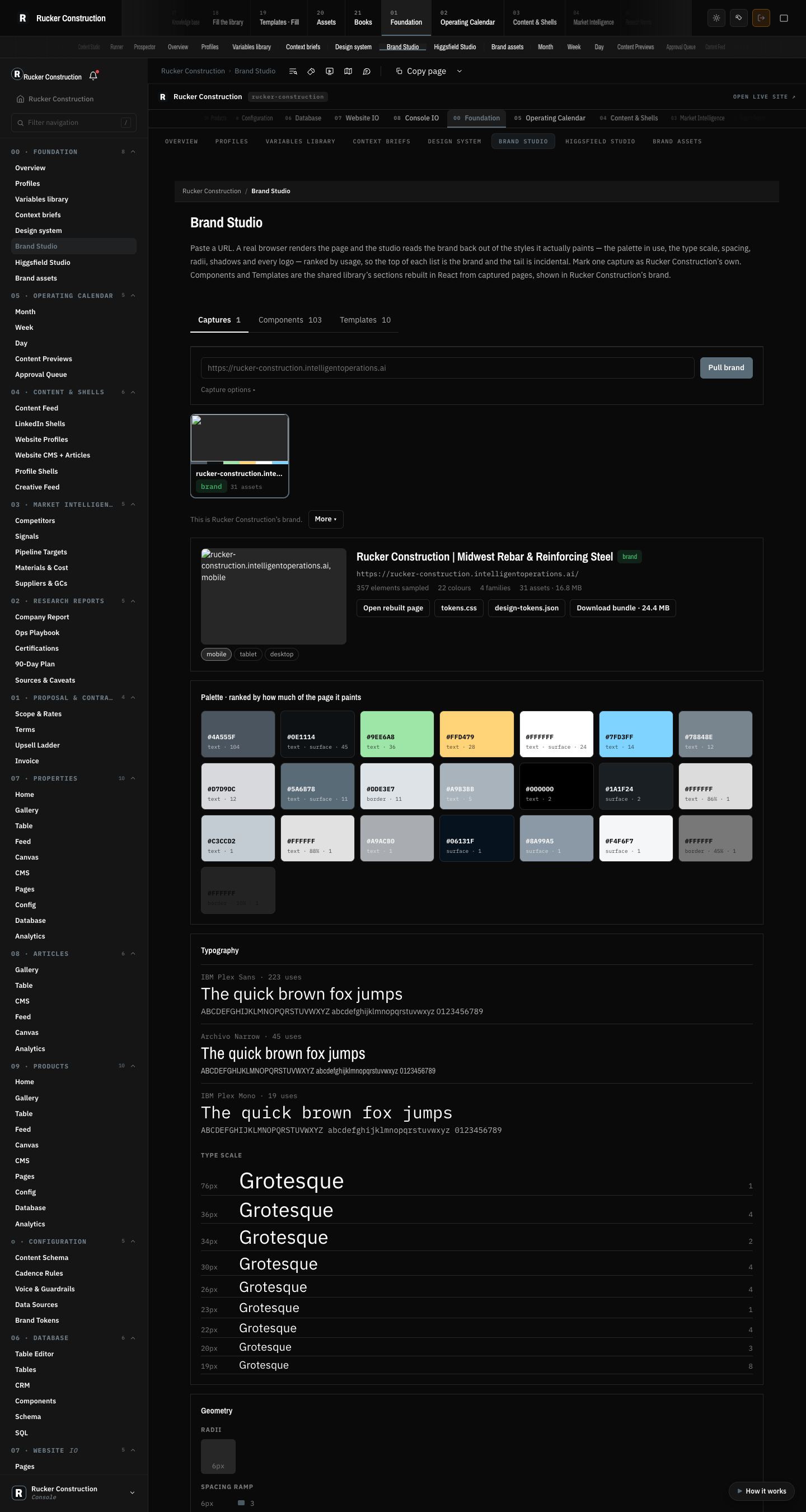
/tenant/rucker-construction/foundation/brand-studio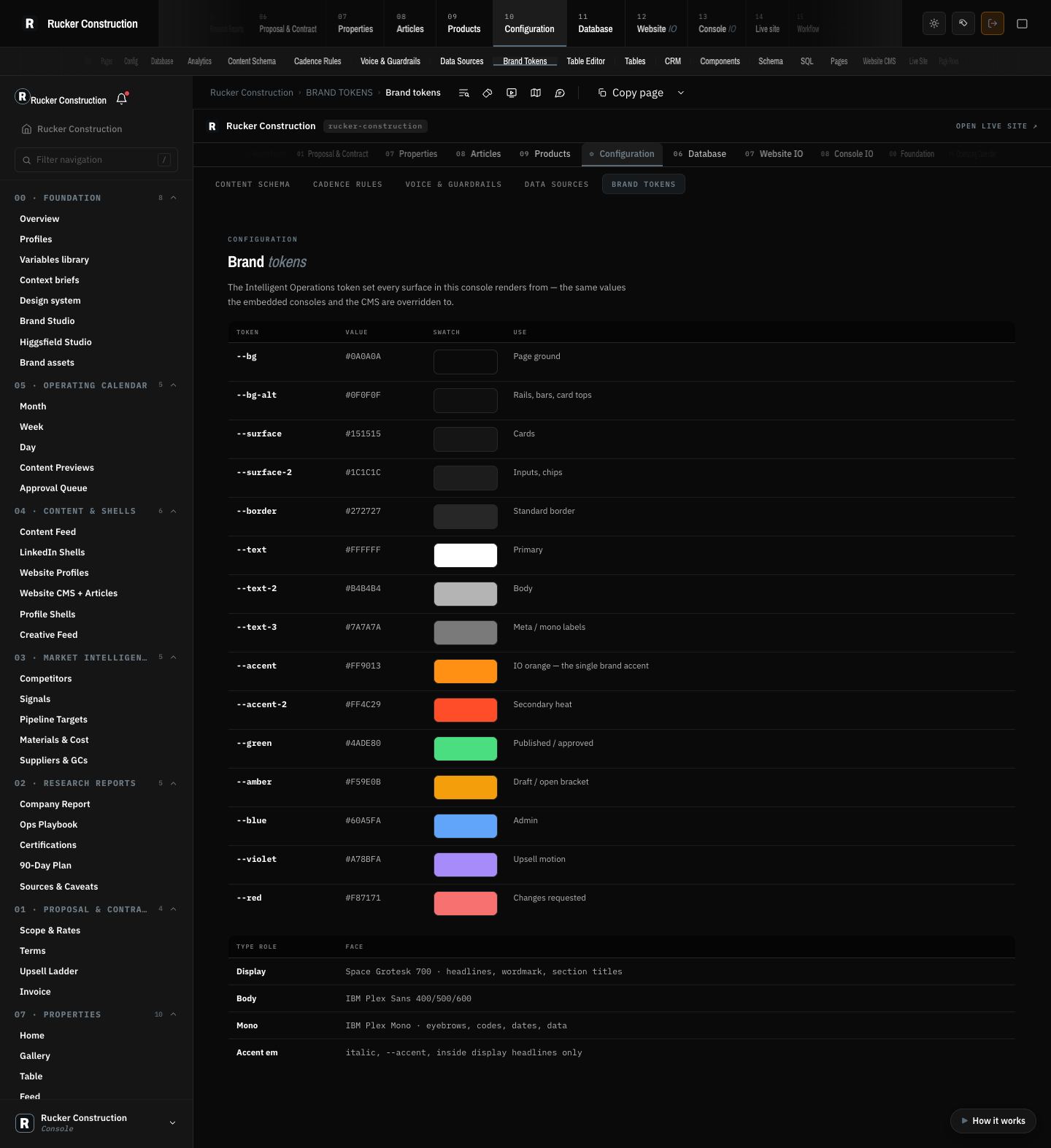
/tenant/rucker-construction/config/tokens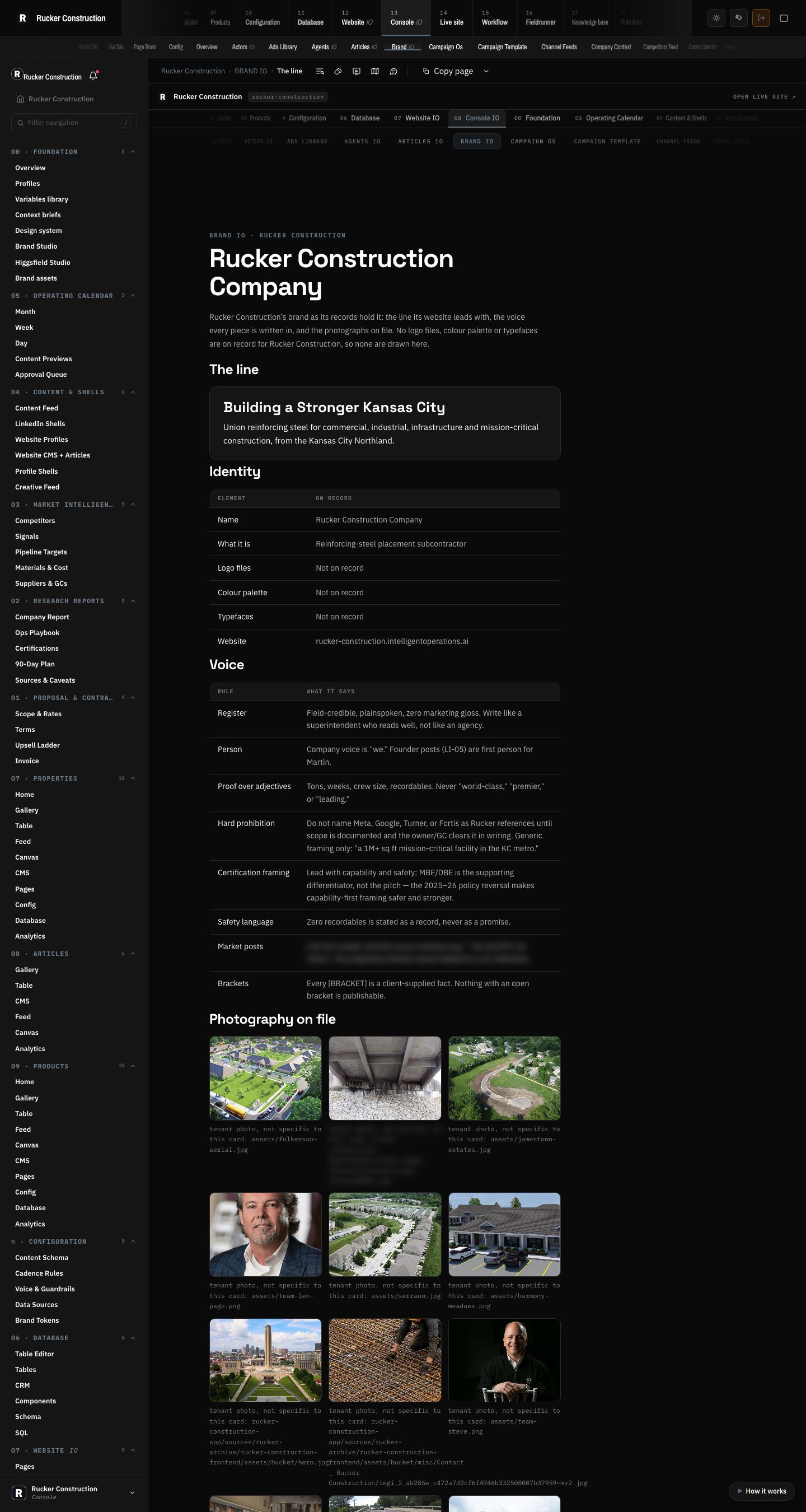
/tenant/rucker-construction/consoles/brand-io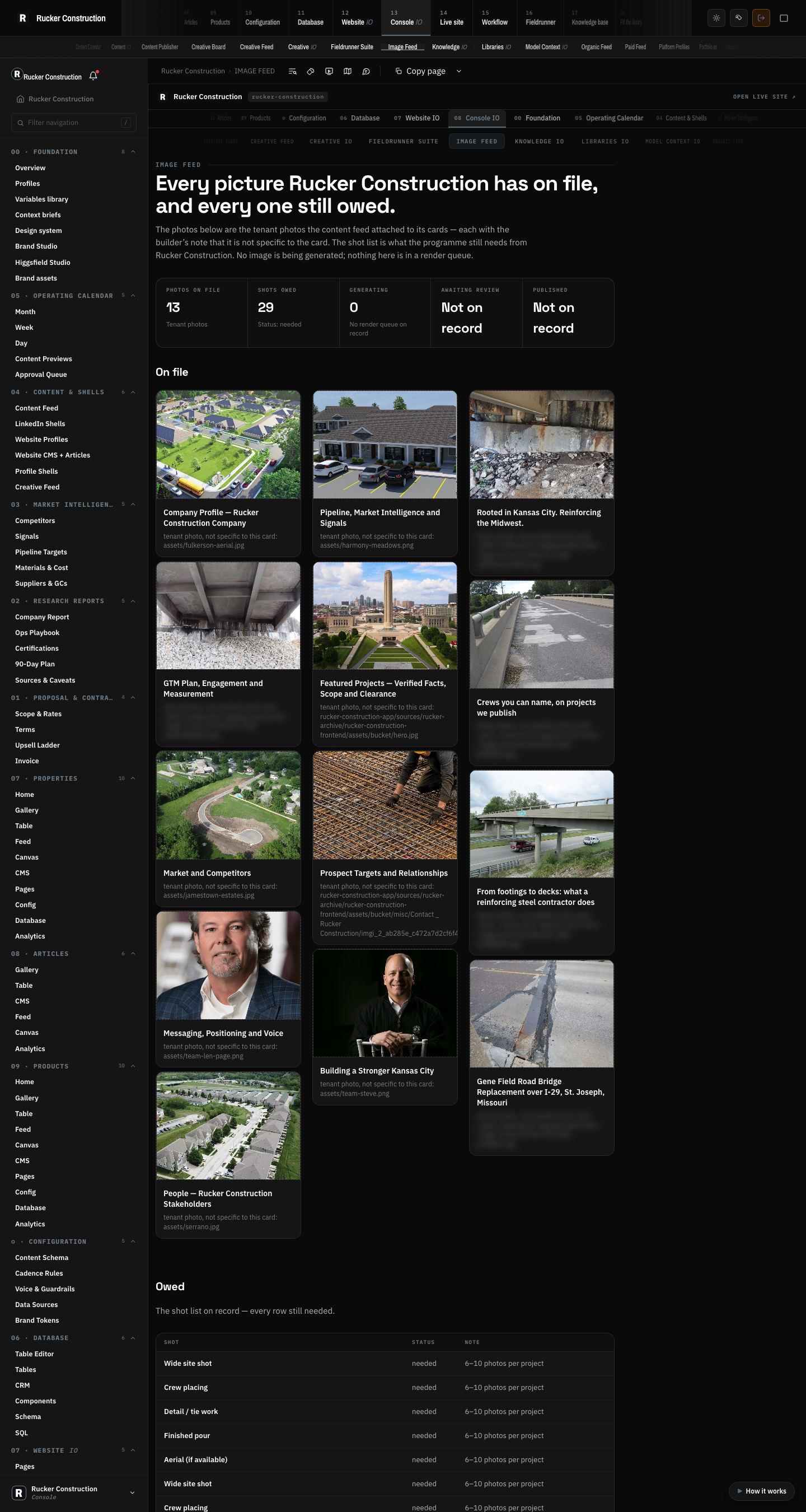
/tenant/rucker-construction/consoles/image-feed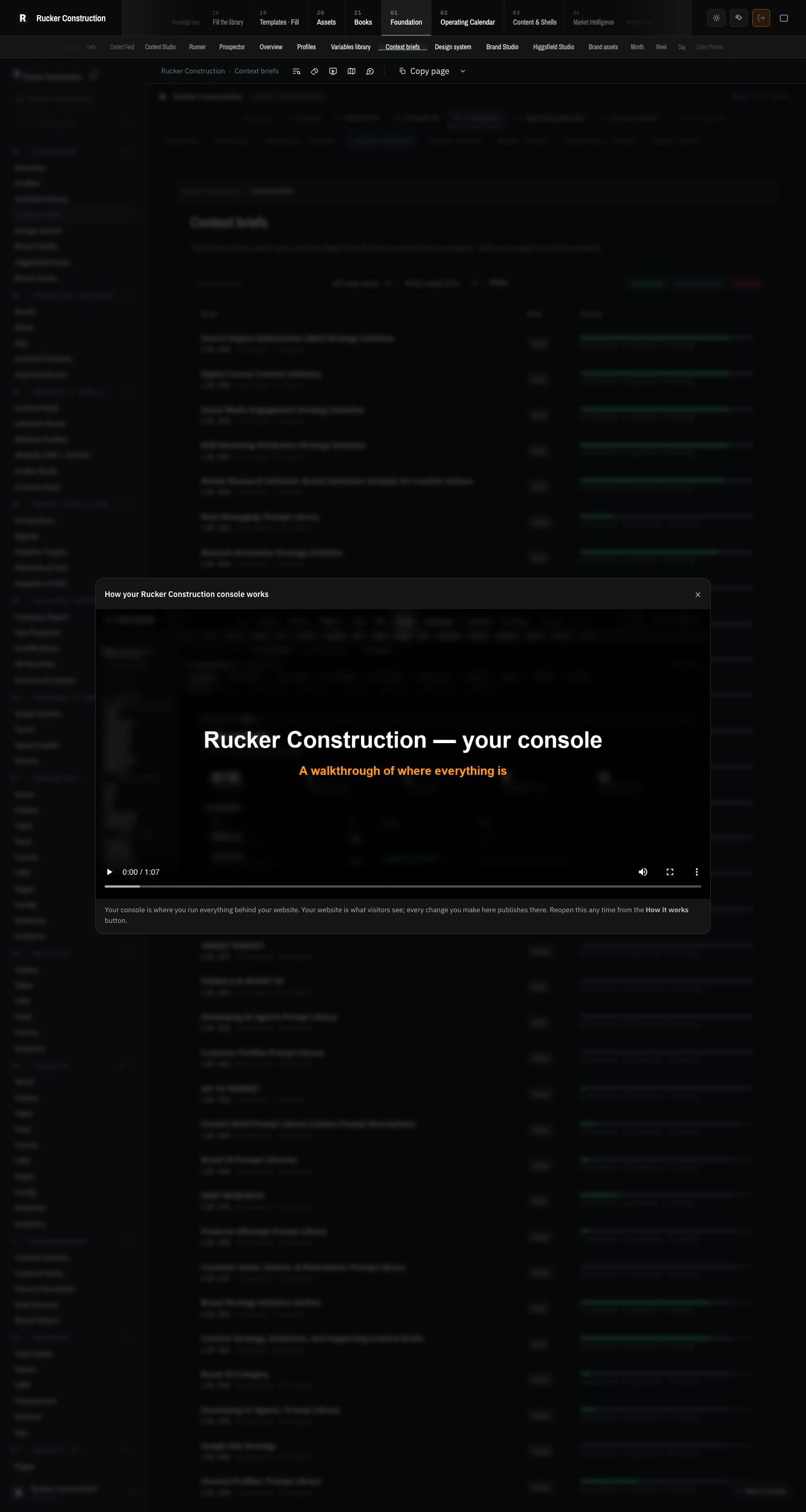
/tenant/rucker-construction/foundation/briefs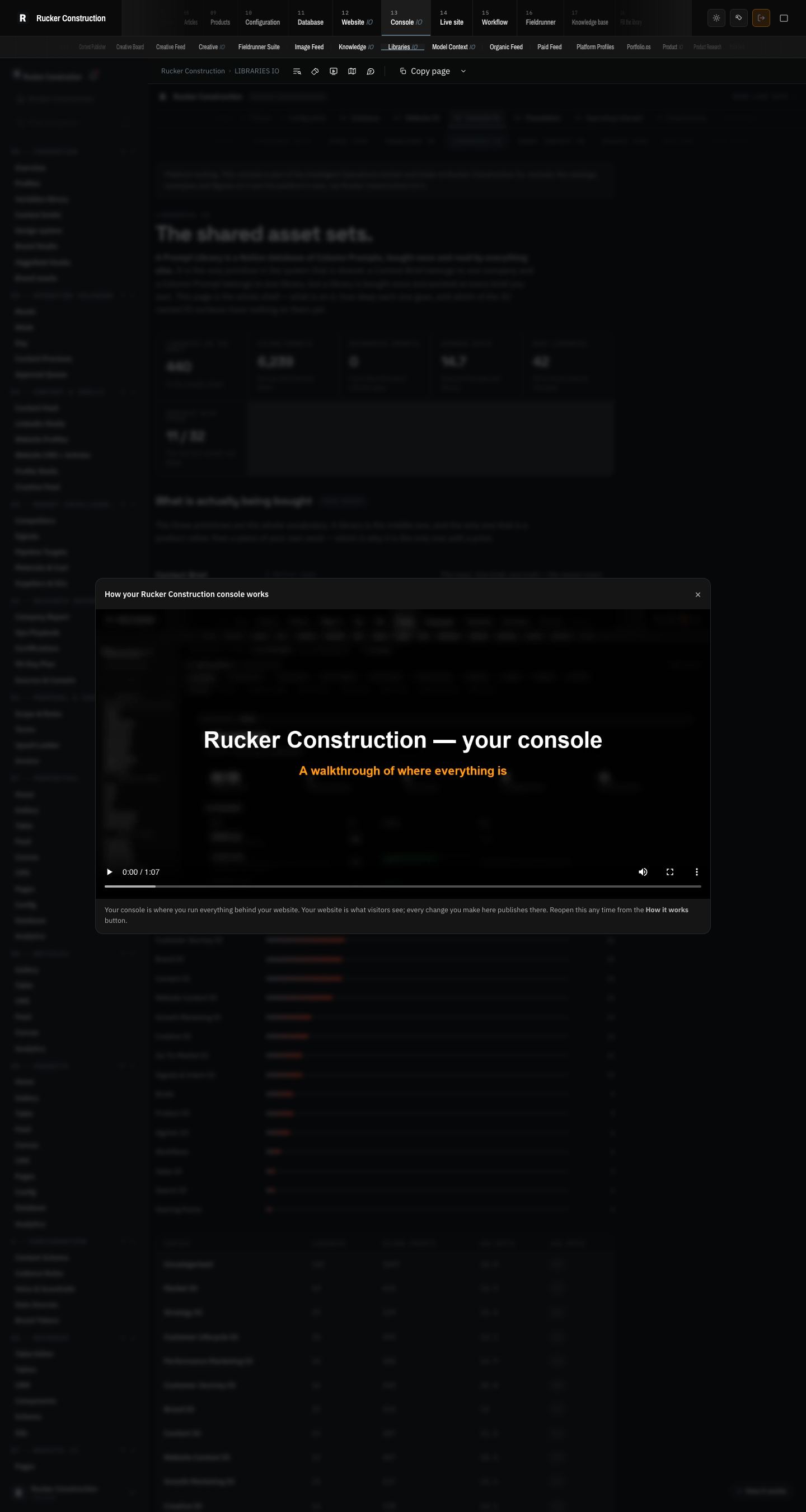
/tenant/rucker-construction/consoles/libraries-io
/tenant/rucker-construction/foundation/variables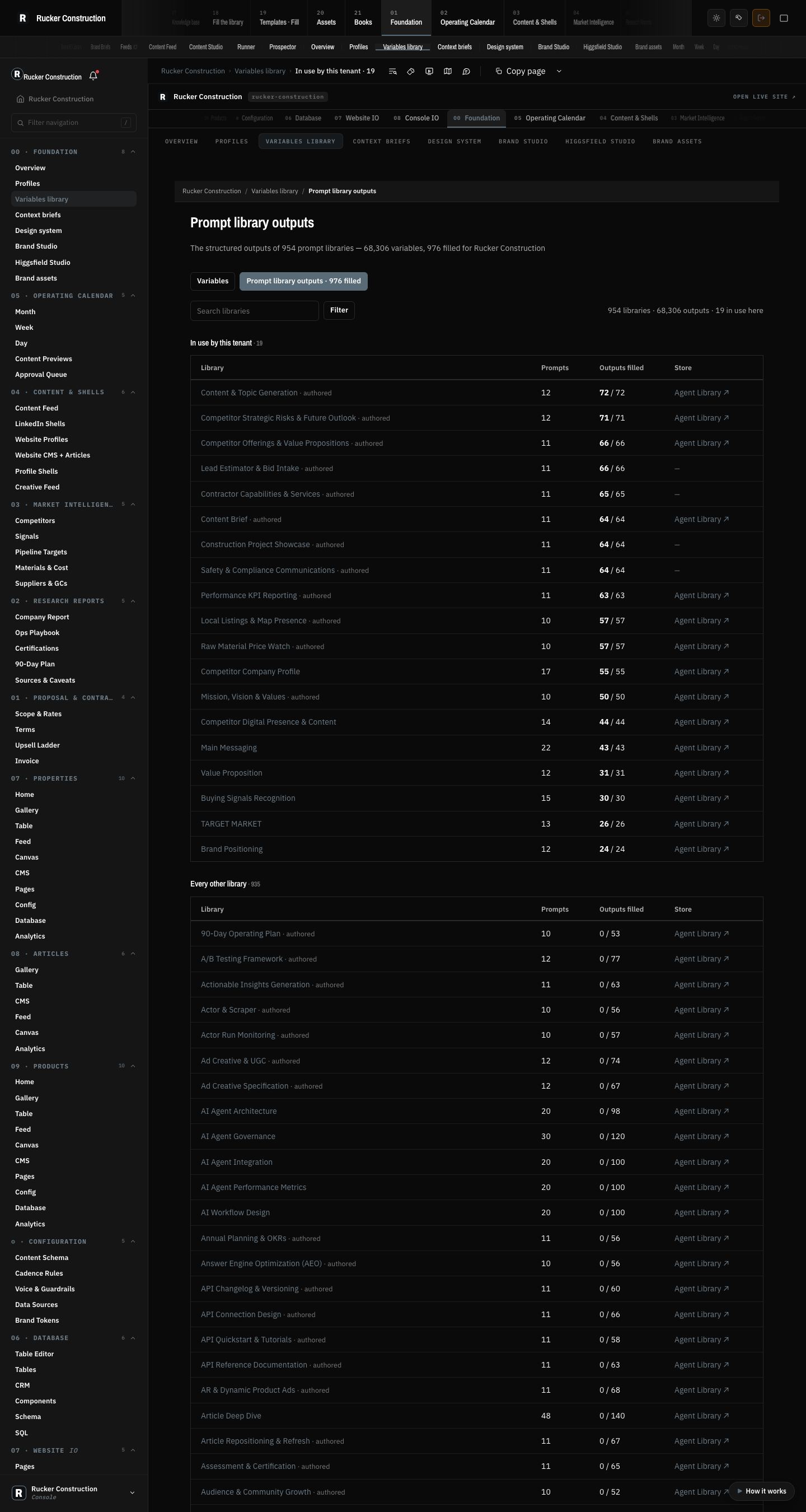
/tenant/rucker-construction/foundation/variables?tab=outputs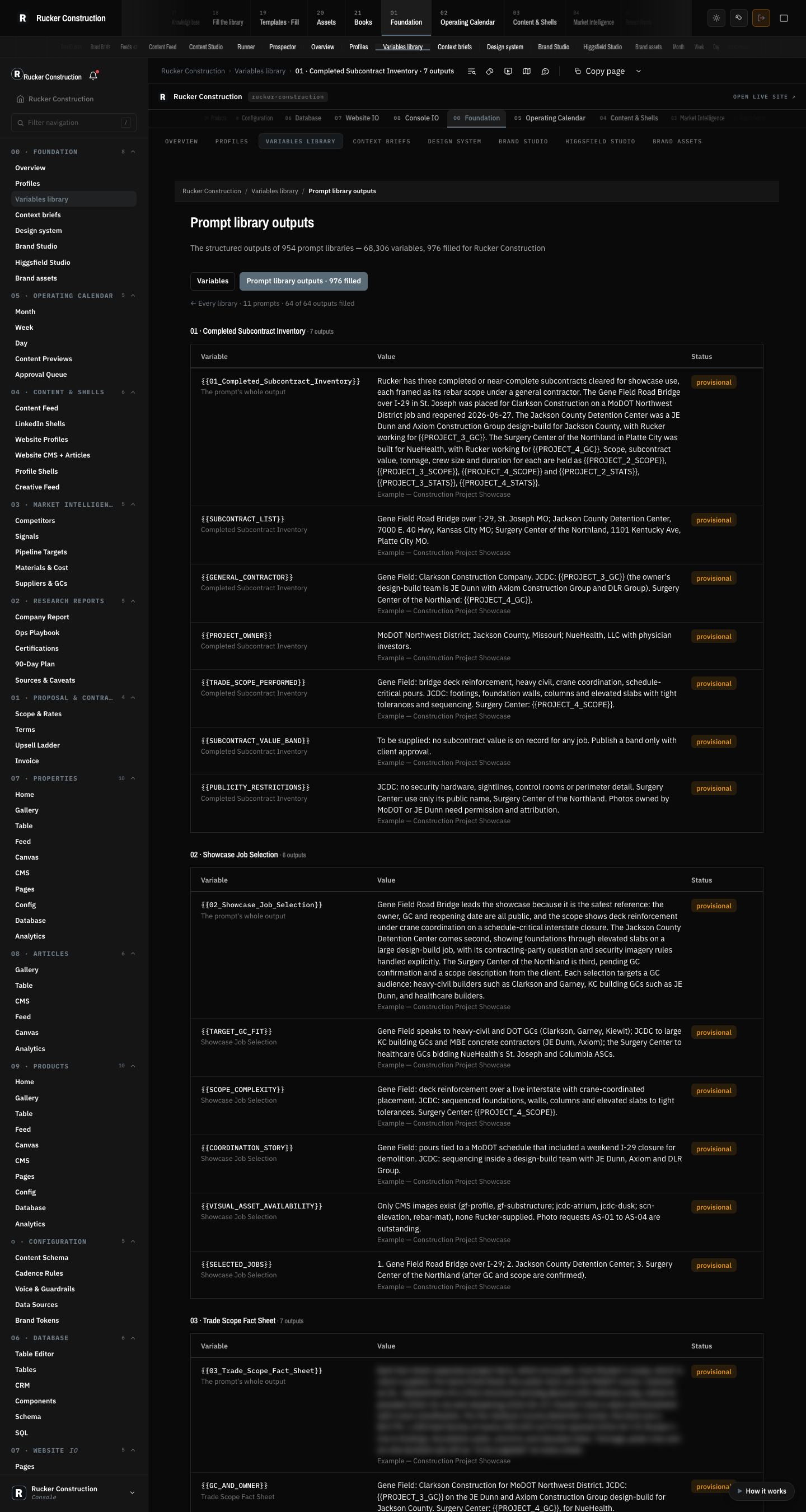
/tenant/rucker-construction/foundation/variables?tab=outputs&lib=construction-project-showcase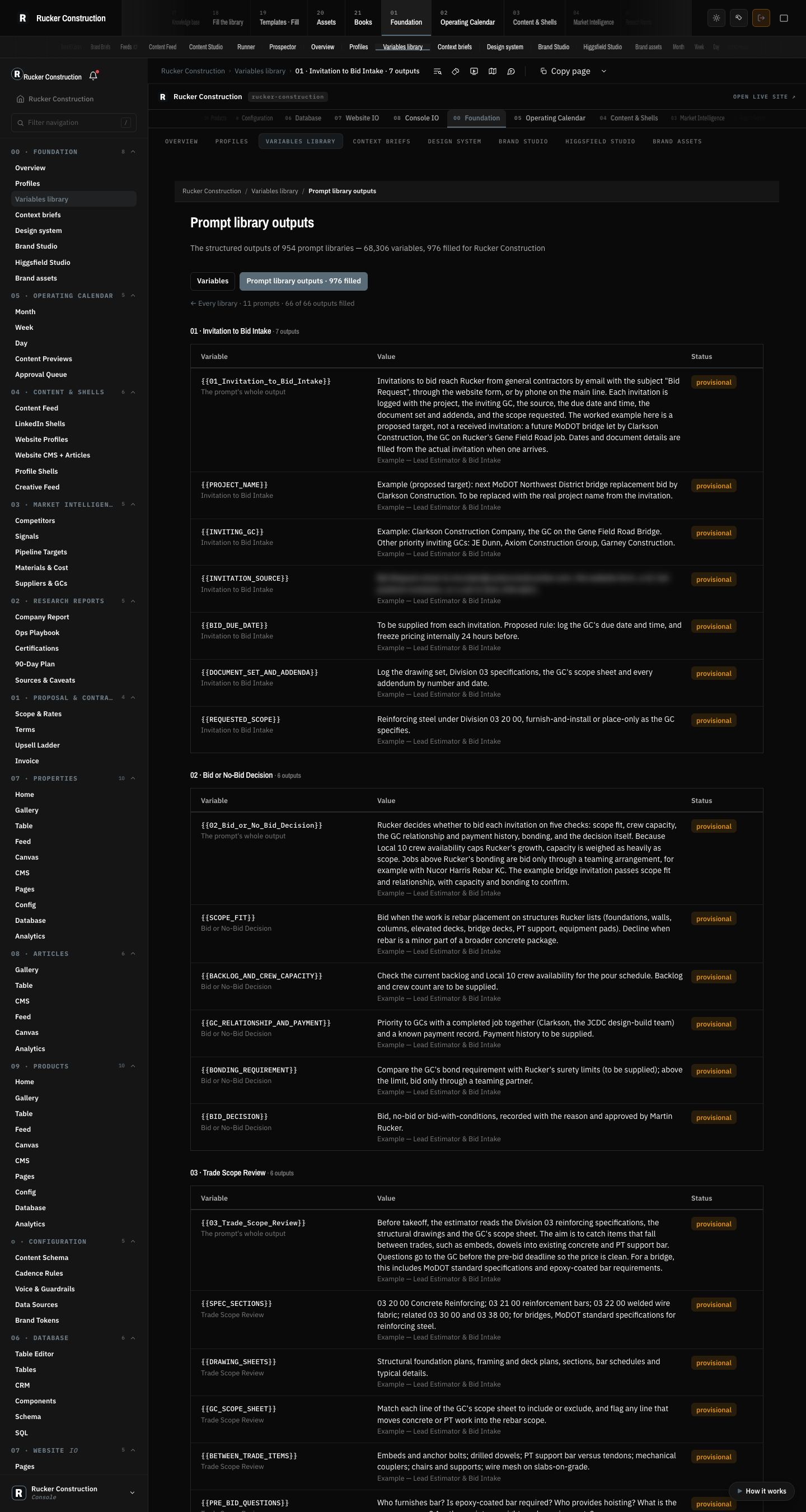
/tenant/rucker-construction/foundation/variables?tab=outputs&lib=lead-estimator-and-bid-intake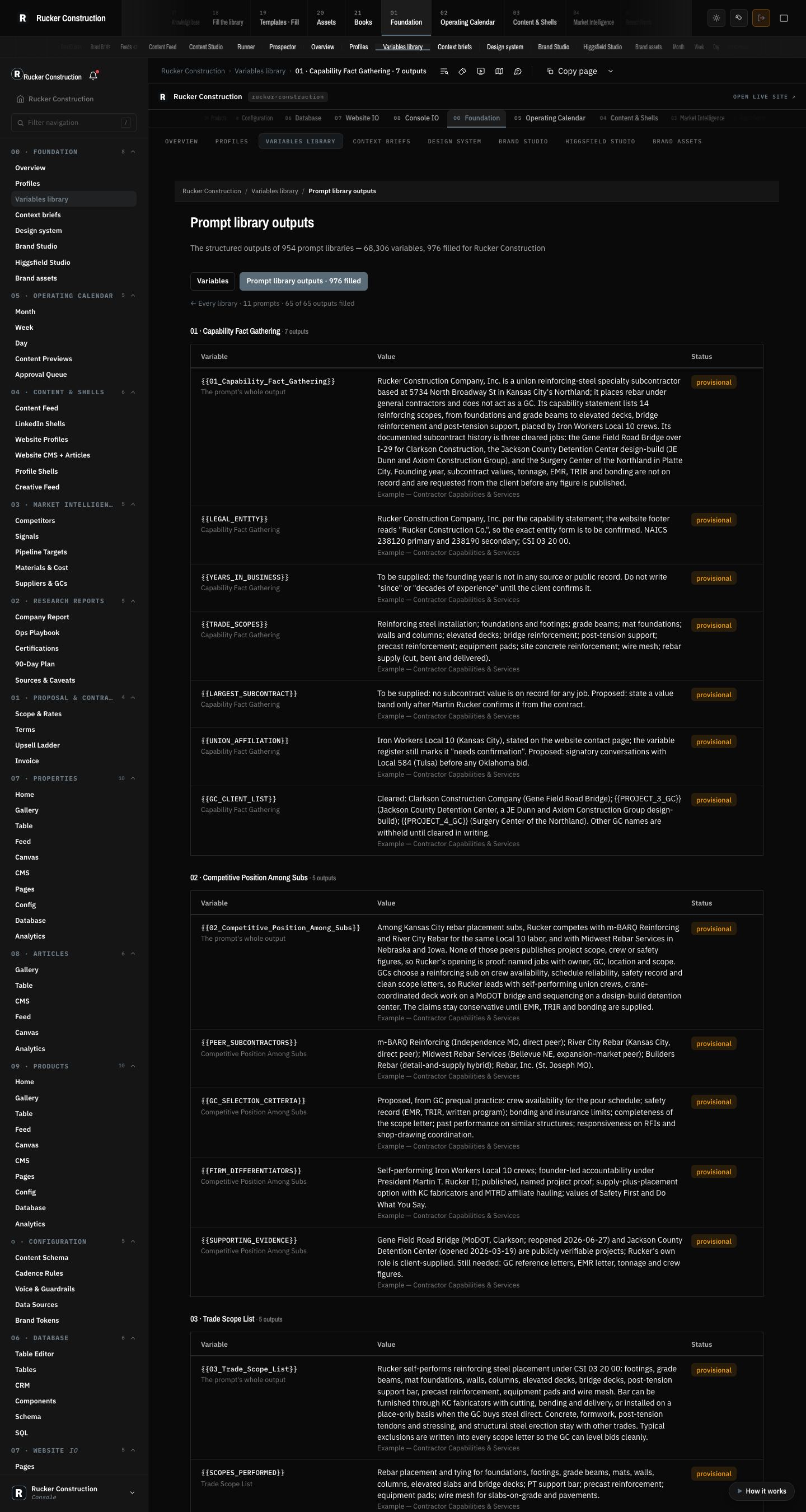
/tenant/rucker-construction/foundation/variables?tab=outputs&lib=contractor-capabilities-and-services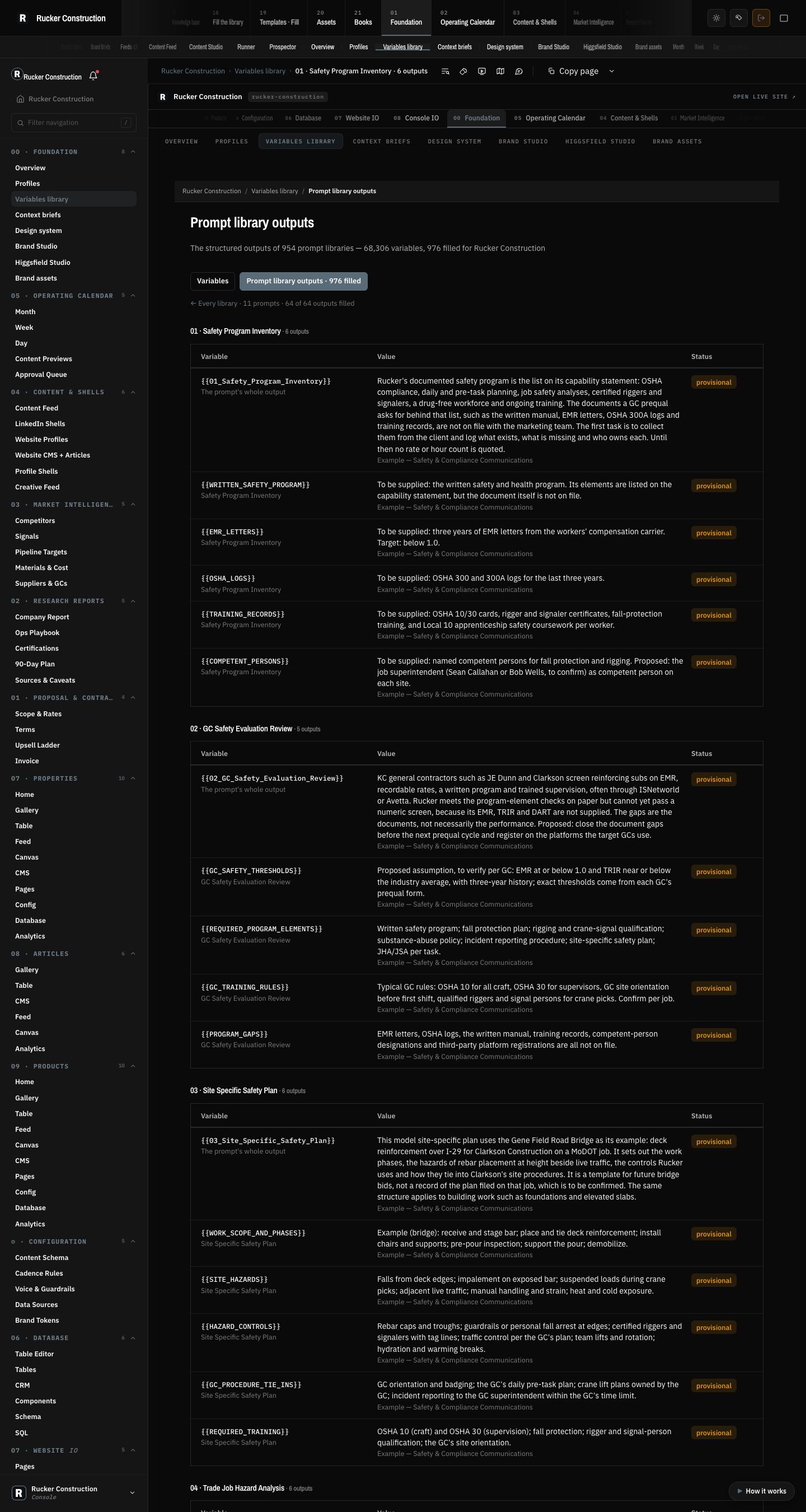
/tenant/rucker-construction/foundation/variables?tab=outputs&lib=safety-and-compliance-communications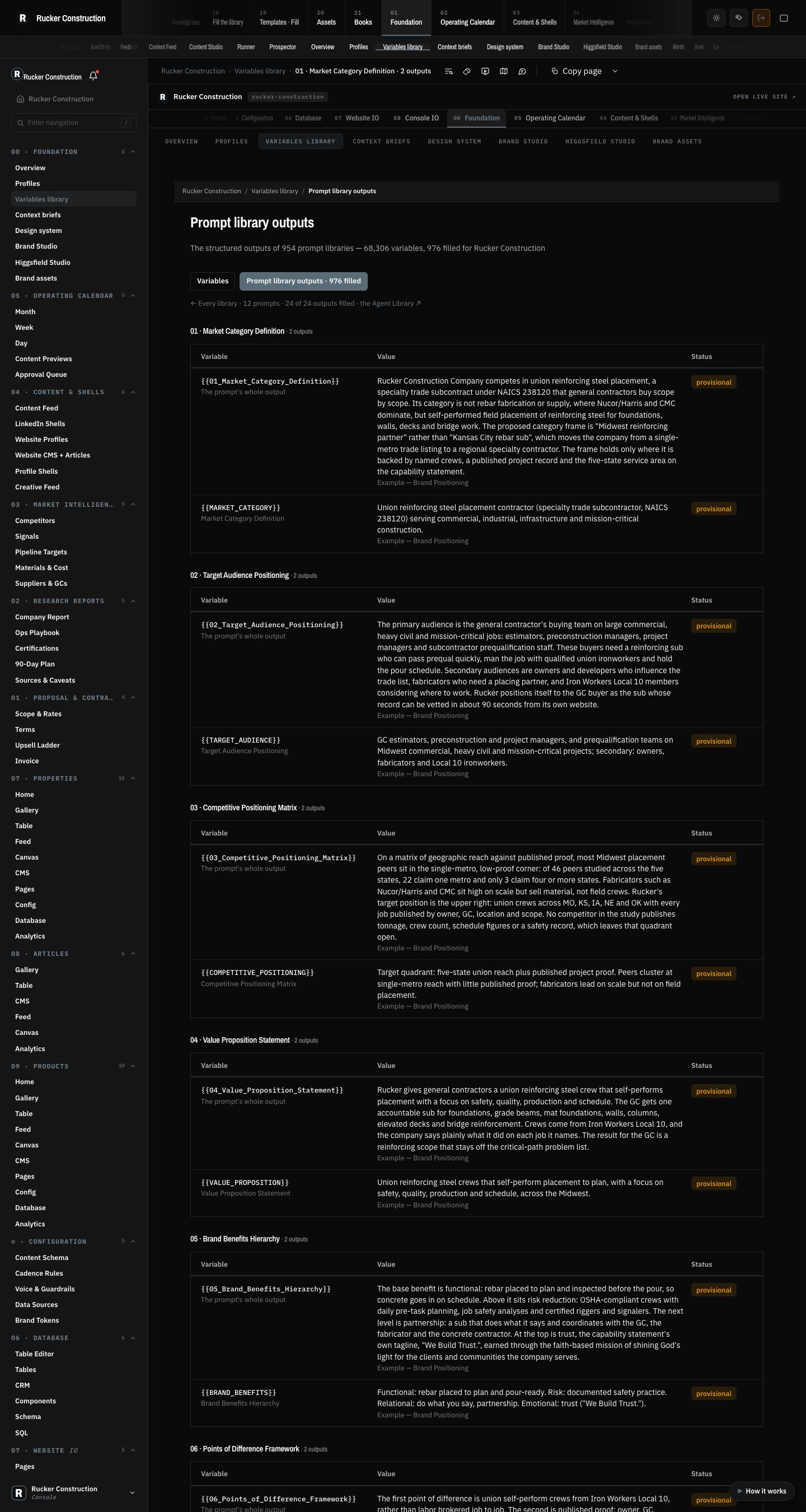
/tenant/rucker-construction/foundation/variables?tab=outputs&lib=brand-positioning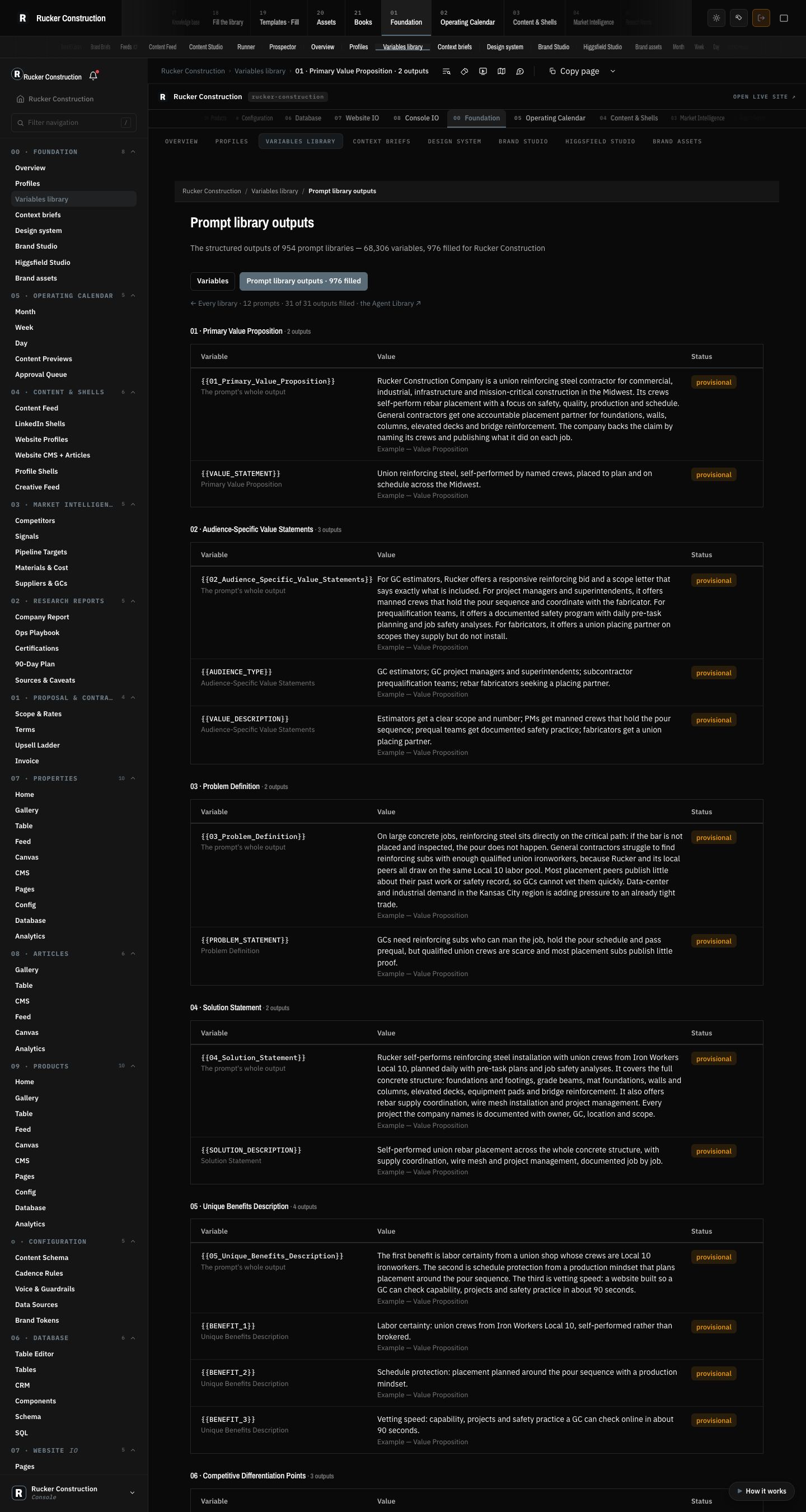
/tenant/rucker-construction/foundation/variables?tab=outputs&lib=value-proposition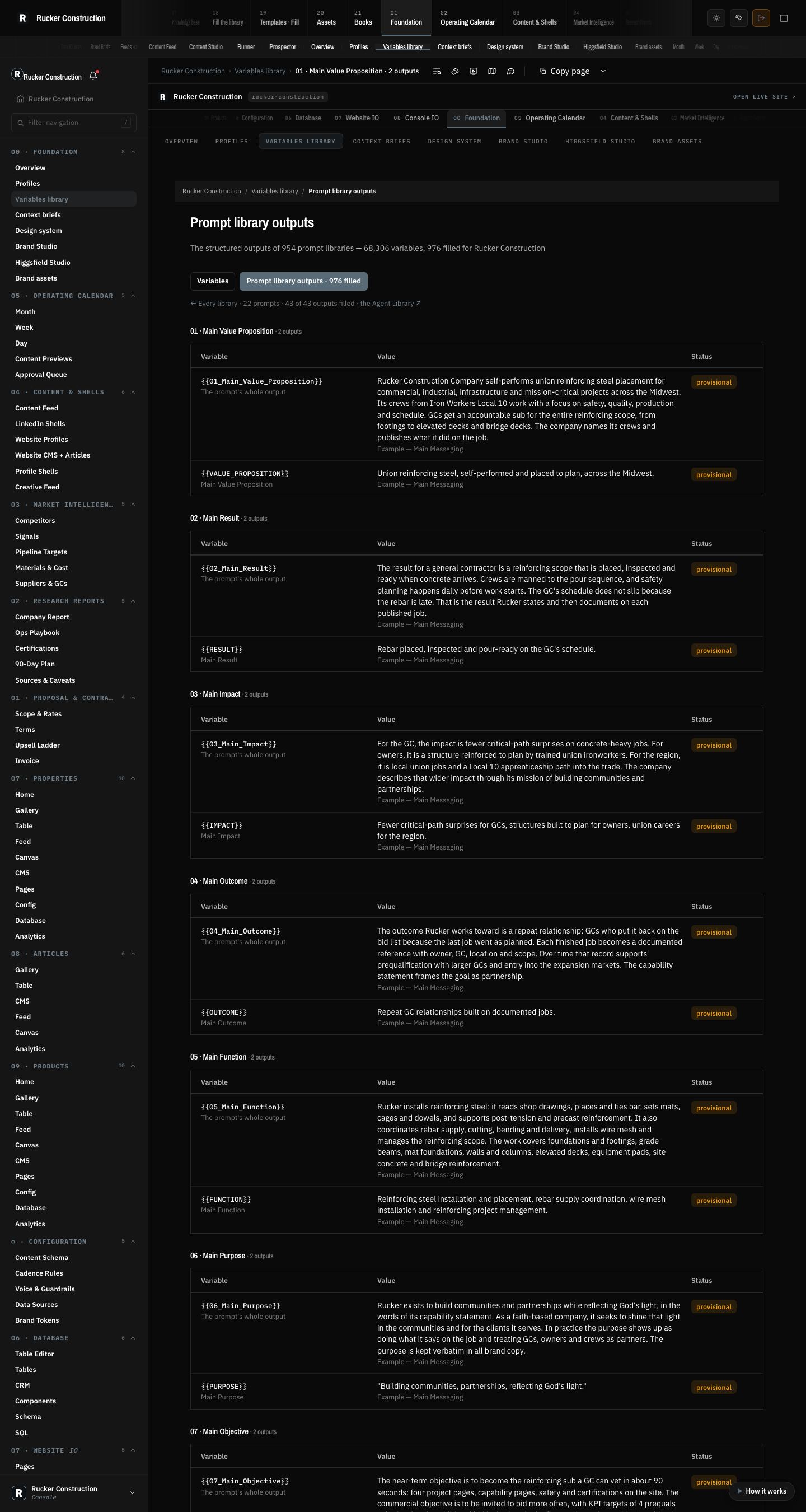
/tenant/rucker-construction/foundation/variables?tab=outputs&lib=main-messaging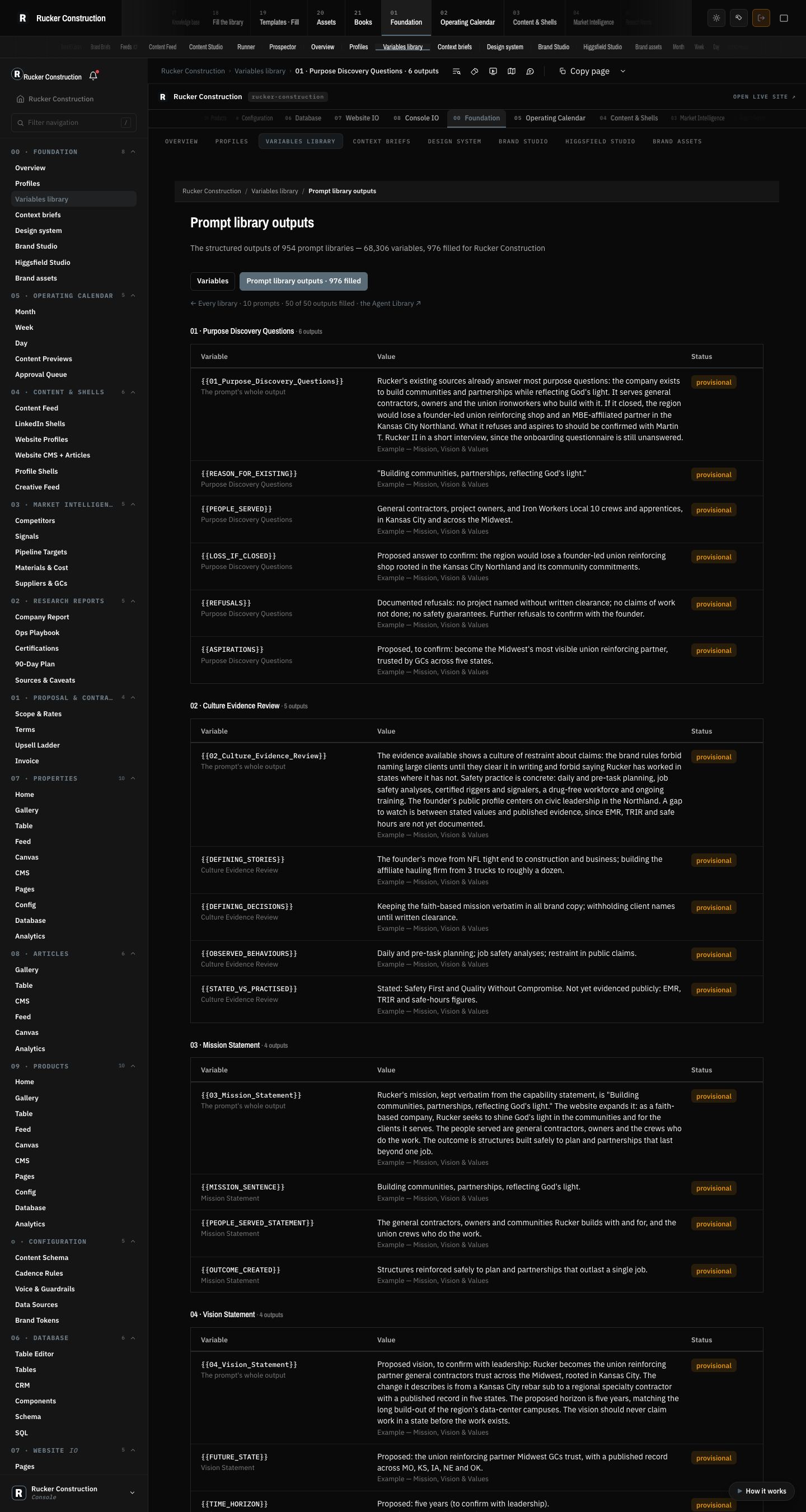
/tenant/rucker-construction/foundation/variables?tab=outputs&lib=mission-vision-and-values

Rucker's proof is its rebar scope on GC-led jobs (Gene Field Road Bridge, Jackson County Detention Center, Surgery Center of the Northland), each needing owner and GC credit and clearance.
- Completed Subcontract Inventory
- Showcase Job Selection
- Trade Scope Fact Sheet
- Sequence and Installation Narrative
- Coordination with the GC and Trades
- Job Safety Record Summary
- Job Photo and Media Plan
- GC Reference and Feedback
- Credit and Confidentiality Check
- Public Case Study Page
- Case Study Reuse in Bids and Prequal
Rucker wins work by bidding GCs' invitations for Division 03 20 00 scope, so it needs a consistent intake, go/no-go, takeoff and hit-rate record by GC.
- Invitation to Bid Intake
- Bid or No-Bid Decision
- Trade Scope Review
- Quantity Takeoff Structure
- Material Pricing and Escalation
- Labour and Equipment Pricing
- Inclusions Exclusions and Qualifications
- Bid Day Submission to GCs
- Bid Accuracy Review
- Post Bid Follow-Up
- Hit Rate by General Contractor
GCs prequalify Rucker as a reinforcing-steel subcontractor, so its scopes, crews, safety program and bonding must be stated accurately for their estimators and prequal teams.
- Capability Fact Gathering
- Competitive Position Among Subs
- Trade Scope List
- Crews Equipment and Capacity
- Markets and Service Area
- Safety Record Summary for GCs
- Bonding Insurance and Certifications
- Capability Statement
- Prequalification Questionnaire Answers
- Capability Accuracy Review
- GC Facing Service Pages
Every GC prequal and site mobilization asks a subcontractor for its safety program, EMR, OSHA logs and payroll compliance, and Safety First is Rucker's first value.
- Safety Program Inventory
- GC Safety Evaluation Review
- Site Specific Safety Plan
- Trade Job Hazard Analysis
- Toolbox Talk Series
- Crew Orientation and Training
- Incident Reporting to the GC
- Labour and Payroll Compliance
- Safety Performance Measures
- GC Documentation Package
- Safety Record Statement for GCs
Rucker is moving from "KC rebar sub" to "Midwest reinforcing partner" and needs one positioning frame behind the regional repositioning.
- Market Category Definition
- Target Audience Positioning
- Competitive Positioning Matrix
- Value Proposition Statement
- Brand Benefits Hierarchy
- Points of Difference Framework
- Points of Parity Framework
- Brand Promise Statement
- Positioning Statement Structure
- Positioning Testing Framework
- Positioning Evolution Timeline
- Category Disruption Strategy
GC buyers vet reinforcing subs on labor, schedule and safety, so Rucker needs a proof-backed value proposition for each buyer role.
- Primary Value Proposition
- Audience-Specific Value Statements
- Problem Definition
- Solution Statement
- Unique Benefits Description
- Competitive Differentiation Points
- Evidence and Proof Points
- Value Quantification Framework
- Emotional Value Components
- Rational Value Components
- Value Delivery Timeline
- Value Proposition Testing Framework
The site, capability statement and LinkedIn posts all need the same core lines, from one-liner to definition.
- Main Value Proposition
- Main Result
- Main Impact
- Main Outcome
- Main Function
- Main Purpose
- Main Objective
- Main Rationale
- Main Use Case
- Main Hook
- Main Jobs to Be Done
- Main User Story
- Main Benefit
- Main Feature
- One-liner
- Summary
- Description
- Overview
- Synopsis
- Excerpt
- Definition
- Explanation
The faith-based mission and five capability-statement values are deliberate brand pillars that need a written vision and rollout.
- Purpose Discovery Questions
- Culture Evidence Review
- Mission Statement
- Vision Statement
- Core Values Set
- Value Behaviour Standards
- Values in Practice
- Public Mission Page Copy
- Alignment Check
- Rollout and Reinforcement Plan
Rucker sells to a narrow B2B audience of GC estimators, PMs and prequal teams across five states and must define it precisely.
- Target Market Overview
- Ideal Customer Profile
- Primary Target Segment
- Target Market Segments
- Customer Personas
- Target Market Industry, Companies, & Job Titles Overview
- Customer Insights & Behaviors Overview
- Customer Goals, Desires, & Motivations Overview
- Customer Communication & Engagement Overview
- Customer Problems & Pain Points Overview
- Customer Personalities & Archetypes Overview
- Customer Transformation Overview
- Storybrand Script
The 13 Sep competitor research (m-BARQ, River City, Nucor/Harris, CMC, Midwest Rebar and others) needs a structured tiered profile.
- Primary, Secondary, and Tertiary Competitor classification
- Primary Competitor Classification
- Direct vs. Indirect competitor definition
- Secondary Competitor Classification
- Emerging/disruptive players
- Tertiary Competitor Classification
- Market share distribution
- Direct Competitor Definition
- Geographic focus & expansion
- Indirect Competitor Definition
- Regulatory/compliance strengths or vulnerabilities
- Emerging/Disruptive Players
- Competitive advantage focus
- Market Share Distribution
- Geographic Focus & Expansion
- Regulatory/Compliance Strengths or Vulnerabilities
- Competitive Advantage Focus
GCs compare reinforcing subs on what is offered and proven, and Rucker's differentiation depends on what placement peers and fabricators publish and do not.
- Competitor Set Definition
- Offering Portfolio Inventory
- Feature And Capability Comparison
- Pricing And Packaging Analysis
- Value Proposition Teardown
- Customer Pain Point Gap Map
- Differentiation Opportunity Shortlist
- Positioning Statement Drafts
- Sales Battlecard Set
- Message Claim Validation
- Competitor Watch Cadence
Tariffs, rebar inflation, labor limits and certification changes shape the 12-month outlook for Rucker and the subs and fabricators it competes with.
- Outlook Scope Questions
- Innovation Signal Review
- Financial Resilience Assessment
- Technology Disruption Exposure
- Key Person And Governance Risk
- Regulatory And Supply Exposure
- Scenario Planning Framework
- Risk And Opportunity Register
- Response Playbook
- Leadership Outlook Brief
- Assumption Stress Test
- Quarterly Outlook Review
The headline finding is that no competitor publishes projects, safety data or a blog, which is Rucker's content opening.
- Website design, UX, and conversion flow
- Website design, UX, and conversion flow
- Content marketing strategy (blogs, webinars, downloads)
- Content marketing strategy
- SEO rankings & keyword strategy
- SEO rankings & keyword strategy
- Social media presence (platforms, tone, engagement)
- Social media presence
- App store reviews (if applicable)
- App store reviews
- Paid ads analysis (via ad libraries)
- Paid ads analysis
- Funnel tactics: lead magnets, retargeting, CTAs
- Funnel tactics
The console's signal library tracks market and GC signals that precede bid invitations.
- Early Stage Interest Indicators
- Mid-Funnel Evaluation Signals
- Late Stage Decision Signals
- Product Specification Reviews
- Competitor Comparison Behaviors
- Pricing Page Interactions
- Budget Discussion Indicators
- Timeline Exploration Markers
- Implementation Planning Activities
- Technical Validation Behaviors
- Stakeholder Involvement Signs
- Purchase Authority Indicators
- Risk Assessment Activities
- ROI Calculation Behaviors
- Post-Demo Engagement Patterns
Rebar prices, Section 232 tariffs and mill margins directly affect Rucker's furnish-and-install bids and market commentary.
- Material Exposure Inventory
- Monitoring Questions
- Price Source Selection
- Price Feed Specification
- Historical Baseline and Ranges
- Alert Threshold Rules
- Cost Impact Model
- Response Playbook
- Price Watch Digest
- Watch Effectiveness Measures
Eight articles and two LinkedIn posts a week need topics tied to documented projects and the questions GC estimators ask.
- Content Discovery Questions
- Audience Question Mining
- Search Demand Review
- Competitor Content Gap Scan
- Topic Pillar Framework
- Topic Idea Generation
- Topic Scoring Model
- Topic Brief Template
- Angle and Hook Development
- Format and Channel Mapping
- Topic Pipeline Schedule
- Topic Performance Review
Each scheduled article needs a brief, starting with the scope-letter checklist for GC estimators.
- Brief Intake Questions
- Audience Reader Profile
- Objective And Success Measure
- Core Message And Angle
- Search Intent And Keyword Plan
- Content Outline
- Tone And Style Direction
- Sources And Evidence Plan
- Call To Action Design
- Brief Quality Checklist
- Distribution And Repurposing Notes
Rucker has no Google Business Profile and no public phone, and the SEO plan calls for a verified GBP.
- Map Presence Audit
- Local Ranking Factors
- Citation Directory Plan
- Review Generation Process
- Review Response Guidelines
- Profile Posts Calendar
- Questions and Answers Seed
- Location Landing Pages
- Map Presence Metrics
- Listings Maintenance Routine
LinkedIn management is the contracted monthly service, with a 13-KPI measurement plan to report against.
- Reporting Requirements Questions
- Tracking Readiness Audit
- KPI Hierarchy
- Metric Definitions
- Targets and Benchmarks
- Report Structure
- Lead Quality Tracking
- Periodic Performance Report
- Optimisation Diagnosis
- Executive Summary
- Reporting Operations Routine
{{01_Completed_Subcontract_Inventory}}- Rucker has three completed or near-complete subcontracts cleared for showcase use, each framed as its rebar scope under a general contractor. The Gene Field Road Bridge over I-29 in St. Joseph was placed for Clarkson Construction on a MoDOT Northwest District job and reopened 2026-06-27. The Jackson County Detention Center was a JE Dunn and Axiom Construction Group design-build for Jackson County, with Rucker working for {{PROJECT_3_GC}}. The Surgery Center of the Northland in Platte City was built for NueHealth, with Rucker working for {{PROJECT_4_GC}}. Scope, subcontract value, tonnage, crew size and duration for each are held as {{PROJECT_2_SCOPE}}, {{PROJECT_3_SCOPE}}, {{PROJECT_4_SCOPE}} and {{PROJECT_2_STATS}}, {{PROJECT_3_STATS}}, {{PROJECT_4_STATS}}.
{{SUBCONTRACT_LIST}}- Gene Field Road Bridge over I-29, St. Joseph MO; Jackson County Detention Center, 7000 E. 40 Hwy, Kansas City MO; Surgery Center of the Northland, 1101 Kentucky Ave, Platte City MO.
{{GENERAL_CONTRACTOR}}- Gene Field: Clarkson Construction Company. JCDC: {{PROJECT_3_GC}} (the owner's design-build team is JE Dunn with Axiom Construction Group and DLR Group). Surgery Center of the Northland: {{PROJECT_4_GC}}.
{{PROJECT_OWNER}}- MoDOT Northwest District; Jackson County, Missouri; NueHealth, LLC with physician investors.
{{TRADE_SCOPE_PERFORMED}}- Gene Field: bridge deck reinforcement, heavy civil, crane coordination, schedule-critical pours. JCDC: footings, foundation walls, columns and elevated slabs with tight tolerances and sequencing. Surgery Center: {{PROJECT_4_SCOPE}}.
{{SUBCONTRACT_VALUE_BAND}}- To be supplied: no subcontract value is on record for any job. Publish a band only with client approval.
{{PUBLICITY_RESTRICTIONS}}- JCDC: no security hardware, sightlines, control rooms or perimeter detail. Surgery Center: use only its public name, Surgery Center of the Northland. Photos owned by MoDOT or JE Dunn need permission and attribution.
{{02_Showcase_Job_Selection}}- Gene Field Road Bridge leads the showcase because it is the safest reference: the owner, GC and reopening date are all public, and the scope shows deck reinforcement under crane coordination on a schedule-critical interstate closure. The Jackson County Detention Center comes second, showing foundations through elevated slabs on a large design-build job, with its contracting-party question and security imagery rules handled explicitly. The Surgery Center of the Northland is third, pending GC confirmation and a scope description from the client. Each selection targets a GC audience: heavy-civil builders such as Clarkson and Garney, KC building GCs such as JE Dunn, and healthcare builders.
{{TARGET_GC_FIT}}- Gene Field speaks to heavy-civil and DOT GCs (Clarkson, Garney, Kiewit); JCDC to large KC building GCs and MBE concrete contractors (JE Dunn, Axiom); the Surgery Center to healthcare GCs bidding NueHealth's St. Joseph and Columbia ASCs.
{{SCOPE_COMPLEXITY}}- Gene Field: deck reinforcement over a live interstate with crane-coordinated placement. JCDC: sequenced foundations, walls, columns and elevated slabs to tight tolerances. Surgery Center: {{PROJECT_4_SCOPE}}.
{{COORDINATION_STORY}}- Gene Field: pours tied to a MoDOT schedule that included a weekend I-29 closure for demolition. JCDC: sequencing inside a design-build team with JE Dunn, Axiom and DLR Group.
{{VISUAL_ASSET_AVAILABILITY}}- Only CMS images exist (gf-profile, gf-substructure; jcdc-atrium, jcdc-dusk; scn-elevation, rebar-mat), none Rucker-supplied. Photo requests AS-01 to AS-04 are outstanding.
{{SELECTED_JOBS}}- 1. Gene Field Road Bridge over I-29; 2. Jackson County Detention Center; 3. Surgery Center of the Northland (after GC and scope are confirmed).
{{03_Trade_Scope_Fact_Sheet}}- Each fact sheet separates project facts, which are public, from Rucker's scope, which is client-supplied. For Gene Field Road, the public facts are the MoDOT owner, Clarkson as GC, replacement of a 1962 structure carrying about 6,500 vehicles a day, notice to proceed 2026-01-16 and reopening 2026-06-27; Rucker's line is deck reinforcement with crane coordination. For the Jackson County Detention Center, the facts are a $317M, 1,000-bed facility of nearly 400,000 sq ft that opened 2026-03-19; Rucker's line is footings, foundation walls, columns and elevated slabs. Tonnage, peak crew and on-site duration are left as "to be supplied" on every sheet.
{{GC_AND_OWNER}}- Gene Field: Clarkson Construction for MoDOT Northwest District. JCDC: {{PROJECT_3_GC}} on the JE Dunn and Axiom Construction Group design-build for Jackson County. Surgery Center: {{PROJECT_4_GC}}, for NueHealth.
{{BUILDING_TYPE}}- Highway bridge (interstate overpass replacement); county detention facility; ambulatory surgery center with four operating rooms.
{{SCOPE_QUANTITIES}}- To be supplied: Rucker tonnage and bar counts are not on record for any job. Do not estimate.
{{ELEMENTS_COVERED}}- Gene Field: bridge deck reinforcement. JCDC: footings, foundation walls, columns, elevated slabs. Surgery Center: {{PROJECT_4_SCOPE}}.
{{PEAK_CREW_SIZE}}- To be supplied: peak crew size is not on record for any job.
{{ON_SITE_DURATION}}- To be supplied from the client. Public context only: Gene Field ran from notice to proceed 2026-01-16 to reopening 2026-06-27; Rucker's own on-site dates are not recorded.
{{04_Sequence_and_Installation_Narrative}}- On the Gene Field Road Bridge, Rucker's awarded scope was the reinforcing steel for the new deck, placed under Clarkson Construction after the old 1962 structure came down during a weekend I-29 closure. Placement was coordinated with the GC's crane and tied to schedule-critical pours so the bridge could reopen on 2026-06-27. On the Jackson County Detention Center, Rucker placed reinforcement for footings, foundation walls, columns and elevated slabs in the sequence the design-build team set, where tolerances were tight. The narratives describe method and sequence only; crew counts, tonnage and schedule gains stay out until the client supplies them.
{{AWARDED_SCOPE}}- Gene Field: reinforcing steel installation for the new bridge deck. JCDC: reinforcing for footings, foundation walls, columns and elevated slabs.
{{INSTALLATION_SEQUENCE}}- Gene Field: after demolition, deck reinforcement placed and tied ahead of each scheduled pour. JCDC: footings, then foundation walls, then columns and elevated slabs level by level. Detailed step dates to be supplied.
{{SITE_CONSTRAINT}}- Gene Field: work over a live interstate carrying traffic after a single weekend closure (2026-02-07 to 02-09). JCDC: tight tolerances on a secure-facility design-build.
{{METHOD_USED}}- Crane-coordinated bundle picks with the GC, placement checked against shop drawings before each pour inspection. To confirm with Rucker's superintendent.
{{SCHEDULE_RESULT}}- Public record: Gene Field reopened 2026-06-27; JCDC opened 2026-03-19, reported on time and under budget by the GC. Rucker's own schedule contribution is not measured.
{{05_Coordination_with_the_GC_and_Trades}}- Rucker works inside the GC's schedule, so each case study describes how it coordinated with the GC and the concrete, formwork and inspection trades around it. On Gene Field the key interfaces were Clarkson's crane and pour schedule; on the detention center they were the design-build team and the concrete contractor. The coordination details below are the proposed standard to confirm with Rucker's superintendent, not recorded facts from either job. Any RFI counts or turnaround times will be added only from job records.
{{GC_COORDINATION_CADENCE}}- Proposed: daily foreman check-in with the GC superintendent, attendance at weekly subcontractor meetings, and a pour-readiness walk before each placement.
{{INTERFACING_TRADES}}- Concrete and formwork contractor; crane operator and signalers; PT installer where present; special inspector; embed and MEP sleeve trades on building work.
{{RFI_AND_SUBMITTAL_CYCLE}}- Proposed: shop drawings and bar lists from the fabricator submitted through the GC; RFIs raised through the GC's system. Job-level RFI counts are not on record.
{{FIELD_CONFLICT_RESOLUTION}}- Proposed: conflicts between bar and embeds or sleeves raised to the GC before placement, resolved with the engineer of record, and logged. No specific incident is on record.
{{06_Job_Safety_Record_Summary}}- No job-level safety figures exist for any of Rucker's showcase projects: crew hours, recordables and GC recognition are all unrecorded. Each case study therefore describes the safety controls that apply to rebar placement rather than claiming a result. Those controls come from Rucker's stated program: pre-task planning, job safety analyses, certified riggers and signalers, and rebar cap and fall protection on elevated work. A zero-recordable line may be added only as a verified record from the GC's logs, never as a promise.
{{CREW_HOURS_WORKED}}- To be supplied: no job-level hours are recorded for any showcase job.
{{RECORDABLE_INCIDENTS}}- To be supplied: confirm from OSHA 300 logs and GC records before stating any figure, including zero.
{{SITE_SPECIFIC_PLAN}}- Proposed: a site-specific safety plan per job tied to the GC's program. Whether one was filed on Gene Field or JCDC is to be confirmed.
{{GC_SAFETY_RECOGNITION}}- None on record. Do not claim any award or recognition.
{{KEY_HAZARD_CONTROLS}}- Rebar caps on protruding bar; fall protection on decks and walls; rigging and signaling by certified personnel during crane picks; traffic control coordination beside live I-29 lanes.
{{07_Job_Photo_and_Media_Plan}}- Rucker has no photos of its own crews on any showcase job; the CMS images come from MoDOT, JE Dunn and other sources and need permission. The plan is to collect Rucker-supplied photos (requests AS-01 to AS-04) showing bar placement, crews at work and finished reinforcement before pours. Detention-center images must avoid security features, and every image needs GC or owner approval before publication. Until then, case studies use approved public imagery with attribution.
{{REQUIRED_SHOTS}}- Deck mat before pour (Gene Field); crew tying bar with PPE visible; crane pick of bar bundles; wall and column cages (JCDC, non-secure areas only); finished structure exterior.
{{IMAGE_SOURCES}}- Rucker field photos (requested, AS-01 to AS-04); MoDOT imagery for Gene Field with attribution; JE Dunn imagery for JCDC with permission; Surgery Center imagery rights not recorded.
{{GC_AND_OWNER_APPROVAL}}- Clarkson and MoDOT for Gene Field; JE Dunn, Axiom and Jackson County for JCDC; NueHealth and the GC for the Surgery Center. Approval recorded in writing before publishing.
{{EXCLUSIONS_AND_RELEASES}}- No security hardware, sightlines, control rooms or perimeter at JCDC; no identifiable workers without a release; no patient areas at the Surgery Center.
{{08_GC_Reference_and_Feedback}}- The strongest reference is the Clarkson Construction project manager or superintendent on Gene Field Road, because the GC is public and the job is complete. The plan is to ask Martin Rucker to request one, with written consent. The Jackson County reference comes from {{PROJECT_3_GC}}, and the Surgery Center reference from {{PROJECT_4_GC}}. No testimonial is published until a named GC contact approves the exact words.
{{GC_REFERENCE_CONTACT}}- To be supplied: the Clarkson Construction project manager or superintendent on Gene Field Road, with consent. JCDC reference to follow once the contracting party is confirmed.
{{REFERENCE_QUESTIONS}}- Proposed: Did Rucker staff the job when promised? How did its placement support the pour schedule? How were bar and embed conflicts handled? Would you invite Rucker to bid again?
{{APPROVED_QUOTE}}- None on record. Do not publish a quote until the GC contact approves the exact wording in writing.
{{REFERENCE_CALL_CONSENT}}- To be obtained in writing from each GC contact before their name appears in a bid or prequal package.
{{09_Credit_and_Confidentiality_Check}}- Every case study credits the owner and GC first and describes Rucker's role as the reinforcing subcontractor, never as the builder. Scope claims are limited to what the capability statement lists and the client confirms. The data-center job is on hold and excluded, and no data-center owner or GC is named anywhere. The Surgery Center appears under its public name, and figures cite MoDOT, JE Dunn or NueHealth releases.
{{GC_AND_OWNER_CREDIT}}- "Built by Clarkson Construction for MoDOT; reinforcing steel by Rucker." "Design-build by JE Dunn and Axiom Construction Group for Jackson County; reinforcing steel by Rucker." Surgery Center credit pending GC confirmation.
{{SCOPE_CLAIM_ACCURACY}}- Rucker's involvement is client-supplied; no public source names Rucker on these jobs. Claims stay to the listed elements, and the Surgery Center "infection control" claim is dropped until substantiated.
{{NDA_AND_PUBLICITY_TERMS}}- To confirm: publicity clauses in each subcontract. The data-center job is excluded pending written clearance.
{{NAMING_APPROVALS}}- Cleared for naming: MoDOT, Clarkson, Jackson County, JE Dunn, Axiom, NueHealth. Rucker's JCDC contracting party is still open.
{{FIGURE_SOURCES}}- Gene Field: MoDOT releases (6,500 vehicles a day, 1962 structure, reopened 2026-06-27). JCDC: JE Dunn (398,619 sq ft, $317M, 1,000 beds). Surgery Center: NueHealth (four ORs, groundbreaking 2025-05-09).
{{10_Public_Case_Study_Page}}- The first public case study is the Gene Field Road Bridge, written for GC estimators and heavy-civil project managers. It opens with a fact block crediting MoDOT and Clarkson Construction, then narrates Rucker's deck reinforcement, crane coordination and schedule-critical pours around the I-29 closure. Rucker figures are shown as "to be supplied" in the draft and removed from the public page until confirmed. The page ends with a GC reference block, once consent exists, and an invitation to send a Bid Request.
{{PAGE_HEADLINE}}- Gene Field Road Bridge over I-29: Reinforcing Steel for Clarkson Construction
{{FACT_SHEET_BLOCK}}- Owner: MoDOT Northwest District. GC: Clarkson Construction Company. Location: St. Joseph, MO. Scope: bridge deck reinforcement. Reopened: 2026-06-27.
{{NARRATIVE_BLOCKS}}- The job: replacing a 1962 overpass carrying about 6,500 vehicles a day. The work: deck reinforcement placed with the GC's crane ahead of schedule-critical pours. The result: the bridge reopened on 2026-06-27.
{{GC_REFERENCE_BLOCK}}- Reserved for an approved Clarkson reference; left empty until a named contact consents in writing.
{{BID_INVITATION_CONTACT}}- Bidding a bridge or heavy-civil job? Send a Bid Request to [email on file] or call [phone on file].
{{11_Case_Study_Reuse_in_Bids_and_Prequal}}- Case studies are reused as one-page attachments matched to the job being bid: Gene Field for bridge and DOT work, the Jackson County Detention Center for foundations and elevated slabs, and the Surgery Center for healthcare. The same pages feed the work-history section of GC prequal forms. Each attachment is checked for current figures and naming approvals before it goes out. Proposed: refresh every quarter or when a new job closes out.
{{JOB_SELECTION_FOR_BID}}- Match by structure: bridge and heavy civil get Gene Field; building foundations, walls and elevated slabs get JCDC; healthcare gets the Surgery Center once confirmed.
{{BID_ATTACHMENT_FORMAT}}- Proposed: one-page PDF per job with fact block, scope line and photo, attached behind the scope letter.
{{PREQUAL_PACKAGE_USE}}- Used as the work-history section with owner, GC, location, scope and completion date; reference contacts added once consent exists.
{{REFRESH_CADENCE}}- Proposed: quarterly review, plus an update at each job closeout or when client figures arrive.
{{01_Invitation_to_Bid_Intake}}- Invitations to bid reach Rucker from general contractors by email with the subject "Bid Request", through the website form, or by phone on the main line. Each invitation is logged with the project, the inviting GC, the source, the due date and time, the document set and addenda, and the scope requested. The worked example here is a proposed target, not a received invitation: a future MoDOT bridge let by Clarkson Construction, the GC on Rucker's Gene Field Road job. Dates and document details are filled from the actual invitation when one arrives.
{{PROJECT_NAME}}- Example (proposed target): next MoDOT Northwest District bridge replacement bid by Clarkson Construction. To be replaced with the real project name from the invitation.
{{INVITING_GC}}- Example: Clarkson Construction Company, the GC on the Gene Field Road Bridge. Other priority inviting GCs: JE Dunn, Axiom Construction Group, Garney Construction.
{{INVITATION_SOURCE}}- Bid Request email to [email on file], the website form, a GC bid platform invitation, or a call to [phone on file].
{{BID_DUE_DATE}}- To be supplied from each invitation. Proposed rule: log the GC's due date and time, and freeze pricing internally 24 hours before.
{{DOCUMENT_SET_AND_ADDENDA}}- Log the drawing set, Division 03 specifications, the GC's scope sheet and every addendum by number and date.
{{REQUESTED_SCOPE}}- Reinforcing steel under Division 03 20 00, furnish-and-install or place-only as the GC specifies.
{{02_Bid_or_No_Bid_Decision}}- Rucker decides whether to bid each invitation on five checks: scope fit, crew capacity, the GC relationship and payment history, bonding, and the decision itself. Because Local 10 crew availability caps Rucker's growth, capacity is weighed as heavily as scope. Jobs above Rucker's bonding are bid only through a teaming arrangement, for example with Nucor Harris Rebar KC. The example bridge invitation passes scope fit and relationship, with capacity and bonding to confirm.
{{SCOPE_FIT}}- Bid when the work is rebar placement on structures Rucker lists (foundations, walls, columns, elevated decks, bridge decks, PT support, equipment pads). Decline when rebar is a minor part of a broader concrete package.
{{BACKLOG_AND_CREW_CAPACITY}}- Check the current backlog and Local 10 crew availability for the pour schedule. Backlog and crew count are to be supplied.
{{GC_RELATIONSHIP_AND_PAYMENT}}- Priority to GCs with a completed job together (Clarkson, the JCDC design-build team) and a known payment record. Payment history to be supplied.
{{BONDING_REQUIREMENT}}- Compare the GC's bond requirement with Rucker's surety limits (to be supplied); above the limit, bid only through a teaming partner.
{{BID_DECISION}}- Bid, no-bid or bid-with-conditions, recorded with the reason and approved by Martin Rucker.
{{03_Trade_Scope_Review}}- Before takeoff, the estimator reads the Division 03 reinforcing specifications, the structural drawings and the GC's scope sheet. The aim is to catch items that fall between trades, such as embeds, dowels into existing concrete and PT support bar. Questions go to the GC before the pre-bid deadline so the price is clean. For a bridge, this includes MoDOT standard specifications and epoxy-coated bar requirements.
{{SPEC_SECTIONS}}- 03 20 00 Concrete Reinforcing; 03 21 00 reinforcement bars; 03 22 00 welded wire fabric; related 03 30 00 and 03 38 00; for bridges, MoDOT standard specifications for reinforcing steel.
{{DRAWING_SHEETS}}- Structural foundation plans, framing and deck plans, sections, bar schedules and typical details.
{{GC_SCOPE_SHEET}}- Match each line of the GC's scope sheet to include or exclude, and flag any line that moves concrete or PT work into the rebar scope.
{{BETWEEN_TRADE_ITEMS}}- Embeds and anchor bolts; drilled dowels; PT support bar versus tendons; mechanical couplers; chairs and supports; wire mesh on slabs-on-grade.
{{PRE_BID_QUESTIONS}}- Who furnishes bar? Is epoxy-coated bar required? Who provides hoisting? What is the pour sequence? Are there winter or night-work requirements?
{{04_Quantity_Takeoff_Structure}}- Takeoff is organized by structural element so it matches the pour sequence and the GC's schedule. Quantities are carried in tons with bar size, and coated bar is kept separate from black bar. Waste and lap allowances are applied by element, and alternates are priced separately. Every takeoff records the drawing revision it was taken from.
{{TAKEOFF_BREAKDOWN}}- By element: footings, grade beams, mats, walls, columns, elevated slabs and decks, equipment pads, and site concrete; subdivided by bar size and coating.
{{UNITS_OF_MEASURE}}- Tons for bar (by size), square feet for wire mesh, each for couplers and dowels.
{{WASTE_AND_LAPS}}- Laps and splices per the drawings; proposed waste allowance set per element and confirmed against the fabricator's bar list.
{{ALTERNATES_AND_UNIT_ITEMS}}- Priced separately: epoxy-coated versus black bar, mechanical couplers, and a per-ton unit price for added reinforcement.
{{DRAWING_REVISION}}- Record the sheet numbers, revision and date for every quantity, and re-check after each addendum.
{{05_Material_Pricing_and_Escalation}}- On furnish-and-install bids, bar is priced from fabricator quotes by KC suppliers such as Nucor Harris Rebar KC, Carter-Waters or CMC's Kansas City yard. Prices are volatile: delivered mid-market rebar is about $1,400 to $1,450 per short ton, Section 232 tariffs are 50 percent of customs value, and fabricated rebar PPI is up about 16.6 percent year on year. Rucker therefore uses short quote validity, buys early when awarded, and states an escalation clause in every bid. On place-only bids, material is excluded.
{{SUPPLIER_QUOTES}}- At least two fabricator quotes per bid (for example Nucor Harris Rebar KC, Carter-Waters, CMC KC), with validity dates noted.
{{FABRICATION_AND_DETAILING}}- Detailing and shop drawings by the fabricator, included in the fabricator quote and checked against the takeoff.
{{FREIGHT_AND_DELIVERY}}- Delivered to site by the fabricator, or hauled by the affiliate MTRD where it lowers cost; phased deliveries matched to the pour schedule.
{{PURCHASE_TIMING}}- Proposed: lock mill and fabrication pricing within days of award to limit exposure.
{{ESCALATION_PROVISION}}- Proposed: material price held for 30 days; after that, adjusted to the fabricator's invoice. Given tariff and PPI volatility, stated on every bid.
{{06_Labour_and_Equipment_Pricing}}- Labor is priced from Local 10 journeyman and apprentice rates with fringes, a crew mix and production rates by element. Rucker has no job-cost production data on file yet, so industry reference rates are used until its own records replace them. Hoisting normally comes from the GC's crane, and any Rucker-supplied equipment is priced as rental. Site adjustments cover traffic, height, winter work and congested elements.
{{CREW_COMPOSITION}}- Proposed: one foreman with journeymen and apprentices per Local 10 ratios, sized to the pour schedule.
{{PRODUCTION_RATES}}- Industry reference until Rucker job-cost data exist: 8 to 16 man-hours per ton for footings and walls; 13 to 15 for slabs; 12 to 22 for beams and columns.
{{WAGE_AND_FRINGE_BASIS}}- Local 10 collective bargaining agreement rates plus fringes, or the prevailing-wage determination on public work. Current rates to be supplied.
{{HOISTING_AND_EQUIPMENT}}- GC-provided crane by default; rentals from Foley Equipment or United Rentals priced when needed; hauling through MTRD.
{{SITE_CONDITION_ADJUSTMENTS}}- Adders for work beside live traffic, elevated decks, congested cages, winter conditions, overtime and night work.
{{07_Inclusions_Exclusions_and_Qualifications}}- Each Rucker bid states exactly what is included, what is excluded, and the conditions on the price, so the GC can level it against other reinforcing bids. Inclusions follow the Division 03 20 00 scope. Exclusions cover concrete, PT tendons, embeds unless listed, and testing. Qualifications cover escalation, quote validity, hoisting and payment terms, and every addendum received is acknowledged by number.
{{INCLUDED_SCOPE}}- Furnish (if specified), detail, deliver, place and tie reinforcing steel and wire mesh per the listed drawings and specifications, including chairs and supports.
{{EXCLUDED_ITEMS}}- Concrete and formwork; PT tendons and stressing; embeds and anchor bolts unless listed; drilling and epoxy doweling; testing and inspection; winter protection; bond premium unless requested.
{{PRICING_QUALIFICATIONS}}- Material price subject to escalation after 30 days (proposed); based on GC-provided hoisting; based on continuous work areas; excludes premium time unless noted.
{{ADDENDA_ACKNOWLEDGED}}- Every addendum listed by number and date on the bid form.
{{PAYMENT_TERMS_ASSUMED}}- Proposed: monthly progress billing with retainage per the prime contract, including stored-material billing for delivered bar.
{{08_Bid_Day_Submission_to_GCs}}- On bid day, the estimator checks for late addenda, gets price sign-off from Martin Rucker, completes any GC-specific forms and sends the number before the GC's deadline. Each submission is logged with the time sent and the recipient. Rucker stays available by phone after submission so GCs can level scope. The log becomes the source for hit-rate tracking.
{{FINAL_ADDENDA_CHECK}}- Check the GC's bid platform and email for addenda on the morning of bid day and adjust the price if needed.
{{PRICE_SIGN_OFF}}- Final price approved by President Martin T. Rucker II.
{{GC_SPECIFIC_FORMS}}- GC bid form, scope sheet, MBE/DBE participation forms where applicable (Rucker's own certification is pending), and bond letter if required.
{{SUBMISSION_LOG}}- Proposed: log of project, GC, amount, time sent, recipient and confirmation received.
{{LEVELING_AVAILABILITY}}- Estimator and Martin Rucker available on the main line, [phone on file], for the GC's leveling calls after submission.
{{09_Bid_Accuracy_Review}}- Before submission, a second person reviews the bid for accuracy. Quantities are traced to drawing sheets, unit prices checked against fabricator quotes, and labor hours compared with the reference production range. Quote validity is confirmed through the award date, and totals are reconciled from takeoff to summary. Findings are fixed before sign-off.
{{QUANTITY_TRACEABILITY}}- Every ton traced to a drawing sheet and revision.
{{UNIT_PRICE_CHECK}}- Material per ton checked against at least two fabricator quotes and the current delivered-price range.
{{LABOUR_RANGE_CHECK}}- Man-hours per ton compared with the reference range for each element; outliers explained.
{{QUOTE_VALIDITY}}- Supplier quote dates checked against the expected award date; escalation qualification added if they expire first.
{{TOTAL_RECONCILIATION}}- Takeoff totals reconciled to the bid summary and the bid form before sign-off.
{{10_Post_Bid_Follow_Up}}- After submission, Rucker confirms the GC received the number and offers a scope review to help level. When the prime bid is announced, the result is logged, and win or lose, Rucker asks the GC for feedback on price and scope. For public jobs such as MoDOT lettings, prime results are public and are recorded the same day.
{{NUMBER_CONFIRMATION}}- Call or email the GC estimator on bid day to confirm the number arrived.
{{SCOPE_REVIEW_OFFER}}- Offer a short scope-leveling call to walk through inclusions and exclusions.
{{PRIME_BID_RESULT}}- Record the apparent low prime bidder and whether Rucker's GC won; MoDOT letting results are public.
{{GC_FEEDBACK_REQUEST}}- Ask the GC where Rucker's number and scope landed and what would win the next one.
{{11_Hit_Rate_by_General_Contractor}}- Rucker has no bid log on record, so hit rate by GC cannot yet be reported. The proposed tracker records every bid by GC, the award, the prime outcome, Rucker's price position and the reason for any loss. After two quarters, it shows which GCs are worth pursuing and where pricing or scope is losing work. Reporting starts with the first logged bid.
{{BIDS_PER_GC}}- To be supplied: no bid history on record. Tracked from the first logged bid.
{{AWARDS_PER_GC}}- To be supplied: awards tracked per GC from the bid log.
{{PRIME_BID_OUTCOMES}}- Tracked per bid: whether Rucker's GC won the prime, since a sub can only win if its GC does.
{{PRICE_POSITION}}- Proposed: record where Rucker's number ranked against other rebar bids when the GC shares it.
{{LOSS_REASONS}}- Proposed categories: price, scope gap, capacity, bonding, schedule, relationship. None recorded yet.
{{01_Capability_Fact_Gathering}}- Rucker Construction Company, Inc. is a union reinforcing-steel specialty subcontractor based at 5734 North Broadway St in Kansas City's Northland; it places rebar under general contractors and does not act as a GC. Its capability statement lists 14 reinforcing scopes, from foundations and grade beams to elevated decks, bridge reinforcement and post-tension support, placed by Iron Workers Local 10 crews. Its documented subcontract history is three cleared jobs: the Gene Field Road Bridge over I-29 for Clarkson Construction, the Jackson County Detention Center design-build (JE Dunn and Axiom Construction Group), and the Surgery Center of the Northland in Platte City. Founding year, subcontract values, tonnage, EMR, TRIR and bonding are not on record and are requested from the client before any figure is published.
{{LEGAL_ENTITY}}- Rucker Construction Company, Inc. per the capability statement; the website footer reads "Rucker Construction Co.", so the exact entity form is to be confirmed. NAICS 238120 primary and 238190 secondary; CSI 03 20 00.
{{YEARS_IN_BUSINESS}}- To be supplied: the founding year is not in any source or public record. Do not write "since" or "decades of experience" until the client confirms it.
{{TRADE_SCOPES}}- Reinforcing steel installation; foundations and footings; grade beams; mat foundations; walls and columns; elevated decks; bridge reinforcement; post-tension support; precast reinforcement; equipment pads; site concrete reinforcement; wire mesh; rebar supply (cut, bent and delivered).
{{LARGEST_SUBCONTRACT}}- To be supplied: no subcontract value is on record for any job. Proposed: state a value band only after Martin Rucker confirms it from the contract.
{{UNION_AFFILIATION}}- Iron Workers Local 10 (Kansas City), stated on the website contact page; the variable register still marks it "needs confirmation". Proposed: signatory conversations with Local 584 (Tulsa) before any Oklahoma bid.
{{GC_CLIENT_LIST}}- Cleared: Clarkson Construction Company (Gene Field Road Bridge); {{PROJECT_3_GC}} (Jackson County Detention Center, a JE Dunn and Axiom Construction Group design-build); {{PROJECT_4_GC}} (Surgery Center of the Northland). Other GC names are withheld until cleared in writing.
{{02_Competitive_Position_Among_Subs}}- Among Kansas City rebar placement subs, Rucker competes with m-BARQ Reinforcing and River City Rebar for the same Local 10 labor, and with Midwest Rebar Services in Nebraska and Iowa. None of those peers publishes project scope, crew or safety figures, so Rucker's opening is proof: named jobs with owner, GC, location and scope. GCs choose a reinforcing sub on crew availability, schedule reliability, safety record and clean scope letters, so Rucker leads with self-performing union crews, crane-coordinated deck work on a MoDOT bridge and sequencing on a design-build detention center. The claims stay conservative until EMR, TRIR and bonding are supplied.
{{PEER_SUBCONTRACTORS}}- m-BARQ Reinforcing (Independence MO, direct peer); River City Rebar (Kansas City, direct peer); Midwest Rebar Services (Bellevue NE, expansion-market peer); Builders Rebar (detail-and-supply hybrid); Rebar, Inc. (St. Joseph MO).
{{GC_SELECTION_CRITERIA}}- Proposed, from GC prequal practice: crew availability for the pour schedule; safety record (EMR, TRIR, written program); bonding and insurance limits; completeness of the scope letter; past performance on similar structures; responsiveness on RFIs and shop-drawing coordination.
{{FIRM_DIFFERENTIATORS}}- Self-performing Iron Workers Local 10 crews; founder-led accountability under President Martin T. Rucker II; published, named project proof; supply-plus-placement option with KC fabricators and MTRD affiliate hauling; values of Safety First and Do What You Say.
{{SUPPORTING_EVIDENCE}}- Gene Field Road Bridge (MoDOT, Clarkson; reopened 2026-06-27) and Jackson County Detention Center (opened 2026-03-19) are publicly verifiable projects; Rucker's own role is client-supplied. Still needed: GC reference letters, EMR letter, tonnage and crew figures.
{{03_Trade_Scope_List}}- Rucker self-performs reinforcing steel placement under CSI 03 20 00: footings, grade beams, mat foundations, walls, columns, elevated decks, bridge decks, post-tension support bar, precast reinforcement, equipment pads and wire mesh. Bar can be furnished through KC fabricators with cutting, bending and delivery, or installed on a place-only basis when the GC buys steel direct. Concrete, formwork, post-tension tendons and stressing, and structural steel erection stay with other trades. Typical exclusions are written into every scope letter so the GC can level bids cleanly.
{{SCOPES_PERFORMED}}- Rebar placement and tying for foundations, footings, grade beams, mats, walls, columns, elevated slabs and bridge decks; PT support bar; precast reinforcement; equipment pads; wire mesh for slabs-on-grade and pavements.
{{SELF_PERFORM_VS_SUPPLY}}- Placement is self-performed by Rucker's union crews. Supply (fabrication, cutting, bending, delivery) is furnished through fabricator partners such as Nucor Harris Rebar KC or Carter-Waters, or excluded when the GC buys bar direct.
{{SPEC_DIVISIONS}}- Division 03 20 00 Concrete Reinforcing (03 21 00 reinforcement bars, 03 22 00 welded wire fabric); interfaces with 03 30 00 cast-in-place concrete and 03 38 00 post-tensioned concrete.
{{TYPICAL_EXCLUSIONS}}- Proposed standard exclusions: concrete and formwork; PT tendons and stressing; embeds and anchor bolts unless listed; coring and doweling into existing concrete; testing and inspection; winter protection; hoisting beyond the GC's crane unless priced; bond premium unless requested.
{{04_Crews_Equipment_and_Capacity}}- Rucker's field capacity rests on Iron Workers Local 10 crews under a named superintendent and project manager, but the crew count is not on record. Public estimates put the company at 1 to 10 employees, and union dispatch is how it scales, so the honest capacity statement is about manpower sources, not headcount. Owned equipment is also unrecorded; hoisting typically comes from the GC's crane, as on the crane-coordinated Gene Field bridge deck. Proposed: publish concurrent-job capacity only after the client confirms crew size and current backlog.
{{FIELD_SUPERVISION}}- Sean Callahan is named Project Manager / Superintendent on the capability statement; the website names Bob Wells as Superintendent, a Local 10 member with nearly 20 years in construction. Which role each holds is to be confirmed.
{{CRAFT_WORKFORCE}}- Union ironworkers (rodbusters) and apprentices dispatched through Iron Workers Local 10. To be supplied: current journeyman and apprentice count.
{{MANPOWER_SURGE_SOURCE}}- Local 10 hiring hall, which also serves m-BARQ and River City Rebar, so crew availability, not bid volume, caps growth. Proposed: Local 584 (Tulsa) and Local 48 (OKC) signatory access before Oklahoma work.
{{OWNED_EQUIPMENT}}- To be supplied: no owned-equipment list exists. Rentals are available through Foley Equipment and United Rentals, and MTRD (affiliate) provides heavy hauling.
{{CONCURRENT_JOB_CAPACITY}}- To be supplied: not on record. Proposed: state a concurrent-job number only once crew count and backlog are confirmed by Martin Rucker.
{{05_Markets_and_Service_Area}}- The capability statement names eight markets: data centers, manufacturing, distribution, healthcare, transportation, municipal, education and commercial. Rucker's documented work covers three of them: transportation (Gene Field Road Bridge), municipal/justice (Jackson County Detention Center) and healthcare (Surgery Center of the Northland). The statement claims a five-state area of Missouri, Kansas, Iowa, Nebraska and Oklahoma, while the live site still says Kansas City metro. Rucker has not worked in all five states, so the service area is described as where it bids, not where it has built.
{{MARKETS_SERVED}}- Data centers; manufacturing; distribution; healthcare; transportation; municipal; education; commercial (capability statement). Documented jobs: transportation, justice/municipal, healthcare.
{{GEOGRAPHIC_COVERAGE}}- Home market Kansas City metro (MO and KS) from the Northland; documented reach to St. Joseph, MO (about 55 miles). Proposed coverage: Missouri, Kansas, Iowa, Nebraska and Oklahoma.
{{LICENSED_JURISDICTIONS}}- To be supplied: no state or city contractor licenses are on record. Confirm before listing any jurisdiction on a prequal form.
{{TRAVEL_LIMITS}}- Proposed: day-travel radius around Kansas City without per diem; per diem and lodging priced for jobs outside the metro; Oklahoma only after Local 584 access is settled.
{{06_Safety_Record_Summary_for_GCs}}- Rucker's capability statement lists its safety program elements: OSHA compliance, daily and pre-task planning, job safety analyses, certified riggers and signalers, a drug-free workforce and ongoing safety training. It claims "1000s" of safe hours, but the actual hour count, EMR and TRIR have not been supplied, so no rate is published. The GC-facing summary will state the record as a record once the insurer's EMR letter and OSHA 300A logs are in hand, never as a promise. Until then, prequal responses attach the written program and name the supervisor accountable for it.
{{EMR_BY_YEAR}}- To be supplied: EMR letter from the workers' compensation carrier for the last three years. Target: below 1.0, per the certification plan.
{{TRIR_AND_DART}}- To be supplied: TRIR and DART rates from OSHA 300/300A logs for the last three years. Not published until verified.
{{OSHA_CITATIONS}}- To be supplied: confirm whether any OSHA citations exist in the last five years; answer "none" only after checking the OSHA establishment search and company records.
{{SAFETY_PROGRAM_ELEMENTS}}- OSHA compliant; daily and pre-task planning; job safety analyses; certified riggers and signalers; drug-free workforce; ongoing safety training (capability statement).
{{SAFETY_STAFF_AND_TRAINING}}- Field supervision owns daily safety; a dedicated safety officer is not on record. To be supplied: OSHA 10/30 cards, rigger and signaler certificates, and Local 10 apprenticeship safety training records.
{{07_Bonding_Insurance_and_Certifications}}- Rucker's bonding capacity, surety and insurance limits are not on record, and the capability statement lists MBE/DBE certification as pending with no body or date. The affiliate MTRD holds MBE/SLBE and DBE certifications, but those belong to MTRD and are not claimed for Rucker. The recommended stack is NMSDC MBE through Mountain Plains MSDC first, then Missouri MBE, KCMO small-business and conditional USDOT DBE, plus SAM.gov and GC gates such as ISNetworld or Avetta. On scopes above Rucker's bonding, the proposed route is teaming with a fabricator such as Nucor Harris Rebar KC.
{{BONDING_CAPACITY}}- To be supplied: single-job and aggregate limits from the surety letter. Not stated in any source.
{{SURETY_AND_BROKER}}- To be supplied: surety company and bonding agent names from the client.
{{INSURANCE_COVERAGES}}- To be supplied: general liability, auto, umbrella and workers' compensation limits from the current certificate of insurance. Proposed: match the limits most KC GCs require before listing.
{{CERTIFICATIONS_HELD}}- None documented for Rucker; MBE/DBE listed as pending. Proposed priority: NMSDC MBE (Mountain Plains MSDC), Missouri MBE (OEO), KCMO small-business, USDOT DBE (conditional), SAM.gov registration.
{{EXPIRY_DATES}}- To be supplied: expiry dates for insurance certificates, surety letter and any certification once issued; tracked in a renewal calendar owned by the office.
{{08_Capability_Statement}}- The one-page capability statement presents Rucker as a union reinforcing-steel subcontractor that self-performs rebar placement for general contractors on commercial, industrial, infrastructure and institutional work. It lists the 14 reinforcing scopes, the Local 10 workforce and named field supervision, the safety program elements, and three representative jobs with owner and GC named. Figures that are not yet supplied, such as EMR, TRIR, bonding and tonnage, are left out rather than estimated. It closes with the bid route: a Bid Request to the published inbox or the main line.
{{FIRM_SUMMARY}}- Rucker Construction Company, Inc. is a union reinforcing-steel subcontractor in Kansas City's Northland that self-performs rebar placement for general contractors. Tagline: "We Build Trust."
{{SCOPE_SECTION}}- Foundations and footings; grade beams; mat foundations; walls and columns; elevated decks; bridge reinforcement; post-tension support; precast reinforcement; equipment pads; site concrete; wire mesh; rebar supply through KC fabricators.
{{CAPACITY_SECTION}}- Iron Workers Local 10 crews under a named project manager/superintendent; hoisting coordinated with the GC's crane; affiliate hauling through MTRD. Crew count to be supplied.
{{SAFETY_AND_BONDING_SECTION}}- OSHA compliant; daily and pre-task planning; JSAs; certified riggers and signalers; drug-free workforce. EMR, TRIR and bonding limits to be supplied before this section is printed.
{{REPRESENTATIVE_PROJECTS}}- Gene Field Road Bridge over I-29, St. Joseph (MoDOT Northwest District; GC Clarkson Construction); Jackson County Detention Center (Jackson County; GC {{PROJECT_3_GC}}, JE Dunn and Axiom design-build); Surgery Center of the Northland, Platte City (NueHealth; GC {{PROJECT_4_GC}}).
{{ESTIMATING_CONTACT}}- Send a Bid Request to [email on file] (subject "Bid Request") or call the main line, [phone on file].
{{09_Prequalification_Questionnaire_Answers}}- Rucker can answer the company-information section of a GC prequal today: legal name, address, NAICS 238120, CSI 03 20 00, Local 10 affiliation and named officers. The financial, bonding, safety-rate and claims sections need documents the client has not yet supplied, so each is answered "to be provided" with a date rather than guessed. Work-history references use the three cleared jobs, with the GC named and the contracting party on the Jackson County job left open until confirmed. Proposed: build one master prequal file and reuse it across ISNetworld, Avetta and GC-specific forms.
{{COMPANY_INFORMATION}}- Rucker Construction Company, Inc.; 5734 North Broadway St, Kansas City, MO 64118; main line [phone on file]; President Martin T. Rucker II; NAICS 238120 / 238190; union (Iron Workers Local 10). Year founded and entity form to confirm.
{{FINANCIAL_REFERENCES}}- To be supplied: bank reference, CPA-reviewed financial statements and trade references (for example a fabricator account). None on record.
{{BONDING_LETTER}}- To be supplied: a current surety letter stating single and aggregate limits. Proposed: request it before the next prequal cycle opens.
{{CLAIMS_AND_LITIGATION}}- To be supplied: a signed statement on claims, liens, litigation and terminations for the last five years. Do not answer "none" until the client confirms.
{{WORK_HISTORY_REFERENCES}}- Gene Field Road Bridge (Clarkson Construction, MoDOT; reopened 2026-06-27); Jackson County Detention Center (GC {{PROJECT_3_GC}}; JE Dunn / Axiom design-build; opened 2026-03-19); Surgery Center of the Northland (NueHealth; GC {{PROJECT_4_GC}}). Reference contacts are supplied with each GC's written consent.
{{10_Capability_Accuracy_Review}}- Before any capability document ships, every figure is traced to a client document or public source, and anything untraceable is removed. Safety and bonding numbers stay out until the EMR letter, OSHA logs and surety letter are on file and match. Certification wording says "pending" until an issuing body confirms. Naming follows the confidentiality rule: only cleared owners and GCs appear, and data-center clients stay unnamed until written clearance.
{{FIGURE_TRACEABILITY}}- Every number needs a source row: project facts from MoDOT, JE Dunn or NueHealth releases; Rucker figures only from client documents. Tonnage, crew size and duration are currently blank and must stay blank.
{{SAFETY_FIGURE_MATCH}}- EMR must match the carrier's letter and TRIR must match the OSHA 300A arithmetic; the "1000s of safe hours" line stays unquantified until an hour count is supplied.
{{BONDING_AND_INSURANCE_CURRENCY}}- Check certificate and surety letter dates before each submission; none are on file yet.
{{CERTIFICATION_VALIDITY}}- Rucker holds no documented certification; MBE/DBE is "pending". MTRD's MBE/DBE certifications must not be presented as Rucker's.
{{NAMING_CLEARANCE}}- Cleared: MoDOT, Clarkson, Jackson County, JE Dunn, Axiom, NueHealth. Hold: any data-center owner or GC. Use only the public name, "Surgery Center of the Northland", for the Platte City facility.
{{11_GC_Facing_Service_Pages}}- Each service page speaks to a GC estimator or project manager: what Rucker places, on which structures, with which crews, and how to send a bid. Pages cover rebar placement, bridge and heavy-civil reinforcement, foundations and mats, elevated decks and PT support, and rebar supply with installation. Each page links to the matching case study, such as Gene Field Road for bridge work or the Jackson County Detention Center for foundations and elevated slabs. Capacity lines stay qualitative until crew figures are supplied, and every page ends with the Bid Request route.
{{SCOPE_DESCRIPTION}}- Proposed lead page: "Rebar placement for general contractors: footings, grade beams, mats, walls, columns, elevated decks and bridge decks, placed by Iron Workers Local 10 crews."
{{MARKETS_AND_PROJECT_TYPES}}- Transportation and bridges; justice and municipal; healthcare; plus capability-statement markets (data centers, manufacturing, distribution, education, commercial) without named jobs.
{{CAPACITY_SUMMARY}}- Union crews from Local 10, a named superintendent on every job, crane coordination with the GC, and affiliate hauling through MTRD. Crew numbers to be supplied.
{{RELATED_CASE_STUDIES}}- Bridge page: Gene Field Road Bridge. Foundations and elevated slabs page: Jackson County Detention Center. Healthcare page: Surgery Center of the Northland.
{{BID_REQUEST_ROUTE}}- Every page ends with "Send a Bid Request": the site form or email with subject "Bid Request" to [email on file], or [phone on file].
{{01_Safety_Program_Inventory}}- Rucker's documented safety program is the list on its capability statement: OSHA compliance, daily and pre-task planning, job safety analyses, certified riggers and signalers, a drug-free workforce and ongoing training. The documents a GC prequal asks for behind that list, such as the written manual, EMR letters, OSHA 300A logs and training records, are not on file with the marketing team. The first task is to collect them from the client and log what exists, what is missing and who owns each. Until then no rate or hour count is quoted.
{{WRITTEN_SAFETY_PROGRAM}}- To be supplied: the written safety and health program. Its elements are listed on the capability statement, but the document itself is not on file.
{{EMR_LETTERS}}- To be supplied: three years of EMR letters from the workers' compensation carrier. Target: below 1.0.
{{OSHA_LOGS}}- To be supplied: OSHA 300 and 300A logs for the last three years.
{{TRAINING_RECORDS}}- To be supplied: OSHA 10/30 cards, rigger and signaler certificates, fall-protection training, and Local 10 apprenticeship safety coursework per worker.
{{COMPETENT_PERSONS}}- To be supplied: named competent persons for fall protection and rigging. Proposed: the job superintendent (Sean Callahan or Bob Wells, to confirm) as competent person on each site.
{{02_GC_Safety_Evaluation_Review}}- KC general contractors such as JE Dunn and Clarkson screen reinforcing subs on EMR, recordable rates, a written program and trained supervision, often through ISNetworld or Avetta. Rucker meets the program-element checks on paper but cannot yet pass a numeric screen, because its EMR, TRIR and DART are not supplied. The gaps are the documents, not necessarily the performance. Proposed: close the document gaps before the next prequal cycle and register on the platforms the target GCs use.
{{GC_SAFETY_THRESHOLDS}}- Proposed assumption, to verify per GC: EMR at or below 1.0 and TRIR near or below the industry average, with three-year history; exact thresholds come from each GC's prequal form.
{{REQUIRED_PROGRAM_ELEMENTS}}- Written safety program; fall protection plan; rigging and crane-signal qualification; substance-abuse policy; incident reporting procedure; site-specific safety plan; JHA/JSA per task.
{{GC_TRAINING_RULES}}- Typical GC rules: OSHA 10 for all craft, OSHA 30 for supervisors, GC site orientation before first shift, qualified riggers and signal persons for crane picks. Confirm per job.
{{PROGRAM_GAPS}}- EMR letters, OSHA logs, the written manual, training records, competent-person designations and third-party platform registrations are all not on file.
{{03_Site_Specific_Safety_Plan}}- This model site-specific plan uses the Gene Field Road Bridge as its example: deck reinforcement over I-29 for Clarkson Construction on a MoDOT job. It sets out the work phases, the hazards of rebar placement at height beside live traffic, the controls Rucker uses and how they tie into Clarkson's site procedures. It is a template for future bridge bids, not a record of the plan filed on that job, which is to be confirmed. The same structure applies to building work such as foundations and elevated slabs.
{{WORK_SCOPE_AND_PHASES}}- Example (bridge): receive and stage bar; place and tie deck reinforcement; install chairs and supports; pre-pour inspection; support the pour; demobilize.
{{SITE_HAZARDS}}- Falls from deck edges; impalement on exposed bar; suspended loads during crane picks; adjacent live traffic; manual handling and strain; heat and cold exposure.
{{HAZARD_CONTROLS}}- Rebar caps and troughs; guardrails or personal fall arrest at edges; certified riggers and signalers with tag lines; traffic control per the GC's plan; team lifts and rotation; hydration and warming breaks.
{{GC_PROCEDURE_TIE_INS}}- GC orientation and badging; the GC's daily pre-task plan; crane lift plans owned by the GC; incident reporting to the GC superintendent within the GC's time limit.
{{REQUIRED_TRAINING}}- OSHA 10 (craft) and OSHA 30 (supervision); fall protection; rigger and signal-person qualification; the GC's site orientation.
{{04_Trade_Job_Hazard_Analysis}}- The rebar-placement job hazard analysis breaks the work into receiving bar, staging, placing and tying, and inspection, with the hazard and control for each step. It is written for Rucker's crews and signed by each worker before starting. It matches the "job safety analyses" and "daily and pre-task planning" elements on the capability statement. The analysis below is the proposed standard; job-specific versions are completed by the foreman.
{{TASK_STEPS}}- 1. Receive and unload bar bundles; 2. stage and sort by mark; 3. hoist to work area; 4. place and tie bar; 5. set chairs and supports; 6. cap exposed ends; 7. walk-through before inspection.
{{STEP_HAZARDS}}- Struck-by during unloading and picks; pinch points; sprains from lifting; falls at edges; impalement; lacerations from wire and bar ends.
{{CONTROLS_AND_PPE}}- Hard hat, safety glasses, cut-resistant gloves, high-visibility vest and safety-toe boots; tag lines and a signal person for picks; rebar caps; fall arrest where required.
{{PERMITS_AND_INSPECTIONS}}- Crane lift plan approval by the GC; daily fall-protection equipment inspection; pre-pour reinforcement inspection by the special inspector.
{{CREW_SIGN_OFF}}- Each crew member signs the JHA at the start of the shift; the foreman keeps it on site and files it weekly.
{{05_Toolbox_Talk_Series}}- Rucker's toolbox talks are short, crew-level briefings tied to the hazards of placing reinforcing steel. The first talk covers impalement protection, the hazard most specific to rodbusters. Each talk explains the hazard, the safe practice and one question for the crew, and attendance is signed. Proposed cadence: one talk per week per crew, logged for GC safety audits.
{{TALK_TOPIC}}- Impalement protection: capping and covering exposed rebar.
{{HAZARD_EXPLANATION}}- Vertical bar ends in walls, columns and dowels can cause serious injury if someone falls onto them or walks into them.
{{SAFE_PRACTICE}}- Cap or trough every exposed vertical end at the end of each placement, use approved caps rated for the fall height, and check caps before leaving the area.
{{CREW_QUESTION}}- Where on this job are bar ends left exposed the longest, and who caps them?
{{ATTENDANCE_RECORD}}- Sign-in sheet with date, topic, foreman and each attendee, filed with the weekly JHA packet.
{{06_Crew_Orientation_and_Training}}- Every worker Rucker puts on a job receives a company orientation, then the GC's site orientation before the first shift. The company orientation covers the safety program, the drug-free workforce policy, reporting and the right to stop work. Required certifications are verified before dispatch, and records go to the GC with the first-day paperwork. Local 10 apprentices also carry apprenticeship training (6,750 on-the-job hours and 824 classroom hours over four years).
{{FIRM_ORIENTATION}}- Proposed: safety program overview; drug-free workforce policy; stop-work authority; incident reporting; PPE standards; values of Safety First and Do What You Say.
{{REQUIRED_CERTIFICATIONS}}- OSHA 10 for craft, OSHA 30 for supervisors; rigger and signal-person qualification for anyone rigging or signaling; fall-protection training.
{{GC_SITE_ORIENTATION}}- Completed at each GC's site before the first shift and documented by the GC.
{{BADGING_AND_ACCESS}}- Per GC rules; at secure sites such as a detention facility, background checks and escorted access may apply.
{{RECORDS_TO_GC}}- Crew list, certification copies, orientation sign-offs and the site-specific plan, sent to the GC before mobilization.
{{07_Incident_Reporting_to_the_GC}}- If an incident happens, Rucker's foreman secures the scene, gets care for the injured and notifies the GC superintendent immediately. A written report follows within the GC's deadline, with a root-cause review and corrective actions. The procedure below is the proposed standard; no incident history is on record. Reports are shared with the GC, and the lessons feed the next toolbox talk.
{{IMMEDIATE_RESPONSE}}- Stop work in the area, give first aid and call emergency services if needed, secure the scene, and preserve evidence.
{{GC_NOTIFICATION}}- Notify the GC superintendent right away by phone, then in writing the same day; notify OSHA within the required window for serious injuries.
{{ROOT_CAUSE_INVESTIGATION}}- Proposed: foreman and project manager interview witnesses, review the JHA and conditions, and identify causes within 48 hours.
{{WRITTEN_REPORT}}- Incident report with date, time, location, people involved, description, immediate causes, root causes and actions, sent to the GC.
{{CORRECTIVE_ACTIONS}}- Assigned with owner and due date, verified by the superintendent, and covered in the next toolbox talk.
{{08_Labour_and_Payroll_Compliance}}- Rucker is a union shop, so wages and fringes follow the Iron Workers Local 10 agreement, and public jobs add prevailing-wage and certified-payroll duties. A MoDOT bridge such as Gene Field typically requires state or federal prevailing wage with certified payroll submitted through the GC; the specific requirement on that job is to be confirmed. Worker classifications follow the union agreement for journeymen and apprentices. Apprentice ratios follow Local 10 rules and the wage determination.
{{WAGE_DETERMINATION}}- Per job: Missouri prevailing wage on state and local public work and Davis-Bacon rates on federal-aid work; confirm which applies to each bid.
{{WORKER_CLASSIFICATIONS}}- Ironworker (reinforcing) journeyman, foreman and apprentice, per the Local 10 agreement. Local 10 apprentices start at $21.90 an hour.
{{FRINGE_CONTRIBUTIONS}}- Paid to Local 10 benefit funds per the collective bargaining agreement. Current rates to be supplied.
{{CERTIFIED_PAYROLL}}- Proposed: weekly certified payroll to the GC on public jobs, using the required form, signed by the company.
{{APPRENTICE_RATIOS}}- Per Local 10 rules and the applicable wage determination. The Local 10 apprenticeship runs four years (6,750 OJT hours, 824 classroom hours).
{{09_Safety_Performance_Measures}}- Rucker has no measured safety data on file yet, so this set starts as a tracking plan. Lagging measures are EMR, TRIR and DART from carrier letters and OSHA logs. Leading measures are pre-task plans completed, toolbox talks held and near misses reported. The first report goes to Martin Rucker once three years of records are collected, and GC audit findings are logged from then on.
{{EMR_TREND}}- To be supplied: three-year EMR from carrier letters. Target: below 1.0.
{{RECORDABLE_AND_DART_RATES}}- To be supplied: calculated from OSHA 300 logs and hours worked.
{{NEAR_MISS_REPORTS}}- Proposed: count per month from foreman reports, starting with the next job.
{{LEADING_ACTIVITY_COUNTS}}- Proposed: pre-task plans, JHAs signed and toolbox talks held per crew per week.
{{GC_AUDIT_FINDINGS}}- None on record. Proposed: log each GC site audit finding and its closure date.
{{10_GC_Documentation_Package}}- The GC safety package is one file sent with each prequal and before each mobilization. It holds the written program, EMR and OSHA summaries, the job-specific plan and JHAs, training records, the insurance certificate and payroll documents. Most items are not yet on file, so the package is a checklist for the client to fill. Proposed: keep it current and ready to send within 48 hours of a GC request.
{{PROGRAM_DOCUMENTS}}- Written safety program; drug-free workforce policy; fall protection plan; incident reporting procedure. To be supplied.
{{EMR_AND_OSHA_SUMMARIES}}- Three-year EMR letters and OSHA 300A summaries. To be supplied.
{{JOB_SPECIFIC_PLANS}}- Site-specific safety plan and rebar-placement JHA for the job, built from the templates in this library.
{{TRAINING_RECORDS_PACKAGE}}- Crew list with OSHA 10/30, rigger and signaler, and fall-protection certificates. To be supplied.
{{INSURANCE_AND_PAYROLL_DOCUMENTS}}- Certificate of insurance naming the GC; workers' compensation proof; certified payroll on public jobs. Limits to be supplied.
{{11_Safety_Record_Statement_for_GCs}}- Safety First is the first of Rucker's values, and its program is built into how its crews place bar: daily pre-task planning, job safety analyses, certified riggers and signalers and a drug-free workforce. Rucker works inside each GC's safety program, from site orientation to incident reporting. Its record will be stated with verified EMR and TRIR figures once the carrier letters and OSHA logs are supplied, and never as a promise. President Martin T. Rucker II and the job superintendent are accountable for safety on every job.
{{SAFETY_COMMITMENT}}- Safety First: every crew plans each task before it starts and has the authority to stop work.
{{PROGRAM_INTEGRATION}}- Rucker follows each GC's orientation, pre-task planning, lift plans and incident reporting, and adds its own JHAs and toolbox talks.
{{VERIFIED_RECORD}}- To be supplied: EMR and TRIR from carrier letters and OSHA logs. No figure is stated until verified.
{{ACCOUNTABLE_LEADERSHIP}}- President Martin T. Rucker II; the job superintendent (Sean Callahan or Bob Wells, to confirm) on site.
{{01_Market_Category_Definition}}- Rucker Construction Company competes in union reinforcing steel placement, a specialty trade subcontract under NAICS 238120 that general contractors buy scope by scope. Its category is not rebar fabrication or supply, where Nucor/Harris and CMC dominate, but self-performed field placement of reinforcing steel for foundations, walls, decks and bridge work. The proposed category frame is "Midwest reinforcing partner" rather than "Kansas City rebar sub", which moves the company from a single-metro trade listing to a regional specialty contractor. The frame holds only where it is backed by named crews, a published project record and the five-state service area on the capability statement.
{{MARKET_CATEGORY}}- Union reinforcing steel placement contractor (specialty trade subcontractor, NAICS 238120) serving commercial, industrial, infrastructure and mission-critical construction.
{{02_Target_Audience_Positioning}}- The primary audience is the general contractor's buying team on large commercial, heavy civil and mission-critical jobs: estimators, preconstruction managers, project managers and subcontractor prequalification staff. These buyers need a reinforcing sub who can pass prequal quickly, man the job with qualified union ironworkers and hold the pour schedule. Secondary audiences are owners and developers who influence the trade list, fabricators who need a placing partner, and Iron Workers Local 10 members considering where to work. Rucker positions itself to the GC buyer as the sub whose record can be vetted in about 90 seconds from its own website.
{{TARGET_AUDIENCE}}- GC estimators, preconstruction and project managers, and prequalification teams on Midwest commercial, heavy civil and mission-critical projects; secondary: owners, fabricators and Local 10 ironworkers.
{{03_Competitive_Positioning_Matrix}}- On a matrix of geographic reach against published proof, most Midwest placement peers sit in the single-metro, low-proof corner: of 46 peers studied across the five states, 22 claim one metro and only 3 claim four or more states. Fabricators such as Nucor/Harris and CMC sit high on scale but sell material, not field crews. Rucker's target position is the upper right: union crews across MO, KS, IA, NE and OK with every job published by owner, GC, location and scope. No competitor in the study publishes tonnage, crew count, schedule figures or a safety record, which leaves that quadrant open.
{{COMPETITIVE_POSITIONING}}- Target quadrant: five-state union reach plus published project proof. Peers cluster at single-metro reach with little published proof; fabricators lead on scale but not on field placement.
{{04_Value_Proposition_Statement}}- Rucker gives general contractors a union reinforcing steel crew that self-performs placement with a focus on safety, quality, production and schedule. The GC gets one accountable sub for foundations, grade beams, mat foundations, walls, columns, elevated decks and bridge reinforcement. Crews come from Iron Workers Local 10, and the company says plainly what it did on each job it names. The result for the GC is a reinforcing scope that stays off the critical-path problem list.
{{VALUE_PROPOSITION}}- Union reinforcing steel crews that self-perform placement to plan, with a focus on safety, quality, production and schedule, across the Midwest.
{{05_Brand_Benefits_Hierarchy}}- The base benefit is functional: rebar placed to plan and inspected before the pour, so concrete goes in on schedule. Above it sits risk reduction: OSHA-compliant crews with daily pre-task planning, job safety analyses and certified riggers and signalers. The next level is partnership: a sub that does what it says and coordinates with the GC, the fabricator and the concrete contractor. At the top is trust, the capability statement's own tagline, "We Build Trust.", earned through the faith-based mission of shining God's light for the clients and communities the company serves.
{{BRAND_BENEFITS}}- Functional: rebar placed to plan and pour-ready. Risk: documented safety practice. Relational: do what you say, partnership. Emotional: trust ("We Build Trust.").
{{06_Points_of_Difference_Framework}}- The first point of difference is union self-perform crews from Iron Workers Local 10, rather than labor brokered job to job. The second is published proof: owner, GC, location and scope for each job named, where no competitor in the regional study publishes tonnage, crew count or safety record. The third is the proposed five-state footprint, MO, KS, IA, NE and OK, including Oklahoma, which the leading multi-state peer omits. A fourth, supporting difference is the affiliate hauling firm Martin T. Rucker Development, which can pair placement with heavy hauling.
{{POINTS_OF_DIFFERENCE}}- Local 10 union self-perform crews; published project proof; five-state service area including Oklahoma; affiliate hauling through Martin T. Rucker Development.
{{07_Points_of_Parity_Framework}}- To be considered at all, Rucker must match what every GC prequal form asks for: OSHA compliance, a written safety program, insurance certificates, a bonding letter and an EMR. It must place to shop drawings, coordinate with the fabricator's delivery sequence and meet inspection before each pour. These are table stakes and are not differentiators. Several of the documents behind them, including EMR, bonding capacity and insurance limits, are not yet published and are the first gap to close.
{{POINTS_OF_PARITY}}- OSHA compliance; written safety program; insurance certificates; bonding letter; EMR; placement to shop drawings; pour-ready inspections.
{{08_Brand_Promise_Statement}}- Rucker promises general contractors that its crews will do what they say: show up manned, place the steel to plan and hold the schedule safely. The promise is built on the five commitments on the capability statement: Safety First, Do What You Say, Quality Without Compromise, Production Mindset and Partnership. Safety is stated as a record once the record is documented, never as a guarantee. The company signs the promise with the tagline "We Build Trust."
{{BRAND_PROMISE}}- Do what we say: manned crews, steel placed to plan, schedule held safely. "We Build Trust."
{{09_Positioning_Statement_Structure}}- For general contractors building commercial, industrial, infrastructure and mission-critical projects in the Midwest, Rucker Construction Company is the union reinforcing steel contractor whose crews self-perform placement with a focus on safety, quality, production and schedule. Unlike single-metro placement shops that publish little about their work, Rucker names its crews and publishes what it did on each job. The proposed regional line is: "Union reinforcing steel across five states — placed by crews you can name, on projects we publish." It closes with the sign-off "Rooted in Kansas City. Reinforcing the Midwest."
{{POSITIONING_STATEMENT}}- For Midwest GCs on commercial, industrial, infrastructure and mission-critical work, Rucker is the union reinforcing steel contractor whose named crews self-perform placement and whose projects are published.
{{10_Positioning_Testing_Framework}}- Proposed: test the regional positioning with five to eight GC estimators and prequal managers before the site copy changes, using the current "Building a Stronger Kansas City" line against "Building a Stronger Midwest". Ask each buyer what they would need to see to put Rucker on a bid list outside Kansas City. Track two signals after launch: prequal packages requested and bid invitations from outside the KC metro. The KPI plan sets targets of 4 prequals submitted and 2 additional bid invitations in the first 30 days.
{{POSITIONING_TESTING}}- Proposed: estimator interviews comparing KC and Midwest lines; post-launch tracking of prequals submitted (target 4 in 30 days) and bid invitations (target +2 in 30 days).
{{11_Positioning_Evolution_Timeline}}- Today the live site positions Rucker as Kansas City's rebar specialist, with 33 strings across 12 pages tying the brand to the metro. The proposed next stage replaces those strings with the Midwest message house while keeping the faith-based mission, the NAP and the Local 10 affiliation unchanged. The stage after that depends on proof: certifications, EMR and Rucker-level project statistics published on the site. The agency's growth path runs from Kansas City crews toward Kansas City plus Tulsa and then the wider Plains, a proposal rather than a client goal.
{{POSITIONING_EVOLUTION}}- Now: Kansas City rebar specialist. Next (proposed): Midwest reinforcing partner. Later: proven regional partner once certifications, EMR and project statistics are published.
{{12_Category_Disruption_Strategy}}- The category norm among Midwest placement subs is silence: few project pages, no published safety data and no blog. Rucker's proposed disruption is to operate in the open, publishing project case studies, capability pages, a Local 10 apprenticeship story and market commentary for GC estimators. This turns a trade usually bought on price and relationships into one a GC can research before the first call. It does not require new services, only proof that is documented and cleared for publication.
{{CATEGORY_DISRUPTION}}- Break the category's silence: publish project case studies, safety practice, apprenticeship and market commentary so GCs can vet a reinforcing sub before the first call.
{{01_Primary_Value_Proposition}}- Rucker Construction Company is a union reinforcing steel contractor for commercial, industrial, infrastructure and mission-critical construction in the Midwest. Its crews self-perform rebar placement with a focus on safety, quality, production and schedule. General contractors get one accountable placement partner for foundations, walls, columns, elevated decks and bridge reinforcement. The company backs the claim by naming its crews and publishing what it did on each job.
{{VALUE_STATEMENT}}- Union reinforcing steel, self-performed by named crews, placed to plan and on schedule across the Midwest.
{{02_Audience_Specific_Value_Statements}}- For GC estimators, Rucker offers a responsive reinforcing bid and a scope letter that says exactly what is included. For project managers and superintendents, it offers manned crews that hold the pour sequence and coordinate with the fabricator. For prequalification teams, it offers a documented safety program with daily pre-task planning and job safety analyses. For fabricators, it offers a union placing partner on scopes they supply but do not install.
{{AUDIENCE_TYPE}}- GC estimators; GC project managers and superintendents; subcontractor prequalification teams; rebar fabricators seeking a placing partner.
{{VALUE_DESCRIPTION}}- Estimators get a clear scope and number; PMs get manned crews that hold the pour sequence; prequal teams get documented safety practice; fabricators get a union placing partner.
{{03_Problem_Definition}}- On large concrete jobs, reinforcing steel sits directly on the critical path: if the bar is not placed and inspected, the pour does not happen. General contractors struggle to find reinforcing subs with enough qualified union ironworkers, because Rucker and its local peers all draw on the same Local 10 labor pool. Most placement peers publish little about their past work or safety record, so GCs cannot vet them quickly. Data-center and industrial demand in the Kansas City region is adding pressure to an already tight trade.
{{PROBLEM_STATEMENT}}- GCs need reinforcing subs who can man the job, hold the pour schedule and pass prequal, but qualified union crews are scarce and most placement subs publish little proof.
{{04_Solution_Statement}}- Rucker self-performs reinforcing steel installation with union crews from Iron Workers Local 10, planned daily with pre-task plans and job safety analyses. It covers the full concrete structure: foundations and footings, grade beams, mat foundations, walls and columns, elevated decks, equipment pads and bridge reinforcement. It also offers rebar supply coordination, wire mesh installation and project management. Every project the company names is documented with owner, GC, location and scope.
{{SOLUTION_DESCRIPTION}}- Self-performed union rebar placement across the whole concrete structure, with supply coordination, wire mesh and project management, documented job by job.
{{05_Unique_Benefits_Description}}- The first benefit is labor certainty from a union shop whose crews are Local 10 ironworkers. The second is schedule protection from a production mindset that plans placement around the pour sequence. The third is vetting speed: a website built so a GC can check capability, projects and safety practice in about 90 seconds.
{{BENEFIT_1}}- Labor certainty: union crews from Iron Workers Local 10, self-performed rather than brokered.
{{BENEFIT_2}}- Schedule protection: placement planned around the pour sequence with a production mindset.
{{BENEFIT_3}}- Vetting speed: capability, projects and safety practice a GC can check online in about 90 seconds.
{{06_Competitive_Differentiation_Points}}- Against local placement peers, Rucker differentiates on published proof, since no peer in the regional study publishes tonnage, crew count, schedule figures or a safety record. Against fabricators, it differentiates on field crews: fabricators ship bar, Rucker places it. The proposed five-state footprint, including Oklahoma, sets it apart from the leading multi-state peer, whose list omits Oklahoma. These points should be stated as facts about Rucker, not as claims about being the largest or the only one.
{{DIFFERENTIATION_POINT_1}}- Published proof: owner, GC, location and scope on every job named, where peers publish little.
{{DIFFERENTIATION_POINT_2}}- Field placement by union crews, not material supply, across a five-state service area that includes Oklahoma.
{{07_Evidence_and_Proof_Points}}- Current evidence is limited to what is documented: the Gene Field Road Bridge replacement over I-29 in St. Joseph, the Jackson County Detention Center and the Surgery Center of the Northland, each cleared for naming. The capability statement lists 14 core capabilities and six safety practices, including certified riggers and signalers and a drug-free workforce. Still owed before publication: Rucker-level tonnage and crew figures for each job, EMR, TRIR, safe hours and bonding capacity. Nothing is published with an open bracket, and no project is named without written clearance.
{{EVIDENCE_TYPE}}- Named project references; capability statement; safety practice list; pending: EMR, TRIR, safe hours, bonding letter, per-job tonnage.
{{PROOF_POINT}}- Reinforcing steel installation on the Gene Field Road Bridge over I-29 in St. Joseph, MO, a MoDOT project delivered by Clarkson Construction that reopened on 2026-06-27.
{{08_Value_Quantification_Framework}}- Rucker's value to a GC should be quantified in the terms the buyer uses: pours held on schedule, crew size available on the start date, and recordable incidents. Proposed metrics for each published job are tons placed, crew size at peak, placement duration in weeks and recordables. None of these figures has been supplied yet, so every case study currently carries only public project facts. Placement productivity from industry references, 8 to 16 man-hours per ton for footings and walls, is a benchmark for estimating and is not presented as Rucker data.
{{VALUE_METRIC_1}}- Proposed: tons placed and placement duration per job (Rucker job-cost data, not yet supplied).
{{VALUE_METRIC_2}}- Proposed: crew size at peak and recordable incidents per job (to be supplied and verified).
{{09_Emotional_Value_Components}}- For the GC's project manager, the emotional value is not having to worry about the rebar scope on the morning of a pour. For owners and communities, it is working with a faith-based company that sets out to shine God's light in the communities and for the clients it serves. For ironworkers, it is belonging to a union crew that is named and credited for its work. The tagline "We Build Trust." carries all three.
{{EMOTIONAL_BENEFIT}}- Peace of mind on pour days; working with a faith-based partner; crews who are named and credited.
{{10_Rational_Value_Components}}- Rationally, Rucker offers a self-performed union crew, a documented safety program, and a scope that spans foundations to elevated decks and bridge decks. It holds NAICS 238120 and 238190 classifications and lists MBE/DBE certification as pending. Its affiliate, Martin T. Rucker Development, holds MBE/SLBE and DBE certifications for heavy hauling. The GC can evaluate these on a prequal form without a sales call.
{{RATIONAL_BENEFIT}}- Self-performed union crews; documented safety program; full concrete-structure scope; NAICS 238120/238190; MBE/DBE certification pending.
{{11_Value_Delivery_Timeline}}- Value starts at bid, with a clear reinforcing scope and exclusions list returned to the estimator. At mobilization, Rucker commits crew size and sequence against the GC's pour schedule. During placement, daily pre-task plans and inspections keep each pour ready. At closeout, the job becomes a published case study once facts and clearance are confirmed, which feeds the next bid.
{{DELIVERY_PHASE}}- Bid: scope and exclusions. Mobilization: crew and sequence. Placement: daily pre-task plans and pour-ready inspection. Closeout: cleared case study.
{{12_Value_Proposition_Testing_Framework}}- Proposed: test the value proposition in two places, the GC conversation and the website. In conversations, ask estimators which benefit, labor certainty, schedule or vetting speed, matters most on their next bid. On the site, compare contact and prequal-request rates between a version leading with union crews and one leading with published proof. Review results monthly against the 90-day KPI targets.
{{TESTING_METHOD}}- Proposed: structured estimator interviews plus a two-variant headline test on the capabilities page.
{{RESULTS_ANALYSIS}}- Proposed: monthly review of prequal requests, bid invitations and inbound inquiries against 30- and 90-day targets (3 then 10 inquiries a month).
{{01_Main_Value_Proposition}}- Rucker Construction Company self-performs union reinforcing steel placement for commercial, industrial, infrastructure and mission-critical projects across the Midwest. Its crews from Iron Workers Local 10 work with a focus on safety, quality, production and schedule. GCs get an accountable sub for the entire reinforcing scope, from footings to elevated decks and bridge decks. The company names its crews and publishes what it did on the job.
{{VALUE_PROPOSITION}}- Union reinforcing steel, self-performed and placed to plan, across the Midwest.
{{02_Main_Result}}- The result for a general contractor is a reinforcing scope that is placed, inspected and ready when concrete arrives. Crews are manned to the pour sequence, and safety planning happens daily before work starts. The GC's schedule does not slip because the rebar is late. That is the result Rucker states and then documents on each published job.
{{RESULT}}- Rebar placed, inspected and pour-ready on the GC's schedule.
{{03_Main_Impact}}- For the GC, the impact is fewer critical-path surprises on concrete-heavy jobs. For owners, it is a structure reinforced to plan by trained union ironworkers. For the region, it is local union jobs and a Local 10 apprenticeship path into the trade. The company describes that wider impact through its mission of building communities and partnerships.
{{IMPACT}}- Fewer critical-path surprises for GCs, structures built to plan for owners, union careers for the region.
{{04_Main_Outcome}}- The outcome Rucker works toward is a repeat relationship: GCs who put it back on the bid list because the last job went as planned. Each finished job becomes a documented reference with owner, GC, location and scope. Over time that record supports prequalification with larger GCs and entry into the expansion markets. The capability statement frames the goal as partnership.
{{OUTCOME}}- Repeat GC relationships built on documented jobs.
{{05_Main_Function}}- Rucker installs reinforcing steel: it reads shop drawings, places and ties bar, sets mats, cages and dowels, and supports post-tension and precast reinforcement. It also coordinates rebar supply, cutting, bending and delivery, installs wire mesh and manages the reinforcing scope. The work covers foundations and footings, grade beams, mat foundations, walls and columns, elevated decks, equipment pads, site concrete and bridge reinforcement.
{{FUNCTION}}- Reinforcing steel installation and placement, rebar supply coordination, wire mesh installation and reinforcing project management.
{{06_Main_Purpose}}- Rucker exists to build communities and partnerships while reflecting God's light, in the words of its capability statement. As a faith-based company, it seeks to shine that light in the communities and for the clients it serves. In practice the purpose shows up as doing what it says on the job and treating GCs, owners and crews as partners. The purpose is kept verbatim in all brand copy.
{{PURPOSE}}- "Building communities, partnerships, reflecting God's light."
{{07_Main_Objective}}- The near-term objective is to become the reinforcing sub a GC can vet in about 90 seconds: four project pages, capability pages, safety and certifications on the site. The commercial objective is to be invited to bid more often, with KPI targets of 4 prequals submitted and 2 additional bid invitations in the first 30 days. The positioning objective is to move from "KC rebar sub" to "Midwest reinforcing partner". All three are proposed targets, not client-set goals.
{{OBJECTIVE}}- Proposed: a prequal-grade website and more bid invitations (targets: 4 prequals and +2 invitations in 30 days; 10 and +8 in 90 days).
{{08_Main_Rationale}}- GCs choose reinforcing subs on labor, schedule and safety, and they increasingly check online before a prequal call. Rucker's local peers publish little, so documented proof is an open advantage. Data-center and industrial construction in the Kansas City region is expanding demand for reinforcing work while union labor stays tight. A sub that is both manned and visible is positioned for that demand.
{{RATIONALE}}- GCs buy on labor, schedule and safety and research online; peers publish little; regional demand is rising while union labor is scarce.
{{09_Main_Use_Case}}- A GC's estimator is building a bid for a large concrete structure in the Kansas City region and needs a union reinforcing number. She finds Rucker's capabilities page, checks its named projects and safety practice, and sends drawings to the bid inbox with the subject "Bid Request". Rucker returns a scope and number, passes prequal and is carried on the job. After the job, it becomes another published reference.
{{10_Main_Hook}}- The hook is proof in a trade that rarely shows any. Rucker publishes the owner, GC, location and scope of every job it names, placed by crews it names. The proposed regional line carries it: "Union reinforcing steel across five states — placed by crews you can name, on projects we publish." It works because the GC can check it.
{{HOOK}}- Placed by crews you can name, on projects we publish.
{{11_Main_Jobs_to_Be_Done}}- The GC's main job is to get the reinforcing scope bought, manned and finished without delaying concrete. Related jobs are passing the sub through prequal, hitting the owner's diversity participation goals where they apply, and keeping the site safe. The estimator's job is a complete, comparable number on bid day. Rucker's messaging should speak to each of these jobs in the buyer's words.
{{JOBS_TO_BE_DONE}}- Buy, man and finish the reinforcing scope without delaying pours; pass the sub through prequal; keep the site safe; get a complete number on bid day.
{{12_Main_User_Story}}- As a GC project manager on a concrete-heavy job, I want a reinforcing sub with enough union ironworkers to hold my pour schedule, so that the rebar never becomes the reason a pour moves. As an estimator, I want a clear scope and exclusions, so that I can compare bids on bid day. As a prequal manager, I want safety and insurance documents on request, so that I can approve the sub quickly.
{{USER_STORY}}- As a GC project manager, I want a manned union reinforcing crew that holds my pour schedule, so that rebar never delays concrete.
{{13_Main_Benefit}}- The main benefit is certainty on the reinforcing scope: crews that show up manned, place to plan and work safely. That certainty protects the GC's schedule and reputation with the owner. It is delivered by a union shop that self-performs rather than brokers labor. It is proven by published project records.
{{BENEFIT}}- Certainty on the reinforcing scope: manned, placed to plan, safe.
{{14_Main_Feature}}- The defining feature is self-performed placement by union ironworkers from Iron Workers Local 10. Supporting features are daily and pre-task planning, job safety analyses, certified riggers and signalers, and a drug-free workforce. The company can also coordinate rebar supply and delivery and install wire mesh. Its affiliate, Martin T. Rucker Development, provides heavy-construction hauling.
{{FEATURE}}- Self-performed placement by Iron Workers Local 10 crews, with daily pre-task planning and job safety analyses.
{{15_One_liner}}- Rucker Construction Company is a union reinforcing steel contractor that self-performs rebar placement for commercial, industrial, infrastructure and mission-critical construction across the Midwest. It is headquartered in Kansas City's Northland. Its crews focus on safety, quality, production and schedule. Its sign-off is "Rooted in Kansas City. Reinforcing the Midwest."
{{ONE_LINER}}- Union reinforcing steel contractor, rooted in Kansas City and reinforcing the Midwest.
{{16_Summary}}- Rucker Construction Company, Inc. is a union reinforcing steel contractor based at 5734 North Broadway St in Kansas City, Missouri. Its crews self-perform reinforcing steel installation for foundations, grade beams, mat foundations, walls and columns, elevated decks and bridges. It serves data center, manufacturing, distribution, healthcare, transportation, municipal, education and commercial markets across MO, KS, IA, NE and OK. The company is faith-based, led by President Martin T. Rucker II, and signs its work "We Build Trust."
{{SUMMARY}}- Kansas City-based union reinforcing steel contractor self-performing rebar placement across eight markets and five states.
{{17_Description}}- Rucker Construction Company places reinforcing steel for general contractors on commercial, industrial, infrastructure and mission-critical projects. Its union crews work from shop drawings to set bar in footings, grade beams, mat foundations, walls, columns, elevated decks, equipment pads and bridge decks. The company also coordinates rebar supply, installs wire mesh and manages the reinforcing scope. Its referenced work includes the Gene Field Road Bridge over I-29, the Jackson County Detention Center and the Surgery Center of the Northland.
{{DESCRIPTION}}- Union reinforcing steel placement for GCs, from footings to bridge decks, with supply coordination, wire mesh and project management.
{{18_Overview}}- Rucker is a specialty trade contractor in reinforcing steel, NAICS 238120, headquartered in Kansas City's Northland in Clay County. It self-performs with union ironworkers and lists 14 core capabilities on its capability statement. Its service area covers five states and eight markets, with the Kansas City metro as its home base. The company is expanding its public record, with project case studies and a newsroom on its site.
{{OVERVIEW}}- Kansas City Northland reinforcing steel contractor, union self-perform, 14 core capabilities, five-state service area.
{{19_Synopsis}}- Founded by former NFL tight end and Kansas City Northland civic leader Martin T. Rucker II, Rucker Construction Company places reinforcing steel with union crews for the Midwest's commercial, industrial and infrastructure builders. It sets out to do what it says, work safely and publish what it did. Its affiliate, Martin T. Rucker Development, provides certified minority-owned heavy hauling. Both companies share a faith-based commitment to the communities they serve.
{{SYNOPSIS}}- A founder-led, faith-based union reinforcing contractor from the Kansas City Northland that publishes what it builds.
{{20_Excerpt}}- Reinforcing steel is set before anyone sees the structure, and it decides whether the pour happens on time. Rucker's union crews place bar in footings, walls, decks and bridge decks across the Midwest, with daily pre-task planning on every shift. The company names its crews and publishes what it did on the job. It is rooted in Kansas City and reinforcing the Midwest.
{{EXCERPT}}- Union crews placing reinforcing steel across the Midwest, rooted in Kansas City.
{{21_Definition}}- A reinforcing steel contractor, or rebar placement sub, is the specialty trade that installs the steel bars and mesh that give concrete its tensile strength. Working from shop drawings, the crew places, spaces and ties bar in footings, walls, columns, slabs and decks so it passes inspection before the concrete pour. Rucker Construction Company is a union reinforcing steel contractor of this kind. It self-performs the work rather than subcontracting it.
{{DEFINITION}}- A specialty trade contractor that places and ties reinforcing steel to plan before concrete is poured.
{{22_Explanation}}- General contractors split concrete work into trades: formwork, reinforcing steel and concrete placement. Rucker takes the reinforcing trade, receiving fabricated bar from the supplier, placing and tying it to the engineer's drawings and getting it inspected before each pour. Because the pour cannot happen until the rebar is ready, the reinforcing sub's crew size and sequence directly drive the schedule. That is why Rucker leads with manned union crews and a production mindset.
{{EXPLANATION}}- Rucker places and ties fabricated bar to the drawings and gets it inspected before each pour, so its crew and sequence drive the concrete schedule.
{{01_Purpose_Discovery_Questions}}- Rucker's existing sources already answer most purpose questions: the company exists to build communities and partnerships while reflecting God's light. It serves general contractors, owners and the union ironworkers who build with it. If it closed, the region would lose a founder-led union reinforcing shop and an MBE-affiliated partner in the Kansas City Northland. What it refuses and aspires to should be confirmed with Martin T. Rucker II in a short interview, since the onboarding questionnaire is still unanswered.
{{REASON_FOR_EXISTING}}- "Building communities, partnerships, reflecting God's light."
{{PEOPLE_SERVED}}- General contractors, project owners, and Iron Workers Local 10 crews and apprentices, in Kansas City and across the Midwest.
{{LOSS_IF_CLOSED}}- Proposed answer to confirm: the region would lose a founder-led union reinforcing shop rooted in the Kansas City Northland and its community commitments.
{{REFUSALS}}- Documented refusals: no project named without written clearance; no claims of work not done; no safety guarantees. Further refusals to confirm with the founder.
{{ASPIRATIONS}}- Proposed, to confirm: become the Midwest's most visible union reinforcing partner, trusted by GCs across five states.
{{02_Culture_Evidence_Review}}- The evidence available shows a culture of restraint about claims: the brand rules forbid naming large clients until they clear it in writing and forbid saying Rucker has worked in states where it has not. Safety practice is concrete: daily and pre-task planning, job safety analyses, certified riggers and signalers, a drug-free workforce and ongoing training. The founder's public profile centers on civic leadership in the Northland. A gap to watch is between stated values and published evidence, since EMR, TRIR and safe hours are not yet documented.
{{DEFINING_STORIES}}- The founder's move from NFL tight end to construction and business; building the affiliate hauling firm from 3 trucks to roughly a dozen.
{{DEFINING_DECISIONS}}- Keeping the faith-based mission verbatim in all brand copy; withholding client names until written clearance.
{{OBSERVED_BEHAVIOURS}}- Daily and pre-task planning; job safety analyses; restraint in public claims.
{{STATED_VS_PRACTISED}}- Stated: Safety First and Quality Without Compromise. Not yet evidenced publicly: EMR, TRIR and safe-hours figures.
{{03_Mission_Statement}}- Rucker's mission, kept verbatim from the capability statement, is "Building communities, partnerships, reflecting God's light." The website expands it: as a faith-based company, Rucker seeks to shine God's light in the communities and for the clients it serves. The people served are general contractors, owners and the crews who do the work. The outcome is structures built safely to plan and partnerships that last beyond one job.
{{MISSION_SENTENCE}}- Building communities, partnerships, reflecting God's light.
{{PEOPLE_SERVED_STATEMENT}}- The general contractors, owners and communities Rucker builds with and for, and the union crews who do the work.
{{OUTCOME_CREATED}}- Structures reinforced safely to plan and partnerships that outlast a single job.
{{04_Vision_Statement}}- Proposed vision, to confirm with leadership: Rucker becomes the union reinforcing partner general contractors trust across the Midwest, rooted in Kansas City. The change it describes is from a Kansas City rebar sub to a regional specialty contractor with a published record in five states. The proposed horizon is five years, matching the long build-out of the region's data-center campuses. The vision should never claim work in a state before the work exists.
{{FUTURE_STATE}}- Proposed: the union reinforcing partner Midwest GCs trust, with a published record across MO, KS, IA, NE and OK.
{{TIME_HORIZON}}- Proposed: five years (to confirm with leadership).
{{CHANGE_DESCRIBED}}- From Kansas City rebar sub to regional reinforcing partner with documented proof.
{{05_Core_Values_Set}}- Rucker already has a values set on its capability statement: Safety First, Do What You Say, Quality Without Compromise, Production Mindset and Partnership. These five should be the official values rather than the website's separate "Rucker Advantage" list, which reads as benefits. Where values conflict, safety outranks production and quality outranks speed. Keeping five values makes them easy to recall on the job.
{{VALUE_NAMES}}- Safety First; Do What You Say; Quality Without Compromise; Production Mindset; Partnership.
{{VALUE_MEANINGS}}- Everyone goes home safe; commitments are kept; steel is placed to plan every time; crews plan for output and schedule; GCs, owners and crews are treated as partners.
{{TRADEOFFS_RESOLVED}}- Safety outranks production; quality outranks speed; a kept commitment outranks a new promise.
{{VALUE_COUNT}}- 5
{{06_Value_Behaviour_Standards}}- Safety First looks like a pre-task plan before every shift and stopping work when conditions change. Do What You Say looks like crew counts and start dates that match what was promised at bid. Quality Without Compromise looks like steel checked against drawings before inspection, not after. Production Mindset and Partnership look like planning placement around the GC's pour sequence and raising problems early, with the superintendent owning the standards in the field.
{{VALUE_BEHAVIOURS}}- Pre-task plan every shift; crew and start dates match the bid; self-check steel before inspection; raise problems early.
{{VALUE_ANTI_BEHAVIOURS}}- Skipping the job safety analysis to save time; overpromising crew size; leaving placement errors for the inspector to find.
{{EXAMPLE_DECISIONS}}- Proposed examples: declining a start date the crew cannot man; pausing placement when rigging conditions change.
{{BEHAVIOUR_OWNERS}}- President for commitments and partnership; superintendent for safety and quality in the field.
{{07_Values_in_Practice}}- In hiring, Rucker screens for safety habits and reliability as well as trade skill, drawing on Local 10 members and apprentices. In reviews, crews are recognized for safe shifts and schedules held. With customers, the values show up in scope letters that say what is and is not included and in early warning on risks. In decisions, leadership can cite a value when choosing which bids to pursue.
{{HIRING_APPLICATION}}- Screen Local 10 ironworkers and apprentices for safety habits and reliability as well as skill.
{{REVIEW_APPLICATION}}- Recognize safe shifts, schedules held and placement right the first time.
{{CUSTOMER_APPLICATION}}- Clear scope letters with exclusions; early warning on schedule or supply risks.
{{DECISION_APPLICATION}}- Pursue bids the crews can man safely; decline those they cannot.
{{08_Public_Mission_Page_Copy}}- Rucker Construction Company is a faith-based union reinforcing steel contractor. Our mission is building communities, partnerships, reflecting God's light, and we seek to shine that light in the communities and for the clients we serve. Our vision is to be the reinforcing partner general contractors trust across the Midwest, rooted in Kansas City. We work by five values: Safety First, Do What You Say, Quality Without Compromise, Production Mindset and Partnership.
{{MISSION_COPY}}- Building communities, partnerships, reflecting God's light. As a faith-based company, we seek to shine God's light in the communities and for the clients we serve.
{{VISION_COPY}}- To be the reinforcing partner general contractors trust across the Midwest, rooted in Kansas City.
{{VALUES_COPY}}- Safety First. Do What You Say. Quality Without Compromise. Production Mindset. Partnership.
{{VALUE_EXAMPLES}}- Safety First: a pre-task plan before every shift. Do What You Say: the crew we promise is the crew that shows up.
{{09_Alignment_Check}}- Proposed: run a short alignment check twice a year with the office and field leads. Ask each person to state the mission and name the five values, and score how often the values were cited in recent decisions. Ask two or three GC partners whether Rucker did what it said on their last job. Record results in the console so the next check has a baseline.
{{MISSION_RECALL}}- Proposed target: every office and field lead can state the mission and name all five values.
{{VALUES_PRACTISED_SCORE}}- Proposed: self-rated 1 to 5 per value, reviewed twice a year; no baseline yet.
{{DECISION_CITATIONS}}- Proposed: count of bid, staffing and safety decisions where a value was cited, logged monthly.
{{CUSTOMER_ALIGNMENT}}- Proposed: ask GC partners after each job whether Rucker did what it said.
{{10_Rollout_and_Reinforcement_Plan}}- Proposed: Martin T. Rucker II signs off the mission, vision and five values first. The values are then introduced to crews at a safety meeting and added to the onboarding packet for new hires and apprentices. The public mission page and capability statement use the same wording. A monthly recognition for a crew member who lived a value keeps them visible, and can be shared on LinkedIn with permission.
{{LEADERSHIP_SIGNOFF}}- Proposed: President Martin T. Rucker II approves the final wording.
{{STAFF_LAUNCH}}- Proposed: introduce the values at a crew safety meeting with one field example each.
{{ONBOARDING_UPDATE}}- Proposed: add mission and values to the onboarding packet for new hires and apprentices.
{{PROCESS_CHANGES}}- Proposed: reference the values in pre-task planning and in the bid go/no-go checklist.
{{RECOGNITION_ROUTINE}}- Proposed: a monthly value recognition for a crew member, shared on LinkedIn with permission.
{{01_Target_Market_Overview}}- Rucker's target market is general contractors delivering concrete-intensive commercial, industrial, infrastructure and mission-critical projects across Missouri, Kansas, Iowa, Nebraska and Oklahoma. The core is the Kansas City metro, where data-center campuses, manufacturing, healthcare and public buildings are driving reinforcing demand. Expansion markets named in the strategy are Tulsa, Oklahoma City, Omaha, Des Moines, Wichita and Springfield, MO. The buyer is always the GC or concrete contractor who holds the reinforcing subcontract.
{{TARGET_MARKET_OVERVIEW}}- GCs on concrete-intensive projects in MO, KS, IA, NE and OK, centered on Kansas City, with Tulsa and other Plains metros as proposed expansion.
{{02_Ideal_Customer_Profile}}- The ideal customer is a regional or national general contractor with an active Kansas City or Midwest office that self-performs concrete or buys it as a trade package. It builds data centers, industrial plants, hospitals, public buildings or bridges with large foundations, mats and elevated decks. It prequalifies subs through a formal process and values union labor and schedule reliability. It has repeat work in the region, so one good job leads to the next bid.
{{IDEAL_CUSTOMER_PROFILE}}- Regional or national GC with a Midwest office, repeat concrete-intensive work, a formal prequal process and a preference for union trades.
{{03_Primary_Target_Segment}}- The primary segment is Kansas City-area general contractors on mission-critical and heavy civil work, including JE Dunn, Clarkson Construction, Garney Construction and Axiom Construction Group. These firms already appear in Rucker's project history or its target list. They combine repeat regional work with large reinforcing scopes. Success here funds the proof needed for the expansion markets.
{{PRIMARY_TARGET_SEGMENT}}- Kansas City GCs on mission-critical, heavy civil and public work, including JE Dunn, Clarkson, Garney and Axiom.
{{04_Target_Market_Segments}}- Segment one is mission-critical and data-center builders in the Kansas City region. Segment two is heavy civil and transportation, where MoDOT bridge work such as the Gene Field Road Bridge applies. Segment three is healthcare, municipal and education buildings, including projects like the Surgery Center of the Northland and the Jackson County Detention Center. Segment four is fabricators and suppliers who need a union placing partner, such as Nucor/Harris and Carter-Waters.
{{TARGET_MARKET_SEGMENTS}}- Mission-critical and data centers; heavy civil and transportation; healthcare, municipal and education; fabricator teaming partners.
{{05_Customer_Personas}}- The Estimator builds the reinforcing number on bid day and wants a clear scope, a fast response and a comparable price. The Project Manager runs the job and wants crew commitments that match the pour schedule. The Prequal Manager checks safety, insurance and bonding before a sub can bid. The Superintendent in the field wants a rebar foreman who communicates and fixes issues before inspection.
{{CUSTOMER_PERSONAS}}- The Estimator (scope, speed, price); the Project Manager (crew and schedule); the Prequal Manager (safety, insurance, bonding); the Superintendent (field coordination).
{{06_Target_Market_Industry_Companies_Job_Titles_Overview}}- The industry is commercial and heavy construction, with GCs, construction managers and concrete contractors as buyers. Named target accounts include JE Dunn, Clarkson Construction, Garney Construction, Axiom Construction Group, Mortenson, DPR Construction and Clayco. Job titles are Chief Estimator, Preconstruction Manager, Project Manager, Superintendent, Subcontractor Prequalification Manager and Supplier Diversity Manager. Owners and developers such as NueHealth are secondary influencers.
{{TARGET_MARKET_INDUSTRY_COMPANIES_JOB_TITLES_OVERVIEW}}- Commercial and heavy construction GCs (JE Dunn, Clarkson, Garney, Axiom, Mortenson, DPR, Clayco and others); titles: estimator, preconstruction manager, PM, superintendent, prequal and supplier diversity managers.
{{07_Customer_Insights_Behaviors_Overview}}- GC buyers rely on relationships and past performance, but they check a sub's website and LinkedIn before a first call. They prequalify through platforms and forms that ask for EMR, insurance, bonding and safety programs. Estimators are busiest in the days before bid, so response time matters. On data-center work, owners and GCs keep project details under NDA, which limits what a sub can publish.
{{CUSTOMER_INSIGHTS_BEHAVIORS_OVERVIEW}}- Buyers rely on relationships but vet online; prequal is document-driven; estimators reward fast responses; mission-critical work is often under NDA.
{{08_Customer_Goals_Desires_Motivations_Overview}}- GCs want to win the job and then deliver it without trade problems. They are motivated by schedule, safety performance and the owner's satisfaction, and on some public or owner-driven work by diversity participation goals. Individual buyers want subs that make them look good to their project executives. A reliable reinforcing sub reduces their personal risk.
{{CUSTOMER_GOALS_DESIRES_MOTIVATIONS_OVERVIEW}}- Win and deliver without trade problems; protect schedule and safety; meet participation goals where required; reduce personal risk.
{{09_Customer_Communication_Engagement_Overview}}- GC buyers engage through bid invitations, plan rooms, email and phone, and through relationships at associations such as AGC Missouri and the Builders' Association. LinkedIn is where they see who is working and hiring. Rucker's bid inbox takes requests with the subject line "Bid Request", and its main line is [phone on file]. The contracted LinkedIn cadence is two posts a week, with founder posts in Martin's first person.
{{CUSTOMER_COMMUNICATION_ENGAGEMENT_OVERVIEW}}- Bid invitations, email and phone, association events and LinkedIn; bid requests go to the published inbox with subject "Bid Request".
{{10_Customer_Problems_Pain_Points_Overview}}- The top pain is labor: finding a reinforcing sub with enough qualified union ironworkers when every local peer draws on the same Local 10 pool. The second is schedule risk when rebar is late or fails inspection. The third is vetting: most placement subs publish little, so prequal takes time. Rising material costs, with fabricated rebar prices up 16.6% year on year in mid-2026 per AGC, add bid risk.
{{CUSTOMER_PROBLEMS_PAIN_POINTS_OVERVIEW}}- Scarce union labor; schedule risk from late or failed rebar; slow vetting of subs who publish little; volatile rebar costs.
{{11_Customer_Personalities_Archetypes_Overview}}- The Pragmatist estimator wants numbers and exclusions, not adjectives. The Guardian prequal manager cares about documents and safety records. The Driver project manager judges everything by the schedule. The Builder superintendent respects crews who know the work and communicate in the field, which is why Rucker's voice should sound like a superintendent who reads well.
{{CUSTOMER_PERSONALITIES_ARCHETYPES_OVERVIEW}}- Pragmatist estimator; Guardian prequal manager; Driver project manager; Builder superintendent.
{{12_Customer_Transformation_Overview}}- Before working with Rucker, the GC treats the reinforcing scope as a risk to be watched. After a job, the GC has a sub it trusts to man the work, hold the pour sequence and work safely. Over repeated jobs, Rucker becomes a default name on the reinforcing bid list. The transformation is from uncertainty to a relationship the GC can plan around.
{{CUSTOMER_TRANSFORMATION_OVERVIEW}}- From treating rebar as a schedule risk to having a reinforcing partner the GC plans around.
{{13_Storybrand_Script}}- The hero is a GC project manager with a concrete-heavy job and a pour schedule to protect. The problem is that union reinforcing crews are scarce and a late rebar scope stops the pour. Rucker is the guide: a union reinforcing contractor that self-performs, plans every shift and publishes what it has built. The plan is simple: send drawings with "Bid Request", get a clear scope, and Rucker mans the job to the sequence, so pours go on time; the risk avoided is the delayed pour and the conversation with the owner that follows.
{{STORYBRAND_SCRIPT}}- Hero: the GC PM. Problem: scarce crews and late rebar. Guide: Rucker. Plan: send a Bid Request, get a clear scope, crews manned to sequence. Success: pours on time. Failure avoided: the delayed pour.
{{01_Primary_Secondary_and_Tertiary_Competitor_classification}}- Rucker's competitive set, as profiled on 13 Sep 2026, falls into three tiers. Primary competitors are direct placement peers in the Kansas City region: m-BARQ Reinforcing, River City Rebar and Builders Rebar. Secondary competitors are fabricators and suppliers who can bundle placement or influence who gets the scope, led by Nucor Rebar Fabrication (Harris Rebar) and Commercial Metals Co. Tertiary competitors are expansion-market peers such as Midwest Rebar Services in Nebraska and national placement firms such as Foundation Steel, whose Kansas City activity is not yet confirmed.
{{BUSINESS_TYPE}}- Primary: reinforcing steel placement subcontractors. Secondary: rebar fabricators and suppliers. Tertiary: expansion-market and national placement firms.
{{MARKET_SEGMENT}}- Commercial, industrial, heavy civil and mission-critical concrete construction in MO, KS, IA, NE and OK.
{{KEY_OFFERINGS}}- Rebar placement and tying; fabrication, cutting and bending; detailing; supply and delivery; post-tension support.
{{01_Primary_Competitor_Classification}}- The primary competitors are the Kansas City-area placement subs that bid the same GC scopes with the same Local 10 labor. m-BARQ Reinforcing in Independence, MO, founded in April 2016, has a Procore profile listing 14 projects. River City Rebar in Kansas City, MO, founded in 2018, claims the KC metro. Builders Rebar has a KC Blue Book listing and a named six-person team and operates as a detail-and-supply shop with limited field story.
{{BUSINESS_TYPE}}- Primary: reinforcing steel placement subcontractors. Secondary: rebar fabricators and suppliers. Tertiary: expansion-market and national placement firms.
{{MARKET_SEGMENT}}- Commercial, industrial, heavy civil and mission-critical concrete construction in MO, KS, IA, NE and OK.
{{KEY_OFFERINGS}}- Rebar placement and tying; fabrication, cutting and bending; detailing; supply and delivery; post-tension support.
{{02_Direct_vs_Indirect_competitor_definition}}- A direct competitor is any firm that bids the reinforcing placement subcontract to the same GCs in the same markets, which today means m-BARQ, River City Rebar and Builders Rebar in Kansas City and Midwest Rebar Services in Omaha. Indirect competitors sell material or packages that can take placement off the table: fabricators like Nucor/Harris, CMC and Carter-Waters, and Nucor's Harris Supply Solutions channel. Several indirect competitors are also potential partners, since they fabricate the bar Rucker places. The research recommends treating Nucor/Harris and Carter-Waters as teaming conversations rather than rivals.
{{SECONDARY_BUSINESS_ACTIVITIES}}- Rebar fabrication, detailing, supply and delivery, merchant bar sales.
{{RELATED_MARKET_SEGMENTS}}- Steel mills and fabrication; construction supply; concrete accessories.
{{02_Secondary_Competitor_Classification}}- Secondary competitors are the fabricators and suppliers: Nucor Rebar Fabrication (Harris Rebar) at 7020 Universal Ave in Kansas City, Commercial Metals Co. with a KC yard on Chouteau Trafficway, and Carter-Waters, a Kansas City supplier founded in 1922. They compete for the reinforcing budget when GCs buy furnish-and-install packages. They also represent Rucker's best supply relationships. Harris Supply Solutions is a channel risk because it sells material nationally without field crews.
{{SECONDARY_BUSINESS_ACTIVITIES}}- Rebar fabrication, detailing, supply and delivery, merchant bar sales.
{{RELATED_MARKET_SEGMENTS}}- Steel mills and fabrication; construction supply; concrete accessories.
{{03_Emerging_disruptive_players}}- Foundation Steel is a national, woman-owned placement firm with PTI certification and 325 or more field staff, flagged as provisional because it is not established for Kansas City. 3-Feathers Construction in Raytown, MO holds MBE/DBE certification with five bodies and claims five states but names no projects. Meuniot Steel in Tulsa has the strongest project page in Oklahoma but is non-union. Each could shift the expansion markets, so each needs monitoring rather than response.
{{TERTIARY_BUSINESS_ACTIVITIES}}- Multi-state placement, PT installation, certified-minority contracting, non-union field placement.
{{EMERGING_MARKETS}}- Oklahoma (Tulsa, OKC) data-center and industrial work; Omaha and Des Moines mission-critical.
{{03_Tertiary_Competitor_Classification}}- Tertiary competitors include Midwest Rebar Services of Bellevue, NE, the incumbent in Omaha, which claims seven states but omits Oklahoma. Rebar, Inc. in St. Joseph, MO operates in an adjacent metro where Rucker already worked on the Gene Field Road Bridge. Gerdau is a reference only, having exited US rebar in 2018 by selling to CMC. These firms matter mainly as the expansion plan advances.
{{TERTIARY_BUSINESS_ACTIVITIES}}- Multi-state placement, PT installation, certified-minority contracting, non-union field placement.
{{EMERGING_MARKETS}}- Oklahoma (Tulsa, OKC) data-center and industrial work; Omaha and Des Moines mission-critical.
{{04_Market_share_distribution}}- No market share data exists for reinforcing placement in the Kansas City region, so shares cannot be stated. What is known: CMC and Nucor dominate fabrication and supply nationally, and CMC reported record rebar margins tied to data centers in early 2026. In placement, the market is fragmented: of 46 peers across the five states, 22 claim a single metro and only 3 claim four or more states. Labor rather than bid volume caps each firm's share.
{{COMPANY_NAMES}}- m-BARQ Reinforcing; River City Rebar; Builders Rebar; Midwest Rebar Services; Nucor/Harris Rebar; Commercial Metals Co.; Carter-Waters; Foundation Steel.
{{KEY_OFFERINGS}}- Rebar placement and tying; fabrication, cutting and bending; detailing; supply and delivery; post-tension support.
{{MARKET_POSITION}}- Fabricators (Nucor/Harris, CMC) lead on scale; placement is fragmented among single-metro peers; Midwest Rebar Services leads in multi-state reach.
{{04_Direct_Competitor_Definition}}- Rucker defines a direct competitor as a union or open-shop firm that bids the reinforcing placement subcontract to the same GCs, in the same metros, on the same project types. Under that definition, m-BARQ and River City Rebar are the closest peers in Kansas City, with Builders Rebar as a hybrid. Midwest Rebar Services is the direct competitor in Omaha. Direct competitors are monitored, not contacted.
{{COMPANY_NAMES}}- m-BARQ Reinforcing; River City Rebar; Builders Rebar; Midwest Rebar Services; Nucor/Harris Rebar; Commercial Metals Co.; Carter-Waters; Foundation Steel.
{{KEY_OFFERINGS}}- Rebar placement and tying; fabrication, cutting and bending; detailing; supply and delivery; post-tension support.
{{MARKET_POSITION}}- Fabricators (Nucor/Harris, CMC) lead on scale; placement is fragmented among single-metro peers; Midwest Rebar Services leads in multi-state reach.
{{05_Geographic_focus_expansion}}- m-BARQ and River City Rebar focus on the Kansas City metro. Midwest Rebar Services claims NE, IA, KS, MO, ND, SD and MN but not Oklahoma. Meuniot Steel covers OK, AR, TX, MO and KS from Tulsa, non-union. Rucker's proposed alternative is five states including Oklahoma with union crews, gated by an Iron Workers Local 584 signatory conversation in Tulsa.
{{COMPANY_NAMES}}- m-BARQ Reinforcing; River City Rebar; Builders Rebar; Midwest Rebar Services; Nucor/Harris Rebar; Commercial Metals Co.; Carter-Waters; Foundation Steel.
{{ALTERNATIVE_PRODUCTS_OR_SERVICES}}- Furnish-and-install packages from fabricators; material-only supply; GC self-performed rebar; precast alternatives.
{{05_Indirect_Competitor_Definition}}- An indirect competitor offers the GC another way to get reinforcing done without hiring a placement sub. That includes fabricators selling furnish-and-install packages, suppliers shipping material only, GCs or concrete contractors that self-perform rebar, and precast systems that move reinforcing into a plant. Rucker's counter to each is what cannot be shipped in: union field crews, schedule control and, through its affiliate, heavy hauling. Precast reinforcement is also one of Rucker's own listed capabilities.
{{COMPANY_NAMES}}- m-BARQ Reinforcing; River City Rebar; Builders Rebar; Midwest Rebar Services; Nucor/Harris Rebar; Commercial Metals Co.; Carter-Waters; Foundation Steel.
{{ALTERNATIVE_PRODUCTS_OR_SERVICES}}- Furnish-and-install packages from fabricators; material-only supply; GC self-performed rebar; precast alternatives.
{{06_Regulatory_compliance_strengths_or_vulnerabilities}}- Certification is the main regulatory differentiator in this set. 3-Feathers holds MBE/DBE certification with five bodies; Rucker lists MBE/DBE as pending, and its affiliate holds MBE/SLBE and DBE certifications. Kansas City's M/WBE program was repealed on 2026-08-11 and the October 2025 federal DBE rule change removed presumptions, which reduces certification as a lever. Safety records, EMR and TRIR are not published by any competitor studied.
{{COMPANY_NAMES}}- m-BARQ Reinforcing; River City Rebar; Builders Rebar; Midwest Rebar Services; Nucor/Harris Rebar; Commercial Metals Co.; Carter-Waters; Foundation Steel.
{{INNOVATIVE_APPROACHES}}- Procore project profiles (m-BARQ); PTI certification and national field staff (Foundation Steel); detailed Oklahoma project pages (Meuniot).
{{06_Emerging_Disruptive_Players}}- The players most likely to disrupt Rucker's plans are those entering its expansion markets with scale or certification. Foundation Steel could bid large data-center scopes if it establishes in the region. Meuniot Steel already owns Oklahoma search visibility. 3-Feathers could win on certification alone where diversity goals remain.
{{COMPANY_NAMES}}- m-BARQ Reinforcing; River City Rebar; Builders Rebar; Midwest Rebar Services; Nucor/Harris Rebar; Commercial Metals Co.; Carter-Waters; Foundation Steel.
{{INNOVATIVE_APPROACHES}}- Procore project profiles (m-BARQ); PTI certification and national field staff (Foundation Steel); detailed Oklahoma project pages (Meuniot).
{{07_Competitive_advantage_focus}}- Each competitor leans on a different advantage. Nucor/Harris and CMC lean on scale and material supply; Carter-Waters on a century of local supply relationships and its T-Mobile Center credential; m-BARQ on project volume visible in Procore; Midwest Rebar Services on multi-state reach. Rucker's chosen advantage is union crews plus published proof across five states. Percentage shares cannot be stated from the sources.
{{PERCENTAGE_SHARES}}- Not available: no source reports market share for reinforcing placement in the region.
{{MAJOR_PLAYERS}}- Nucor/Harris Rebar; Commercial Metals Co.; Carter-Waters; m-BARQ Reinforcing; Midwest Rebar Services.
{{07_Market_Share_Distribution}}- Market share cannot be quantified from available sources, and none should be estimated for public use. Structurally, fabrication is concentrated in two national players, CMC and Nucor, while placement is fragmented among small firms of 1 to 10 or so employees. Labor from Local 10 is shared across Rucker, m-BARQ and River City. A sub's effective share is set by how many crews it can field.
{{PERCENTAGE_SHARES}}- Not available: no source reports market share for reinforcing placement in the region.
{{MAJOR_PLAYERS}}- Nucor/Harris Rebar; Commercial Metals Co.; Carter-Waters; m-BARQ Reinforcing; Midwest Rebar Services.
{{08_Geographic_Focus_Expansion}}- Competitors' footprints cluster tightly: most placement peers claim one metro, a few claim one or two states. Midwest Rebar Services is the multi-state exception north of Kansas City, and Meuniot the exception south, in Oklahoma. Rucker's proposed expansion path targets Tulsa first, where a hyperscale data-center campus broke ground in April 2026, then Omaha and Des Moines. Expansion requires signatory access through Locals 584, 48, 21 and 67.
{{REGIONS_SERVED}}- Kansas City metro (m-BARQ, River City, Builders Rebar); NE, IA, KS, MO, ND, SD, MN (Midwest Rebar Services); OK, AR, TX, MO, KS (Meuniot).
{{EXPANSION_STRATEGIES}}- Rucker proposed: Tulsa first via Local 584, then Omaha and Des Moines; competitors show no published expansion plans.
{{09_Regulatory_Compliance_Strengths_or_Vulnerabilities}}- The regulatory frameworks that matter are OSHA, prequalification platforms such as ISNetworld, Avetta and Veriforce, state licensing, bonding, and minority business certification through NMSDC, Missouri OEO and USDOT DBE. Competitors publish little on any of these, which is a vulnerability for them and an opening for Rucker once its own documents are complete. Rucker's own status is incomplete: MBE/DBE pending, EMR, bonding capacity and state licenses not documented. The recommended first step is NMSDC MBE through Mountain Plains MSDC.
{{REGULATORY_FRAMEWORKS}}- OSHA; GC prequal platforms (ISNetworld, Avetta, Veriforce); bonding; NMSDC MBE; Missouri OEO; USDOT DBE; SAM.gov.
{{COMPLIANCE_STATUS}}- Rucker: OSHA compliant, MBE/DBE pending, EMR and bonding undocumented. Competitors: largely unpublished.
{{10_Competitive_Advantage_Focus}}- Rucker's competitive advantage focus should be the combination no competitor claims publicly: union self-perform crews, a five-state service area including Oklahoma, and a published record of what it did on each job. Supporting advantages are the affiliate hauling firm and the founder's regional civic profile. The advantage must be proven by documents, so certifications, EMR and per-job statistics are the priority investments. Claims of being the largest or the only one are avoided.
{{UNIQUE_SELLING_PROPOSITIONS}}- Union self-perform crews; five-state reach including Oklahoma; published project proof; placement plus affiliate hauling.
{{INNOVATIONS}}- Proposed: prequal-grade website a GC can vet in 90 seconds; public case studies with Rucker-level statistics; market commentary for estimators.
{{01_Competitor_Set_Definition}}- Rucker competes for reinforcing steel placement subcontracts that general contractors award scope by scope, so its competitor set is defined by who can win that scope, not by who sells rebar. The direct set is Kansas City placement peers (m-BARQ Reinforcing, River City Rebar, Builders Rebar) plus Midwest Rebar Services in Omaha; the adjacent set is fabricators and suppliers that can bundle furnish-and-install packages. Substitutes are GC self-performed rebar, material-only supply and precast. No lost-deal record exists yet, so the set rests on the 13 Sep 2026 competitor research and is reviewed quarterly.
{{DIRECT_COMPETITORS}}- m-BARQ Reinforcing (Independence, MO); River City Rebar (Kansas City, MO); Builders Rebar (Kansas City, MO); Midwest Rebar Services (Bellevue, NE).
{{ADJACENT_COMPETITORS}}- Nucor Rebar Fabrication (Harris Rebar); Commercial Metals Co.; Carter-Waters; Harris Supply Solutions as a national material channel.
{{SUBSTITUTE_SOLUTIONS}}- GC or concrete-contractor self-performed reinforcing; material-only supply with the GC placing; precast and prefabricated reinforcement cages that move bar work into a plant.
{{SEGMENT_SPECIFIC_RIVALS}}- Oklahoma industrial and municipal: Meuniot Steel (Tulsa, non-union). Certified-minority scopes: 3-Feathers Construction (Raytown, MO). Large multi-state scopes: Foundation Steel (national, provisional for Kansas City). St. Joseph area: Rebar, Inc.
{{LOST_DEAL_EVIDENCE}}- None on record. Proposed: log the GC, scope, bid date and stated reason for every lost reinforcing bid in the bid-intake record, so the next review can separate price, labor availability and prequal outcomes.
{{02_Offering_Portfolio_Inventory}}- Placement peers publish a narrow portfolio, mostly rebar placement and tying, sometimes with detailing or supply. Fabricators publish fabrication, cutting, bending, delivery and material sales, and some offer furnish-and-install. Rucker's own portfolio is field placement across 14 capabilities plus rebar supply coordination, wire mesh and project management. Public sources for competitors were reviewed on 13 Sep 2026 and none lists tiers or bundles by name.
{{COMPETITOR_PRODUCT_LINES}}- m-BARQ: placement (Procore profile lists 14 projects). Builders Rebar: detailing and supply with limited field work. Nucor/Harris and CMC: fabrication, cutting, bending, delivery. Carter-Waters: supply since 1922. Midwest Rebar Services: placement across a claimed seven states.
{{SERVICE_TIERS}}- No competitor publishes named service tiers. The working split is placement-only, furnish-and-install and detailing-plus-supply.
{{BUNDLES_AND_ADD_ONS}}- Fabricators bundle material with installation. Builders Rebar pairs detailing with supply. Foundation Steel cites post-tension capability. No placement peer publishes a supply-plus-placement package with hauling.
{{STATED_TARGET_CUSTOMER}}- General contractors and concrete contractors on commercial, industrial and infrastructure work; fabricators target GCs buying packages by the ton.
{{SOURCE_AND_DATE}}- Competitor websites, Procore and KC Blue Book listings, and the 13 Sep 2026 regional competitor study; re-check each quarter.
{{03_Feature_And_Capability_Comparison}}- On published capability, no placement peer documents crew counts, tonnage, schedule performance or safety metrics, so most comparison rows cannot be confirmed either way. Confirmed differences are that Rucker is a union self-performing shop with named cleared references and a 14-item capability list, while Nucor/Harris and CMC lead on fabrication scale. Parity exists on core placement of footings, walls and decks. Everything unconfirmed is held in a separate list and kept out of public copy.
{{COMPARED_CAPABILITIES}}- Union field crews; footings and mat foundations; walls and columns; elevated decks; bridge reinforcement; post-tension support; fabrication and detailing; supply and delivery; published safety data; published project record.
{{CONFIRMED_DIFFERENCES}}- Rucker publishes named, cleared project references; fabricators supply material and Rucker does not fabricate; Foundation Steel cites PTI certification and 325+ field staff; 3-Feathers holds MBE/DBE certification and Rucker's is pending.
{{PARITY_AREAS}}- Core placement and tying of reinforcing for foundations, walls and slabs; access to the same Local 10 labor pool as m-BARQ and River City; Kansas City metro coverage.
{{CUSTOMER_WEIGHTED_ROWS}}- Proposed weighting from estimator interviews: crew availability on the start date; safety record and prequal documents; published past performance; schedule control; price per ton. Weights to be confirmed with three GC estimators.
{{UNVERIFIED_CLAIMS}}- Midwest Rebar Services' seven-state reach; 3-Feathers' five-state claim with no named projects; Foundation Steel's Kansas City presence; any peer crew-size claim. None is repeated publicly until verified.
{{04_Pricing_And_Packaging_Analysis}}- No competitor publishes prices, so no price range can be stated for any firm. Placement is typically priced per ton or as a lump sum against the drawings, and fabricators price material per ton delivered. Market reference points are rebar near $1,012 per metric tonne in Q1 2026 and mid-market delivered rebar near $1,400 to $1,450 per short ton, with Section 232 tariffs adding volatility to material-inclusive bids. Rucker's own pricing approach is Proposed: state scope and exclusions clearly, and quote placement separately from material.
{{PRICE_POINTS}}- Not published by any competitor. Market references only: about $1,012 per metric tonne (Q1 2026 spot); about $1,400 to $1,450 per short ton delivered; fabricated rebar up 16.6% year on year. Target: Rucker's own unit rates come from job-cost data, not yet supplied.
{{BILLING_MODELS}}- Per ton placed; lump sum against drawings; furnish-and-install by the ton delivered and installed; progress billing through the GC's schedule of values.
{{CONTRACT_TERMS}}- Not published. Typical GC subcontract terms (retainage, payment-when-paid, bonding) are to be documented from Rucker's own contracts.
{{HIDDEN_COSTS}}- Material escalation under tariffs on furnish-and-install bids; standby time when pours slip; rework from drawing revisions; hoisting and rigging not in scope. Rucker's scope letter should list each as included or excluded.
{{IMPLIED_TARGET_CUSTOMER}}- Per-ton and lump-sum placement pricing implies GC estimators buying against drawings; bundled fabricator packages imply GCs wanting one vendor for material and labor.
{{05_Value_Proposition_Teardown}}- Competitor claims are generic. Placement peers lean on experience and location, fabricators on scale and supply capacity, Carter-Waters on local history and a named stadium credential, Midwest Rebar Services on multi-state reach. Proof offered is thin: a Procore project count, a certification or a year founded, rather than tonnage, crews or safety results. Rucker's opening is proof a GC can check, stated as facts about Rucker and not as claims to be largest or only.
{{HEADLINE_CLAIMS}}- Nucor/Harris: national fabrication scale. CMC: supply capacity and market leadership. Carter-Waters: a century of Kansas City supply. m-BARQ: project volume. Midwest Rebar Services: multi-state reach. 3-Feathers: certified-minority contracting.
{{PROMISED_OUTCOMES}}- Mostly implied: on-time material, dependable placement, broad coverage. No competitor states a measured outcome such as schedule days held or recordable rate.
{{PROOF_OFFERED}}- Carter-Waters cites 5 million pounds of rebar on the T-Mobile Center; m-BARQ's Procore profile shows 14 projects; Foundation Steel cites PTI certification; 3-Feathers cites MBE/DBE certification.
{{CLAIM_STRENGTH}}- Specific and checkable: Carter-Waters project tonnage, certifications. Generic: experience, reliability, coverage. None is backed by safety or schedule data.
{{APPEAL_TYPE}}- Rational (scale, certification, tonnage) for fabricators and certified firms; relational (local, long-standing) for Carter-Waters and small placement peers.
{{06_Customer_Pain_Point_Gap_Map}}- The research found no published customer complaints about any competitor, so none are stated. The gaps are structural: GCs cannot see crew capacity, safety records or past performance for most placement subs and must rely on phone calls and references. Labor scarcity from a shared Local 10 pool is the common pain across the market. Rucker's copy answers these needs with its own proof and does not criticize named competitors.
{{COMPLAINT_THEMES}}- None published. Industry themes from GC conversations still to be gathered: crew availability, late starts, drawing-revision rework, prequal paperwork delays.
{{COMPLAINT_FREQUENCY}}- Not available; no review or complaint source exists for reinforcing subcontractors in this market.
{{COMPETITOR_COVERAGE}}- No placement peer publishes safety data, tonnage, crew size or schedule results; Meuniot's Oklahoma project page and m-BARQ's Procore profile are the closest to published proof.
{{UNSERVED_NEEDS}}- Fast vetting of capability, projects and safety practice; a clear scope letter with exclusions; visible crew availability by start date; closeout documentation a GC can reuse.
{{REVIEW_SOURCES}}- Procore project profiles, KC Blue Book, competitor sites, and Proposed: three structured interviews with GC estimators and superintendents.
{{07_Differentiation_Opportunity_Shortlist}}- The shortlist has four options: published project proof with Rucker-level statistics, union self-perform crews across a five-state area that includes Oklahoma, a supply-plus-placement package with a local fabricator, and a visible Local 10 recruiting and apprenticeship story. The first is the priority because no placement peer publishes owner, GC, location and scope on each job, and it is hard to copy without real job history. Each option needs documents Rucker does not yet hold, so proof work comes before any public claim.
{{DIFFERENTIATION_OPTIONS}}- Published project proof; union self-perform across five states including Oklahoma; supply-plus-placement package with a local fabricator and affiliate hauling; Local 10 apprenticeship and recruiting story.
{{EXPLOITED_GAP}}- GCs cannot vet placement subs online; no peer publishes jobs, safety or crew data; no peer runs a recruiting story.
{{TARGET_CUSTOMERS}}- GC estimators and preconstruction managers; project managers and superintendents; subcontractor prequalification teams; fabricators seeking a union placing partner.
{{PROOF_REQUIRED}}- Owner and GC clearance on each named job; per-job tonnage and peak crew size; EMR and TRIR; bonding letter; MBE/DBE status; Local 10 apprenticeship figures. Project 2 to 4 scope and statistics: {{PROJECT_2_SCOPE}}; {{PROJECT_3_SCOPE}}; {{PROJECT_4_SCOPE}}.
{{COPY_RESISTANCE}}- High for published project statistics and safety data, since peers lack the records; medium for the five-state footprint; low for any adjective claim.
{{08_Positioning_Statement_Drafts}}- Proposed positioning: for general contractors building concrete-intensive work in the Midwest, Rucker Construction is the union reinforcing steel partner that self-performs placement with named crews and publishes what it did on every job. Unlike material-only suppliers and single-metro placement peers, Rucker pairs union field crews with proof a GC can check before the first call. The reason to believe is the set of cleared project references and the documented safety program. The draft stays factual and avoids largest or only claims.
{{POSITIONING_AUDIENCE}}- General contractors and concrete contractors that hold the reinforcing subcontract on commercial, industrial, infrastructure and mission-critical projects in MO, KS, IA, NE and OK.
{{CATEGORY_FRAME}}- Proposed: Midwest reinforcing partner, a union reinforcing steel placement subcontractor, not a fabricator or supplier.
{{COMPETITIVE_ALTERNATIVE}}- Single-metro placement peers, fabricator furnish-and-install packages and GC self-performed reinforcing.
{{KEY_BENEFIT}}- Labor certainty and pour-schedule protection, with capability a GC can vet in about 90 seconds.
{{REASON_TO_BELIEVE}}- Union self-performed crews; cleared references on the Gene Field Road Bridge over I-29, the Jackson County Detention Center and the Surgery Center of the Northland; a documented safety program.
{{09_Sales_Battlecard_Set}}- Each battlecard is for a GC estimator conversation and pairs one competitor type with Rucker's honest answer. Against fabricators, acknowledge their material scale and offer placement as the part they cannot ship. Against single-metro peers, lead with published proof and five-state reach. Against self-perform, offer a crew on call for peak pours. Cards never criticize a named competitor and claims stay within the evidence list.
{{COMPETITOR_STRENGTHS}}- Fabricators: scale, material supply, bundled packages. m-BARQ: visible project volume. Carter-Waters: local history and named credentials. Midwest Rebar Services: multi-state reach. 3-Feathers: certification.
{{COMPETITOR_WEAKNESSES}}- Stated only as gaps in public information: little published safety data, crew counts, tonnage or schedule results; no recruiting story; single-metro footprints for most placement peers. No claim about a competitor's quality.
{{LIKELY_OBJECTIONS}}- Rucker is smaller than a fabricator package; union labor costs more; prequal documents are incomplete; no Oklahoma track record yet; bonding capacity not stated.
{{DISCOVERY_QUESTIONS}}- Who holds the reinforcing scope on this job today? What start date and peak crew do you need? Which prequal platform do you use? What has caused reinforcing delays on past pours? Is material in or out of the scope?
{{WALK_AWAY_CRITERIA}}- Open-shop only scopes; start dates Rucker cannot man with Local 10 crews; owner-controlled insurance or bonding terms outside Rucker's documented capacity; GCs that decline a written scope and exclusions letter.
{{10_Message_Claim_Validation}}- Every planned claim is checked against a named source with a date before use. Claims about Rucker's jobs need GC and owner clearance; claims about safety need EMR and TRIR documents; claims about competitors are limited to what they publish. Superlatives such as largest, only, best or fastest are not used. Anything that names a competitor, cites a certification or quotes a price goes to legal review first.
{{PLANNED_CLAIMS}}- Union self-performed reinforcing crews; 14 core capabilities; cleared references on three named projects; five-state service area including Oklahoma; documented safety practices; "We Build Trust."
{{CLAIM_EVIDENCE}}- Capability statement (14 capabilities, six safety practices); project clearances on the three named jobs; Iron Workers Local 10 signatory status to be documented by a letter; Oklahoma footprint is Proposed and gated by a Local 584 conversation.
{{SOURCE_DATES}}- Competitor research 2026-09-13; Gene Field Road Bridge reopening 2026-06-27; Jackson County Detention Center opening 2026-03-19; capability statement current edition, date to confirm.
{{SUPERLATIVE_RULES}}- No largest, only, best, leading, fastest or safest. Numbers only with a source and date. Comparisons only to published facts about a named firm, and never to its quality.
{{LEGAL_REVIEW_FLAGS}}- Any named competitor; MBE/DBE or certification wording while pending; safety statistics; per-job tonnage; owner and GC names beyond the cleared references; pricing statements; the faith-based mission wording on public pages.
{{11_Competitor_Watch_Cadence}}- The watch runs monthly on a light set of public signals and quarterly for a full refresh. Signals are new project pages, certifications, Procore and Blue Book changes, hires, footprint expansion and pricing or tariff news. A named owner checks each source and any trigger event, such as a peer entering Oklahoma or a fabricator announcing placement crews, prompts an immediate refresh.
{{WATCHED_SIGNALS}}- New projects and case studies; certifications and prequal listings; expansion into Oklahoma, Omaha or Des Moines; fabricator furnish-and-install announcements; hiring and Local 10 signatory news; tariff and rebar price changes.
{{SIGNAL_SOURCES}}- Competitor sites; Procore and KC Blue Book profiles; LinkedIn company pages; Kansas City Business Journal and construction trade press; MoDOT and county award notices; mill and tariff reports.
{{CHECK_FREQUENCY}}- Monthly light check on all direct competitors; quarterly full refresh; same-week check when a trigger event is reported.
{{SIGNAL_OWNERS}}- Proposed: Martin T. Rucker II approves actions; the Intelligent Operations content team runs the monthly check; the estimating lead reviews bid-related signals.
{{REFRESH_TRIGGERS}}- A competitor enters Oklahoma or another expansion market; a peer publishes safety or crew data; a fabricator launches placement; a certification rule change; a lost bid that cites a competitor.
{{01_Outlook_Scope_Questions}}- The outlook exists to inform three Rucker decisions: whether to enter Oklahoma in the next 12 months, how to price furnish-and-install bids under tariff volatility, and where to invest in certification and proof documents. The planning horizon is 12 months with a review each quarter. Priority competitors are m-BARQ, River City Rebar, Midwest Rebar Services, Meuniot Steel and the fabricators Nucor/Harris and CMC. No rumours are on record, so the known-rumour list starts empty.
{{OUTLOOK_DECISIONS}}- Enter Oklahoma or not; how to price material-inclusive bids; whether to pursue MBE/DBE certification; whether to add a fabricator partnership.
{{PLANNING_HORIZON}}- 12 months, with quarterly reviews; a longer view for certification and labor.
{{PRIORITY_COMPETITORS}}- m-BARQ Reinforcing; River City Rebar; Midwest Rebar Services; Meuniot Steel; Nucor/Harris; Commercial Metals Co.
{{KNOWN_RUMOURS}}- None on record. Proposed: log any GC or supplier comment about a peer expanding, hiring or changing ownership as a rumour with date and source.
{{DECISION_OWNERS}}- Martin T. Rucker II for strategy and approvals; estimating lead for bid pricing; operations lead for labor and crews (names to confirm).
{{02_Innovation_Signal_Review}}- Innovation signals in this trade are modest. Public sources show Procore project profiles at m-BARQ, PTI certification and large field staff at Foundation Steel, and a detailed Oklahoma project page at Meuniot. No placement peer publishes technical hiring, partnerships or a roadmap. The verdict is slow pace: the trade changes through labor, materials and certification, not technology launches.
{{RECENT_LAUNCHES}}- No product launches found. Closest signals: m-BARQ's Procore listing and Meuniot's Oklahoma project page.
{{TECHNICAL_HIRING}}- No technical or estimating-software hiring found in public sources; peers do not publish job postings of note.
{{PARTNERSHIP_ANNOUNCEMENTS}}- None found among placement peers; Nucor's Harris Supply Solutions channel extends material sales nationally.
{{STATED_ROADMAP_ITEMS}}- None published by any placement peer. Midwest Rebar Services lists a seven-state footprint but no plans.
{{PACE_VERDICT}}- Slow. Competitive movement comes from footprint, certification and labor, not technology.
{{03_Financial_Resilience_Assessment}}- Private placement peers do not disclose financials, so resilience can only be judged from structure and public signals. Fabricators CMC and Nucor are public and reported strong rebar margins tied to industrial demand in early 2026, while placement peers are small firms of roughly 1 to 10 employees. Customer concentration and funding history are not available for any peer, and ratings are therefore low confidence.
{{OWNERSHIP_STRUCTURE}}- CMC and Nucor: public companies. Foundation Steel: woman-owned, privately held. m-BARQ, River City, Builders Rebar, 3-Feathers: small private firms. Carter-Waters: Kansas City supplier founded 1922.
{{FUNDING_HISTORY}}- Not available for any peer; no public funding or acquisition records found.
{{HEADCOUNT_TRENDS}}- Foundation Steel cites 325 or more field staff; Builders Rebar names a six-person team; 3-Feathers reports five bodies. No trend data for any firm.
{{CUSTOMER_CONCENTRATION}}- Not available. Procore profiles suggest m-BARQ's active projects average about $16.0M, but concentration is unknown.
{{RESILIENCE_RATING}}- Fabricators: high (public, scale). Foundation Steel: medium (low confidence). Small placement peers: unknown, treated as medium-low because labor caps volume.
{{04_Technology_Disruption_Exposure}}- Technology disruption to reinforcing placement is limited in the next 12 months. The relevant shifts are prefabricated and precast reinforcement cages, digital takeoff and detailing, and buyer vetting through prequal platforms and online profiles. Rucker's main exposure is on the vetting channel, where peers already have Procore and Blue Book listings. Readiness is strongest on prequal and weakest on digital proof until project and safety data are published.
{{RELEVANT_TECH_SHIFTS}}- Prefabricated and precast reinforcement; digital takeoff and detailing; prequal platforms (ISNetworld, Avetta, Veriforce); online project profiles in Procore.
{{LEGACY_DEPENDENCIES}}- Manual takeoff and phone-and-email bid intake; a four-page website with a mailto-only contact form and no public phone.
{{CHANNEL_DEPENDENCE}}- Bid invitations arrive from GCs by email; a few relationships produce most invitations. LinkedIn is the only active social channel.
{{READINESS_BY_SHIFT}}- Precast: low risk, already a listed capability. Digital takeoff: medium, to assess. Prequal platforms: medium, documents owed. Online proof: low readiness today, closing through the tenant site.
{{DISRUPTOR_ENTRANTS}}- Foundation Steel entering the region with scale; Harris Supply Solutions selling material nationally; 3-Feathers on certification. None is a technology disruptor.
{{05_Key_Person_And_Governance_Risk}}- Rucker's own key-person exposure is the brand's link to President Martin T. Rucker II and to field leadership, which public sources name inconsistently. Competitors are mostly owner-operated, so their succession is unclear and unverifiable. No executive departures or ownership changes were found. The risk to watch is labor leadership, since a peer that loses its field lead may lose crews to others in the same Local 10 pool.
{{LEADERSHIP_TEAM}}- Builders Rebar names a six-person team; most peers name only an owner. Rucker: President Martin T. Rucker II; field lead named differently across sources, to confirm.
{{EXECUTIVE_DEPARTURES}}- None found in public sources.
{{SUCCESSION_CLARITY}}- Unknown for all placement peers; owner-operated firms rarely publish succession plans.
{{OWNERSHIP_CHANGES}}- None found among direct peers. Gerdau exited U.S. rebar in 2018 by selling to CMC.
{{KEY_PERSON_DEPENDENCE}}- High for small owner-operated peers and for Rucker's founder-led relationships; mitigate by documenting the estimating, safety and field leads in prequal packages.
{{06_Regulatory_And_Supply_Exposure}}- The shared exposures are material prices, tariffs and labor. Section 232 tariffs at 50% of customs value and fabricated rebar prices up 16.6% year on year hit furnish-and-install bids most. Regulatory obligations include OSHA, prequal platforms, bonding, state licensing and minority-business certification, and Kansas City's M/WBE program was repealed on 2026-08-11. Enforcement history for peers was not found.
{{REGULATORY_OBLIGATIONS}}- OSHA; state contractor licensing; bonding; prequal platforms; NMSDC MBE, Missouri OEO and USDOT DBE where certified; SAM.gov for federal work.
{{ENFORCEMENT_HISTORY}}- None found for any competitor. Proposed: check OSHA establishment search each quarter for direct peers.
{{SUPPLIER_CONCENTRATION}}- Kansas City rebar supply is concentrated in CMC, Nucor/Harris and Carter-Waters; all placement peers buy from the same few fabricators.
{{REGIONAL_CONCENTRATION}}- Most placement peers claim one metro; Kansas City demand from industrial and public projects is shared by all of them.
{{SHARED_EXPOSURES}}- Rebar and tariff pricing; Local 10 labor scarcity; federal DBE rule changes since October 2025; GC payment timing.
{{07_Scenario_Planning_Framework}}- Three scenarios frame the 12-month outlook. Tight labor, steady demand keeps crews scarce and favors firms that can man jobs. Tariff squeeze raises material costs and pushes GCs toward placement-only pricing. Regional entrant sees a multi-state or national firm take Kansas City or Oklahoma scopes. Each scenario has a named trigger and a leading signal, and likelihoods are judgments, not calculations.
{{SCENARIO_NAMES}}- Tight labor, steady demand; Tariff squeeze; Regional entrant.
{{SCENARIO_TRIGGERS}}- Local 10 hiring shortfalls and declining bid-day crew availability; new tariff action or mill price increases; a national placement firm opening a Kansas City office or winning an Oklahoma scope.
{{LIKELIHOOD_ESTIMATE}}- Judgment: tight labor, high; tariff squeeze, medium-high; regional entrant, medium. No probabilities are calculated.
{{IMPACT_ON_BUSINESS}}- Tight labor: favors Rucker's union crews but caps growth. Tariff squeeze: margin pressure on material-inclusive bids. Regional entrant: pressure in expansion markets before the home market.
{{EARLY_WARNING_SIGNS}}- GC requests for earlier crew commitments; mill price announcements; peer job postings or new offices; new certifications in Oklahoma.
{{08_Risk_And_Opportunity_Register}}- The register holds six entries, three risks and three opportunities, each with a score, timeframe and owner. Risks are tariff-driven cost swings, labor shortage and incomplete prequal documents. Opportunities are published project proof, a fabricator partnership and an Oklahoma entry through Local 584. Scores are Proposed judgments on a 1 to 5 scale and are revisited each quarter.
{{REGISTER_ENTRIES}}- Risk: tariff cost swings. Risk: Local 10 labor shortage. Risk: incomplete prequal documents (EMR, bonding, certification). Opportunity: published project proof. Opportunity: fabricator partnership. Opportunity: Oklahoma entry via Local 584.
{{LIKELIHOOD_SCORE}}- Proposed (1 to 5): tariffs 4; labor 4; prequal gaps 3; proof 4; fabricator partnership 3; Oklahoma 2.
{{IMPACT_SCORE}}- Proposed (1 to 5): tariffs 4; labor 5; prequal gaps 4; proof 4; partnership 3; Oklahoma 4.
{{TIME_FRAME}}- Tariffs and labor: ongoing. Prequal documents: 0 to 3 months. Proof: 0 to 6 months. Partnership: 3 to 9 months. Oklahoma: 6 to 12 months.
{{ENTRY_OWNER}}- Proposed: estimating lead for tariffs; operations lead for labor; president for prequal documents, partnership and Oklahoma; content team for proof.
{{09_Response_Playbook}}- Responses are pre-agreed so a competitor move does not trigger a rushed reaction. A price move by a peer is answered with clearer scope letters, not price cuts. A messaging move is answered by publishing more proof. A sales move, such as a peer winning a long-standing GC, prompts a relationship call by the president. Every response above a set threshold needs the president's approval.
{{RESPONSE_TRIGGERS}}- A peer publishes safety or project data; a peer enters Oklahoma or Omaha; a fabricator launches furnish-and-install crews; two bids lost to the same competitor in a quarter; new tariff action.
{{PRICING_RESPONSE}}- Hold placement unit rates; quote placement separately from material; add escalation language on material-inclusive bids. Discounts only with the president's approval.
{{MESSAGING_RESPONSE}}- Publish the next cleared case study or safety fact within two weeks; never name the competitor; keep claims to documented proof.
{{SALES_RESPONSE}}- President or estimating lead calls the affected GCs within a week, offers a crew-availability review and a scope-and-exclusions letter.
{{DECISION_AUTHORITY}}- Martin T. Rucker II approves pricing exceptions and any public response; estimating lead may adjust bid pricing within approved ranges.
{{10_Leadership_Outlook_Brief}}- Over the next 12 months Rucker's main risks are labor scarcity, tariff-driven cost swings and gaps in prequal documentation, and its main opportunity is proof no placement peer publishes. Competitors are mostly small, single-metro and slow to change, so the larger threats are entrants and material costs. The recommended focus is to finish prequal documents, publish cleared project proof and test Oklahoma through a Local 584 conversation. Confidence is medium overall because peer financials and complaint data are not available.
{{HEADLINE_FINDINGS}}- No placement peer publishes projects, safety or crew data; peers are small and mostly single-metro; fabricators dominate material scale; tariffs and labor are the shared pressures.
{{RECOMMENDED_ACTIONS}}- Complete EMR, TRIR, bonding and certification documents; publish cleared case studies with Rucker-level statistics; open a Local 584 conversation in Tulsa; add tariff language to bids; log every lost bid.
{{KEY_ASSUMPTIONS}}- Local 10 labor stays tight; Section 232 tariffs stay in place; peers do not publish proof in the next two quarters; GCs value published vetting data.
{{CONFIDENCE_LEVELS}}- Competitor positions: medium. Financial resilience: low. Labor and tariffs: medium-high. Oklahoma feasibility: low until signatory access is confirmed.
{{DECISIONS_REQUESTED}}- Approve the documents push (EMR, TRIR, bonding); approve the Local 584 conversation; approve a monthly competitor check owner.
{{11_Assumption_Stress_Test}}- The four core assumptions are stress-tested against what would disprove them. If a peer publishes safety and project data, Rucker's proof lead narrows and the content plan must speed up. If tariffs are lifted, the tariff-squeeze scenario fades and pricing language relaxes. If Local 584 will not admit Rucker crews, the Oklahoma plan fails. The recommendations are most sensitive to the labor and Oklahoma assumptions.
{{ASSUMPTION_LIST}}- Labor stays tight; tariffs continue; peers stay quiet on proof; GCs value online vetting; Oklahoma signatory access is possible.
{{DISPROOF_EVIDENCE}}- Peer projects or safety data appear; tariff repeal; Local 10 members idle in large numbers; GCs say they do not check websites; Local 584 declines signatory access.
{{RECOMMENDATION_SENSITIVITY}}- Oklahoma entry is most sensitive; the prequal documents push holds under every assumption; tariff language is cheap under all cases.
{{NEXT_EVIDENCE_TO_GATHER}}- Three GC estimator interviews; OSHA search for direct peers; Local 584 signatory terms; lost-bid reasons once logged.
{{12_Quarterly_Outlook_Review}}- Each quarter the outlook is reviewed against indicators, scenarios are reweighted and predictions are scored. The first review is due at the end of December 2026 and compares the scenarios with bid-day crew availability, tariff news and competitor publishing. Any early trigger, such as a peer entering Oklahoma, prompts a review sooner. Decisions are logged so the next quarter can test them.
{{REVIEW_INDICATORS}}- Bid invitations received and won; crew availability on bid day; rebar price and tariff news; new competitor projects or certifications; prequal documents completed.
{{SCENARIO_REWEIGHTING}}- Raise tight labor if two bids are lost on crew availability; raise tariff squeeze on new tariff action; raise regional entrant if a national firm opens locally.
{{PREDICTION_OUTCOMES}}- Score each prior prediction as confirmed, partly confirmed or wrong, with evidence; first scoring due after Q4 2026.
{{EARLY_REVIEW_TRIGGERS}}- A peer enters Oklahoma; a peer publishes safety data; a fabricator launches placement; major tariff action; loss of a long-standing GC.
{{DECISIONS_LOGGED}}- Decision, date, owner and the assumption it rests on, recorded in the console; none yet.
{{01_Website_design_UX_and_conversion_flow}}- Competitor websites in the set are basic: most placement peers have brochure sites with few project pages, no safety data and no blog. Meuniot Steel's project page is the strongest in Oklahoma. Rucker's own live site has four pages with a mailto-only contact form and no published phone, while the IO tenant site adds Projects, Newsroom and case studies. The evaluation should score each site on navigation, mobile layout, calls to action and how quickly a GC can find projects, safety and contact details.
{{INTUITIVE_NAVIGATION}}- Target: Projects, Capabilities, Markets, Safety and Contact reachable from the top nav in one click.
{{RESPONSIVE_DESIGN}}- Target: every page usable on a phone at a jobsite, with tap-to-call and drawing upload.
{{CLEAR_CALLS_ACTION}}- Target: "Send a Bid Request" and "Request our prequal package" on every page.
{{CURRENT_WEBSITE}}- ruckerconstruction.com: four pages, mailto-only form, no phone, no sitemap or structured data. IO tenant site: 12 pages with projects and newsroom.
{{STEPS_EVALUATING_EXISTING_DESIGN}}- List each competitor site; record pages, projects shown, safety data, contact paths; time how long a GC takes to find a project and a phone number; compare with Rucker.
{{CORE_COMPONENTS}}- Project case studies; capabilities pages; market pages; safety and certifications page; bid request form; team page.
{{PROCESS_TRIGGER}}- A GC or estimator arriving from search, LinkedIn or a bid invitation.
{{PROCESS_STEPS}}- Land on home or a project page; check capabilities and safety; send a Bid Request with drawings; receive scope and number.
{{02_Content_marketing_strategy_blogs_webinars_downloads}}- No competitor in the set runs a blog, publishes webinars or offers downloads. Content gaps identified in the research include project case studies with statistics, the data-center narrative at local level, EMR and TRIR, recruiting and the Local 10 apprenticeship, and market commentary aimed at GC estimators. Rucker's month-1 plan fills these with eight articles, including data-center foundations, mat foundations, rebar cost 2026, GC prequal and the Local 10 apprenticeship. This is the single largest open field in the competitive set.
{{CONTENT_STRATEGY}}- Competitors: none. Rucker: case studies, articles for estimators (data-center foundations, rebar cost 2026, prequal), apprenticeship and safety content.
{{02_Content_marketing_strategy}}- Competitors' content marketing is effectively absent. Rucker's strategy is proof, not adjectives: publish what was done on each job, the safety practice behind it and useful commentary for estimators. Articles run 900 to 1,400 words and target named keywords. LinkedIn posts share the same material in shorter form.
{{CONTENT_STRATEGY}}- Competitors: none. Rucker: case studies, articles for estimators (data-center foundations, rebar cost 2026, prequal), apprenticeship and safety content.
{{03_SEO_rankings_keyword_strategy}}- The research observed essentially no competitor ranking with real content for the priority terms. Rucker's keyword map has 22 terms, led by "rebar contractor Kansas City", "reinforcing steel contractor Kansas City", "data center rebar contractor Midwest", "bridge deck reinforcement contractor Missouri" and "rebar contractor Tulsa". Each keyword maps to one page. The 90-day target is 20 keywords ranked in the top 20 and ranking pages in 4 expansion metros.
{{SEO_RANKINGS}}- Competitors: no meaningful content rankings observed. Rucker targets: 8 top-20 keywords in 30 days, 20 in 90 days.
{{KEYWORD_STRATEGY}}- One keyword per page: KC head terms on home and capabilities; data-center, bridge and Tulsa terms on market pages; question keywords on articles.
{{04_Social_media_presence_platforms_tone_engagement}}- LinkedIn is the only relevant social platform in this trade. m-BARQ, River City and Midwest Rebar Services have LinkedIn company pages, and Nucor/Harris KC has a live page, but no post from any of the 10 companies could be verified in June to September 2026. Tone, where present, is corporate or silent. Rucker's plan is two posts a week under contract, with founder posts in Martin's first person, aiming to be the only visible reinforcing contractor in the feed.
{{SOCIAL_MEDIA}}- Competitors: LinkedIn pages with no verifiable recent posts. Rucker: two LinkedIn posts a week, founder amplification within 24 hours.
{{04_Social_media_presence}}- Across the competitive set, LinkedIn pages exist but show no verifiable activity in the June to September 2026 window. Rucker can own the feed with steady project, safety, hiring and market posts. The target is +150 followers in 30 days and +500 in 90 days, with 3% to 4% engagement. Posts never name an owner or GC as a Rucker reference without written clearance.
{{SOCIAL_MEDIA}}- Competitors: LinkedIn pages with no verifiable recent posts. Rucker: two LinkedIn posts a week, founder amplification within 24 hours.
{{05_App_store_reviews_if_applicable}}- App store reviews do not apply: no company in the set, including Rucker, publishes a mobile app. The nearest equivalent is Google Business Profile reviews, which the research did not capture for competitors. Rucker has no verified Google Business Profile yet, and setting one up under the primary category "Concrete contractor" is recommended. No reviews should be solicited or published until the profile exists.
{{APP_REVIEWS}}- Not applicable; no apps in the set. Proposed substitute: Google Business Profile reviews once Rucker's profile is verified.
{{05_App_store_reviews}}- Not applicable to this market. Rucker should track Google Business Profile actions instead, with targets of 20 a month at 30 days and 60 a month at 90 days.
{{APP_REVIEWS}}- Not applicable; no apps in the set. Proposed substitute: Google Business Profile reviews once Rucker's profile is verified.
{{06_Paid_ads_analysis_via_ad_libraries}}- No paid advertising was recorded for any competitor in the research. Proposed: check the Meta Ad Library, the Google Ads Transparency Center and the LinkedIn ad library quarterly for each competitor and record what is found. Rucker's contract does not include paid media, and organic LinkedIn and search are the planned channels.
{{PAID_ADS}}- None observed in the research. Proposed: quarterly ad-library checks for each competitor.
{{06_Paid_ads_analysis}}- Paid ads are not a factor in this competitive set today. If Rucker adds paid media later, LinkedIn targeting of GC estimators and preconstruction managers in its five states would be the logical starting point. That is a proposal outside the current engagement.
{{PAID_ADS}}- None observed in the research. Proposed: quarterly ad-library checks for each competitor.
{{07_Funnel_tactics_lead_magnets_retargeting_CTAs}}- Competitors show no visible funnel tactics: no lead magnets, no retargeting and generic contact pages. Rucker's funnel is simple and fits how GCs buy: a Bid Request CTA, a downloadable capability statement and a prequal package on request. Proposed additions are a phone number on every page and a drawing upload on the contact form. Retargeting is not recommended at this stage.
{{FUNNEL_TACTICS}}- Competitors: none visible. Rucker: Bid Request CTA; capability statement download; prequal package request; proposed phone and drawing upload.
{{07_Funnel_tactics}}- The GC funnel runs from discovery on search or LinkedIn, to vetting on project and safety pages, to a Bid Request. Rucker's CTAs should say exactly that: "Send a Bid Request" and "Request our prequal package". The retired CTA "Connect with Your Kansas City Rebar Specialists" becomes "Connect with Your Midwest Rebar Specialists".
{{FUNNEL_TACTICS}}- Competitors: none visible. Rucker: Bid Request CTA; capability statement download; prequal package request; proposed phone and drawing upload.
{{01_Early_Stage_Interest_Indicators}}- Early interest from a GC shows up as visits to Rucker's capabilities and project pages, clicks from LinkedIn posts and new followers from GC companies. A GC estimator viewing the company page or Martin's profile after a post is an early signal. Market-level signals come first in this trade: a hyperscaler shell-LLC filing, a rezoning or a Port KC bond vote often precedes any GC contact by months. The console's signal library records both kinds.
{{CLICK_THROUGH_RATES}}- Proposed: LinkedIn post click-through and site visits from GC company domains, reported monthly.
{{02_Mid_Funnel_Evaluation_Signals}}- In the evaluation stage, a GC asks for Rucker's capability statement, prequal package or references. It may register Rucker in its prequal system or ask for insurance and safety documents. On the website, repeat visits to project pages and the safety page indicate evaluation. A request to speak with a past GC is a strong mid-funnel signal.
{{PRODUCT_REVIEWS}}- Requests for references from past GCs such as Clarkson or Axiom; views of project case studies; prequal package requests.
{{03_Late_Stage_Decision_Signals}}- Late-stage signals are specific: the GC asks Rucker to confirm crew size and start date, requests a scope review meeting or asks for a bond. Questions about exclusions, pour sequence or price validity mean Rucker is being leveled against another sub. A request for a revised number after bid is a close signal. Each is logged against the opportunity.
{{PRICE_NEGOTIATION_EMAILS}}- Requests for a revised or best-and-final number; questions about exclusions and price validity; requests to hold pricing.
{{04_Product_Specification_Reviews}}- When a GC reviews Rucker's capabilities in detail, it is usually matching them to a specific job. Signals include questions about epoxy-coated bar, post-tension support, precast reinforcement or bridge deck experience. A GC that asks about crew certifications or rigging is checking fit for a heavy pick-intensive scope. These questions should route straight to the estimator.
{{FEATURE_LISTS}}- Questions about PT support, precast reinforcement, bridge decks, mat foundations, crew certifications or wire mesh.
{{05_Competitor_Comparison_Behaviors}}- A GC comparing Rucker with another reinforcing sub may ask how Rucker's price or crew differs, or mention another firm's scope. Invitations that note a fabricator's furnish-and-install option also signal comparison. Rucker's response is its own proof, never criticism of the competitor. The research names the firms most likely to be compared.
{{COMPETITOR_NAMES}}- m-BARQ Reinforcing; River City Rebar; Builders Rebar; Nucor/Harris furnish-and-install; Midwest Rebar Services in Omaha.
{{06_Pricing_Page_Interactions}}- Rucker does not publish pricing, so the equivalent signal is interaction with the Bid Request and contact pages. Proposed: track views of the contact page, clicks on the Bid Request CTA and capability statement downloads. A GC visitor who views projects and then the contact page in one session is a strong signal. These are reported monthly with the KPI set.
{{PAGE_VIEWS}}- Proposed: contact and Bid Request page views, CTA clicks and capability statement downloads per month.
{{07_Budget_Discussion_Indicators}}- Budget signals arrive as requests for budget pricing during design, especially on CM at-risk and design-build jobs. A GC asking for a per-ton range or a rough order of magnitude on a data-center foundation is testing budget. Questions about material escalation and tariffs show the GC is worried about cost. Each request is an early chance to be carried on the job.
{{BUDGET_RANGES}}- Requests for per-ton or lump-sum budget numbers; escalation and tariff questions; allowance discussions.
{{08_Timeline_Exploration_Markers}}- Timeline signals include a GC asking when crews are available, how long placement would take, or whether Rucker can support a phased schedule. Public dates matter too: groundbreakings, notice to proceed and trade buyout dates. For example, trade buyout on a large Tulsa data-center campus is gated by union signatory access. Dates are logged so follow-up lands before buyout.
{{DATES_MENTIONED}}- Crew availability dates; placement durations; groundbreaking and notice-to-proceed dates; trade buyout dates.
{{09_Implementation_Planning_Activities}}- Once a GC begins planning implementation with Rucker, it shares the pour sequence, site logistics plan and schedule. It may invite Rucker to a preconstruction meeting or ask for a site-specific safety plan. These activities mean award is close or done. Rucker responds with its crew plan and delivery sequence.
{{PROJECT_PLANS}}- Pour sequence, site logistics plan, baseline schedule, preconstruction meeting invitation, request for site-specific safety plan.
{{10_Technical_Validation_Behaviors}}- Technical validation looks like the GC or engineer asking about congestion at column-beam joints, splice methods or placement tolerances. RFIs from Rucker during bidding can start this conversation. A request for shop drawing review or a meeting with the detailer is a strong signal. These conversations are led by the superintendent or estimator.
{{TECHNICAL_SPECIFICATIONS}}- Placement tolerances; splice and coupler methods; epoxy or galvanized bar; congestion details; PT tendon support.
{{11_Stakeholder_Involvement_Signs}}- More stakeholders joining the conversation is a sign of seriousness. The estimator is followed by the project manager, superintendent, prequal manager and sometimes supplier diversity staff. On owner-driven projects, the owner's construction manager may ask about Rucker directly. The console records who is involved at each account.
{{LISTS_OF_STAKEHOLDERS}}- GC estimator; project manager; superintendent; prequal manager; supplier diversity manager; owner's construction manager.
{{12_Purchase_Authority_Indicators}}- Purchase authority for a reinforcing subcontract usually sits with the GC's project manager or project executive, with the chief estimator recommending. Subcontract execution involves procurement or buyout managers on large GCs. Signals include a call from a project executive or a subcontract draft from procurement. These titles are the priority contacts in the target account list.
{{TITLES_OF_DECISION_MAKERS}}- Project Executive; Senior Project Manager; Chief Estimator; Procurement or Buyout Manager; Vice President of Operations.
{{13_Risk_Assessment_Activities}}- A GC assessing risk asks for Rucker's EMR, insurance limits, bonding capacity and safety program. It may review OSHA logs or run a prequal platform check. Requests for a performance bond or a subguard enrollment are late-stage risk steps. Rucker's missing documents are the main obstacle at this stage.
{{RISK_ASSESSMENT_DOCUMENTS}}- EMR letter; OSHA 300A; insurance certificate; bonding capacity letter; prequal platform record; safety program manual.
{{14_ROI_Calculation_Behaviors}}- GCs rarely calculate ROI on a sub, but they compare total cost of risk. Signals include comparing Rucker's number with a furnish-and-install package, asking about schedule savings from larger crews or prefabricated cages, and weighing diversity participation value. Rucker should answer with schedule and crew facts rather than discounts. Cost comparisons are logged for pricing analysis.
{{COST_COMPARISONS}}- Rucker placement plus fabricator material versus furnish-and-install; crew size versus schedule; prefabricated cage alternates.
{{15_Post_Demo_Engagement_Patterns}}- The trade equivalent of a demo is a scope review meeting or a site walk. After one, engaged GCs follow up with questions, share updated drawings or invite Rucker to rebid. Disengagement shows as silence past the bid date. Proposed: send a short follow-up after every scope review asking what else the GC needs.
{{FEEDBACK_FORMS}}- Proposed: a three-question follow-up after scope reviews and job closeouts: what went well, what to improve, would you bid us again.
{{01_Material_Exposure_Inventory}}- Rucker's main material exposure is reinforcing bar, purchased from fabricators when its bids include material. Secondary exposures are welded wire mesh, tie wire and accessories, and diesel for delivery and hauling. The size of exposure depends on whether a job is placement-only or furnish-and-install. Annual volumes and cost shares have not been supplied and should come from Rucker's job-cost records.
{{TRACKED_MATERIALS}}- Rebar (Grade 60 black and epoxy-coated); welded wire mesh; tie wire; chairs and accessories; diesel.
{{AFFECTED_OFFERINGS}}- Rebar supply (cutting, bending, delivery) and furnish-and-install bids; wire mesh installation; hauling through the affiliate.
{{ANNUAL_VOLUMES}}- Not yet supplied; to be taken from Rucker job-cost records in tons per year.
{{COST_SHARE}}- Not yet supplied; material share of revenue on furnish-and-install jobs to be calculated from job costs.
{{INDIRECT_EXPOSURES}}- Section 232 tariffs; mill margin changes at CMC and Nucor; diesel costs; construction labor cost index.
{{02_Monitoring_Questions}}- The watch should answer four questions each week. Is the rebar price moving up or down, and how fast? Can fabricators pass increases through to Rucker before bids are awarded, and can Rucker pass them to GCs? Which open bids and signed contracts are fixed-price, and are there substitutes such as welded wire or prefabricated cages that change the exposure?
{{DIRECTION_QUESTIONS}}- Is rebar spot moving more than 1.5% month on month? Are mill margins widening?
{{PASS_THROUGH_QUESTIONS}}- Will the fabricator hold price to award? Does the GC contract allow escalation?
{{CONTRACT_EXPOSURE_QUESTIONS}}- Which open bids and signed jobs carry material at a fixed price, and for how long?
{{SUBSTITUTE_QUESTIONS}}- Would welded wire, alternate splicing or prefabricated cages lower cost or risk on this job?
{{03_Price_Source_Selection}}- Candidate sources are the BLS producer price index for fabricated rebar, Argus steel pricing, AGC's monthly PPI analysis, Census construction spending and mill earnings commentary from CMC and Nucor. BLS and AGC are free and reliable; Argus is paid and more timely. The console's ticker watchlist adds NUE, CMC and STLD as market signals. Fabricator quotes are the fallback and the most accurate price for any specific job.
{{CANDIDATE_SOURCES}}- BLS PPI (fabricated rebar, nonresidential inputs); AGC PPI analysis; Argus steel; Census C30; CMC and Nucor earnings; fabricator quotes.
{{SOURCE_RELIABILITY}}- High: BLS, Census, AGC. High but paid: Argus. Directional: equity prices and earnings commentary.
{{UPDATE_FREQUENCY}}- Monthly for BLS, AGC and Census; weekly for tickers; per bid for fabricator quotes.
{{LICENCE_TERMS}}- BLS and Census public domain; AGC free to cite with attribution; Argus by subscription, not republished.
{{FALLBACK_SOURCE}}- Current quotes from Nucor/Harris and Carter-Waters.
{{04_Price_Feed_Specification}}- The feed collects monthly index values from BLS and Census by API or download, AGC commentary by RSS, and weekly ticker closes for the 20-symbol watchlist. Each record stores the date, source, series, value, unit and a note. Prices are normalized to US dollars per short ton, with metric tonnes converted. Collection runs on the first business day of each month, with tickers weekly on Friday.
{{COLLECTION_METHODS}}- BLS and Census API; AGC RSS; ticker closes from a market data feed; fabricator quotes entered manually.
{{STORED_FIELDS}}- Date; source; series or symbol; value; unit; currency; note.
{{UNIT_STANDARDS}}- US dollars per short ton; metric tonne prices converted at 1.1023.
{{CURRENCY_HANDLING}}- All values in USD; non-USD sources converted on the collection date.
{{COLLECTION_SCHEDULE}}- Monthly on the first business day for indices; weekly on Friday for tickers.
{{05_Historical_Baseline_and_Ranges}}- The baseline starts from mid-2026 reference points already in the research. Rebar spot was about $1,012 per metric tonne in Q1 2026 CFR Illinois, delivered mid-market about $1,400 to $1,450 per short ton, and fabricated rebar PPI was up 16.6% year on year in mid-2026. A longer history, at least five years, should be loaded from BLS to set typical ranges and seasonal patterns. Rucker's own budget price per ton should be set from its recent fabricator quotes.
{{HISTORY_PERIOD}}- Proposed: five years of BLS fabricated rebar PPI, plus 2026 reference points.
{{AVERAGE_PRICE}}- Reference: delivered rebar about $1,400 to $1,450 per short ton, mid-2026.
{{TYPICAL_RANGE}}- To be calculated from the five-year history once loaded.
{{SEASONAL_PATTERN}}- To be tested against history; construction demand typically firms in spring.
{{BUDGET_PRICE}}- Proposed: set per quarter from the latest fabricator quotes.
{{06_Alert_Threshold_Rules}}- Proposed alerts follow the console's signal library. A rebar PPI move above 1.5% in a month triggers an internal alert and a possible market commentary post. Weekly moves of 5% to 10% in mill stocks trigger a review. Any quote above the budget price, or any Section 232 change, alerts the estimator and President.
{{MOVE_THRESHOLDS}}- Rebar PPI more than 1.5% month on month; mill and input tickers plus or minus 5% to 10% weekly.
{{BUDGET_PRICE_BREACH}}- Any fabricator quote above the quarterly budget price.
{{VOLATILITY_BANDS}}- Normal: under 1.5% monthly. Elevated: 1.5% to 5%. High: above 5% or any tariff change.
{{ALERT_RECIPIENTS}}- Estimator and President; superintendent for jobs in progress.
{{07_Cost_Impact_Model}}- Material cost flows to Rucker only on bids that include supply; placement-only jobs are exposed to labor cost, not steel. On furnish-and-install jobs, the impact is tons remaining times the price change, less any amount the fabricator holds or the GC contract allows as escalation. The pass-through lag is the time between Rucker's bid and the fabricator's price validity date. Margin impact is the unit cost change times remaining tons, divided by contract value.
{{COST_FLOW_RULES}}- Placement-only: no steel exposure. Furnish-and-install: full exposure on unbought tons.
{{PASS_THROUGH_LAG}}- Gap between bid date and fabricator price validity, typically the award window.
{{FIXED_PRICE_SHARE}}- Share of open contract tons with material at a fixed price; to be calculated from the bid log.
{{UNIT_COST_IMPACT}}- Price change per ton on unbought material.
{{MARGIN_IMPACT}}- Unit cost change times remaining tons, divided by contract value.
{{08_Response_Playbook}}- When an alert fires, the estimator confirms the move against a second source or a fresh fabricator quote. It then estimates the impact on each open bid and fixed-price job. Levers include asking the fabricator to hold price, buying material early, adding an escalation clause, or switching a bid to placement-only. The President decides, and GCs are told early and plainly when a bid must change.
{{MOVE_CONFIRMATION}}- Confirm with a second source or a fresh fabricator quote within two business days.
{{IMPACT_ESTIMATE_STEP}}- Recalculate each open bid and fixed-price job using the cost impact model.
{{AVAILABLE_LEVERS}}- Fabricator price hold; early buy; escalation clause; placement-only bid; alternate reinforcing method.
{{DECISION_AUTHORITY}}- President Martin T. Rucker II, on the estimator's recommendation.
{{COMMUNICATION_STEP}}- Tell affected GCs early and plainly, with the source and date of the price move.
{{09_Price_Watch_Digest}}- Proposed: a monthly one-page digest for leadership and, in edited form, a LinkedIn market commentary post for GC estimators. It lists notable moves, their drivers, the estimated impact on Rucker's open work, the outlook and recommended actions. Public posts cite the number and the source window, as the voice rules require. Evergy load filings and other BD-only intelligence stay internal.
{{NOTABLE_MOVES}}- Example format: "Fabricated rebar PPI +16.6% year on year (AGC, mid-2026)."
{{MOVE_DRIVERS}}- Section 232 tariffs at 50%; data-center demand lifting mill margins; lower imports.
{{ESTIMATED_IMPACT}}- Calculated per open job from the cost impact model; internal only.
{{OUTLOOK_SIGNALS}}- Mill earnings guidance; Dodge Momentum Index; Census data-center spending; tariff proclamations.
{{RECOMMENDED_ACTIONS}}- For example: request price holds on bids due this month; add escalation language to new bids.
{{10_Watch_Effectiveness_Measures}}- Proposed: measure the watch by feed uptime, how many days of warning alerts give before a quote changes, the share of alerts that prove false, and cost avoided through early buys or price holds. Results are reviewed quarterly. Cost avoided is counted only where a documented decision followed an alert. No figures exist yet because the feed is not live.
{{FEED_UPTIME}}- Proposed target: 95% of scheduled collections completed.
{{ALERT_LEAD_TIME}}- Proposed: days between an alert and the next fabricator quote change.
{{FALSE_ALERT_RATE}}- Proposed: share of alerts not confirmed by a second source.
{{COST_AVOIDED}}- Proposed: documented savings from price holds or early buys after an alert; none yet.
{{01_Content_Discovery_Questions}}- Rucker's content serves a union reinforcing steel subcontractor that sells to general contractors, so the content goal is to help estimators and project managers vet it before the first call. The audience asks practical questions about scope, schedule, safety and labor. Existing content is four pages on the live site plus the tenant site's projects and newsroom, and publishing capacity is two LinkedIn posts a week and eight articles in the first months. All content needs approval from Martin T. Rucker II.
{{BUSINESS_OFFER}}- Union reinforcing steel placement for foundations, walls, decks and bridge work, with rebar supply coordination, wire mesh and project management, sold to general contractors in MO, KS, IA, NE and OK.
{{AUDIENCE_QUESTIONS}}- What does a reinforcing sub include in its scope? How is rebar priced under current tariffs? What prequal documents can you provide? Can you man a job on our start date? What have you placed before?
{{EXISTING_CONTENT}}- Four-page ruckerconstruction.com; tenant-site projects and newsroom; capability statement; LinkedIn company page; four project pages and eight articles in draft.
{{CONTENT_GOALS}}- Earn prequal requests and bid invitations; show proof no placement peer publishes; support the Midwest regional repositioning. Target: 3 inquiries a month at 30 days, 10 at 90 days.
{{PUBLISHING_CAPACITY}}- Two LinkedIn posts a week under contract; eight articles in the first plan; all copy approved by Martin T. Rucker II before publishing.
{{02_Audience_Question_Mining}}- Questions come from GC estimators, project managers, superintendents and prequal teams, and from fabricators looking for a placing partner. They cluster around scope, cost, schedule, safety documentation and labor. The language is trade language: takeoff, tonnage, placement, tying, pour sequence, mat, grade beam. No customer question archive exists yet, so sources are the competitor research and interviews to be held.
{{CUSTOMER_QUESTIONS}}- What is included in a rebar placement scope? How many tons per day can a crew place? What does rebar cost per ton right now? How do tariffs affect bids? What safety records can you show? How do you coordinate with the fabricator?
{{QUESTION_SOURCES}}- 13 Sep 2026 competitor study; bid-intake emails; prequal forms received; Proposed: three GC estimator interviews; search-suggested queries.
{{AUDIENCE_LANGUAGE}}- Takeoff, tonnage, placement and tying, pour sequence, mat foundation, grade beam, shop drawings, prequal, EMR, scope letter.
{{RECURRING_OBJECTIONS}}- Union cost; crew availability; incomplete prequal documents; no proof outside Kansas City.
{{BUYING_STAGE_QUESTIONS}}- Awareness: why does rebar schedule matter on a pour? Consideration: what should a reinforcing scope letter include? Decision: can Rucker pass our prequal and man the start date?
{{03_Search_Demand_Review}}- Search demand for this trade is small and specific, and estimators search by task. Candidate subjects include rebar quantities for common foundations, rebar cost and tariffs, placement scope and prequalification. Competing pages are mostly supplier catalogs and calculators, with few contractor-written explanations. Volumes have not been pulled and are Proposed for a keyword pull before the next plan.
{{CANDIDATE_SUBJECTS}}- Rebar quantities for mat foundations; rebar cost per ton and tariffs; what a reinforcing subcontract includes; union rebar placement in Kansas City; reinforcing steel prequalification.
{{SEARCH_INTENT}}- Mostly informational for quantities and cost; commercial for union rebar placement Kansas City; navigational for contractor names.
{{DEMAND_LEVEL}}- Not measured. Proposed: pull monthly volumes and difficulty for each candidate with the keyword tool before scheduling.
{{COMPETING_PAGES}}- Supplier calculators and catalogs; fabricator service pages; trade articles. No placement peer publishes project-backed explanations.
{{SEASONAL_PATTERNS}}- Construction interest rises in spring and early summer; bid activity and tariff news can spike at any time. Proposed: plan cost and tariff posts around quarterly price reports.
{{04_Competitor_Content_Gap_Scan}}- Competitor content is thin. Placement peers run brochure sites with few project pages, no safety data and no blog, and fabricators publish product pages and price news. The weak areas are project case studies, safety practice, labor and recruiting, and plain-language estimating guidance. Rucker's expertise advantage is that it does the placement, so it can explain what happens on the deck, not just the material.
{{COMPETITOR_TOPICS}}- Fabrication services; supply and delivery; corporate history; material specifications; occasional project mentions.
{{COMPETITOR_FORMATS}}- Static service pages; Procore project profiles; product catalogs; occasional news posts.
{{WEAK_COVERAGE_AREAS}}- Case studies with owner, GC and scope; safety program; apprenticeship and labor; estimating help for GCs.
{{UNCOVERED_TOPICS}}- Pour-sequence planning; what a scope letter should list; tariff effects on furnish-and-install bids; Local 10 apprenticeship; Midwest market commentary.
{{EXPERTISE_ADVANTAGES}}- Self-performing union crews; a documented safety program; real project experience on a bridge, a detention center and a surgery center.
{{05_Topic_Pillar_Framework}}- Four pillars organize the content. Field Proof covers cleared projects and what Rucker placed on each. Estimating and Scope helps GC estimators write and compare reinforcing scopes. Safety and Workforce covers the safety program and union labor. Market and Materials covers rebar price, tariffs and Midwest conditions. Each pillar links to a service or contact action.
{{CONTENT_PILLARS}}- Field Proof; Estimating and Scope; Safety and Workforce; Market and Materials.
{{PILLAR_PURPOSES}}- Field Proof builds credibility; Estimating and Scope earns search traffic from estimators; Safety and Workforce answers prequal; Market and Materials builds regular reasons to read.
{{LINKED_OFFERS}}- Field Proof: project pages and capability statement. Estimating: bid request page. Safety: prequal package request. Market: LinkedIn follow and bid invitation.
{{SUBTOPIC_AREAS}}- Bridge reinforcement; detention and healthcare facilities; mats and grade beams; scope letters; takeoff accuracy; pre-task planning; Local 10 apprenticeship; tariffs and rebar price.
{{PILLAR_AUDIENCE_NEEDS}}- Estimators need scope clarity; superintendents need schedule certainty; prequal teams need documents; owners and communities want to see trusted local builders.
{{06_Topic_Idea_Generation}}- Ideas combine documented projects with questions GCs ask. Working titles include a scope-letter checklist, a pour-sequence explainer, a tariff primer for estimators and project features on the three cleared jobs. Customer stories are limited to cleared references, and each feature waits for owner and GC clearance and Rucker-level statistics. Angles lean on what the field crews actually do.
{{WORKING_TITLES}}- What a Reinforcing Scope Letter Should List; How Rebar Placement Fits the Pour Sequence; Rebar Prices and Tariffs: What Estimators Should Watch; Placing Reinforcing Steel on the Gene Field Road Bridge; Inside a Detention Center Reinforcing Scope; Reinforcing Steel for a Surgery Center.
{{QUESTIONS_ANSWERED}}- What belongs in the scope? How does placement affect the pour? How do tariffs change bid pricing? What did Rucker place on a named job?
{{IDEA_SOURCES}}- Bid-intake questions; competitor gap scan; cleared project files; estimator interviews; tariff and price reports.
{{TOPIC_ANGLES}}- Checklist for estimators; superintendent's view of a pour morning; cost explainer with sourced numbers; project feature with photos and scope.
{{CUSTOMER_STORY_TOPICS}}- Gene Field Road Bridge over I-29 (MoDOT, Clarkson Construction); Jackson County Detention Center, with {{PROJECT_3_GC}} as general contractor; Surgery Center of the Northland, with {{PROJECT_4_GC}} as general contractor. Each needs clearance and {{PROJECT_2_STATS}}, {{PROJECT_3_STATS}} and {{PROJECT_4_STATS}} as supplied.
{{07_Topic_Scoring_Model}}- Topics are scored on five criteria: audience demand, proof available, fit with a pillar, business value and effort. Proof and business value carry the most weight because Rucker's edge is verifiable substance. Demand scores are Proposed until a keyword pull exists, and effort reflects clearances and photos needed. Topics scoring above the threshold enter the schedule.
{{SCORING_CRITERIA}}- Audience demand; proof available; pillar fit; business value; effort to produce.
{{CRITERIA_WEIGHTS}}- Proposed: proof 30%; business value 25%; demand 20%; pillar fit 15%; effort 10%.
{{DEMAND_SCORES}}- Proposed (1 to 5) pending keyword data: scope letter 4; pour sequence 3; tariffs 4; project features 2 to 3.
{{EFFORT_SCORES}}- Proposed (1 low to 5 high): scope letter 2; pour sequence 3; tariffs 3; project features 4 because of clearances and photos.
{{SELECTION_THRESHOLD}}- Proposed: score 3.5 or higher goes into the next month's schedule; below 3 is parked.
{{08_Topic_Brief_Template}}- The topic brief records the reader, the single question the piece answers, the angle, the evidence required and the next step for the reader. For Rucker, the audience is a named GC role and the evidence is always a cleared fact, a sourced number or a Rucker document. The next step is a bid request or a prequal package request. The template is used for every article.
{{TOPIC_AUDIENCE}}- A general contractor's estimator, project manager or superintendent in MO, KS, IA, NE or OK.
{{CORE_QUESTION}}- One question a GC asks about reinforcing steel, stated in the reader's words.
{{TOPIC_ANGLE}}- The view from the crew: what happens on the deck and why it matters to the schedule.
{{REQUIRED_EVIDENCE}}- A cleared project fact, a sourced market number with date, or a Rucker document; no claim without one of these.
{{READER_NEXT_STEP}}- Send a bid request to the Rucker bid inbox, ask for the prequal package or follow the company on LinkedIn.
{{09_Angle_and_Hook_Development}}- Priority topics are the scope-letter checklist, the tariff explainer and the first project feature. Each has an alternative angle and an opening hook that states a concrete problem a GC has faced. Proof points are cleared project facts and sourced market figures. The differentiating viewpoint is that placement is decided on the deck by named crews, which suppliers cannot claim.
{{PRIORITY_TOPICS}}- What a Reinforcing Scope Letter Should List; Rebar Prices and Tariffs: What Estimators Should Watch; Placing Reinforcing Steel on the Gene Field Road Bridge.
{{ALTERNATIVE_ANGLES}}- Scope letter as a risk checklist versus as a bidding tool; tariffs from the estimator's versus the superintendent's side; bridge project as schedule story versus safety story.
{{OPENING_HOOKS}}- "The pour is at seven. The bar is not tied. Whose scope was that?" / "Rebar rose 16.6% in a year; is your bid clause ready?" / "A bridge over I-29 reopened on 2026-06-27; here is what went into its deck."
{{PROOF_POINTS}}- Gene Field Road Bridge reopening date; sourced rebar price figures; Section 232 tariff rate; capability statement list of 14 capabilities.
{{DIFFERENTIATING_VIEWPOINT}}- Union crews place the steel and plan each day, so Rucker explains scope and schedule from the deck, not from a catalog.
{{10_Format_and_Channel_Mapping}}- Articles live on the tenant site and are cut into LinkedIn posts, which is the active channel at two posts a week. Checklists are offered as downloadable one-pagers and project features use photos from cleared jobs. Channel priority follows the audience: the site for search and bid requests, LinkedIn for reach among GC staff. A Google Business Profile, once verified, is a third channel.
{{TOPIC_FORMATS}}- Articles of 800 to 1,200 words; one-page checklists; project case studies; short LinkedIn posts with one photo.
{{PUBLISHING_CHANNELS}}- Rucker tenant site newsroom; LinkedIn company page; ruckerconstruction.com; Google Business Profile once verified.
{{REPURPOSING_PLAN}}- Each article yields two LinkedIn posts, one checklist PDF and one snippet for the bid-request email signature.
{{FORMAT_RATIONALE}}- Estimators search and save checklists; LinkedIn reaches superintendents and owners; case studies carry proof.
{{CHANNEL_PRIORITY}}- 1 site; 2 LinkedIn; 3 Google Business Profile; 4 email to existing GC contacts.
{{11_Topic_Pipeline_Schedule}}- The pipeline runs eight articles over roughly 16 weeks, with two LinkedIn posts a week drawn from them. Each piece has an owner, a draft date, a review by Martin T. Rucker II and a publication date. Dates are Proposed from the week of 2026-10-05, and project features wait on clearances. Slips are logged and the next topic moves up.
{{TOPIC_SEQUENCE}}- 1 Scope letter checklist; 2 Tariff explainer; 3 Gene Field Road Bridge feature; 4 Pour sequence explainer; 5 Jackson County Detention Center feature; 6 Surgery Center feature; 7 Local 10 apprenticeship; 8 Midwest market note.
{{TOPIC_OWNERS}}- Proposed: Intelligent Operations content team drafts; estimating lead fact-checks; Martin T. Rucker II approves.
{{DRAFT_DEADLINES}}- Proposed: draft due 7 days before each publication date.
{{REVIEW_STEPS}}- Fact check by estimating or operations lead; clearance check for names and photos; final approval by Martin T. Rucker II.
{{PUBLICATION_DATES}}- Proposed: one article every two weeks from 2026-10-15, through late January 2027.
{{12_Topic_Performance_Review}}- Performance is reviewed monthly by topic using site visits, LinkedIn engagement and inquiries, then compared with the score each topic received. No results exist yet, so every measure starts at zero and targets are the 30- and 90-day inquiry goals. The review decides which topics are repeated and what enters the next round. Lead attribution depends on the bid inbox subject and form source being tagged.
{{TOPIC_TRAFFIC}}- No data yet; site visits by article from analytics once tracking is live.
{{TOPIC_ENGAGEMENT}}- No data yet; LinkedIn reactions, comments and clicks per post.
{{TOPIC_LEADS}}- No data yet; bid requests and prequal requests by source. Target: 3 inquiries a month at 30 days, 10 at 90 days.
{{SCORE_VERSUS_RESULT}}- To compare each topic's score with its results after 60 days and adjust weights.
{{NEXT_ROUND_TOPICS}}- Decided after the first review; candidates are the next safety, workforce and market pieces.
{{01_Brief_Intake_Questions}}- This brief is for the first scheduled article, "What a Reinforcing Scope Letter Should List," published on the Rucker tenant site and repeated on LinkedIn. Its purpose is to help a GC estimator compare reinforcing bids and to show Rucker's scope discipline. The requester is the Intelligent Operations content team and Martin T. Rucker II approves. The subject expert is the estimating lead at Rucker, named on confirmation, and the deadline is Proposed as 2026-10-14 for a 2026-10-15 publication.
{{CONTENT_PURPOSE}}- Help GC estimators compare reinforcing scopes and show Rucker's clear scope and exclusions practice; earn bid requests.
{{PUBLICATION_CHANNEL}}- Rucker tenant site newsroom, then two LinkedIn posts and a downloadable checklist.
{{REQUESTER_AND_APPROVERS}}- Requester: Intelligent Operations content team. Fact check: Rucker estimating lead. Final approval: Martin T. Rucker II.
{{DEADLINE}}- Proposed: draft 2026-10-08, approval 2026-10-14, publish 2026-10-15.
{{SUBJECT_EXPERT}}- Rucker estimating lead (name to confirm); 30-minute interview before drafting.
{{02_Audience_Reader_Profile}}- The reader is a general contractor's estimator or preconstruction manager who is leveling reinforcing bids under time pressure. The reader knows construction well but not each sub's scope conventions. The triggering problem is two bids that look alike and differ in what they leave out, and the reader is at the consideration stage. The likely objection is that a union sub will price higher or cannot prove what is included.
{{READER_ROLE}}- GC estimator or preconstruction manager, secondarily project manager; based in MO, KS, IA, NE or OK.
{{READER_KNOWLEDGE_LEVEL}}- Expert in construction, intermediate on reinforcing scope details such as shop drawings, tying, chairs and supports.
{{TRIGGERING_PROBLEM}}- Reinforcing bids that differ in unstated inclusions, leaving gaps that surface after award.
{{JOURNEY_STAGE}}- Consideration: comparing subcontractors before award.
{{LIKELY_OBJECTION}}- Union labor costs more, and the sub's documents may be incomplete. Answer with scope clarity, cleared references and documented safety practice.
{{03_Objective_And_Success_Measure}}- The objective is to earn bid requests and prequal requests from GC estimators by demonstrating scope discipline. The desired action is to send a bid request or ask for the prequal package. The primary metric is bid and prequal requests tied to the article, measured for 90 days after publication. No baseline exists, so the target is Proposed.
{{PRIMARY_OBJECTIVE}}- Generate bid requests and prequal requests from GC estimators.
{{DESIRED_ACTION}}- Send a bid request to the Rucker bid inbox or request the prequal package.
{{PRIMARY_METRIC}}- Bid and prequal requests attributed to the article by source tag.
{{BASELINE_AND_TARGET}}- Baseline: none. Target: 2 attributed requests in 90 days, inside the 10-inquiries-a-month goal.
{{MEASUREMENT_WINDOW}}- 90 days from publication, reviewed at 30 and 60 days.
{{04_Core_Message_And_Angle}}- The core message is that a clear reinforcing scope letter prevents schedule problems, and Rucker writes one for every bid. The angle is the view from the deck: what a crew needs to know to place steel to plan. Supporting points are the scope items, the exclusions and the coordination with the fabricator. Existing coverage is mostly supplier catalogs and calculators, which leaves the scope conversation open.
{{CORE_MESSAGE}}- A reinforcing scope letter that lists inclusions and exclusions protects the pour schedule.
{{DIFFERENTIATING_ANGLE}}- Written from the field crew's view by a union placement sub, not from a supplier catalog.
{{SUPPORTING_POINTS}}- Scope items from takeoff to tying; material in or out; hoisting and supports; drawing revisions; inspection and pour readiness; fabricator coordination.
{{EXISTING_COVERAGE_GAP}}- Supplier calculators and catalogs dominate; no placement peer explains scope in plain language.
{{05_Search_Intent_And_Keyword_Plan}}- The primary keyword is Proposed as "rebar subcontractor scope of work," with secondary phrases around scope letter, inclusions and exclusions. Intent is informational with a commercial edge, since readers are comparing subs. The article answers four questions a reader would type, and keywords go in the title, first paragraph, two headings and the meta description. Volumes are to be checked with the keyword tool before drafting.
{{PRIMARY_KEYWORD}}- Proposed: rebar subcontractor scope of work (volume to verify).
{{SECONDARY_KEYWORDS}}- Proposed: reinforcing steel scope letter; rebar placement inclusions and exclusions; rebar subcontract checklist; union rebar placement Kansas City.
{{QUESTIONS_TO_ANSWER}}- What does a rebar placement scope include? What is usually excluded? Who supplies chairs and tie wire? How are drawing revisions handled?
{{SEARCH_INTENT}}- Informational with commercial intent: readers compare subcontractors.
{{KEYWORD_PLACEMENT}}- Primary in title, first 100 words, one heading and meta description; secondary in headings and body where natural.
{{06_Content_Outline}}- The outline opens with the cost of an unclear scope, then walks through the scope items, the common exclusions and the coordination points, and closes with a checklist and a bid request link. The working title is "What a Reinforcing Scope Letter Should List." Target length is about 1,000 words, with each section serving one purpose. Headline options test a checklist framing against a risk framing.
{{WORKING_TITLE}}- What a Reinforcing Scope Letter Should List
{{HEADLINE_OPTIONS}}- A Reinforcing Scope Letter Checklist for GC Estimators; Two Rebar Bids, One Missing Line: How to Level Them; What Belongs in a Rebar Placement Scope.
{{SECTION_HEADINGS}}- Why scope gaps show up on pour day; What to include; What to exclude in writing; Coordinating with the fabricator; A one-page checklist; Send us your drawings.
{{SECTION_PURPOSES}}- Hook with the problem; give the checklist; set expectations; show coordination; offer the download; convert to a bid request.
{{WORD_COUNT_TARGETS}}- Introduction 120; include 250; exclude 200; coordination 180; checklist 150; close 100; total about 1,000.
{{07_Tone_And_Style_Direction}}- The tone is plainspoken, confident and practical, in Rucker's proof-over-adjectives voice. The piece is written at an accessible professional reading level, in the company's third-person or plural first-person voice, and uses trade terms correctly. Faith-based mission language is kept out of technical articles. Short paragraphs and a checklist format make it easy to scan.
{{TONE_DESCRIPTORS}}- Plainspoken; practical; confident; respectful of the estimator's time.
{{READING_LEVEL}}- Grade 9 to 10; trade terms used without explanation only when common to estimators.
{{POINT_OF_VIEW}}- Plural first person ("we") for Rucker, second person for the reader's decisions.
{{PREFERRED_TERMS}}- Reinforcing steel; placement; scope letter; exclusions; pour-ready; union crews. Avoid largest, only, best and unsourced numbers.
{{FORMATTING_RULES}}- Short paragraphs; bulleted checklists; H2 headings; one photo from a cleared job; no emoji.
{{08_Sources_And_Evidence_Plan}}- Evidence comes from Rucker's own scope letters, the estimating lead's interview and sourced industry references. Quotes are limited to the estimating lead, and any figure must have a source and date. Internal data such as sample scope-letter language is used with approval. Claims about other firms are not made.
{{REQUIRED_SOURCES}}- Rucker capability statement; a redacted sample scope letter; ACI or CRSI references for standard practice, cited by title and year.
{{EXPERT_QUOTES}}- One quote from the Rucker estimating lead on what goes wrong when scope is unclear, approved before use.
{{INTERNAL_DATA}}- Sample scope-letter language and exclusions list; bid-intake questions received. No client names.
{{VERIFICATION_NEEDED}}- Standard-practice references; any number cited; approval of the quote; clearance of any photo.
{{ASSET_REQUESTS}}- One cleared job photo from the field; a one-page checklist layout in brand navy and orange; logo file.
{{09_Call_To_Action_Design}}- The primary call to action is to send drawings for a bid, routed to the bid inbox with the subject line "Bid Request." The secondary is to download the scope checklist. CTAs sit after the checklist section and at the end. The promise throughout is a clear scope and exclusions letter, and the destination page must deliver exactly that.
{{PRIMARY_CTA_TEXT}}- Send us your drawings for a bid
{{SECONDARY_CTA_TEXT}}- Download the scope checklist
{{CTA_PLACEMENT}}- After the checklist section and at the end of the article.
{{CTA_DESTINATION}}- Bid-request page with the Bid Request email subject; checklist PDF on the tenant site.
{{PROMISE_CONTINUITY}}- The article promises a clear scope and exclusions letter; the bid page states that every Rucker bid includes one.
{{10_Brief_Quality_Checklist}}- Before sign-off the brief is checked for a named reader, one objective, a measurable target, sourced evidence, approved expert quote and a matching call to action. Checks pass except where noted below. Open items are the estimating lead's name, the keyword volumes and the clearance of the photo. Sign-off is by Martin T. Rucker II after the fixes.
{{BRIEF_CHECKS}}- Reader named; one objective; metric and window; keyword plan; outline with word counts; sources listed; CTA and destination; approvals named.
{{FAILED_ITEMS}}- Estimating lead not yet named; keyword volume unverified; photo not yet cleared.
{{REQUIRED_FIXES}}- Confirm the estimating lead; run keyword pull; obtain photo clearance before drafting.
{{SIGN_OFF_OWNER}}- Martin T. Rucker II
{{11_Distribution_And_Repurposing_Notes}}- After publication the article is posted to the newsroom, shared on LinkedIn in two posts and linked from the capability and bid pages. Excerpts come from the checklist and the opening problem. The performance review is set for 90 days after publication. Internal links point to the bid page, the capabilities page and the related tariff article.
{{PUBLISH_STEPS}}- Approve; publish to newsroom; add internal links; post LinkedIn day 1 and day 8; add to bid-request email footer; tag sources for tracking.
{{INTERNAL_LINKS}}- Bid-request page; capabilities page; tariff explainer; Gene Field Road Bridge project page.
{{PROMOTION_CHANNELS}}- LinkedIn company page; email to existing GC contacts; Google Business Profile post once verified.
{{EXCERPT_CANDIDATES}}- The opening pour-day problem; the exclusions list; the one-line checklist summary.
{{PERFORMANCE_REVIEW_DATE}}- Proposed: 2027-01-13, 90 days after publication.
{{01_Map_Presence_Audit}}- Rucker has no verified Google Business Profile today, so its map presence starts from zero. The live site publishes no phone number, which also blocks consistent NAP citations. The research recommends creating a profile at 5734 North Broadway St, Kansas City, MO 64118 with primary category "Concrete contractor" once the public phone and legal entity form are confirmed. Competitor profiles were not audited and should be checked before launch.
{{PROFILE_COMPLETENESS}}- No profile exists; to create with name, address, phone [phone on file], website, category, hours, services and photos.
{{VERIFICATION_STATUS}}- Not verified; no profile yet.
{{REVIEW_STANDING}}- No reviews; none solicited until the profile is verified.
{{COMPETITOR_COMPARISON}}- Proposed: audit m-BARQ, River City Rebar, Builders Rebar and Nucor/Harris KC map listings before launch.
{{BIGGEST_GAPS}}- No Google Business Profile; no phone on the website; legal entity form to confirm (Company, Inc. versus Co.).
{{02_Local_Ranking_Factors}}- Local ranking depends on relevance, distance and prominence. Relevance comes from the right primary category, services that match the 14 capabilities and a website with matching pages. Distance is fixed by the Northland address, so market pages must carry the expansion metros. Prominence grows with consistent citations, reviews from GCs and links from associations; the priority is relevance first, then citations, then reviews.
{{RELEVANCE_ACTIONS}}- Primary category "Concrete contractor"; services list matching the capability statement; link to the reinforcing steel installation page.
{{DISTANCE_CONSIDERATIONS}}- Profile sits in Clay County, Kansas City Northland; expansion metros are served through market pages, not extra listings.
{{PROMINENCE_ACTIONS}}- Consistent NAP citations; GC reviews after closeout; association member listings (AGC Missouri, Builders' Association).
{{FACTOR_PRIORITY}}- 1 relevance; 2 citation consistency; 3 reviews; 4 links.
{{03_Citation_Directory_Plan}}- Core directories are Google, Bing Places and Apple Business Connect. Industry directories include The Blue Book, ConstructConnect, Dodge and association member directories such as AGC Missouri and the Builders' Association. Local directories include the Northland Regional Chamber and Kansas City business listings. Every listing uses the same name, address and phone.
{{CORE_DIRECTORIES}}- Google Business Profile; Bing Places; Apple Business Connect.
{{INDUSTRY_DIRECTORIES}}- The Blue Book; ConstructConnect; Dodge; AGC Missouri; Builders' Association; CRSI.
{{LOCAL_DIRECTORIES}}- Northland Regional Chamber; Kansas City area business directories.
{{LISTING_STATUS}}- No listings confirmed; LinkedIn company page exists with admin access outstanding.
{{FIXES_NEEDED}}- Confirm legal name form; publish phone on the site; use one NAP format everywhere.
{{04_Review_Generation_Process}}- Reviews for a trade sub come from GC partners, not consumers. Proposed: ask the GC project manager for a Google review after closeout, alongside the testimonial request. The request is made by email with a direct review link. One follow-up is sent after a week, and no incentives are offered.
{{REQUEST_MOMENT}}- After job closeout, once the GC has confirmed completion.
{{REQUEST_CHANNEL}}- Email from the President or superintendent.
{{REQUEST_MESSAGE}}- Proposed: "If our crew did right by you on [project], a short Google review would help other GCs find us."
{{REVIEW_LINK}}- Direct Google review link, generated once the profile is verified.
{{FOLLOW_UP_RULE}}- One reminder after seven days; no incentives.
{{05_Review_Response_Guidelines}}- Every review gets a reply. Positive replies thank the reviewer by company, mention the project only if it is cleared, and stay short. Negative replies acknowledge the concern, avoid project details and invite an offline conversation with the President. Replies go out within two business days, and reviews that break platform policy are reported rather than argued.
{{POSITIVE_REPLY_RULES}}- Thank the reviewer; mention cleared projects only; one or two sentences.
{{NEGATIVE_REPLY_RULES}}- Acknowledge; no job details or blame; invite a call with the President.
{{RESPONSE_TIME}}- Within two business days.
{{RESPONDER}}- President Martin T. Rucker II or a delegated manager.
{{POLICY_VIOLATION_PROCESS}}- Report through the platform's flagging tool; do not reply in kind.
{{06_Profile_Posts_Calendar}}- Proposed: one Google profile post a week, reusing cleared LinkedIn content. Post types rotate through project updates, safety, hiring and market commentary. Copy is two or three sentences with a clear button. Images come from Rucker's own jobsite photography once available.
{{POST_SCHEDULE}}- Proposed: weekly, on Tuesdays alongside the LinkedIn cadence.
{{POST_TYPES}}- Project update; safety; hiring for Local 10 ironworkers; market commentary.
{{POST_COPY}}- Example: "Our crews are placing deck steel this week. Every shift starts with a pre-task plan. Send drawings with the subject Bid Request."
{{CALL_TO_ACTION_BUTTONS}}- Call; Learn more (to the capabilities page).
{{POST_IMAGES}}- Rucker jobsite photos with crews in full PPE; no NDA-covered sites.
{{07_Questions_and_Answers_Seed}}- Proposed: seed the profile's questions and answers with what GCs and job seekers actually ask. The answers should be factual and short. Questions come from bid inquiries, prequal forms and recruiting calls. The office manager or President monitors new questions weekly.
{{COMMON_QUESTIONS}}- Are you a union contractor? What areas do you serve? How do I send a bid request? Are you hiring ironworkers?
{{OWNER_ANSWERS}}- Yes, our crews are Iron Workers Local 10. We serve MO, KS, IA, NE and OK. Email drawings with the subject "Bid Request". Local 10 members can send a resume with the subject "Resume Submission".
{{QUESTION_SOURCES}}- Bid inquiries; prequal forms; recruiting calls; LinkedIn messages.
{{MONITORING_OWNER}}- President or a delegated office manager, weekly.
{{08_Location_Landing_Pages}}- Because Rucker has one office, location pages are market pages rather than branches. The keyword map calls for a Kansas City page and pages for expansion markets such as Oklahoma. Each page states what Rucker can do in that market without claiming work it has not done there. The Kansas City page embeds a map of the Northland office and uses LocalBusiness structured data that matches the profile.
{{PAGE_DETAILS}}- /markets/kansas-city (primary) and /markets/oklahoma, plus pages for Omaha, Des Moines, Wichita and Springfield as proposed.
{{LOCAL_CONTENT}}- Local projects where cleared; union local for the area; the market's construction drivers.
{{EMBEDDED_MAP}}- Google map of 5734 North Broadway St on the Kansas City page only.
{{LOCAL_PROOF}}- Kansas City: Jackson County Detention Center; St. Joseph: Gene Field Road Bridge. No Oklahoma project claims.
{{STRUCTURED_DATA_MATCH}}- LocalBusiness JSON-LD with the same name, address, phone and category as the profile.
{{09_Map_Presence_Metrics}}- The KPI plan sets targets of 20 Google Business Profile actions a month at 30 days and 60 a month at 90 days. Actions include calls, website clicks and direction requests. Reviews are tracked by count and average rating once they begin. Tracked clicks use UTM tags on the profile's website link.
{{PROFILE_INTERACTIONS}}- Target: 20 GBP actions a month at 30 days, 60 a month at 90 days.
{{REVIEW_METRICS}}- Proposed: review count and average rating, reported monthly once reviews begin.
{{TRACKED_CLICKS}}- Website clicks tagged utm_source=google&utm_medium=organic&utm_campaign=gbp.
{{LOCATION_TARGETS}}- Kansas City metro first; expansion metros tracked through market page rankings.
{{REVIEW_INTERVAL}}- Monthly review alongside the KPI report.
{{10_Listings_Maintenance_Routine}}- Proposed: weekly, check new questions and reviews and publish the weekly post. Monthly, check that hours, phone and services match across all listings and update photos. Before holidays, set special hours so GCs know when the office is closed. The President owns the profile and an office manager handles routine tasks.
{{WEEKLY_TASKS}}- Answer questions and reviews; publish the weekly post.
{{MONTHLY_TASKS}}- Check NAP consistency across listings; add new photos; review metrics.
{{TASK_OWNERS}}- President (owner); office manager or agency (routine tasks).
{{HOLIDAY_CHECKS}}- Set special hours before Thanksgiving, Christmas, New Year and other office closures.
{{01_Reporting_Requirements_Questions}}- LinkedIn reporting for Rucker serves President Martin T. Rucker II, who approves all content, and the agency that runs the page. The campaign objective is organic: make Rucker the visible reinforcing contractor in the feed and turn reach into bid invitations. Reports should inform which post types to keep, how founder amplification is working and whether LinkedIn is producing inquiries. Tracking is not yet in place: admin access to the company page is outstanding and no Insight Tag is installed.
{{REPORT_AUDIENCE}}- President Martin T. Rucker II; the agency account team.
{{CAMPAIGN_OBJECTIVES}}- Organic visibility with GC buyers; followers; engagement; inbound inquiries and bid invitations.
{{DECISIONS_INFORMED}}- Which post types to keep; posting days; founder amplification; whether to add paid LinkedIn later.
{{REPORTING_CADENCE}}- Monthly report; weekly check on posting and approvals.
{{TRACKING_STATUS}}- Not ready: company page admin access outstanding; no Insight Tag; baselines dated October 1, 2026 not yet filled.
{{02_Tracking_Readiness_Audit}}- Before reporting can start, four items need fixing. The LinkedIn Insight Tag should be installed on the website, and a conversion defined for Bid Request form submissions and contact page visits. Attribution windows only matter if paid campaigns begin, but should be set now for consistency. Inquiries should be logged in the console CRM with the source recorded.
{{INSIGHT_TAG_STATUS}}- Not installed; install on all site pages once page admin access is granted.
{{CONVERSION_DEFINITIONS}}- Bid Request submission; prequal package request; contact page visit from LinkedIn.
{{ATTRIBUTION_WINDOWS}}- Proposed: 30-day click, 7-day view, used only if paid campaigns begin.
{{CRM_SYNC_STATUS}}- Inquiries logged manually in the console CRM with source; no automated sync.
{{TRACKING_FIXES}}- Grant admin access; install Insight Tag; add UTM tags to post links; record source on every inquiry.
{{03_KPI_Hierarchy}}- At the top are business outcomes: bid invitations and prequals submitted. Conversion KPIs are inbound inquiries and Bid Requests traced to LinkedIn. Engagement KPIs are engagement rate, follower growth and share compliance by Martin and staff. Delivery KPIs are impressions and posts published on schedule.
{{BUSINESS_OUTCOMES}}- Bid invitations (+2 in 30 days, +8 in 90 days); prequals submitted (4, then 10).
{{CONVERSION_KPIS}}- Inbound inquiries (3 a month, then 10 a month); Bid Requests with LinkedIn as source.
{{ENGAGEMENT_KPIS}}- Engagement rate (3%, then 4%); followers (+150, then +500); share compliance (80%, then 90%).
{{DELIVERY_KPIS}}- Impressions (15,000, then 60,000); posts published on the contracted cadence.
{{PRIMARY_KPI_BY_OBJECTIVE}}- Visibility: impressions. Audience: followers. Pipeline: inbound inquiries.
{{04_Metric_Definitions}}- Engagement rate is reactions, comments, shares and clicks divided by impressions, per LinkedIn page analytics. Share compliance is the share of posts reshared by Martin and named staff within 24 hours. Inbound inquiries are Bid Requests, calls and messages logged in the CRM, counted once per company per project. Monthly figures use calendar months in Central Time.
{{METRIC_FORMULAS}}- Engagement rate = (reactions + comments + shares + clicks) / impressions. Share compliance = posts reshared within 24 hours / posts published.
{{METRIC_SOURCES}}- LinkedIn page analytics; website analytics; console CRM.
{{CONVERSION_COUNTING}}- One inquiry per company per project; duplicates merged.
{{DATE_RANGE_RULES}}- Calendar months in Central Time; 30- and 90-day targets measured from October 1, 2026.
{{05_Targets_and_Benchmarks}}- Targets come from the program's KPI plan: 15,000 impressions, +150 followers, 3% engagement and 80% share compliance in 30 days, rising to 60,000, +500, 4% and 90% at 90 days. Inbound inquiries are targeted at 3 a month, then 10. These are provisional targets, set before any baseline was measured. Diagnostic ranges help read results between reviews.
{{KPI_TARGETS}}- 30 days: 15,000 impressions, +150 followers, 3% engagement, 80% share compliance, 3 inquiries. 90 days: 60,000, +500, 4%, 90%, 10 a month.
{{DIAGNOSTIC_RANGES}}- Engagement under 2%: revisit post types. Share compliance under 60%: fix the amplification routine.
{{TARGET_BASIS}}- Program KPI plan (13_measurement_kpi), baselines dated October 1, 2026.
{{PROVISIONAL_FLAGS}}- All targets provisional until baselines are measured.
{{06_Report_Structure}}- The monthly report opens with a three-line summary, then a pacing section showing posts published against the contracted two a week. Campaign results show each KPI against target. The audience breakdown shows followers and viewers by company and job title, with GC firms highlighted. Creative results rank posts by type, and a lead quality section lists inquiries and their outcome.
{{SUMMARY_SECTION}}- Three lines: what happened, against target, and the next step.
{{PACING_SECTION}}- Posts published versus the contracted two a week; approvals within the one-business-day SLA.
{{CAMPAIGN_RESULTS}}- Impressions, followers, engagement rate, share compliance and inquiries versus 30- and 90-day targets.
{{AUDIENCE_BREAKDOWN}}- Followers and viewers by company, job function and location, highlighting GCs and estimators.
{{CREATIVE_RESULTS}}- Posts ranked by engagement, grouped by type: project, safety, hiring, market commentary, founder.
{{LEAD_QUALITY_SECTION}}- Inquiries with source, company, project and status (qualified, bid, won, lost).
{{07_Lead_Quality_Tracking}}- An inquiry is captured when a GC sends a Bid Request, calls or messages from LinkedIn. It is entered in the console CRM the same day with its source. The estimator qualifies it against the go/no-go criteria. Where possible, it is matched to the post or campaign that led to it.
{{LEAD_CAPTURE_STEP}}- Bid Request email, call to [phone on file] or LinkedIn message.
{{CRM_ENTRY_STEP}}- Logged in the console CRM the same day with source and UTM.
{{QUALIFICATION_STEP}}- Scored with the go/no-go criteria by the estimator.
{{CAMPAIGN_MATCHING}}- Matched to post via UTM or by asking "how did you hear about us?"
{{OWNERS}}- Agency logs and reports; estimator qualifies; President reviews monthly.
{{08_Periodic_Performance_Report}}- The first periodic report will cover October 2026, the month the content plan starts. It will show results against the 30-day targets, explain what drove any variance, and describe who engaged. No results exist yet, so these fields describe what the report will contain. Recommendations focus on post mix and amplification.
{{PERIOD_RESULTS}}- First period: October 2026; results to be recorded after the month closes.
{{TARGET_VARIANCE}}- Each KPI shown as actual versus target with the percentage difference.
{{CHANGE_DRIVERS}}- Post types and topics that moved results; founder reshares; posting days.
{{AUDIENCE_INSIGHTS}}- Which GC firms and job titles engaged most.
{{RECOMMENDED_ACTIONS}}- Keep the top post types; fix the amplification routine if share compliance lags; test posting days.
{{09_Optimisation_Diagnosis}}- Diagnosis follows the funnel from impression to inquiry. Stage rates are engagement per impression, profile visits per engagement and inquiries per profile visit. The weakest stage gets the change. Likely early causes are low reach before founder amplification is routine and weak CTAs on posts.
{{STAGE_RATES}}- Impression to engagement; engagement to page or site visit; visit to inquiry.
{{WEAKEST_STAGE}}- To be identified from the first month's data.
{{LIKELY_CAUSES}}- Low reach without consistent founder reshares; posts without a clear CTA; generic imagery instead of Rucker crews.
{{PRIORITY_CHANGE}}- Proposed first change: founder reshare within 24 hours on every post.
{{10_Executive_Summary}}- The executive summary for Martin fits in four lines. Spend is the $250 a month LinkedIn management fee, with no paid media. It states whether outcomes met target, the main reason and the one next step. It is sent with the monthly invoice.
{{SPEND_SUMMARY}}- LinkedIn management at $250 a month; no paid media spend.
{{OUTCOME_VS_TARGET}}- Impressions, followers, engagement and inquiries against the 30-day or 90-day targets.
{{MAIN_REASON}}- The single biggest driver of the month's result.
{{NEXT_STEP}}- One action for the coming month.
{{11_Reporting_Operations_Routine}}- On the first business day of the month, the agency pulls LinkedIn page analytics, website analytics and the CRM inquiry log. It checks for missing posts, duplicate inquiries and broken UTM tags. The report is assembled in the console and sent to Martin. Every report is archived in the Rucker engagement console.
{{DATA_PULL}}- First business day of each month: LinkedIn analytics, website analytics, CRM log.
{{QUALITY_CHECKS}}- Missing posts; duplicate inquiries; broken UTMs; figures matching the source.
{{ASSEMBLY_STEP}}- Built in the Rucker console from the report template.
{{DISTRIBUTION_LIST}}- President Martin T. Rucker II; agency account lead.
{{ARCHIVE_LOCATION}}- Rucker engagement console, reports section.
Screens were captured from Rucker Construction’s own site and tenant console on 2026-09-30, with personal data blurred. Variable values are the structured outputs of its prompt libraries, marked Provisional in its console until the client confirms them.