Case study · A tenant on Intelligent Operations
Pat Ivey · GO
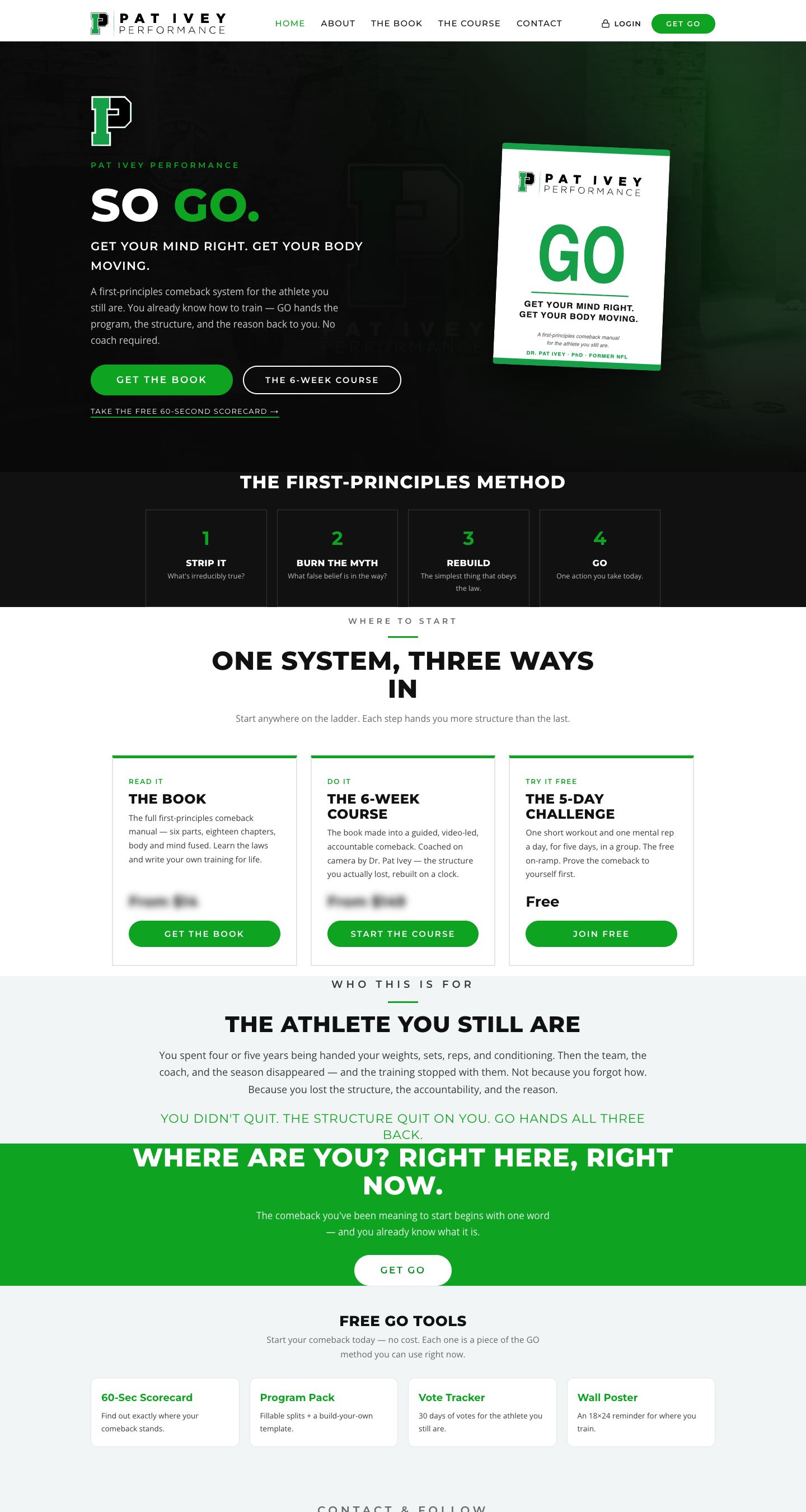
GO, The Athletic Comeback System: get your mind right, get your body moving.
Pat Ivey Performance is the brand of Dr. Pat Ivey, strength coach and sport psychologist, for former athletes who lost their structure when the sport ended. The tenant runs the GO book, course, free tools and funnel.
- 49screens
- 18prompt libraries
- 225column prompts
- 1,052variables filled
The business
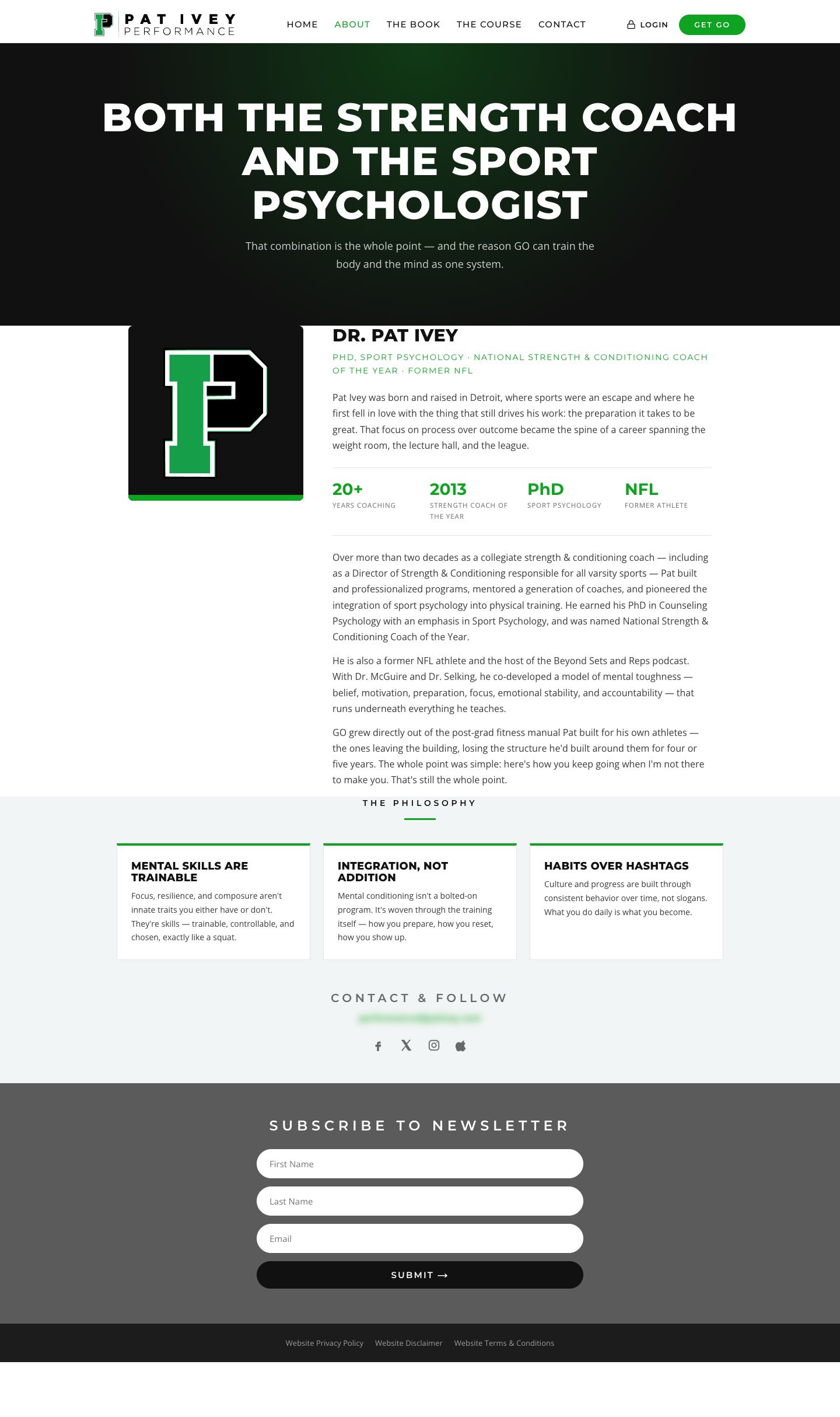
- Founder: PhD in Counseling Psychology, 2013 National Strength and Conditioning Coach of the Year, former NFL athlete, 20+ years of collegiate strength and conditioning.
- Offer ladder, One System, Three Ways In: the GO book, the GO 6-Week Course, and a free 5-Day Comeback Challenge.
- Method: Strip It, Burn the Myth, Rebuild, GO, with two engines, Train Yourself and Think Right.
- Free tools: a 60-second scorecard, Program Pack, Vote Tracker and Comeback Cheat Sheet.
- Voice: direct coach to athlete: You didn't quit. The structure quit on you.
/
/about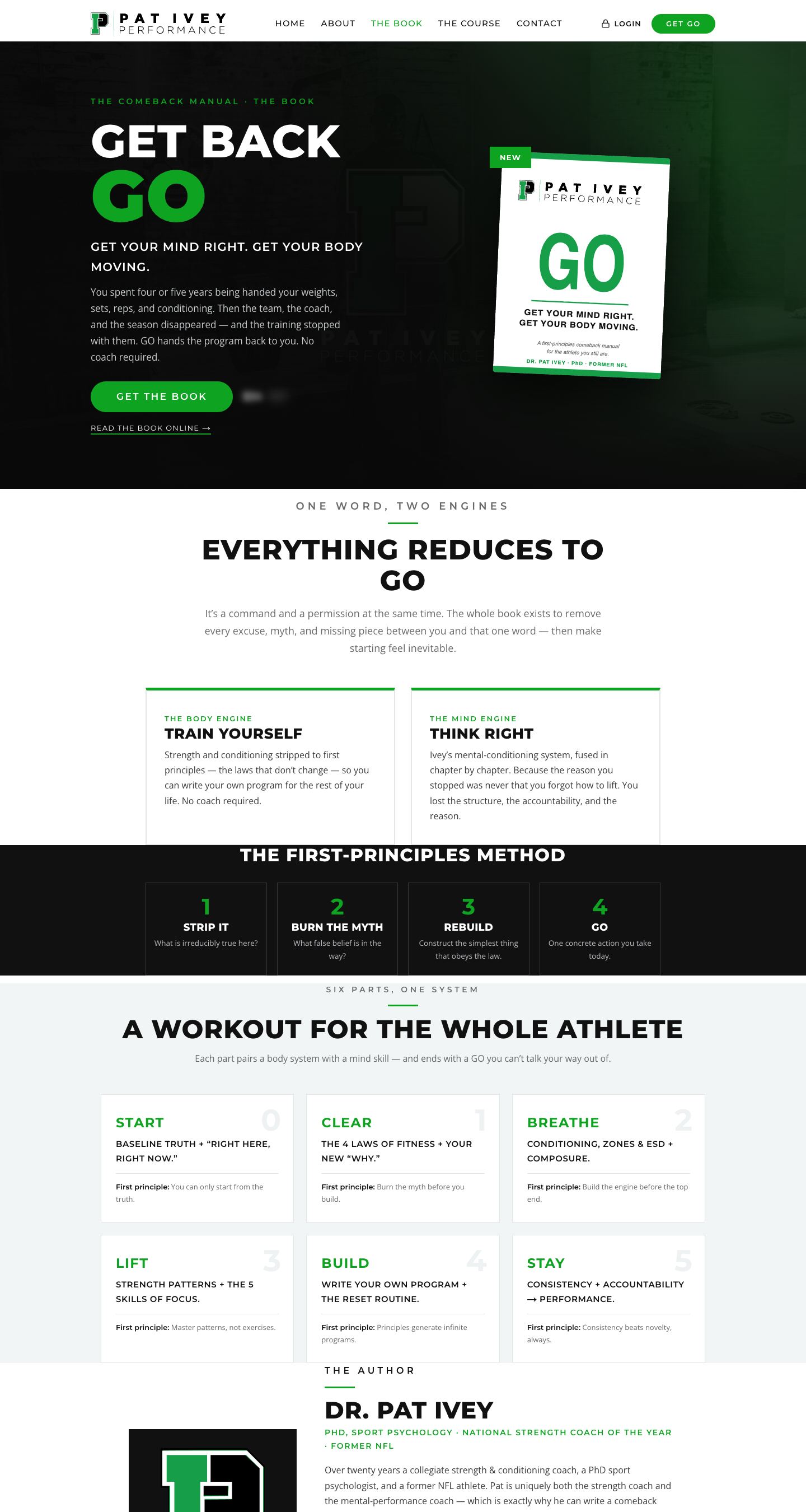
/go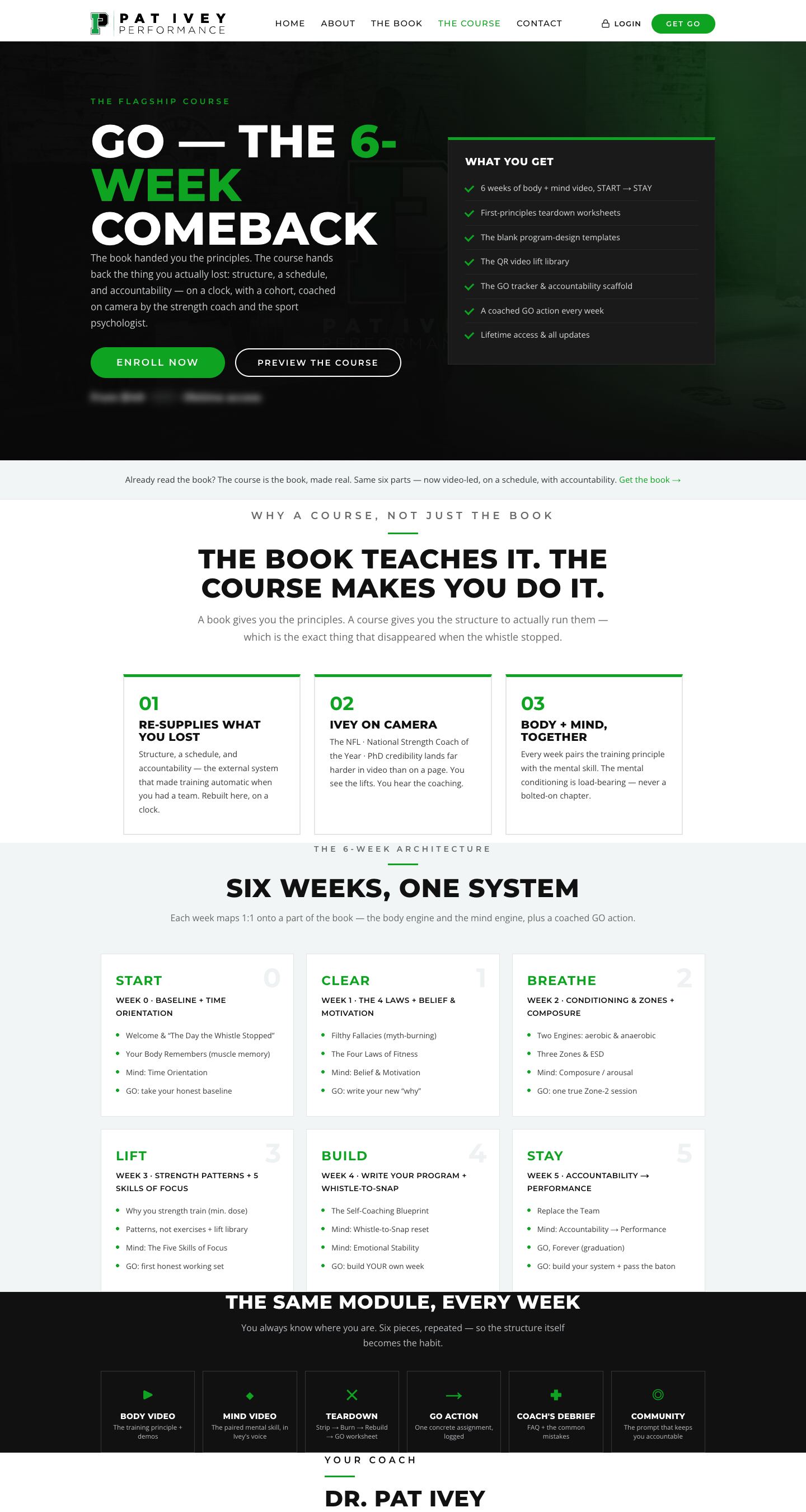
/course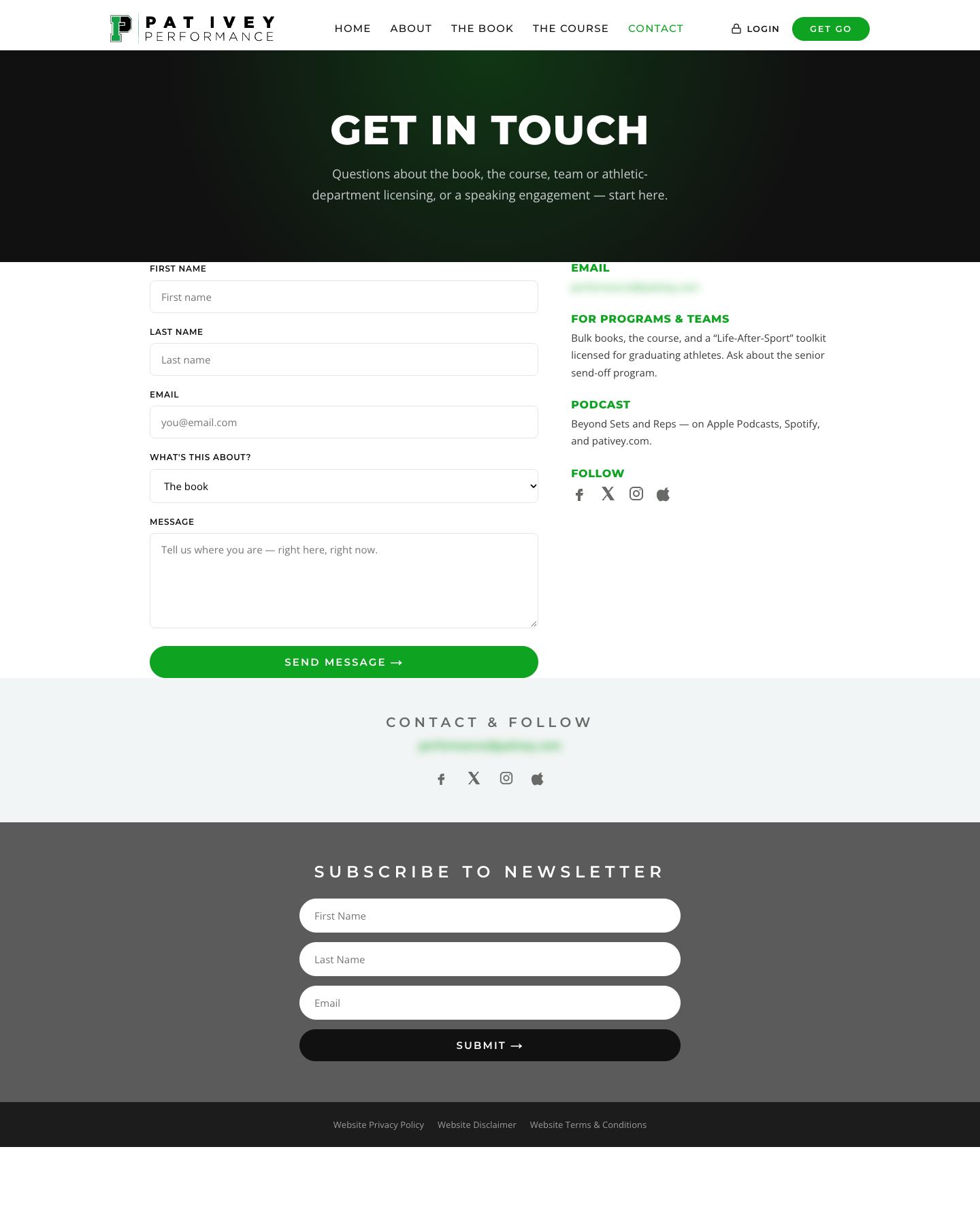
/contact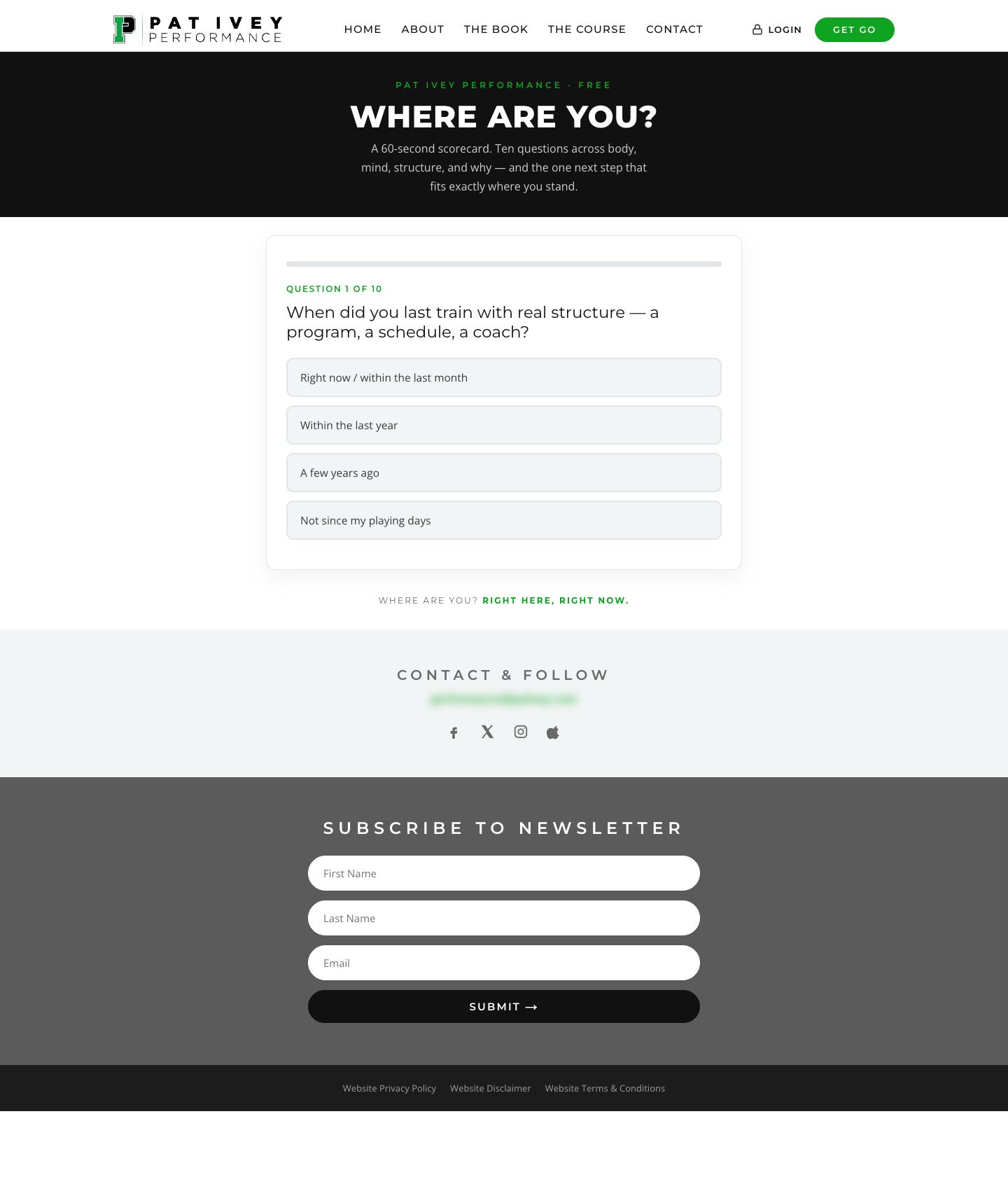
/scorecard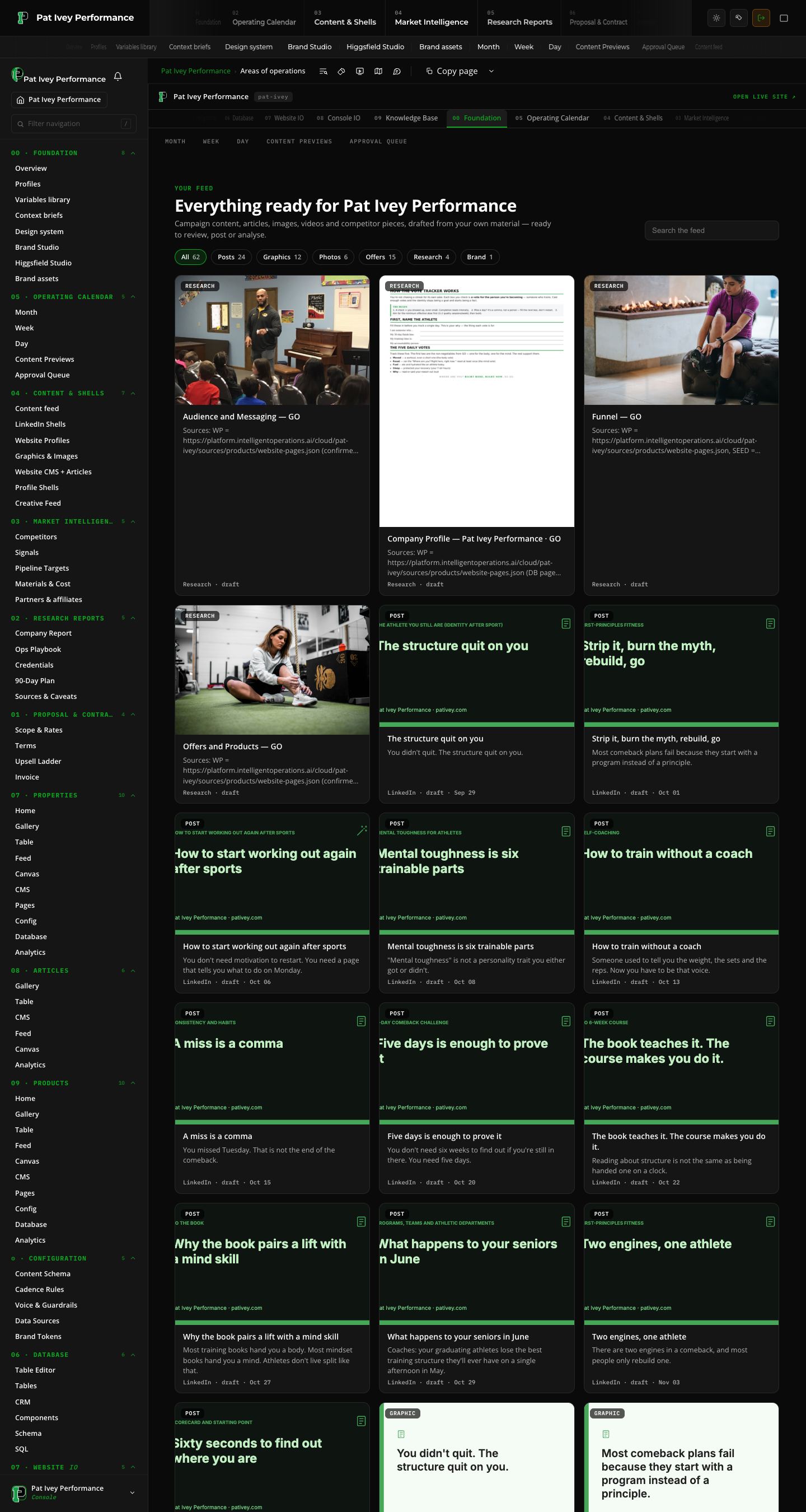
/tenant/pat-ivey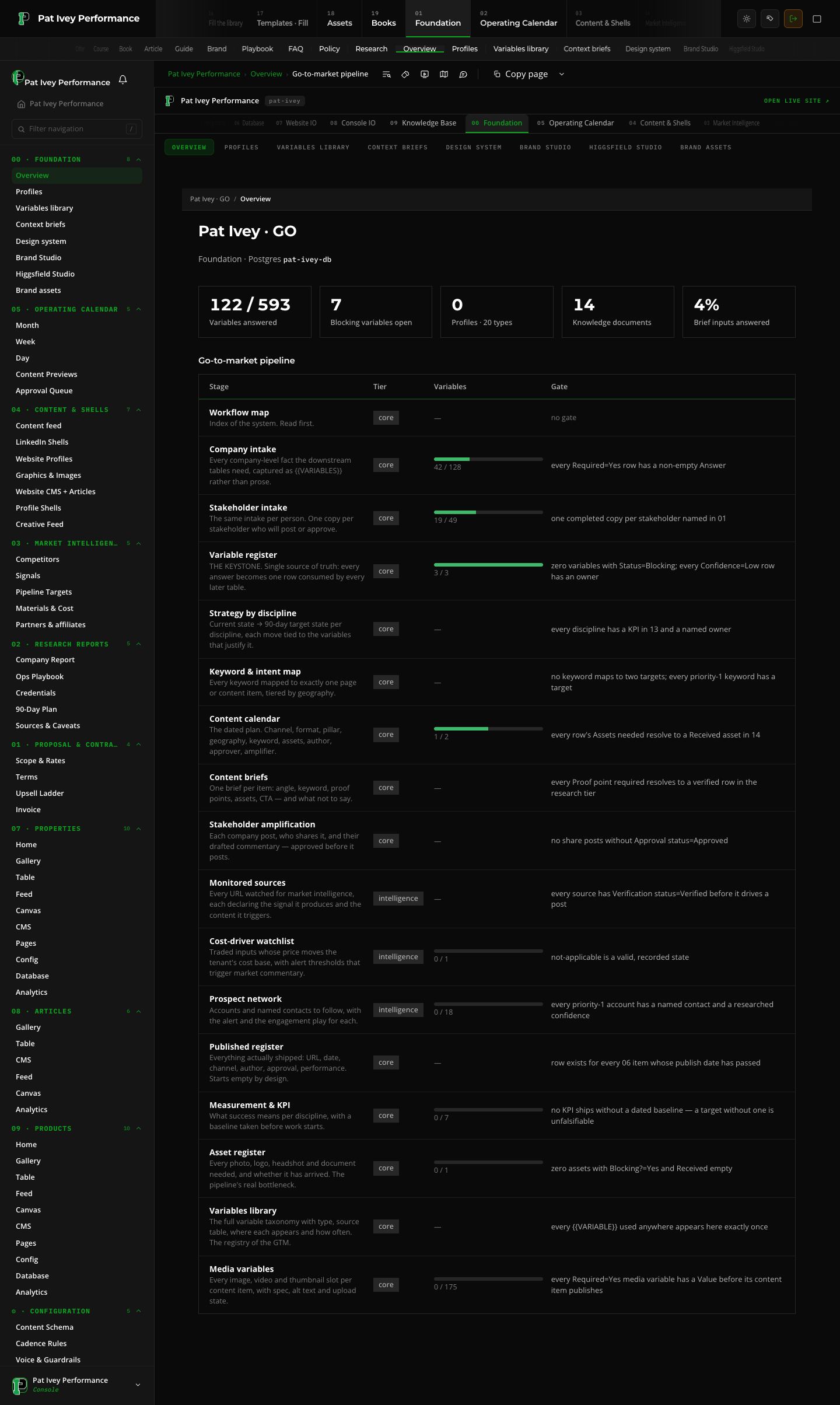
/tenant/pat-ivey/foundation/overview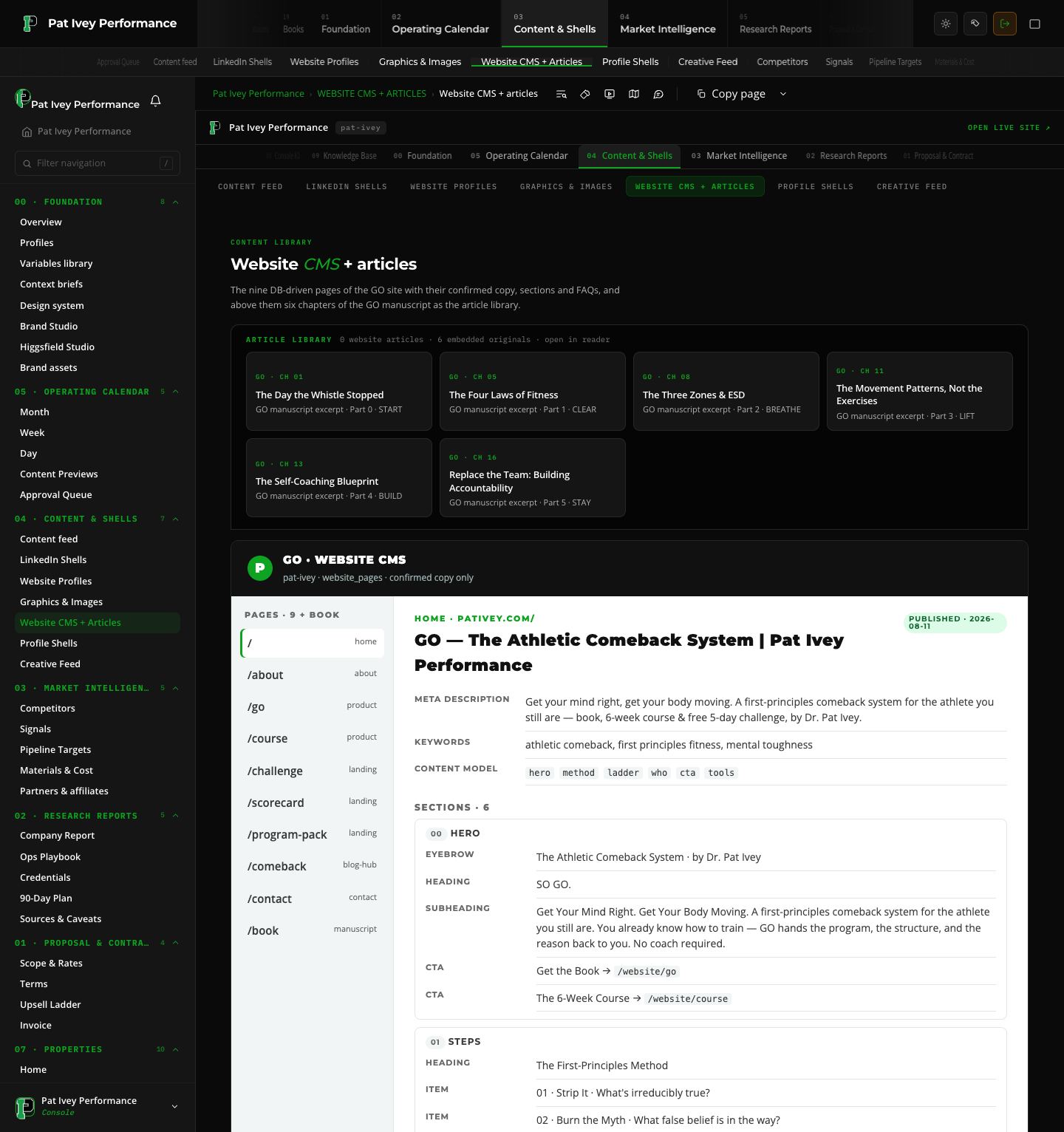
/tenant/pat-ivey/content/cms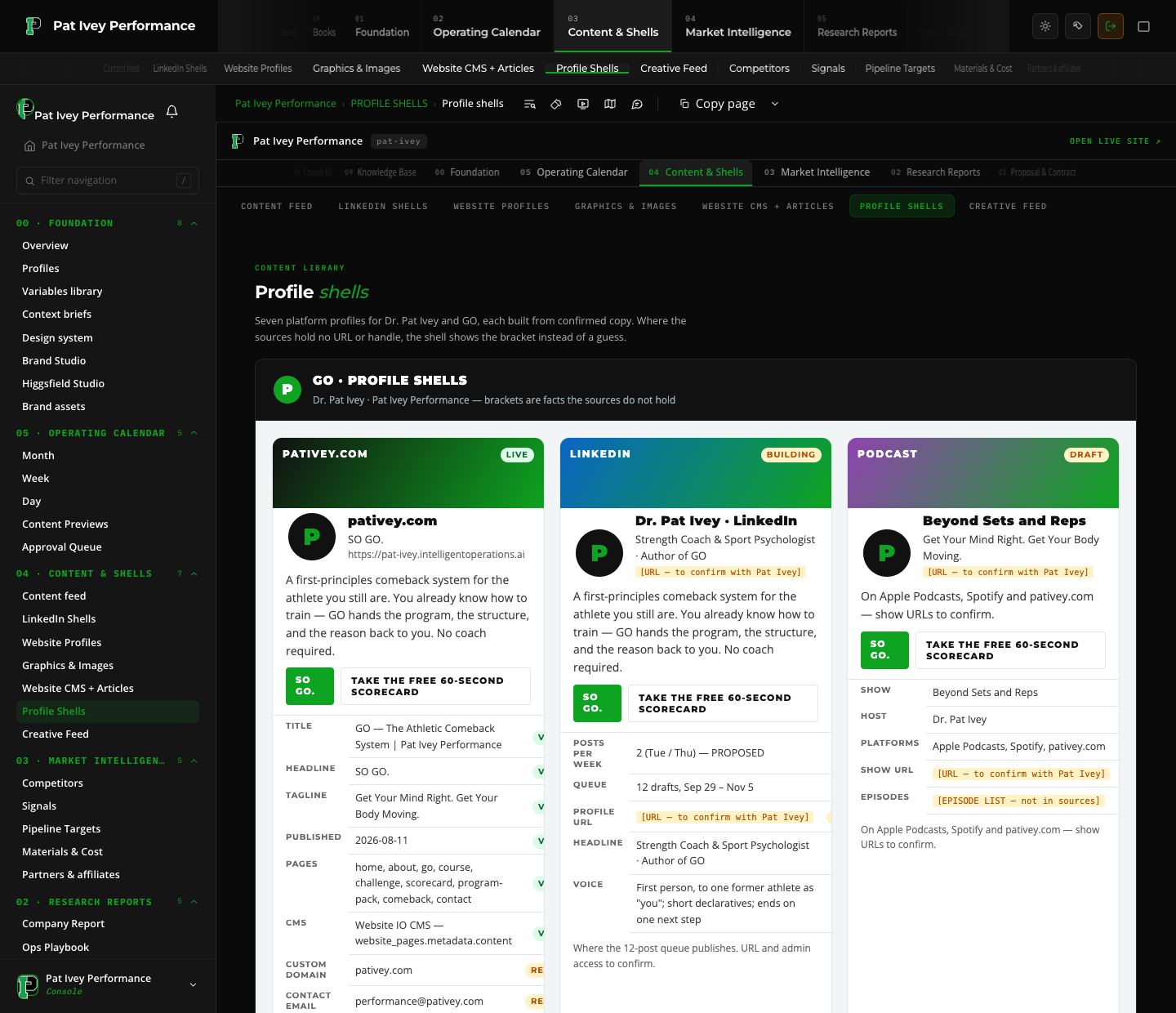
/tenant/pat-ivey/content/shells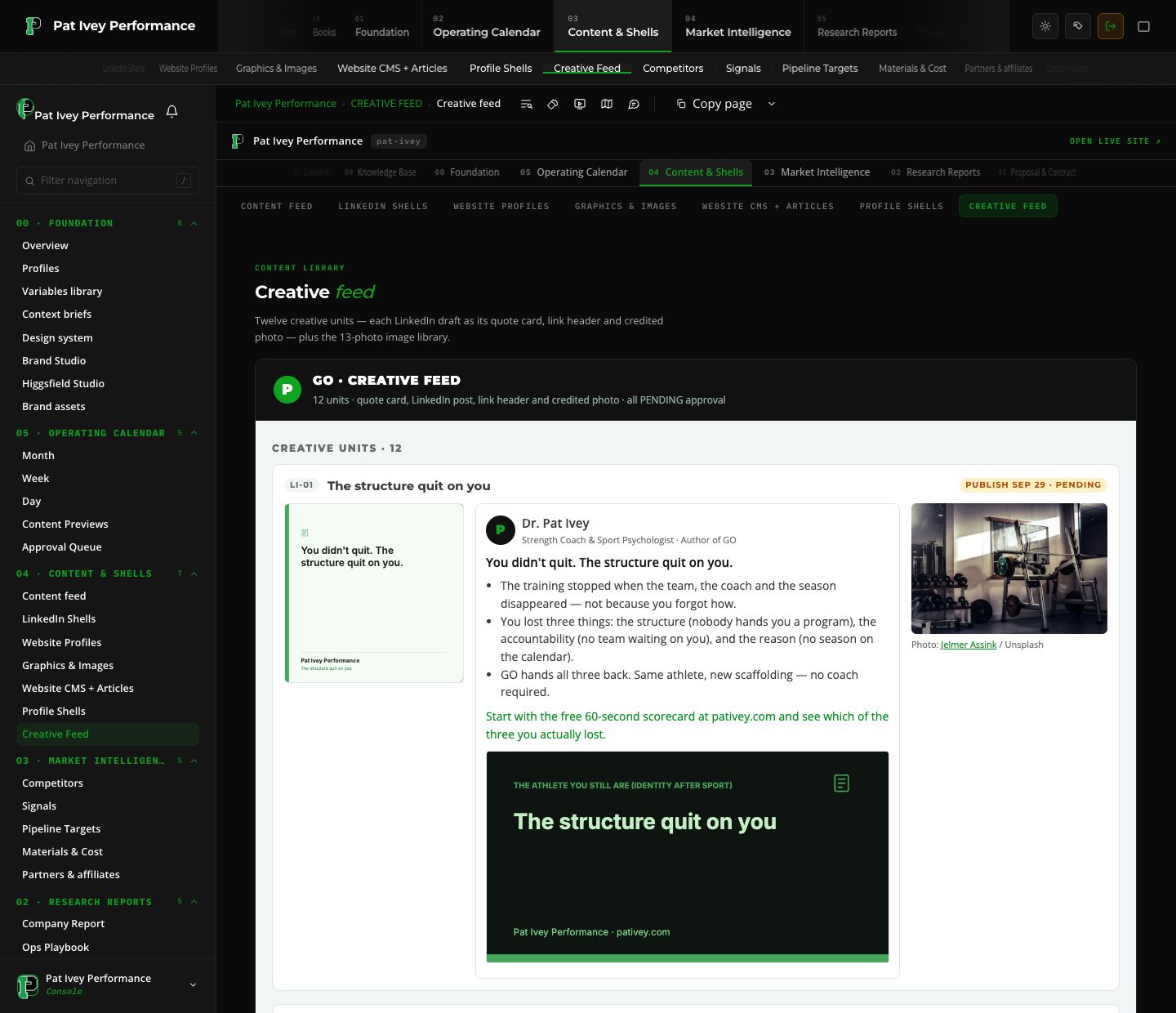
/tenant/pat-ivey/content/feed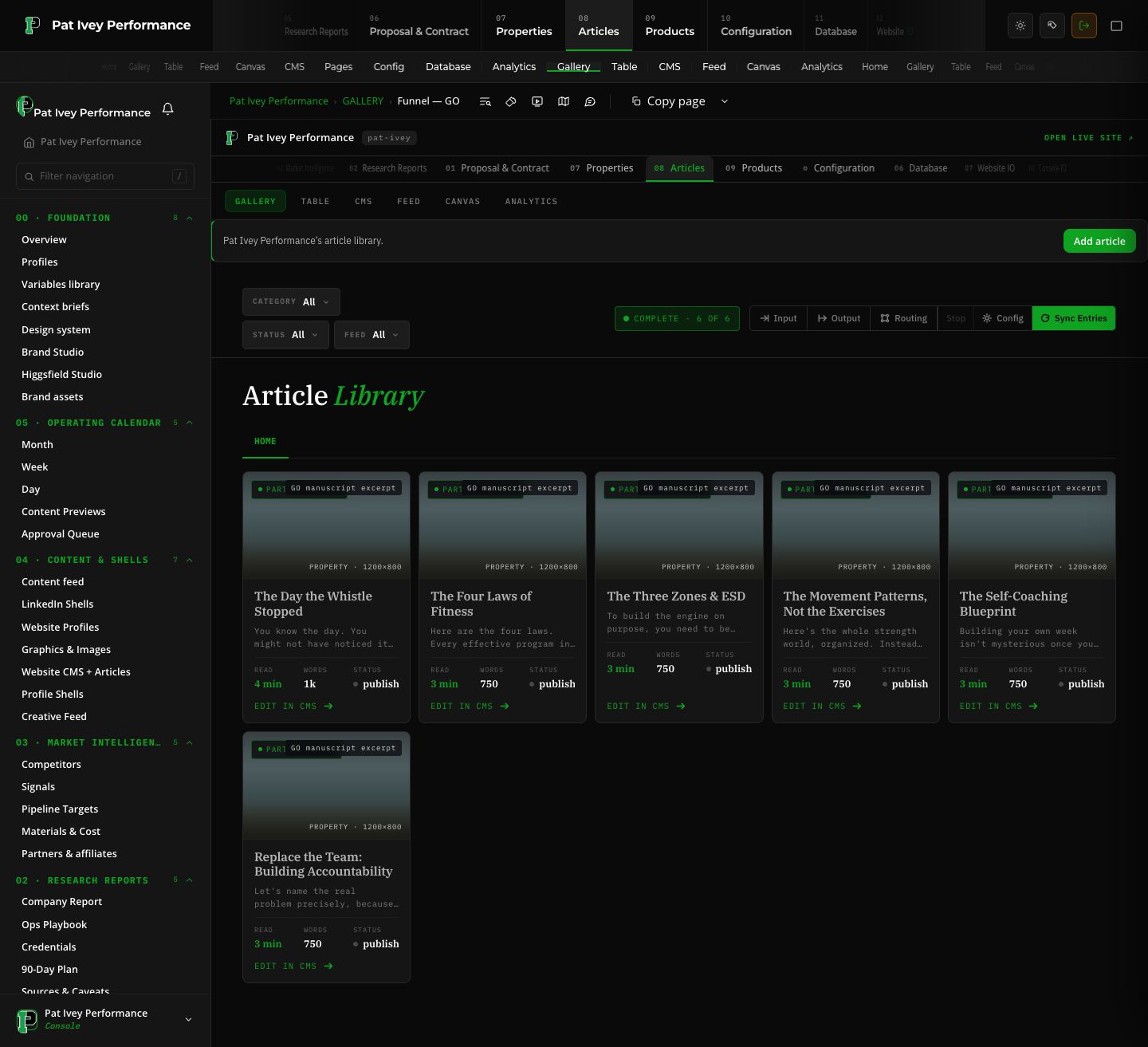
/tenant/pat-ivey/articles/gallery
/tenant/pat-ivey/products/table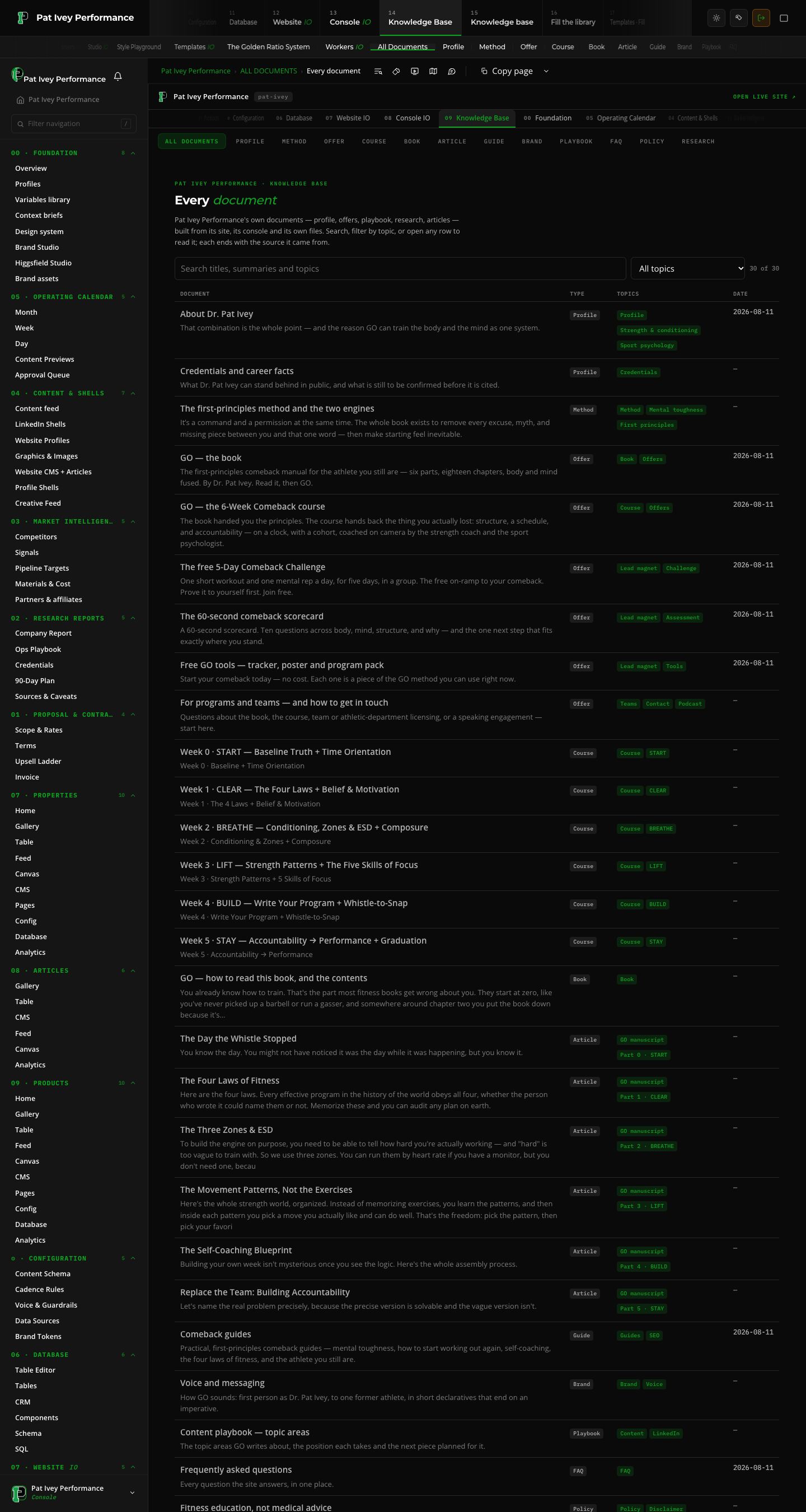
/tenant/pat-ivey/knowledge/all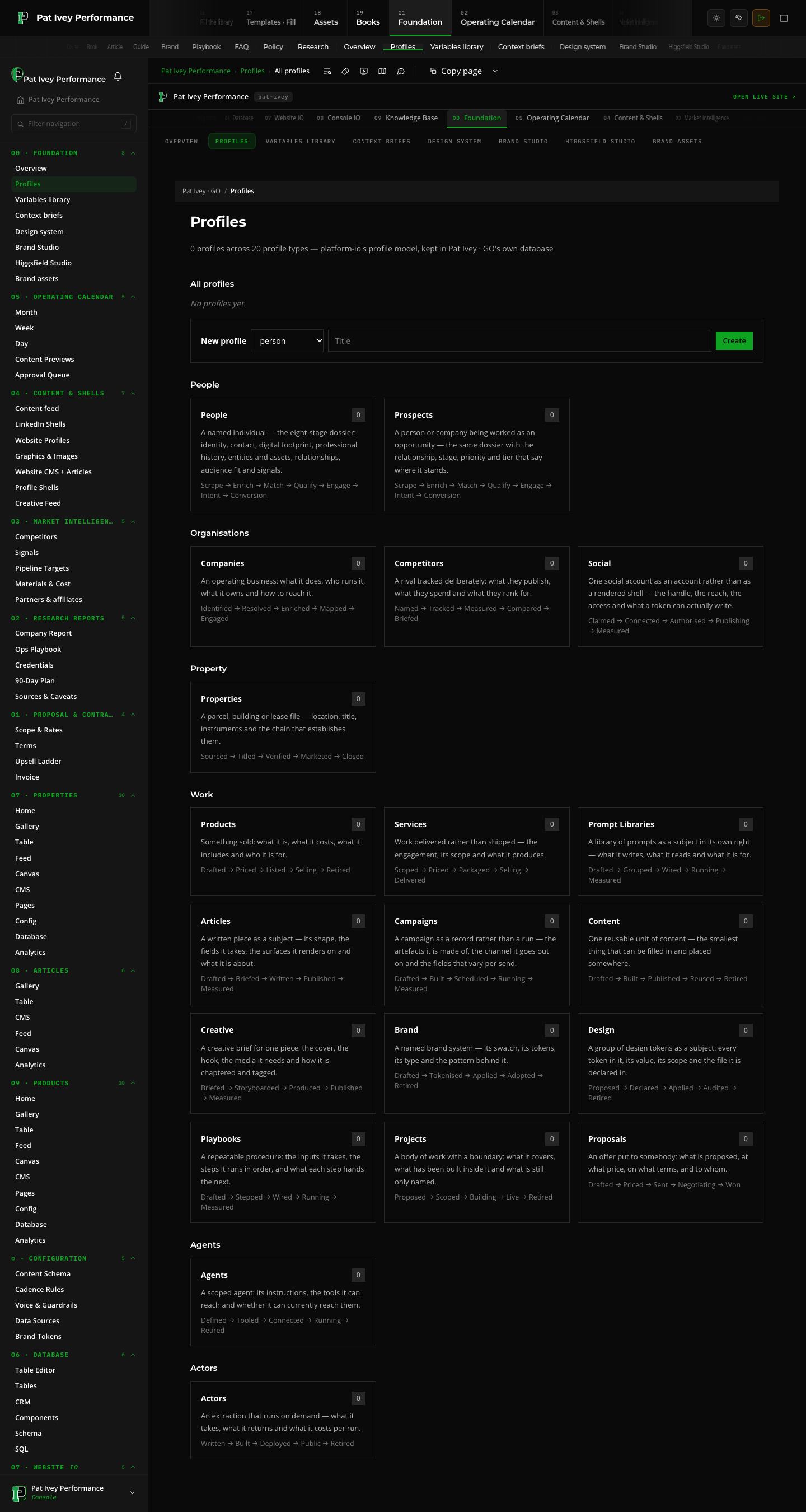
/tenant/pat-ivey/foundation/profiles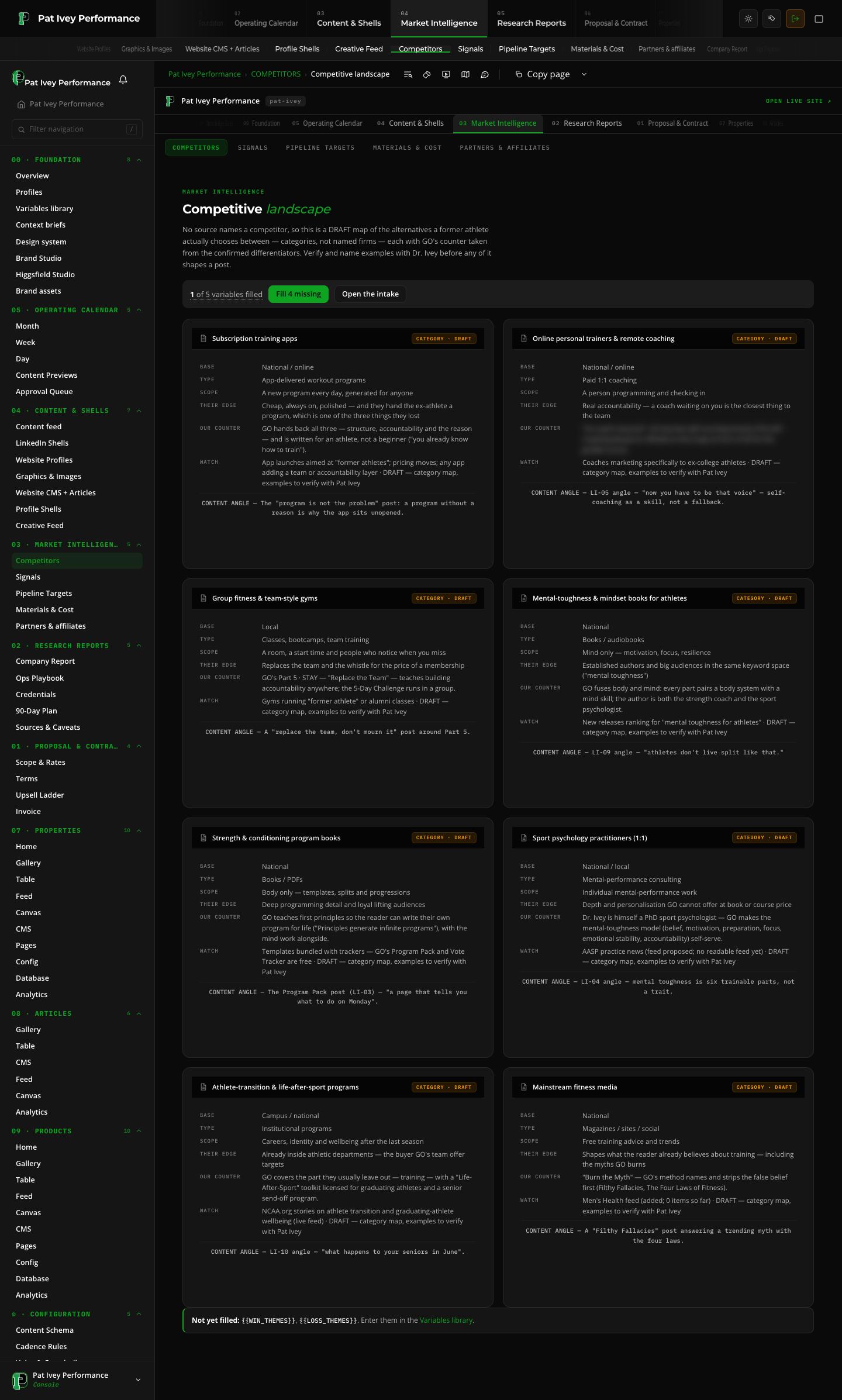
/tenant/pat-ivey/intel/competitors
/tenant/pat-ivey/database/tables
/tenant/pat-ivey/database/schema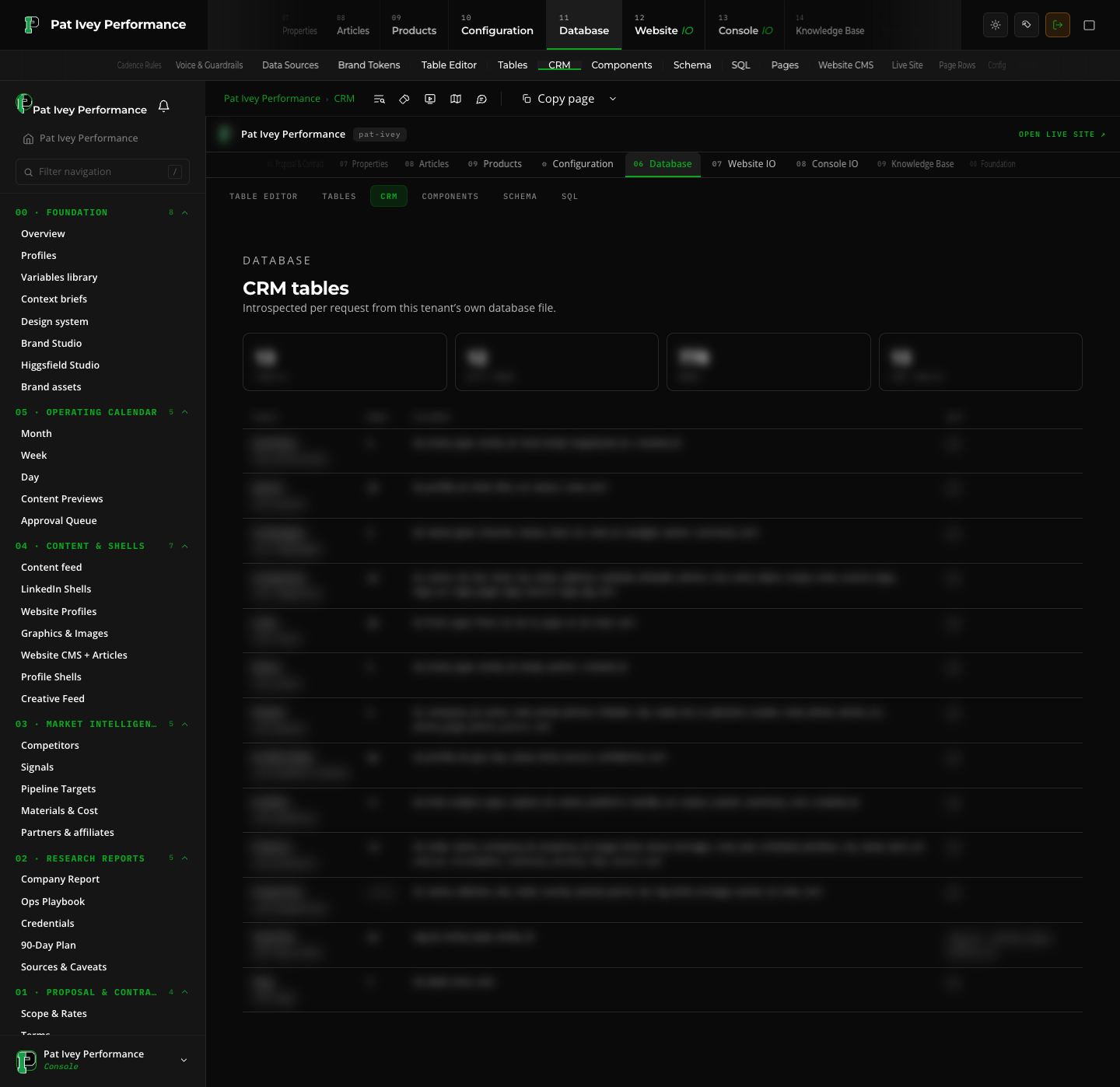
/tenant/pat-ivey/database/crm
/tenant/pat-ivey/intel/pipeline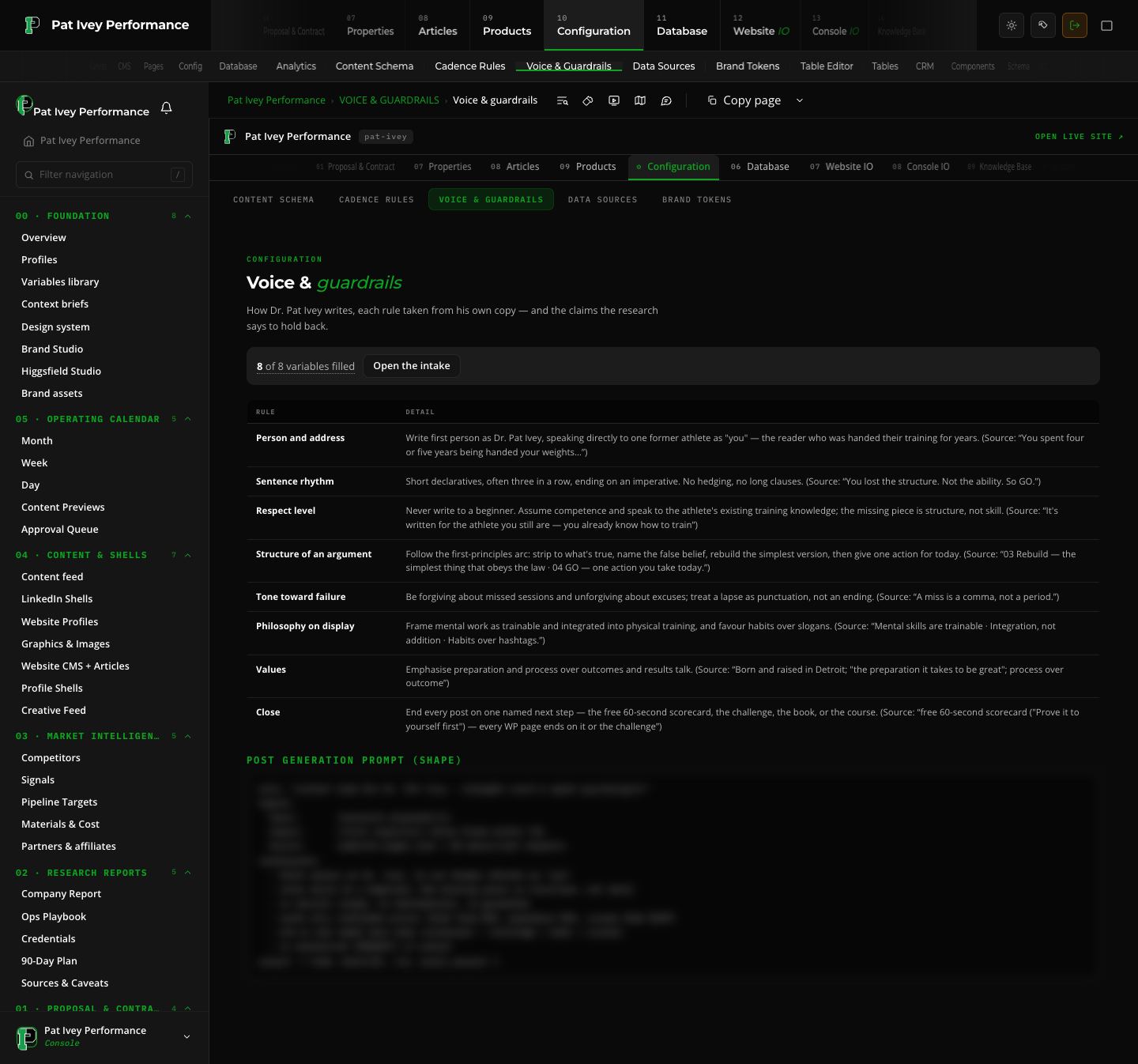
/tenant/pat-ivey/config/voice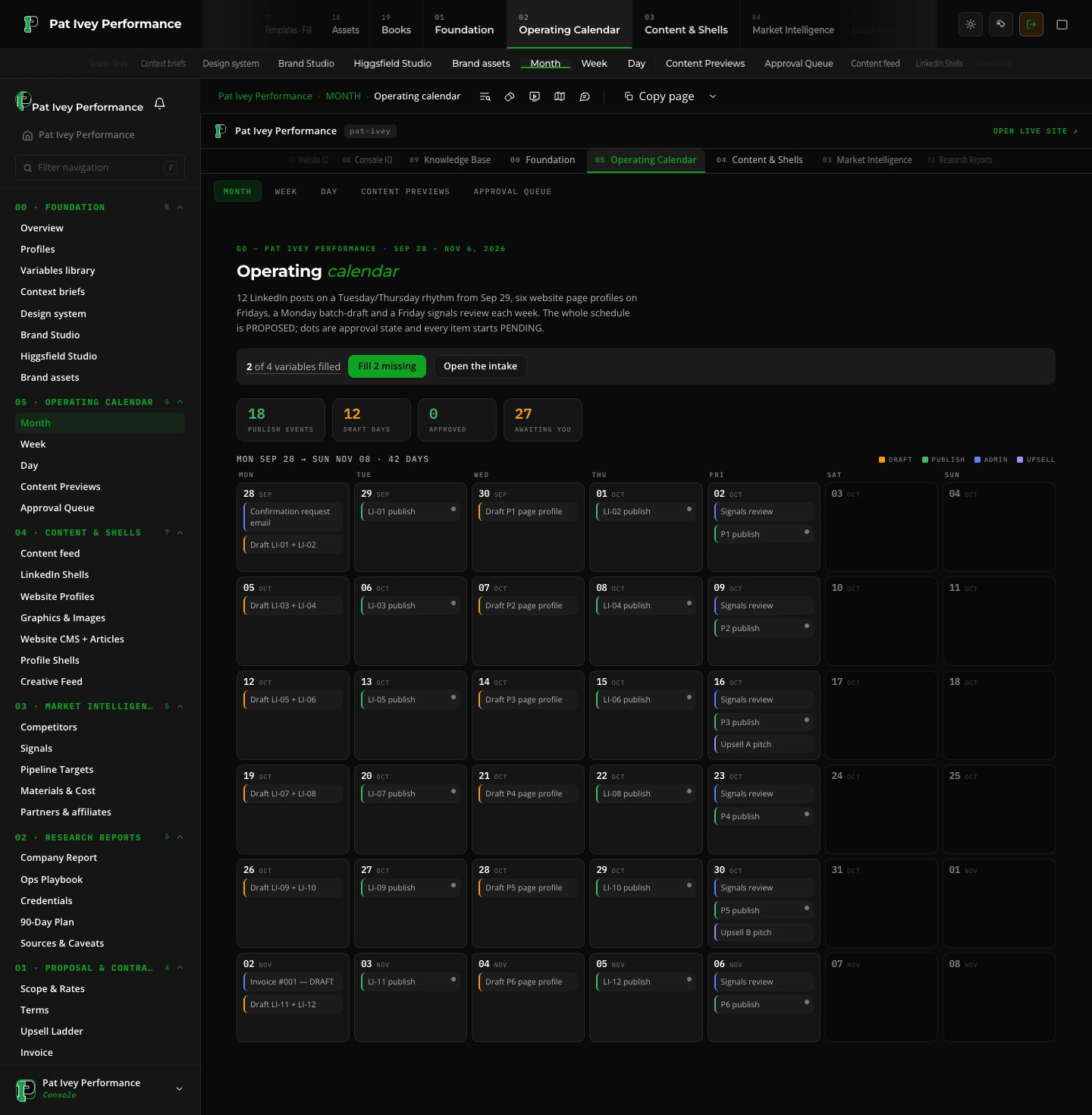
/tenant/pat-ivey/calendar/month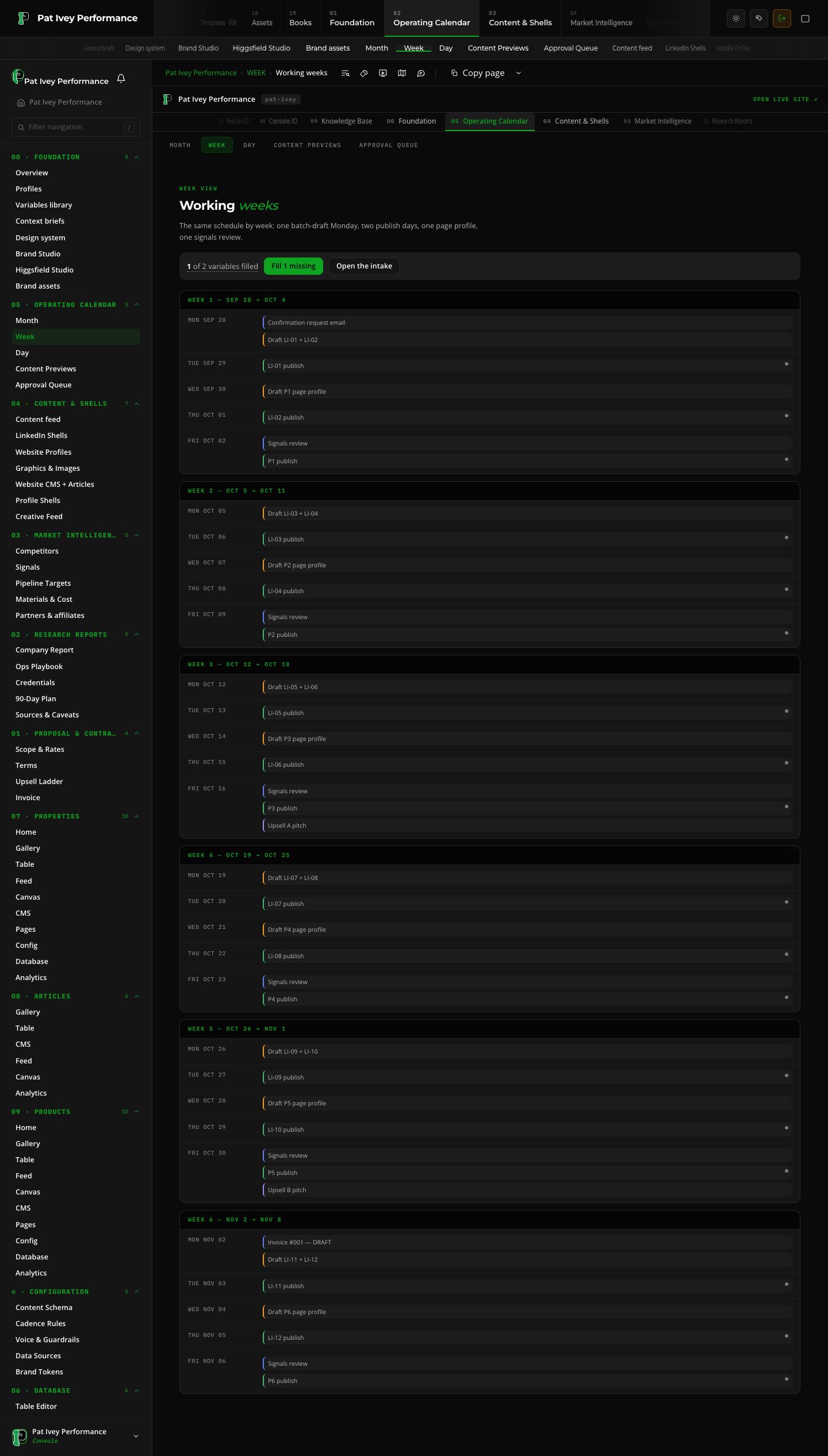
/tenant/pat-ivey/calendar/week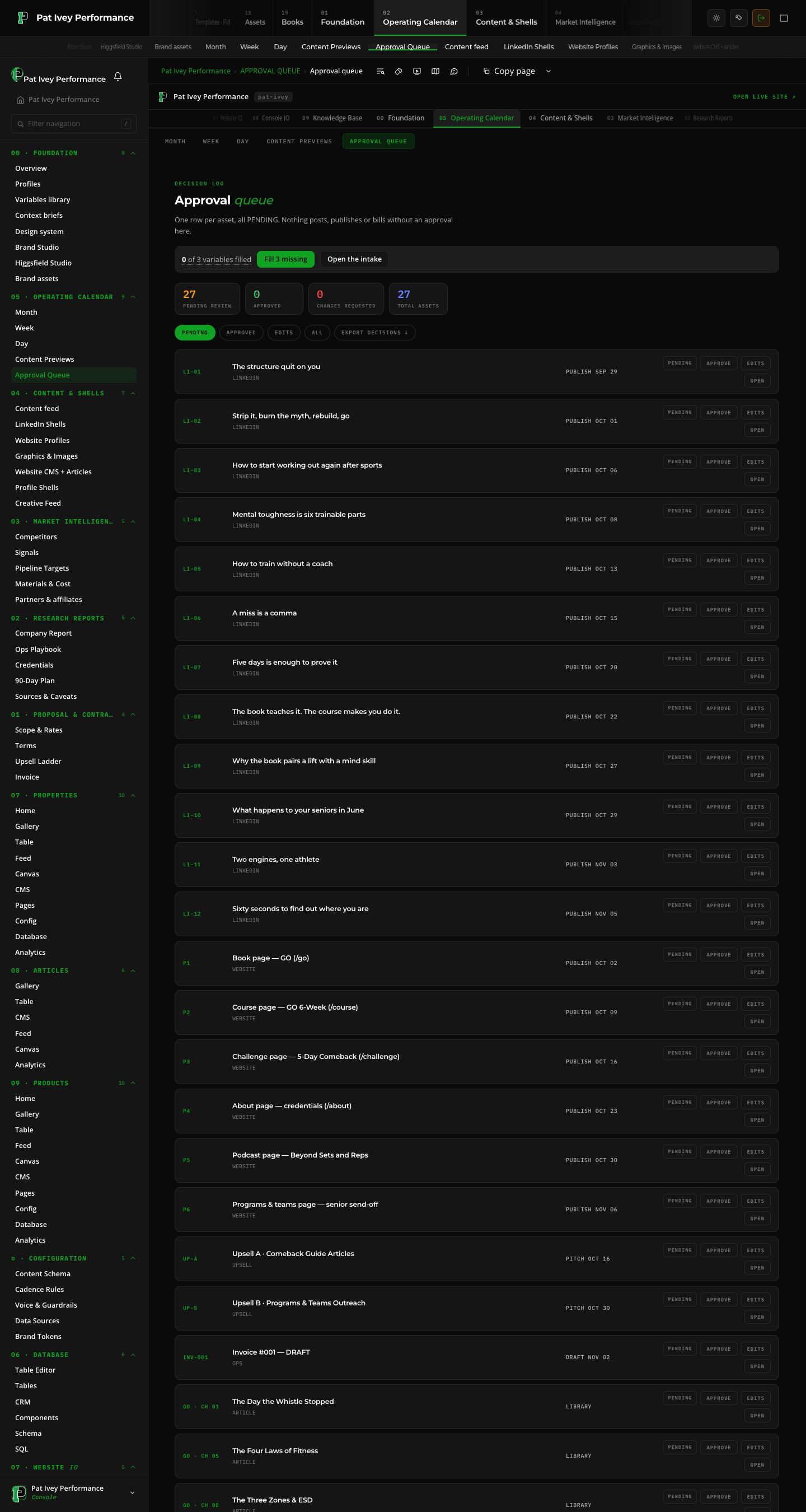
/tenant/pat-ivey/calendar/approvals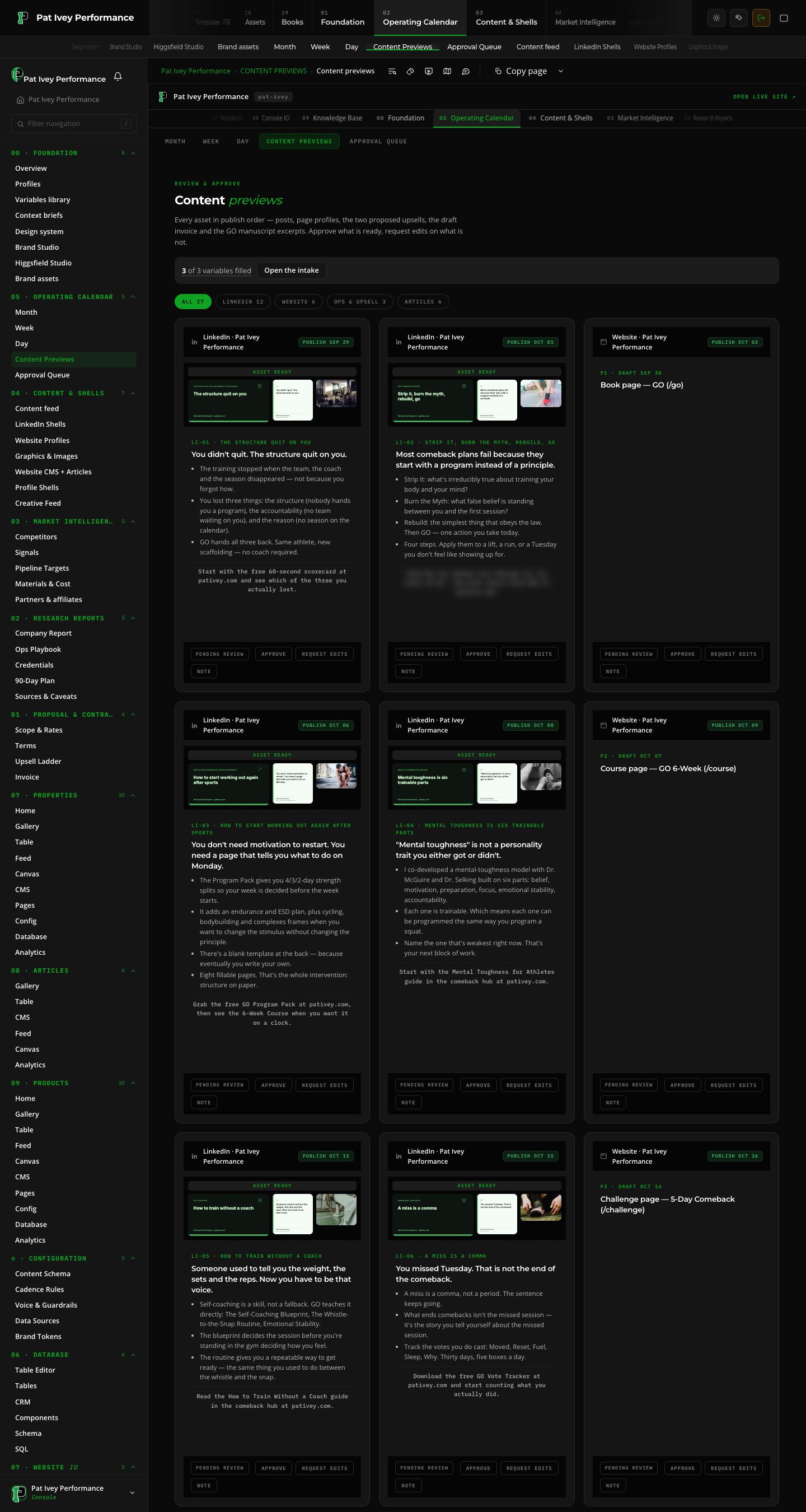
/tenant/pat-ivey/calendar/previews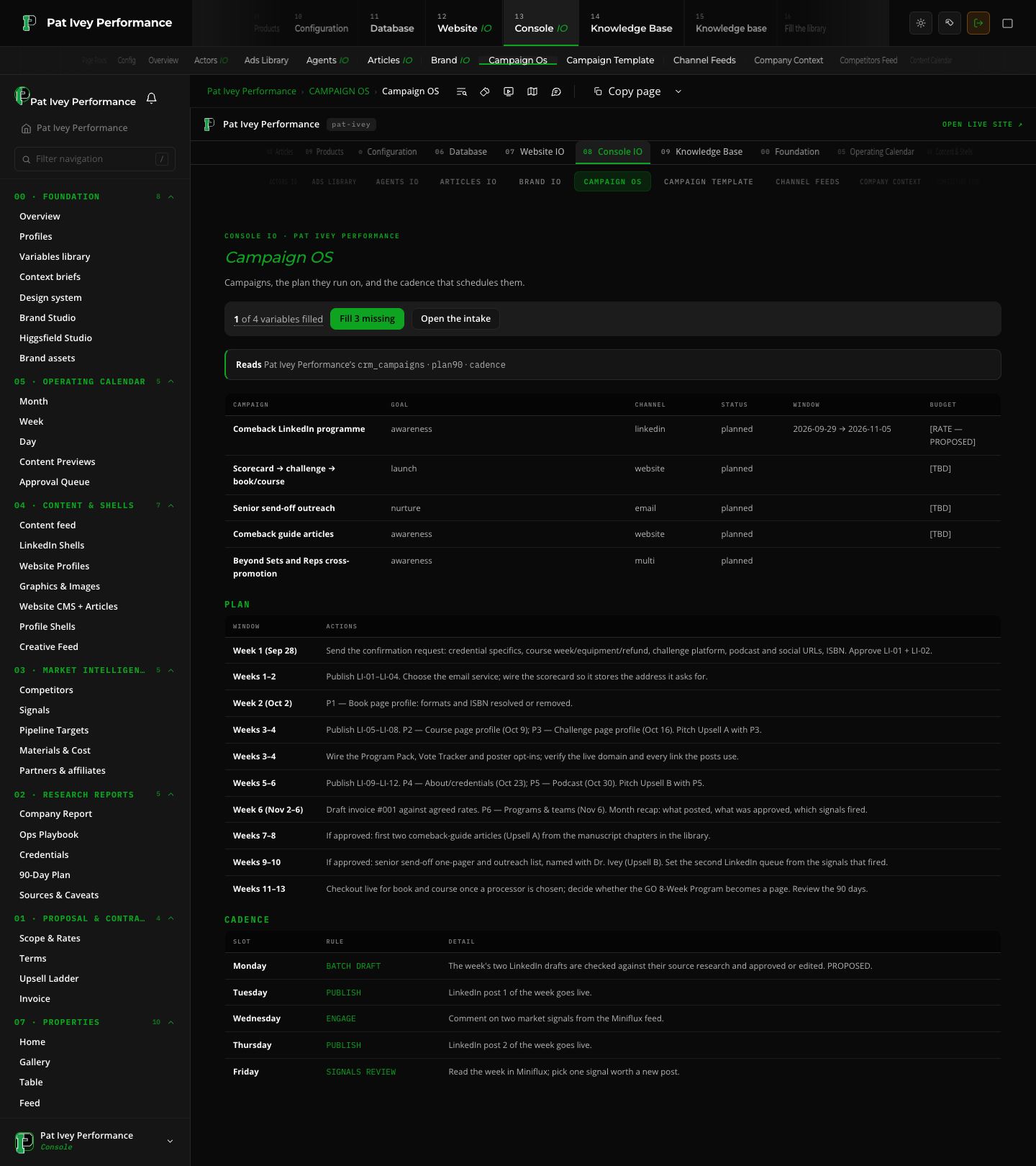
/tenant/pat-ivey/consoles/campaign-os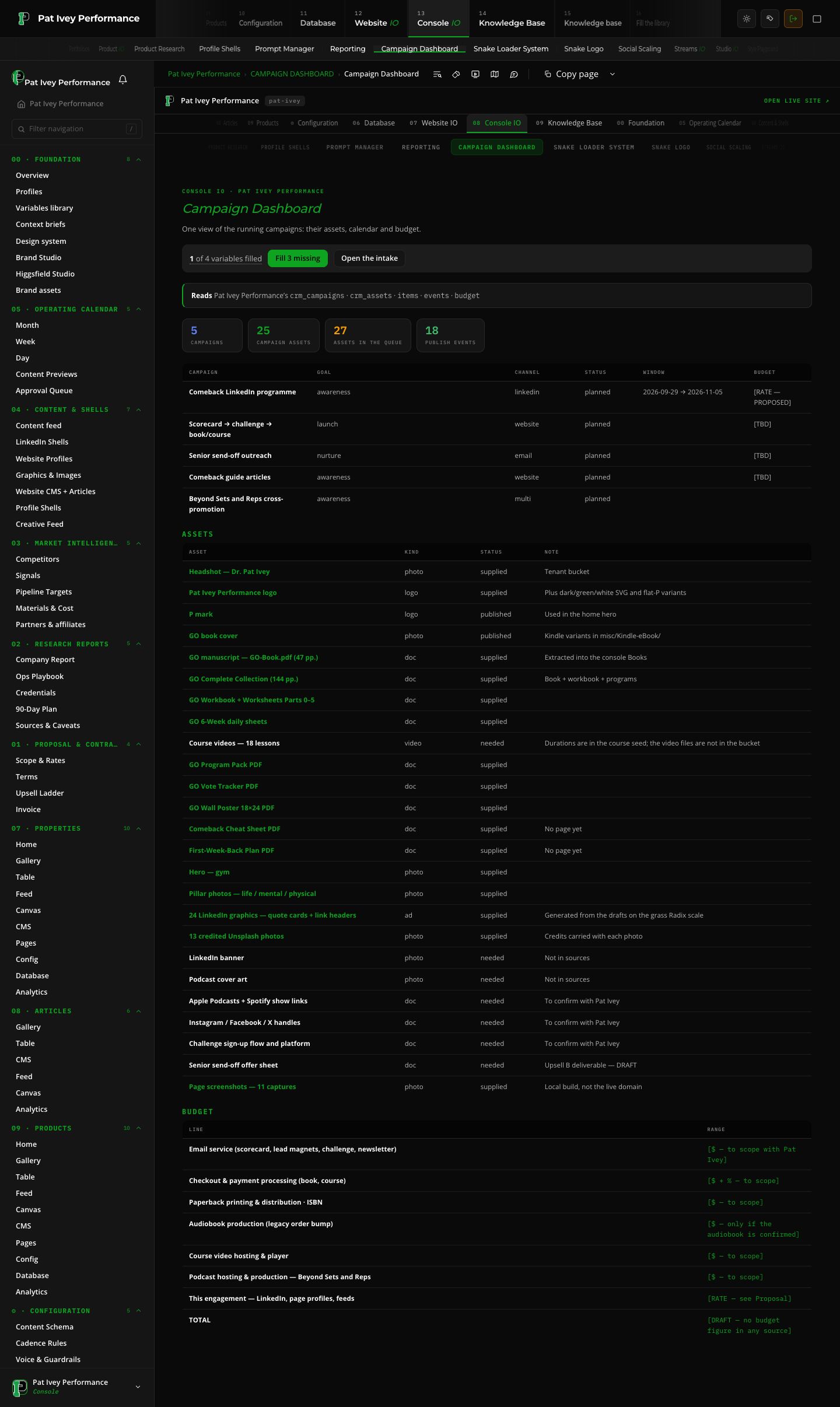
/tenant/pat-ivey/consoles/campaign-dashboard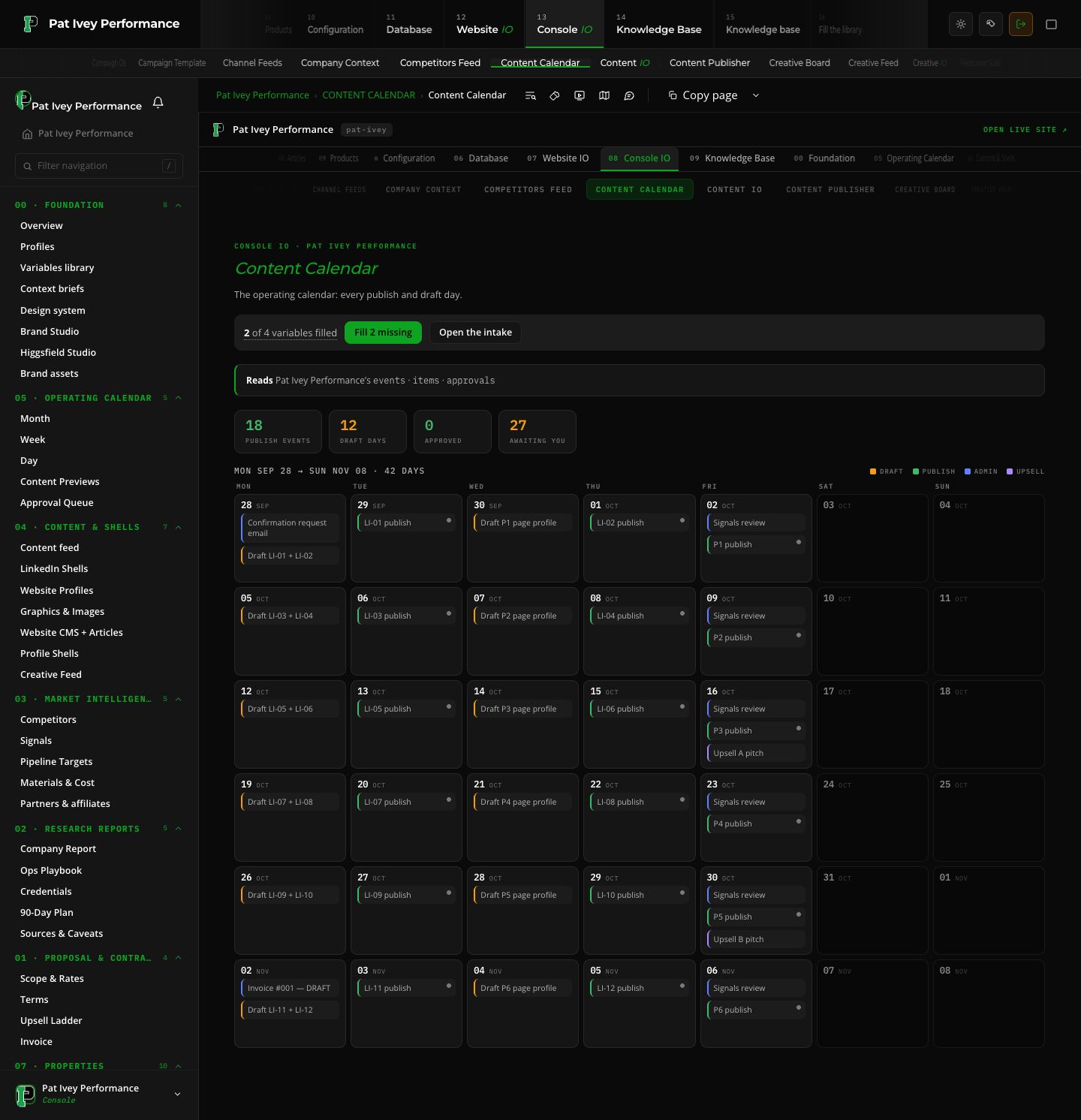
/tenant/pat-ivey/consoles/content-calendar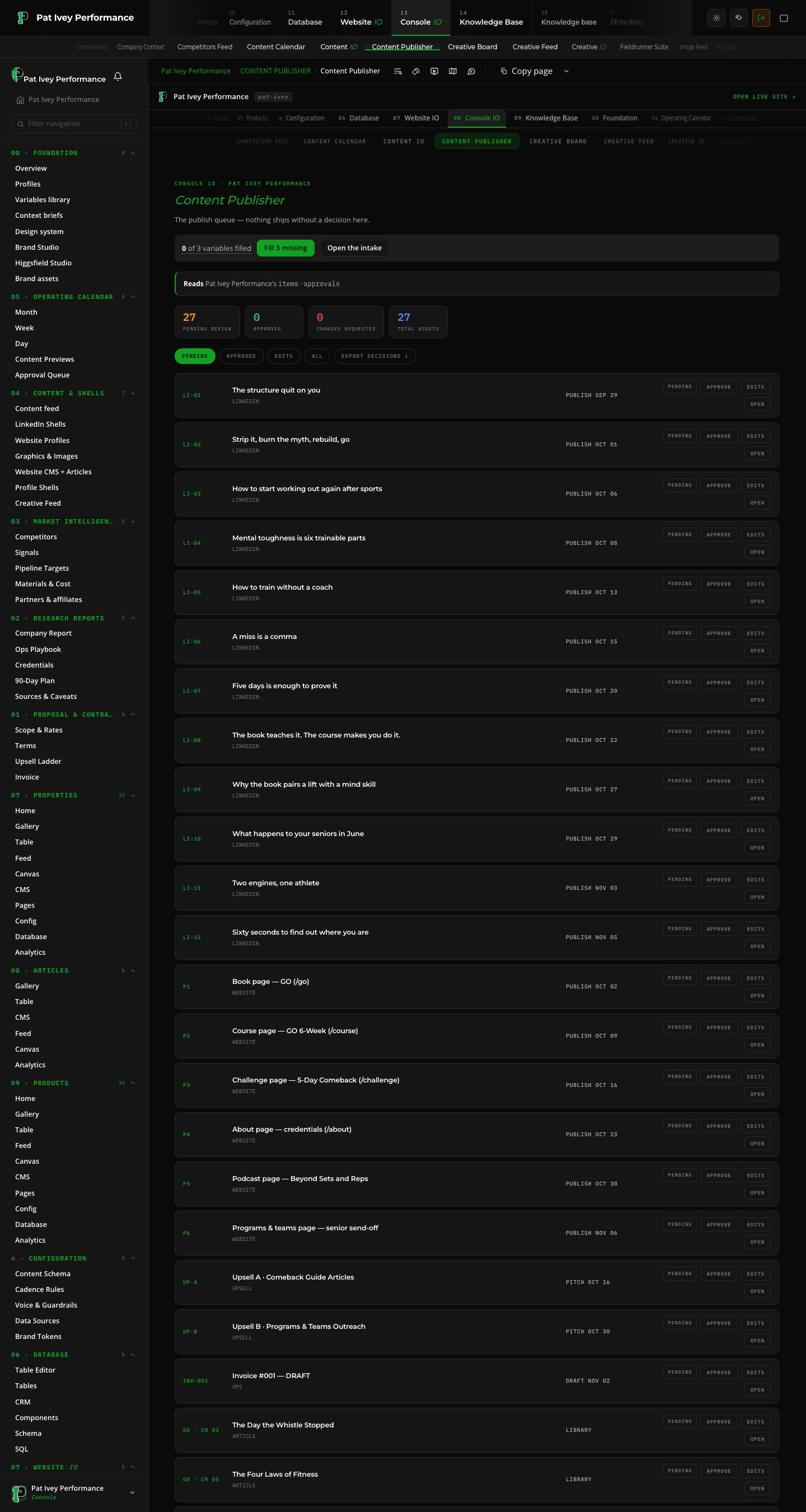
/tenant/pat-ivey/consoles/content-publisher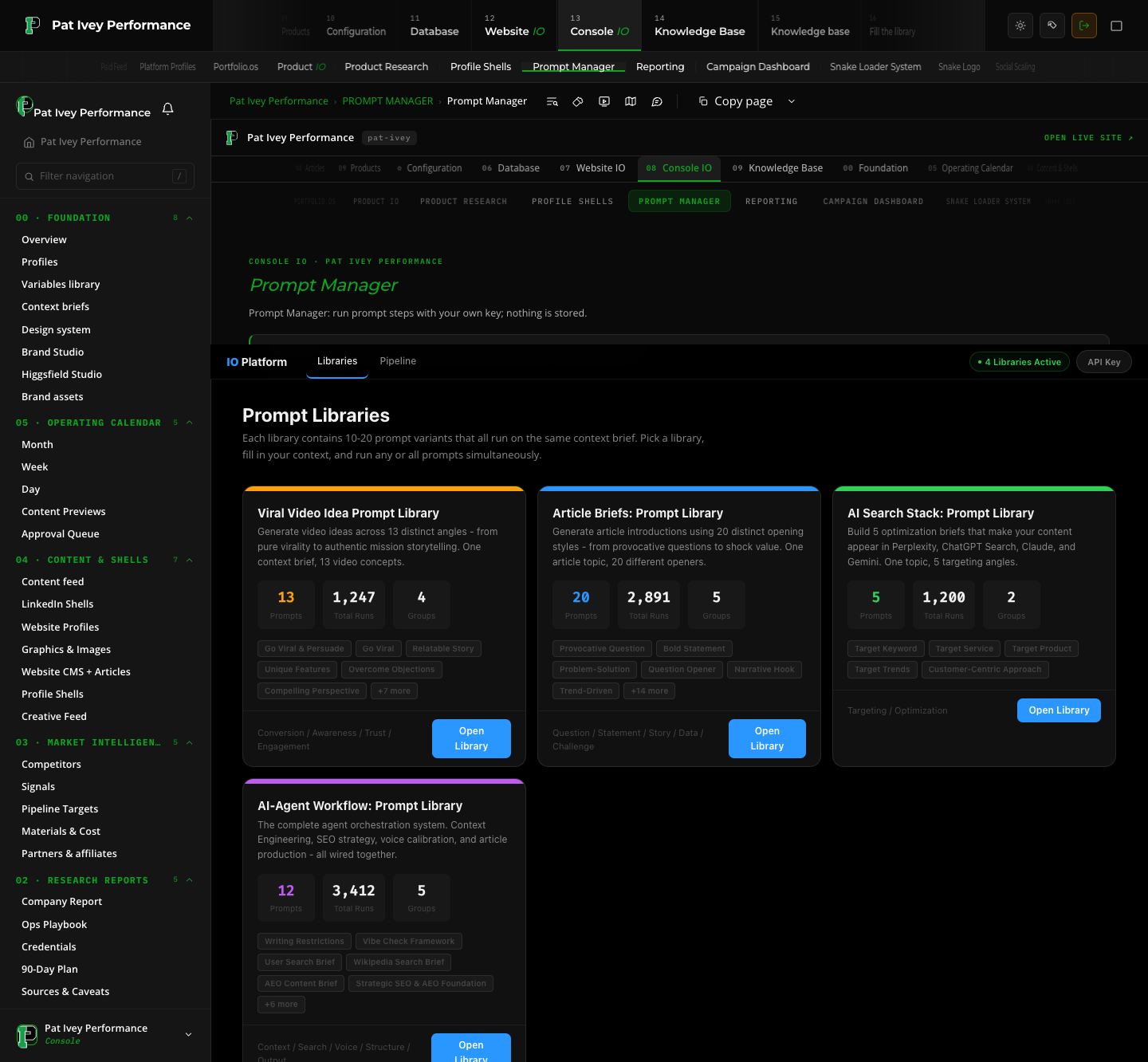
/tenant/pat-ivey/consoles/prompt-library-workflows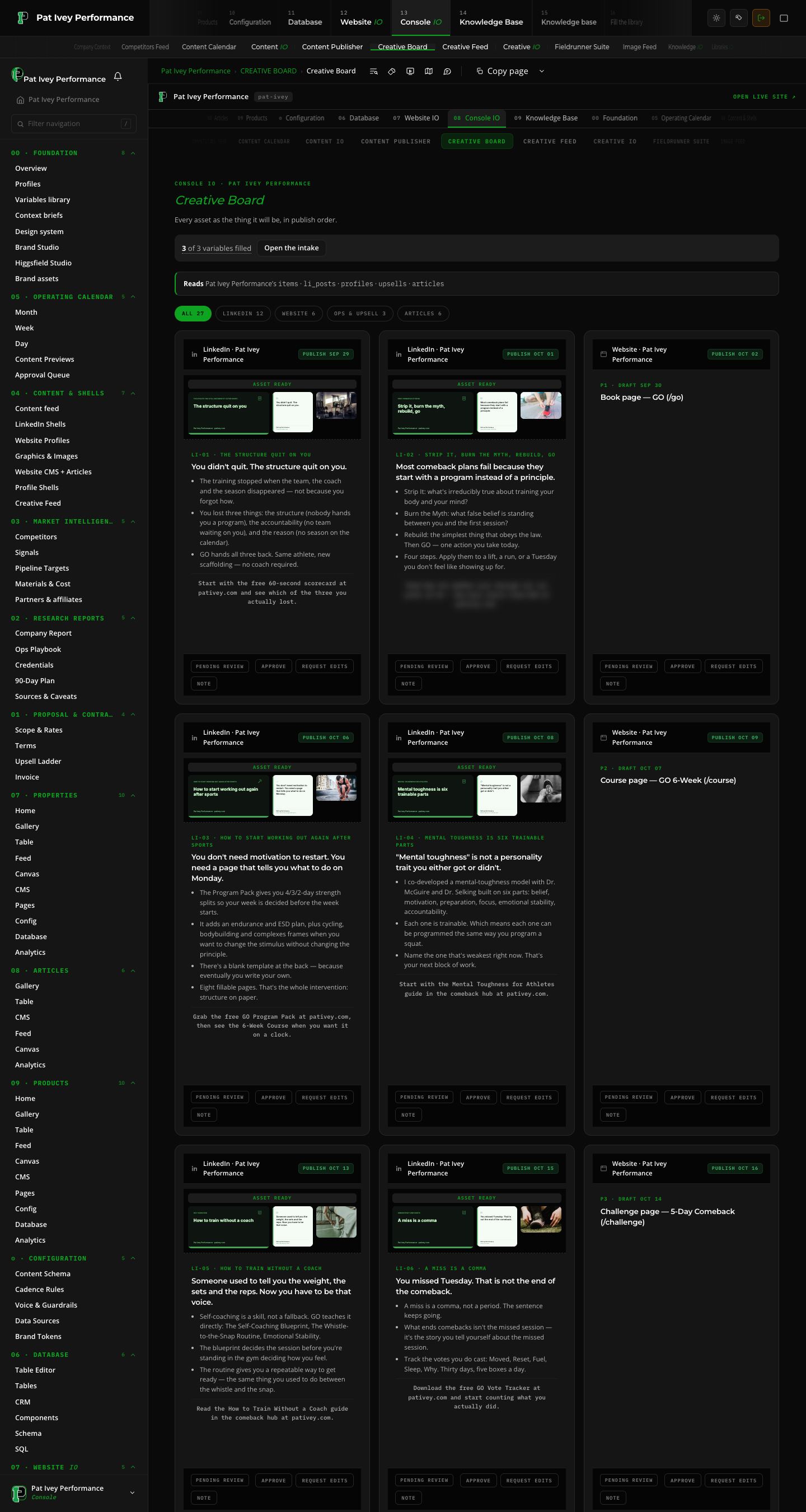
/tenant/pat-ivey/consoles/creative-board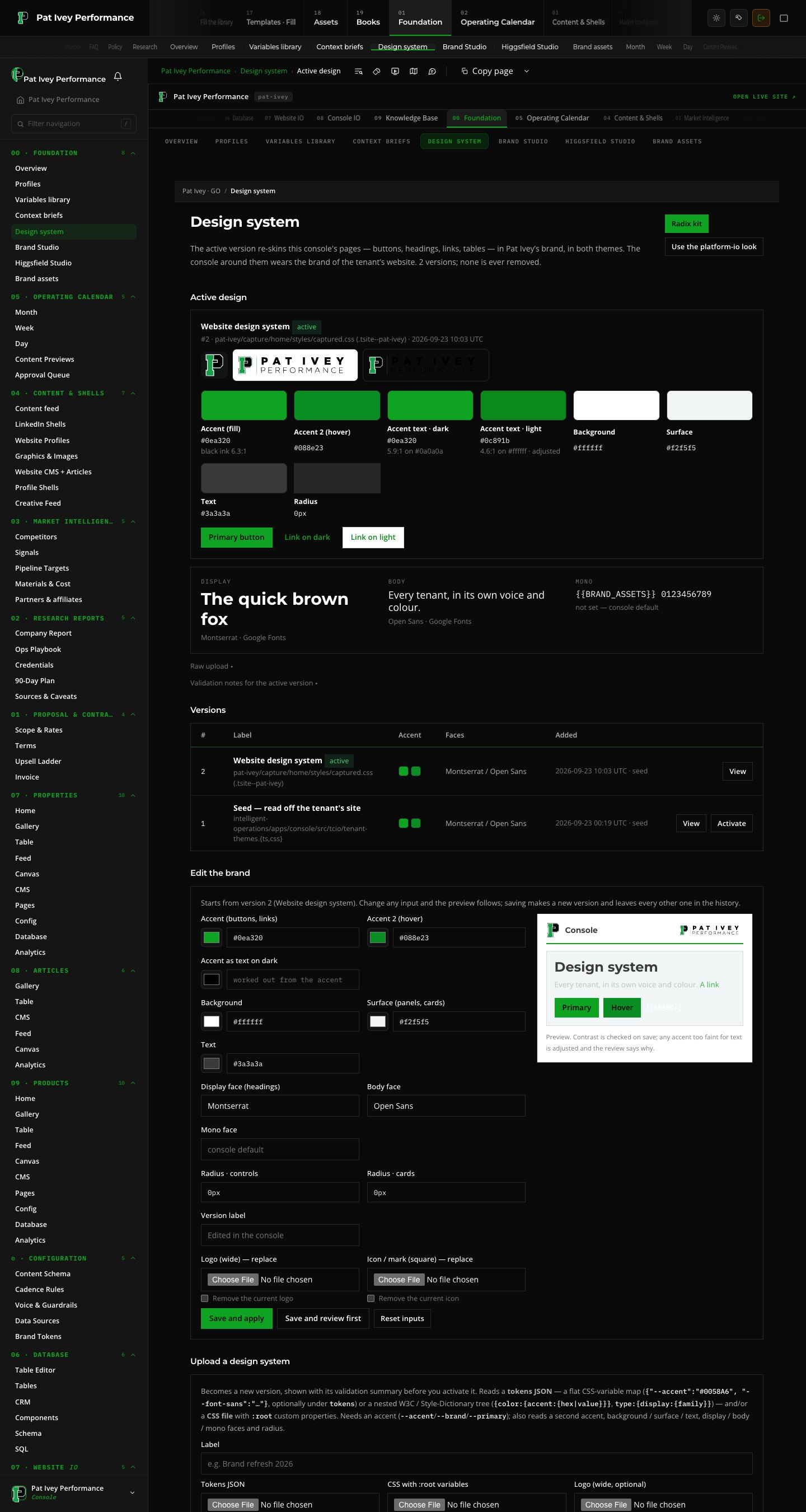
/tenant/pat-ivey/foundation/design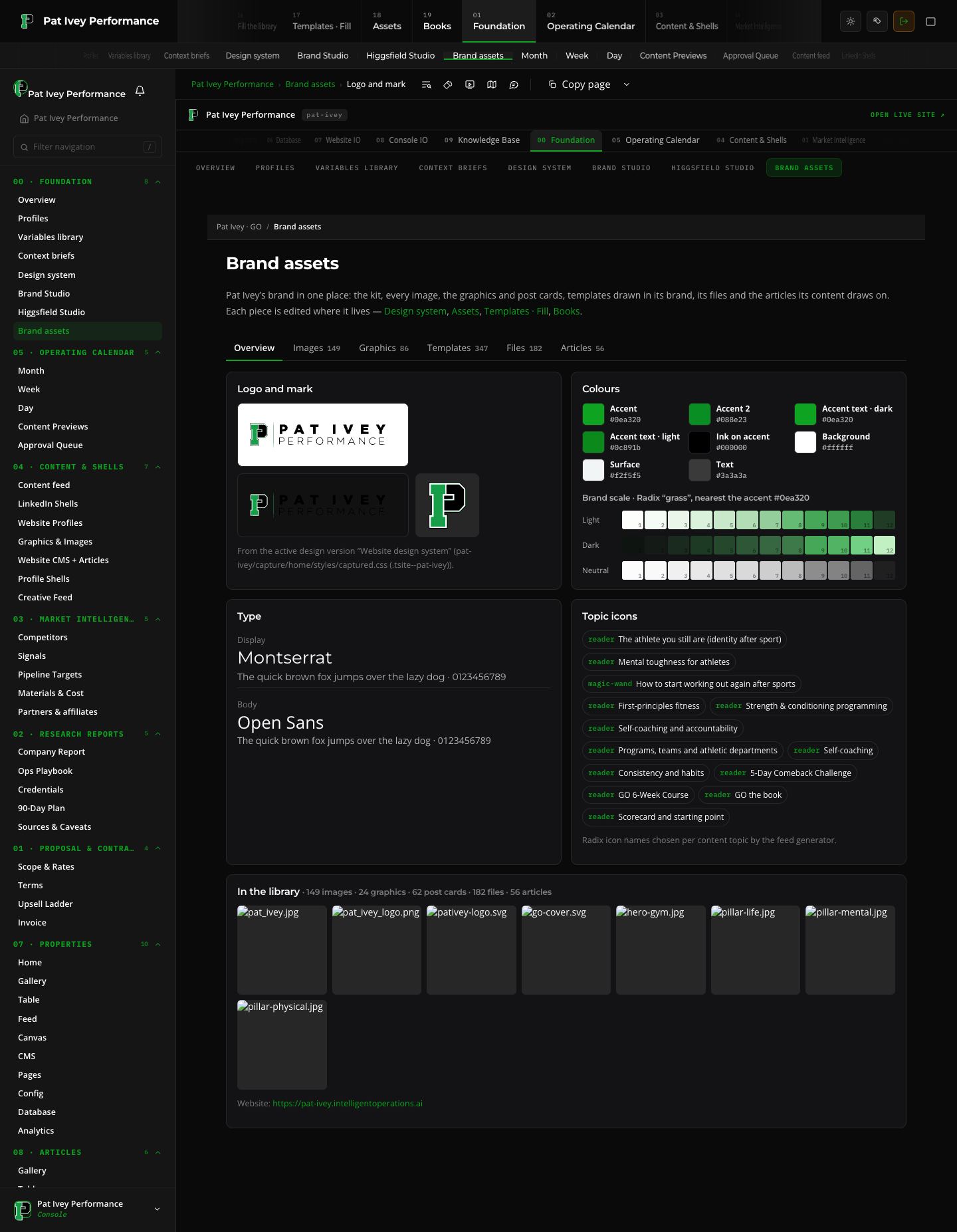
/tenant/pat-ivey/foundation/brand-assets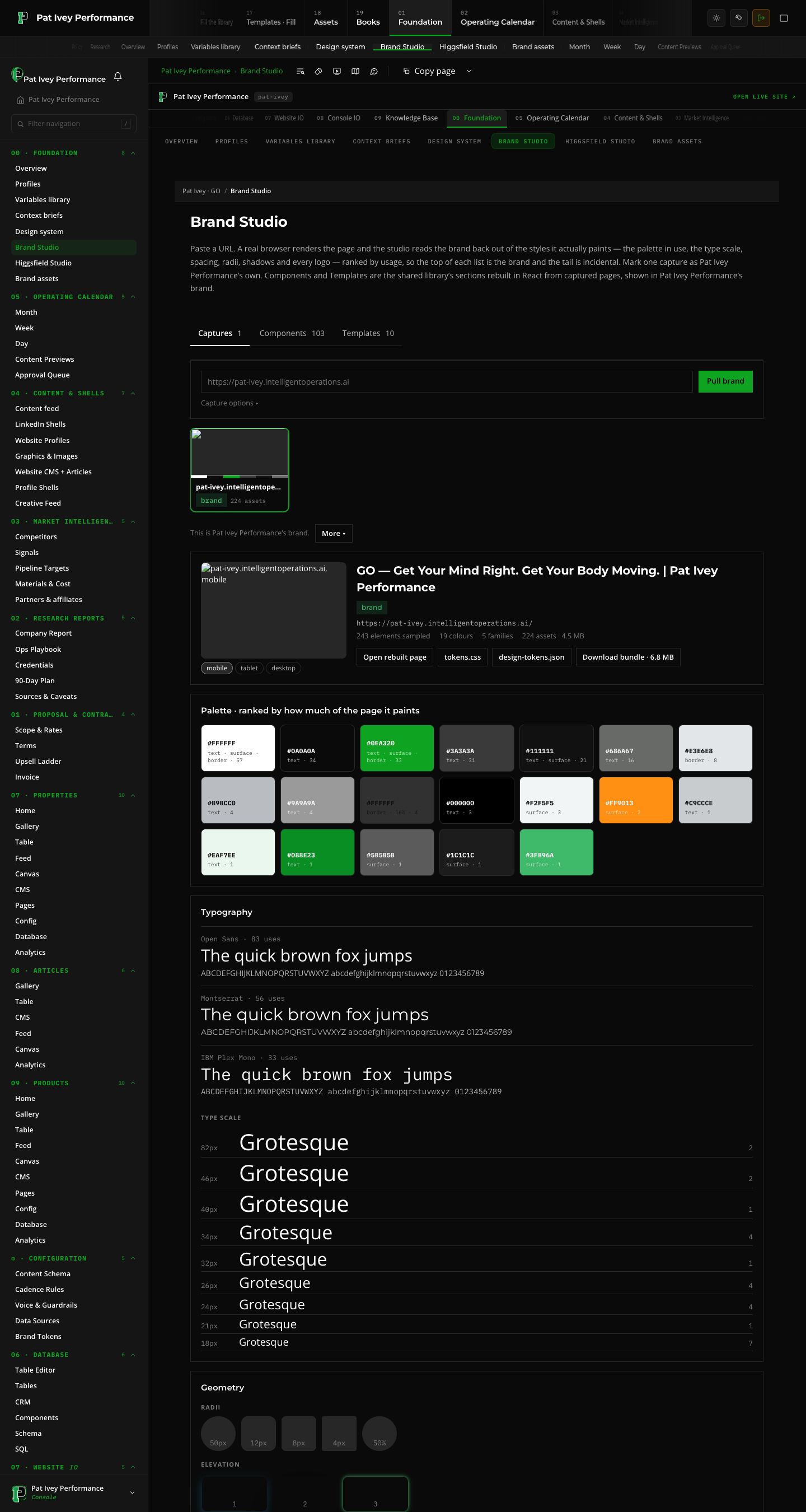
/tenant/pat-ivey/foundation/brand-studio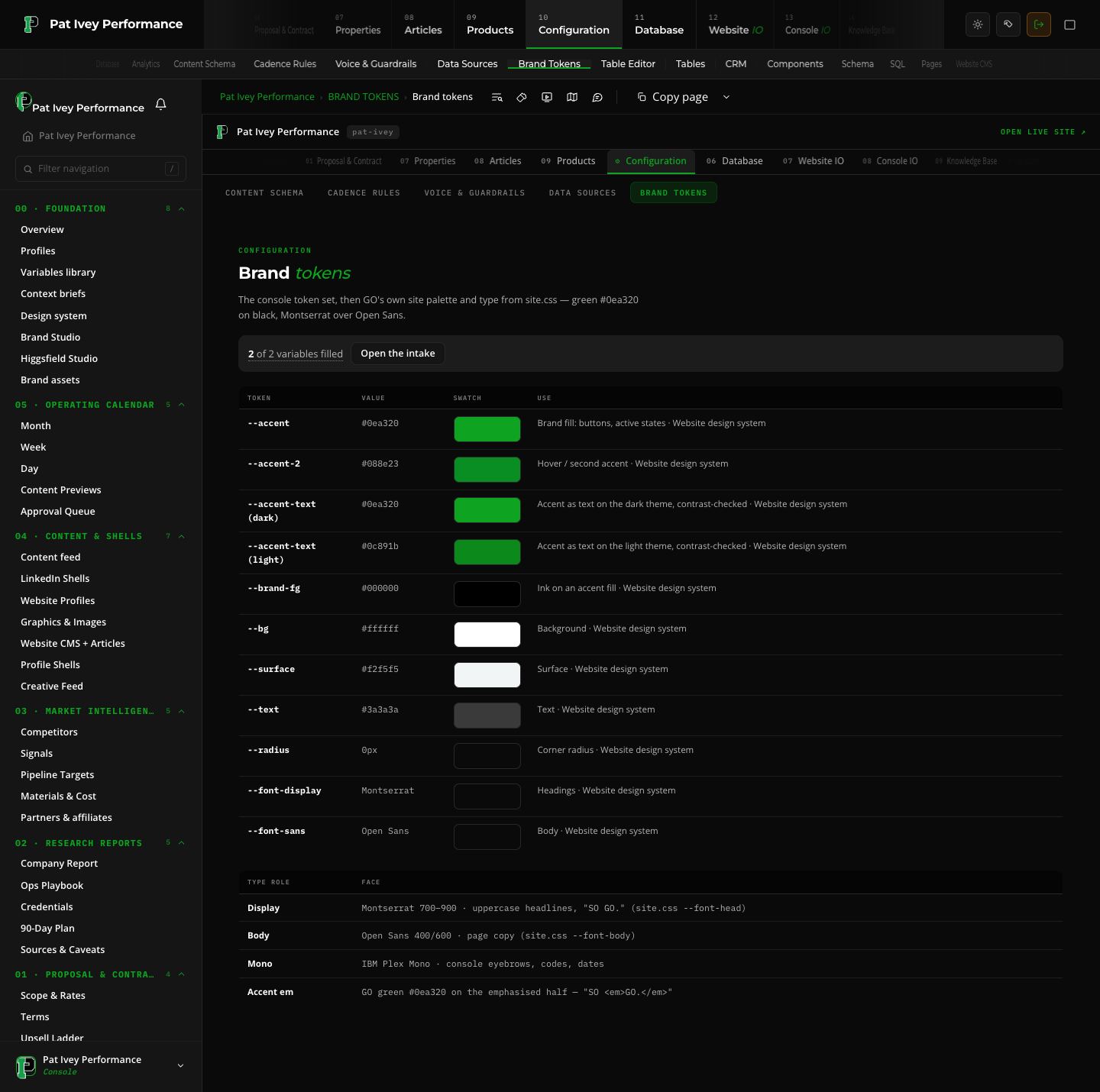
/tenant/pat-ivey/config/tokens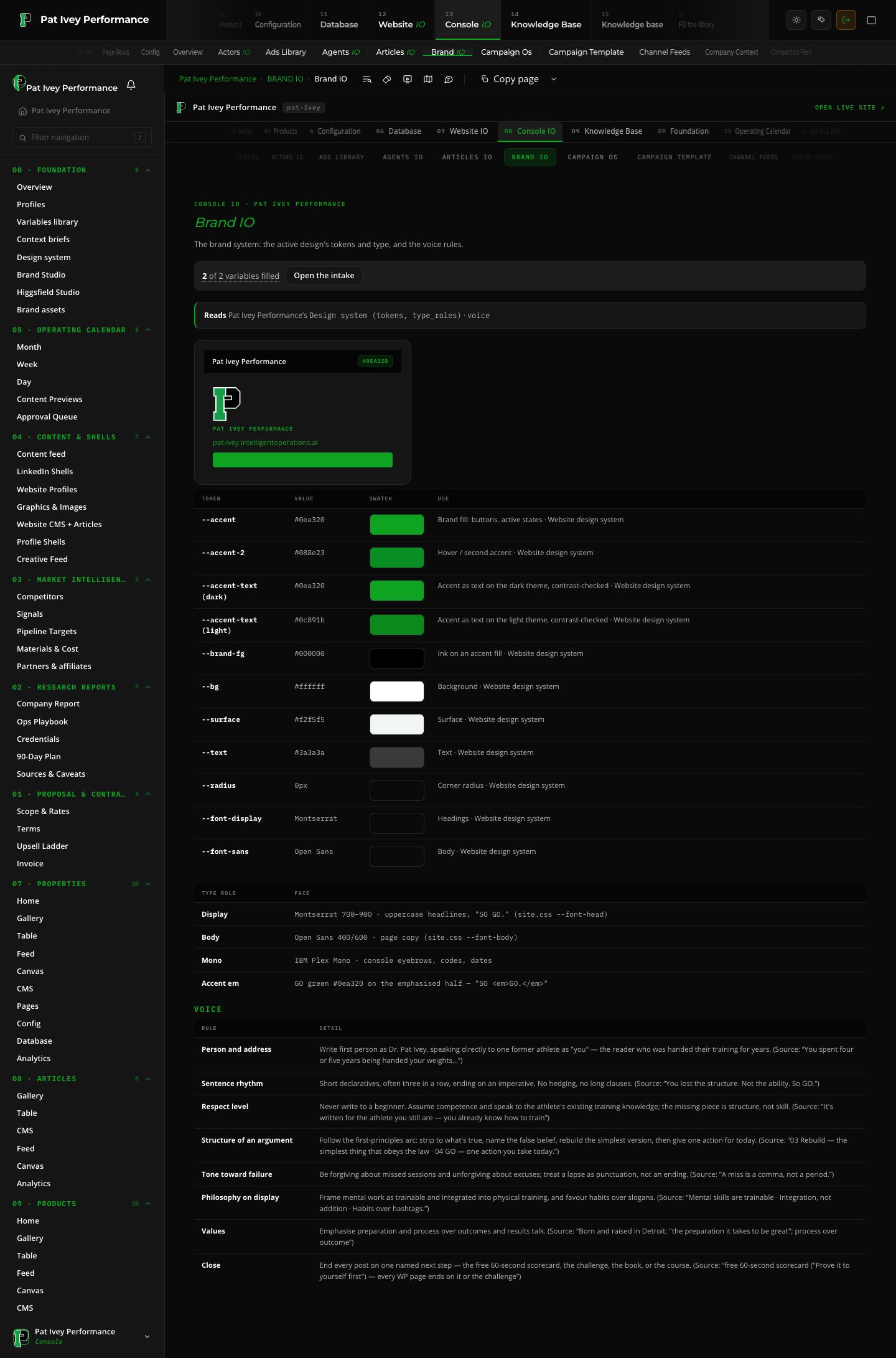
/tenant/pat-ivey/consoles/brand-io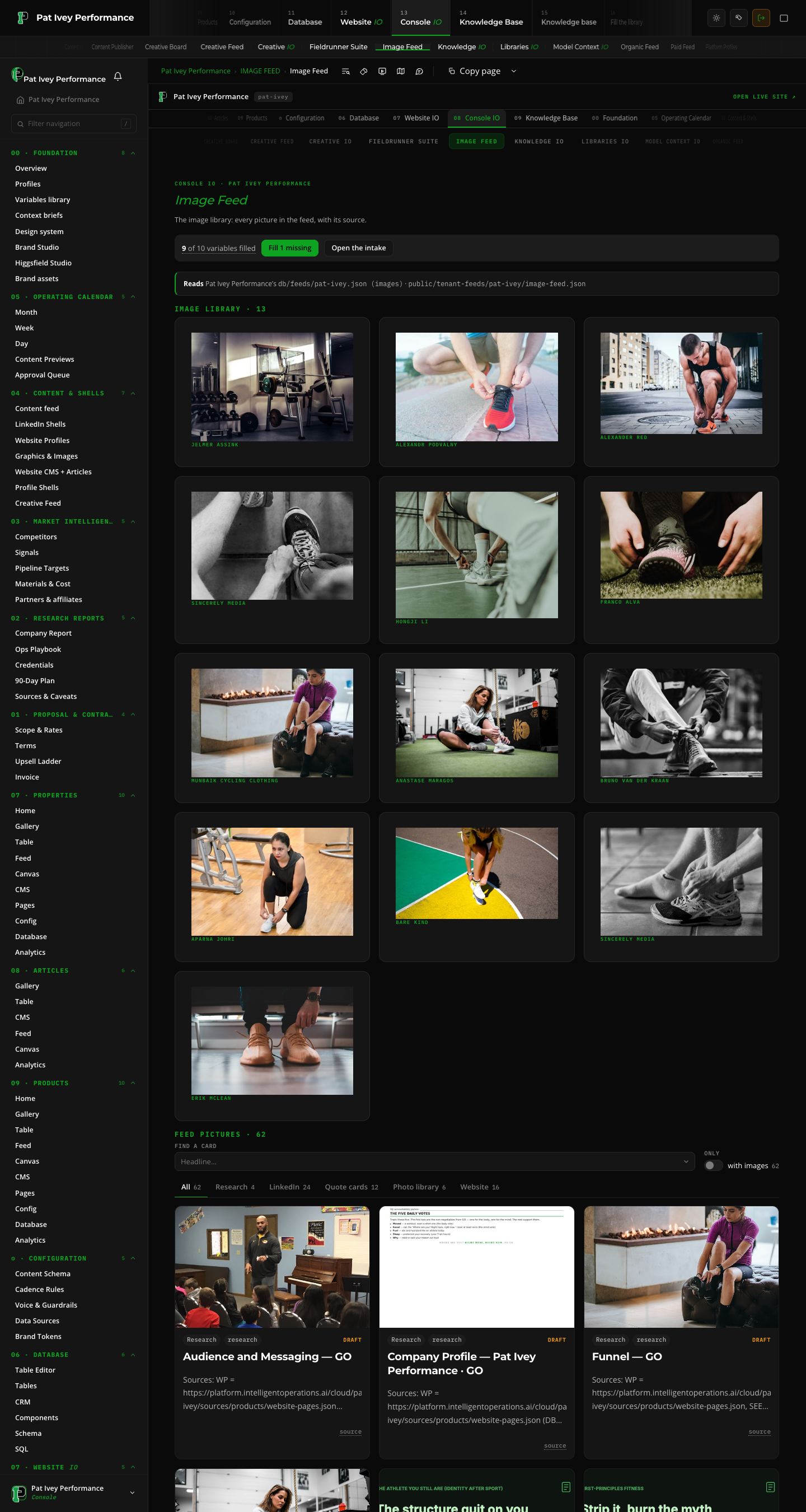
/tenant/pat-ivey/consoles/image-feed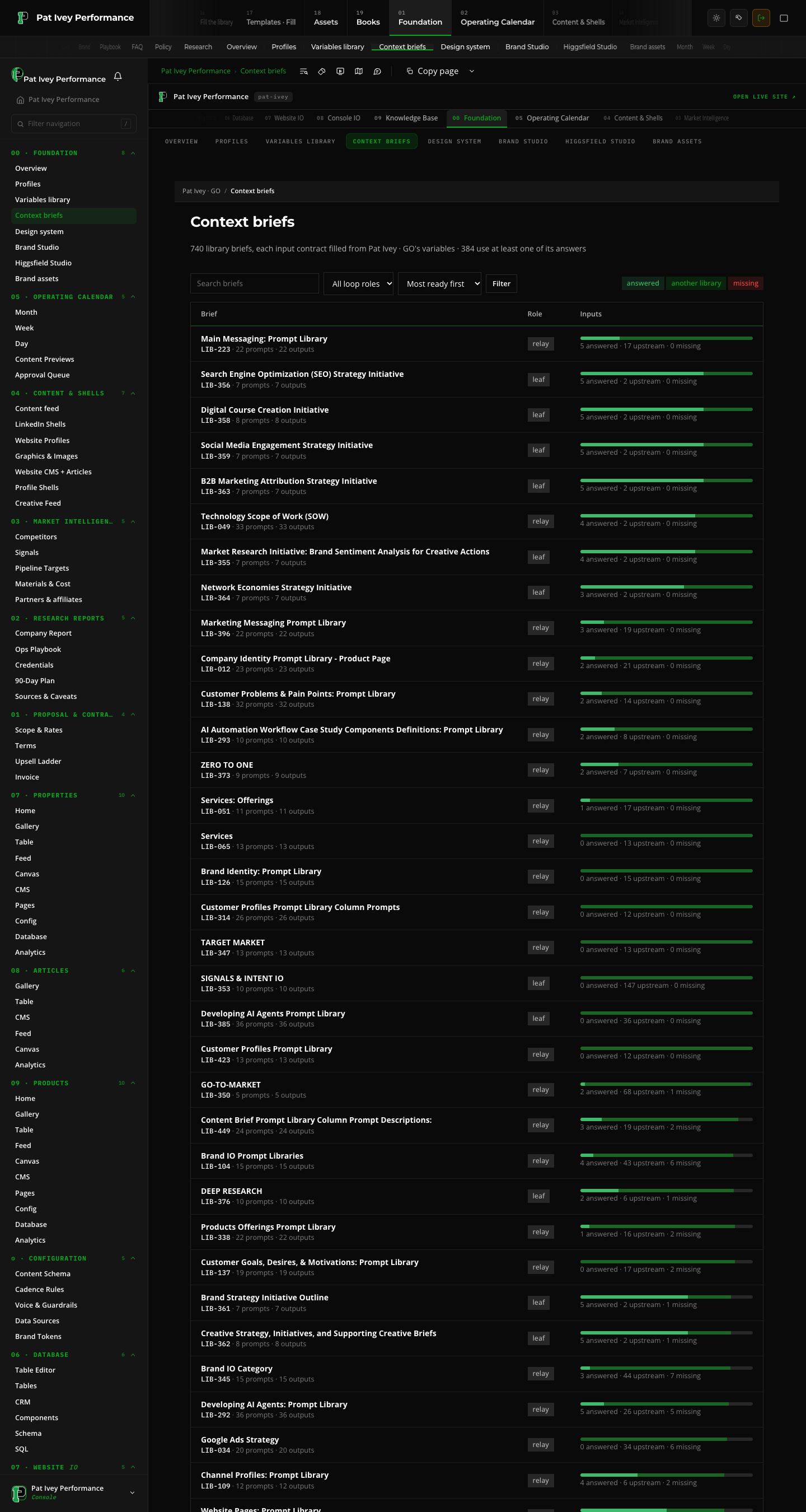
/tenant/pat-ivey/foundation/briefs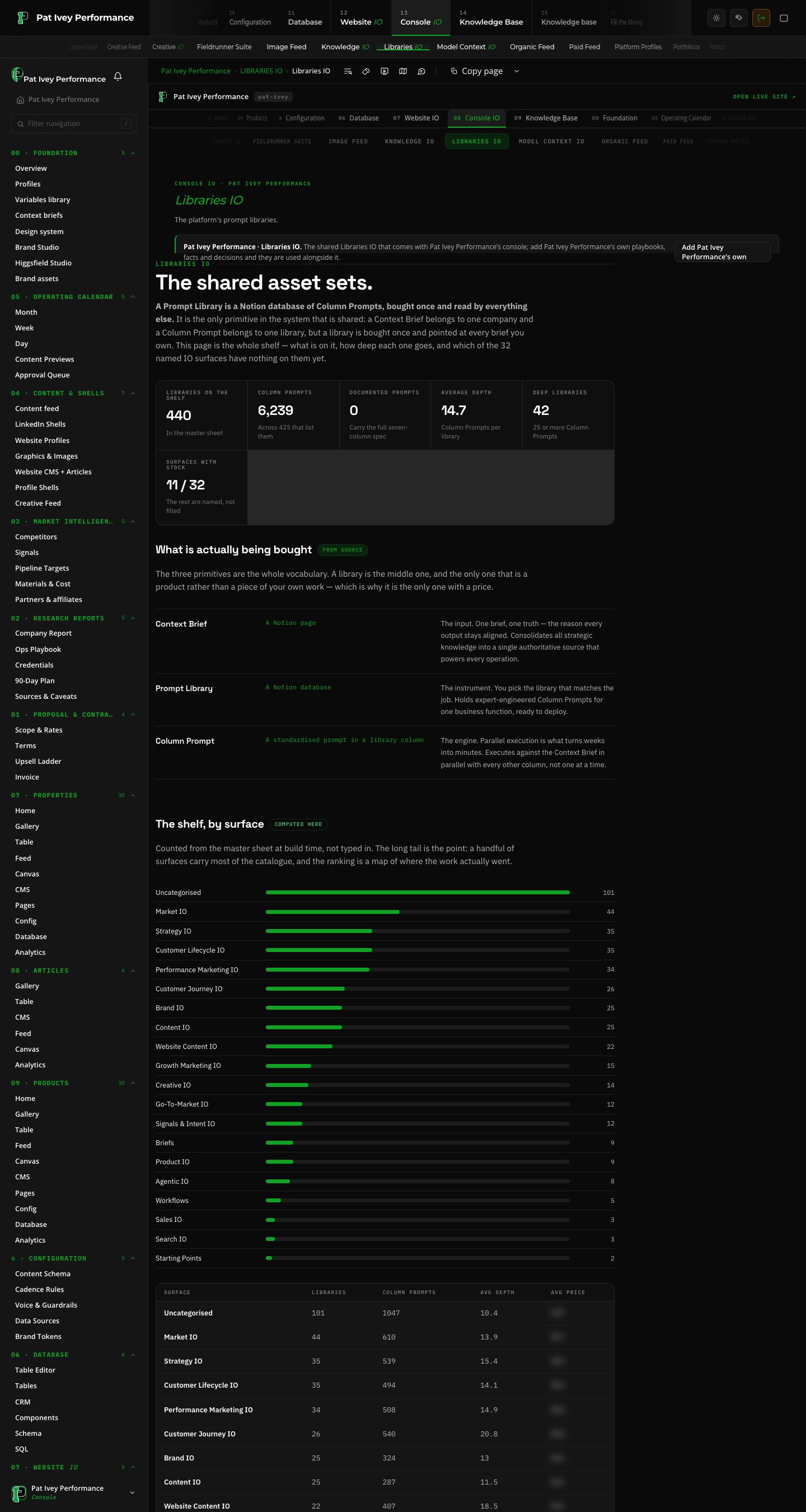
/tenant/pat-ivey/consoles/libraries-io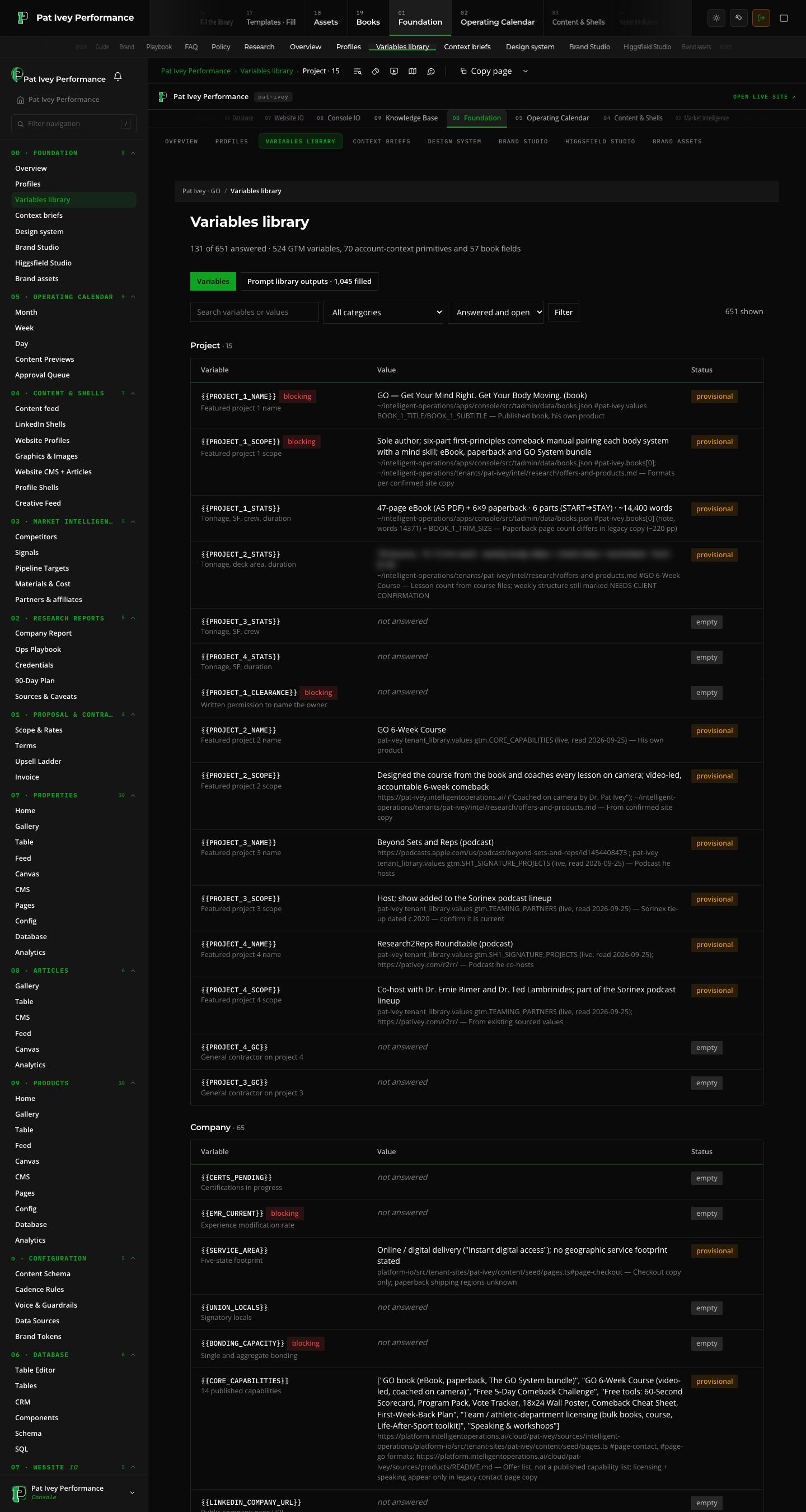
/tenant/pat-ivey/foundation/variables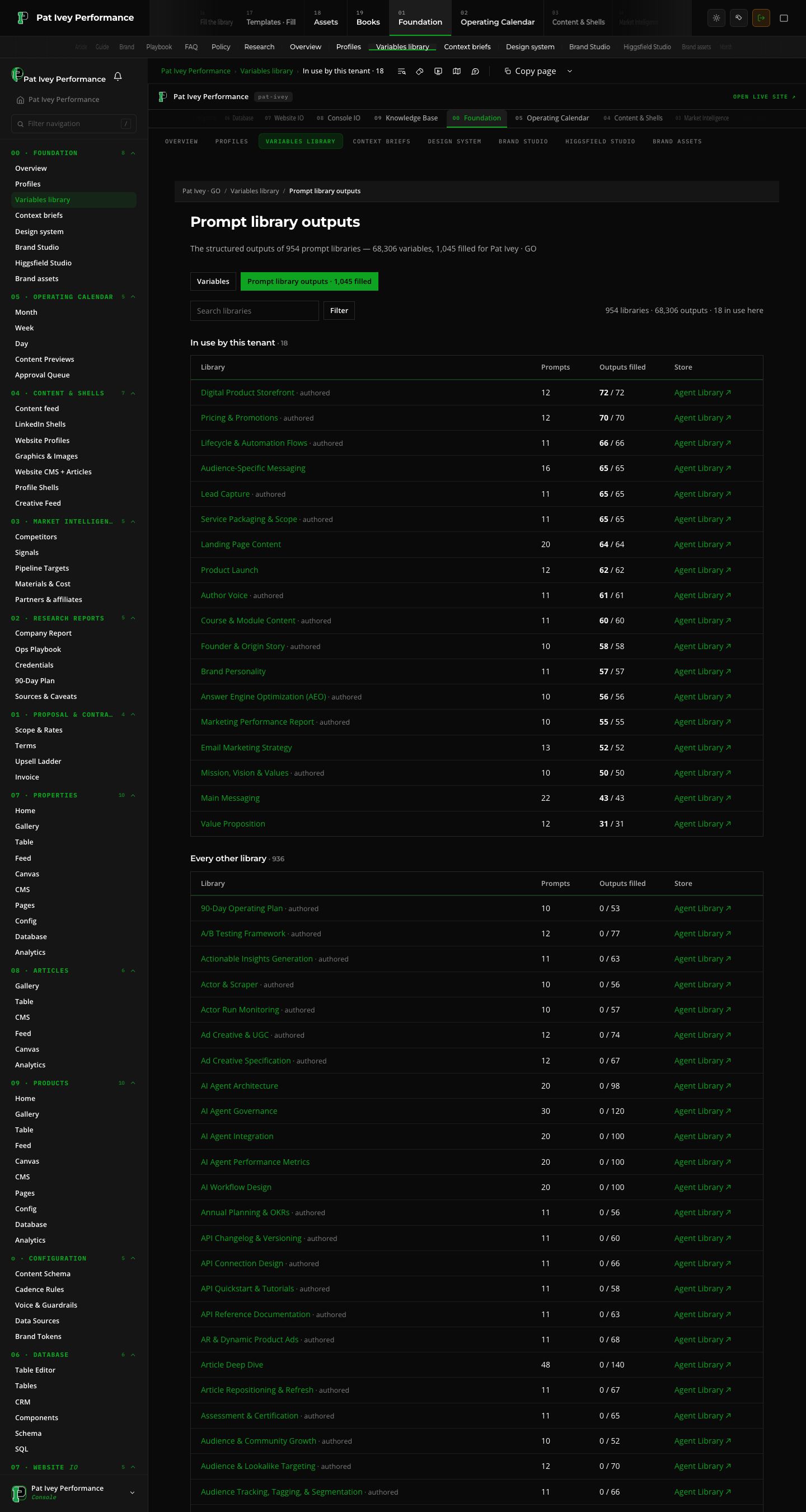
/tenant/pat-ivey/foundation/variables?tab=outputs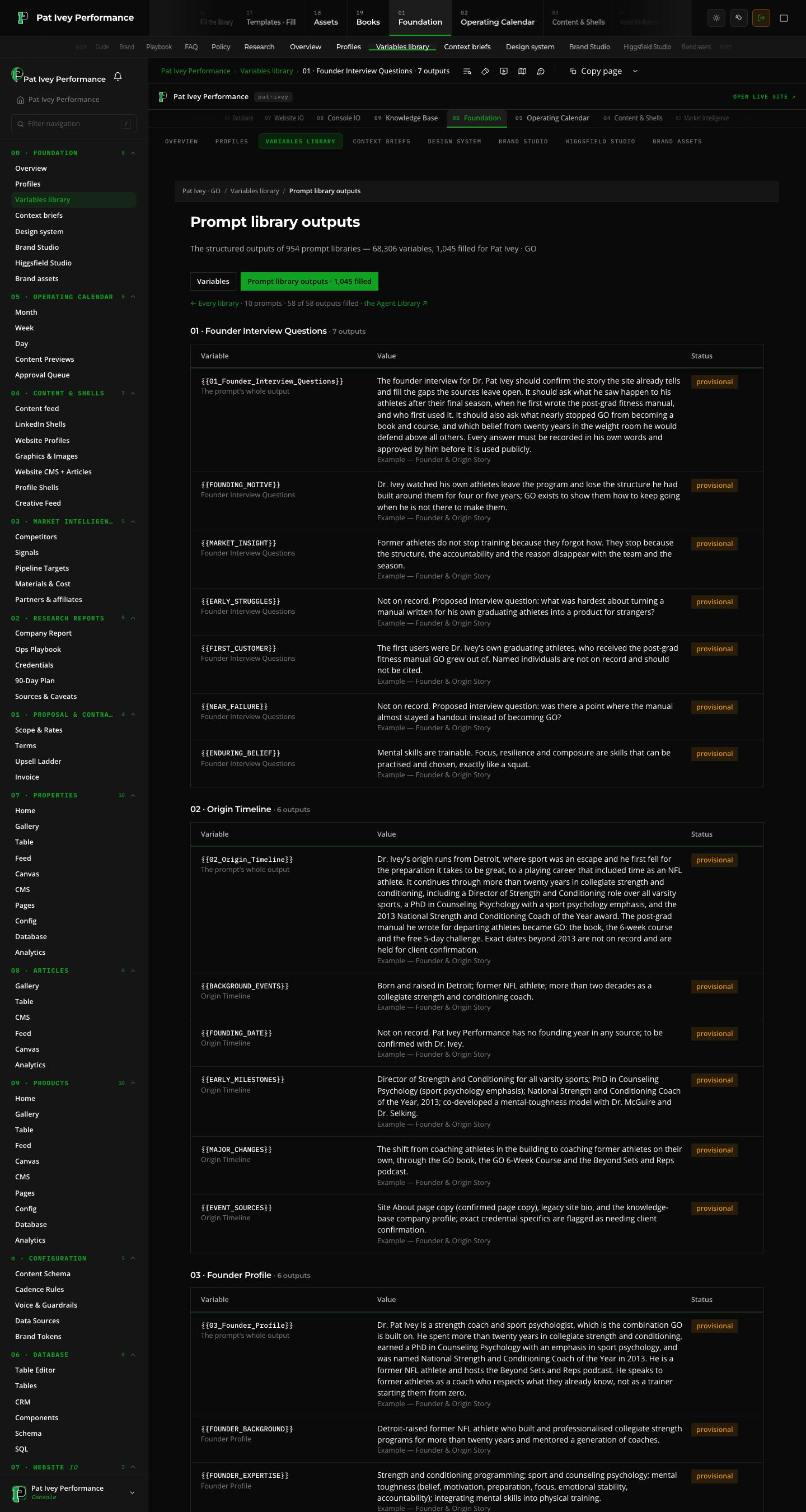
/tenant/pat-ivey/foundation/variables?tab=outputs&lib=founder-and-origin-story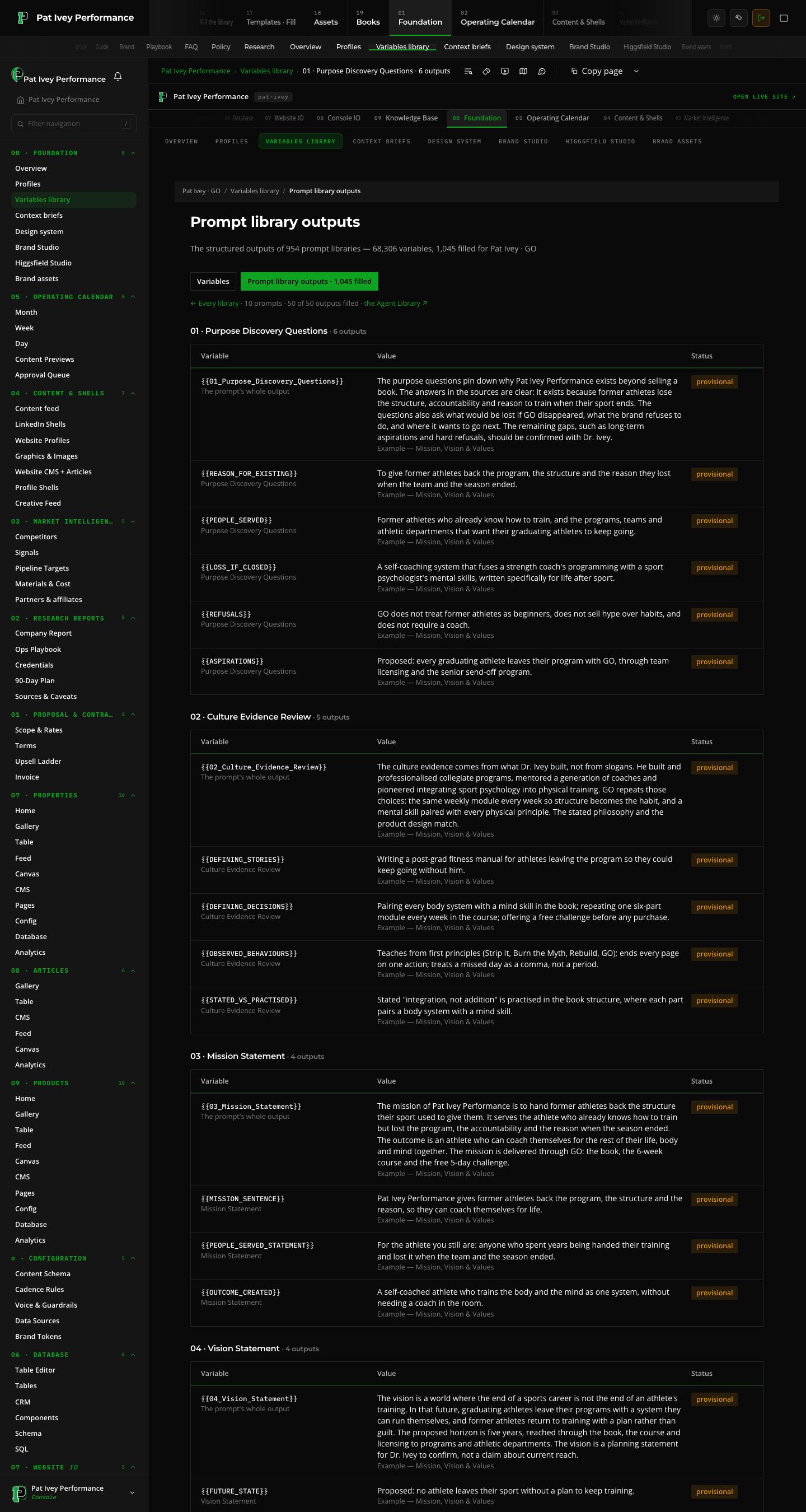
/tenant/pat-ivey/foundation/variables?tab=outputs&lib=mission-vision-and-values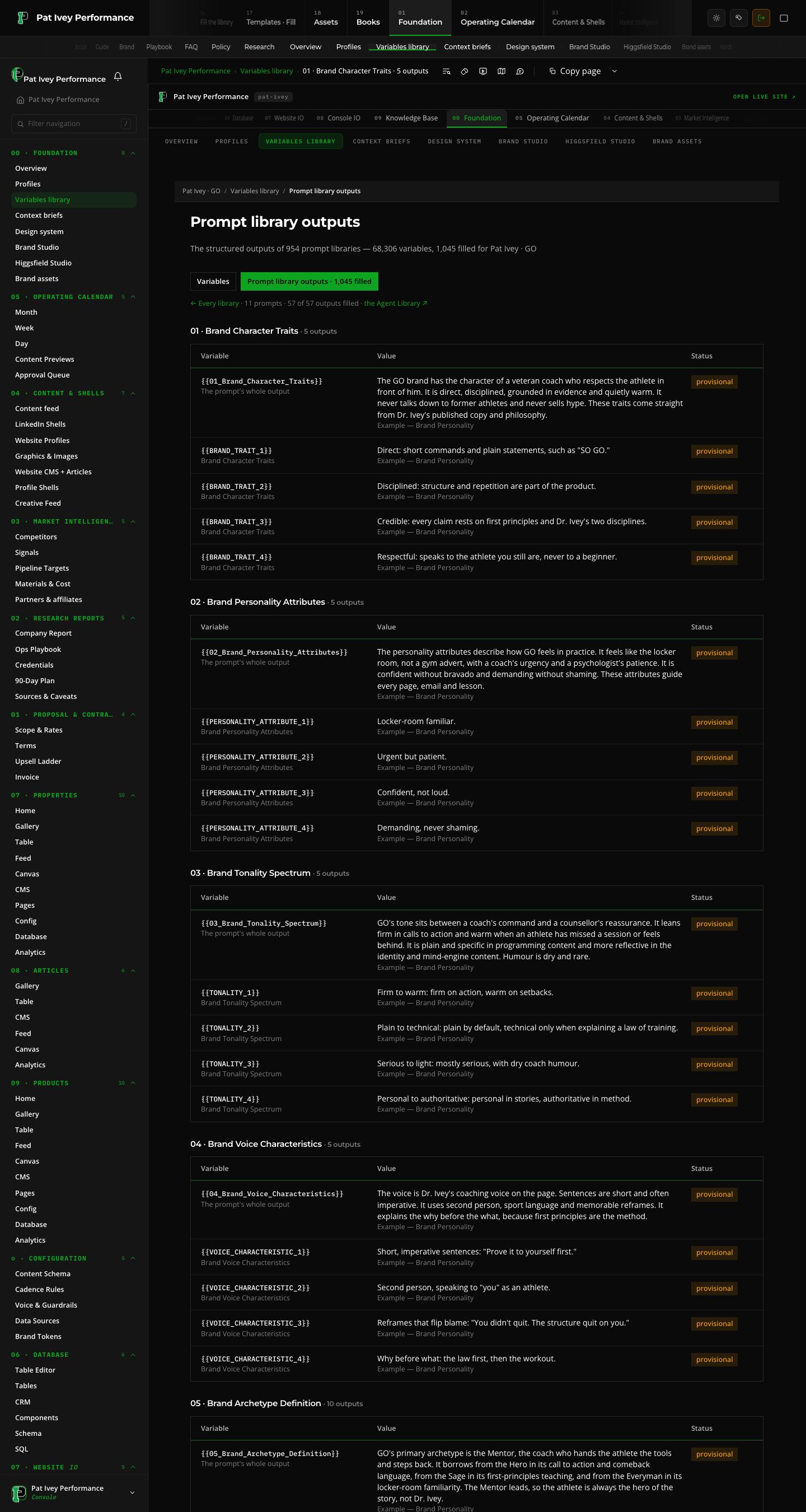
/tenant/pat-ivey/foundation/variables?tab=outputs&lib=brand-personality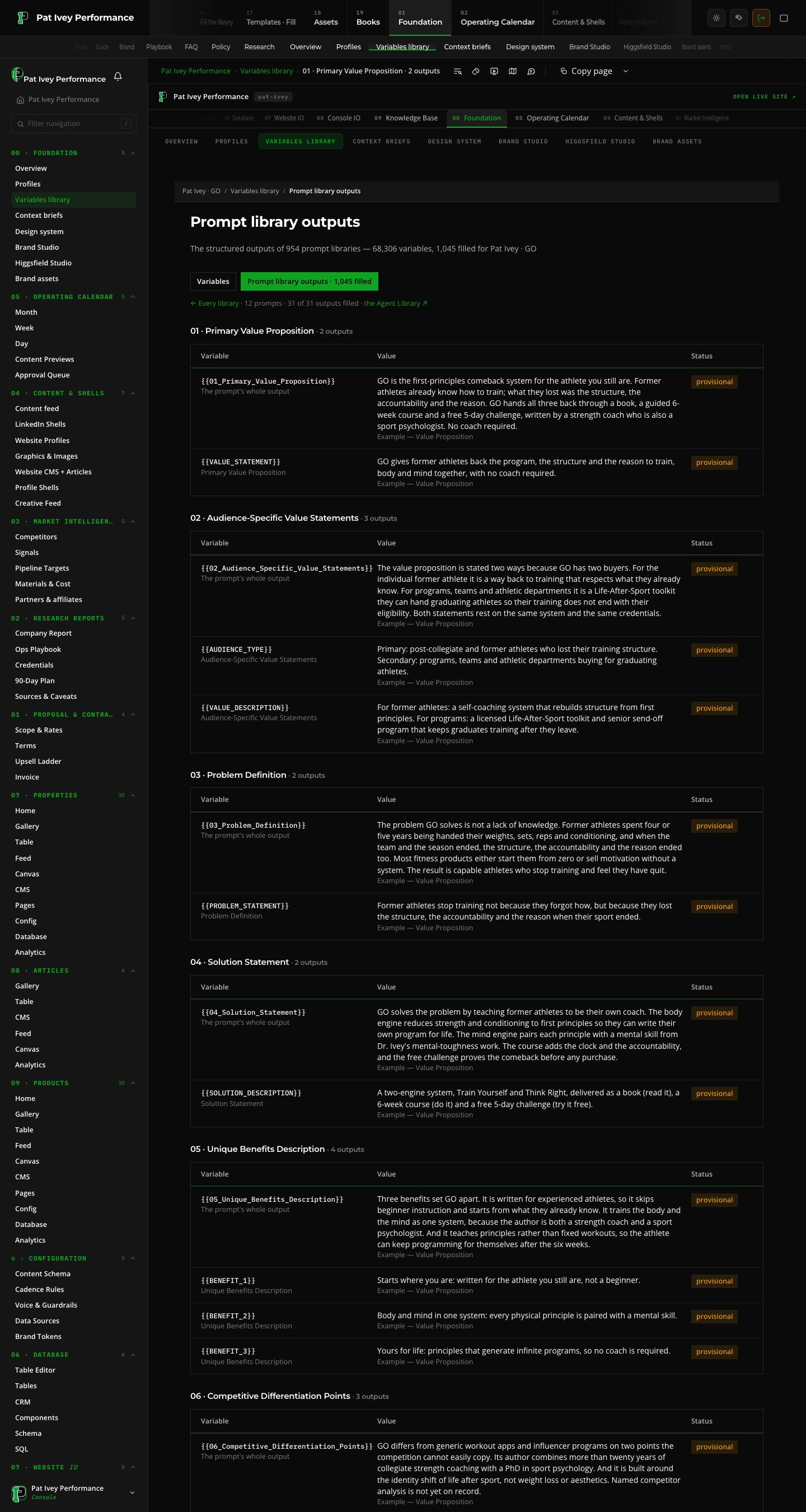
/tenant/pat-ivey/foundation/variables?tab=outputs&lib=value-proposition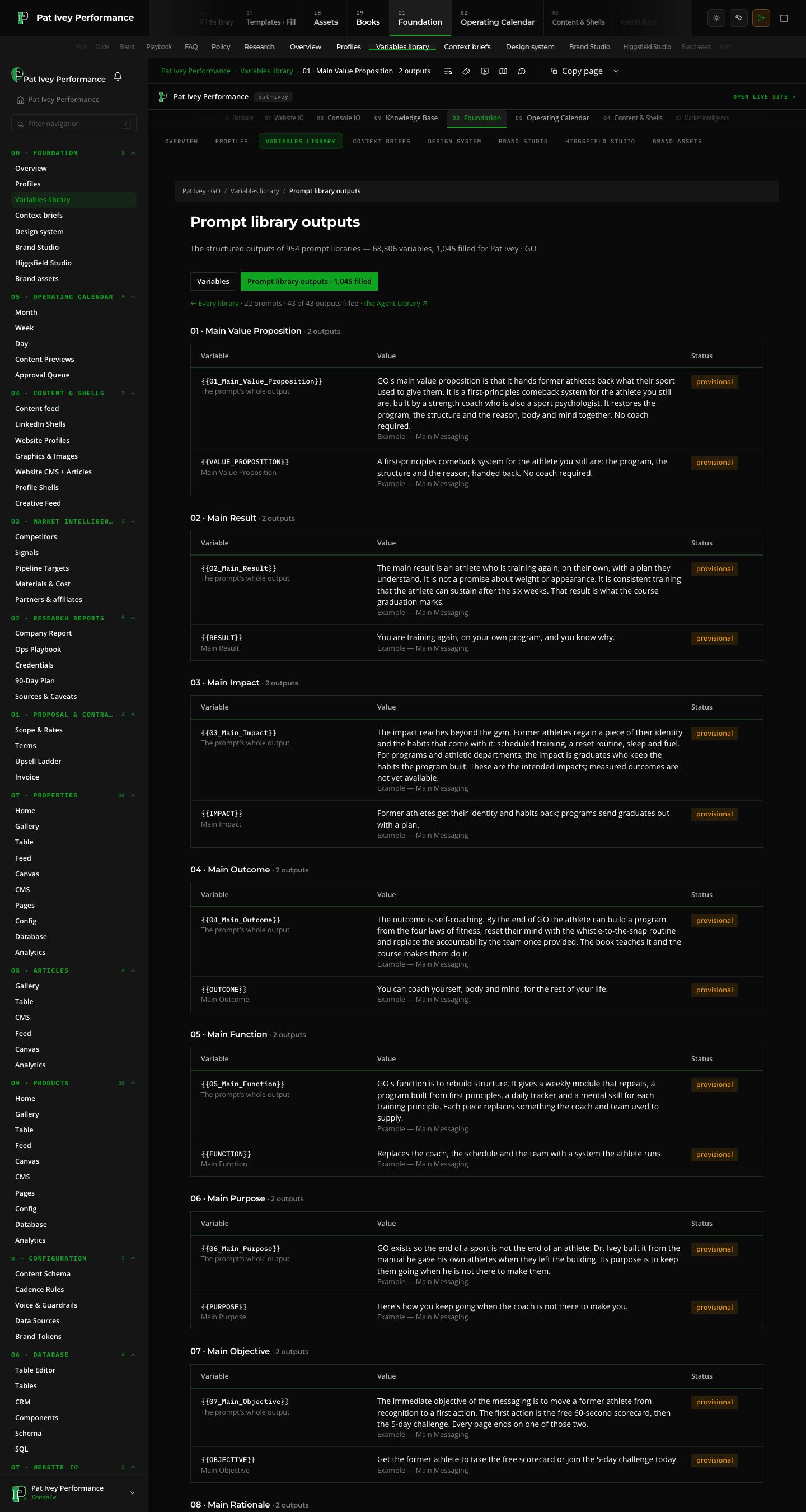
/tenant/pat-ivey/foundation/variables?tab=outputs&lib=main-messaging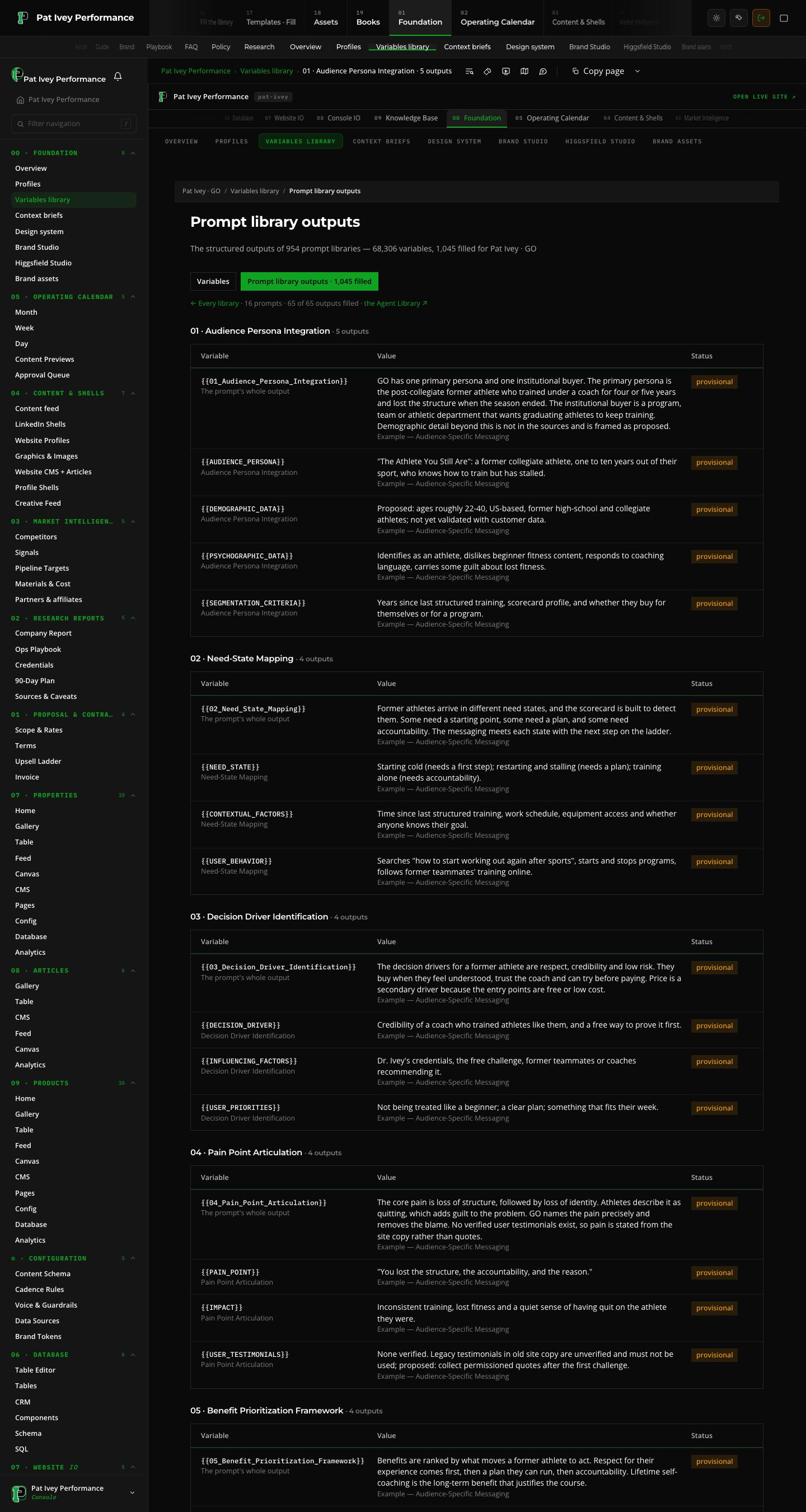
/tenant/pat-ivey/foundation/variables?tab=outputs&lib=audience-specific-messaging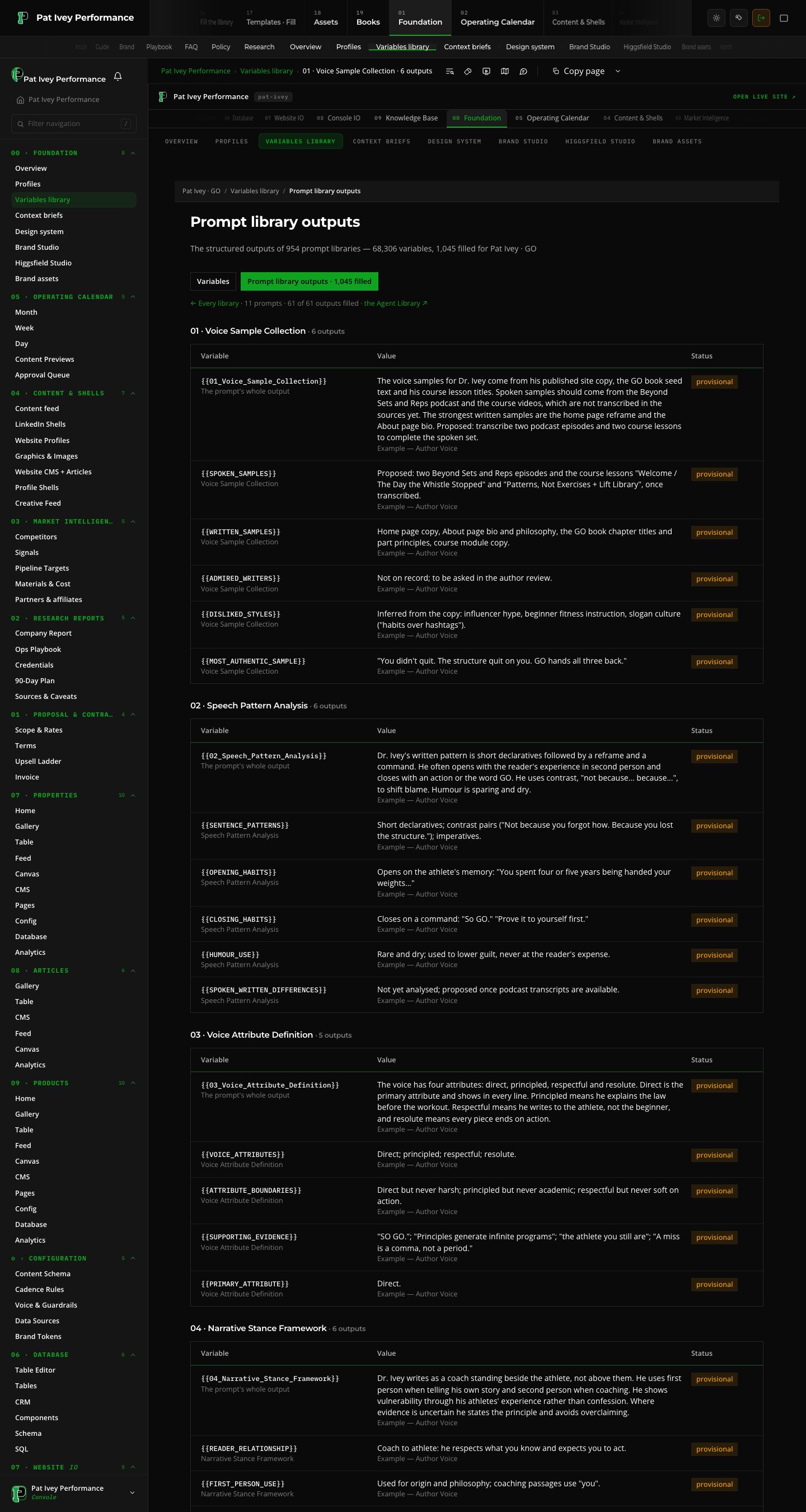
/tenant/pat-ivey/foundation/variables?tab=outputs&lib=author-voice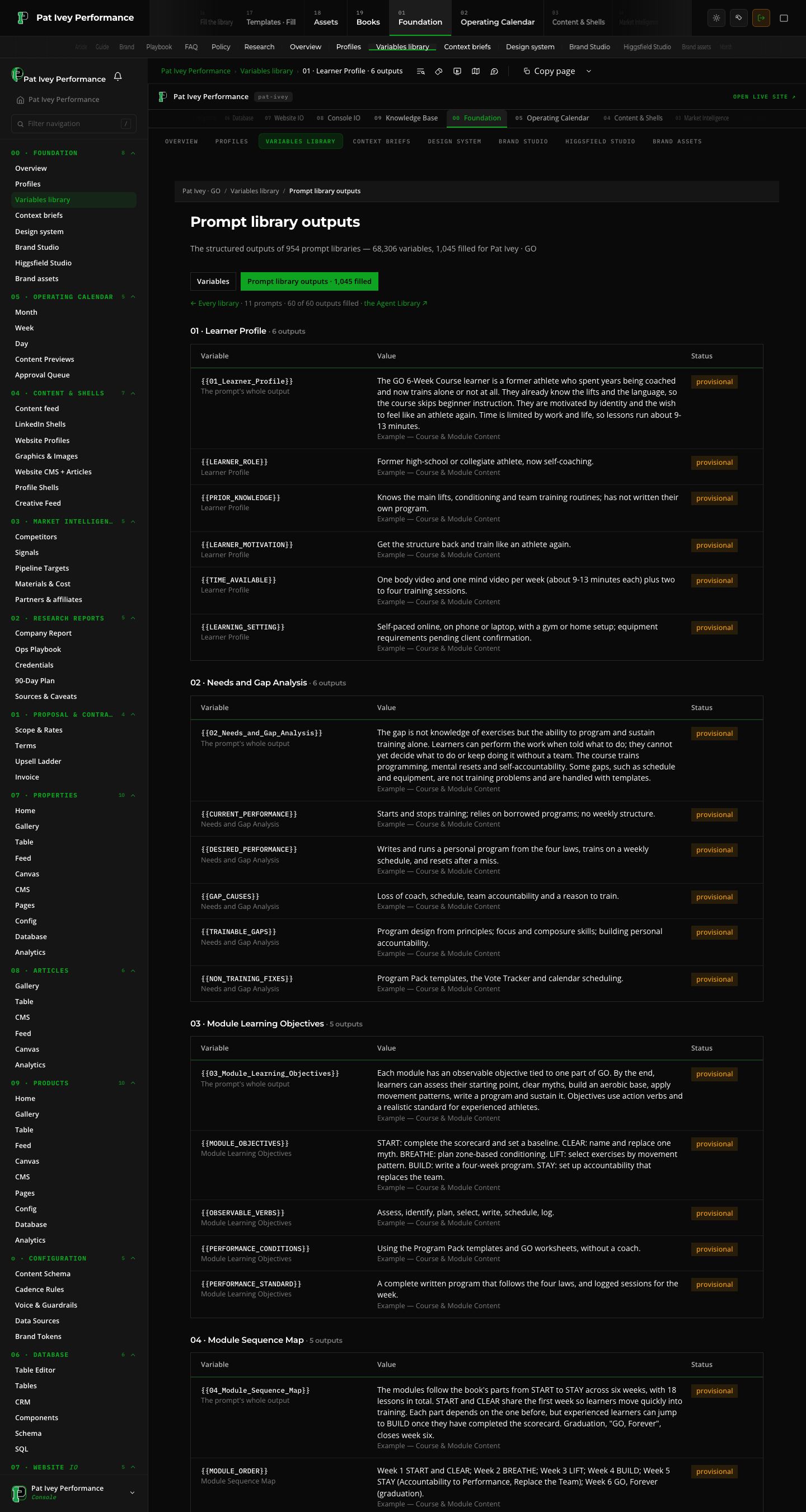
/tenant/pat-ivey/foundation/variables?tab=outputs&lib=course-and-module-content#0ea320



GO is sold on Dr. Ivey's story: the manual he wrote for his own departing athletes.
- Founder Interview Questions
- Origin Timeline
- Founder Profile
- Story Arc
- Story Truth Standards
- Signature Origin Story
- Short-Form Versions
- Founder Bio Set
- Story Resonance Review
- Story Deployment Map
His published philosophy (trainable mental skills, integration, habits over hashtags) needs to become a mission and values the brand can apply.
- Purpose Discovery Questions
- Culture Evidence Review
- Mission Statement
- Vision Statement
- Core Values Set
- Value Behaviour Standards
- Values in Practice
- Public Mission Page Copy
- Alignment Check
- Rollout and Reinforcement Plan
The coach-to-athlete voice is the brand's main asset and must stay consistent across the book, course and site.
- Brand Character Traits
- Brand Personality Attributes
- Brand Tonality Spectrum
- Brand Voice Characteristics
- Brand Archetype Definition
- Brand Personality Dos and Don'ts
- Brand Humor Guidelines
- Brand Emotional Range
- Brand Personality Expression Examples
- Brand Personality in Different Contexts
- Brand Personality Evolution Framework
GO must explain in one line why a former athlete needs structure, not another beginner program.
- Primary Value Proposition
- Audience-Specific Value Statements
- Problem Definition
- Solution Statement
- Unique Benefits Description
- Competitive Differentiation Points
- Evidence and Proof Points
- Value Quantification Framework
- Emotional Value Components
- Rational Value Components
- Value Delivery Timeline
- Value Proposition Testing Framework
The site, book listing and podcast need one set of approved lines built on the "structure quit on you" reframe.
- Main Value Proposition
- Main Result
- Main Impact
- Main Outcome
- Main Function
- Main Purpose
- Main Objective
- Main Rationale
- Main Use Case
- Main Hook
- Main Jobs to Be Done
- Main User Story
- Main Benefit
- Main Feature
- One-liner
- Summary
- Description
- Overview
- Synopsis
- Excerpt
- Definition
- Explanation
GO sells to two audiences, former athletes and the programs that graduate them.
- Audience Persona Integration
- Need-State Mapping
- Decision Driver Identification
- Pain Point Articulation
- Benefit Prioritization Framework
- Language Preference Adaptation
- Communication Style Matching
- Channel Preference Integration
- Content Format Optimization
- Messaging Sequence Strategy
- Objection Anticipation Framework
- Social Proof Customization
- Technical Depth Calibration
- Industry-Specific Terminology
- Cultural Relevance Adaptation
- Emotional Appeal Customization
Dr. Ivey is the author of the book and course, so ghostwritten emails and guides must sound like him.
- Voice Sample Collection
- Speech Pattern Analysis
- Voice Attribute Definition
- Narrative Stance Framework
- Signature Vocabulary List
- Sentence Rhythm Rules
- Voice Do And Avoid Guide
- Sample Passage Rewrite
- Author Review Questions
- Voice Match Scoring
- Voice Guide Summary
The GO 6-Week Course is the main paid product and follows an 18-lesson, six-part weekly module.
- Learner Profile
- Needs and Gap Analysis
- Module Learning Objectives
- Module Sequence Map
- Lesson Outline
- Lesson Script
- Worked Examples and Practice
- Knowledge Check Questions
- Job Aid and Summary Sheet
- Content Quality Review
- Learning Effectiveness Metrics
The book, course and PDF tools are sold directly from pativey.com with instant digital access.
- Digital Offer Inventory
- Buyer Intent Questions
- Product Packaging Model
- Delivery And Access Method
- License Terms Summary
- Storefront Navigation Structure
- Product Listing Page
- Listing Copy
- Preview And Sample Assets
- Purchase To Access Test
- Refund And Support Policy
- Storefront Sales Measures
Confirmed and legacy prices need one architecture before checkout launches.
- Pricing Input Questions
- Competitive Price Scan
- Price Architecture
- Margin Floor Rules
- Promotion Type Menu
- Discount Guardrails
- Promotional Calendar
- Offer Copy Variants
- Price Change Communication
- Promotion Test Design
- Promotion Results Analysis
- Pricing Health Measures
The scorecard and free tools are the funnel's entry and are not yet wired to an email service.
- Conversion Goal Questions
- Lead Offer Inventory
- Lead Magnet Concept
- Form Field Strategy
- Capture Point Placement
- Form Copy And Labels
- Thank-You Page Content
- Lead Routing Rules
- Consent And Privacy Notice
- Form Test Plan
- Lead Quality Measures
The course page is the key conversion page on the site.
- Hero Section Framework
- Value Proposition Structure
- Problem-Agitation-Solution Format
- Feature Section Framework
- Benefit Translation Structure
- Social Proof Integration Format
- Objection Handling Framework
- Technical Specifications Structure
- Pricing Table Format
- Process/Timeline Framework
- Risk Reversal Structure
- Guarantee Statement Format
- Urgency Creation Framework
- Call-to-Action Structure
- Form Optimization Format
- Trust Elements Framework
- FAQ Section Structure
- About Section Format
- Technical Requirements Framework
- Next Steps Guidance Structure
The ladder from scorecard to challenge to book to course runs on automated email.
- Lifecycle Stage Map
- Data And Trigger Readiness
- Flow Portfolio
- Entry Exit And Suppression Rules
- Welcome Flow Sequence
- Abandonment Flow Sequences
- Post-Purchase And Retention Flows
- Win-Back And Sunset Flows
- Flow Personalisation And Branching
- Flow QA And Testing
- Flow Performance Measurement
Every free tool collects an email, making email the primary sales channel.
- Email Marketing Goals and Objectives
- Target Audience and Buyer Personas
- Email List Segmentation and Management
- Email Content Themes and Types
- Email Design and Layout
- Email Copywriting and Optimization
- Email Automation and Workflows
- Email Deliverability and Compliance
- Email Performance Metrics and KPIs
- Email Analytics and Reporting
- A/B Testing and Optimization
- Integration with Overall Marketing Strategy
- Continuous Optimization and Improvement
The comeback guide hub targets questions like "how to start working out again after sports".
- Question Universe Discovery
- Answer Opportunity Assessment
- Answer Architecture
- Answer Writing Rules
- Direct Answer Drafts
- Structured Data Plan
- Voice and Conversational Fit
- Answer Readiness Audit
- Answer Visibility Measures
- Answer Refresh Cycle
The GO system (book, course, challenge) has not yet launched on the public domain.
- Launch Announcement Framework
- Product Positioning Statement
- Key Messaging Points
- Launch Email Sequences
- Press Release Template
- Launch Timeline Communications
- Launch Event Content
- Launch Video Script Framework
- Early Adopter Messaging
- Sales Team Enablement Materials
- Launch FAQ Document
- Launch Success Metrics Framework
Team licensing, the senior send-off program and speaking need defined packages.
- Service Demand Review
- Buyer Segment Needs
- Package Architecture
- Package Definitions
- Tier Differentiation
- Scope Boundary Rules
- Pricing Logic
- Package Page Copy
- Delivery Playbook Link
- Package Launch Test
- Package Performance Measures
No baselines exist, so a reporting structure is needed from launch day.
- Reporting Scope and Goals
- Metric Hierarchy
- Attribution and Data Notes
- Funnel Performance Summary
- Channel Performance Breakdown
- Campaign Results Review
- Content and Engagement Signals
- Performance Diagnosis
- Next Period Allocation
- Marketing Report Summary
{{01_Founder_Interview_Questions}}- The founder interview for Dr. Pat Ivey should confirm the story the site already tells and fill the gaps the sources leave open. It should ask what he saw happen to his athletes after their final season, when he first wrote the post-grad fitness manual, and who first used it. It should also ask what nearly stopped GO from becoming a book and course, and which belief from twenty years in the weight room he would defend above all others. Every answer must be recorded in his own words and approved by him before it is used publicly.
{{FOUNDING_MOTIVE}}- Dr. Ivey watched his own athletes leave the program and lose the structure he had built around them for four or five years; GO exists to show them how to keep going when he is not there to make them.
{{MARKET_INSIGHT}}- Former athletes do not stop training because they forgot how. They stop because the structure, the accountability and the reason disappear with the team and the season.
{{EARLY_STRUGGLES}}- Not on record. Proposed interview question: what was hardest about turning a manual written for his own graduating athletes into a product for strangers?
{{FIRST_CUSTOMER}}- The first users were Dr. Ivey's own graduating athletes, who received the post-grad fitness manual GO grew out of. Named individuals are not on record and should not be cited.
{{NEAR_FAILURE}}- Not on record. Proposed interview question: was there a point where the manual almost stayed a handout instead of becoming GO?
{{ENDURING_BELIEF}}- Mental skills are trainable. Focus, resilience and composure are skills that can be practised and chosen, exactly like a squat.
{{02_Origin_Timeline}}- Dr. Ivey's origin runs from Detroit, where sport was an escape and he first fell for the preparation it takes to be great, to a playing career that included time as an NFL athlete. It continues through more than twenty years in collegiate strength and conditioning, including a Director of Strength and Conditioning role over all varsity sports, a PhD in Counseling Psychology with a sport psychology emphasis, and the 2013 National Strength and Conditioning Coach of the Year award. The post-grad manual he wrote for departing athletes became GO: the book, the 6-week course and the free 5-day challenge. Exact dates beyond 2013 are not on record and are held for client confirmation.
{{BACKGROUND_EVENTS}}- Born and raised in Detroit; former NFL athlete; more than two decades as a collegiate strength and conditioning coach.
{{FOUNDING_DATE}}- Not on record. Pat Ivey Performance has no founding year in any source; to be confirmed with Dr. Ivey.
{{EARLY_MILESTONES}}- Director of Strength and Conditioning for all varsity sports; PhD in Counseling Psychology (sport psychology emphasis); National Strength and Conditioning Coach of the Year, 2013; co-developed a mental-toughness model with Dr. McGuire and Dr. Selking.
{{MAJOR_CHANGES}}- The shift from coaching athletes in the building to coaching former athletes on their own, through the GO book, the GO 6-Week Course and the Beyond Sets and Reps podcast.
{{EVENT_SOURCES}}- Site About page copy (confirmed page copy), legacy site bio, and the knowledge-base company profile; exact credential specifics are flagged as needing client confirmation.
{{03_Founder_Profile}}- Dr. Pat Ivey is a strength coach and sport psychologist, which is the combination GO is built on. He spent more than twenty years in collegiate strength and conditioning, earned a PhD in Counseling Psychology with an emphasis in sport psychology, and was named National Strength and Conditioning Coach of the Year in 2013. He is a former NFL athlete and hosts the Beyond Sets and Reps podcast. He speaks to former athletes as a coach who respects what they already know, not as a trainer starting them from zero.
{{FOUNDER_BACKGROUND}}- Detroit-raised former NFL athlete who built and professionalised collegiate strength programs for more than twenty years and mentored a generation of coaches.
{{FOUNDER_EXPERTISE}}- Strength and conditioning programming; sport and counseling psychology; mental toughness (belief, motivation, preparation, focus, emotional stability, accountability); integrating mental skills into physical training.
{{FOUNDER_VALUES}}- Process over outcome; mental skills are trainable; integration, not addition; habits over hashtags.
{{FOUNDER_VOICE}}- Direct, short and coach-like, with locker-room imagery and plain commands: "SO GO." "Prove it to yourself first." "A miss is a comma, not a period."
{{CUSTOMER_CONNECTION}}- He wrote GO for the same people he coached for twenty years: athletes on the day their locker was cleaned out.
{{04_Story_Arc}}- The arc starts in a world where the athlete is handed every weight, set and rep by a coach and a schedule. The problem Dr. Ivey noticed was that when the season ended, his athletes lost the structure, the accountability and the reason, and the training stopped with them. He acted by writing a post-grad fitness manual so they could keep going without him, and the struggle was compressing two careers, strength coach and sport psychologist, into one system anyone could run alone. The turning point is the reframe at the heart of GO, "You didn't quit. The structure quit on you," and the present purpose is to hand that structure back through the book, the course and the free challenge.
{{WORLD_BEFORE}}- Four or five years of being handed the program: the weights, the sets, the reps, the conditioning, the coach and the team.
{{PROBLEM_NOTICED}}- When the whistle stopped, athletes who knew exactly how to train stopped training, because the structure left with the season.
{{DECISION_TO_ACT}}- He wrote a post-grad fitness manual for his own departing athletes: here is how you keep going when I am not there to make you.
{{STRUGGLE}}- Turning the body engine and the mind engine into one self-coaching system that works without a coach in the room. Specific setbacks are not on record.
{{TURNING_POINT}}- The reframe that became the brand: "You didn't quit. The structure quit on you. GO hands all three back."
{{PRESENT_PURPOSE}}- Give every former athlete the program, the structure and the reason back, one system with three ways in: read it, do it, or try it free.
{{05_Story_Truth_Standards}}- Every fact in the GO origin story must trace to confirmed site copy or to Dr. Ivey's own approval. Credentials are stated exactly as the About page states them until he confirms the specifics, and no athlete, school or team is named without permission. Dialogue is limited to lines he has published or approved, and the story never implies outcomes for readers that have not been measured. Dr. Ivey is the final approver of every public version.
{{VERIFIABILITY_RULE}}- Only use facts that appear in confirmed page copy or that Dr. Ivey confirms in writing; anything else is held back.
{{DIALOGUE_RULE}}- Quote only published lines (for example "here's how you keep going when I'm not there to make you") or lines he approves; never reconstruct conversations with athletes.
{{CREDIT_RULE}}- Credit Dr. McGuire and Dr. Selking as co-developers of the mental-toughness model whenever the model is described.
{{EXAGGERATION_RULE}}- No invented transformations, client counts or results; the legacy testimonials are unverified and stay out of the story.
{{APPROVAL_OWNER}}- Dr. Pat Ivey approves every version; Intelligent Operations prepares drafts.
{{06_Signature_Origin_Story}}- The signature story opens on the day an athlete's locker is cleaned out, the moment GO's dedication names. It moves to Dr. Ivey's view from the weight room: athletes who knew exactly how to train, stopping anyway once the team and the season were gone. It follows him writing the post-grad manual for his own athletes, drawing on twenty years of strength coaching and a PhD in sport psychology. It closes on GO today, a book, a 6-week course and a free challenge that hand back the structure, the accountability and the reason.
{{OPENING_SCENE}}- The day the whistle stopped: an empty locker, no schedule on the wall, and nobody telling you what today's lift is.
{{PROBLEM_SECTION}}- Four or five years of being handed the program, then nothing. Not because you forgot how, but because you lost the structure, the accountability and the reason.
{{STRUGGLE_SECTION}}- Dr. Ivey saw it happen to his own athletes and built them a manual so they could keep going when he was not there to make them.
{{TURNING_POINT_SECTION}}- The insight that became GO: you didn't quit, the structure quit on you, so rebuild it from first principles and let a coach's system replace the coach.
{{PRESENT_DAY_SECTION}}- Today GO is one system with three ways in: read the book, do the 6-week course, or try the 5-day challenge free. So GO.
{{07_Short_Form_Versions}}- The short versions keep one idea: the structure quit on you, and GO hands it back. The one-sentence version suits social bios and podcast intros, the bio paragraph suits guest posts and speaker pages, and the spoken version is written to be said aloud in under thirty seconds. Each version names Dr. Ivey's two disciplines, strength coaching and sport psychology, because that pairing is the reason the system works.
{{ONE_SENTENCE_VERSION}}- Dr. Pat Ivey, a strength coach and sport psychologist, built GO from the manual he gave his own athletes so they could keep training after the team and the season were gone.
{{BIO_PARAGRAPH}}- Dr. Pat Ivey spent more than twenty years as a collegiate strength and conditioning coach, earned a PhD in sport psychology and was named National Strength and Conditioning Coach of the Year in 2013. GO grew out of the post-grad manual he built for his departing athletes, and it now reaches every former athlete through a book, a 6-week course and a free 5-day challenge.
{{SPOKEN_VERSION}}- For twenty years I watched athletes walk out of my weight room and stop training. Not because they forgot how. Because the structure quit on them. So I wrote them a manual. That manual is GO.
{{08_Founder_Bio_Set}}- The bio set gives Dr. Ivey one consistent identity across every surface: strength coach and sport psychologist. The short bio fits bylines and podcast listings, the long bio fits the About page and speaking requests, and the first-person profile fits the book and course introductions. All versions use the credentials exactly as published on the About page, pending his confirmation of the specifics.
{{THIRD_PERSON_SHORT}}- Dr. Pat Ivey is a strength coach and sport psychologist, a former NFL athlete, the 2013 National Strength and Conditioning Coach of the Year, and the author of GO.
{{THIRD_PERSON_LONG}}- Dr. Pat Ivey was born and raised in Detroit and spent more than two decades as a collegiate strength and conditioning coach, including as a Director of Strength and Conditioning responsible for all varsity sports. He holds a PhD in Counseling Psychology with an emphasis in sport psychology, was named National Strength and Conditioning Coach of the Year in 2013, is a former NFL athlete and hosts the Beyond Sets and Reps podcast.
{{FIRST_PERSON_PROFILE}}- I coached strength for more than twenty years and I studied the mind for just as long. GO is the manual I built for my athletes the day they left the building, and now it is yours.
{{HEADSHOT_CAPTION}}- Dr. Pat Ivey, strength coach and sport psychologist, author of GO.
{{09_Story_Resonance_Review}}- The resonance review tests the story with former athletes before it goes on the home page and into sales emails. Proposed method: five to eight conversations with post-collegiate athletes who have not yet bought, asking them to retell the story in their own words. Success means they repeat the reframe, name both of Dr. Ivey's disciplines and can say what GO is for. Findings are recorded here; none have been collected yet.
{{RECALLED_ELEMENTS}}- Target: listeners recall "the structure quit on you" and the cleaned-out locker without prompting. Not yet tested.
{{CREDIBILITY_FEEDBACK}}- Target: listeners find the pairing of strength coach and sport psychologist more credible than either alone. Not yet tested.
{{VALUE_CLARITY}}- Target: listeners can say GO gives them a program, structure and a reason, not just workouts. Not yet tested.
{{REVISIONS}}- Proposed: cut any detail listeners do not recall and move the reframe earlier if it is not repeated back.
{{10_Story_Deployment_Map}}- The origin story is deployed wherever a former athlete first meets Dr. Ivey. The long version lives on the About page and in the book's opening chapter, the short version on the home page and course page, and the spoken version at the start of podcast episodes and talks. The team-licensing version is adapted for athletic departments buying the Life-After-Sport toolkit. Intelligent Operations maintains the copy and Dr. Ivey approves changes.
{{WEBSITE_PLACEMENT}}- About page (full story), home page hero support line, course instructor block, and the book page.
{{PRESS_PLACEMENT}}- Proposed: a one-page press kit with the short bio, headshot and origin paragraph for podcast and media bookings.
{{SALES_PLACEMENT}}- Team and athletic-department licensing emails and the senior send-off program pitch.
{{PROFILE_PLACEMENT}}- Beyond Sets and Reps podcast listing, social bios once profile URLs are confirmed, and speaking engagement pages.
{{PLACEMENT_OWNERS}}- Intelligent Operations drafts and publishes; Dr. Pat Ivey approves.
{{01_Purpose_Discovery_Questions}}- The purpose questions pin down why Pat Ivey Performance exists beyond selling a book. The answers in the sources are clear: it exists because former athletes lose the structure, accountability and reason to train when their sport ends. The questions also ask what would be lost if GO disappeared, what the brand refuses to do, and where it wants to go next. The remaining gaps, such as long-term aspirations and hard refusals, should be confirmed with Dr. Ivey.
{{REASON_FOR_EXISTING}}- To give former athletes back the program, the structure and the reason they lost when the team and the season ended.
{{PEOPLE_SERVED}}- Former athletes who already know how to train, and the programs, teams and athletic departments that want their graduating athletes to keep going.
{{LOSS_IF_CLOSED}}- A self-coaching system that fuses a strength coach's programming with a sport psychologist's mental skills, written specifically for life after sport.
{{REFUSALS}}- GO does not treat former athletes as beginners, does not sell hype over habits, and does not require a coach.
{{ASPIRATIONS}}- Proposed: every graduating athlete leaves their program with GO, through team licensing and the senior send-off program.
{{02_Culture_Evidence_Review}}- The culture evidence comes from what Dr. Ivey built, not from slogans. He built and professionalised collegiate programs, mentored a generation of coaches and pioneered integrating sport psychology into physical training. GO repeats those choices: the same weekly module every week so structure becomes the habit, and a mental skill paired with every physical principle. The stated philosophy and the product design match.
{{DEFINING_STORIES}}- Writing a post-grad fitness manual for athletes leaving the program so they could keep going without him.
{{DEFINING_DECISIONS}}- Pairing every body system with a mind skill in the book; repeating one six-part module every week in the course; offering a free challenge before any purchase.
{{OBSERVED_BEHAVIOURS}}- Teaches from first principles (Strip It, Burn the Myth, Rebuild, GO); ends every page on one action; treats a missed day as a comma, not a period.
{{STATED_VS_PRACTISED}}- Stated "integration, not addition" is practised in the book structure, where each part pairs a body system with a mind skill.
{{03_Mission_Statement}}- The mission of Pat Ivey Performance is to hand former athletes back the structure their sport used to give them. It serves the athlete who already knows how to train but lost the program, the accountability and the reason when the season ended. The outcome is an athlete who can coach themselves for the rest of their life, body and mind together. The mission is delivered through GO: the book, the 6-week course and the free 5-day challenge.
{{MISSION_SENTENCE}}- Pat Ivey Performance gives former athletes back the program, the structure and the reason, so they can coach themselves for life.
{{PEOPLE_SERVED_STATEMENT}}- For the athlete you still are: anyone who spent years being handed their training and lost it when the team and the season ended.
{{OUTCOME_CREATED}}- A self-coached athlete who trains the body and the mind as one system, without needing a coach in the room.
{{04_Vision_Statement}}- The vision is a world where the end of a sports career is not the end of an athlete's training. In that future, graduating athletes leave their programs with a system they can run themselves, and former athletes return to training with a plan rather than guilt. The proposed horizon is five years, reached through the book, the course and licensing to programs and athletic departments. The vision is a planning statement for Dr. Ivey to confirm, not a claim about current reach.
{{FUTURE_STATE}}- Proposed: no athlete leaves their sport without a plan to keep training.
{{TIME_HORIZON}}- Proposed: five years.
{{CHANGE_DESCRIBED}}- From "I used to be an athlete" to "I'm the athlete I still am," with the structure rebuilt by the athlete rather than handed over by a coach.
{{05_Core_Values_Set}}- The core values come directly from Dr. Ivey's published philosophy and the GO method. There are four: mental skills are trainable, integration not addition, habits over hashtags, and first principles. Each value settles a real trade-off in how GO is written and sold. Four values is enough to guide decisions without becoming a poster.
{{VALUE_NAMES}}- Mental Skills Are Trainable; Integration, Not Addition; Habits Over Hashtags; First Principles.
{{VALUE_MEANINGS}}- Focus and composure are skills, not traits; mental conditioning is woven through training, not bolted on; daily behaviour beats slogans; start from what is irreducibly true and rebuild the simplest thing that obeys the law.
{{TRADEOFFS_RESOLVED}}- Habits over hashtags chooses a repeatable weekly module over novelty; first principles chooses teaching laws over handing out fixed workouts.
{{VALUE_COUNT}}- Four.
{{06_Value_Behaviour_Standards}}- Each value is turned into behaviour the content and customer experience must show. Trainable mental skills means every lesson includes a mental rep, not just a pep talk. Integration means no standalone motivation content detached from training. Habits over hashtags means consistency is rewarded over intensity, and first principles means every program recommendation explains the law behind it.
{{VALUE_BEHAVIOURS}}- Every lesson pairs a body principle with a mind skill; every page ends on one GO action; missed days are reframed, not punished.
{{VALUE_ANTI_BEHAVIOURS}}- Hype-driven transformation claims; beginner-level instruction for experienced athletes; shaming language about lost fitness.
{{EXAMPLE_DECISIONS}}- The Vote Tracker scores five daily votes rather than weight or reps, because consistency beats novelty.
{{BEHAVIOUR_OWNERS}}- Dr. Pat Ivey for content; Intelligent Operations for site, email and product experience.
{{07_Values_in_Practice}}- The values show up in how Pat Ivey Performance chooses partners, reviews content, treats customers and makes product decisions. There is no staff beyond Dr. Ivey on record, so hiring applies to contractors and collaborators. Content is reviewed against the four values before publishing. Customer replies and refunds follow the same respect for the athlete that the book shows.
{{HIRING_APPLICATION}}- Collaborators and any certified coaches must teach from first principles and pair physical and mental work.
{{REVIEW_APPLICATION}}- Every new lesson, email and page is checked for a paired mind skill and a single GO action before publishing.
{{CUSTOMER_APPLICATION}}- Replies treat buyers as athletes who know how to train; a stalled buyer gets a restart plan, not a sales push.
{{DECISION_APPLICATION}}- New offers are added only if they deliver structure, accountability or a reason, the three things GO hands back.
{{08_Public_Mission_Page_Copy}}- The public mission copy speaks to the athlete directly and keeps the locker-room tone. It states the mission in one line, describes the vision as a future where no athlete leaves sport without a plan, and lists the four values with one example each. It is proposed for the About page, below Dr. Ivey's bio and philosophy.
{{MISSION_COPY}}- You lost the structure. Not the ability. Pat Ivey Performance exists to hand it back.
{{VISION_COPY}}- A day when no athlete walks out of their last season without a plan to keep going.
{{VALUES_COPY}}- Mental skills are trainable. Integration, not addition. Habits over hashtags. First principles, always.
{{VALUE_EXAMPLES}}- Every GO lesson pairs a lift with a mental rep; the Vote Tracker counts five daily votes, not personal records.
{{09_Alignment_Check}}- The alignment check confirms the mission and values are understood and used, not just published. With a one-person business the check focuses on content and customers. Proposed: a quarterly review of new content against the values, and a short buyer survey asking what GO is for. No scores have been collected yet.
{{MISSION_RECALL}}- Target: most surveyed buyers describe GO as giving back structure, accountability and a reason. Not yet measured.
{{VALUES_PRACTISED_SCORE}}- Proposed: score each new lesson and email 1-5 against the four values; target an average of 4 or higher.
{{DECISION_CITATIONS}}- Proposed: record which value justified each product decision in the quarterly review.
{{CUSTOMER_ALIGNMENT}}- Proposed: one survey question after week 2 of the course asking what the buyer thinks GO is for.
{{10_Rollout_and_Reinforcement_Plan}}- Rollout is simple because the team is small. Dr. Ivey signs off the mission, vision and values, then they go onto the About page, into the course welcome and into the team-licensing materials. Reinforcement comes through the content itself, with each value restated in the relevant book part and course week. Graduation from the course is the recognition moment.
{{LEADERSHIP_SIGNOFF}}- Dr. Pat Ivey signs off the final wording.
{{STAFF_LAUNCH}}- Share with Intelligent Operations and any collaborators as the brief for all content and copy.
{{ONBOARDING_UPDATE}}- Add the mission and values to the course welcome lesson and the challenge day-one email.
{{PROCESS_CHANGES}}- Add a values check to the publishing checklist for every lesson, email and page.
{{RECOGNITION_ROUTINE}}- Course graduation ("GO, Forever") and the pass-the-baton moment recognise athletes who kept going.
{{01_Brand_Character_Traits}}- The GO brand has the character of a veteran coach who respects the athlete in front of him. It is direct, disciplined, grounded in evidence and quietly warm. It never talks down to former athletes and never sells hype. These traits come straight from Dr. Ivey's published copy and philosophy.
{{BRAND_TRAIT_1}}- Direct: short commands and plain statements, such as "SO GO."
{{BRAND_TRAIT_2}}- Disciplined: structure and repetition are part of the product.
{{BRAND_TRAIT_3}}- Credible: every claim rests on first principles and Dr. Ivey's two disciplines.
{{BRAND_TRAIT_4}}- Respectful: speaks to the athlete you still are, never to a beginner.
{{02_Brand_Personality_Attributes}}- The personality attributes describe how GO feels in practice. It feels like the locker room, not a gym advert, with a coach's urgency and a psychologist's patience. It is confident without bravado and demanding without shaming. These attributes guide every page, email and lesson.
{{PERSONALITY_ATTRIBUTE_1}}- Locker-room familiar.
{{PERSONALITY_ATTRIBUTE_2}}- Urgent but patient.
{{PERSONALITY_ATTRIBUTE_3}}- Confident, not loud.
{{PERSONALITY_ATTRIBUTE_4}}- Demanding, never shaming.
{{03_Brand_Tonality_Spectrum}}- GO's tone sits between a coach's command and a counsellor's reassurance. It leans firm in calls to action and warm when an athlete has missed a session or feels behind. It is plain and specific in programming content and more reflective in the identity and mind-engine content. Humour is dry and rare.
{{TONALITY_1}}- Firm to warm: firm on action, warm on setbacks.
{{TONALITY_2}}- Plain to technical: plain by default, technical only when explaining a law of training.
{{TONALITY_3}}- Serious to light: mostly serious, with dry coach humour.
{{TONALITY_4}}- Personal to authoritative: personal in stories, authoritative in method.
{{04_Brand_Voice_Characteristics}}- The voice is Dr. Ivey's coaching voice on the page. Sentences are short and often imperative. It uses second person, sport language and memorable reframes. It explains the why before the what, because first principles are the method.
{{VOICE_CHARACTERISTIC_1}}- Short, imperative sentences: "Prove it to yourself first."
{{VOICE_CHARACTERISTIC_2}}- Second person, speaking to "you" as an athlete.
{{VOICE_CHARACTERISTIC_3}}- Reframes that flip blame: "You didn't quit. The structure quit on you."
{{VOICE_CHARACTERISTIC_4}}- Why before what: the law first, then the workout.
{{05_Brand_Archetype_Definition}}- GO's primary archetype is the Mentor, the coach who hands the athlete the tools and steps back. It borrows from the Hero in its call to action and comeback language, from the Sage in its first-principles teaching, and from the Everyman in its locker-room familiarity. The Mentor leads, so the athlete is always the hero of the story, not Dr. Ivey.
{{ARCHETYPE_1}}- Mentor (primary): the coach who makes you your own coach.
{{ARCHETYPE_2}}- Hero (supporting): the comeback, told as the athlete's own.
{{ARCHETYPE_3}}- Sage (supporting): first principles and the four laws of fitness.
{{ARCHETYPE_4}}- Everyman (supporting): the shared memory of the team, the whistle and the locker.
{{06_BRAND_PERSONALITY_DOS_AND_DON_TS}}- Do speak like a coach to an athlete and end on an action; don't speak like a fitness influencer or promise transformations.
{{DOS_1}}- Do use sport language and a single clear action.
{{DOS_2}}- Do explain the principle behind every recommendation.
{{DON_TS_1}}- Don't treat the reader as a beginner or use shame about lost fitness.
{{DON_TS_2}}- Don't use hype, before-and-after claims or unverified testimonials.
{{06_Brand_Personality_Dos_and_Don_ts}}- The dos and don'ts protect the coach's voice from drifting into generic fitness marketing. GO should always sound like it knows the reader was an athlete, explain the why, and close on one action. It should never promise a body, invent results or talk down. When in doubt, write it the way Dr. Ivey would say it in the weight room.
{{DOS_LIKE_BE_AUTHENTIC_AND_DON_TS_LIKE_AVOID_JARGON}}- Do: be direct, use locker-room language, give one action, credit the athlete. Don't: use hype, jargon without explanation, beginner framing, or claims that are not proven.
{{07_Brand_Humor_Guidelines}}- Humour in GO is dry and comes from shared athlete experience. It is used to lower guilt about lost fitness, not to mock anyone. It never undercuts the method or the credentials. It is rare in programming content and more common in social and email.
{{HUMOR_GUIDELINE_1}}- Use shared-experience humour, such as the memory of being handed a workout card.
{{HUMOR_GUIDELINE_2}}- Never joke about the reader's body or weight.
{{HUMOR_GUIDELINE_3}}- Keep it dry; one line, then back to the point.
{{HUMOR_GUIDELINE_4}}- No humour in the mind-engine lessons on emotional stability.
{{08_Brand_Emotional_Range}}- GO moves across a controlled emotional range. It names the loss athletes feel when their sport ends, then turns quickly to resolve and pride. It can be tough in a call to action and gentle after a miss. It avoids despair and avoids hype.
{{EMOTIONAL_RANGE_1}}- Loss: the day the whistle stopped.
{{EMOTIONAL_RANGE_2}}- Resolve: one action today.
{{EMOTIONAL_RANGE_3}}- Pride: the athlete you still are.
{{EMOTIONAL_RANGE_4}}- Reassurance: a miss is a comma, not a period.
{{09_Brand_Personality_Expression_Examples}}- These examples show the personality in real GO copy. Each is taken from the site or written in its style for a specific surface. They show the command, the reframe, the reassurance and the call to action. Use them as reference lines for new content.
{{EXPRESSION_EXAMPLE_1}}- Home hero: "Get Your Mind Right. Get Your Body Moving."
{{EXPRESSION_EXAMPLE_2}}- Reframe: "You didn't quit. The structure quit on you. GO hands all three back."
{{EXPRESSION_EXAMPLE_3}}- Tracker: "A miss is a comma, not a period."
{{EXPRESSION_EXAMPLE_4}}- Course: "The Book Teaches It. The Course Makes You Do It."
{{10_Brand_Personality_in_Different_Contexts}}- The personality flexes by context while the voice stays recognisable. Sales pages are the most commanding, lessons the most explanatory, emails the most personal and team-licensing materials the most professional. The coach is always present, but he adjusts for who is in the room.
{{CONTEXT_1}}- Sales pages: commanding, one CTA, credentials visible.
{{CONTEXT_2}}- Course lessons: explanatory and patient, law before workout.
{{CONTEXT_3}}- Email: personal, first person from Dr. Ivey, short.
{{CONTEXT_4}}- Team licensing: professional and outcome-framed for athletic directors and coaches.
{{11_Brand_Personality_Evolution_Framework}}- The personality should evolve only as the audience evolves. As team licensing grows, a more institutional register is added without losing the coach's voice. Changes are reviewed once a year against buyer feedback and approved by Dr. Ivey. The core traits, direct and respectful, do not change.
{{EVOLUTION_FRAMEWORK_1}}- Fixed: direct, disciplined, credible, respectful.
{{EVOLUTION_FRAMEWORK_2}}- Flexible: formality level for institutional buyers.
{{EVOLUTION_FRAMEWORK_3}}- Review trigger: new audience segment or an annual review.
{{EVOLUTION_FRAMEWORK_4}}- Approval: Dr. Pat Ivey signs off any change to tone guidance.
{{01_Primary_Value_Proposition}}- GO is the first-principles comeback system for the athlete you still are. Former athletes already know how to train; what they lost was the structure, the accountability and the reason. GO hands all three back through a book, a guided 6-week course and a free 5-day challenge, written by a strength coach who is also a sport psychologist. No coach required.
{{VALUE_STATEMENT}}- GO gives former athletes back the program, the structure and the reason to train, body and mind together, with no coach required.
{{02_Audience_Specific_Value_Statements}}- The value proposition is stated two ways because GO has two buyers. For the individual former athlete it is a way back to training that respects what they already know. For programs, teams and athletic departments it is a Life-After-Sport toolkit they can hand graduating athletes so their training does not end with their eligibility. Both statements rest on the same system and the same credentials.
{{AUDIENCE_TYPE}}- Primary: post-collegiate and former athletes who lost their training structure. Secondary: programs, teams and athletic departments buying for graduating athletes.
{{VALUE_DESCRIPTION}}- For former athletes: a self-coaching system that rebuilds structure from first principles. For programs: a licensed Life-After-Sport toolkit and senior send-off program that keeps graduates training after they leave.
{{03_Problem_Definition}}- The problem GO solves is not a lack of knowledge. Former athletes spent four or five years being handed their weights, sets, reps and conditioning, and when the team and the season ended, the structure, the accountability and the reason ended too. Most fitness products either start them from zero or sell motivation without a system. The result is capable athletes who stop training and feel they have quit.
{{PROBLEM_STATEMENT}}- Former athletes stop training not because they forgot how, but because they lost the structure, the accountability and the reason when their sport ended.
{{04_Solution_Statement}}- GO solves the problem by teaching former athletes to be their own coach. The body engine reduces strength and conditioning to first principles so they can write their own program for life. The mind engine pairs each principle with a mental skill from Dr. Ivey's mental-toughness work. The course adds the clock and the accountability, and the free challenge proves the comeback before any purchase.
{{SOLUTION_DESCRIPTION}}- A two-engine system, Train Yourself and Think Right, delivered as a book (read it), a 6-week course (do it) and a free 5-day challenge (try it free).
{{05_Unique_Benefits_Description}}- Three benefits set GO apart. It is written for experienced athletes, so it skips beginner instruction and starts from what they already know. It trains the body and the mind as one system, because the author is both a strength coach and a sport psychologist. And it teaches principles rather than fixed workouts, so the athlete can keep programming for themselves after the six weeks.
{{BENEFIT_1}}- Starts where you are: written for the athlete you still are, not a beginner.
{{BENEFIT_2}}- Body and mind in one system: every physical principle is paired with a mental skill.
{{BENEFIT_3}}- Yours for life: principles that generate infinite programs, so no coach is required.
{{06_Competitive_Differentiation_Points}}- GO differs from generic workout apps and influencer programs on two points the competition cannot easily copy. Its author combines more than twenty years of collegiate strength coaching with a PhD in sport psychology. And it is built around the identity shift of life after sport, not weight loss or aesthetics. Named competitor analysis is not yet on record.
{{DIFFERENTIATION_POINT_1}}- Dual expertise: a National Strength and Conditioning Coach of the Year who is also a PhD sport psychologist.
{{DIFFERENTIATION_POINT_2}}- Built for life after sport: the reframe "the structure quit on you" speaks to former athletes specifically.
{{07_Evidence_and_Proof_Points}}- The proof available today is credential proof and product proof, not outcome proof. Dr. Ivey's credentials are published, and the product itself shows the method: eighteen chapters, eighteen lessons, the Program Pack and the Vote Tracker. Customer outcomes and testimonials are not yet verified and must not be used. Proposed: collect challenge and course completion data and permissioned quotes after launch.
{{EVIDENCE_TYPE}}- Credentials and product contents now; permissioned customer outcomes later.
{{PROOF_POINT}}- PhD in Counseling Psychology (sport psychology emphasis); 2013 National Strength and Conditioning Coach of the Year; former NFL athlete; 20+ years in collegiate strength and conditioning.
{{08_Value_Quantification_Framework}}- Value is quantified by behaviour, not by body change, because GO sells structure. The two proposed metrics are sessions completed and weeks with a full set of daily votes on the Vote Tracker. Both can be self-reported inside the course and challenge. Baselines will be set from the first cohort; no figures exist yet.
{{VALUE_METRIC_1}}- Proposed: training sessions completed per week, compared with the athlete's scorecard answer on scheduled training time.
{{VALUE_METRIC_2}}- Proposed: days with all five Vote Tracker votes cast (Moved, Reset, Fuel, Sleep, Why) over 30 days.
{{09_Emotional_Value_Components}}- The emotional value of GO is getting an identity back. Former athletes often feel they have lost part of who they were and quietly blame themselves. GO removes the blame with its core reframe and replaces it with pride and momentum. The athlete leaves feeling like an athlete again.
{{EMOTIONAL_BENEFIT}}- Relief from the guilt of having "quit," and the pride of being the athlete you still are.
{{10_Rational_Value_Components}}- The rational value is a complete, reusable system at a low price. The book starts from $14 and the paperback is $24; the course starts from $149; the challenge is free. The Program Pack gives 4-, 3- and 2-day splits and an endurance plan, and the principles let the athlete write new programs without paying a coach.
{{RATIONAL_BENEFIT}}- A lifetime programming method from $14, with templates and trackers, that replaces the need for an ongoing coach.
{{11_Value_Delivery_Timeline}}- Value arrives in stages. The 60-second scorecard gives a starting point immediately, the 5-day challenge proves momentum inside a week, and the 6-week course rebuilds the structure on a clock. After graduation the athlete runs their own program, which is where the lasting value sits.
{{DELIVERY_PHASE}}- Minute 1: scorecard and Comeback Profile. Days 1-5: free challenge. Weeks 1-6: guided course. Week 7 onward: self-coached for life.
{{12_Value_Proposition_Testing_Framework}}- The value proposition should be tested before paid promotion. Proposed: an A/B test of the home hero between the reframe line and the tagline, measured on scorecard starts, plus five buyer interviews after the first challenge. Results are recorded here once the email platform and analytics are live. No tests have been run yet.
{{TESTING_METHOD}}- Proposed: A/B test of home hero headlines on scorecard start rate; short post-challenge interviews.
{{RESULTS_ANALYSIS}}- Proposed: choose the variant with the higher scorecard start rate after at least two weeks and a meaningful sample; record interview themes alongside.
{{01_Main_Value_Proposition}}- GO's main value proposition is that it hands former athletes back what their sport used to give them. It is a first-principles comeback system for the athlete you still are, built by a strength coach who is also a sport psychologist. It restores the program, the structure and the reason, body and mind together. No coach required.
{{VALUE_PROPOSITION}}- A first-principles comeback system for the athlete you still are: the program, the structure and the reason, handed back. No coach required.
{{02_Main_Result}}- The main result is an athlete who is training again, on their own, with a plan they understand. It is not a promise about weight or appearance. It is consistent training that the athlete can sustain after the six weeks. That result is what the course graduation marks.
{{RESULT}}- You are training again, on your own program, and you know why.
{{03_Main_Impact}}- The impact reaches beyond the gym. Former athletes regain a piece of their identity and the habits that come with it: scheduled training, a reset routine, sleep and fuel. For programs and athletic departments, the impact is graduates who keep the habits the program built. These are the intended impacts; measured outcomes are not yet available.
{{IMPACT}}- Former athletes get their identity and habits back; programs send graduates out with a plan.
{{04_Main_Outcome}}- The outcome is self-coaching. By the end of GO the athlete can build a program from the four laws of fitness, reset their mind with the whistle-to-the-snap routine and replace the accountability the team once provided. The book teaches it and the course makes them do it.
{{OUTCOME}}- You can coach yourself, body and mind, for the rest of your life.
{{05_Main_Function}}- GO's function is to rebuild structure. It gives a weekly module that repeats, a program built from first principles, a daily tracker and a mental skill for each training principle. Each piece replaces something the coach and team used to supply.
{{FUNCTION}}- Replaces the coach, the schedule and the team with a system the athlete runs.
{{06_Main_Purpose}}- GO exists so the end of a sport is not the end of an athlete. Dr. Ivey built it from the manual he gave his own athletes when they left the building. Its purpose is to keep them going when he is not there to make them.
{{PURPOSE}}- Here's how you keep going when the coach is not there to make you.
{{07_Main_Objective}}- The immediate objective of the messaging is to move a former athlete from recognition to a first action. The first action is the free 60-second scorecard, then the 5-day challenge. Every page ends on one of those two.
{{OBJECTIVE}}- Get the former athlete to take the free scorecard or join the 5-day challenge today.
{{08_Main_Rationale}}- The rationale is that former athletes are held back by structure, not knowledge. Beginner programs insult them and motivation content does not last. A system built on first principles, from a coach who understands both training and the mind, fits the real problem.
{{RATIONALE}}- The athlete lost the structure, not the ability, so GO rebuilds the structure instead of re-teaching the basics.
{{09_Main_Use_Case}}- The core use case is a former college athlete a few years out of their sport who has tried to restart training and stalled. They take the scorecard, join the free challenge, read the book and enrol in the course to get the clock and accountability back. Programs use the same system as a senior send-off for graduating athletes.
{{10_Main_Hook}}- The hook is the reframe that removes blame. Most former athletes believe they quit; GO tells them the structure quit on them. It is short, true to their experience and immediately followed by a way back.
{{HOOK}}- You didn't quit. The structure quit on you.
{{11_Main_Jobs_to_Be_Done}}- The job a former athlete hires GO for is to get back to training without starting over as a beginner. Related jobs are to feel like an athlete again, to have someone or something to answer to, and to know what to do each day. The product ladder maps to these jobs.
{{JOBS_TO_BE_DONE}}- Get me training again without treating me like a beginner; give me a plan, a clock and a reason.
{{12_Main_User_Story}}- The user story is written from the athlete's side. It captures who they are, what they want and why. It is used to check every new page and feature.
{{USER_STORY}}- As a former athlete who knows how to train but lost my structure, I want a program and a reason I can run myself, so I can train consistently again without a coach.
{{13_Main_Benefit}}- The main benefit is independence. GO teaches principles, so the athlete does not need to keep buying programs or paying a coach. The Program Pack and the four laws give them the tools to write their own training for life.
{{BENEFIT}}- You become your own coach, for life.
{{14_Main_Feature}}- The main feature is the two-engine structure. Every part of the book and every week of the course pairs a body system with a mind skill, from START to STAY. It is the feature that turns Dr. Ivey's two careers into one method.
{{FEATURE}}- Two engines, one system: Train Yourself (body) and Think Right (mind), paired in every part.
{{15_One_liner}}- The one-liner is used in bios, ads and social profiles. It states the offer, the audience and the author in one breath.
{{ONE_LINER}}- GO: the first-principles comeback system for former athletes, by strength coach and sport psychologist Dr. Pat Ivey.
{{16_Summary}}- The summary gives the whole offer in a few lines for listings and partner pages. It names the three ways in and the promise of self-coaching.
{{SUMMARY}}- GO is a comeback system for former athletes by Dr. Pat Ivey. Read the book from $14, do the guided 6-week course from $149, or try the 5-day challenge free. No coach required.
{{17_Description}}- The description expands the summary for store listings and the book page. It explains the two engines, the six parts and the author's credentials.
{{DESCRIPTION}}- GO: Get Your Mind Right. Get Your Body Moving. is a six-part, eighteen-chapter comeback manual that pairs strength and conditioning with mental conditioning, part by part from START to STAY. Written by Dr. Pat Ivey, a PhD sport psychologist and former National Strength and Conditioning Coach of the Year, it hands former athletes the program, the structure and the reason back.
{{18_Overview}}- The overview is for team and athletic-department buyers who need the whole picture quickly. It covers the book, the course, the free tools and the licensing option.
{{OVERVIEW}}- Pat Ivey Performance offers the GO book, the GO 6-Week Course, free tools (scorecard, Program Pack, Vote Tracker, poster) and a Life-After-Sport toolkit licensed to programs for graduating athletes, plus speaking and workshops.
{{19_Synopsis}}- The synopsis follows the book's arc for readers deciding whether to buy. It moves from the day the whistle stopped to GO, forever.
{{SYNOPSIS}}- It starts the day the whistle stopped, burns the myths that keep you stuck, builds the engine and the patterns, teaches you to program for yourself, and ends with a system you keep for life.
{{20_Excerpt}}- The excerpt is a short passage in Dr. Ivey's voice for social posts and email previews. It uses confirmed site lines.
{{EXCERPT}}- "You spent four or five years being handed your weights, sets, reps, and conditioning. Then the team, the coach, and the season disappeared — and the training stopped with them. GO hands the program back to you."
{{21_Definition}}- The definition answers the question "What is GO?" in one sentence for search and AI answers.
{{DEFINITION}}- GO is a comeback training system for former athletes, combining first-principles strength and conditioning with sport-psychology mental skills, created by Dr. Pat Ivey.
{{22_Explanation}}- The explanation walks through how GO works for someone who has never heard of it. It is used on the home page method section and in the challenge welcome email. It follows the First-Principles Method in four steps.
{{EXPLANATION}}- GO uses the First-Principles Method: Strip It (what is irreducibly true), Burn the Myth (what false belief is in the way), Rebuild (the simplest thing that obeys the law) and GO (one action you take today).
{{01_Audience_Persona_Integration}}- GO has one primary persona and one institutional buyer. The primary persona is the post-collegiate former athlete who trained under a coach for four or five years and lost the structure when the season ended. The institutional buyer is a program, team or athletic department that wants graduating athletes to keep training. Demographic detail beyond this is not in the sources and is framed as proposed.
{{AUDIENCE_PERSONA}}- "The Athlete You Still Are": a former collegiate athlete, one to ten years out of their sport, who knows how to train but has stalled.
{{DEMOGRAPHIC_DATA}}- Proposed: ages roughly 22-40, US-based, former high-school and collegiate athletes; not yet validated with customer data.
{{PSYCHOGRAPHIC_DATA}}- Identifies as an athlete, dislikes beginner fitness content, responds to coaching language, carries some guilt about lost fitness.
{{SEGMENTATION_CRITERIA}}- Years since last structured training, scorecard profile, and whether they buy for themselves or for a program.
{{02_Need_State_Mapping}}- Former athletes arrive in different need states, and the scorecard is built to detect them. Some need a starting point, some need a plan, and some need accountability. The messaging meets each state with the next step on the ladder.
{{NEED_STATE}}- Starting cold (needs a first step); restarting and stalling (needs a plan); training alone (needs accountability).
{{CONTEXTUAL_FACTORS}}- Time since last structured training, work schedule, equipment access and whether anyone knows their goal.
{{USER_BEHAVIOR}}- Searches "how to start working out again after sports", starts and stops programs, follows former teammates' training online.
{{03_Decision_Driver_Identification}}- The decision drivers for a former athlete are respect, credibility and low risk. They buy when they feel understood, trust the coach and can try before paying. Price is a secondary driver because the entry points are free or low cost.
{{DECISION_DRIVER}}- Credibility of a coach who trained athletes like them, and a free way to prove it first.
{{INFLUENCING_FACTORS}}- Dr. Ivey's credentials, the free challenge, former teammates or coaches recommending it.
{{USER_PRIORITIES}}- Not being treated like a beginner; a clear plan; something that fits their week.
{{04_Pain_Point_Articulation}}- The core pain is loss of structure, followed by loss of identity. Athletes describe it as quitting, which adds guilt to the problem. GO names the pain precisely and removes the blame. No verified user testimonials exist, so pain is stated from the site copy rather than quotes.
{{PAIN_POINT}}- "You lost the structure, the accountability, and the reason."
{{IMPACT}}- Inconsistent training, lost fitness and a quiet sense of having quit on the athlete they were.
{{USER_TESTIMONIALS}}- None verified. Legacy testimonials in old site copy are unverified and must not be used; proposed: collect permissioned quotes after the first challenge.
{{05_Benefit_Prioritization_Framework}}- Benefits are ranked by what moves a former athlete to act. Respect for their experience comes first, then a plan they can run, then accountability. Lifetime self-coaching is the long-term benefit that justifies the course.
{{BENEFIT}}- 1 Written for the athlete you still are; 2 a program and structure; 3 accountability on a clock; 4 self-coaching for life.
{{PRIORITY_LEVEL}}- High: respect and plan. Medium: accountability. Long-term: self-coaching.
{{USER_RELEVANCE}}- Highest for athletes one to five years out who have tried and stalled.
{{06_Language_Preference_Adaptation}}- Language adapts by audience while staying in English and in Dr. Ivey's voice. Individuals get locker-room language and short commands. Institutional buyers get the same message in a more professional register, with outcomes framed for athlete welfare.
{{LANGUAGE}}- US English.
{{TONE}}- Individuals: coach to athlete. Programs: coach to colleague.
{{FORMALITY_LEVEL}}- Informal for individuals; moderately formal for athletic departments.
{{07_Communication_Style_Matching}}- Style matches how each audience consumes content. Former athletes prefer short, visual and actionable content they can use today. Program leaders prefer a concise overview and a clear licensing path.
{{STYLE}}- Short, direct, action-first.
{{PREFERRED_FORMAT}}- Individuals: short video, checklists, trackers, email. Programs: one-page overview and a call.
{{EXAMPLES}}- "Prove it to yourself first" button on the scorecard; the one-page Comeback Cheat Sheet; a licensing one-pager for athletic directors.
{{08_Channel_Preference_Integration}}- Channel choices follow where former athletes already spend time. Owned channels are the site, email and the Beyond Sets and Reps podcast; social profiles exist but their URLs are not yet confirmed. Program buyers are reached directly through Dr. Ivey's coaching network.
{{CHANNEL}}- Site and email (primary), podcast, social once URLs are confirmed, direct outreach to programs.
{{USAGE_FREQUENCY}}- Proposed: weekly email and podcast; three social posts a week once accounts are confirmed.
{{ENGAGEMENT_TYPE}}- Scorecard completions, challenge joins, tool downloads, podcast listens.
{{09_Content_Format_Optimization}}- Formats are chosen to produce one action each. The scorecard is interactive, the tools are fillable PDFs, the course is short video, and the comeback guides are search articles. Each format ends on the next step in the ladder.
{{FORMAT}}- Interactive scorecard; PDF tools; 9-13 minute lesson videos; long-form comeback guides.
{{OPTIMIZATION_CRITERIA}}- Completion rate and click to the next step.
{{TARGET_AUDIENCE}}- Former US high-school and collegiate athletes across sports.
{{10_Messaging_Sequence_Strategy}}- The sequence moves from recognition to action to commitment. First the reframe, then the scorecard, then a free tool or the challenge, then the book, then the course. Program buyers get a shorter sequence from overview to call.
{{SEQUENCE}}- Reframe, scorecard, free tool or challenge, book, course.
{{MESSAGE_TYPE}}- Recognition, diagnosis, proof, purchase, commitment.
{{AUDIENCE_SEGMENT}}- Individual former athletes; a separate two-step sequence for programs.
{{11_Objection_Anticipation_Framework}}- The main objections are experience, time and trust. Former athletes worry it will be too basic, that they do not have time, or that it is another program they will not finish. Each objection has an answer grounded in the product.
{{OBJECTION}}- "I already know how to train." "I don't have time." "I'll quit like last time."
{{ANTICIPATED_RESPONSE}}- It is written for athletes who know how to train; the Program Pack has 2-day splits; the course adds a clock and accountability, and a miss is a comma, not a period.
{{SUPPORTING_EVIDENCE}}- Program Pack 4/3/2-day splits; weekly six-part course module; Vote Tracker; Dr. Ivey's credentials.
{{12_Social_Proof_Customization}}- Social proof today is limited to Dr. Ivey's credentials, because no customer testimonials are verified. After launch, proof should be collected separately for individuals and for programs. Nothing may be published without permission.
{{TESTIMONIAL}}- None verified yet. Proposed: permissioned quotes from challenge and course graduates.
{{CASE_STUDY}}- Proposed: one program case study after the first senior send-off licence, with the program's approval.
{{ENDORSEMENT}}- Credentials: 2013 National Strength and Conditioning Coach of the Year; PhD sport psychology; former NFL athlete.
{{13_Technical_Depth_Calibration}}- Technical depth is set for experienced athletes. GO can use terms like ESD, aerobic and anaerobic engines and movement patterns, but explains the principle behind each. Program buyers need less training detail and more on delivery and licensing.
{{TECHNICAL_DETAIL}}- Four laws of fitness, three zones and ESD, movement patterns, the whistle-to-the-snap routine.
{{USER_LEVEL}}- Intermediate to advanced trainees with a coached background.
{{APPLICATION_CONTEXT}}- Book chapters and course lessons; simplified in ads and social.
{{14_Industry_Specific_Terminology}}- GO uses a small set of its own terms consistently. They should be defined once in each format and used the same way everywhere. The key terms come from the book.
{{TERM}}- First-Principles Method; Body Engine; Mind Engine; Vote Tracker; Whistle-to-the-Snap Routine.
{{DEFINITION}}- First-Principles Method: Strip It, Burn the Myth, Rebuild, GO. Vote Tracker: 30-day grid of five daily votes. Whistle-to-the-Snap: a short reset routine between efforts.
{{USAGE_CONTEXT}}- Home hero, challenge invitation, course sales page, senior send-off pitch.
{{15_Cultural_Relevance_Adaptation}}- GO draws on shared US sport culture: the whistle, the snap, the locker room and senior day. These references resonate across sports but lean on team-sport experience. Examples should include individual sports, such as rowing and track, so no former athlete feels left out.
{{CULTURAL_REFERENCE}}- The whistle, the snap, the locker room, the season, senior day.
{{ADAPTATION_STRATEGY}}- Use examples from both team and individual sports; avoid football-only language outside chapter titles.
{{TARGET_AUDIENCE}}- Former US high-school and collegiate athletes across sports.
{{16_Emotional_Appeal_Customization}}- The emotional appeal is pride in identity, set against the loss of leaving sport. It is used to open, then turned quickly into action. For programs, the appeal is care for athletes after they leave.
{{EMOTIONAL_APPEAL}}- Pride: the athlete you still are.
{{TARGET_EMOTION}}- From guilt and loss to pride and momentum.
{{USAGE_CONTEXT}}- Home hero, challenge invitation, course sales page, senior send-off pitch.
{{01_Voice_Sample_Collection}}- The voice samples for Dr. Ivey come from his published site copy, the GO book seed text and his course lesson titles. Spoken samples should come from the Beyond Sets and Reps podcast and the course videos, which are not transcribed in the sources yet. The strongest written samples are the home page reframe and the About page bio. Proposed: transcribe two podcast episodes and two course lessons to complete the spoken set.
{{SPOKEN_SAMPLES}}- Proposed: two Beyond Sets and Reps episodes and the course lessons "Welcome / The Day the Whistle Stopped" and "Patterns, Not Exercises + Lift Library", once transcribed.
{{WRITTEN_SAMPLES}}- Home page copy, About page bio and philosophy, the GO book chapter titles and part principles, course module copy.
{{ADMIRED_WRITERS}}- Not on record; to be asked in the author review.
{{DISLIKED_STYLES}}- Inferred from the copy: influencer hype, beginner fitness instruction, slogan culture ("habits over hashtags").
{{MOST_AUTHENTIC_SAMPLE}}- "You didn't quit. The structure quit on you. GO hands all three back."
{{02_Speech_Pattern_Analysis}}- Dr. Ivey's written pattern is short declaratives followed by a reframe and a command. He often opens with the reader's experience in second person and closes with an action or the word GO. He uses contrast, "not because... because...", to shift blame. Humour is sparing and dry.
{{SENTENCE_PATTERNS}}- Short declaratives; contrast pairs ("Not because you forgot how. Because you lost the structure."); imperatives.
{{OPENING_HABITS}}- Opens on the athlete's memory: "You spent four or five years being handed your weights..."
{{CLOSING_HABITS}}- Closes on a command: "So GO." "Prove it to yourself first."
{{HUMOUR_USE}}- Rare and dry; used to lower guilt, never at the reader's expense.
{{SPOKEN_WRITTEN_DIFFERENCES}}- Not yet analysed; proposed once podcast transcripts are available.
{{03_Voice_Attribute_Definition}}- The voice has four attributes: direct, principled, respectful and resolute. Direct is the primary attribute and shows in every line. Principled means he explains the law before the workout. Respectful means he writes to the athlete, not the beginner, and resolute means every piece ends on action.
{{VOICE_ATTRIBUTES}}- Direct; principled; respectful; resolute.
{{ATTRIBUTE_BOUNDARIES}}- Direct but never harsh; principled but never academic; respectful but never soft on action.
{{SUPPORTING_EVIDENCE}}- "SO GO."; "Principles generate infinite programs"; "the athlete you still are"; "A miss is a comma, not a period."
{{PRIMARY_ATTRIBUTE}}- Direct.
{{04_Narrative_Stance_Framework}}- Dr. Ivey writes as a coach standing beside the athlete, not above them. He uses first person when telling his own story and second person when coaching. He shows vulnerability through his athletes' experience rather than confession. Where evidence is uncertain he states the principle and avoids overclaiming.
{{READER_RELATIONSHIP}}- Coach to athlete: he respects what you know and expects you to act.
{{FIRST_PERSON_USE}}- Used for origin and philosophy; coaching passages use "you".
{{VULNERABILITY_LEVEL}}- Moderate: acknowledges loss after sport; limited personal confession.
{{UNCERTAINTY_HANDLING}}- States the first principle and invites the athlete to test it ("Prove it to yourself first").
{{FORBIDDEN_STANCES}}- Guru, drill sergeant, influencer, or anyone promising a body.
{{05_Signature_Vocabulary_List}}- GO has a clear signature vocabulary built from sport and first principles. The signature phrases should be reused exactly, the metaphors kept consistent, and generic fitness words replaced with GO's own terms. A short banned list keeps hype out.
{{SIGNATURE_PHRASES}}- SO GO; the athlete you still are; the structure quit on you; prove it to yourself first; a miss is a comma, not a period; right here, right now.
{{RECURRING_METAPHORS}}- The whistle stopping; the cleaned-out locker; replacing the team; the two engines; passing the baton.
{{PREFERRED_TERMS}}- Comeback, structure, system, principles, reps (mental and physical), votes.
{{BANNED_WORDS}}- Hack, shred, beast mode, transformation guaranteed, effortless, secret.
{{PLAIN_SUBSTITUTES}}- "Hack" becomes "principle"; "transformation" becomes "comeback"; "workout plan" becomes "program".
{{06_Sentence_Rhythm_Rules}}- Rhythm is short-short-long: two short lines and then one that explains. Paragraphs stay under four sentences. Fragments are allowed for emphasis, and capitals are reserved for GO and a few command lines.
{{SENTENCE_LENGTH_RULES}}- Most sentences under 15 words; one longer explanatory sentence per paragraph.
{{PARAGRAPH_LENGTH_RULES}}- Two to four sentences; one idea per paragraph.
{{FRAGMENT_USE}}- Allowed for emphasis: "Not because you forgot how."
{{PUNCTUATION_HABITS}}- Full stops over commas; few exclamation marks; em dashes for a turn in thought.
{{EMPHASIS_DEVICES}}- Capitals for GO and "SO GO."; repetition in threes (the program, the structure, the reason).
{{07_Voice_Do_And_Avoid_Guide}}- The do-and-avoid guide keeps ghostwritten content sounding like Dr. Ivey. Do write to an athlete, explain the principle and end with one action. Avoid hype, beginner framing and long academic explanations. The most common error is sounding like a generic fitness brand.
{{DO_GUIDANCE}}- Open on the athlete's experience; name the principle; give one GO action; keep it short.
{{AVOID_GUIDANCE}}- Hype, shame, beginner instructions, research jargon without explanation, unverified results.
{{COMMON_VOICE_ERRORS}}- Listing many tips instead of one action; soft motivational language; overlong explanations.
{{BEFORE_AFTER_EXAMPLES}}- Before: "Here are 10 tips to get motivated to work out again!" After: "You don't need motivation. You need structure. Schedule two sessions this week. So GO."
{{08_Sample_Passage_Rewrite}}- The sample rewrite shows how a neutral paragraph becomes GO copy. The topic is starting to train again after sport. The voiced version applies the reframe, the short rhythm and the single action. Annotations explain each change.
{{NEUTRAL_PASSAGE}}- Many former athletes find it hard to start exercising again after their sports careers end. It can help to set small goals and create a routine that fits your schedule.
{{VOICED_PASSAGE}}- You didn't forget how to train. You lost the structure. So build it back, small: two sessions on the calendar this week, and tell one person your goal. That's your first vote. GO.
{{CHANGE_ANNOTATIONS}}- Second person; blame shifted to structure; one concrete action; accountability borrowed from the scorecard; closes on GO.
{{PASSAGE_TOPIC}}- Starting to train again after sport.
{{09_Author_Review_Questions}}- The review questions ask Dr. Ivey to mark which lines sound like him and which do not. His corrections update the vocabulary and banned-word lists. The review has not yet taken place; the fields below are the proposed questions.
{{RECOGNISED_LINES}}- Proposed question: which of the signature phrases would you say out loud to an athlete?
{{UNRECOGNISED_LINES}}- Proposed question: which drafted lines would you never say?
{{AUTHOR_CORRECTIONS}}- To be recorded after review.
{{NEW_BANNED_WORDS}}- To be recorded after review.
{{10_Voice_Match_Scoring}}- Voice match is scored on each new piece before publishing. Each attribute is scored 1-5, vocabulary and rhythm are checked against the rules, and anything below threshold is revised. Chapter drift is checked across long content like the book and course.
{{ATTRIBUTE_SCORES}}- Proposed: score direct, principled, respectful and resolute 1-5 each.
{{VOCABULARY_COMPLIANCE}}- Proposed: zero banned words; at least one signature phrase in pieces over 300 words.
{{RHYTHM_COMPLIANCE}}- Proposed: average sentence length under 15 words; no paragraph over four sentences.
{{REVISION_THRESHOLD}}- Proposed: revise any piece averaging below 4 on the attribute scores.
{{CHAPTER_DRIFT}}- Proposed: spot-check one chapter or lesson per part for drift toward academic tone.
{{11_Voice_Guide_Summary}}- Dr. Ivey's voice is a coach speaking to an athlete who already knows how to train. It is direct, principled, respectful and always ends on action. It uses GO's own vocabulary and bans hype. The one error to avoid is sounding like a generic fitness brand.
{{VOICE_ESSENCE}}- A coach who respects you and expects you to act.
{{STANCE_SUMMARY}}- Beside the athlete, not above them; first person for the story, second person for the coaching.
{{KEY_VOCABULARY_RULES}}- Use SO GO, the athlete you still are, the structure quit on you; never hack, shred or transformation.
{{PRIMARY_ERROR_TO_AVOID}}- Generic fitness-influencer hype.
{{01_Learner_Profile}}- The GO 6-Week Course learner is a former athlete who spent years being coached and now trains alone or not at all. They already know the lifts and the language, so the course skips beginner instruction. They are motivated by identity and the wish to feel like an athlete again. Time is limited by work and life, so lessons run about 9-13 minutes.
{{LEARNER_ROLE}}- Former high-school or collegiate athlete, now self-coaching.
{{PRIOR_KNOWLEDGE}}- Knows the main lifts, conditioning and team training routines; has not written their own program.
{{LEARNER_MOTIVATION}}- Get the structure back and train like an athlete again.
{{TIME_AVAILABLE}}- One body video and one mind video per week (about 9-13 minutes each) plus two to four training sessions.
{{LEARNING_SETTING}}- Self-paced online, on phone or laptop, with a gym or home setup; equipment requirements pending client confirmation.
{{02_Needs_and_Gap_Analysis}}- The gap is not knowledge of exercises but the ability to program and sustain training alone. Learners can perform the work when told what to do; they cannot yet decide what to do or keep doing it without a team. The course trains programming, mental resets and self-accountability. Some gaps, such as schedule and equipment, are not training problems and are handled with templates.
{{CURRENT_PERFORMANCE}}- Starts and stops training; relies on borrowed programs; no weekly structure.
{{DESIRED_PERFORMANCE}}- Writes and runs a personal program from the four laws, trains on a weekly schedule, and resets after a miss.
{{GAP_CAUSES}}- Loss of coach, schedule, team accountability and a reason to train.
{{TRAINABLE_GAPS}}- Program design from principles; focus and composure skills; building personal accountability.
{{NON_TRAINING_FIXES}}- Program Pack templates, the Vote Tracker and calendar scheduling.
{{03_Module_Learning_Objectives}}- Each module has an observable objective tied to one part of GO. By the end, learners can assess their starting point, clear myths, build an aerobic base, apply movement patterns, write a program and sustain it. Objectives use action verbs and a realistic standard for experienced athletes.
{{MODULE_OBJECTIVES}}- START: complete the scorecard and set a baseline. CLEAR: name and replace one myth. BREATHE: plan zone-based conditioning. LIFT: select exercises by movement pattern. BUILD: write a four-week program. STAY: set up accountability that replaces the team.
{{OBSERVABLE_VERBS}}- Assess, identify, plan, select, write, schedule, log.
{{PERFORMANCE_CONDITIONS}}- Using the Program Pack templates and GO worksheets, without a coach.
{{PERFORMANCE_STANDARD}}- A complete written program that follows the four laws, and logged sessions for the week.
{{04_Module_Sequence_Map}}- The modules follow the book's parts from START to STAY across six weeks, with 18 lessons in total. START and CLEAR share the first week so learners move quickly into training. Each part depends on the one before, but experienced learners can jump to BUILD once they have completed the scorecard. Graduation, "GO, Forever", closes week six.
{{MODULE_ORDER}}- Week 1 START and CLEAR; Week 2 BREATHE; Week 3 LIFT; Week 4 BUILD; Week 5 STAY (Accountability to Performance, Replace the Team); Week 6 GO, Forever (graduation).
{{MODULE_DEPENDENCIES}}- BUILD depends on BREATHE and LIFT; STAY depends on a written program from BUILD.
{{MODULE_DURATION}}- One week per module; lessons run about 9-13 minutes.
{{ENTRY_AND_SKIP_POINTS}}- Everyone starts with the scorecard; proposed: allow a skip to BUILD for learners who already follow a structured program.
{{05_Lesson_Outline}}- Every lesson follows the same six-part module so the structure becomes the habit. It opens with the body video and the principle, pairs it with a mind video, works through a teardown worksheet, and ends with one GO action. A coach's debrief and a community prompt close the week. The outline below uses Week 3, LIFT.
{{LESSON_OPENING}}- Body Video: "Patterns, Not Exercises + Lift Library": why movement patterns matter more than any single exercise.
{{EXPLANATION}}- The principle: master patterns, not exercises; every lift is a squat, hinge, push, pull, carry or lunge variant.
{{DEMONSTRATION}}- Demos from the QR video lift library.
{{GUIDED_PRACTICE}}- Teardown worksheet: Strip It, Burn the Myth, Rebuild, GO for the athlete's current lift list.
{{INDEPENDENT_PRACTICE}}- GO Action: rebuild one training day by pattern and log it.
{{LESSON_SUMMARY}}- Coach's Debrief: FAQs and common mistakes, then the community accountability prompt.
{{06_Lesson_Script}}- Lesson scripts are written for Dr. Ivey to deliver on camera. Narration is short and direct, on-screen text repeats the principle and the action, and visuals move between Dr. Ivey and demonstration footage. Each script ends with the week's GO action.
{{NARRATION}}- "You don't need a hundred exercises. You need a handful of patterns and the discipline to own them. Here's how you pick yours."
{{ON_SCREEN_TEXT}}- Master patterns, not exercises. Your GO Action: rebuild one day by pattern.
{{VISUAL_CUES}}- Dr. Ivey to camera; cut to lift library demos; worksheet on screen during the teardown.
{{LEARNER_ACTION_POINTS}}- Pause to list your current lifts; sort them by pattern; log the rebuilt day.
{{07_Worked_Examples_and_Practice}}- Worked examples show learners how to apply a principle to a realistic case before they do it themselves. The example is a former athlete with three days a week who needs to rebuild a program. The steps follow the Program Pack's 3-day split. Feedback compares the learner's plan with the four laws.
{{PRACTICE_SCENARIO}}- A former athlete, four years out, can train three days a week with access to a basic gym.
{{WORKED_STEPS}}- Pick the 3-day split from the Program Pack; assign patterns per day; add conditioning by zone; set progression rules.
{{PRACTICE_TASK}}- Build your own week using your available days and equipment.
{{PRACTICE_FEEDBACK}}- Check your plan against the four laws; the Coach's Debrief lists the most common mistakes.
{{08_Knowledge_Check_Questions}}- Knowledge checks confirm understanding of the principles before learners write their programs. Questions are short, practical and tied to the module objective. Feedback explains why each option is right or wrong in Dr. Ivey's voice.
{{CHECK_QUESTIONS}}- Which matters more when choosing a lift: the exercise or the movement pattern?
{{ANSWER_OPTIONS}}- A the exercise name; B the movement pattern; C whatever is trending; D the heaviest option.
{{CORRECT_ANSWER}}- B the movement pattern.
{{OPTION_FEEDBACK}}- Patterns, not exercises: any lift that trains the pattern can do the job, which is why principles generate infinite programs.
{{09_Job_Aid_and_Summary_Sheet}}- The job aid is the Comeback Cheat Sheet and the GO Vote Tracker, printed or kept on a phone. It lists the key steps of the method, the decision rules for a missed session, and where to get help. It lets learners keep going after the course without rewatching videos.
{{KEY_STEPS}}- Strip It; Burn the Myth; Rebuild; GO.
{{DECISION_RULES}}- Missed a session: a miss is a comma, not a period, so do the next one as planned. Stalled for two weeks: return to the scorecard and reset.
{{HELP_RESOURCES}}- Coach's Debrief videos, the community prompt, and [email on file]
{{10_Content_Quality_Review}}- Quality review checks accuracy, alignment and accessibility before release. Dr. Ivey confirms every training and psychology claim. Objectives are checked against lesson content, and videos need captions. A pilot with a small group is proposed before full launch.
{{EXPERT_ACCURACY_CHECK}}- Dr. Pat Ivey reviews every lesson script and worksheet.
{{OBJECTIVE_ALIGNMENT}}- Each lesson's GO action must practise the module objective.
{{ACCESSIBILITY_CHECK}}- Captions on all videos; worksheets readable on mobile; fillable PDFs.
{{TERMINOLOGY_CONSISTENCY}}- Use the book's terms exactly: Body Engine, Mind Engine, First-Principles Method, Vote Tracker.
{{PILOT_FINDINGS}}- Not yet run; proposed pilot with the first challenge graduates.
{{11_Learning_Effectiveness_Metrics}}- Effectiveness is measured across four levels. Reaction is measured by a short weekly rating, learning by the knowledge checks, behaviour by logged sessions and Vote Tracker streaks, and results by graduation with a written program. Baselines will come from the first cohort; nothing has been measured yet.
{{REACTION_MEASURE}}- Proposed: a one-question weekly rating inside the course.
{{LEARNING_MEASURE}}- Proposed: knowledge-check pass rate per module.
{{BEHAVIOR_MEASURE}}- Proposed: sessions logged per week and Vote Tracker days completed.
{{RESULTS_MEASURE}}- Proposed: share of enrolled learners who graduate with a written program.
{{DATA_SOURCES}}- Course platform completion data, worksheet uploads, and tracker self-reports (platform to be selected).
{{01_Digital_Offer_Inventory}}- Pat Ivey Performance has a complete digital inventory ready for a storefront. It includes the GO book in eBook form, the GO 6-Week Course, and a set of PDF tools: the Program Pack, Vote Tracker, Wall Poster, Comeback Cheat Sheet, First-Week-Back Plan, workbook and daily sheets. The files are stored in the tenant's asset bucket. Readiness is high for the free tools and book, while course structure details and some prices still need client confirmation.
{{DIGITAL_PRODUCTS}}- GO eBook; GO audiobook (legacy bump); GO 6-Week Course; Program Pack; Vote Tracker; Wall Poster 18x24; Comeback Cheat Sheet; First-Week-Back Plan; GO Workbook and worksheets; 6-week and 8-week daily sheets.
{{PRODUCT_FORMATS}}- PDF and ePub (eBook); video course with worksheets; fillable 8-page PDF (Program Pack); 3-page PDF (Vote Tracker); print-ready PDF (poster).
{{PROBLEM_SOLVED}}- Each product returns part of the structure a former athlete lost: a program, a tracker, a plan for the first week back, or a guided course with a clock.
{{SOURCE_LOCATIONS}}- Tenant asset bucket (pat-ivey-assets), lead-magnets folder; course lessons in the site's course player.
{{READINESS_STATUS}}- Ready: free tools and book files. Pending confirmation: course weekly structure, equipment, refund terms, legacy prices and course tiers.
{{02_Buyer_Intent_Questions}}- The buyer's intent questions check why a former athlete is about to pay. Most want a plan they trust and fast access. Their alternatives are free workout apps, old team programs and hiring a coach. Trust comes from Dr. Ivey's credentials and the free tools they have already used.
{{BUYER_JOBS}}- Get a program I can run myself; get back into a routine this week; stop starting over.
{{CURRENT_ALTERNATIVES}}- Free apps and videos, saved team programs, personal trainers, or doing nothing.
{{TRUST_REQUIREMENTS}}- Credentials visible; free sample first; clear refund terms; secure checkout.
{{DELIVERY_EXPECTATIONS}}- Instant digital access by email, with a way to download again later.
{{EXPECTED_PRICE}}- Confirmed: book from $14, paperback $24, course from $149.
{{03_Product_Packaging_Model}}- Packaging follows the site's ladder, "One System, Three Ways In." Single products are the book and the course; the bundle is The GO System from legacy copy; the free tools act as the collection. A membership is not offered and is not recommended until the course has run. The upgrade path runs from free tool to challenge to book to course.
{{SINGLE_PRODUCTS}}- GO eBook (from $14); GO paperback ($24); GO 6-Week Course (from $149).
{{BUNDLE_DEFINITIONS}}- Legacy, pending confirmation: The GO System $49 (paperback, eBook, audiobook, workbook and tracker, QR lift library, templates, bonus pack).
{{COLLECTION_OFFER}}- Free tools collection: Program Pack, Vote Tracker, Wall Poster, Cheat Sheet, First-Week-Back Plan.
{{MEMBERSHIP_OFFER}}- None. Proposed: revisit only after the first course cohort.
{{UPGRADE_PATHS}}- Free tool, then 5-Day Challenge, then book, then course; checkout bumps for audiobook (+$9) and Program Pack (+$19) pending confirmation.
{{04_Delivery_And_Access_Method}}- Access is delivered instantly after payment, which matches the site's "Instant digital access" promise. The buyer gets a confirmation page, an access email with a download or login link, and a client login for the course. The checkout processor and email platform are not yet connected, so the method below is proposed.
{{PAYMENT_CONFIRMATION}}- Proposed: on-page confirmation with order summary immediately after payment.
{{ACCESS_EMAIL}}- Proposed: an email from [email on file] within one minute with download links or course login.
{{ACCESS_LINK_METHOD}}- Proposed: signed download links for PDFs; account login via the site's client login page for the course.
{{LINK_VALIDITY}}- Proposed: download links valid for 7 days, renewable from the account page.
{{REDOWNLOAD_PATH}}- Client login page on the site.
{{05_License_Terms_Summary}}- License terms are personal use for individual buyers and per-athlete for programs. Buyers may print and fill the PDFs for themselves but may not resell or share them. Team licences cover named graduating athletes. Terms are proposed and need Dr. Ivey's approval.
{{USE_SCOPE}}- Personal, non-commercial use.
{{USER_LIMITS}}- One buyer per purchase; course access is non-transferable.
{{MODIFICATION_RIGHTS}}- Buyers may fill in and print templates for their own training.
{{REDISTRIBUTION_RESTRICTIONS}}- No resale, sharing or posting of files or course videos.
{{TEAM_LICENSE_TERMS}}- Programs licence per named athlete in a graduating class through the Life-After-Sport toolkit.
{{06_Storefront_Navigation_Structure}}- The storefront is the existing site, organised around the three ways in. The home page shows the ladder, and collection pages separate the book, the course and the free tools. With so few products, search and filters are unnecessary. The GO System bundle is surfaced on the book page and at checkout.
{{STOREFRONT_HOME}}- Home: "One System, Three Ways In" with Read It, Do It, Try It Free.
{{COLLECTION_PAGES}}- The Book (/go); The Course (/course); Free Tools (Program Pack, Vote Tracker, Poster).
{{SEARCH_AND_FILTERS}}- Not needed at the current catalogue size.
{{BUNDLE_SURFACING}}- Book page format selector and checkout order bumps.
{{07_Product_Listing_Page}}- The GO book listing is the model listing page. It leads with the promise, lists the six parts, names the buyer, offers the free online read as a preview, explains instant delivery and answers the main questions. The same structure applies to the course page.
{{LISTING_PROMISE}}- Get Your Mind Right. Get Your Body Moving. The comeback manual for the athlete you still are.
{{INCLUDED_CONTENTS}}- Six parts, eighteen chapters: START, CLEAR, BREATHE, LIFT, BUILD, STAY.
{{INTENDED_BUYER}}- Former athletes who know how to train and lost the structure.
{{PREVIEW_SECTION}}- Read the book online (the site's /book reader) and a free chapter.
{{DELIVERY_EXPLANATION}}- Instant digital access; paperback ships (shipping terms to be confirmed).
{{LISTING_FAQ}}- Is it for beginners? No, it is written for the athlete you still are. Do I need a gym? Equipment guidance pending confirmation. Want it guided? See the 6-Week Course.
{{08_Listing_Copy}}- The listing copy is short and in Dr. Ivey's voice. It uses the confirmed title and tagline, one promise line, and a description of the two engines. The meta description is written for search around "athletic comeback" and "how to start working out again after sports."
{{PRODUCT_TITLE}}- GO: Get Your Mind Right. Get Your Body Moving.
{{ONE_LINE_PROMISE}}- You lost the structure, not the ability. GO hands it back.
{{SHORT_DESCRIPTION}}- A first-principles comeback manual from strength coach and sport psychologist Dr. Pat Ivey, pairing the body engine and the mind engine in six parts. No coach required.
{{INCLUDED_CONTENTS_COPY}}- Eighteen chapters from "The Day the Whistle Stopped" to "GO, Forever", each pairing a training principle with a mental skill.
{{META_DESCRIPTION}}- GO by Dr. Pat Ivey: the first-principles athletic comeback system for former athletes. Train yourself, think right, and start again today.
{{09_Preview_And_Sample_Assets}}- Preview assets reduce risk for a first-time buyer. The site already offers the book online, and lead-magnet preview images exist in the asset bucket. A course walkthrough video is proposed. Full course videos and the workbook are withheld until purchase.
{{SCREENSHOT_SET}}- Program Pack, Vote Tracker and poster preview images (existing); book cover variants.
{{FREE_SAMPLE}}- The online book reader and the free 5-Day Challenge.
{{WALKTHROUGH_ASSET}}- Proposed: a 60-90 second course walkthrough by Dr. Ivey.
{{CONTENTS_LIST}}- Book chapter list and course lesson list with durations.
{{WITHHELD_CONTENT}}- Course videos, full workbook, daily sheets and bonus pack.
{{10_Purchase_To_Access_Test}}- Before launch every product gets an end-to-end test purchase. The test checks payment, email delivery, access, mobile use and time to access. It must be repeated whenever checkout or email tools change. No test has been run because checkout is not yet connected.
{{TEST_PURCHASE_STEPS}}- Buy the eBook and the course in test mode; apply each order bump; complete checkout.
{{EMAIL_DELIVERY_CHECK}}- Access email arrives in inbox (not spam) within one minute.
{{ACCESS_CHECK}}- Download links open; course login works; lessons play.
{{MOBILE_CHECK}}- Checkout, email links and course player work on a phone.
{{TIME_TO_ACCESS}}- Target: under two minutes from payment to first lesson.
{{11_Refund_And_Support_Policy}}- Legacy checkout copy promises a 30-day guarantee, which should be confirmed before launch. Support runs through [email on file] with standard replies for access problems. Self-service help sits on the client login and FAQ pages. Repeated refund requests from the same buyer are reviewed by Dr. Ivey.
{{REFUND_CONDITIONS}}- Legacy copy: 30-day guarantee; exact conditions pending client confirmation.
{{ACCESS_ISSUE_RESPONSE}}- Proposed: reply within one business day with a fresh access link.
{{SELF_SERVICE_HELP}}- Client login redownload; FAQ on the book and course pages.
{{STANDARD_REPLIES}}- Resend access; refund confirmation; how to start the course.
{{REPEAT_REQUEST_RULE}}- Second refund request from the same buyer is reviewed by Dr. Ivey before approval.
{{12_Storefront_Sales_Measures}}- Storefront measures cover views, conversion, revenue by product, bundle attach and refunds. None can be measured until checkout and analytics are connected. Targets are set after the first 30 days of sales. Every measure below is proposed.
{{LISTING_VIEWS}}- Proposed: views of /go and /course per week; baseline to be set.
{{LISTING_CONVERSION_RATE}}- Proposed: purchases divided by listing views; target set after 30 days.
{{REVENUE_BY_PRODUCT}}- Proposed: monthly revenue for book, bundle and course.
{{BUNDLE_ATTACH_RATE}}- Proposed: share of orders with the audiobook or Program Pack bump.
{{REFUND_RATE}}- Proposed: refunds divided by orders, reviewed monthly.
{{01_Pricing_Input_Questions}}- The pricing inputs for GO are mostly known on price and unknown on cost. Confirmed prices are the book from $14, the paperback at $24 and the course from $149; the challenge and tools are free. Costs, margins and past promotion results are not in the sources. The inputs below separate confirmed from pending so later decisions build on the right numbers.
{{LANDED_COSTS}}- Not on record. Digital products have near-zero unit cost; paperback print and shipping costs to be confirmed.
{{TARGET_MARGINS}}- Not on record; to be set with Dr. Ivey.
{{CURRENT_PRICES}}- Confirmed: eBook from $14; paperback $24; course from $149; challenge and tools free. Legacy, unconfirmed: GO System $49; audiobook bump +$9; Program Pack bump +$19; Cohort $499-$999; VIP $1,500+.
{{PAST_PROMOTION_RESULTS}}- None on record; the store has not launched.
{{CHANNEL_PRICE_COMMITMENTS}}- None on record. Proposed: keep site prices equal to any third-party book store price.
{{02_Competitive_Price_Scan}}- A competitive scan has not been done and no competitor prices are in the sources. The scan should cover fitness books by coaches, online strength programs and athlete-transition courses. GO's positioning suggests pricing at the accessible end for the book and mid-market for the course. Findings are recorded here once the scan is complete.
{{COMPETITOR_PRICES}}- Not on record; proposed scan of 8-10 comparable books and programs.
{{DELIVERED_PRICE_COMPARISON}}- Not on record.
{{COMPETITOR_PROMOTION_PATTERNS}}- Not on record; expected to include New Year and back-to-school promotions.
{{CATEGORY_POSITIONING}}- Proposed: accessible book, mid-priced guided course, premium coached tier only after demand is proven.
{{03_Price_Architecture}}- The architecture has three tiers that match the ladder: read it, do it, and a premium coached option. The book and course prices are confirmed; the cohort and VIP tiers exist only in legacy copy. Prices end in whole dollars, which fits the direct brand voice. The GO System bundle bridges the book and the course.
{{PRICE_TIERS}}- Read It (book); Do It (course); Coached (legacy, pending).
{{TIER_PRICE_POINTS}}- Book from $14 (paperback $24); course from $149; legacy Cohort $499-$999 and VIP $1,500+ pending confirmation.
{{TIER_DIFFERENCES}}- Book teaches it; course makes you do it on a clock with video; coached tiers add live calls and feedback.
{{PRICE_ENDING_RULES}}- Whole-dollar prices ending in 4 or 9, as in the existing $14, $24, $49 and $149.
{{BUNDLE_PRICING}}- Legacy GO System $49 (was $74) pending confirmation of contents and strikethrough price.
{{04_Margin_Floor_Rules}}- Margin floors protect the paperback and live tiers, where costs are real. Digital products have little variable cost, so their floor is set by brand position rather than cost. Any price below the floor needs Dr. Ivey's approval. Exact floor numbers are proposed once costs are known.
{{CATEGORY_MARGIN_MINIMUMS}}- Proposed: paperback at least 40% after print and shipping; digital products never below $10.
{{FLOOR_PRICE_CALCULATION}}- Proposed: print cost plus shipping plus payment fees, divided by one minus the margin minimum.
{{VARIABLE_COST_INCLUSIONS}}- Print, shipping, payment processing, platform fees and live-session time.
{{BELOW_FLOOR_APPROVAL}}- Dr. Pat Ivey.
{{05_Promotion_Type_Menu}}- The promotion menu is short because GO sells structure, not deals. Bundles and order bumps are preferred over discounts, the free challenge is the main acquisition offer, and gifts are free tools. Discounts are reserved for launch and team orders.
{{DISCOUNT_MECHANICS}}- Proposed: limited launch pricing on the course; volume pricing for team orders.
{{SHIPPING_OFFERS}}- Proposed: free shipping on the paperback during launch week only.
{{GIFT_OFFERS}}- Free Program Pack or Vote Tracker with the book.
{{BUNDLE_OFFERS}}- The GO System bundle; audiobook and Program Pack order bumps.
{{MECHANIC_GOALS}}- Bundles raise order value; the challenge drives first purchase; launch pricing fills the first cohort.
{{06_Discount_Guardrails}}- Guardrails keep discounts from training buyers to wait for sales. Codes do not stack, are shared only through email and partners, and never apply to team licences. A sitewide promotion runs at most twice a year.
{{STACKING_RULES}}- One code per order; no codes on bundles.
{{CODE_DISTRIBUTION_RULES}}- Codes only through the email list, podcast mentions and approved partners.
{{PROMOTION_EXCLUSIONS}}- Team licences, speaking and coached tiers.
{{FREQUENCY_LIMITS}}- No more than one promotion per product per quarter.
{{SITEWIDE_EVENT_GAP}}- At least four months between sitewide events.
{{07_Promotional_Calendar}}- The calendar follows the moments when former athletes decide to restart: New Year, the end of spring seasons and graduation, and back-to-school in late summer. The graduation window also suits the senior send-off pitch to programs. Dates below are proposed and need lead time for email and content.
{{PROMOTION_DATES}}- Proposed: first week of January; May-June graduation window; late August.
{{PROMOTION_MECHANICS}}- January: course launch pricing. May-June: GO System bundle for graduates. August: free challenge push.
{{INCLUDED_PRODUCTS}}- Course, GO System bundle, 5-Day Challenge.
{{PROMOTION_AUDIENCE}}- Email list and former athletes; programs for the May-June senior send-off.
{{PREPARATION_LEAD_TIMES}}- Four weeks for copy, email and landing pages; eight weeks for program outreach.
{{08_Offer_Copy_Variants}}- Offer copy stays in the brand voice and avoids hype. The headline states the offer, the supporting line connects it to the comeback, the terms line is plain, and the call to action is a command. Variants adjust length per channel.
{{OFFER_HEADLINE}}- Start the 6-Week Comeback this January.
{{SUPPORTING_LINE}}- You lost the structure, not the ability. Six weeks, on a clock, coached by Dr. Pat Ivey.
{{TERMS_LINE}}- Launch price ends on the date shown. 30-day guarantee terms pending confirmation.
{{CALL_TO_ACTION}}- Start the Course
{{CHANNEL_VARIANTS}}- Email: full offer. Social: headline plus CTA. Podcast: spoken line with the code.
{{09_Price_Change_Communication}}- Price changes are announced plainly and early to the email list. The message explains what changes, when, and why, and confirms what stays the same. Existing buyers keep their access. No price change is planned yet; this is the proposed template.
{{CHANGE_DESCRIPTION}}- Proposed template: "The GO 6-Week Course price is changing from [old] to [new]."
{{EFFECTIVE_DATE}}- Proposed: announced at least 14 days before it takes effect.
{{CHANGE_REASON}}- Proposed: new lessons or added support, stated specifically.
{{UNCHANGED_BENEFITS}}- Lifetime access and updates for existing buyers.
{{GRACE_PERIOD}}- 14 days at the old price for the email list.
{{10_Promotion_Test_Design}}- The first promotion test should answer whether a launch price or a bundle sells more courses. A holdout group sees full price. The window is two weeks and incremental margin is measured against the holdout. The test runs after the email platform is live.
{{TEST_DECISION}}- Launch discount on the course versus a free Program Pack and audiobook bundle.
{{HOLDOUT_GROUP}}- Proposed: 20% of the email list sees full price and no bundle.
{{OFFER_VARIANTS}}- A launch price; B full price plus bundle; C holdout.
{{MEASUREMENT_WINDOW}}- Two weeks, with a 30-day refund check.
{{INCREMENTAL_MARGIN_METHOD}}- Margin per recipient in each variant minus the holdout, after refunds.
{{11_Promotion_Results_Analysis}}- No promotions have run, so there are no results yet. After each promotion the analysis records revenue, margin after discount, new-buyer share, lift over holdout and the dip afterwards. Recommendations feed the next quarter's calendar.
{{PROMOTION_REVENUE}}- No data yet.
{{MARGIN_AFTER_DISCOUNT}}- No data yet.
{{NEW_BUYER_SHARE}}- No data yet; proposed target: most promotion buyers are new to GO.
{{INCREMENTAL_LIFT}}- No data yet; measured against the holdout.
{{POST_PROMOTION_DIP}}- No data yet; measured over the 30 days after.
{{PROMOTION_RECOMMENDATIONS}}- To be written after the first January launch.
{{12_Pricing_Health_Measures}}- Pricing health is watched through four measures once sales start. Most revenue should come at full price, discount depth should stay shallow, margins should stay above floors, and GO's position against comparable programs should be checked each year. All are proposed with no baseline yet.
{{FULL_PRICE_SHARE}}- Proposed target: at least 70% of revenue at full price.
{{AVERAGE_DISCOUNT_DEPTH}}- Proposed target: under 20%.
{{CATEGORY_GROSS_MARGIN}}- Proposed: tracked separately for digital, paperback and live services.
{{COMPETITIVE_PRICE_POSITION}}- Proposed: annual check against the competitor scan.
{{01_Conversion_Goal_Questions}}- GO's lead capture exists to turn former athletes into email subscribers who take the challenge. A qualified lead is someone who completes the scorecard or downloads a tool and gives a first name and email. There is no lead volume on record because the scorecard currently stores nothing. Follow-up is by automated email, and program enquiries go to Dr. Ivey.
{{QUALIFIED_LEAD_DEFINITION}}- A former athlete who completes the scorecard or downloads a free tool and opts in with first name and email; for programs, a contact-form enquiry about licensing or speaking.
{{CURRENT_LEAD_VOLUME}}- None recorded; the scorecard is a demo capture and no email service is connected.
{{LEAD_SOURCES}}- Scorecard, free tools (Program Pack, Vote Tracker, Poster), 5-Day Challenge, footer newsletter form, contact form.
{{SALES_FOLLOW_UP}}- Automated email for individuals; Dr. Ivey replies personally to program enquiries.
{{FIRST_INFORMATION_NEEDED}}- First name and email; for programs, organisation and enquiry type.
{{02_Lead_Offer_Inventory}}- GO already has more lead offers than most businesses its size. The scorecard, three downloadable tools and the challenge cover every stage from first curiosity to trial. The Comeback Cheat Sheet and First-Week-Back Plan exist as files but have no landing pages yet. The main gap is a program-buyer offer.
{{EXISTING_OFFERS}}- 60-Second Scorecard; Program Pack; Vote Tracker; Wall Poster; 5-Day Comeback Challenge.
{{POTENTIAL_OFFERS}}- Comeback Cheat Sheet; First-Week-Back Plan; a Life-After-Sport overview for athletic departments.
{{OFFER_STAGES}}- Awareness: poster, cheat sheet. Consideration: scorecard, Program Pack, Vote Tracker. Trial: 5-Day Challenge.
{{OFFER_INTENT}}- Scorecard shows readiness; Program Pack shows intent to train; challenge shows intent to buy.
{{OFFER_GAPS}}- No landing pages for the Cheat Sheet and First-Week-Back Plan; no offer for program buyers.
{{03_Lead_Magnet_Concept}}- The primary lead magnet is the 60-second scorecard, because it diagnoses the gap and routes each athlete to the right next step. It asks ten questions across body, mind, structure and why, and returns a Comeback Profile. Every result ends on the 5-Day Challenge or the course.
{{MAGNET_TITLE}}- Where Are You? The 60-Second GO Scorecard.
{{MAGNET_PROBLEM}}- Former athletes do not know where to start again.
{{MAGNET_FORMAT}}- Interactive ten-question quiz with an emailed Comeback Profile.
{{MAGNET_CONTENTS}}- Questions on last structured training, conditioning, strength, inner voice, plan disruption, scheduled time, accountability, reason, response to a miss and readiness.
{{MAGNET_NEXT_STEP}}- Join the free 5-Day Challenge.
{{04_Form_Field_Strategy}}- Forms ask for as little as possible. Tool and scorecard forms need only first name and email, the newsletter adds last name as the footer already does, and the contact form adds organisation and enquiry type. Additional fields are collected progressively through the scorecard answers.
{{FORM_TYPES}}- Scorecard opt-in; tool download; newsletter; contact.
{{REQUIRED_FORM_FIELDS}}- First name and email.
{{OPTIONAL_FORM_FIELDS}}- Last name (newsletter); sport played (proposed).
{{PROGRESSIVE_FIELDS}}- Scorecard answers stored as profile fields: last structured training, readiness this week.
{{FIELD_ADDITION_RULE}}- Add a field only if it changes which email the lead receives.
{{05_Capture_Point_Placement}}- Capture points follow the site's rule that every page ends on the scorecard or the challenge. The header carries a single call to action, pages end with the scorecard block, and the tool pages have their own forms. Interruptive pop-ups are not recommended for this audience.
{{HEADER_CAPTURE}}- Header button: "Take the Scorecard".
{{IN_PAGE_CAPTURE}}- Scorecard block at the end of every page; challenge block on home, book and course pages.
{{CONTENT_OFFER_PLACEMENTS}}- Program Pack on the book and comeback guide pages; Vote Tracker on the course page.
{{INTERRUPTIVE_PROMPTS}}- None; proposed only an exit prompt on comeback guide articles if tested.
{{LANDING_PAGE_CAPTURE}}- Dedicated pages for scorecard, Program Pack, Vote Tracker, Poster and challenge.
{{06_Form_Copy_And_Labels}}- Form copy uses the brand voice without gimmicks. The headline asks where the athlete is, the value line promises a starting point, and the button repeats the site's command. Error messages are short and helpful.
{{FORM_HEADLINE}}- Where Are You? Right Here, Right Now.
{{VALUE_LINE}}- Ten questions, sixty seconds, and your next step back.
{{FIELD_LABELS}}- First name; Email.
{{ERROR_MESSAGES}}- "Add your first name." "That email doesn't look right."
{{BUTTON_LABEL}}- Prove it to yourself first
{{PRIVACY_LINE}}- We'll email your profile and GO updates. Unsubscribe anytime.
{{07_Thank_You_Page_Content}}- The thank-you page confirms the result and moves straight to the next action. It sets expectations for the email, delivers the tool or profile, and invites the athlete into the challenge. It keeps the momentum of the scorecard.
{{CONFIRMATION_MESSAGE}}- You're in. Your Comeback Profile is on its way.
{{EXPECTATION_SETTING}}- Check your inbox in the next minute; the first challenge email follows tomorrow if you join.
{{OFFER_DELIVERY}}- Profile on screen and by email; tool download link on screen and by email.
{{NEXT_ACTION}}- Join the free 5-Day Challenge.
{{08_Lead_Routing_Rules}}- Routing is automated for individuals and personal for programs. Every lead is written to the email platform with its source and scorecard fields. Program enquiries are tagged and forwarded to Dr. Ivey. No CRM is connected yet; the platform is to be selected.
{{CRM_RECORD_STEP}}- Proposed: create or update a contact in the email platform with source, tool and scorecard answers.
{{ENRICHMENT_STEP}}- None beyond scorecard answers; no third-party enrichment.
{{QUALIFICATION_SCORING}}- Proposed: tag as "ready this week" when the readiness answer is yes, for a faster challenge invite.
{{ASSIGNMENT_RULES}}- Individuals to the welcome flow; licensing and speaking enquiries to Dr. Ivey.
{{OWNER_NOTIFICATION}}- Proposed: email alert to [email on file] for every program enquiry.
{{09_Consent_And_Privacy_Notice}}- Consent is explicit and recorded. The opt-in line states that the lead will receive the profile and GO emails. A privacy policy link sits under every form. Data is kept while the subscriber is active and removed on request.
{{CONSENT_WORDING}}- "By continuing you agree to receive your profile and GO emails from Pat Ivey Performance."
{{MARKETING_OPT_IN}}- Single opt-in at form submit; unsubscribe link in every email.
{{PRIVACY_POLICY_LINK}}- Proposed: /privacy page, linked under every form (page not yet in the site).
{{RETENTION_POLICY}}- Proposed: remove contacts inactive for 12 months after a sunset email.
{{CONSENT_RECORDING}}- Store timestamp, form and source with each contact.
{{10_Form_Test_Plan}}- Every form is tested before the email platform goes live. Functional checks confirm submission and delivery; tracking checks confirm source tags. A short backlog of conversion tests follows once there is traffic.
{{FUNCTIONAL_CHECKS}}- Submit each form; confirm contact created, email delivered and file link works.
{{TRACKING_CHECKS}}- Confirm source and UTM values reach the contact record.
{{CONVERSION_TEST_BACKLOG}}- Scorecard button label; headline variants; placement of the challenge block.
{{TEST_HYPOTHESES}}- "Prove it to yourself first" beats "Start the Scorecard" on starts; showing the question count raises completion.
{{11_Lead_Quality_Measures}}- Lead quality is measured from form to challenge to purchase. None of these can be measured until the email service is connected. Targets are set after the first 30 days. Program enquiries are tracked separately.
{{FORM_CONVERSION_RATE}}- Proposed: opt-ins divided by form views; baseline to be set.
{{LEAD_VOLUME_BY_SOURCE}}- Proposed: weekly leads per source (scorecard, each tool, challenge, newsletter).
{{QUALIFICATION_RATE}}- Proposed: share of leads who join the challenge within 14 days.
{{SPEED_TO_CONTACT}}- Automated: under one minute; program enquiries: target one business day.
{{LEAD_TO_OPPORTUNITY_RATE}}- Proposed: share of leads who buy the book or course within 60 days.
{{01_Hero_Section_Framework}}- The landing page is the GO 6-Week Course page, the main paid product. The hero states the offer in the brand's words, names the coach and ends on a single enrolment button. The background uses the tenant's existing gym photography from the asset bucket. The hero promise is structure, not a body.
{{HEADLINE}}- The GO 6-Week Comeback.
{{SUBHEADLINE}}- The book made into a guided, video-led, accountable comeback. Coached on camera by Dr. Pat Ivey: the structure you actually lost, rebuilt on a clock.
{{BACKGROUND_IMAGE_URL}}- Existing asset misc/Images/hero-gym.jpg in the pat-ivey-assets bucket, served from the tenant's cloud path.
{{CALL_TO_ACTION_TEXT}}- Start the Course
{{02_Value_Proposition_Structure}}- The value section explains why the course exists beside the book. It uses the confirmed line that the book teaches it and the course makes you do it. The supporting statement names the clock and the accountability the athlete lost.
{{VALUE_PROPOSITION}}- The Book Teaches It. The Course Makes You Do It.
{{SUPPORTING_STATEMENT}}- Six weeks of body and mind video, one GO action a week, and the accountability a team used to give you.
{{03_Problem_Agitation_Solution_Format}}- The PAS section follows the home page reframe. It names the lost structure, sharpens it with the guilt of stopping, and resolves with the course. It stays respectful and never shames.
{{PROBLEM}}- You spent years being handed your program. Then the season ended and the training stopped with it.
{{AGITATION}}- You've restarted before. Two good weeks, then work, life and no one waiting for you at 6 a.m.
{{SOLUTION}}- GO puts the structure back on a clock: the same six-part module every week, coached by Dr. Pat Ivey, until you can run it yourself.
{{04_Feature_Section_Framework}}- Features are the six pieces of the weekly module, repeated so the structure becomes the habit. Each is shown with an icon and a one-line description from the site. Images come from the course player screens.
{{FEATURE_TITLE}}- Body Video; Mind Video; Teardown; GO Action; Coach's Debrief; Community.
{{FEATURE_DESCRIPTION}}- The training principle with demos; the paired mental skill in Ivey's voice; the Strip, Burn, Rebuild, GO worksheet; one logged assignment; FAQs and common mistakes; the prompt that keeps you accountable.
{{FEATURE_IMAGE_URL}}- Proposed: course player screenshots, to be captured and stored in the pat-ivey-assets bucket.
{{05_Benefit_Translation_Structure}}- Benefits translate the features into what the athlete gets back. The three benefits are structure, accountability and a lifetime method. Each is stated in second person.
{{BENEFIT_TITLE}}- Structure back; accountability back; a method for life.
{{BENEFIT_DESCRIPTION}}- You always know what this week is for; someone and something is waiting on your GO action; and when week six ends you can write your own program.
{{06_Social_Proof_Integration_Format}}- Customer testimonials are not verified, so this section uses Dr. Ivey's credentials as proof. The format is ready for permissioned graduate quotes after the first cohort. No quotes, names or companies may be added until then.
{{TESTIMONIAL}}- None verified yet; section shows credentials: PhD Sport Psychology, 2013 National Strength and Conditioning Coach of the Year, former NFL athlete, 20+ years coaching.
{{CUSTOMER_NAME}}- To be added only with a graduate's written permission.
{{COMPANY_NAME}}- Not applicable for individual buyers; program names only with approval.
{{07_Objection_Handling_Framework}}- Objections are answered in the page FAQ and near the price. The main one is experience: athletes fear another beginner program. The response points to who the course is written for.
{{OBJECTION}}- "I already know how to train. Why would I need a course?"
{{RESPONSE}}- You do know how. The course isn't there to teach you a squat; it's there to give you back the clock, the structure and the accountability you lost.
{{08_Technical_Specifications_Structure}}- Specifications tell the buyer exactly what they are getting. They cover lesson count, duration, format and access. Equipment requirements are still to be confirmed.
{{SPECIFICATION_TITLE}}- Lessons; length; format; access.
{{SPECIFICATION_DETAIL}}- 18 lessons across six weeks, START to STAY; about 9-13 minutes each; video with worksheets and templates; lifetime access and updates.
{{09_Pricing_Table_Format}}- The pricing table shows the confirmed entry price. Legacy copy includes Cohort and VIP tiers, which should only appear once Dr. Ivey confirms them. Until then the table shows one tier and a link to the free challenge.
{{PLAN_NAME}}- Self-Paced (Cohort and Coached/VIP pending confirmation).
{{PLAN_PRICE}}- From $149.
{{PLAN_FEATURES}}- All six weeks of body and mind video; every worksheet and teardown; program-design templates; QR video lift library; the GO tracker; lifetime access and updates.
{{10_Process_Timeline_Framework}}- The process section shows what happens from enrolment to graduation. It reassures the buyer that the path is short and structured.
{{PROCESS_STEP}}- Enrol; take the scorecard; Week 1 START and CLEAR; Weeks 2-5 BREATHE, LIFT, BUILD, STAY; Week 6 GO, Forever (graduation).
{{TIMELINE}}- Six weeks from first lesson to graduation.
{{11_Risk_Reversal_Structure}}- Risk reversal uses the guarantee named in legacy checkout copy. It must be confirmed before publishing. The free challenge is the second risk reversal: try before paying.
{{GUARANTEE_TITLE}}- 30-Day Guarantee (pending confirmation).
{{GUARANTEE_DETAILS}}- Legacy checkout copy offers a 30-day guarantee; exact terms to be confirmed by Dr. Ivey before launch. Not ready? Try the free 5-Day Challenge first.
{{12_Guarantee_Statement_Format}}- The guarantee statement is one line under the price. It uses the legacy terms only after confirmation.
{{GUARANTEE_DURATION}}- 30 days (pending confirmation).
{{13_Urgency_Creation_Framework}}- Urgency is honest and tied to real dates, never fake timers. The main urgency comes from the athlete's own time: another season without training. A real deadline is used only for launch pricing or a cohort start.
{{URGENCY_MESSAGE}}- Every week you wait is another week the structure stays gone. Start this week.
{{DEADLINE}}- Only real dates: launch-price end date or a confirmed cohort start.
{{14_Call_to_Action_Structure}}- There is one primary call to action and one secondary. The primary enrols; the secondary sends undecided visitors to the free challenge.
{{CALL_TO_ACTION}}- Primary: "Start the Course". Secondary: "Join the Free Challenge".
{{15_Form_Optimization_Format}}- The page itself has no form beyond checkout, which uses the fewest fields possible. The challenge link opens a first-name-and-email form.
{{FORM_FIELD_NAME}}- First name; email (challenge). Checkout: email, payment.
{{FORM_FIELD_TYPE}}- Text; email; secure payment element.
{{16_Trust_Elements_Framework}}- Trust elements are credentials and checkout promises. No third-party badges or awards are shown beyond Dr. Ivey's confirmed credentials.
{{TRUST_BADGE_URL}}- None. Proposed: payment-processor badge at checkout once the processor is selected.
{{TRUST_STATEMENT}}- Secure checkout. Instant digital access. Coached by Dr. Pat Ivey, PhD.
{{17_FAQ_Section_Structure}}- The FAQ answers the questions that block enrolment. It uses the site's confirmed answers where possible and marks unconfirmed details for client review.
{{QUESTION}}- Is this for beginners?
{{ANSWER}}- No. It's written for the athlete you still are. You already know how to train; GO hands the program, the structure and the reason back.
{{18_About_Section_Format}}- The about section presents Dr. Ivey as the coach on camera. It uses the confirmed course instructor copy.
{{ABOUT_TITLE}}- Your Coach: Dr. Pat Ivey.
{{ABOUT_DESCRIPTION}}- Over twenty years a collegiate strength and conditioning coach, a PhD sport psychologist and a former NFL athlete. Pat is both the strength coach and the mental-performance coach, which is why he can coach a comeback that trains the body and the mind as one system.
{{19_Technical_Requirements_Framework}}- Technical requirements are light: a device, internet access and a place to train. Equipment details are pending confirmation.
{{REQUIREMENT_TITLE}}- What you need.
{{REQUIREMENT_DETAIL}}- A phone or laptop to watch lessons, a printer or PDF app for worksheets, and a place to train; equipment guidance to be confirmed.
{{20_Next_Steps_Guidance_Structure}}- The page closes with the next step for each kind of visitor. Ready buyers enrol, undecided visitors take the scorecard, and program leaders contact Dr. Ivey.
{{NEXT_STEP_TITLE}}- Start today.
{{NEXT_STEP_DETAIL}}- Enrol in the course, take the 60-second scorecard, or, for programs and teams, ask about the senior send-off program.
{{01_Lifecycle_Stage_Map}}- GO's lifecycle runs from subscriber to graduate. A former athlete enters through the scorecard or a tool, becomes a challenger in the 5-Day Challenge, a buyer of the book, an enrolled student of the course, and finally a graduate. Each stage has a clear entry behaviour and conversion event. Durations are proposed targets until data exists.
{{LIFECYCLE_STAGES}}- Subscriber; Challenger; Book Buyer; Course Student; Graduate.
{{STAGE_ENTRY_BEHAVIOURS}}- Scorecard or tool opt-in; challenge join; book purchase; course purchase; week-six completion.
{{CONVERSION_EVENT}}- Primary: course purchase. Secondary: book purchase.
{{STAGE_DURATIONS}}- Proposed: subscriber to challenger within 14 days; challenger to buyer within 30 days; course six weeks.
{{02_Data_And_Trigger_Readiness}}- Most triggers exist in the site but are not yet wired. The scorecard is a demo that stores no email, and there is no email service or checkout processor. Profile fields can come from scorecard answers. Connecting an email platform and checkout is the blocking step for every flow.
{{AVAILABLE_EVENTS}}- Planned: scorecard complete, tool download, challenge join, checkout started, purchase, lesson complete.
{{PROFILE_FIELDS}}- First name, email, scorecard answers, tools downloaded, products owned.
{{INTEGRATION_SYNC_TIMING}}- Proposed: real-time webhooks from site and checkout to the email platform.
{{DATA_RELIABILITY}}- Not yet testable; no events are recorded today.
{{BLOCKING_GAPS}}- No email platform; no checkout processor; scorecard not wired.
{{03_Flow_Portfolio}}- Six flows cover the lifecycle. The welcome and challenge flows come first because they feed every sale. Abandonment and post-purchase flows follow once checkout is live. Win-back is last.
{{FLOW_LIST}}- Welcome; 5-Day Challenge; Checkout Abandon; Book-to-Course; Course Onboarding; Win-Back and Sunset.
{{FLOW_STAGES}}- Subscriber; Challenger; Buyer; Student; Lapsed.
{{FLOW_PRIORITY}}- 1 Welcome; 2 Challenge; 3 Checkout Abandon; 4 Book-to-Course; 5 Course Onboarding; 6 Win-Back.
{{BLOCKED_FLOWS}}- All flows are blocked until the email platform is connected; abandonment and post-purchase also wait for checkout.
{{04_Entry_Exit_And_Suppression_Rules}}- Clear rules prevent a subscriber getting three flows at once. Purchases exit sales flows immediately, the challenge takes priority over welcome, and a frequency cap limits sends. Course students are suppressed from all promotional email.
{{FLOW_TRIGGERS}}- Opt-in starts Welcome; challenge join starts Challenge; checkout start without purchase starts Abandon; book purchase starts Book-to-Course.
{{ENTRY_FILTERS}}- Exclude course students from sales flows; exclude unsubscribed and bounced contacts.
{{EXIT_CONDITIONS}}- Purchase of the promoted product; unsubscribe; flow end.
{{REENTRY_LIMITS}}- Welcome once per contact; Abandon once per 30 days.
{{FLOW_PRIORITY_ORDER}}- Course Onboarding, Challenge, Abandon, Book-to-Course, Welcome, Win-Back.
{{FREQUENCY_CAP}}- Proposed: no more than one marketing email per day, except during the 5-Day Challenge.
{{05_Welcome_Flow_Sequence}}- The welcome flow turns a scorecard or tool download into a challenge join. It delivers the promised profile or tool, tells Dr. Ivey's origin in short form, teaches one principle and invites the athlete into the challenge. Buyers branch out as soon as they purchase.
{{WELCOME_EMAILS}}- 1 Your Comeback Profile or tool; 2 The day the whistle stopped (origin); 3 The structure quit on you (the reframe and method); 4 Prove it to yourself first (challenge invite).
{{SEND_DELAYS}}- Immediately; day 1; day 3; day 5.
{{EMAIL_JOBS}}- Deliver; build trust; teach; convert to challenge.
{{CONVERSION_ASK}}- Join the free 5-Day Challenge.
{{PURCHASE_BRANCH}}- On book purchase move to Book-to-Course; on course purchase move to Course Onboarding.
{{06_Abandonment_Flow_Sequences}}- Abandonment flows recover buyers who start checkout and stop. Browse abandonment is skipped because traffic is small. Cart and checkout reminders are short, personal and in Dr. Ivey's voice. Incentives are not used by default to protect full-price sales.
{{BROWSE_ABANDON_EMAILS}}- None at launch; revisit once traffic grows.
{{CART_ABANDON_EMAILS}}- One email after 1 hour: "Your GO order is waiting."
{{CHECKOUT_ABANDON_EMAILS}}- 1 hour: reminder with the item; 24 hours: the reframe and the guarantee (once confirmed); 72 hours: a last note from Dr. Ivey.
{{DYNAMIC_PRODUCT_BLOCKS}}- Show the abandoned item with its price and one line on what it includes.
{{INCENTIVE_RULES}}- No discount by default; test a free Program Pack only in the 72-hour email.
{{07_Post_Purchase_And_Retention_Flows}}- Post-purchase flows make sure buyers use what they bought. Book buyers get a reading plan and the course invitation; course students get weekly nudges tied to the module. Review and quote requests come after graduation, only with permission. There is no replenishment in a digital catalogue.
{{POST_PURCHASE_EMAILS}}- Book: access, start with Part 0, first GO action, course invite. Course: welcome, weekly module reminders, midpoint check-in, graduation.
{{CROSS_SELL_LOGIC}}- Book buyers see the course after day 10; course graduates see team licensing if they coach.
{{REPLENISHMENT_TIMING}}- Not applicable; proposed re-engagement with the 8-week daily sheets after graduation.
{{REVIEW_REQUEST_TIMING}}- Seven days after graduation, asking for a quote with permission to publish.
{{LOYALTY_TRIGGERS}}- Graduation and pass-the-baton: invite graduates to share GO with a former teammate.
{{08_Win_Back_And_Sunset_Flows}}- Win-back flows re-engage subscribers who stop opening, and sunset flows remove those who stay silent. The tone fits the brand: a miss is a comma, not a period. Subscribers can choose less email instead of leaving.
{{INACTIVITY_THRESHOLDS}}- No opens or clicks for 90 days.
{{WIN_BACK_EMAILS}}- 1 "A miss is a comma, not a period"; 2 retake the scorecard; 3 the First-Week-Back Plan.
{{SUNSET_EMAILS}}- One final email at 120 days asking to stay or go.
{{PREFERENCE_OPTION}}- Monthly-only option in every win-back email.
{{SUPPRESSION_ACTION}}- Suppress non-responders after the sunset email.
{{09_Flow_Personalisation_And_Branching}}- Personalisation uses scorecard answers so each athlete gets the right next step. Athletes who say they are ready this week get the challenge invite sooner; those who lack accountability get the Vote Tracker. Everyone else follows the default path.
{{CONDITIONAL_SPLITS}}- Readiness this week; someone knows your goal; products owned.
{{BRANCH_CONDITIONS}}- Ready = yes: challenge invite on day 1. Accountability = no: Vote Tracker email. Owns book: skip book pitch.
{{DYNAMIC_CONTENT_BLOCKS}}- Comeback Profile summary; next-step block by profile.
{{DEFAULT_PATHS}}- Standard four-email welcome.
{{PERSONALISATION_FIELDS}}- First name; profile result; tools downloaded; products owned.
{{10_Flow_QA_And_Testing}}- Each flow is tested with seed contacts before activation. The checks cover triggers, branches, rendering, exits and link tracking. The test is repeated after any change to site forms or checkout.
{{TRIGGER_CHECKS}}- Seed contact enters each flow from the correct form or event.
{{BRANCH_CHECKS}}- Seed contacts with each scorecard answer receive the correct branch.
{{RENDER_CHECKS}}- Emails render in Gmail, Apple Mail and Outlook, desktop and mobile.
{{EXIT_CHECKS}}- Test purchase exits the relevant sales flow within minutes.
{{LINK_TRACKING_CHECKS}}- All links carry UTM source, medium and campaign.
{{11_Flow_Performance_Measurement}}- Flows are measured on revenue per recipient, clicks, conversions, unsubscribes and complaints, with a holdout to prove lift. No data exists yet; targets below are proposed starting points to revisit after 60 days.
{{REVENUE_PER_RECIPIENT}}- Proposed: tracked per flow; baseline after 60 days.
{{FLOW_CLICK_RATE}}- Proposed target: welcome flow clicks above the list's campaign average.
{{FLOW_CONVERSION_RATE}}- Proposed: welcome-to-challenge join rate as the main flow KPI.
{{UNSUBSCRIBE_RATE}}- Proposed ceiling: under 0.5% per email.
{{COMPLAINT_RATE}}- Proposed ceiling: under 0.1%.
{{HOLDOUT_LIFT}}- Proposed: 10% holdout on the Book-to-Course flow to measure incremental course sales.
{{01_Email_Marketing_Goals_and_Objectives}}- Email is GO's primary channel because every free tool, the scorecard and the challenge collect an email. The goal is to turn opt-ins into challenge joins and then into book and course sales. Objectives are to launch the platform, activate the welcome and challenge flows and start a weekly newsletter. All targets are proposed until a baseline exists.
{{GOAL_DESCRIPTION}}- Move former athletes from free opt-in to the 5-Day Challenge to the book and the course.
{{OBJECTIVE_DESCRIPTION}}- Connect an email platform, wire the scorecard and tools, activate welcome and challenge flows, and send a weekly newsletter.
{{TARGET_METRICS}}- Proposed: challenge join rate from welcome; course purchase rate from challenge; list growth per month. Baselines to be set.
{{02_Target_Audience_and_Buyer_Personas}}- The email audience is the persona defined in the messaging work: the athlete you still are. A smaller segment is program leaders who enquire about licensing. Demographics are proposed until the list provides data.
{{AUDIENCE_DESCRIPTION}}- Former athletes who opted in through the scorecard, a tool, the challenge or the footer newsletter.
{{BUYER_PERSONA_PROFILES}}- "The Athlete You Still Are" (individual); "The Program Leader" (athletic director or strength coach buying for graduates).
{{DEMOGRAPHIC_DATA}}- Proposed: US, roughly 22-40, former high-school and collegiate athletes; to be validated.
{{03_Email_List_Segmentation_and_Management}}- Segments follow the lifecycle stages and scorecard answers. The footer form collects first name, last name and email; tool forms collect first name and email. The platform is to be selected, with tagging by source and profile.
{{SEGMENTATION_CRITERIA}}- Lifecycle stage; lead source; scorecard profile; products owned; individual vs program.
{{LIST_MANAGEMENT_TOOLS}}- Proposed: an email service with automation and tagging, to be selected and connected to the site forms.
{{OPT_IN_METHODS}}- Scorecard, free tools, 5-Day Challenge, footer newsletter.
{{04_Email_Content_Themes_and_Types}}- Content themes come from the book's parts and the comeback guide hub. Each newsletter teaches one principle, pairs one mental skill and ends with one GO action. Seasonal content follows the promotional calendar.
{{CONTENT_THEME_DESCRIPTION}}- Life after sport; mental toughness; how to start working out again; first-principles training; self-coaching and accountability.
{{CONTENT_TYPE_EXAMPLES}}- Weekly principle email; podcast episode note from Beyond Sets and Reps; tool spotlight; challenge invite; course launch.
{{SEASONAL_CONTENT_CONSIDERATIONS}}- January restart; May-June graduation and senior send-off; late-August back-to-routine.
{{05_Email_Design_and_Layout}}- Emails are simple and text-led, like a coach's note. They use the brand green (#0ea320) for buttons, Montserrat-style headings where supported and a single call to action. Layouts are mobile first.
{{DESIGN_BEST_PRACTICES}}- One column; short paragraphs; one button; plain-text fallback.
{{RESPONSIVE_DESIGN_ELEMENTS}}- Full-width buttons on mobile; 16px minimum body text.
{{LAYOUT_TEMPLATES}}- Coach's note (text only); tool delivery (image plus button); launch (header image, three bullets, button).
{{06_Email_Copywriting_and_Optimization}}- Copy follows the author voice guide: short sentences, second person, one action. Subject lines are direct and curiosity-led without clickbait. The call to action repeats the site's commands.
{{COPYWRITING_TIPS}}- Open on the athlete's experience; teach one principle; end on one GO action; sign from Dr. Ivey.
{{SUBJECT_LINE_OPTIMIZATION}}- Short and direct: "You didn't quit." "The day the whistle stopped." "A miss is a comma."
{{CALL_TO_ACTION_EXAMPLES}}- Join the Free Challenge; Take the Scorecard; Start the Course; Get the Program Pack.
{{07_Email_Automation_and_Workflows}}- Automation follows the lifecycle flows already defined: welcome, challenge, checkout abandon, book-to-course, course onboarding and win-back. The platform must support webhooks from the site and checkout. Triggers are form submissions and purchase events.
{{AUTOMATION_TOOLS}}- Proposed: the selected email platform plus webhooks from the site and checkout.
{{WORKFLOW_EXAMPLES}}- Welcome (4 emails); 5-Day Challenge (5 daily emails); Book-to-Course (from day 10).
{{TRIGGER_CONDITIONS}}- Form submission; challenge join; checkout started; purchase; 90 days inactive.
{{08_Email_Deliverability_and_Compliance}}- Deliverability starts with authenticating the pativey.com domain and sending from [email on file] Compliance covers CAN-SPAM requirements: a physical mailing address, clear sender identity and a working unsubscribe. The mailing address is not yet on record and must be supplied.
{{DELIVERABILITY_BEST_PRACTICES}}- Authenticate SPF, DKIM and DMARC on pativey.com; warm up gradually; remove bounces.
{{COMPLIANCE_CHECKLIST}}- Sender name and address; physical mailing address (to be provided); one-click unsubscribe; consent records.
{{SPAM_FILTER_AVOIDANCE_TIPS}}- Avoid hype words and all-caps subjects; keep image-to-text ratio low; send from a consistent address.
{{09_Email_Performance_Metrics_and_KPIs}}- Performance is judged on opens, clicks and conversions, with conversions weighted most. No baselines exist. Open rates are treated as directional because of privacy features in mail apps.
{{OPEN_RATES}}- Proposed: tracked as directional only; baseline after the first month.
{{CLICK_THROUGH_RATES}}- Proposed: main engagement KPI per send.
{{CONVERSION_RATES}}- Proposed: challenge join and purchase rate per email.
{{10_Email_Analytics_and_Reporting}}- Reporting is monthly, combining email platform data with site and checkout data. The report shows list growth, flow performance and campaign results. Intelligent Operations prepares it for Dr. Ivey.
{{ANALYTICS_TOOLS}}- Email platform reports; site analytics with UTM tracking; checkout reports.
{{REPORT_FREQUENCY}}- Monthly.
{{KEY_INSIGHTS_EXAMPLES}}- Which tool brings the most challenge joins; which subject lines earn clicks; where the Book-to-Course flow loses readers.
{{11_A_B_Testing_and_Optimization}}- Testing starts with subject lines and moves to calls to action and send times. Each test changes one variable and runs long enough to be meaningful. Results are recorded in the monthly report.
{{TESTING_METHODOLOGIES}}- Split tests of one variable on at least a few hundred recipients, or sequential tests while the list is small.
{{OPTIMIZATION_TIPS}}- Test the reframe line against the tagline in subject lines first.
{{TEST_RESULTS_ANALYSIS}}- Record winner, margin and sample size; adopt only clear winners.
{{12_Integration_with_Overall_Marketing_Strategy}}- Email connects every other channel. Podcast episodes, search articles and social posts all point to the scorecard or a tool, which feeds the list. Launches and the senior send-off campaign run through email first.
{{STRATEGY_ALIGNMENT}}- Email converts the attention earned by the podcast, comeback guides and social.
{{CHANNEL_INTEGRATION_TACTICS}}- Podcast calls to action to the scorecard; guides end with the Program Pack; social links to the challenge.
{{CROSS_PROMOTION_OPPORTUNITIES}}- Beyond Sets and Reps episode notes in the newsletter; guest appearances on athlete podcasts.
{{13_Continuous_Optimization_and_Improvement}}- The email program is reviewed monthly and rebuilt quarterly. Feedback comes from replies, the challenge and the course check-ins. Improvements are logged so the chain of decisions stays visible.
{{REVIEW_FREQUENCY}}- Monthly metrics; quarterly flow review.
{{IMPROVEMENT_METHODS}}- Rewrite the weakest email in each flow each quarter; retire low-click content types.
{{FEEDBACK_LOOPS}}- Reply-to-Dr.-Ivey prompts; challenge day-five question; course midpoint check-in.
{{01_Question_Universe_Discovery}}- Former athletes ask search engines and AI assistants specific questions about getting back to training. The question universe comes from GO's own keyword list and the comeback guide hub. Awareness questions are about restarting and mental toughness, evaluation questions compare approaches, and decision questions concern the book and course. Post-purchase questions cover programming and consistency.
{{AWARENESS_QUESTIONS}}- How do I start working out again after sports? Why did I stop training after college sports? What is mental toughness for athletes?
{{EVALUATION_QUESTIONS}}- Can I train without a coach? What is first-principles fitness? What does a 6-week strength and conditioning program look like?
{{DECISION_QUESTIONS}}- What is the GO book by Pat Ivey? Is the GO 6-Week Course worth it? Who is Dr. Pat Ivey?
{{POST_PURCHASE_QUESTIONS}}- How do I write my own training program? How do I stay consistent after a missed week?
{{QUESTION_SOURCES}}- Site SEO keywords, the comeback guide hub titles, scorecard questions and People Also Ask research (proposed).
{{02_Answer_Opportunity_Assessment}}- The best opportunities are the questions where GO has a distinct answer and a matching page. "How to start working out again after sports" and "how to train without a coach" fit the comeback guides directly. Current answer holders and formats have not been researched yet and are marked for review. Win likelihood is higher on niche athlete-specific questions than on broad fitness ones.
{{TARGET_QUESTIONS}}- How to start working out again after sports; mental toughness for athletes; how to train without a coach; 6-week strength and conditioning program.
{{BUSINESS_VALUE}}- High: each question leads directly to the scorecard, Program Pack or course.
{{CURRENT_ANSWER_HOLDER}}- Not yet researched; proposed audit of current featured answers and AI citations.
{{ANSWER_FORMAT_SHOWN}}- Not yet researched; expected lists and short paragraphs.
{{WIN_LIKELIHOOD}}- Proposed: higher for athlete-specific phrasing, lower for general fitness terms.
{{03_Answer_Architecture}}- Answers are organised into clusters, each with one canonical page. The comeback guide hub becomes the centre, with guides for each cluster, and the book, course and about pages answering decision questions. FAQs sit on the relevant product pages, and internal links move readers from answer to tool.
{{QUESTION_CLUSTERS}}- Restarting after sport; mental toughness; self-coaching and programming; GO and Dr. Ivey.
{{CANONICAL_PAGES}}- /comeback hub and guides; /go (book); /course; /about; /scorecard.
{{FAQ_PLACEMENTS}}- Home, book, course and challenge pages, using the site's confirmed FAQ answers.
{{INTERNAL_LINK_PLAN}}- Every guide links to the scorecard and one tool; product pages link back to the related guide.
{{04_Answer_Writing_Rules}}- Answers follow a consistent pattern so machines and readers can lift them. Headings are the question in plain words, the first sentence answers it directly, and detail follows. The voice stays Dr. Ivey's, but answers are complete without the brand's slogans.
{{HEADING_RULE}}- Use the question as the H2, in the searcher's words.
{{ANSWER_FIRST_RULE}}- Answer in the first sentence, then explain.
{{ANSWER_LENGTH_RULE}}- 40-60 words for the lead answer.
{{FORMAT_RULES}}- Steps as numbered lists; definitions as one sentence; comparisons as short tables.
{{SUPPORTING_DETAIL_RULE}}- Follow with the principle behind the answer and one GO action.
{{05_Direct_Answer_Drafts}}- The drafts below are written for the top target question and reuse facts from the sources. Each draft answers first, gives the GO method as support, and links to a tool. They must be reviewed by Dr. Ivey before publishing.
{{QUESTION_HEADINGS}}- How do I start working out again after sports?
{{ANSWER_BLOCKS}}- Start from structure, not motivation. Most former athletes know how to train; what they lost was the schedule, the accountability and the reason. Put two or three short sessions on your calendar this week, tell one person your goal, and track each day you show up.
{{SUPPORTING_DETAIL}}- GO's First-Principles Method: Strip It, Burn the Myth, Rebuild, GO; the Program Pack offers 4-, 3- and 2-day splits.
{{SOURCE_FACTS}}- Site copy on lost structure; Program Pack contents; scorecard questions on scheduled time and accountability.
{{06_Structured_Data_Plan}}- Structured data should match what each page shows. Book pages use Book, the course page Course, the about page Person, FAQ blocks FAQPage, and the site Organization. The same entity names are used everywhere. Validation has not been run because the site is not yet on its public domain.
{{SCHEMA_TYPES_BY_TEMPLATE}}- Home: Organization and WebSite; /go: Book; /course: Course; /about: Person; FAQ sections: FAQPage; guides: Article.
{{POPULATED_PROPERTIES}}- Name, author (Dr. Pat Ivey), description, offers with confirmed prices, image, url.
{{ENTITY_CONSISTENCY}}- Use "Pat Ivey Performance" for the organisation and "Dr. Pat Ivey" for the person on every page.
{{VALIDATION_STATUS}}- Not yet validated; pending public launch on pativey.com.
{{07_Voice_and_Conversational_Fit}}- Voice assistants read short answers aloud, so each answer has a spoken version under 30 words. Conversational variants cover how people actually ask. Local details do not apply, because GO is sold online nationally.
{{CONVERSATIONAL_VARIANTS}}- "How do I get back in shape after college sports?" "What should I do when I stopped working out after my sport ended?"
{{SPOKEN_ANSWERS}}- Start with structure: schedule two or three short sessions this week, tell someone your goal, and track each day you show up.
{{LOCAL_DETAILS}}- Not applicable; GO is an online product with no service area.
{{BUSINESS_PROFILE_CHECKS}}- Not applicable for local listings; podcast and author profiles should use the same name and description.
{{08_Answer_Readiness_Audit}}- An audit of the target pages is proposed before launch. It scores structure, format match, markup and indexability, and lists fixes. The /challenge and /comeback pages exist only as database copy and have not been captured, which is the first fix.
{{STRUCTURE_SCORE}}- Not yet scored.
{{FORMAT_MATCH}}- Not yet assessed.
{{MARKUP_VALIDITY}}- Not yet validated.
{{INDEXABILITY_CHECK}}- Pending: site currently served from the platform build, not the public domain.
{{REQUIRED_FIXES}}- Publish /challenge and /comeback; add FAQPage markup to product FAQs; add author markup to guides.
{{09_Answer_Visibility_Measures}}- Visibility is measured through search console data and periodic AI answer checks. The key measure is whether GO pages are cited for the target questions. Baselines start at launch; all targets are proposed.
{{ANSWER_OWNERSHIP_RATE}}- Proposed: share of target questions where a GO page is the featured or cited answer.
{{ANSWER_IMPRESSIONS}}- Proposed: search impressions for target questions, from launch.
{{ANSWER_CLICKS}}- Proposed: clicks from those questions.
{{BRANDED_SEARCH_LIFT}}- Proposed: growth in searches for "Pat Ivey" and "GO comeback".
{{ANSWER_PAGE_LEADS}}- Proposed: scorecard and tool opt-ins from answer pages.
{{10_Answer_Refresh_Cycle}}- Answers are reviewed quarterly and after any loss of a featured position. New questions come from search console, podcast listener questions and course check-ins. Updated answers are approved by Dr. Ivey.
{{OWNERSHIP_CHECK}}- Quarterly check of each target question in search and in AI assistants.
{{LOSS_DIAGNOSIS}}- Compare the new answer holder's format and length with ours.
{{ANSWER_UPDATES}}- Rewrite the lead answer, refresh facts and re-validate markup.
{{NEW_QUESTION_INTAKE}}- Search console queries, podcast mailbag, course Coach's Debrief FAQs.
{{REFRESH_FREQUENCY}}- Quarterly.
{{01_Launch_Announcement_Framework}}- The launch announcement introduces the full GO system: the book, the 6-Week Course and the free 5-Day Challenge. It leads with the reframe, names Dr. Ivey's credentials and gives one call to action, the free challenge. It is sent to the email list and posted on the site and podcast. Launch dates are not yet set.
{{HEADER}}- GO is here.
{{SUBHEADER}}- Get Your Mind Right. Get Your Body Moving. The first-principles comeback system for the athlete you still are.
{{BODY_CONTENT}}- You didn't quit. The structure quit on you. Dr. Pat Ivey, strength coach and sport psychologist, built GO to hand it back: read the book, do the 6-week course, or try the 5-day challenge free.
{{CALL_TO_ACTION}}- Be first into the 5-Day Challenge.
{{02_Product_Positioning_Statement}}- For former athletes who know how to train but lost the structure when their sport ended, GO is a comeback system that rebuilds the program, the accountability and the reason. Unlike generic fitness programs, it is written for experienced athletes and pairs every training principle with a mental skill. It is built by a coach who is both a National Strength and Conditioning Coach of the Year and a PhD sport psychologist.
{{POSITIONING}}- The first-principles comeback system for the athlete you still are.
{{TARGET_AUDIENCE}}- Former high-school and collegiate athletes who have stalled since their sport ended.
{{VALUE_PROPOSITION}}- First access to GO and a direct line to Dr. Ivey during the first challenge.
{{COMPETITIVE_ADVANTAGE}}- Strength coach plus sport psychologist in one author; written for experienced athletes.
{{03_Key_Messaging_Points}}- Four messages carry the launch. They come from the main messaging work and appear in every launch asset. Each ends on the challenge or the course.
{{MESSAGE_1}}- You didn't quit. The structure quit on you.
{{MESSAGE_2}}- Body and mind, one system: Train Yourself and Think Right.
{{MESSAGE_3}}- The book teaches it. The course makes you do it.
{{MESSAGE_4}}- Prove it to yourself first: the 5-Day Challenge is free.
{{04_Launch_Email_Sequences}}- The launch sequence runs over two weeks to the email list. It opens with the announcement, follows with the story, then the challenge and finally the course. Follow-ups go only to people who have not acted.
{{EMAIL_SUBJECT}}- 1 "GO is here." 2 "The day the whistle stopped." 3 "Five days. Free. Prove it." 4 "The course starts now."
{{EMAIL_BODY}}- Short notes from Dr. Ivey, each with one principle and one link.
{{CALL_TO_ACTION}}- Be first into the 5-Day Challenge.
{{FOLLOW_UP}}- Resend email 3 with a new subject to non-openers after 48 hours.
{{05_Press_Release_Template}}- The press release announces GO to sports media, athletic departments and podcasts. It uses only confirmed facts and credentials. Contact details are the business email only.
{{HEADLINE}}- Former NFL Athlete and Sport Psychologist Dr. Pat Ivey Launches GO, a Comeback System for Former Athletes
{{SUBHEADLINE}}- Book, 6-week course and free challenge hand former athletes back the structure their sport used to provide.
{{BODY}}- Dr. Pat Ivey, the 2013 National Strength and Conditioning Coach of the Year and a PhD in Counseling Psychology with a sport psychology emphasis, today announced GO: Get Your Mind Right. Get Your Body Moving. GO grew out of the post-grad fitness manual he wrote for his own athletes, and is available as a book from $14, a guided 6-week course from $149 and a free 5-day challenge.
{{CONTACT_INFORMATION}}- [email on file]
{{06_Launch_Timeline_Communications}}- The launch is staged so each step feeds the next. Dates are proposed relative to launch day and need confirmation.
{{MILESTONE_1}}- Launch minus 4 weeks: email platform, checkout and scorecard wired and tested.
{{MILESTONE_2}}- Launch minus 2 weeks: podcast episode on the GO story; waitlist email.
{{MILESTONE_3}}- Launch day: announcement email, site live on pativey.com, press release.
{{MILESTONE_4}}- Launch plus 2 weeks: first challenge closes; course enrolment push.
{{07_Launch_Event_Content}}- The launch event is a live, free kickoff for the first 5-Day Challenge. Dr. Ivey hosts, teaches the First-Principles Method and gives day one's action. It runs online so former athletes anywhere can join.
{{EVENT_NAME}}- GO Live: 5-Day Challenge Kickoff.
{{AGENDA}}- The day the whistle stopped (10 min); the First-Principles Method (15 min); day-one workout and mental rep (10 min); questions (10 min).
{{SPEAKERS}}- Dr. Pat Ivey.
{{LOCATION}}- Online; platform to be selected.
{{08_Launch_Video_Script_Framework}}- The launch video runs about 60 seconds, Dr. Ivey to camera. It opens on the locker, states the reframe, introduces the three ways in and ends on the challenge.
{{INTRODUCTION}}- "The day your locker got cleaned out, the training stopped. Not because you forgot how."
{{KEY_POINTS}}- You lost the structure, the accountability and the reason; GO hands all three back; read it, do it or try it free.
{{CONCLUSION}}- "You didn't quit. The structure quit on you. So GO."
{{CALL_TO_ACTION}}- Be first into the 5-Day Challenge.
{{09_Early_Adopter_Messaging}}- Early adopters are Dr. Ivey's existing network: former athletes he coached and coaches he mentored. They get the launch first and are invited to give feedback. No testimonials exist yet, so the ask is for honest feedback, not endorsements.
{{TARGET_GROUP}}- Former athletes and coaches from Dr. Ivey's network; Beyond Sets and Reps listeners.
{{VALUE_PROPOSITION}}- First access to GO and a direct line to Dr. Ivey during the first challenge.
{{TESTIMONIALS}}- None yet; proposed: request permissioned feedback after the first challenge.
{{CALL_TO_ACTION}}- Be first into the 5-Day Challenge.
{{10_Sales_Team_Enablement_Materials}}- There is no sales team, so enablement means materials for Dr. Ivey's conversations with programs. A one-page overview, a short FAQ and talking points cover licensing and speaking enquiries.
{{TRAINING_CONTENT}}- One-page Life-After-Sport toolkit overview; senior send-off talking points.
{{SALES_TIPS}}- Lead with the graduate's problem; offer a talk as the first step; confirm athlete count early.
{{FAQ}}- What does the toolkit include? How many athletes does a licence cover? Can Dr. Ivey speak to our seniors?
{{CONTACT_INFORMATION}}- [email on file]
{{11_Launch_FAQ_Document}}- The launch FAQ answers the three most likely questions, using confirmed site copy. It sits on the launch page and in the announcement email.
{{QUESTION_1}}- Is GO for beginners?
{{ANSWER_1}}- No. It's written for the athlete you still are: you already know how to train.
{{QUESTION_2}}- What's the difference between the book and the course?
{{ANSWER_2}}- The book teaches it. The course makes you do it, guided and on a clock, coached on camera by Dr. Pat Ivey.
{{QUESTION_3}}- What happens after the free challenge?
{{ANSWER_3}}- Keep going with the book (from $14) or the guided 6-week course (from $149).
{{12_Launch_Success_Metrics_Framework}}- Launch success is measured on four numbers over the first 30 days. They cover list growth, challenge participation, book sales and course enrolments. Targets are proposed and should be set once the list size at launch is known.
{{METRIC_1}}- New email subscribers in 30 days (target set at launch from list size).
{{METRIC_2}}- 5-Day Challenge joins and day-five completion rate.
{{METRIC_3}}- Book orders across formats.
{{METRIC_4}}- Course enrolments.
{{01_Service_Demand_Review}}- Pat Ivey Performance sells services as well as products: team and athletic-department licensing, a senior send-off program, and speaking and workshops. The contact form lists these as enquiry types, but no demand or margin data exists yet. The review below records what is offered and proposes what to track. It should be updated after the first ten enquiries.
{{MOST_REQUESTED_SERVICES}}- Not yet measured. Offered: team and athletic-department licensing; senior send-off program; speaking and workshops.
{{COMMON_COMBINATIONS}}- Proposed: a licence bundled with a speaking session for graduating seniors.
{{TYPICAL_SCOPE_AND_DURATION}}- Proposed: a semester-long licence for a graduating class, or a single 60-90 minute talk or workshop.
{{MARGIN_BY_SERVICE}}- Not on record; to be tracked once pricing is set.
{{SCOPE_OVERRUNS}}- Not on record; proposed to watch custom content requests and extra sessions.
{{02_Buyer_Segment_Needs}}- Institutional buyers want their athletes to leave well prepared for life after sport. Athletic departments and teams usually lack staff time to support graduates once eligibility ends. Budgets and buying processes vary and are not in the sources, so the ranges below are proposed for validation.
{{BUYER_SEGMENTS}}- Collegiate athletic departments; high-school programs; teams and clubs; conferences and events booking speakers.
{{SEGMENT_PROBLEMS}}- Graduating athletes lose structure and wellbeing support the day their eligibility ends.
{{INTERNAL_CAPABILITY}}- Strength staff and sport psychologists focused on current athletes, not graduates.
{{BUDGET_RANGE}}- Not on record; to be learned in discovery calls.
{{BUYING_PROCESS}}- Proposed: athletic director or head of strength and conditioning approves; student-athlete development staff champion.
{{03_Package_Architecture}}- The service ladder mirrors the product ladder. A speaking session is the entry point, a class licence is the core package, and an annual send-off partnership is the premium tier. Programs move up as they see graduates use the system.
{{ENTRY_OFFER}}- A GO talk or workshop for athletes or staff.
{{CORE_PACKAGES}}- Life-After-Sport Toolkit licence for a graduating class: books, course access and tools.
{{PREMIUM_OR_RETAINER}}- Proposed: an annual Senior Send-Off partnership with a live session each year and licences for every graduating class.
{{CLIENT_PROGRESSION_PATH}}- Talk, then class licence, then annual partnership.
{{04_Package_Definitions}}- Each package is defined by buyer, outcome, deliverables and duration. The deliverables come from existing GO products, which keeps delivery cost low. Client inputs are limited to athlete rosters and a date. Final names and details need Dr. Ivey's confirmation.
{{PACKAGE_NAMES}}- GO Talk; Life-After-Sport Toolkit; Senior Send-Off Program.
{{TARGET_BUYER}}- Athletic directors, heads of strength and conditioning, and student-athlete development leads.
{{PACKAGE_OUTCOME}}- Graduating athletes leave with a system to keep training on their own.
{{INCLUDED_DELIVERABLES}}- Books (bulk), GO 6-Week Course access, Program Pack, Vote Tracker and poster, and an optional live session with Dr. Ivey.
{{DURATION}}- Talk: one session. Toolkit: one graduating class. Send-Off: annual.
{{CLIENT_INPUTS}}- Athlete count and emails for course access, a session date and a staff contact.
{{05_Tier_Differentiation}}- Tiers differ by reach, live time with Dr. Ivey and duration. The recommended tier for most departments is the Toolkit, because it covers every graduating athlete without a large time commitment. Upgrades are triggered by strong course completion or a request for a live session.
{{DIFFERENTIATING_DIMENSIONS}}- Number of athletes covered; live sessions; duration.
{{TIER_VALUES}}- Talk: one live session. Toolkit: every graduate covered for one class. Send-Off: every class, every year, with a live session.
{{RECOMMENDED_TIER}}- Life-After-Sport Toolkit.
{{UPGRADE_TRIGGERS}}- Department requests a live session or wants to cover every future class.
{{06_Scope_Boundary_Rules}}- Scope rules keep the packages productised. Custom programming for individual athletes and clinical sport-psychology services are excluded. Extra sessions and custom branding are priced add-ons. Changes go through a written change request.
{{PACKAGE_EXCLUSIONS}}- Individual athlete programming, clinical counselling, and in-season team training.
{{USAGE_LIMITS}}- Licences are per named athlete in the graduating class; course access is non-transferable.
{{PRICED_ADD_ONS}}- Additional live sessions; staff workshops; co-branded poster or cover (proposed).
{{CHANGE_ORDER_RULES}}- Any change to athlete count or sessions is confirmed in writing and invoiced before delivery.
{{07_Pricing_Logic}}- Package pricing should be anchored to the retail price of what each athlete receives, with a volume discount. The book starts at $14 and the course at $149, so per-athlete value is clear. Delivery cost is mostly Dr. Ivey's time for live sessions. Actual prices are not on record and must be set with Dr. Ivey.
{{OUTCOME_VALUE}}- Every graduate leaves with a lifetime self-coaching system; retail value from $163 per athlete (book from $14 plus course from $149).
{{DELIVERY_COST}}- Digital access and printed books; Dr. Ivey's time and travel for live sessions.
{{TARGET_MARGIN}}- Not on record; to be set with Dr. Ivey.
{{PACKAGE_PRICES}}- Not on record. Proposed: per-athlete licence price below retail with a volume tier; speaking fee quoted per engagement.
{{COMPETITOR_REFERENCE}}- Not on record; proposed to benchmark against life-after-sport and athlete-transition programs in discovery.
{{08_Package_Page_Copy}}- The package page speaks to program leaders in a professional version of the GO voice. It leads with the problem their graduates face, lists what each package includes and ends with a call to talk to Dr. Ivey. Prices are shown as "Contact for pricing" until set.
{{PACKAGE_HEADLINES}}- Don't let the structure quit on your graduates.
{{WHO_ITS_FOR}}- Athletic departments, teams and programs that want their athletes to keep going after the last season.
{{INCLUSIONS_COPY}}- The GO book, the 6-week course, the Program Pack and Vote Tracker for every graduating athlete, with an optional live session from Dr. Pat Ivey.
{{PRICE_DISPLAY}}- Contact for pricing.
{{PACKAGE_CTA}}- Ask about the Senior Send-Off Program.
{{09_Delivery_Playbook_Link}}- Delivery is simple and mostly digital. The steps run from roster intake to access, books, the live session and a follow-up. Intelligent Operations handles access and logistics; Dr. Ivey delivers the live session.
{{DELIVERY_STEPS}}- Signed agreement; roster intake; course access emails; book shipment; live session; 30-day follow-up.
{{STEP_TEMPLATES}}- Roster spreadsheet; access email; session brief; follow-up email.
{{STEP_ROLES}}- Intelligent Operations: access and logistics. Dr. Ivey: live session. Client: roster and venue.
{{TIME_BUDGETS}}- Proposed: two hours setup per class plus session time.
{{CLIENT_DEPENDENT_STEPS}}- Roster delivery and session scheduling.
{{10_Package_Launch_Test}}- The packages should be tested with a small group of program leaders from Dr. Ivey's network before being published. The test records which package they choose, what confuses them and how they react to price. No test has run yet.
{{TEST_AUDIENCE}}- Proposed: three to five strength coaches or athletic administrators Dr. Ivey knows.
{{PACKAGE_CHOICES}}- To be recorded.
{{OBJECTIONS_RAISED}}- To be recorded; expected: budget timing and who owns graduates.
{{CONFUSION_POINTS}}- To be recorded.
{{PRICE_REACTIONS}}- To be recorded.
{{11_Package_Performance_Measures}}- Performance is tracked per package once sales begin. The main measures are packages sold, win rate from enquiries, hours against budget and add-on attach rate. Upgrades from Toolkit to Send-Off show the ladder working. No baseline exists yet.
{{SALES_VOLUME}}- Proposed: packages sold per quarter; baseline to be set.
{{WIN_RATE}}- Proposed: signed agreements divided by licensing enquiries.
{{HOURS_VERSUS_BUDGET}}- Proposed: actual delivery hours against the two-hour setup budget.
{{REALIZED_MARGIN}}- Proposed: tracked per package once prices are set.
{{ADD_ON_ATTACH_RATE}}- Proposed: share of packages with an added live session.
{{UPGRADE_RATE}}- Proposed: share of Toolkit clients who move to the annual Send-Off.
{{01_Reporting_Scope_and_Goals}}- The monthly marketing report for Pat Ivey Performance covers the site, email, podcast and product sales. Its goal is to show whether the ladder is working, from scorecard to challenge to book to course. Targets are set after the first 30 days of live data. The report is prepared by Intelligent Operations for Dr. Ivey.
{{REPORTING_PERIOD}}- Monthly, starting the first full month after launch.
{{CHANNELS_IN_SCOPE}}- Website and search, email, Beyond Sets and Reps podcast, social (once profiles are confirmed), program outreach.
{{MARKETING_GOALS}}- Grow the email list; convert opt-ins to challenge joins; convert challengers to book and course buyers; open program licensing conversations.
{{PERIOD_TARGETS}}- To be set after month one; no baselines exist.
{{REPORT_AUDIENCE}}- Dr. Pat Ivey.
{{02_Metric_Hierarchy}}- Metrics are arranged from business outcome down to channel activity. Revenue and course enrolments sit at the top, the ladder conversion rates in the middle, and channel metrics below. Stage definitions match the lifecycle map.
{{OUTCOME_METRICS}}- Revenue by product; course enrolments; program licences signed.
{{FUNNEL_METRICS}}- Scorecard completions; opt-ins; challenge joins; book purchases; course purchases.
{{CHANNEL_METRICS}}- Sessions by source; email clicks; podcast downloads; social link clicks.
{{STAGE_DEFINITIONS}}- Subscriber, Challenger, Book Buyer, Course Student, Graduate (as in the lifecycle map).
{{EXPECTED_CONVERSION_RATES}}- Not yet known; proposed to set from month-one actuals.
{{03_Attribution_and_Data_Notes}}- Attribution is simple because the funnel is short and owned. First touch records how a lead arrived and last touch records what drove a purchase. Tracking gaps are large until the email platform and checkout are connected.
{{ATTRIBUTION_MODEL}}- First touch for leads; last touch for purchases; both reported.
{{LOOKBACK_WINDOWS}}- 30 days for book; 60 days for course.
{{PLATFORM_CRM_RECONCILIATION}}- Monthly match of checkout orders to email contacts.
{{TRACKING_GAPS}}- No email service, no checkout processor and no analytics baseline yet; podcast attribution relies on a spoken URL.
{{04_Funnel_Performance_Summary}}- The funnel summary is empty until launch. When data arrives it will show volume at each stage, conversion between stages, variance to target and change from last month. The weakest stage becomes next month's focus.
{{STAGE_VOLUMES}}- No data yet.
{{STAGE_CONVERSION}}- No data yet.
{{TARGET_VARIANCE}}- No targets yet.
{{PRIOR_PERIOD_CHANGE}}- No prior period.
{{WEAKEST_STAGE}}- To be identified after month one.
{{05_Channel_Performance_Breakdown}}- Channel performance is reported by spend, conversions and cost per acquisition. There is no paid spend on record, so cost is owner time rather than media. Pipeline applies only to program licensing.
{{CHANNEL_SPEND}}- No paid media on record; owned channels only.
{{CHANNEL_CONVERSIONS}}- No data yet.
{{ATTRIBUTED_PIPELINE}}- Program licensing enquiries, once tracked.
{{COST_PER_ACQUISITION}}- Not applicable until paid media runs.
{{RETURN_ON_SPEND}}- Not applicable until paid media runs.
{{06_Campaign_Results_Review}}- The first campaign to review will be the launch. The review compares the launch objectives with results, names the best creative and audience, and records lessons. Nothing has run yet.
{{CAMPAIGN_OBJECTIVES}}- Launch: list growth, challenge joins, first course enrolments.
{{CAMPAIGN_RESULTS}}- Not yet run.
{{TOP_PERFORMING_CREATIVE}}- To be identified; hypothesis: the reframe line.
{{AUDIENCE_PERFORMANCE}}- To be reported by lead source.
{{LESSONS_LEARNED}}- To be recorded after launch.
{{07_Content_and_Engagement_Signals}}- Leading indicators show whether content is building demand before sales move. Search impressions on comeback guides, scorecard starts and podcast downloads are the early signals. Top content and assisted conversions are reported once data exists.
{{LEADING_INDICATORS}}- Scorecard starts; guide impressions; podcast downloads; email clicks.
{{INDICATOR_TRENDS}}- No data yet.
{{TOP_CONTENT_PIECES}}- To be reported; candidates: "How to Start Working Out Again After Sports" and the Program Pack page.
{{ASSISTED_CONVERSIONS}}- To be reported once UTM tracking is live.
{{08_Performance_Diagnosis}}- Diagnosis separates what the business controls from what it does not. Before launch, the biggest controllable factor is the unconnected tracking and email. After launch, seasonality around January and graduation will be the main external factor.
{{PRIMARY_CAUSES}}- To be diagnosed after month one.
{{CONTROLLABLE_FACTORS}}- Email platform and checkout connection; offer copy; send cadence; content output.
{{EXTERNAL_FACTORS}}- Seasonality (New Year, graduation, back-to-school); platform algorithm changes.
{{TRACKING_EFFECTS}}- Mail privacy features inflate opens; podcast attribution is under-counted.
{{09_Next_Period_Allocation}}- Allocation decisions start as effort, not budget, because there is no paid spend. The first shifts move time to wiring the funnel and publishing comeback guides. Planned tests come from the lead capture and email backlogs.
{{BUDGET_SHIFTS}}- None; no paid budget on record.
{{EFFORT_SHIFTS}}- Proposed: first month on connecting email, checkout and scorecard; then weekly guide and newsletter.
{{PLANNED_TESTS}}- Scorecard button label; home hero headline; subject-line reframe versus tagline.
{{EXPECTED_FUNNEL_EFFECT}}- Expected: measurable opt-ins and challenge joins for the first time.
{{10_Marketing_Report_Summary}}- The summary gives Dr. Ivey the month in four lines. Until launch it reports readiness rather than results. After launch it states goals versus results, the channel that mattered most, the diagnosis and the change for next month.
{{GOAL_RESULTS_SUMMARY}}- Pre-launch: funnel not yet wired; no results to report.
{{DECISIVE_CHANNEL}}- Expected: email, fed by the scorecard.
{{DIAGNOSIS_SUMMARY}}- The main constraint is tracking and email infrastructure, not demand evidence.
{{ALLOCATION_CHANGE}}- Connect the email platform and checkout before any promotion.
Screens were captured from Pat Ivey · GO’s own site and tenant console on 2026-09-30, with personal data blurred. Variable values are the structured outputs of its prompt libraries, marked Provisional in its console until the client confirms them.