Case study · A tenant on Intelligent Operations
Kacie Flynn Saunders
Brand alignment, web transformations and scalable digital strategy.
Kacie Flynn-Saunders is a Kansas City senior digital marketing leader who writes weekly about B2B digital strategy for professional-services brands. Her tenant runs the blog, its calendar and her knowledge base.
- 49screens
- 18prompt libraries
- 236column prompts
- 1,038variables filled
The business
- Career: FEWDM co-founder, then digital marketing leadership at Henderson Engineers, HNTB and SCS Engineers.
- Honors: 2016 LaunchKC Grant, 2019 Marketing Communications Awards Best in Show, Centurions Class of 2024; Missouri School of Journalism.
- Audience: marketers and communicators at engineering, infrastructure and professional-services firms.
- Channels: a weekly Tuesday blog with RSS, and LinkedIn.
- Brand: the KF mark in red, Poppins, Inter and Bebas Neue.
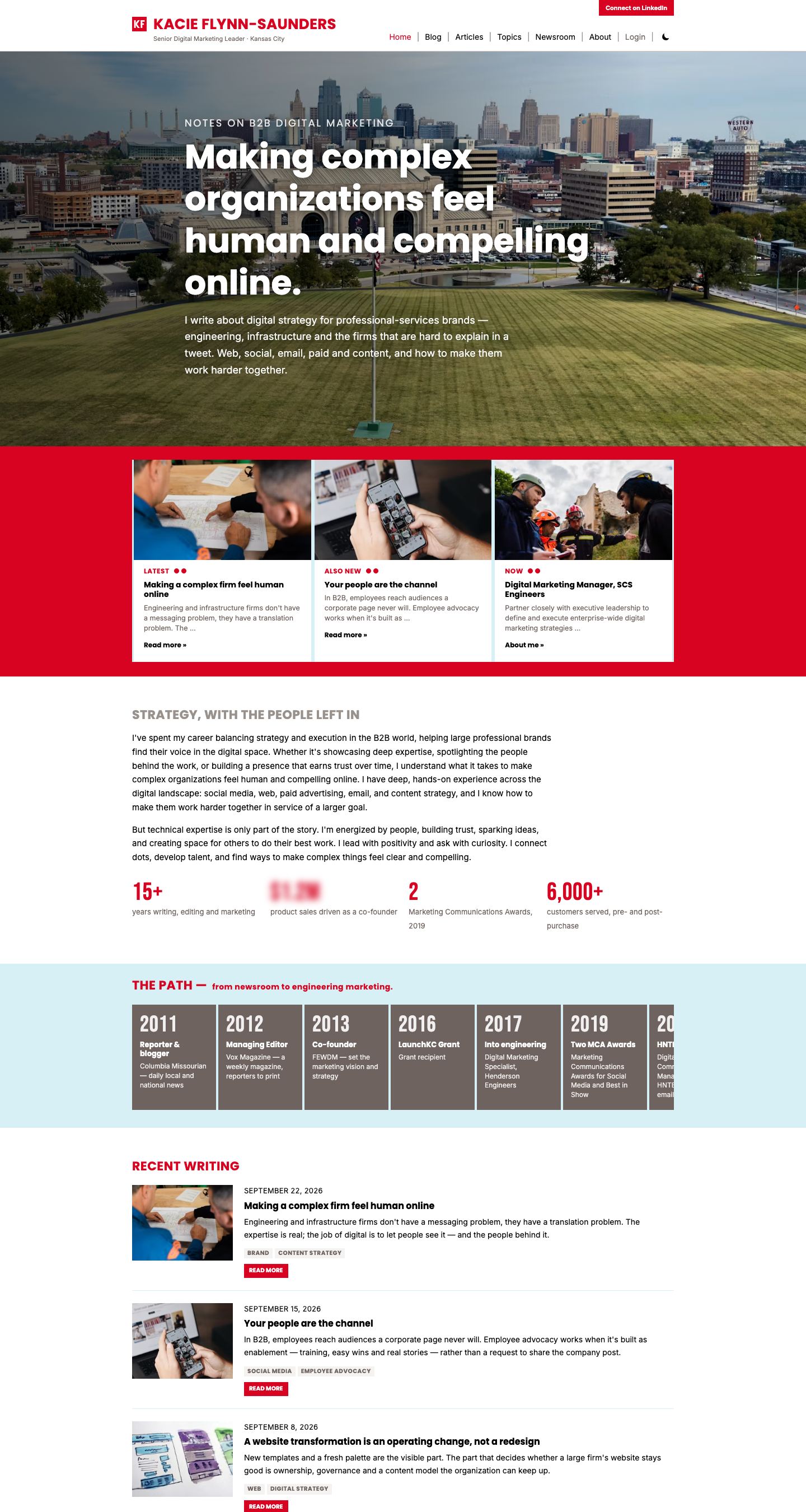
/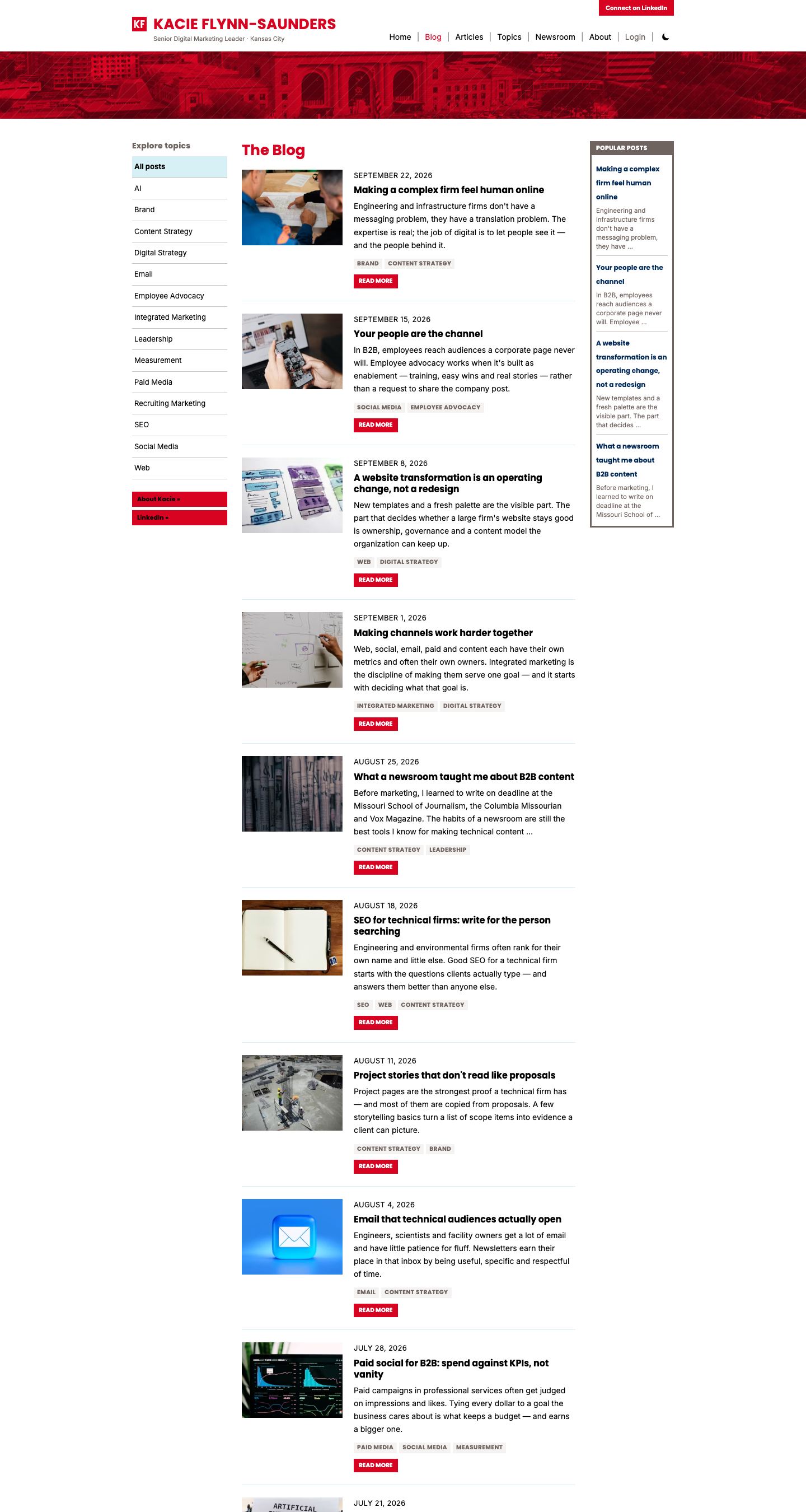
/blog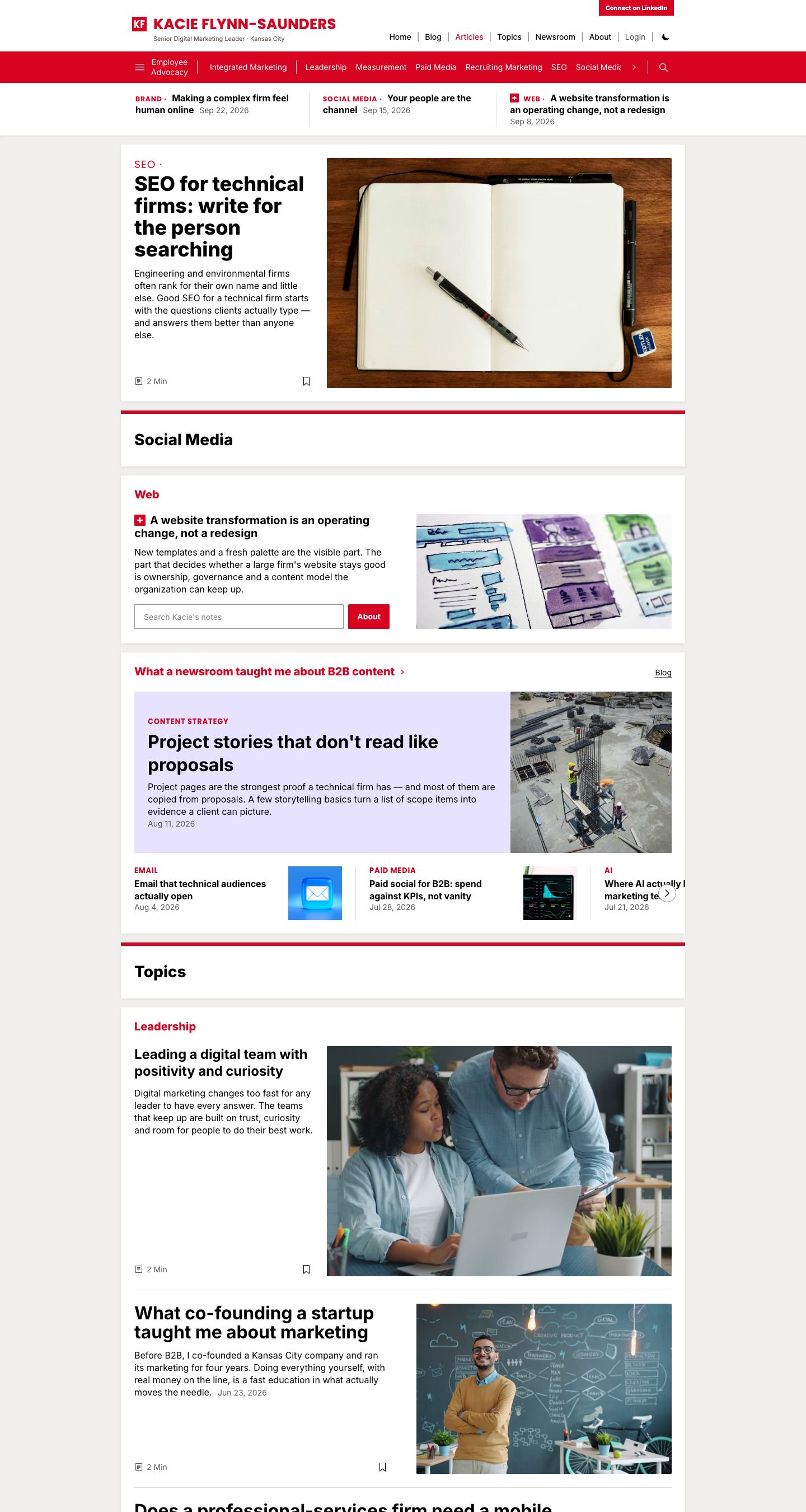
/articles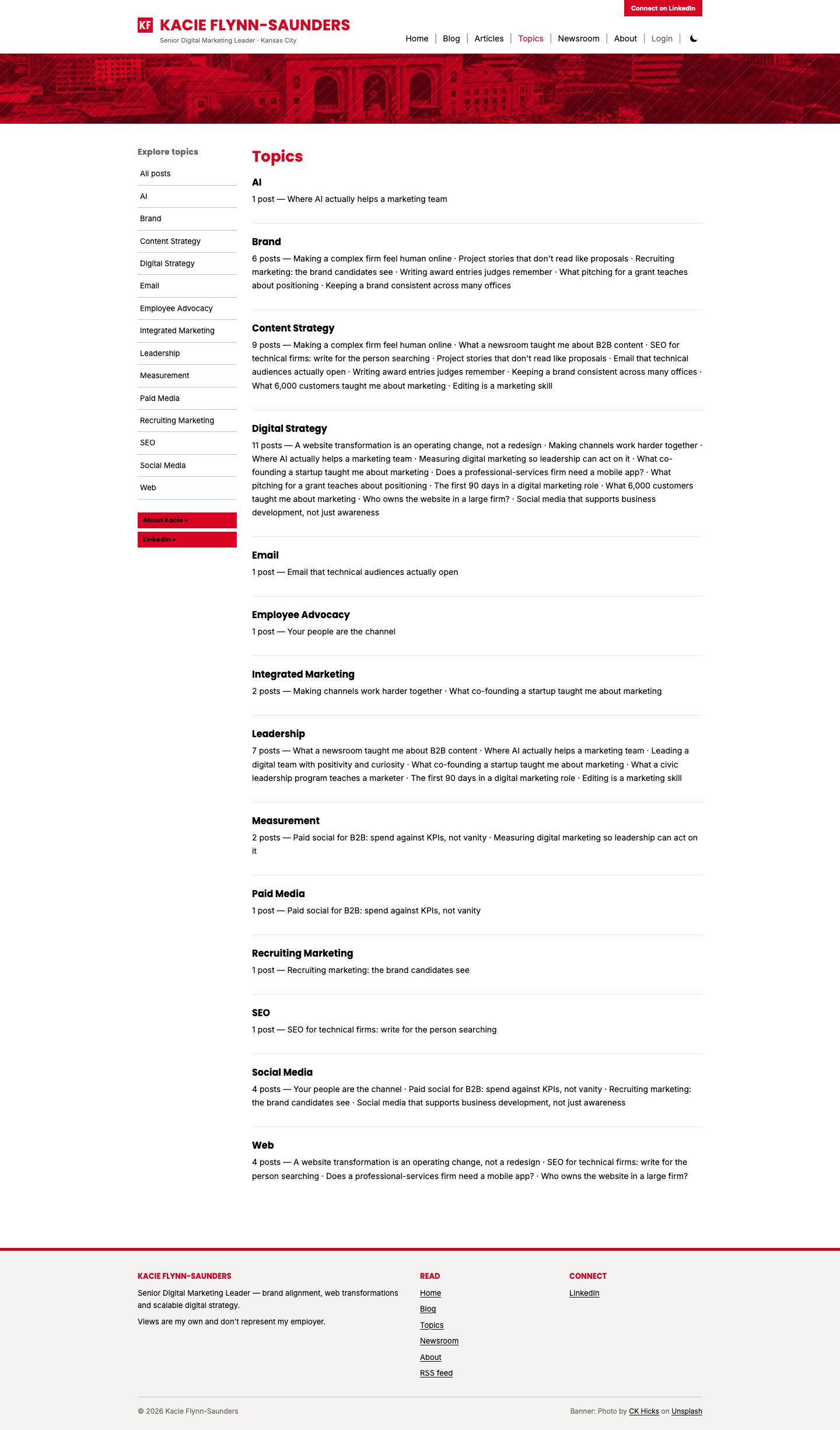
/topics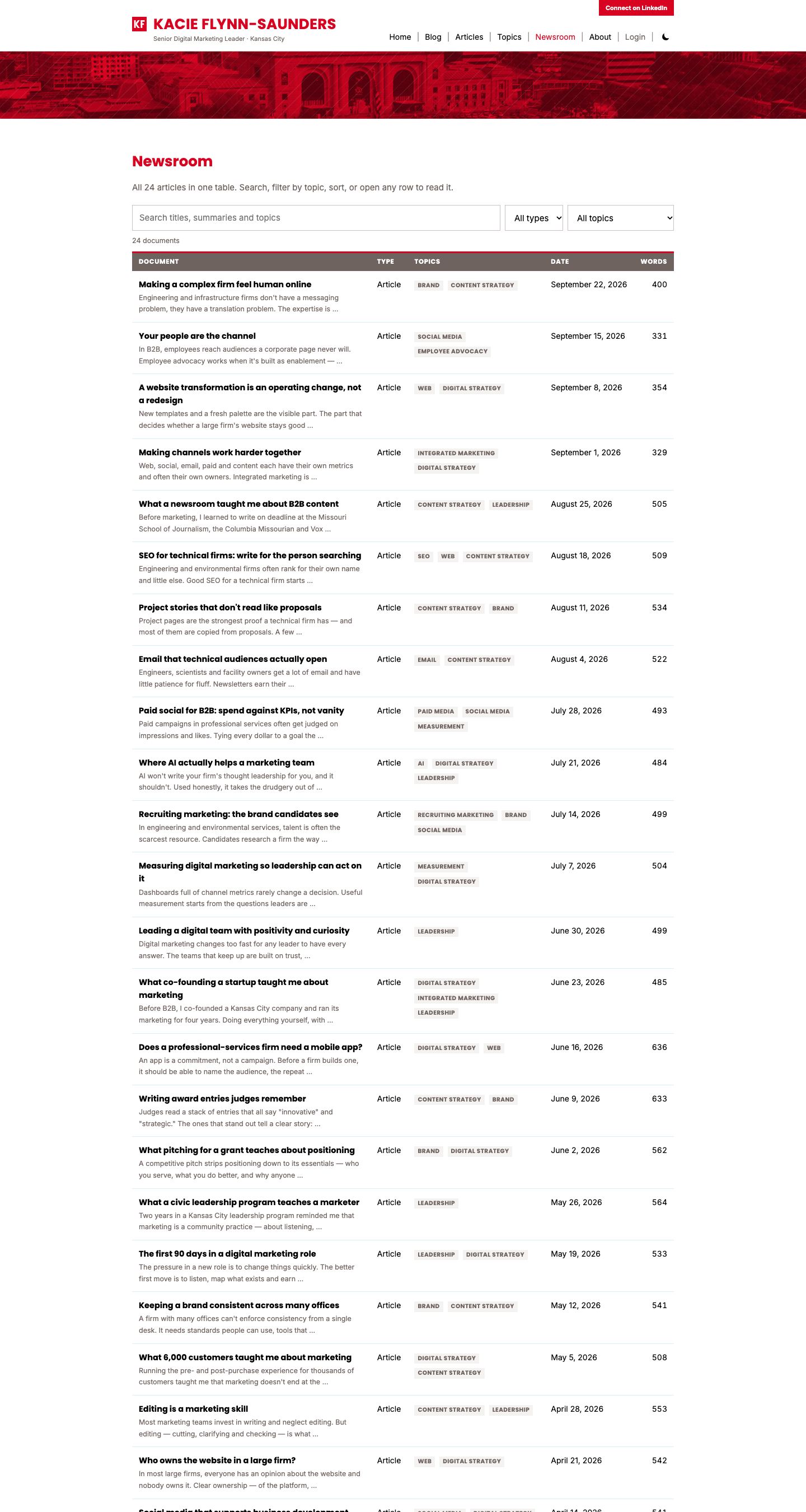
/newsroom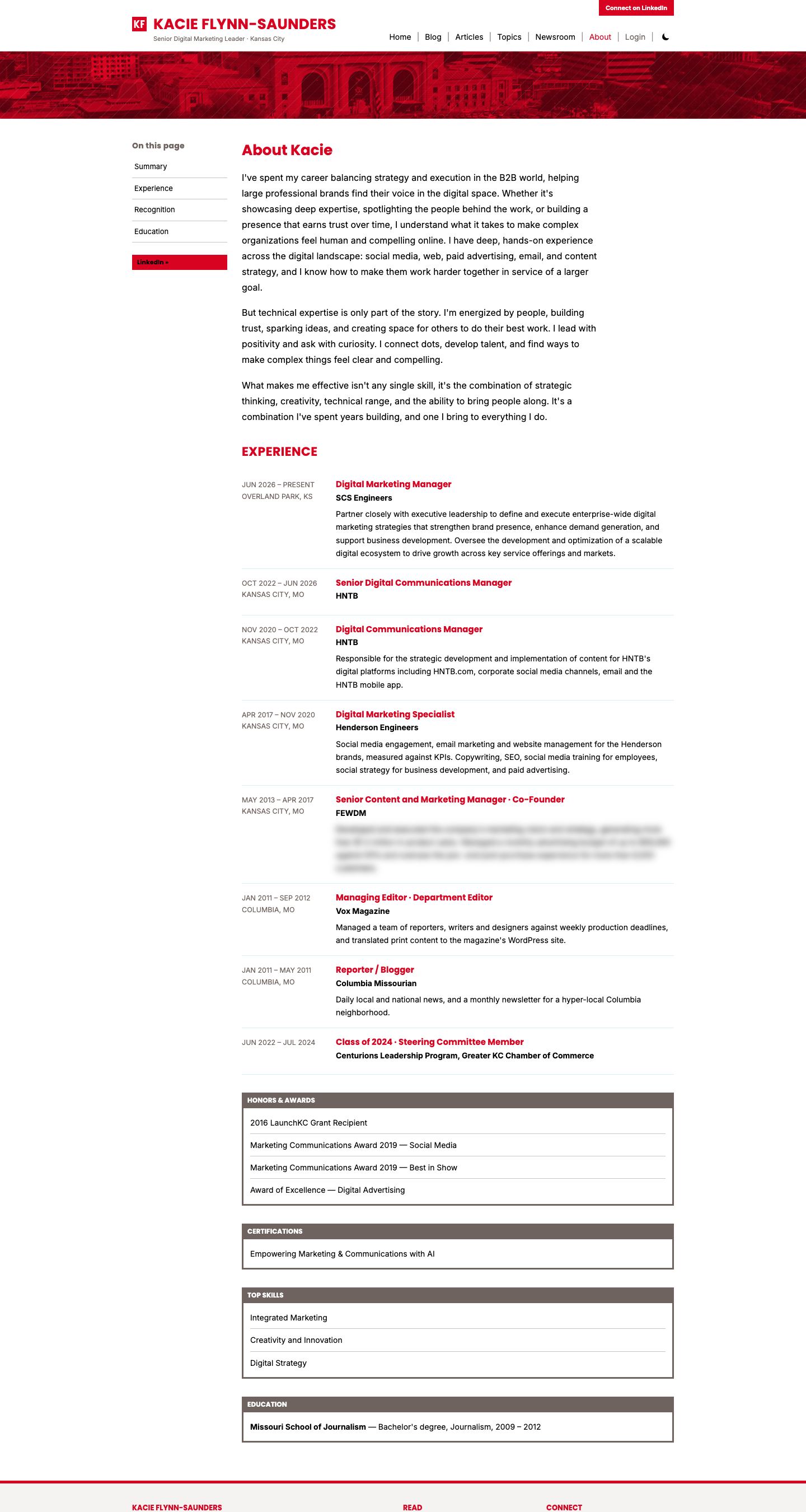
/about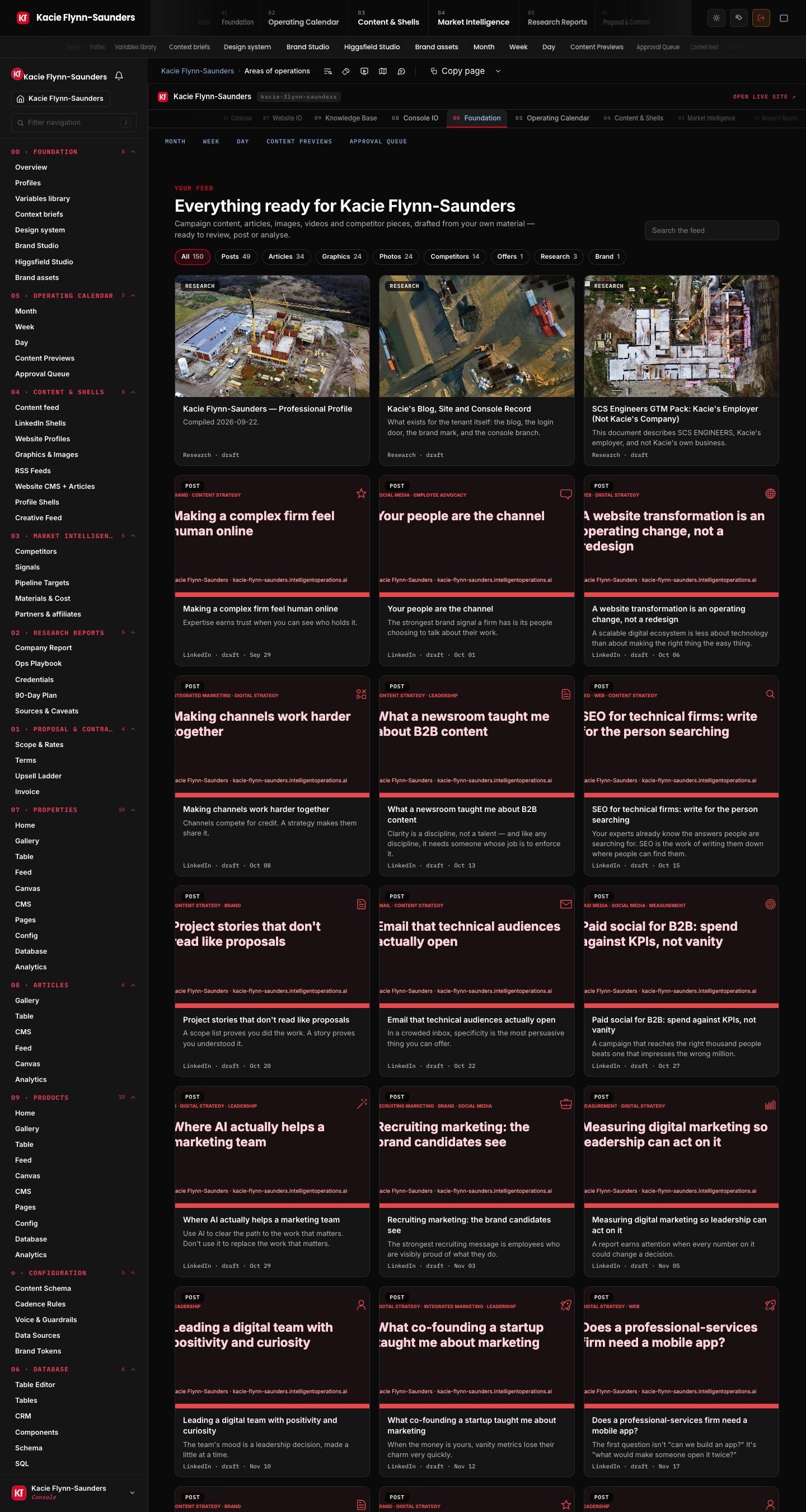
/tenant/kacie-flynn-saunders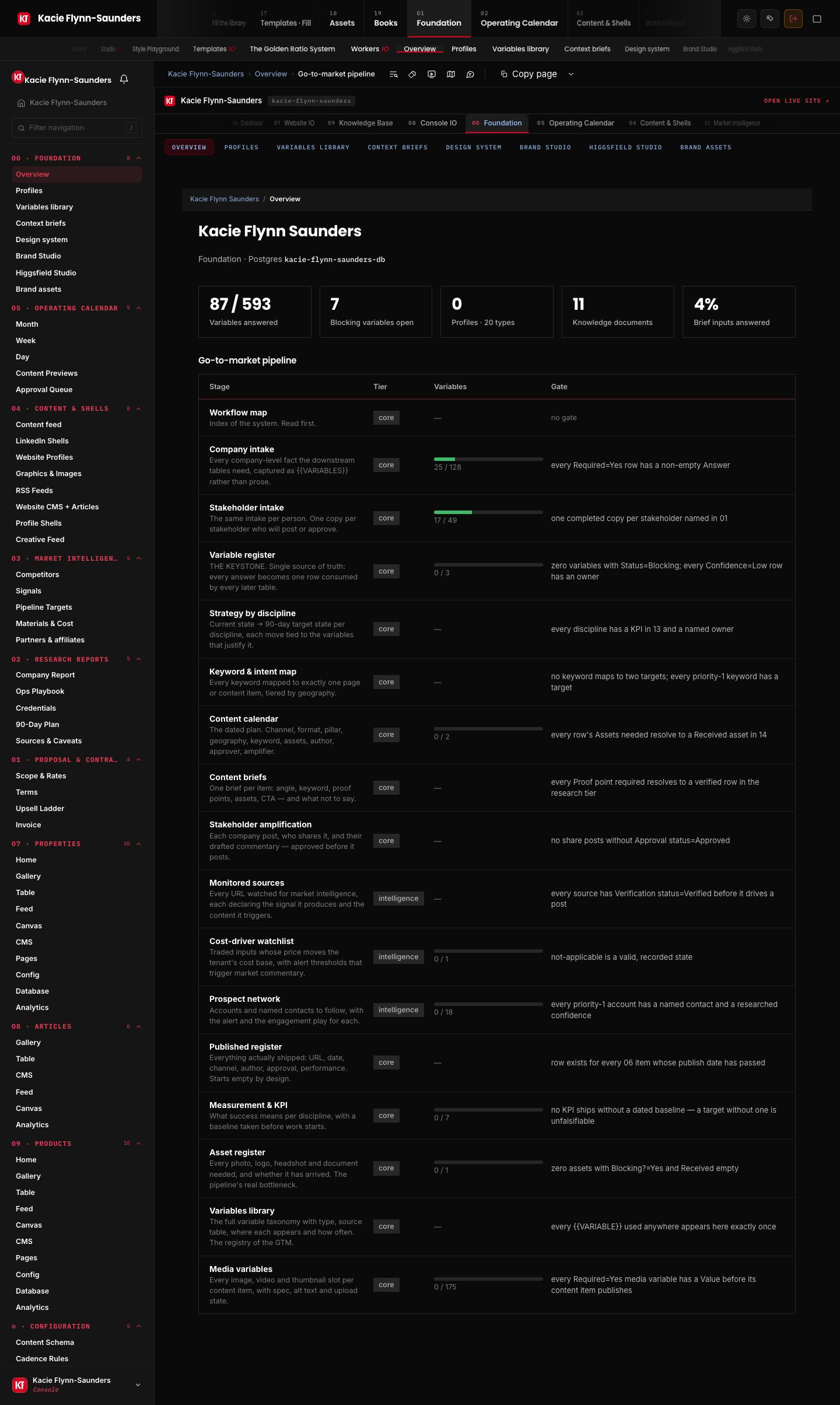
/tenant/kacie-flynn-saunders/foundation/overview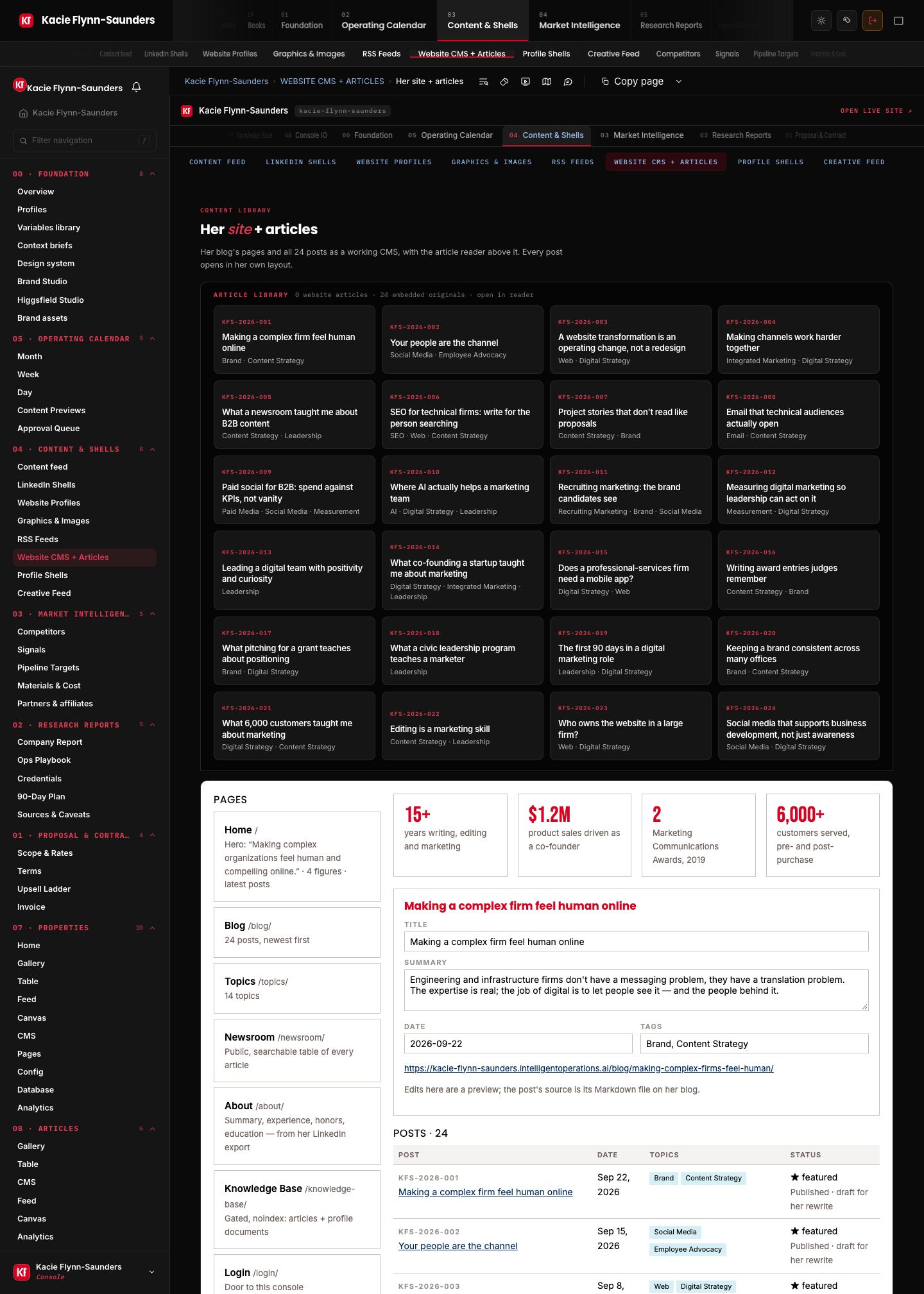
/tenant/kacie-flynn-saunders/content/cms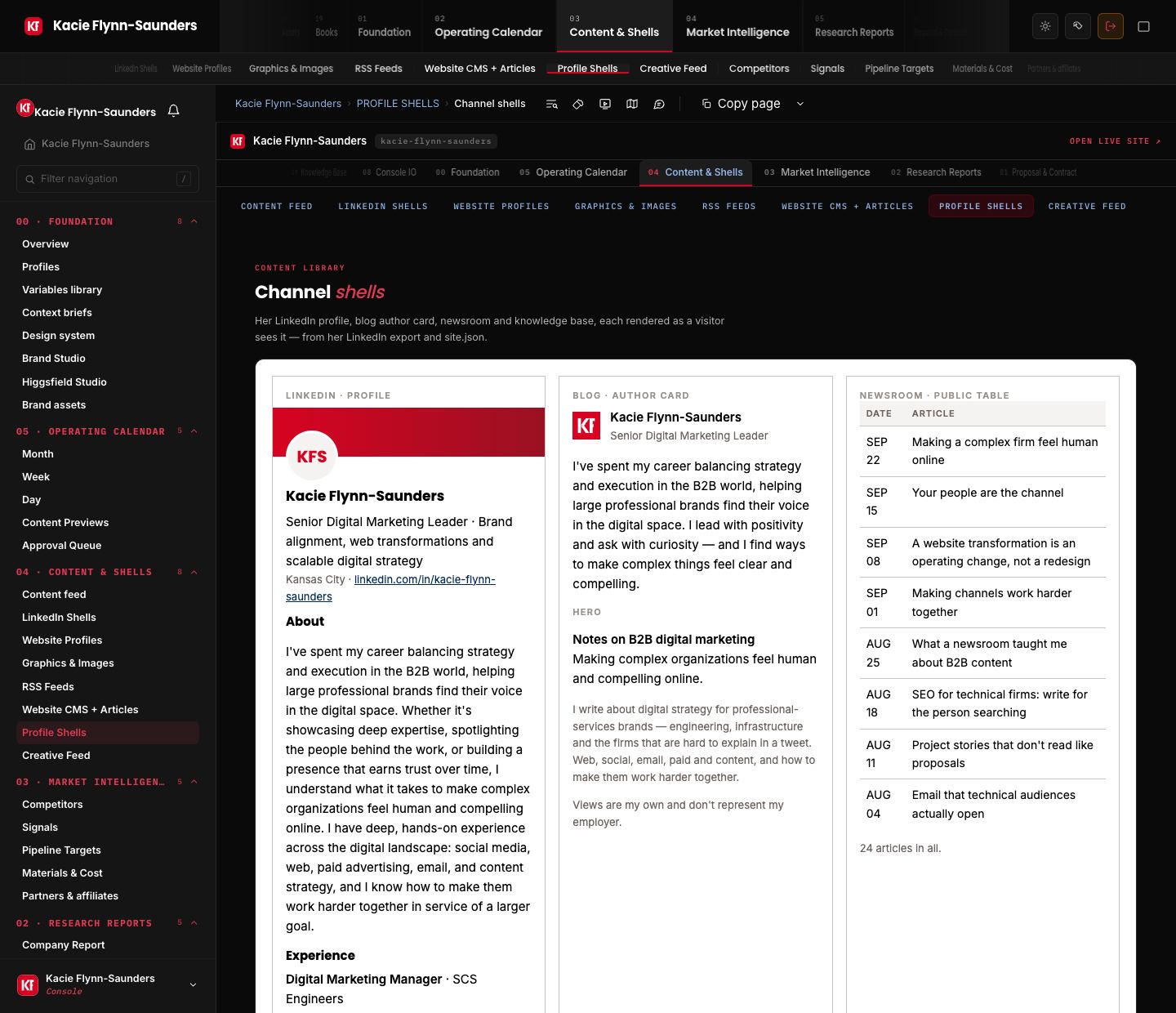
/tenant/kacie-flynn-saunders/content/shells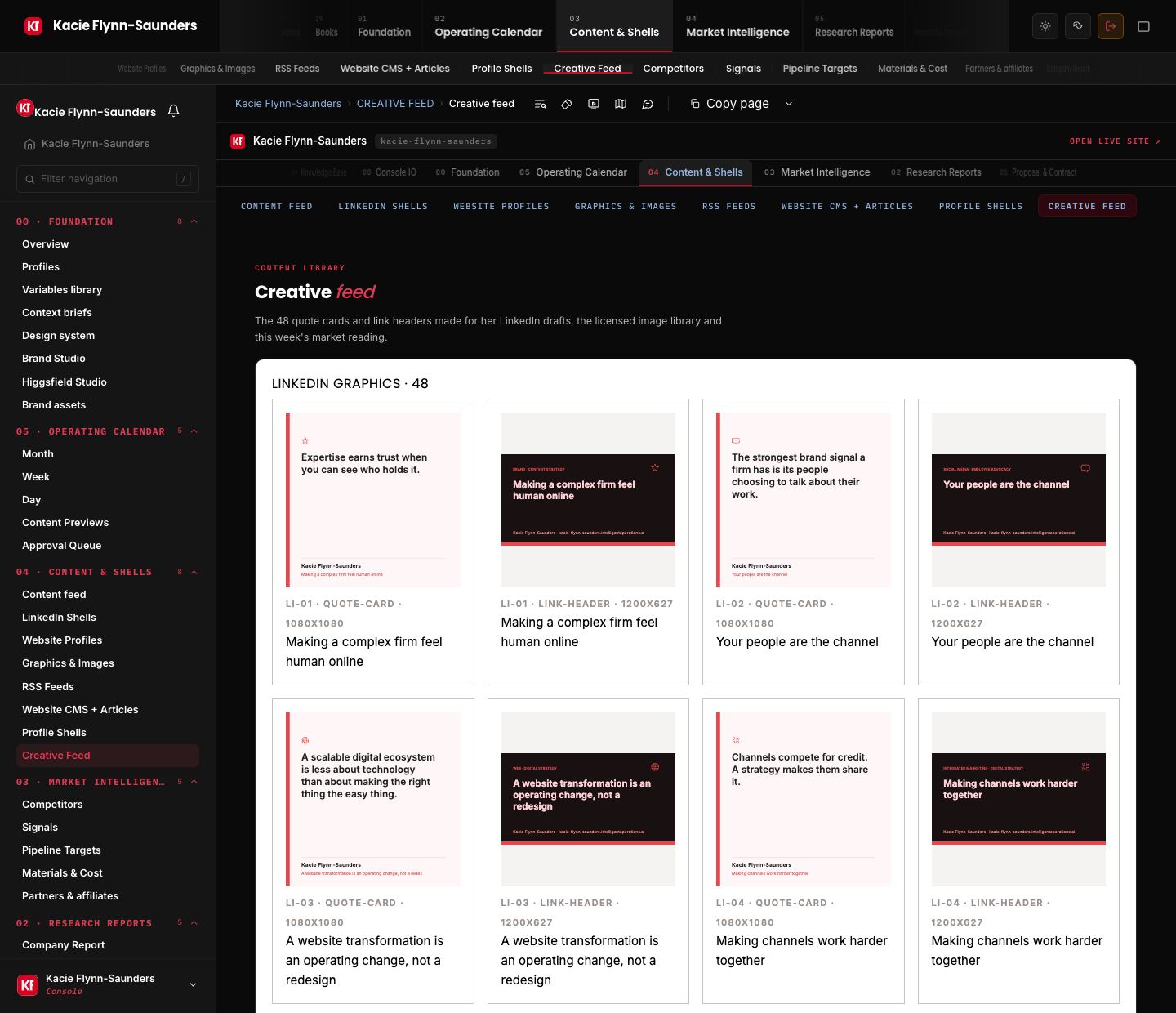
/tenant/kacie-flynn-saunders/content/feed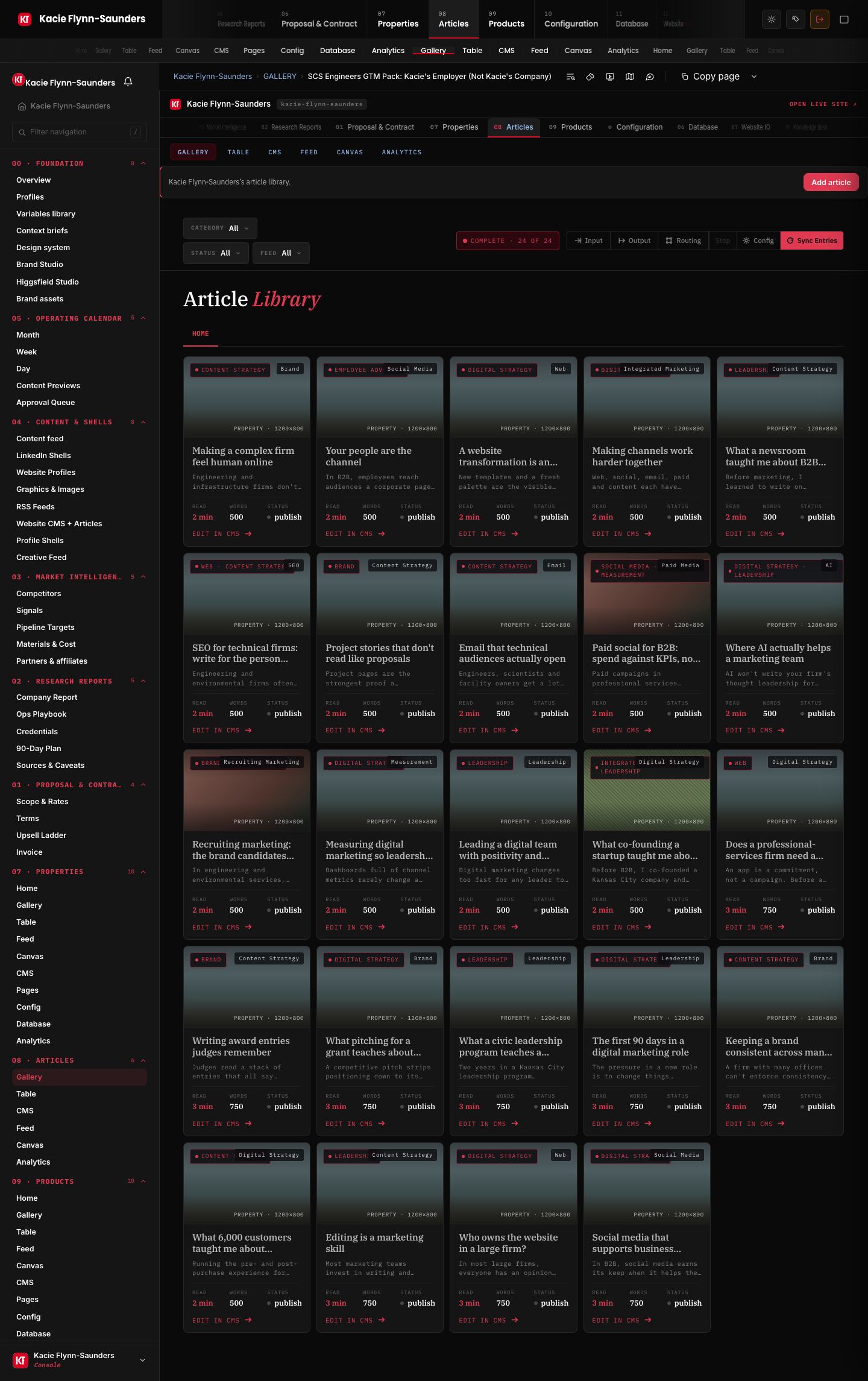
/tenant/kacie-flynn-saunders/articles/gallery
/tenant/kacie-flynn-saunders/products/table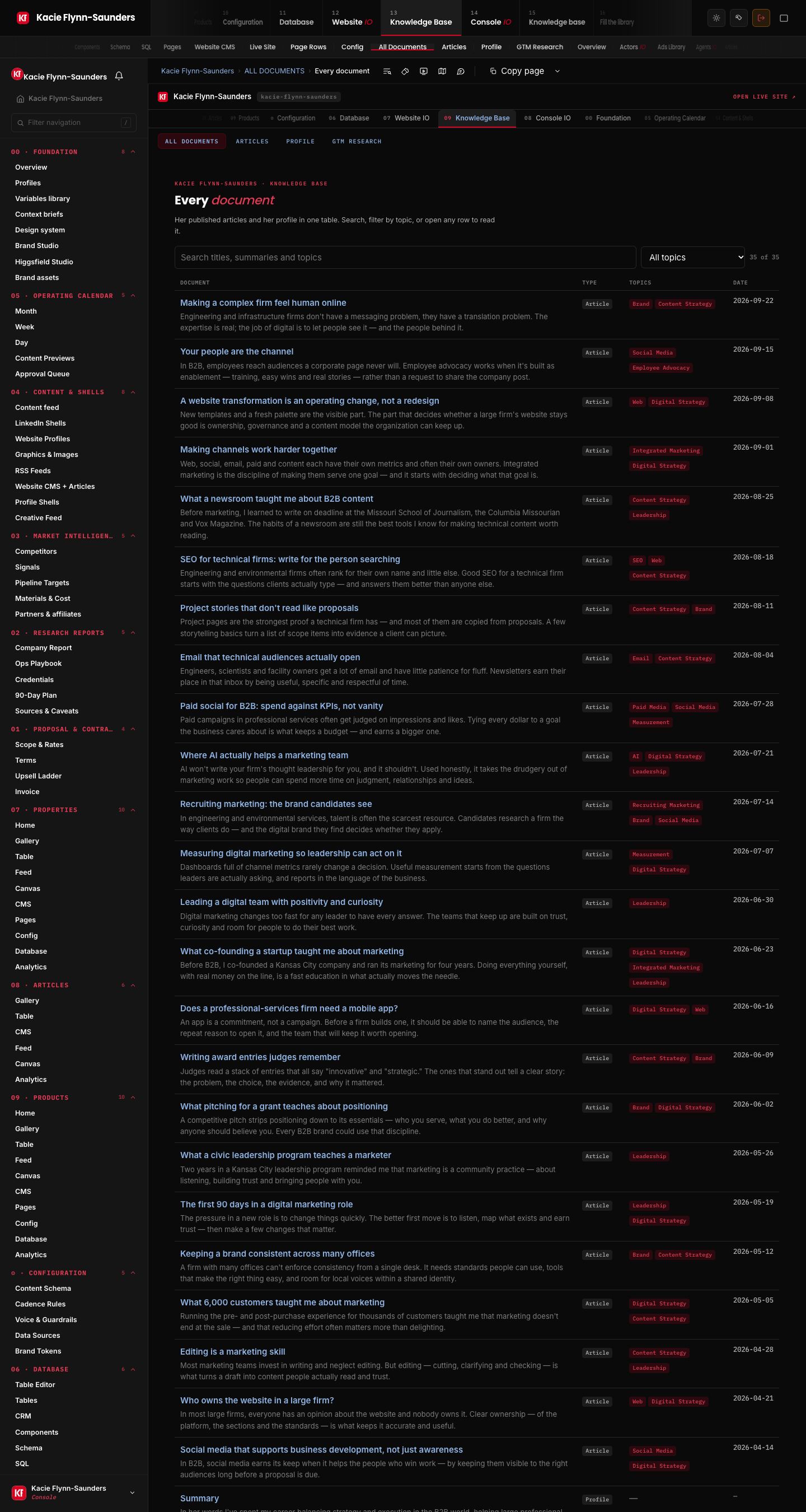
/tenant/kacie-flynn-saunders/knowledge/all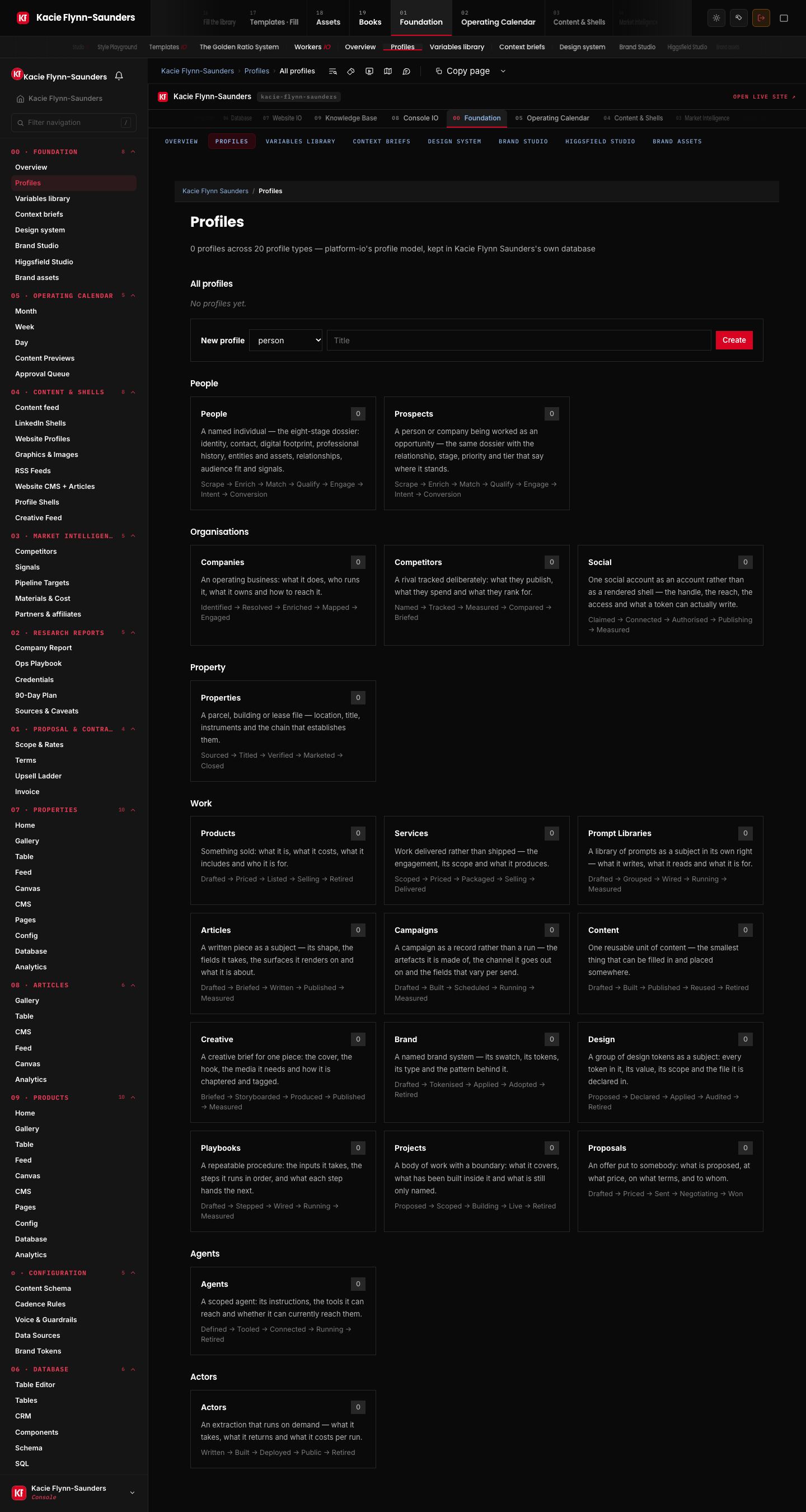
/tenant/kacie-flynn-saunders/foundation/profiles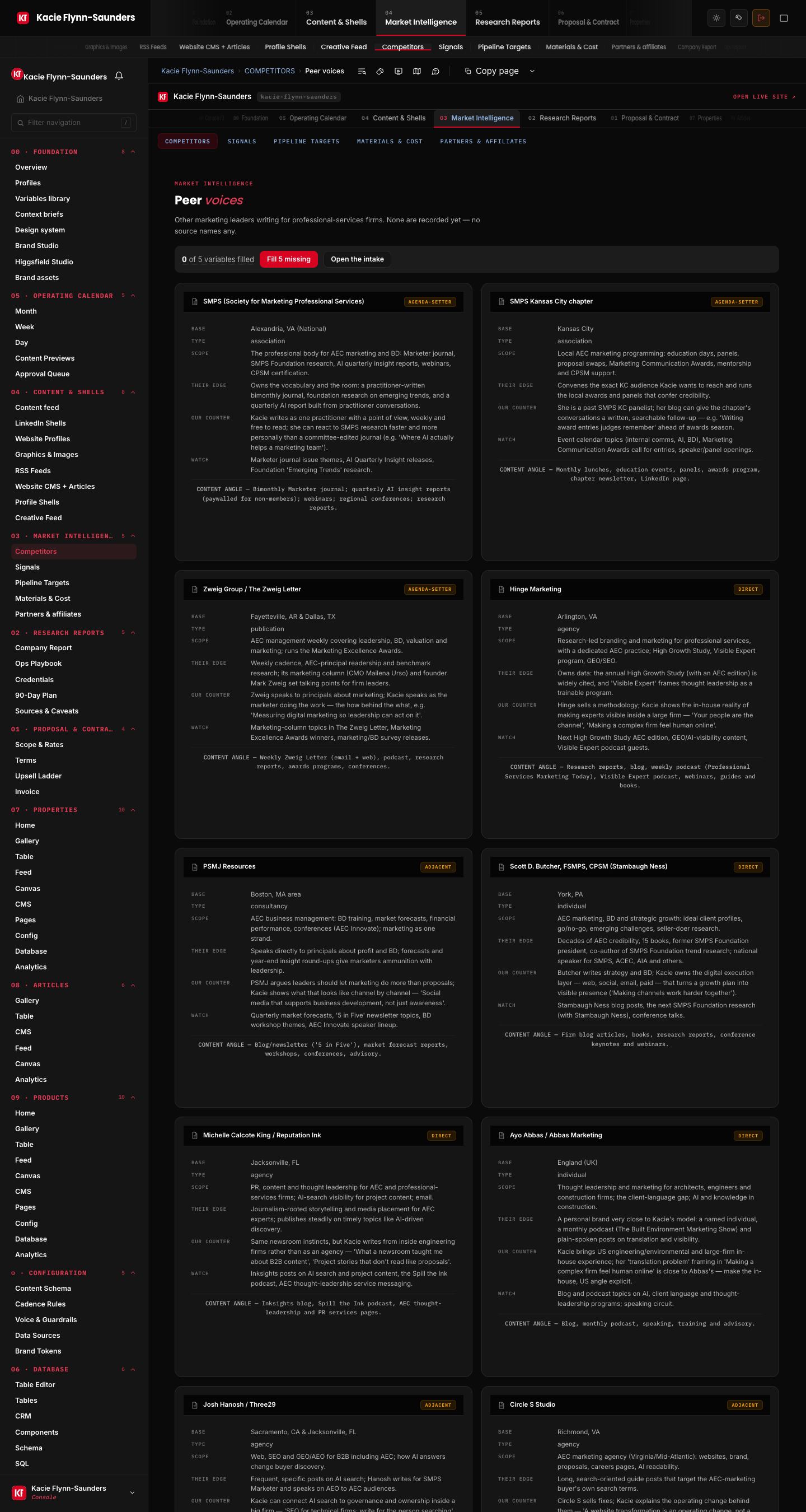
/tenant/kacie-flynn-saunders/intel/competitors
/tenant/kacie-flynn-saunders/database/tables
/tenant/kacie-flynn-saunders/database/schema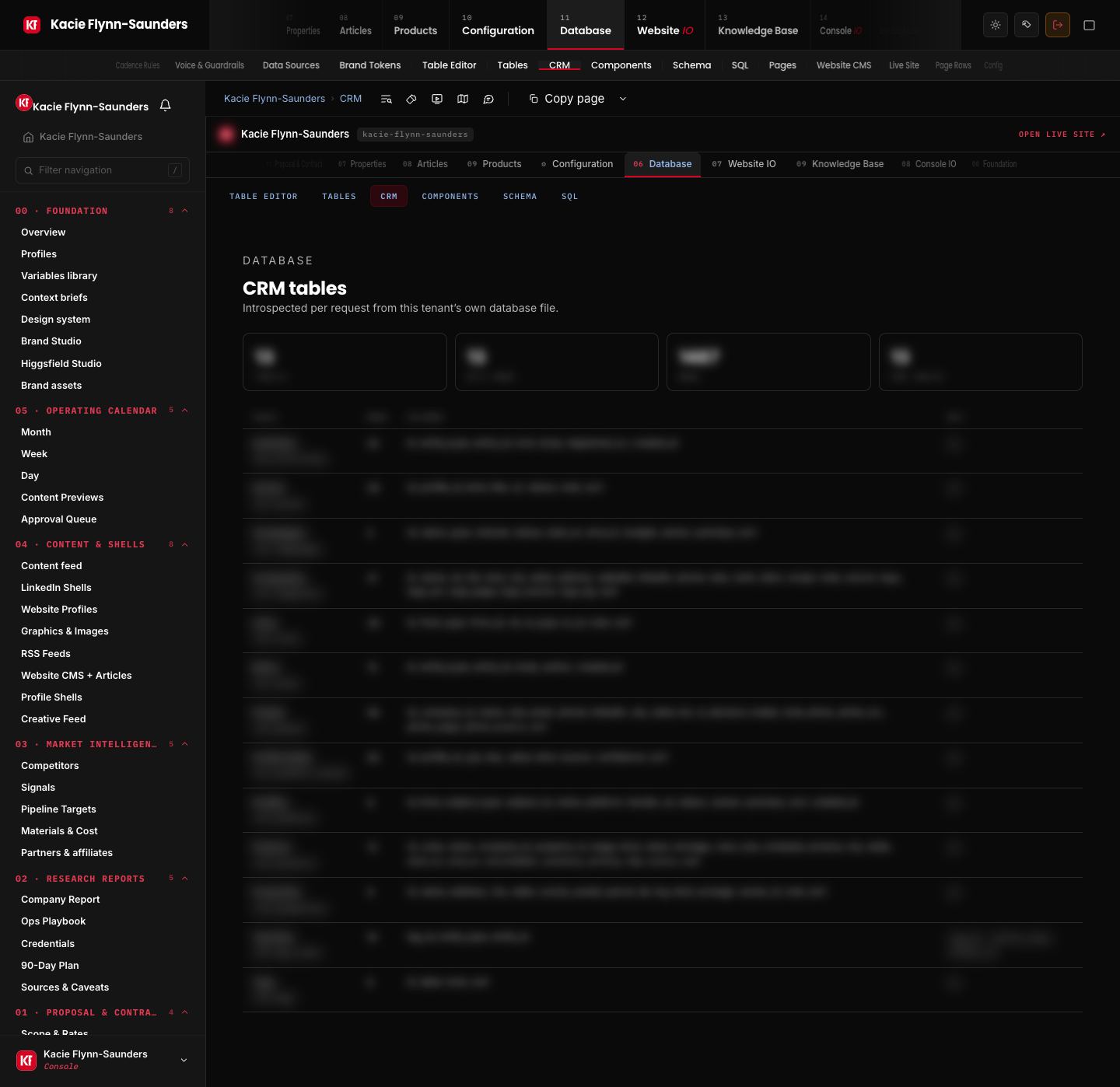
/tenant/kacie-flynn-saunders/database/crm
/tenant/kacie-flynn-saunders/intel/pipeline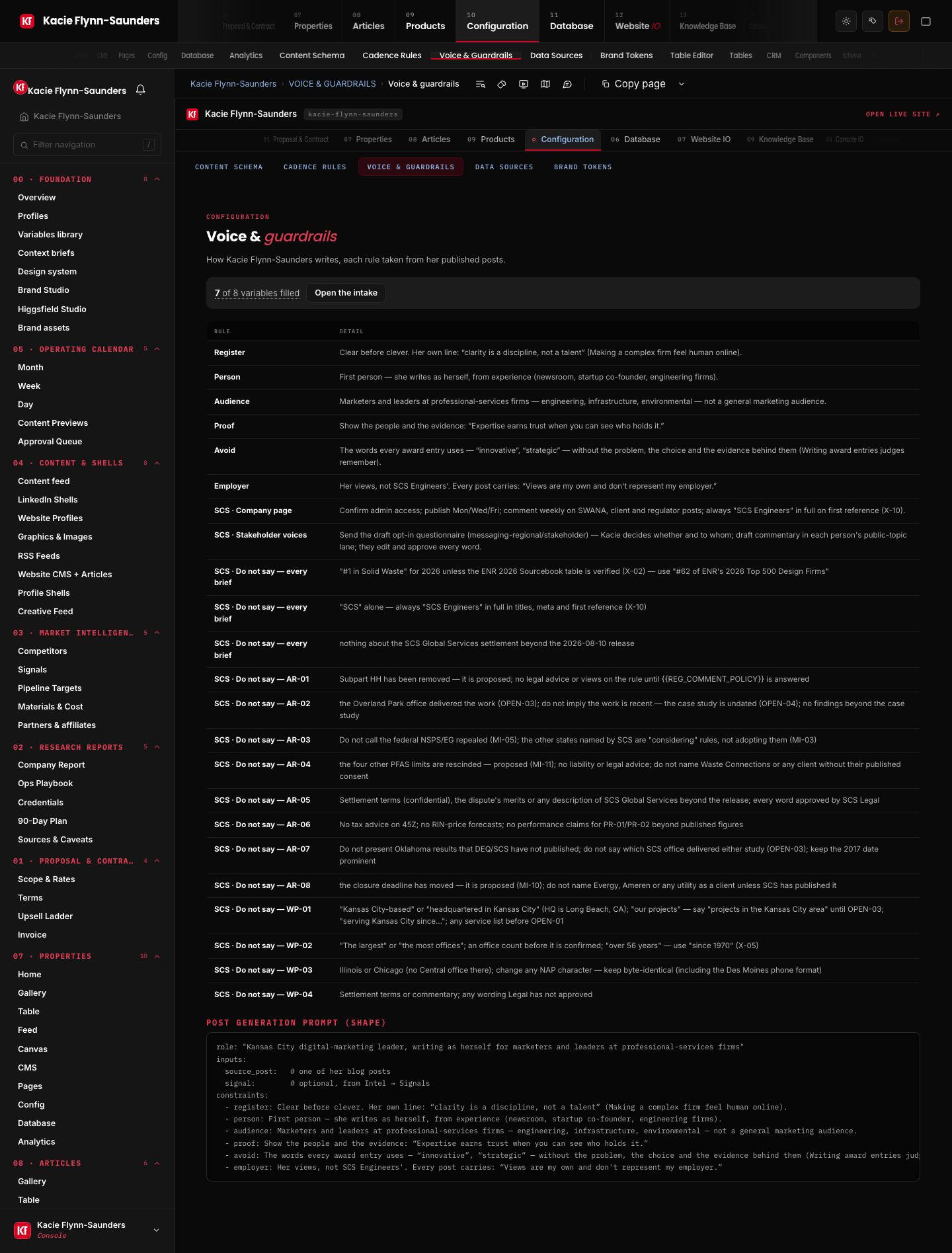
/tenant/kacie-flynn-saunders/config/voice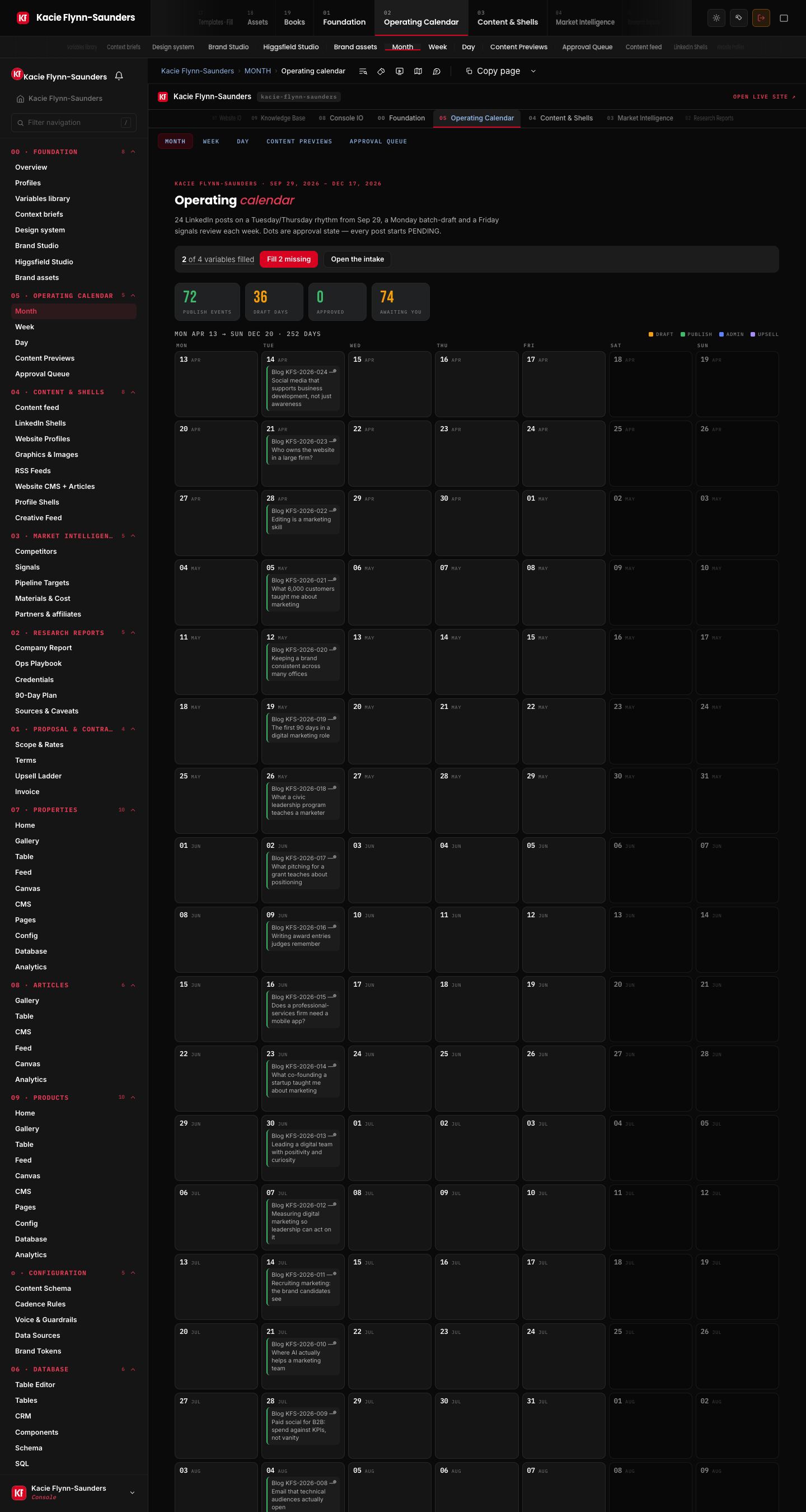
/tenant/kacie-flynn-saunders/calendar/month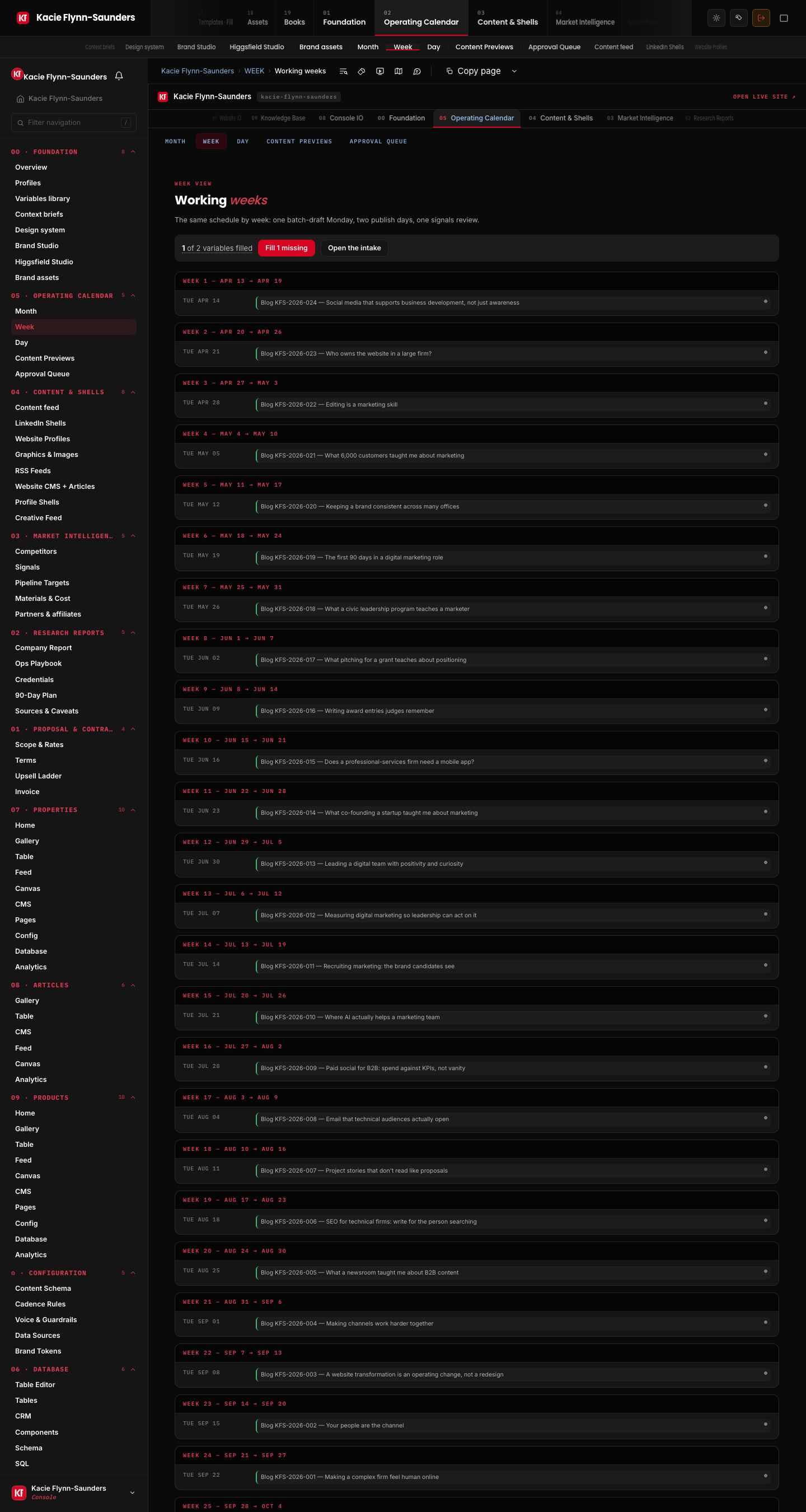
/tenant/kacie-flynn-saunders/calendar/week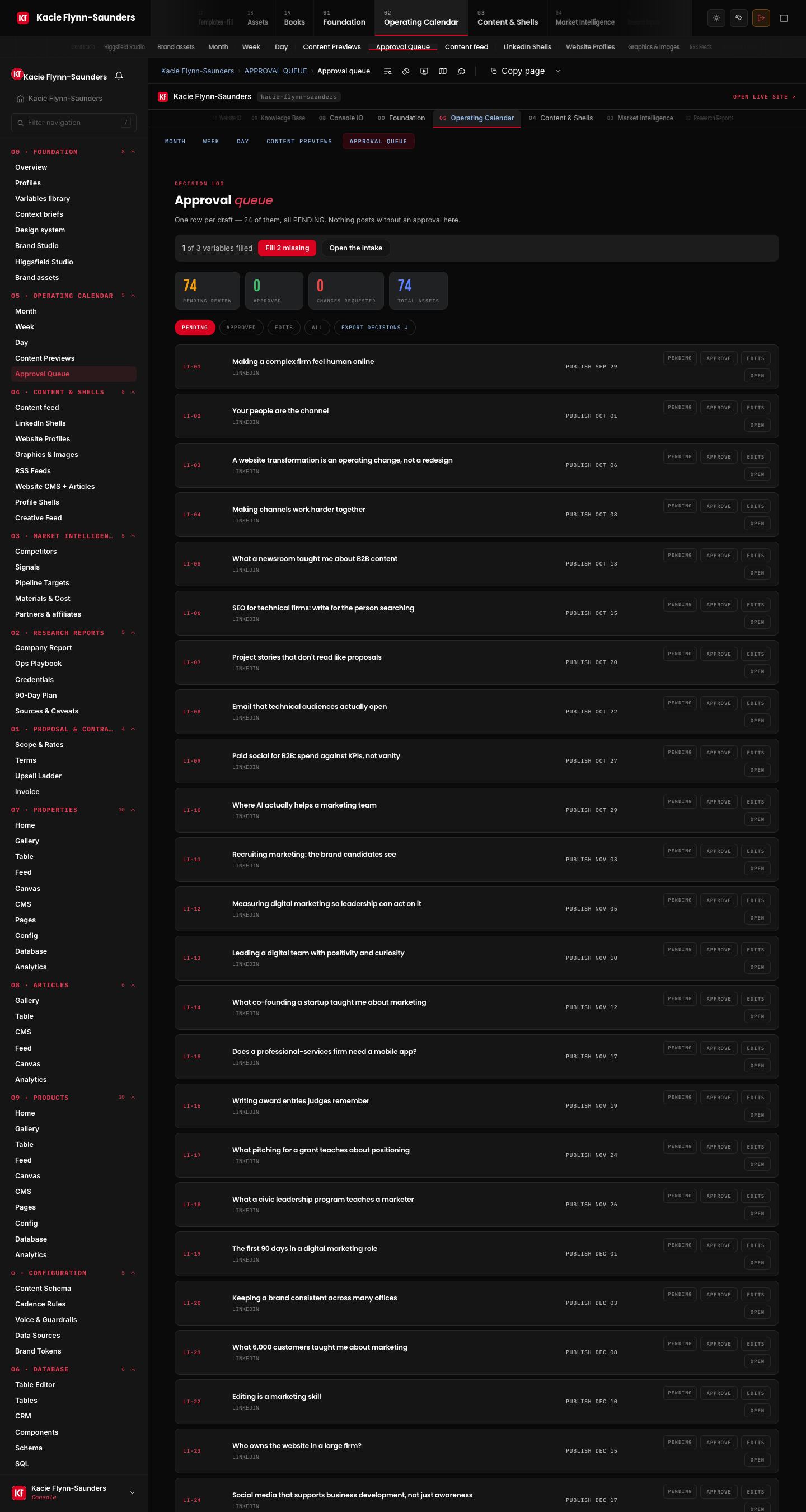
/tenant/kacie-flynn-saunders/calendar/approvals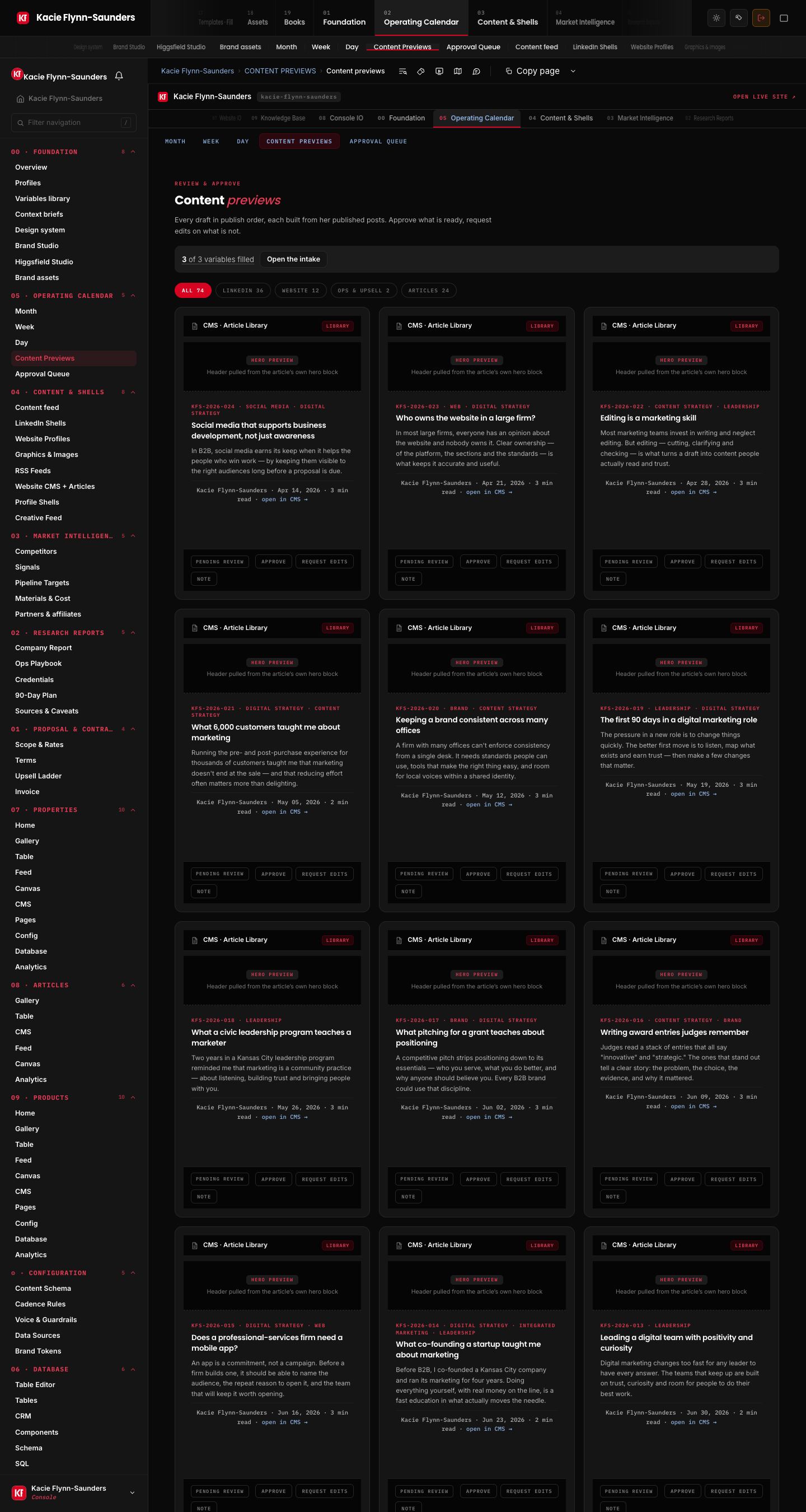
/tenant/kacie-flynn-saunders/calendar/previews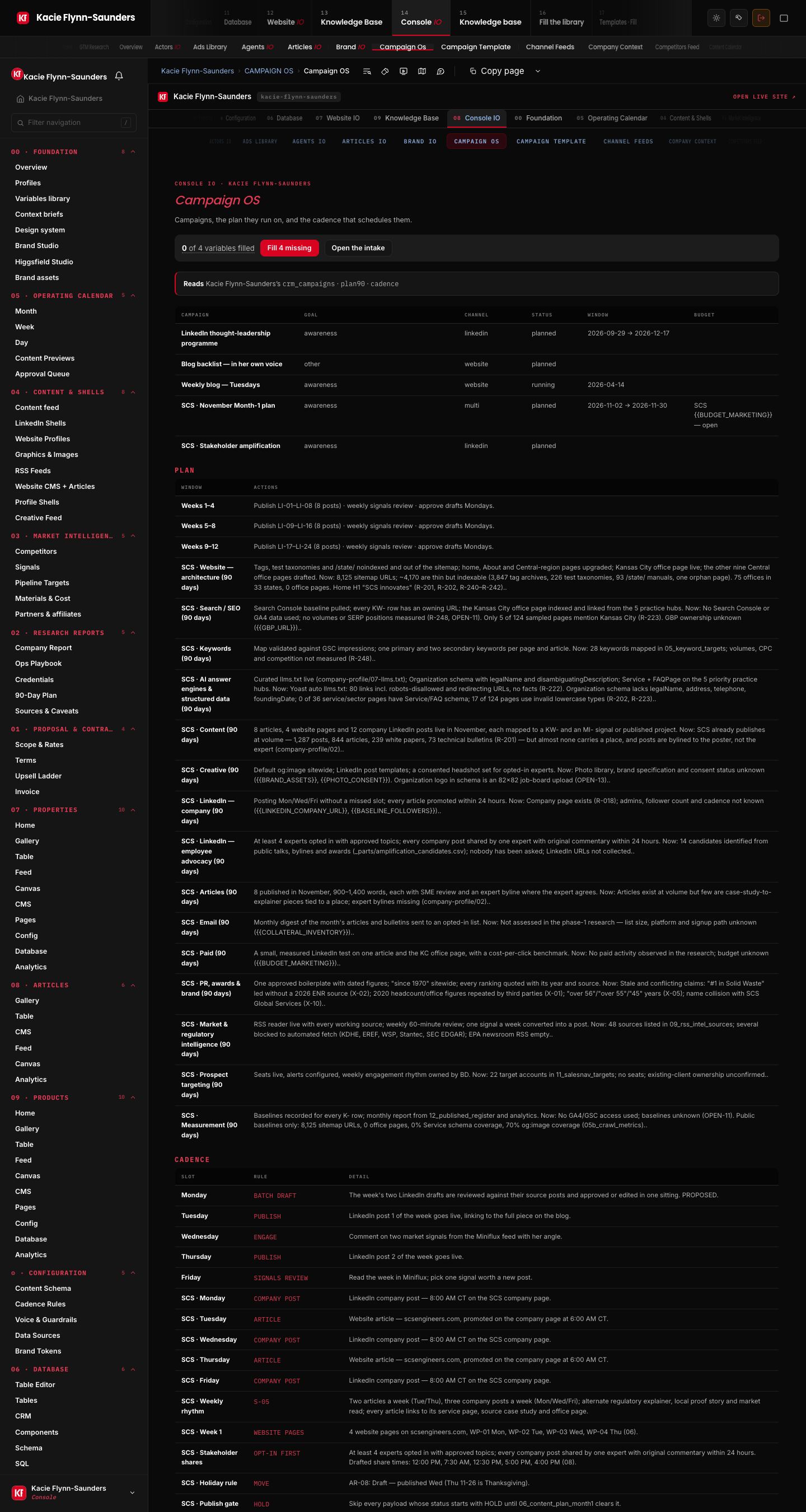
/tenant/kacie-flynn-saunders/consoles/campaign-os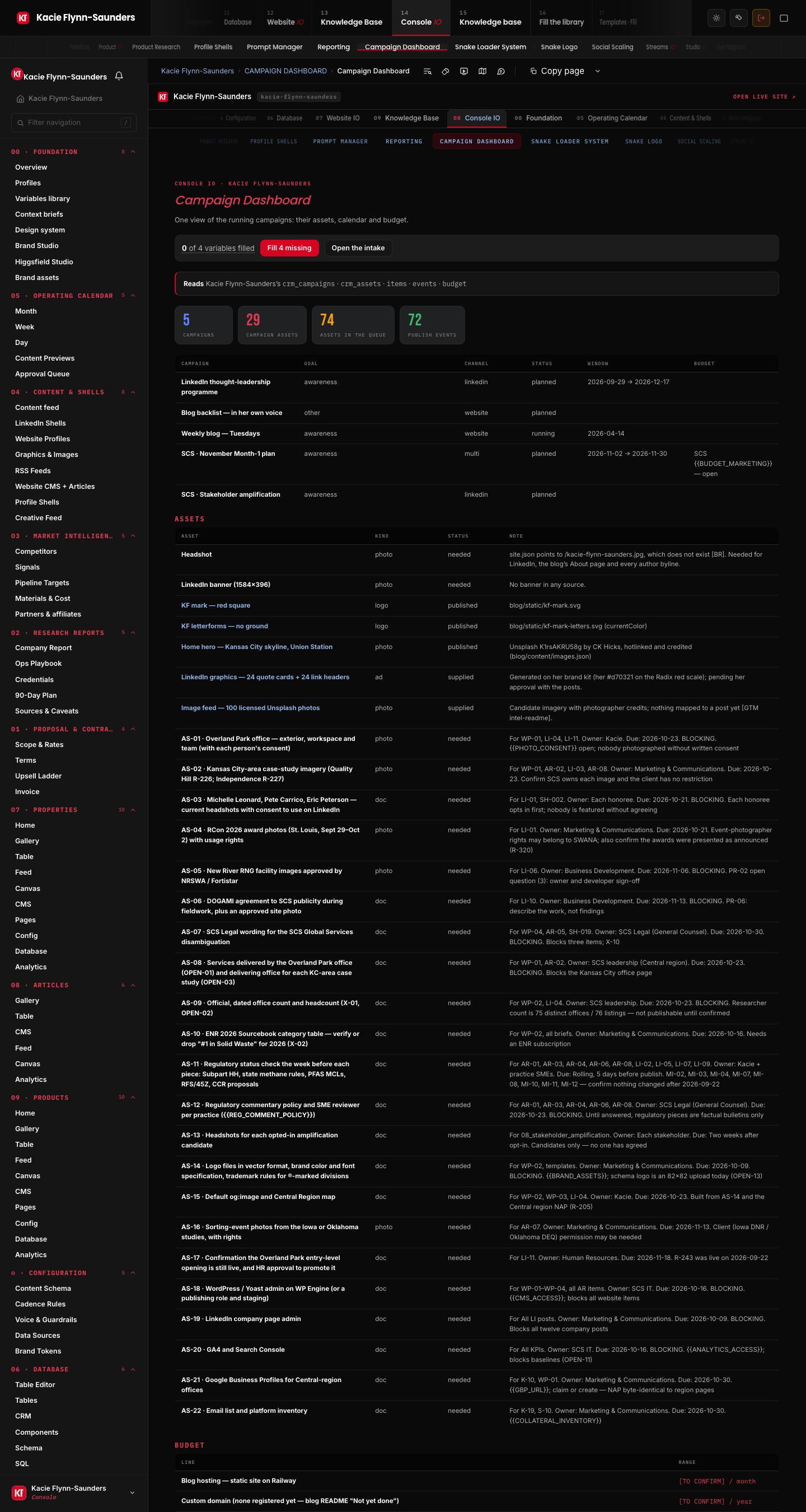
/tenant/kacie-flynn-saunders/consoles/campaign-dashboard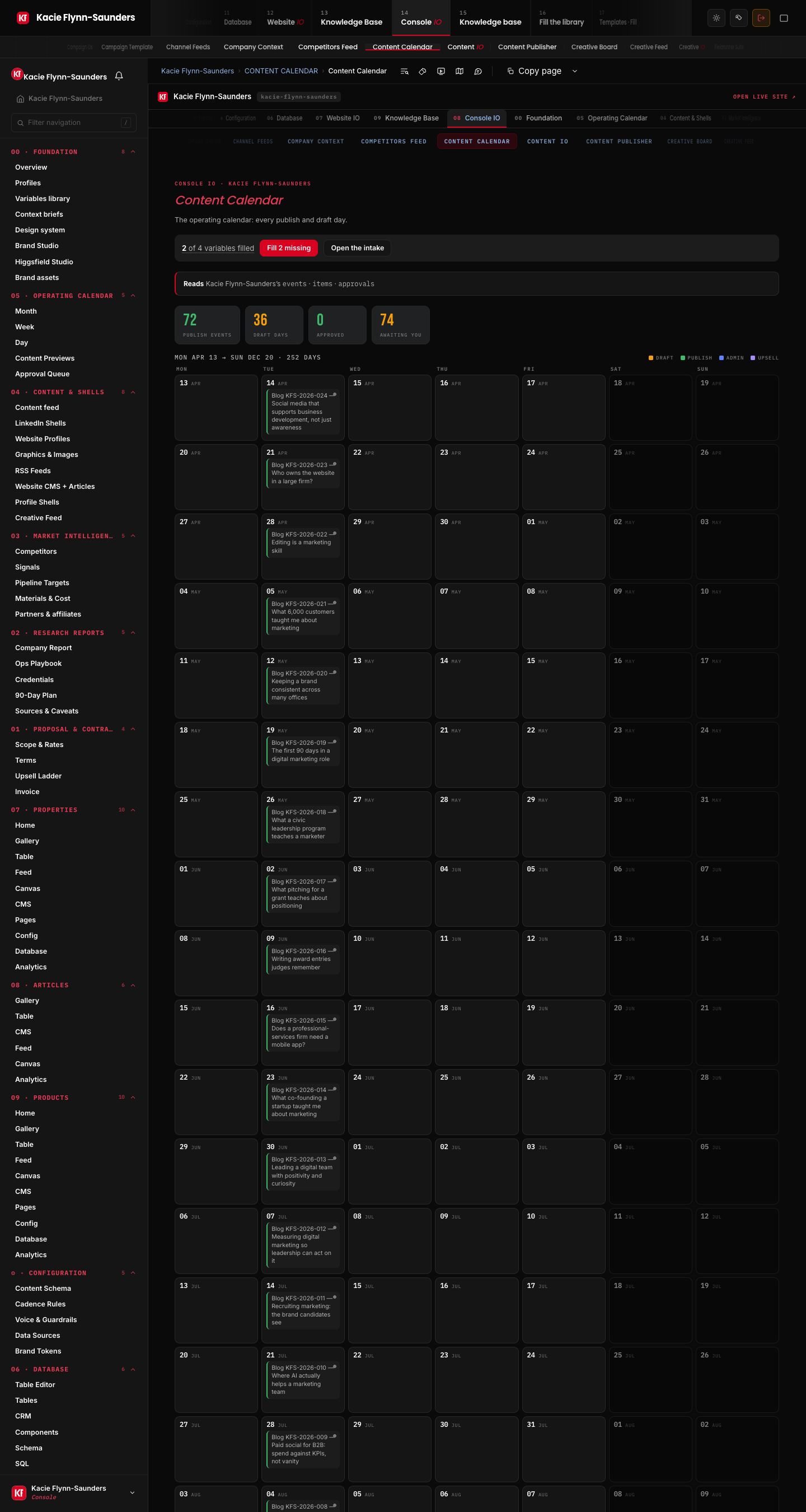
/tenant/kacie-flynn-saunders/consoles/content-calendar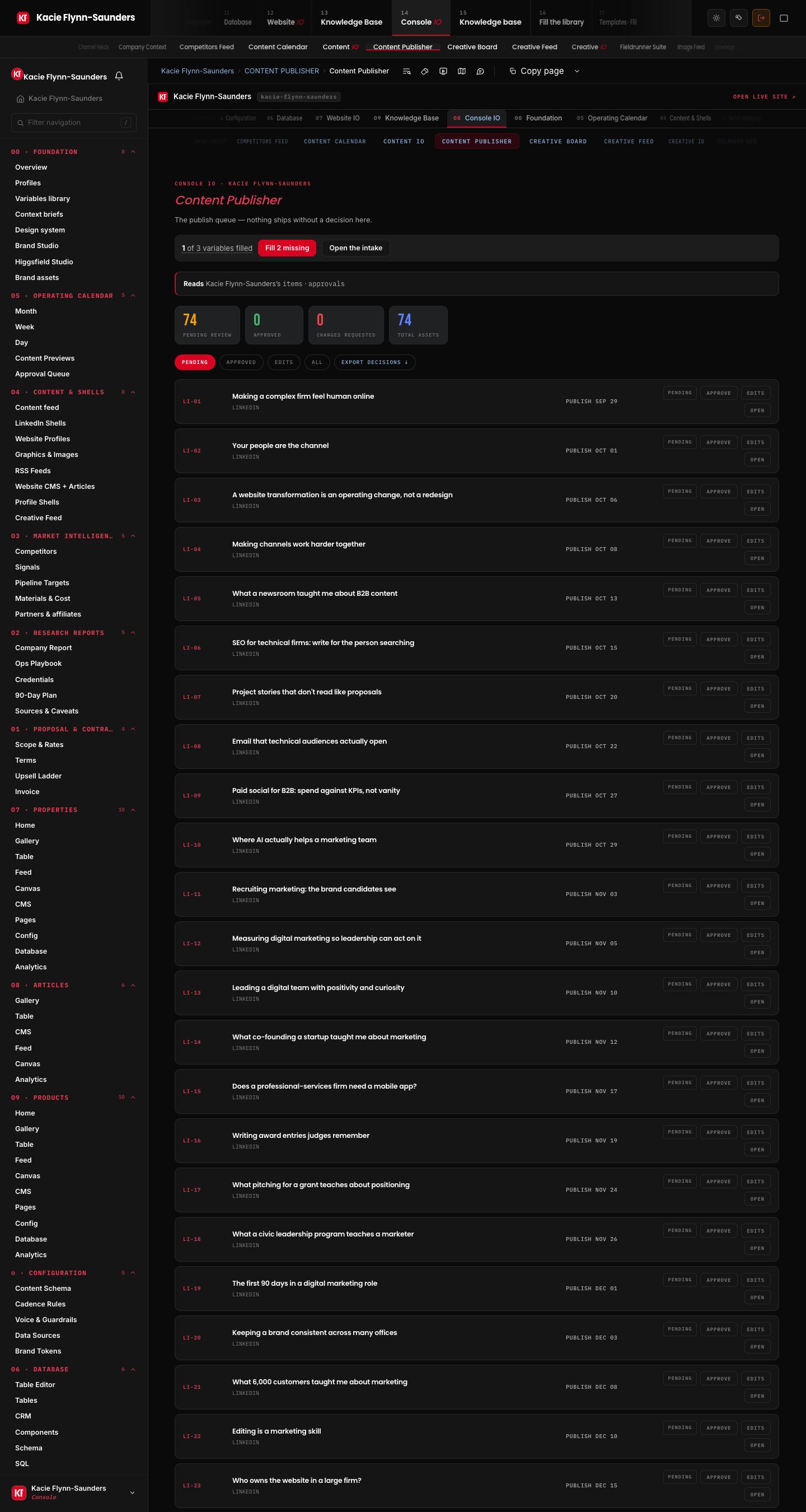
/tenant/kacie-flynn-saunders/consoles/content-publisher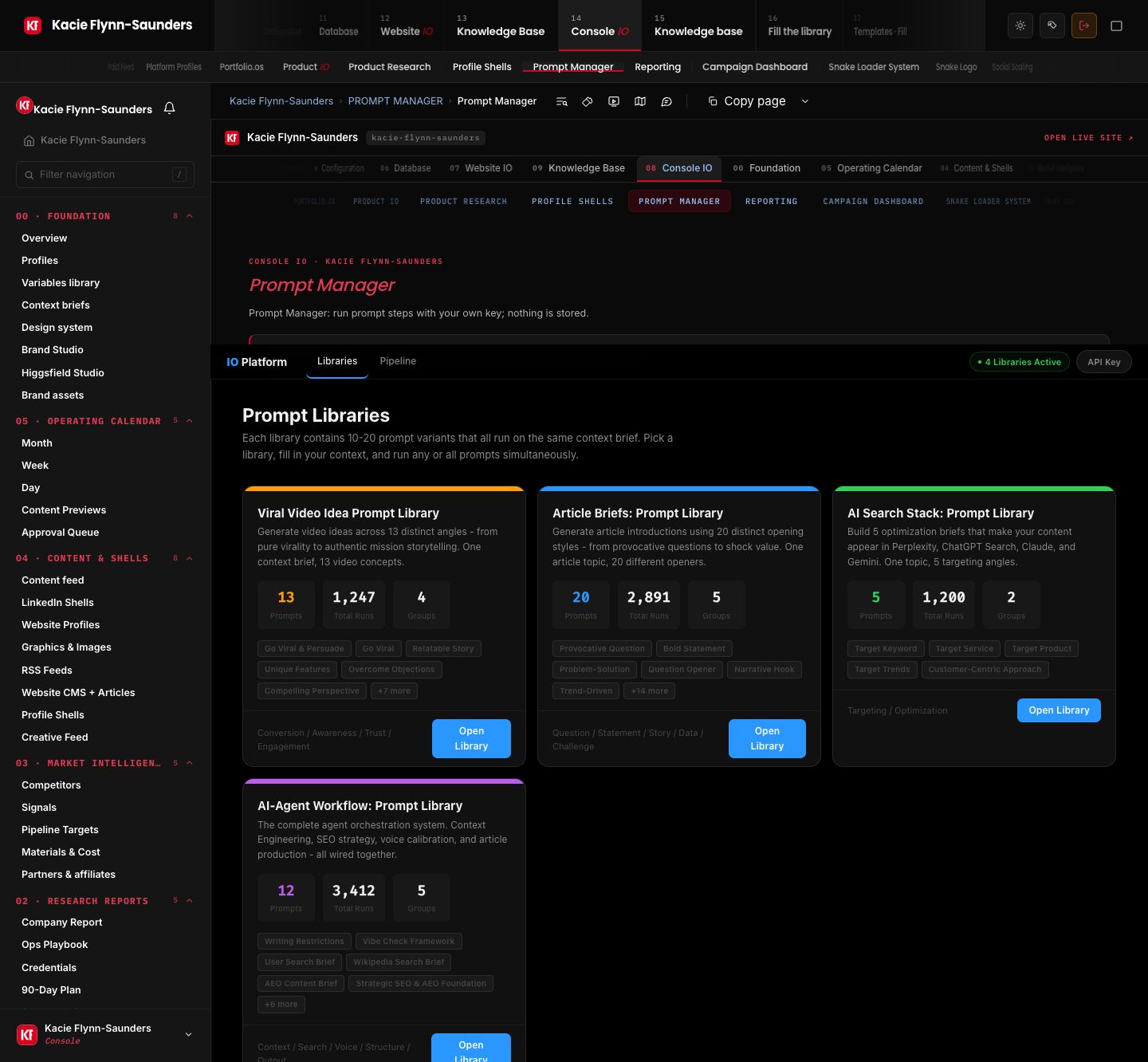
/tenant/kacie-flynn-saunders/consoles/prompt-library-workflows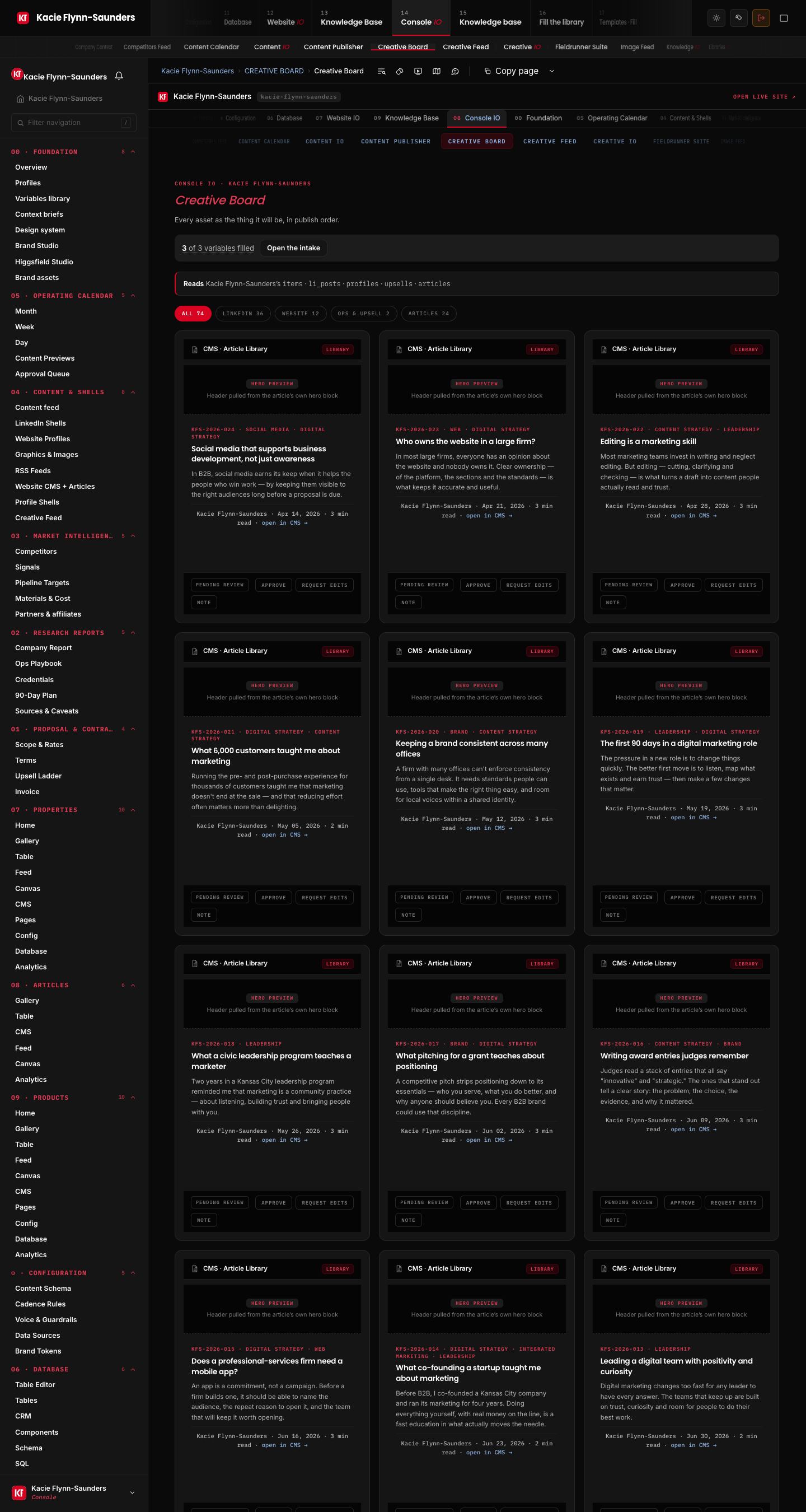
/tenant/kacie-flynn-saunders/consoles/creative-board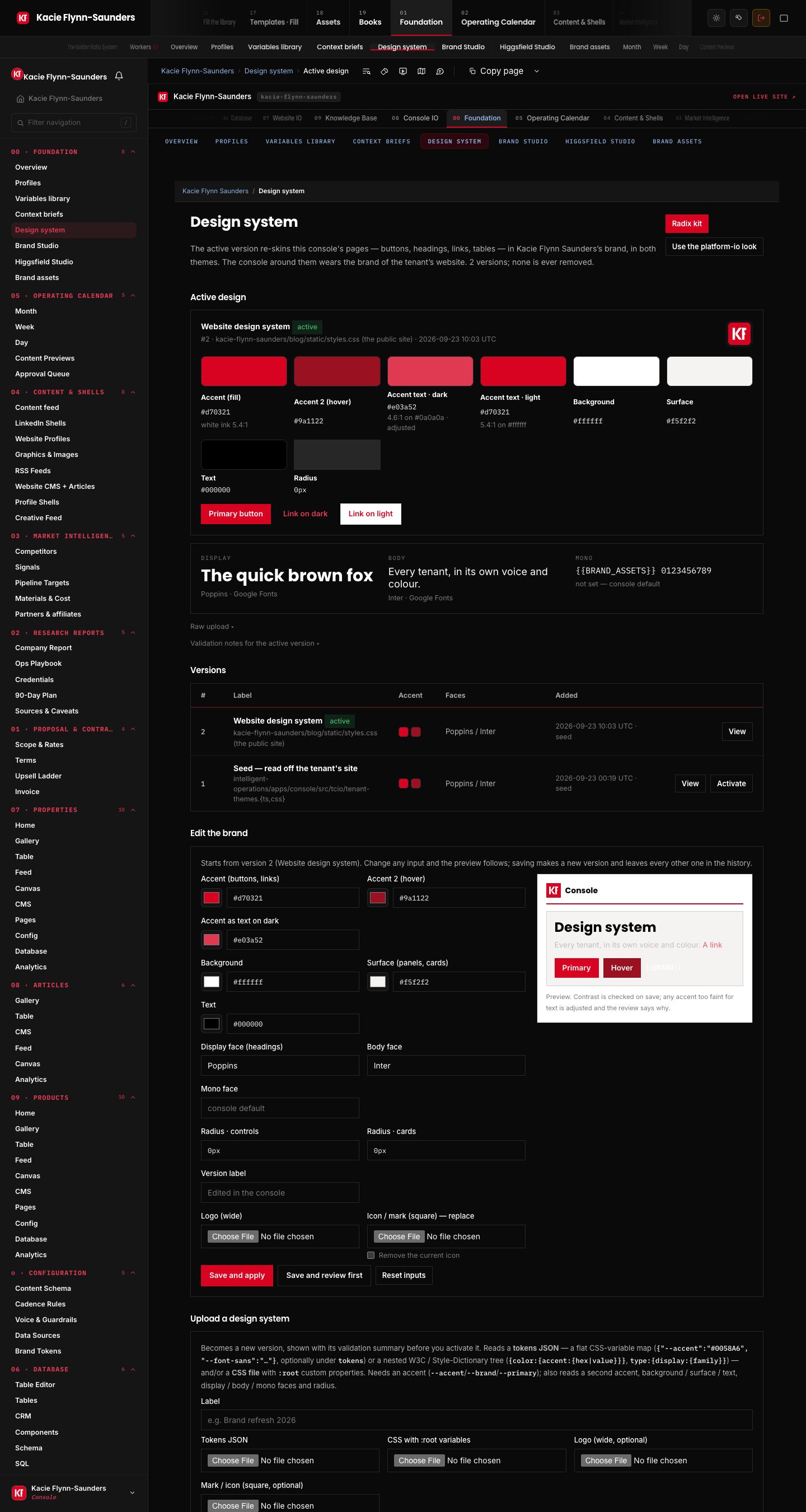
/tenant/kacie-flynn-saunders/foundation/design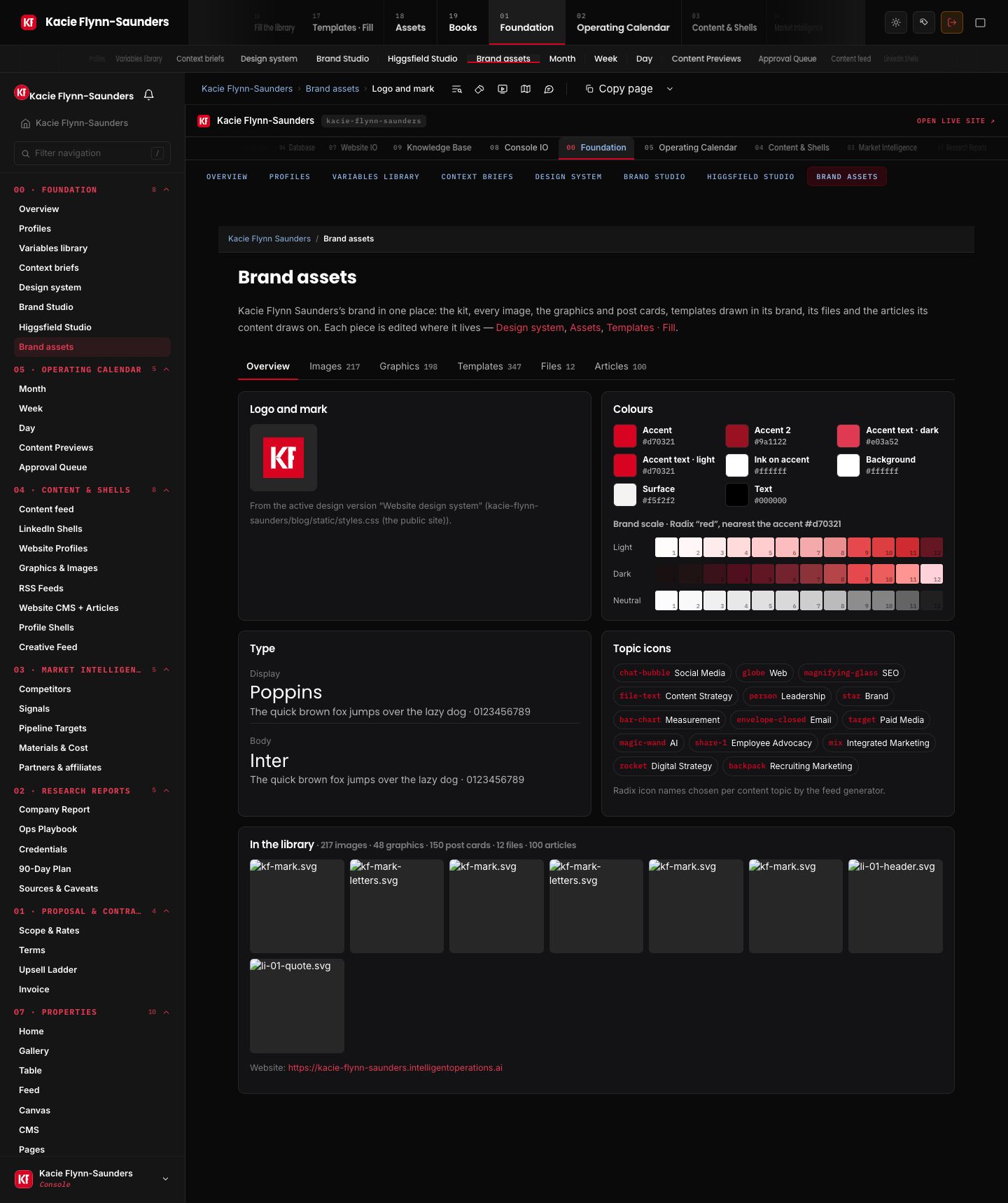
/tenant/kacie-flynn-saunders/foundation/brand-assets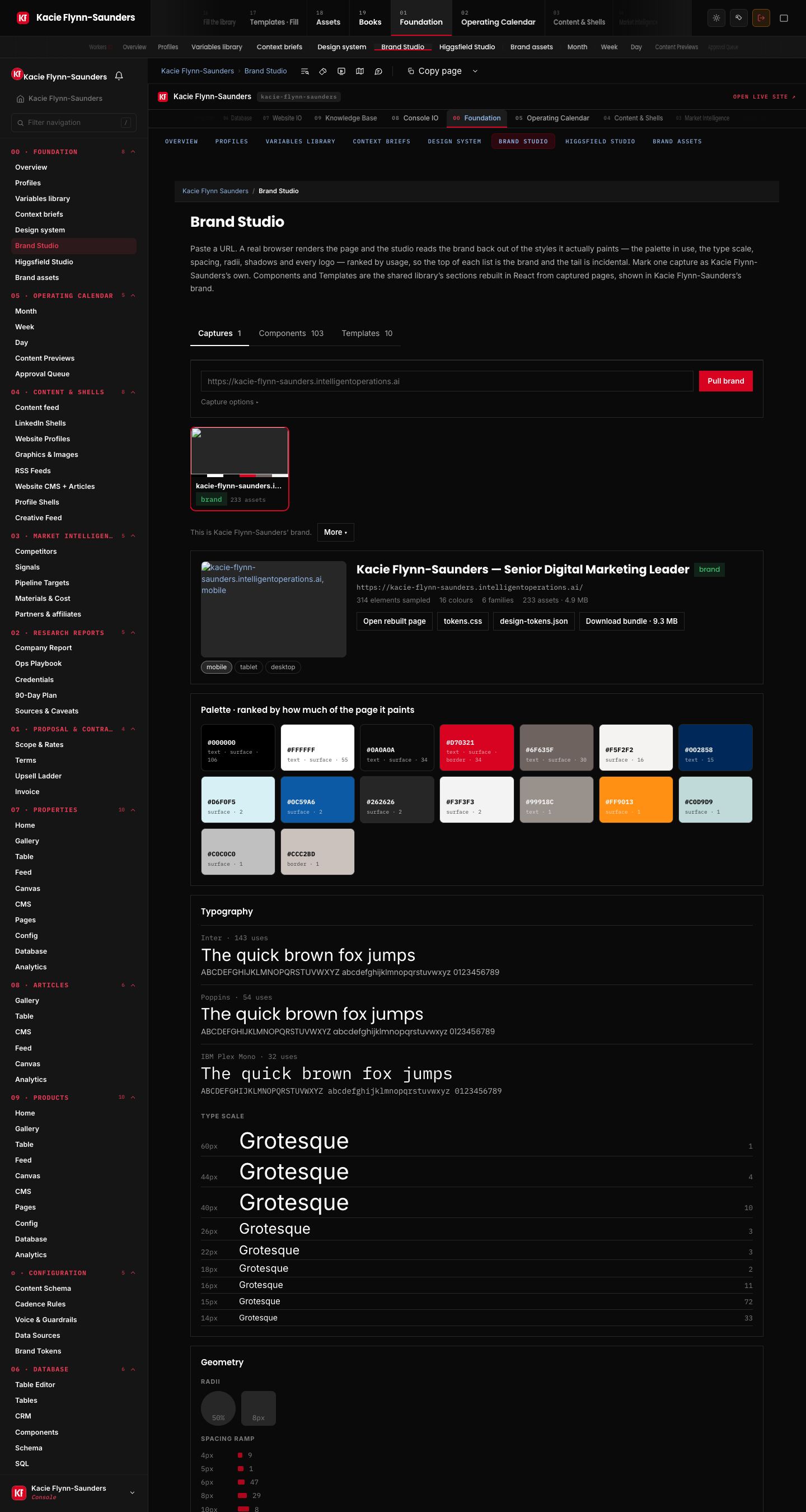
/tenant/kacie-flynn-saunders/foundation/brand-studio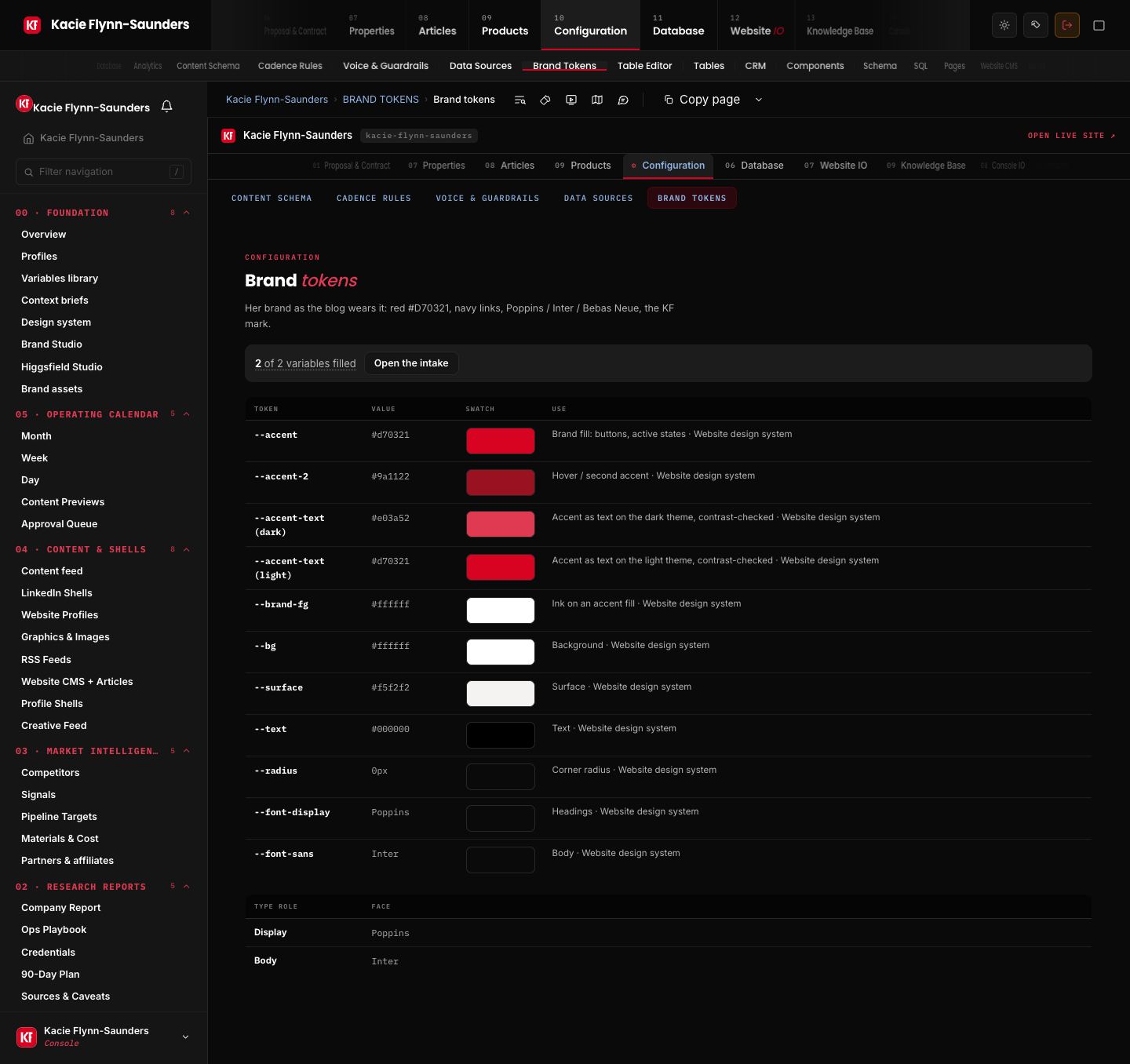
/tenant/kacie-flynn-saunders/config/tokens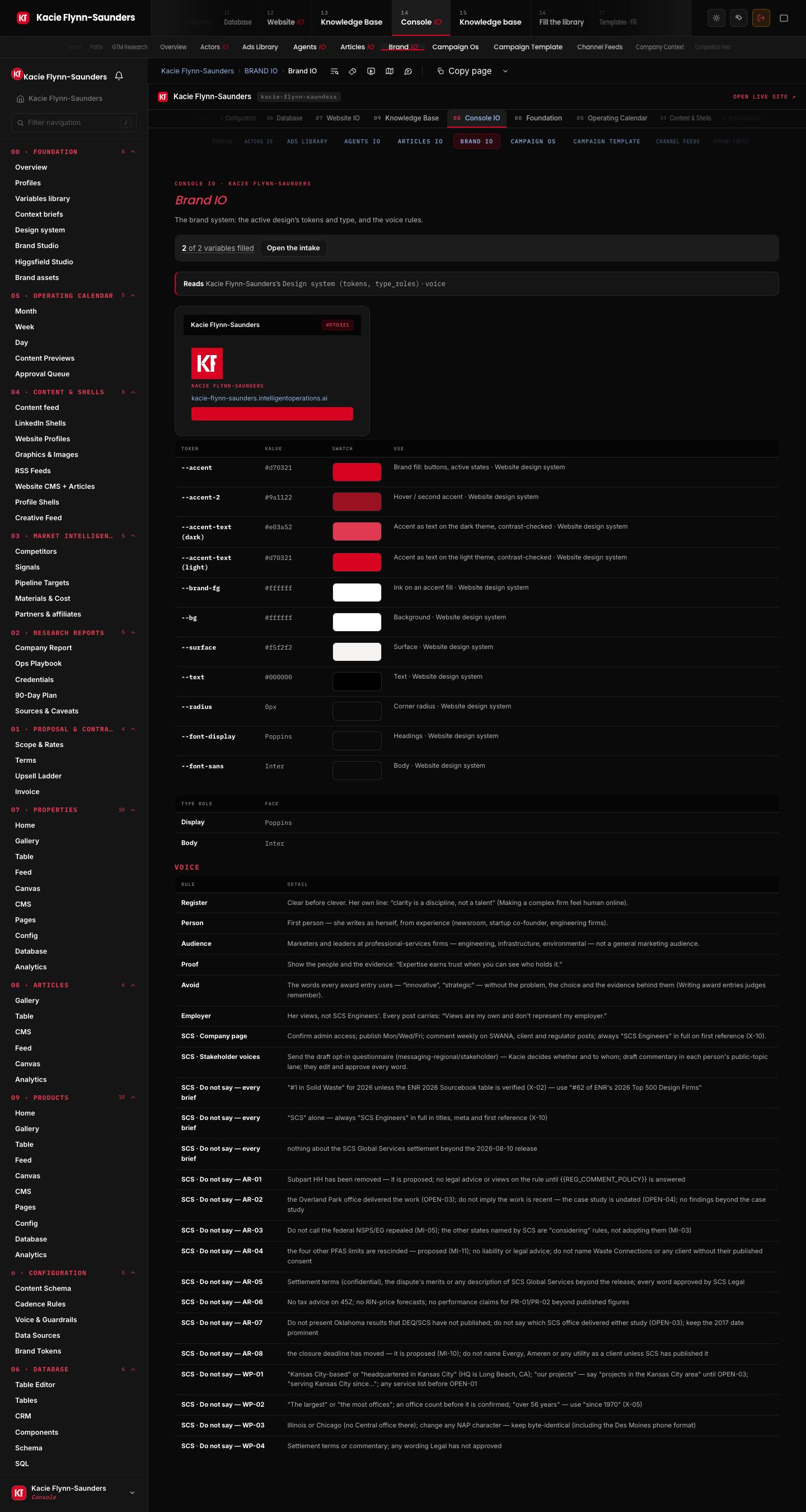
/tenant/kacie-flynn-saunders/consoles/brand-io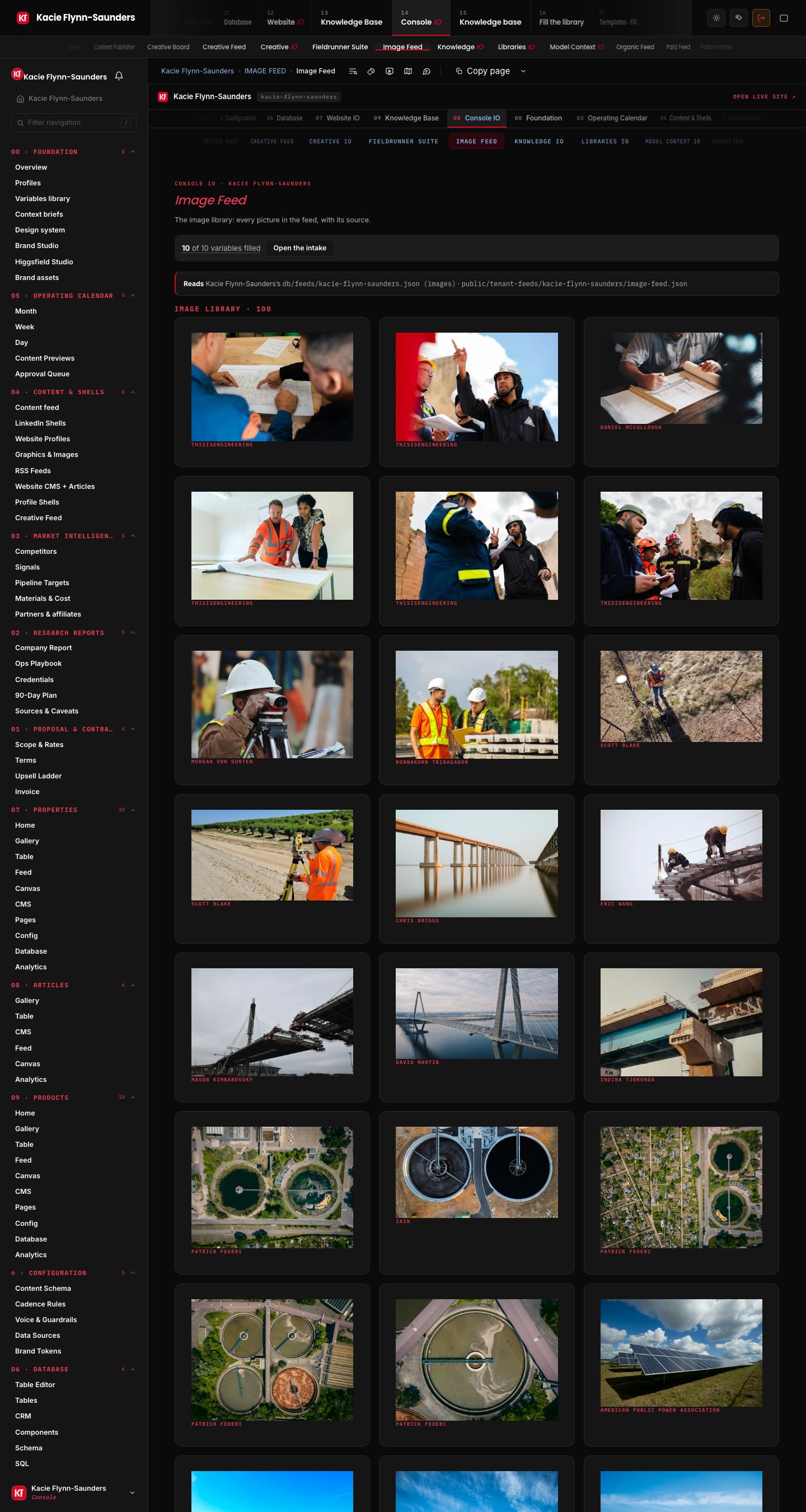
/tenant/kacie-flynn-saunders/consoles/image-feed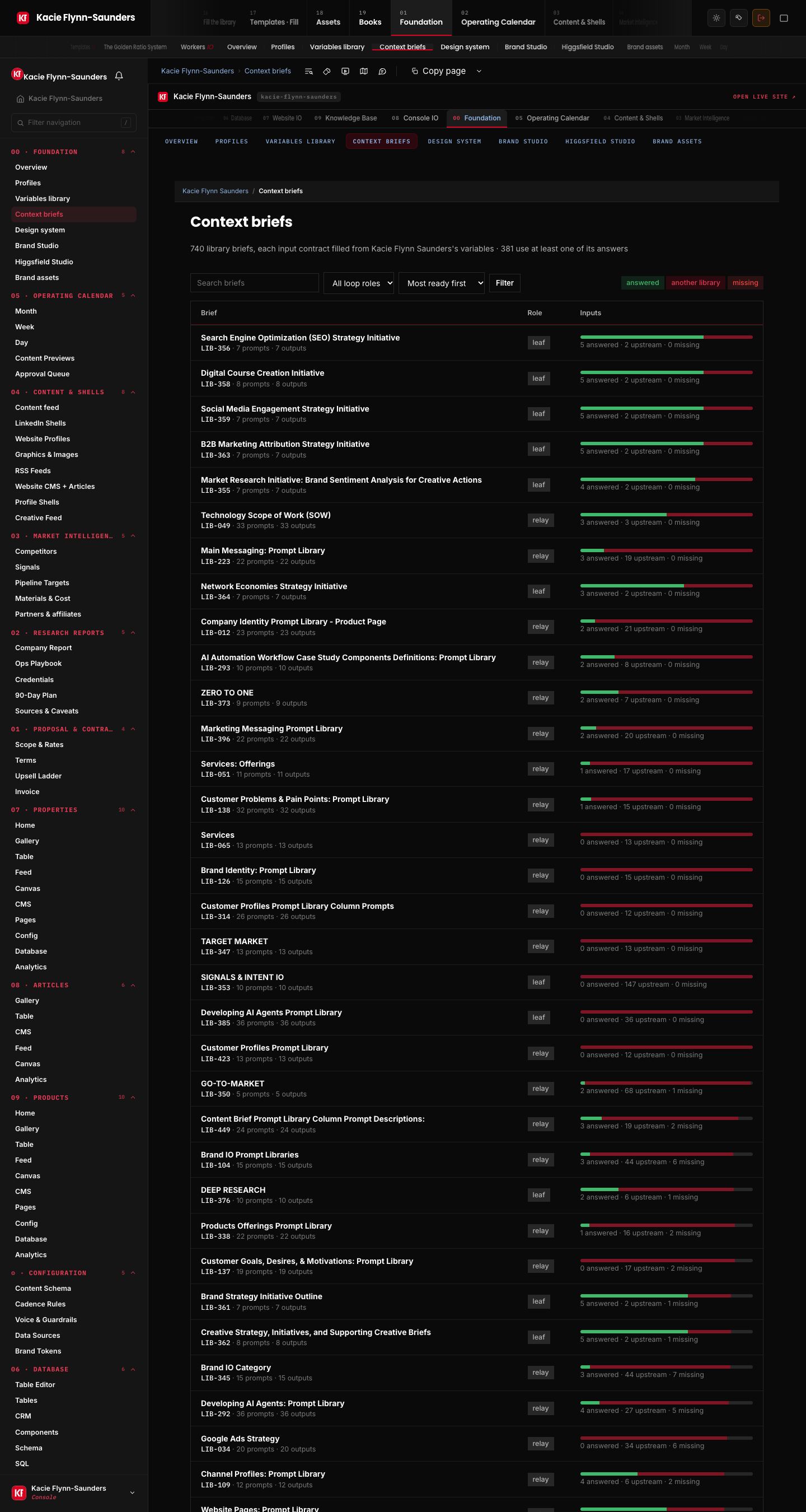
/tenant/kacie-flynn-saunders/foundation/briefs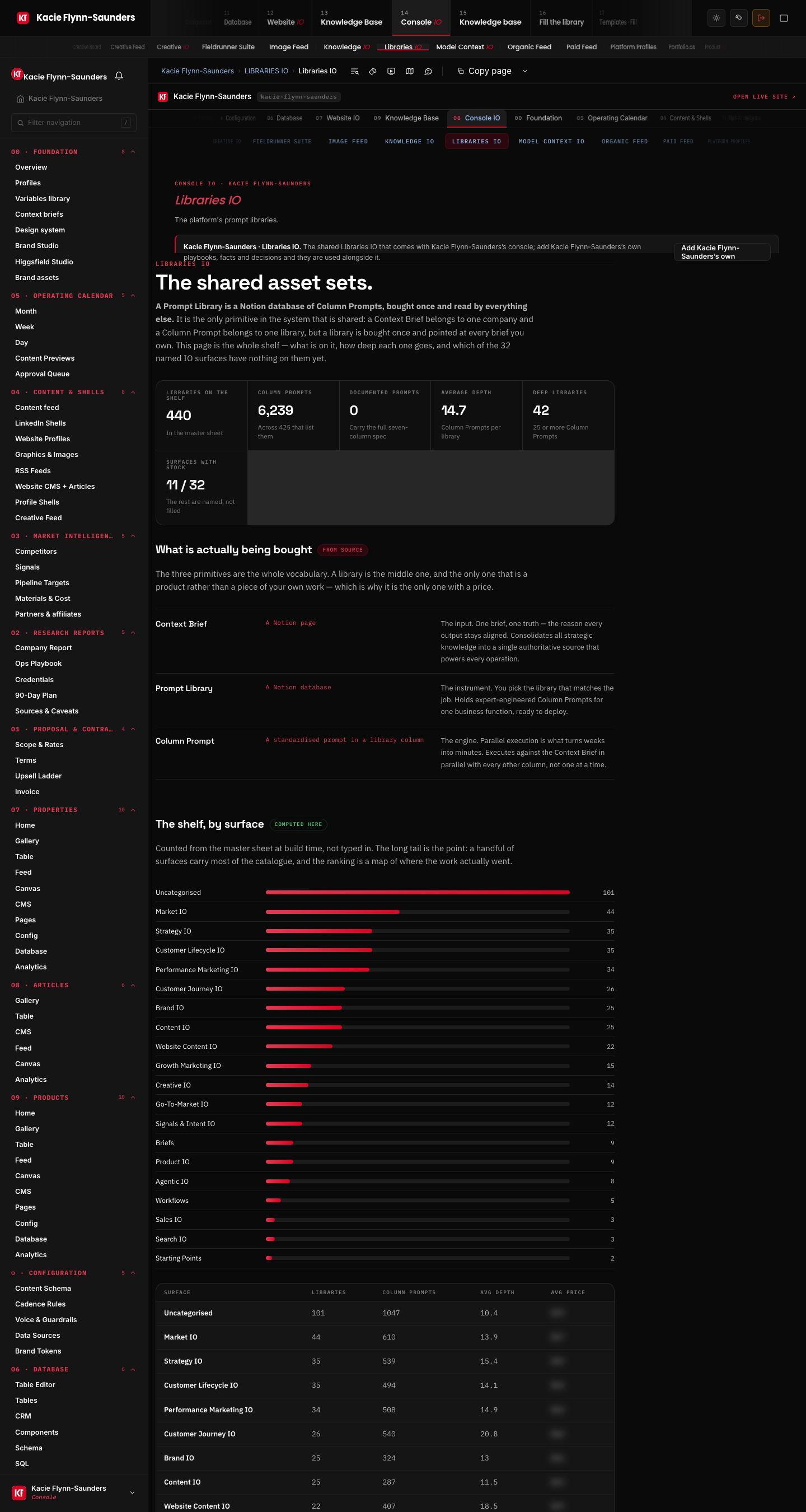
/tenant/kacie-flynn-saunders/consoles/libraries-io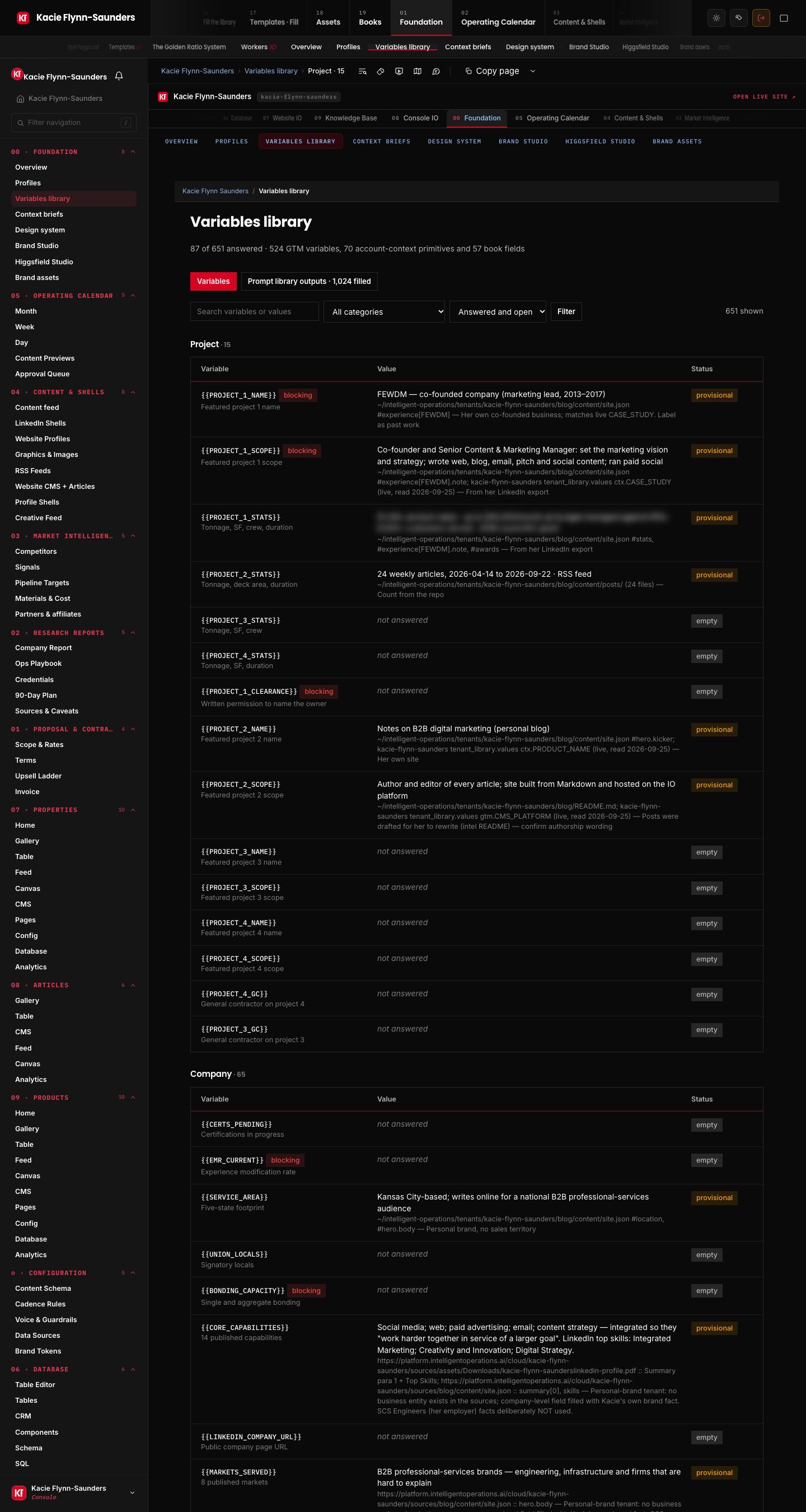
/tenant/kacie-flynn-saunders/foundation/variables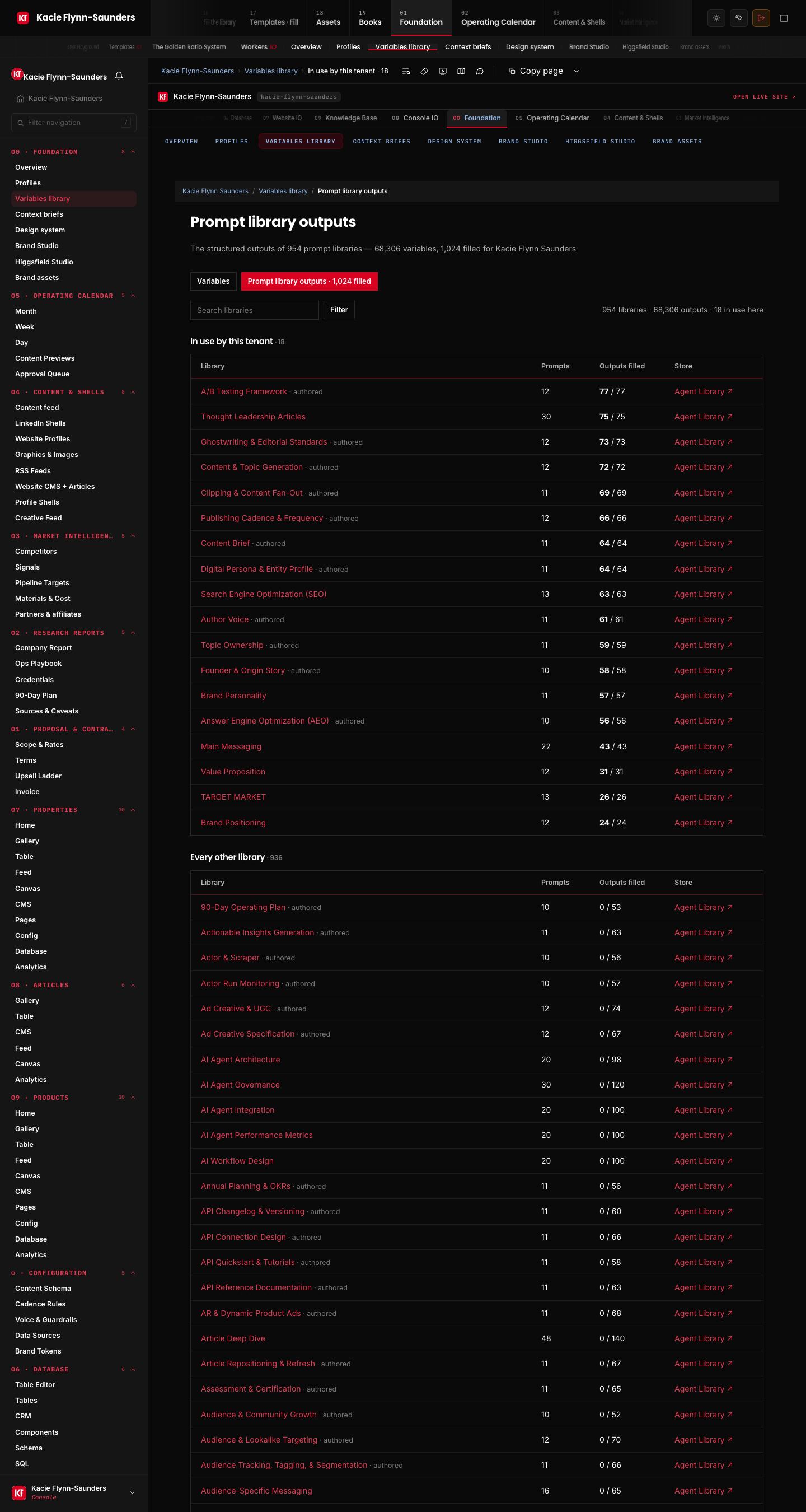
/tenant/kacie-flynn-saunders/foundation/variables?tab=outputs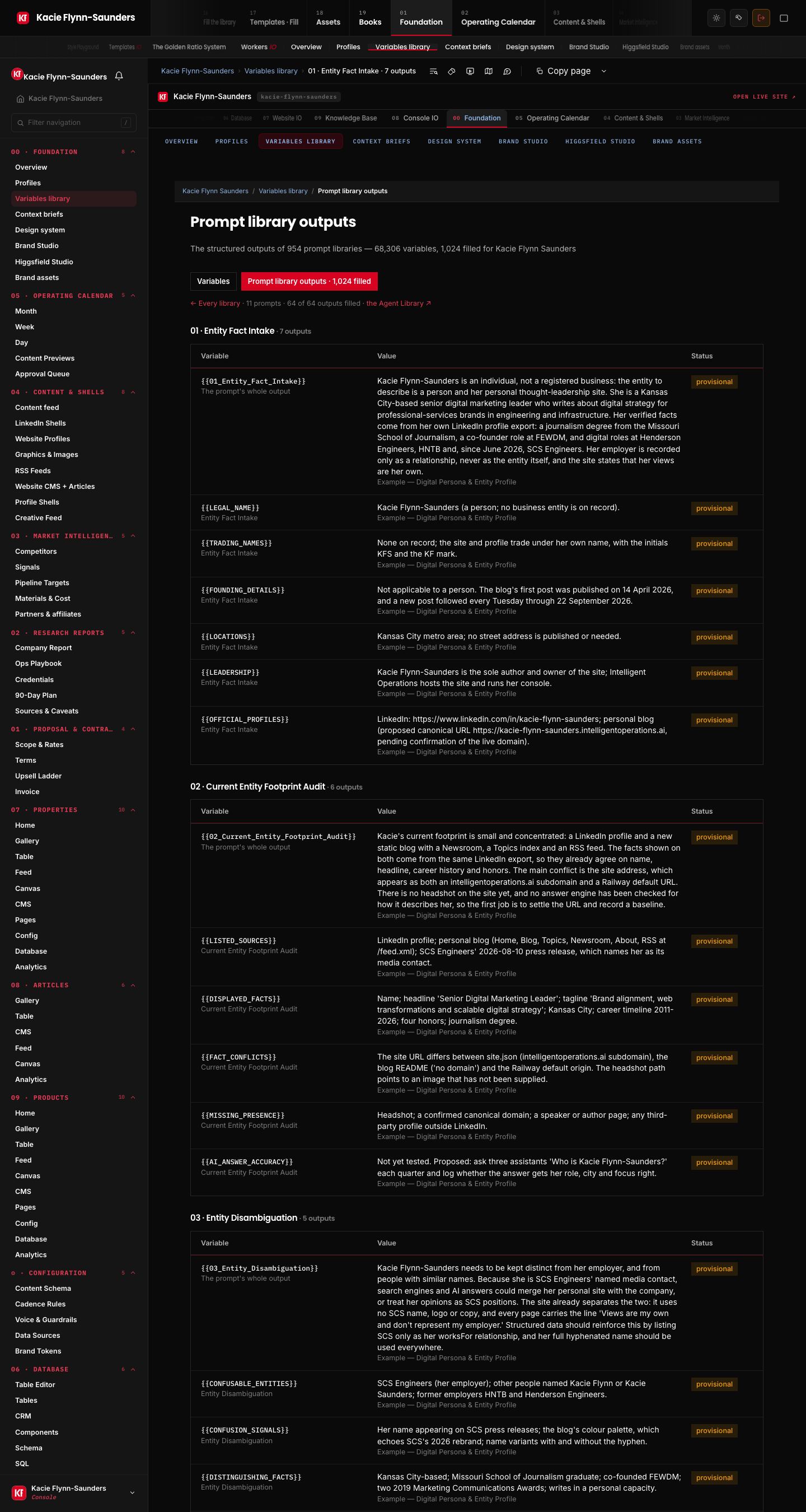
/tenant/kacie-flynn-saunders/foundation/variables?tab=outputs&lib=digital-persona-and-entity-profile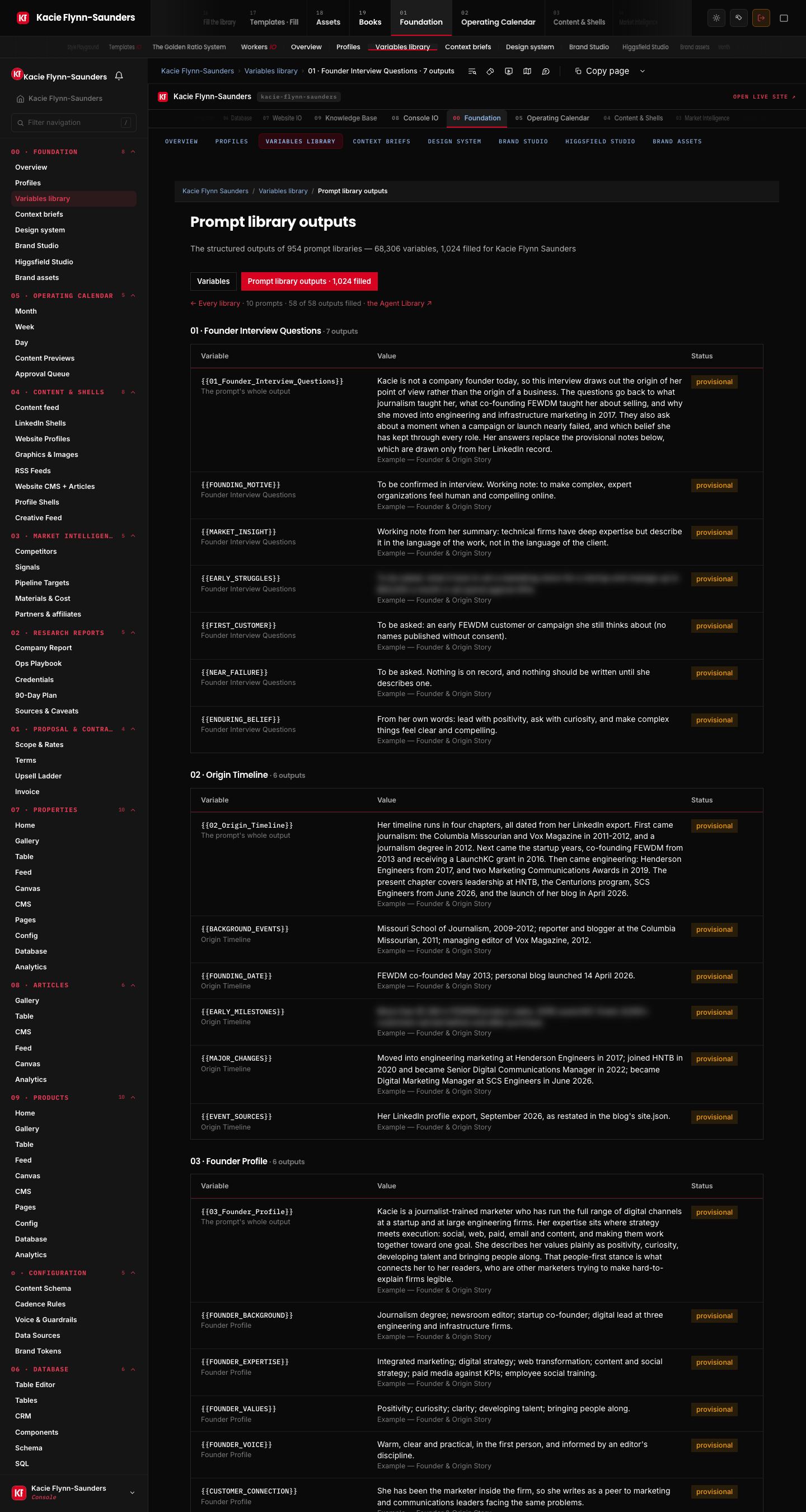
/tenant/kacie-flynn-saunders/foundation/variables?tab=outputs&lib=founder-and-origin-story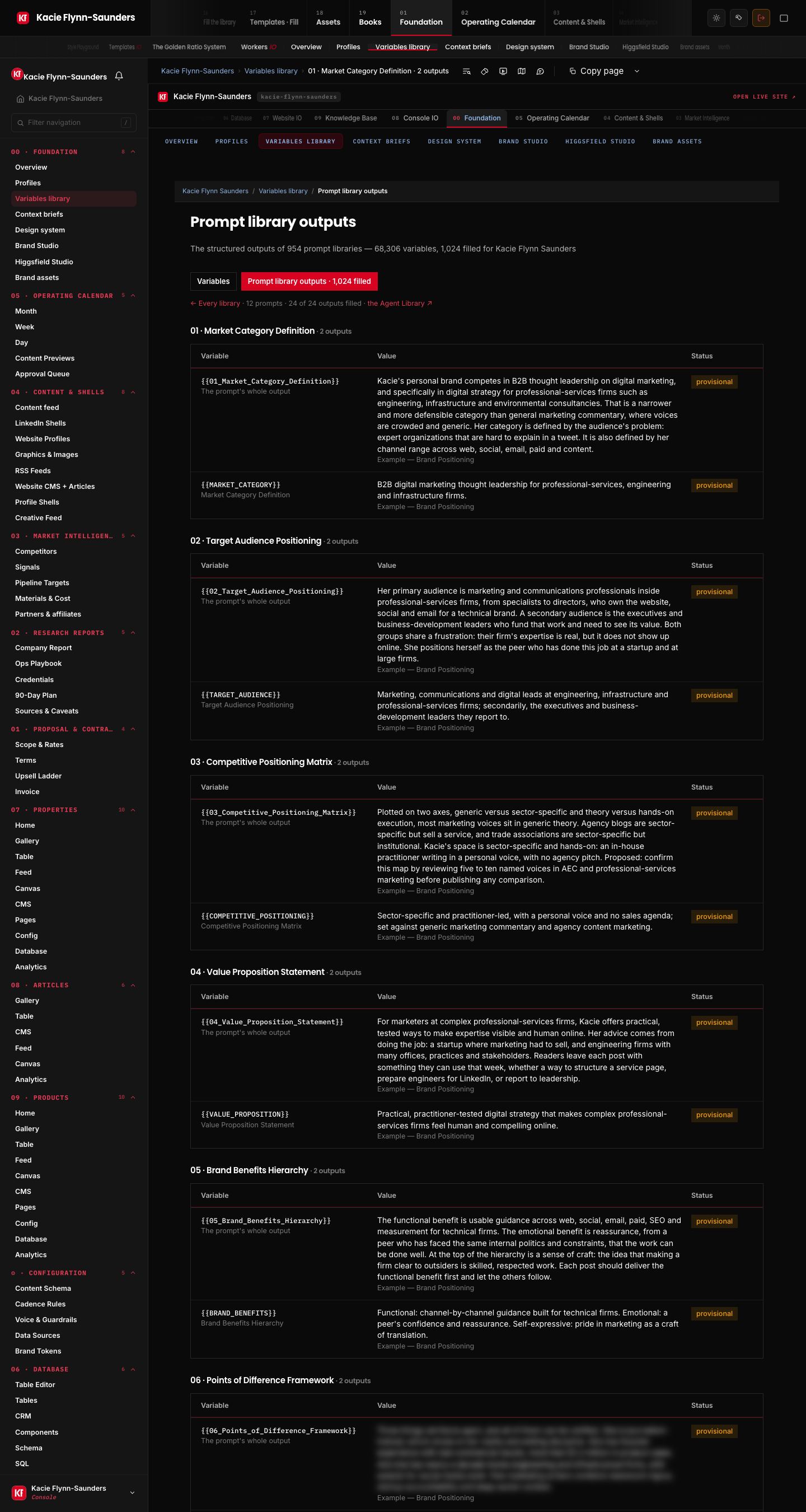
/tenant/kacie-flynn-saunders/foundation/variables?tab=outputs&lib=brand-positioning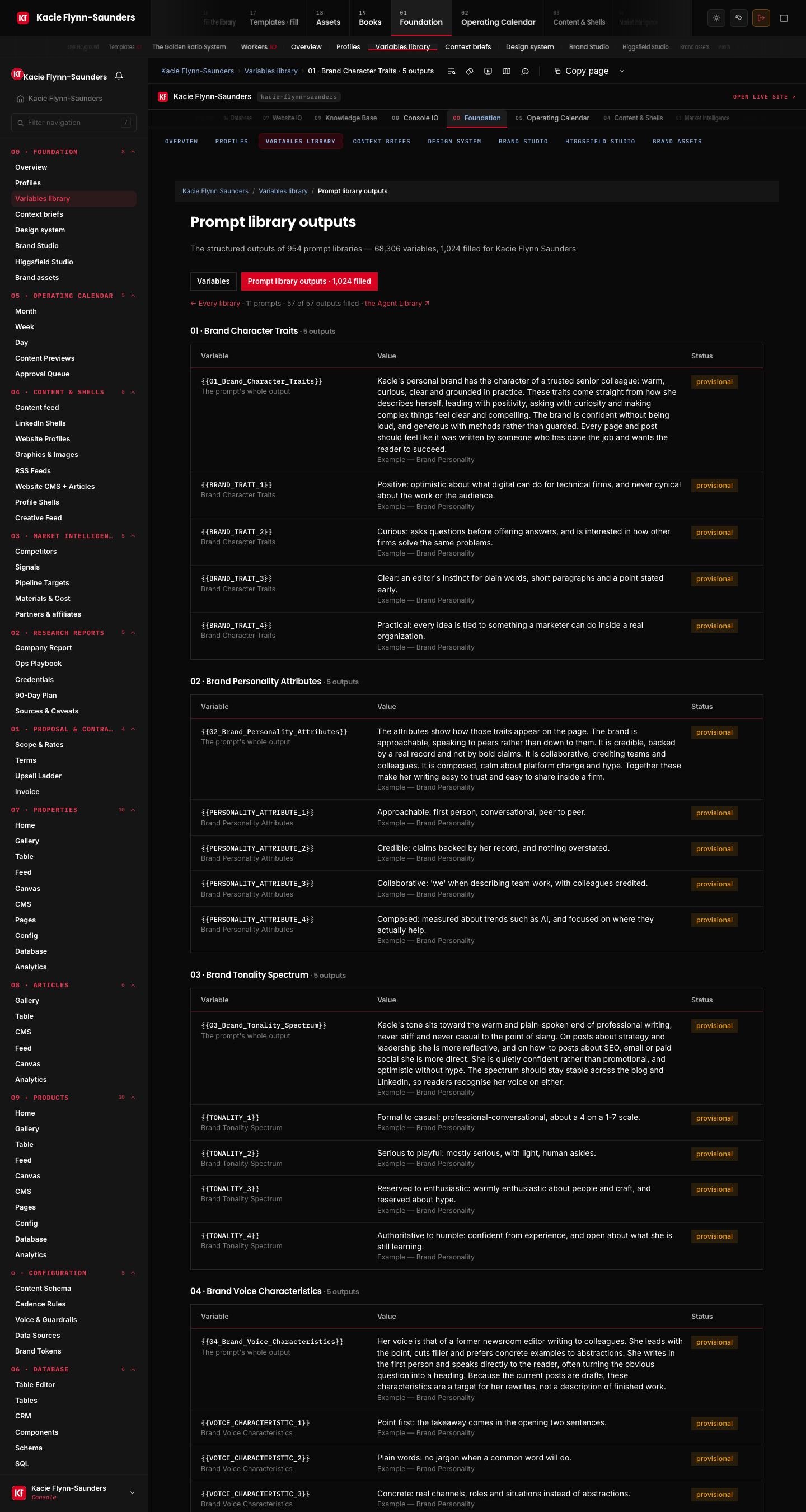
/tenant/kacie-flynn-saunders/foundation/variables?tab=outputs&lib=brand-personality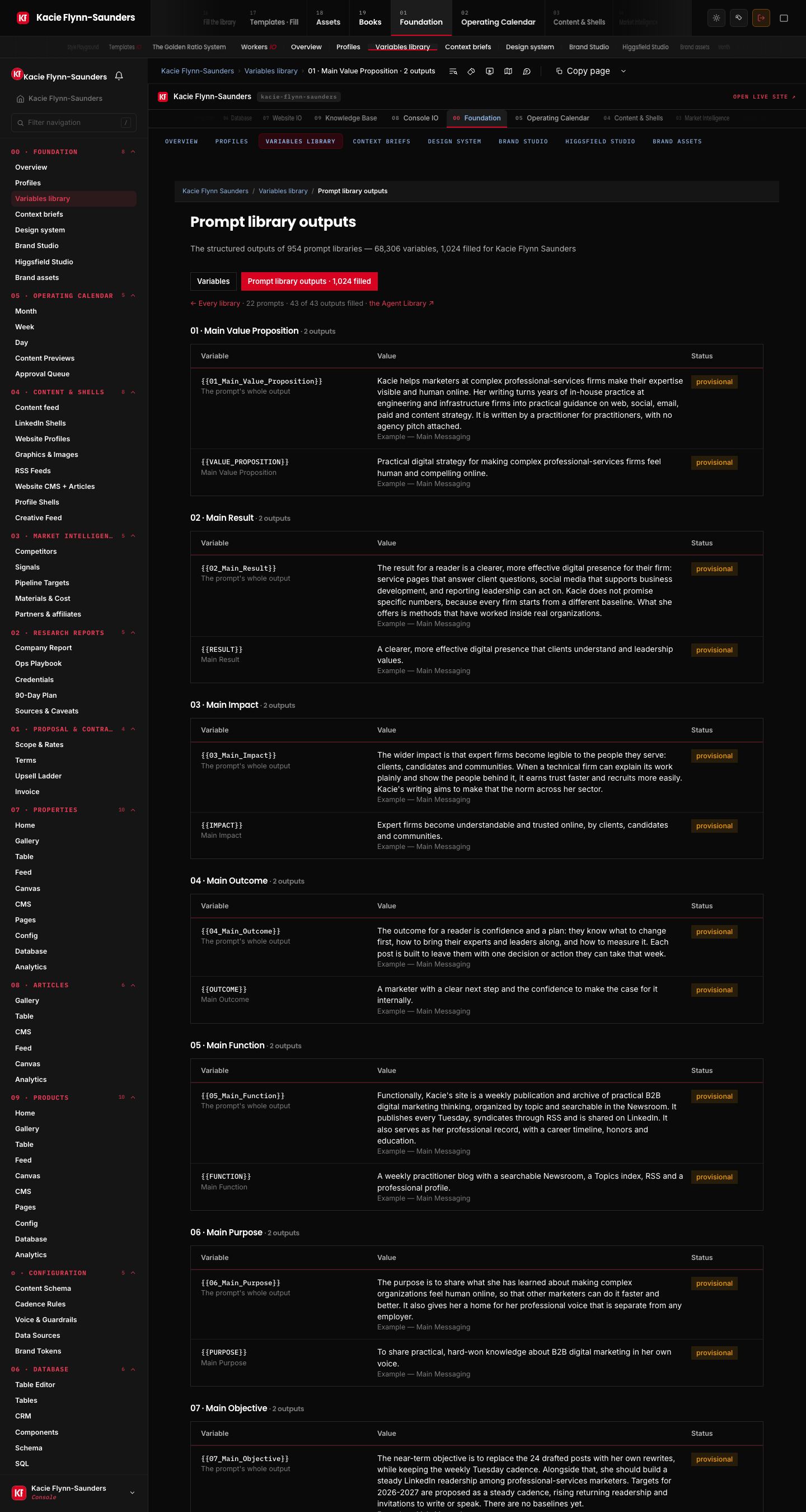
/tenant/kacie-flynn-saunders/foundation/variables?tab=outputs&lib=main-messaging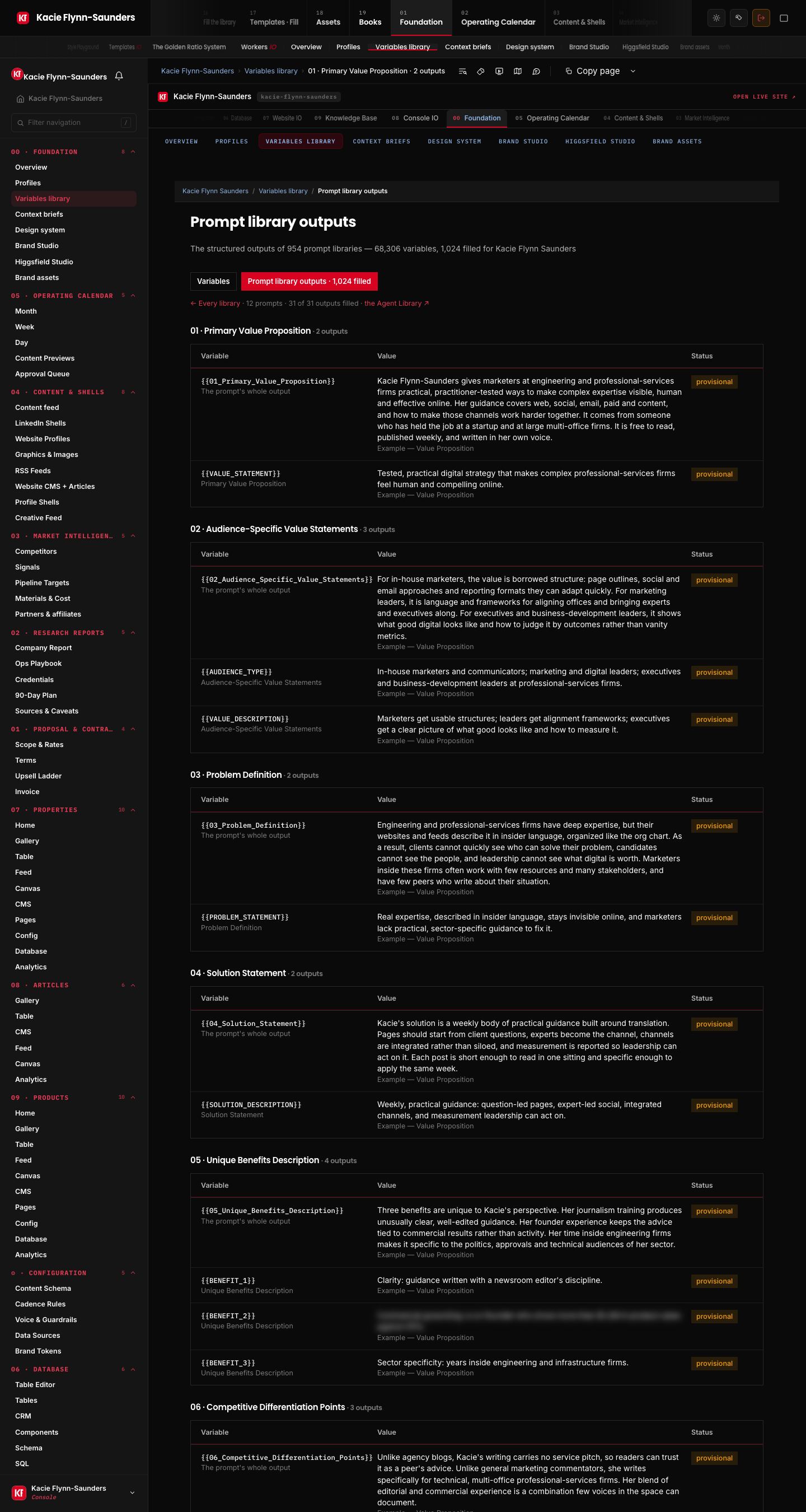
/tenant/kacie-flynn-saunders/foundation/variables?tab=outputs&lib=value-proposition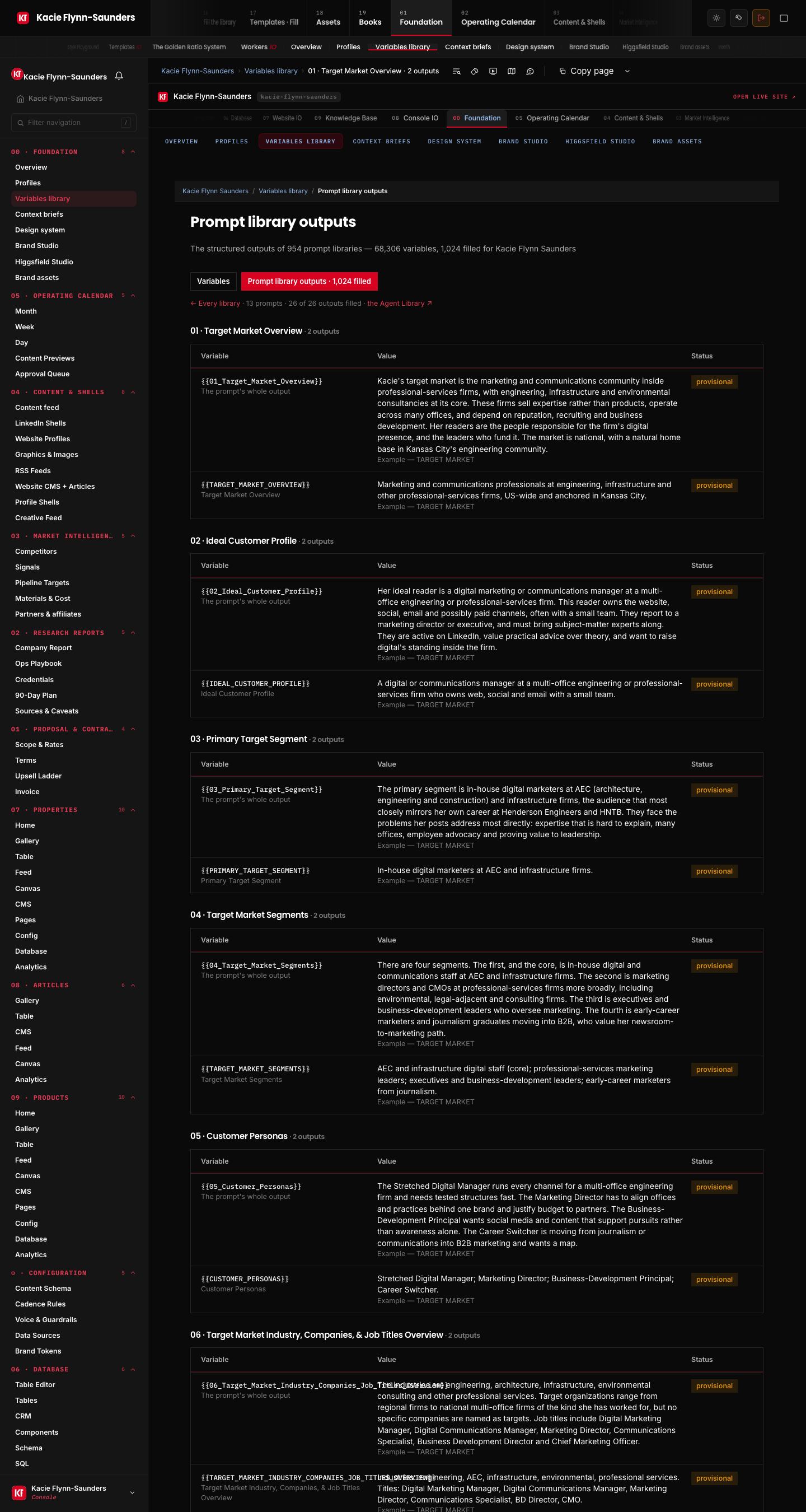
/tenant/kacie-flynn-saunders/foundation/variables?tab=outputs&lib=target-market-2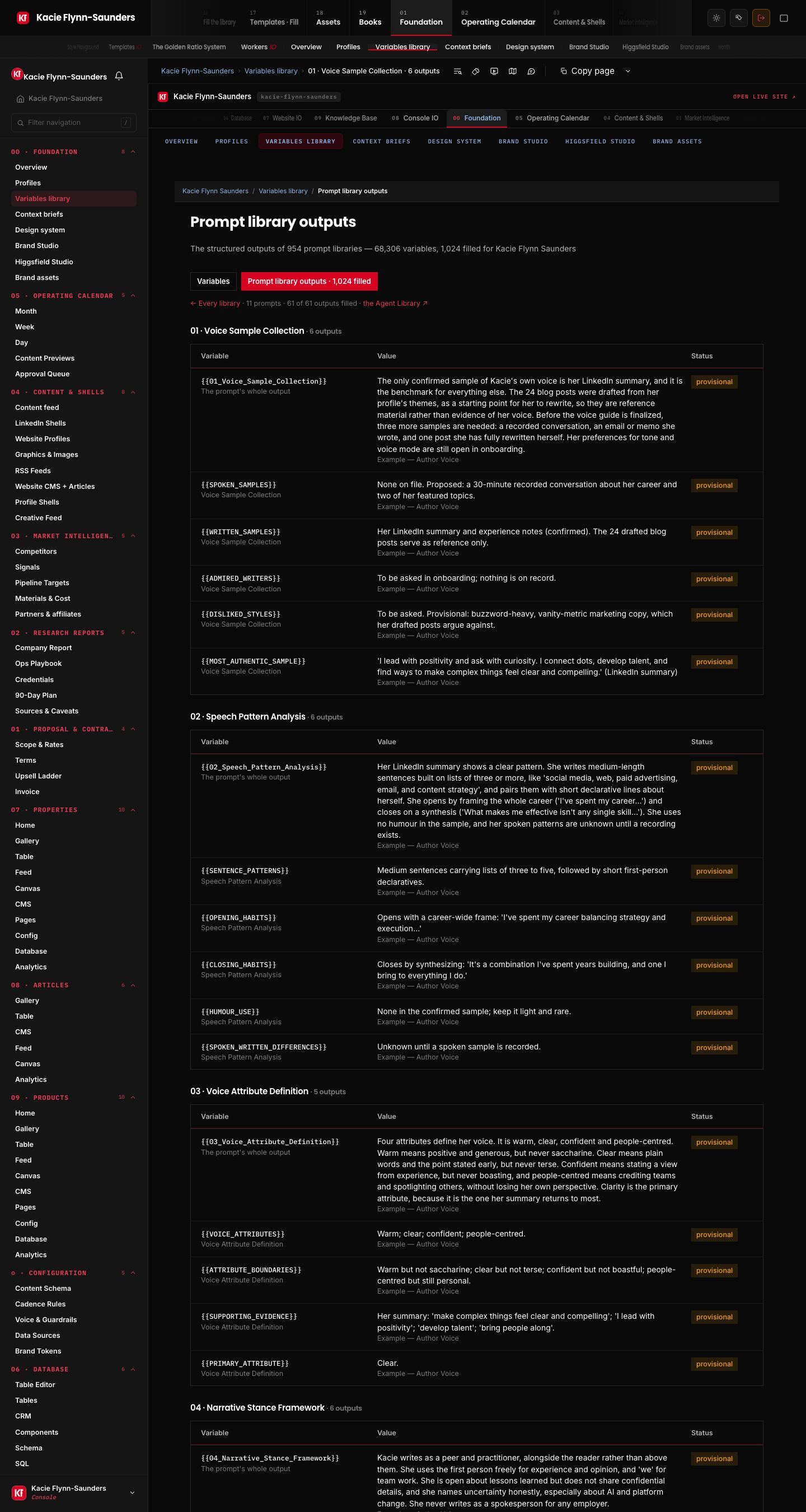
/tenant/kacie-flynn-saunders/foundation/variables?tab=outputs&lib=author-voice#d70321




Kacie is a person, not a company, and needs one canonical identity that keeps her personal site distinct from her employer across LinkedIn, the blog and AI answers.
- Entity Fact Intake
- Current Entity Footprint Audit
- Entity Disambiguation
- Canonical Entity Record
- Entity Description Set
- Identifier and Profile Register
- Entity Relationship Map
- Structured Data Specification
- Answer-Ready Fact Pages
- Consistency Validation
- Entity Maintenance Process
Her newsroom-to-startup-to-engineering-firm path is the story her About page, author box and speaker bios all tell.
- Founder Interview Questions
- Origin Timeline
- Founder Profile
- Story Arc
- Story Truth Standards
- Signature Origin Story
- Short-Form Versions
- Founder Bio Set
- Story Resonance Review
- Story Deployment Map
Her personal brand needs a defensible niche, practitioner digital strategy for professional-services firms, rather than generic marketing commentary.
- Market Category Definition
- Target Audience Positioning
- Competitive Positioning Matrix
- Value Proposition Statement
- Brand Benefits Hierarchy
- Points of Difference Framework
- Points of Parity Framework
- Brand Promise Statement
- Positioning Statement Structure
- Positioning Testing Framework
- Positioning Evolution Timeline
- Category Disruption Strategy
The blog and LinkedIn need one consistent personality, built from her own "positivity and curiosity" self-description.
- Brand Character Traits
- Brand Personality Attributes
- Brand Tonality Spectrum
- Brand Voice Characteristics
- Brand Archetype Definition
- Brand Personality Dos and Don'ts
- Brand Humor Guidelines
- Brand Emotional Range
- Brand Personality Expression Examples
- Brand Personality in Different Contexts
- Brand Personality Evolution Framework
The site hero, summaries and author box need one set of core messages about making complex organizations feel human online.
- Main Value Proposition
- Main Result
- Main Impact
- Main Outcome
- Main Function
- Main Purpose
- Main Objective
- Main Rationale
- Main Use Case
- Main Hook
- Main Jobs to Be Done
- Main User Story
- Main Benefit
- Main Feature
- One-liner
- Summary
- Description
- Overview
- Synopsis
- Excerpt
- Definition
- Explanation
Readers need a clear reason to follow a free practitioner blog, backed only by proof points from her own record.
- Primary Value Proposition
- Audience-Specific Value Statements
- Problem Definition
- Solution Statement
- Unique Benefits Description
- Competitive Differentiation Points
- Evidence and Proof Points
- Value Quantification Framework
- Emotional Value Components
- Rational Value Components
- Value Delivery Timeline
- Value Proposition Testing Framework
Her writing is aimed at a specific audience: in-house marketers and leaders at engineering, AEC and professional-services firms.
- Target Market Overview
- Ideal Customer Profile
- Primary Target Segment
- Target Market Segments
- Customer Personas
- Target Market Industry, Companies, & Job Titles Overview
- Customer Insights & Behaviors Overview
- Customer Goals, Desires, & Motivations Overview
- Customer Communication & Engagement Overview
- Customer Problems & Pain Points Overview
- Customer Personalities & Archetypes Overview
- Customer Transformation Overview
- Storybrand Script
The 24 posts are drafts for her to rewrite, so her real voice has to be defined from her own LinkedIn summary before the rewrites.
- Voice Sample Collection
- Speech Pattern Analysis
- Voice Attribute Definition
- Narrative Stance Framework
- Signature Vocabulary List
- Sentence Rhythm Rules
- Voice Do And Avoid Guide
- Sample Passage Rewrite
- Author Review Questions
- Voice Match Scoring
- Voice Guide Summary
Drafting support for a personal blog needs clear credit, fact-checking, confidentiality and sign-off rules, especially while she works for an employer.
- Collaboration Scope Questions
- Credit And Confidentiality Terms
- Interview Cadence Plan
- Manuscript Style Sheet
- Fact-Checking Protocol
- Source And Permissions Log
- Editorial Pass Sequence
- Legal Read Triggers
- Author Sign-Off Gates
- Manuscript Quality Assessment
- Editorial Standards Scorecard
- Production Handoff Package
A new thought-leadership site needs one owned topic and four pillars that match the blog's existing tags.
- Expertise Territory Questions
- Topic Landscape Assessment
- Owned Topic Statement
- Topic Pillar Framework
- Point Of View Positions
- Subtopic Question Map
- Signature Framework Concept
- Content Anchor Plan
- Topic Boundary Rules
- Authority Signal Measures
- Topic Ownership Summary
Her featured anchor post, the translation argument, is her flagship thought-leadership piece.
- Exploring Emerging Trends in Industry
- H1 Heading: Title as a Problem-Solution Hook
- The Impact of Technology on Social Change
- H1 Subheading: Preparing for Future Success and Transformation
- Strategies for Effective Leadership in a Digital Age
- H1 Body Text Introduction: Problem, Solution, and Context
- The Role of Innovation in Business Growth
- H2 Heading Section 01: Framing Past Struggles
- Building a Sustainable Future: Challenges and Opportunities
- H2 Body Text Section 01: Historical Problems and Market Shifts
- Navigating the Complexities of Global Markets
- H3 Heading Section 01: Early Struggles to Innovate
- The Importance of Diversity and Inclusion in the Workplace
- H3 Heading Section 01: Why Traditional Solutions Failed
- Harnessing Data for Strategic Decision Making
- H3 Heading Section 01: Market Demand Driving New Solutions
- The Future of Work: Adapting to New Realities
- H2 Heading Section 02: Showcasing Current Innovation and Impact
- Engaging Communities Through Corporate Social Responsibility
- H2 Body Text Section 02: Trends, Innovations, and Value
- H3 Heading Section 02: Emerging Trends
- H3 Heading Section 02: Technological Disruption
- H3 Heading Section 02: Urgency of Adoption
- H2 Heading Section 03: Opportunities and Challenges
- H2 Body Text Section 03: Opportunities, Obstacles, and Solutions
- H3 Heading Section 03: Competitive Advantage Through Early Adoption
- H3 Heading Section 03: Overcoming Cost Barriers
- H3 Heading Section 03: Preparing Teams for Innovation
- H2 Heading Section 04: Conclusion and Action Steps
- H2 Body Text Section 04: Summary, Call to Action, and Final Thoughts
The blog already runs on a weekly Tuesday rhythm, and it must stay sustainable alongside a full-time role.
- Current Output Baseline
- Audience Consumption Patterns
- Cadence Objectives
- Production Capacity Assessment
- Channel Frequency Plan
- Day & Time Slotting
- Content Mix Ratios
- Batch Production Schedule
- Buffer & Backlog Rules
- Frequency Test Plan
- Cadence Performance Measures
- Cadence Adjustment Report
A new site has to own her name and win long-tail, sector-specific questions in search.
- Business Type
- Value Proposition
- Target Audience
- Call to Action (CTA)
- Content Format
- SEO Keywords
- Competitive Analysis
- Brand Messaging
- Content Goals
- User Engagement
- Content Distribution
- Feedback Loop
- Performance Metrics
Her post titles are already questions that AI answer engines field, so answer-first structure and Person markup matter.
- Question Universe Discovery
- Answer Opportunity Assessment
- Answer Architecture
- Answer Writing Rules
- Direct Answer Drafts
- Structured Data Plan
- Voice and Conversational Fit
- Answer Readiness Audit
- Answer Visibility Measures
- Answer Refresh Cycle
Each rewrite starts from a brief; this one is for the Brand and Content pillar anchor, 'How to Make a Complex Firm Feel Human Online'.
- Brief Intake Questions
- Audience Reader Profile
- Objective And Success Measure
- Core Message And Angle
- Search Intent And Keyword Plan
- Content Outline
- Tone And Style Direction
- Sources And Evidence Plan
- Call To Action Design
- Brief Quality Checklist
- Distribution And Repurposing Notes
Her console needs a scored, repeatable way to choose weekly topics that fit her four pillars, her record and a three-hour week.
- Content Discovery Questions
- Audience Question Mining
- Search Demand Review
- Competitor Content Gap Scan
- Topic Pillar Framework
- Topic Idea Generation
- Topic Scoring Model
- Topic Brief Template
- Angle and Hook Development
- Format and Channel Mapping
- Topic Pipeline Schedule
- Topic Performance Review
LinkedIn is her main distribution channel, so each anchor post fans out into native LinkedIn posts and carousels.
- Source Asset Assessment
- Channel And Audience Targets
- Moment Selection Criteria
- Fan-Out Map
- Clip Edit Specifications
- Clip Hooks And Captions
- Written Derivatives
- Long-Form Recap Article
- Quality And Brand Review
- Distribution Schedule
- Fan-Out Performance Tracking
With no analytics baseline yet, a disciplined testing plan starts with LinkedIn paired posts on hooks and openings, then moves to the blog once traffic supports it.
- Testing Readiness Questions
- Conversion Baseline Assessment
- Hypothesis Backlog
- Test Prioritisation Framework
- Experiment Design Brief
- Sample Size And Duration Plan
- Variant Copy And Layout Spec
- Test Launch Checklist
- Mid-Test Monitoring Rules
- Result Analysis Report
- Rollout And Learning Log
- Testing Programme Cadence
{{01_Entity_Fact_Intake}}- Kacie Flynn-Saunders is an individual, not a registered business: the entity to describe is a person and her personal thought-leadership site. She is a Kansas City-based senior digital marketing leader who writes about digital strategy for professional-services brands in engineering and infrastructure. Her verified facts come from her own LinkedIn profile export: a journalism degree from the Missouri School of Journalism, a co-founder role at FEWDM, and digital roles at Henderson Engineers, HNTB and, since June 2026, SCS Engineers. Her employer is recorded only as a relationship, never as the entity itself, and the site states that her views are her own.
{{LEGAL_NAME}}- Kacie Flynn-Saunders (a person; no business entity is on record).
{{TRADING_NAMES}}- None on record; the site and profile trade under her own name, with the initials KFS and the KF mark.
{{FOUNDING_DETAILS}}- Not applicable to a person. The blog's first post was published on 14 April 2026, and a new post followed every Tuesday through 22 September 2026.
{{LOCATIONS}}- Kansas City metro area; no street address is published or needed.
{{LEADERSHIP}}- Kacie Flynn-Saunders is the sole author and owner of the site; Intelligent Operations hosts the site and runs her console.
{{OFFICIAL_PROFILES}}- LinkedIn: https://www.linkedin.com/in/kacie-flynn-saunders; personal blog (proposed canonical URL https://kacie-flynn-saunders.intelligentoperations.ai, pending confirmation of the live domain).
{{02_Current_Entity_Footprint_Audit}}- Kacie's current footprint is small and concentrated: a LinkedIn profile and a new static blog with a Newsroom, a Topics index and an RSS feed. The facts shown on both come from the same LinkedIn export, so they already agree on name, headline, career history and honors. The main conflict is the site address, which appears as both an intelligentoperations.ai subdomain and a Railway default URL. There is no headshot on the site yet, and no answer engine has been checked for how it describes her, so the first job is to settle the URL and record a baseline.
{{LISTED_SOURCES}}- LinkedIn profile; personal blog (Home, Blog, Topics, Newsroom, About, RSS at /feed.xml); SCS Engineers' 2026-08-10 press release, which names her as its media contact.
{{DISPLAYED_FACTS}}- Name; headline 'Senior Digital Marketing Leader'; tagline 'Brand alignment, web transformations and scalable digital strategy'; Kansas City; career timeline 2011-2026; four honors; journalism degree.
{{FACT_CONFLICTS}}- The site URL differs between site.json (intelligentoperations.ai subdomain), the blog README ('no domain') and the Railway default origin. The headshot path points to an image that has not been supplied.
{{MISSING_PRESENCE}}- Headshot; a confirmed canonical domain; a speaker or author page; any third-party profile outside LinkedIn.
{{AI_ANSWER_ACCURACY}}- Not yet tested. Proposed: ask three assistants 'Who is Kacie Flynn-Saunders?' each quarter and log whether the answer gets her role, city and focus right.
{{03_Entity_Disambiguation}}- Kacie Flynn-Saunders needs to be kept distinct from her employer, and from people with similar names. Because she is SCS Engineers' named media contact, search engines and AI answers could merge her personal site with the company, or treat her opinions as SCS positions. The site already separates the two: it uses no SCS name, logo or copy, and every page carries the line 'Views are my own and don't represent my employer.' Structured data should reinforce this by listing SCS only as her worksFor relationship, and her full hyphenated name should be used everywhere.
{{CONFUSABLE_ENTITIES}}- SCS Engineers (her employer); other people named Kacie Flynn or Kacie Saunders; former employers HNTB and Henderson Engineers.
{{CONFUSION_SIGNALS}}- Her name appearing on SCS press releases; the blog's colour palette, which echoes SCS's 2026 rebrand; name variants with and without the hyphen.
{{DISTINGUISHING_FACTS}}- Kansas City-based; Missouri School of Journalism graduate; co-founded FEWDM; two 2019 Marketing Communications Awards; writes in a personal capacity.
{{DISAMBIGUATION_PHRASE}}- Kacie Flynn-Saunders, a Kansas City digital marketing leader who writes about B2B digital strategy for engineering and professional-services firms.
{{04_Canonical_Entity_Record}}- The canonical record describes Kacie Flynn-Saunders as a person whose primary category is B2B digital marketing leadership. It uses the hyphenated full name, Kansas City as the location with no street address, LinkedIn as the verified contact point, and the personal blog as the home URL once the domain is confirmed. Her current employer, past employers and honors are listed as relationships and credentials, not as the entity. Every other profile should copy this record word for word.
{{CANONICAL_NAME}}- Kacie Flynn-Saunders
{{ALTERNATE_NAMES}}- Kacie Flynn Saunders (unhyphenated); KFS.
{{PRIMARY_CATEGORY}}- Person: B2B digital marketing leader and writer.
{{CANONICAL_ADDRESS}}- Kansas City metro, United States (city level only).
{{CONTACT_POINTS}}- LinkedIn messages via https://www.linkedin.com/in/kacie-flynn-saunders. Proposed: add a public business email once she chooses one; her personal email stays unpublished.
{{SERVICE_AREA}}- Not applicable; her writing addresses a national audience of professional-services marketers.
{{05_Entity_Description_Set}}- The description set gives Kacie one approved way to be described at every length, from a single line to a full paragraph. Every version leads with what she does, which is B2B digital strategy for professional-services brands. Each then adds where she is (Kansas City) and what backs it up (a journalism degree, a co-founder's commercial results and nearly a decade in engineering and infrastructure marketing). None of the versions speaks for her employer.
{{ONE_LINE_DESCRIPTION}}- Kansas City digital marketing leader who makes complex organizations feel human and compelling online.
{{SHORT_DESCRIPTION}}- Kacie Flynn-Saunders is a senior digital marketing leader in Kansas City. She writes about web, social, email, paid and content strategy for engineering and professional-services firms.
{{PARAGRAPH_DESCRIPTION}}- Kacie Flynn-Saunders is a Kansas City-based digital marketing leader with more than 15 years of writing, editing and marketing behind her. A Missouri School of Journalism graduate, she co-founded FEWDM, where she drove more than $1.2 million in product sales, then led digital work at Henderson Engineers and HNTB. She now writes about brand alignment, web transformation and making channels work harder together.
{{CATEGORY_STATEMENT}}- She belongs in the category of B2B professional-services digital marketing, specifically engineering and infrastructure.
{{06_Identifier_and_Profile_Register}}- As a person rather than a company, Kacie has no business registry identifiers or local listings, and none should be created. The register tracks the profiles that actually establish her identity: LinkedIn, her personal blog and its RSS feed. It also tracks one planned addition, a Wikidata-style knowledge entry, to be considered only after independent coverage exists. Each profile's claim status is recorded so that her name, headline and photo stay the same everywhere.
{{REGISTRY_IDENTIFIERS}}- None; she is an individual with no business registration on record.
{{KNOWLEDGE_BASE_ENTRIES}}- None today. Proposed: revisit a knowledge-base entry only once independent press or speaking coverage exists.
{{BUSINESS_LISTINGS}}- Not applicable; no Google Business Profile or directory listing is appropriate for a personal writing site.
{{SOCIAL_PROFILES}}- LinkedIn (primary); no other social accounts are on record.
{{CLAIM_STATUS}}- LinkedIn: owned by Kacie. Blog: owned, hosted by Intelligent Operations. The domain is still to be confirmed.
{{07_Entity_Relationship_Map}}- Kacie's relationship map ties her to the organizations and places that give her credibility, without letting any of them stand in for her. It records her current employer, SCS Engineers, as a worksFor link, and HNTB, Henderson Engineers, FEWDM and Vox Magazine as career history. It adds the Missouri School of Journalism and the Greater KC Chamber's Centurions program as affiliations, and Kansas City as her home market. Each link is backed by her LinkedIn export, so nothing on the map is inferred.
{{PEOPLE_RELATIONSHIPS}}- No named colleagues are listed publicly. Proposed: add co-authors or interviewees only with their consent.
{{ORGANISATION_RELATIONSHIPS}}- SCS Engineers (current employer, since June 2026); HNTB (2020-2026); Henderson Engineers (2017-2020); FEWDM (co-founder, 2013-2017); Vox Magazine; Columbia Missourian.
{{LOCATION_RELATIONSHIPS}}- Kansas City (home market); Columbia, MO (education and early journalism).
{{OFFERING_RELATIONSHIPS}}- Her personal blog and its weekly articles; no paid services or products are on record.
{{SUPPORTING_SOURCES}}- Her LinkedIn profile export (September 2026) and the blog's site.json, which restates it.
{{08_Structured_Data_Specification}}- The site should publish a single Person record on the home and About pages, with sameAs pointing to LinkedIn. The record should carry her job title, her alumniOf school, her awards and a worksFor link to her employer, marked as a relationship only. Each article should use BlogPosting, with the author referencing that same Person by @id, so every post builds one consistent identity. The Newsroom and Topics pages should use CollectionPage, and the password-protected Knowledge Base should stay out of the markup and the sitemap.
{{ENTITY_TYPE}}- Person (schema.org), with a WebSite and BlogPosting records attributed to it.
{{CORE_PROPERTIES}}- name; jobTitle 'Senior Digital Marketing Leader'; address locality Kansas City; alumniOf Missouri School of Journalism; award (four honors); knowsAbout (digital strategy, integrated marketing, content strategy).
{{SAME_AS_LINKS}}- https://www.linkedin.com/in/kacie-flynn-saunders
{{FOUNDER_PROPERTIES}}- Record the FEWDM co-founder role (2013-2017) in her description; there is no current company to mark up with a founder property.
{{PUBLISHING_PAGES}}- Home and About (Person); each post (BlogPosting); Blog, Topics and Newsroom (CollectionPage).
{{09_Answer_Ready_Fact_Pages}}- Her About page is the fact page answer engines should quote, so it should state her role, city, focus, career and honors in plain sentences near the top. A short FAQ block should answer the questions people actually ask about her: who she is, what she writes about, where she has worked and how to reach her. Each fact should appear once, in the same words used on LinkedIn, with no claims that her own export does not support. A location page is not needed for a person.
{{ABOUT_PAGE_STANDARD}}- Open with the one-line description, then her career timeline, honors, education and the 'views are my own' line.
{{LEADERSHIP_PAGE_STANDARD}}- Not applicable. Her Centurions steering-committee role and team-leadership philosophy belong on the About page.
{{LOCATION_PAGE_STANDARD}}- Not applicable; mention Kansas City in the About copy only.
{{FAQ_STANDARD}}- Four to six questions, each answered in 40-60 words, with the answer first, and the same wording in the FAQPage markup.
{{QUOTABLE_FACTS}}- 15+ years in writing, editing and marketing; $1.2M in product sales as a co-founder; 6,000+ customers served; two 2019 Marketing Communications Awards; 2016 LaunchKC Grant recipient.
{{10_Consistency_Validation}}- Consistency checks confirm that her name, headline, city and photo match everywhere she appears, and that answer engines describe her correctly. With only two owned profiles, the target is a 100 percent match between LinkedIn and the site on every core fact. Each quarter, the same prompts about who she is are put to answer engines, and the markup is validated after every deploy. Any mismatch is fixed at the source record first, then copied outward.
{{LISTING_MATCH_RATE}}- Target: 100% of core fields matching across LinkedIn and the blog; baseline not yet measured.
{{PANEL_ACCURACY}}- No knowledge panel exists today; track whether one appears and whether it is accurate.
{{AI_ANSWER_TESTS}}- Proposed quarterly prompts: 'Who is Kacie Flynn-Saunders?'; 'What does Kacie Flynn-Saunders write about?'; 'Kansas City B2B digital marketing leaders'.
{{MARKUP_VALIDATION}}- Run the Schema.org validator and Google's Rich Results Test on Home, About and one post after each deploy.
{{11_Entity_Maintenance_Process}}- Kacie's entity record changes when her career does, so each change to her role, headline or awards triggers an update. The order is always the same: the canonical record first, then LinkedIn, then the site's content and markup, then any press bio. A light audit every quarter keeps the record current between changes. Kacie owns the facts, and her Intelligent Operations console holds the record that everything else copies.
{{CHANGE_TRIGGERS}}- New role or title; a new award or certification; a headshot supplied; the domain confirmed; a speaking or press appearance.
{{UPDATE_ORDER}}- Canonical record; LinkedIn; blog About page and structured data; the Newsroom; external bios.
{{AUDIT_CADENCE}}- Quarterly, plus within one week of any change trigger.
{{RECORD_OWNER}}- Kacie Flynn-Saunders approves; the record lives in her Intelligent Operations console.
{{01_Founder_Interview_Questions}}- Kacie is not a company founder today, so this interview draws out the origin of her point of view rather than the origin of a business. The questions go back to what journalism taught her, what co-founding FEWDM taught her about selling, and why she moved into engineering and infrastructure marketing in 2017. They also ask about a moment when a campaign or launch nearly failed, and which belief she has kept through every role. Her answers replace the provisional notes below, which are drawn only from her LinkedIn record.
{{FOUNDING_MOTIVE}}- To be confirmed in interview. Working note: to make complex, expert organizations feel human and compelling online.
{{MARKET_INSIGHT}}- Working note from her summary: technical firms have deep expertise but describe it in the language of the work, not in the language of the client.
{{EARLY_STRUGGLES}}- To be asked: what it took to set a marketing vision for a startup and manage up to $50,000 a month in ad spend against KPIs.
{{FIRST_CUSTOMER}}- To be asked: an early FEWDM customer or campaign she still thinks about (no names published without consent).
{{NEAR_FAILURE}}- To be asked. Nothing is on record, and nothing should be written until she describes one.
{{ENDURING_BELIEF}}- From her own words: lead with positivity, ask with curiosity, and make complex things feel clear and compelling.
{{02_Origin_Timeline}}- Her timeline runs in four chapters, all dated from her LinkedIn export. First came journalism: the Columbia Missourian and Vox Magazine in 2011-2012, and a journalism degree in 2012. Next came the startup years, co-founding FEWDM from 2013 and receiving a LaunchKC grant in 2016. Then came engineering: Henderson Engineers from 2017, and two Marketing Communications Awards in 2019. The present chapter covers leadership at HNTB, the Centurions program, SCS Engineers from June 2026, and the launch of her blog in April 2026.
{{BACKGROUND_EVENTS}}- Missouri School of Journalism, 2009-2012; reporter and blogger at the Columbia Missourian, 2011; managing editor of Vox Magazine, 2012.
{{FOUNDING_DATE}}- FEWDM co-founded May 2013; personal blog launched 14 April 2026.
{{EARLY_MILESTONES}}- More than $1.2M in FEWDM product sales; 2016 LaunchKC Grant; 6,000+ customers served before and after purchase.
{{MAJOR_CHANGES}}- Moved into engineering marketing at Henderson Engineers in 2017; joined HNTB in 2020 and became Senior Digital Communications Manager in 2022; became Digital Marketing Manager at SCS Engineers in June 2026.
{{EVENT_SOURCES}}- Her LinkedIn profile export, September 2026, as restated in the blog's site.json.
{{03_Founder_Profile}}- Kacie is a journalist-trained marketer who has run the full range of digital channels at a startup and at large engineering firms. Her expertise sits where strategy meets execution: social, web, paid, email and content, and making them work together toward one goal. She describes her values plainly as positivity, curiosity, developing talent and bringing people along. That people-first stance is what connects her to her readers, who are other marketers trying to make hard-to-explain firms legible.
{{FOUNDER_BACKGROUND}}- Journalism degree; newsroom editor; startup co-founder; digital lead at three engineering and infrastructure firms.
{{FOUNDER_EXPERTISE}}- Integrated marketing; digital strategy; web transformation; content and social strategy; paid media against KPIs; employee social training.
{{FOUNDER_VALUES}}- Positivity; curiosity; clarity; developing talent; bringing people along.
{{FOUNDER_VOICE}}- Warm, clear and practical, in the first person, and informed by an editor's discipline.
{{CUSTOMER_CONNECTION}}- She has been the marketer inside the firm, so she writes as a peer to marketing and communications leaders facing the same problems.
{{04_Story_Arc}}- The arc begins with a newsroom-trained writer who learned that clarity is a discipline. At a startup, she learned what it takes to turn attention into sales. When she moved into engineering and infrastructure marketing, she found expert firms that struggled to be understood online, and decided that her job was translation rather than invention. The struggle has been making large, many-office organizations speak with one clear, human voice across web, social and email. Today she shares what she has learned, so that other marketers can do the same work faster.
{{WORLD_BEFORE}}- Professional-services firms described their work in the language of the work: precise, organized by practice area, and hard for a stranger to follow.
{{PROBLEM_NOTICED}}- The expertise was real, but people could not see it, or the people behind it, on a website or a feed.
{{DECISION_TO_ACT}}- In 2017 she brought a journalist's and founder's toolkit into engineering marketing at Henderson Engineers.
{{STRUGGLE}}- Aligning many offices, practices and channels behind one brand, and proving digital's value to leadership.
{{TURNING_POINT}}- Award-winning social work in 2019, and leading HNTB's digital platforms, showed that human, people-first content works for technical firms.
{{PRESENT_PURPOSE}}- To help complex organizations feel human and compelling online, and to share the methods openly on her blog.
{{05_Story_Truth_Standards}}- Every line of Kacie's story has to be something she can point to in her own record or confirm herself. Figures come only from her LinkedIn export, and no dialogue is invented. Employers and colleagues are credited accurately, and no employer's results are presented as hers alone. Because the blog's first 24 posts are drafts written from her profile's themes, nothing in them counts as her testimony until she has rewritten and approved it.
{{VERIFIABILITY_RULE}}- Every date, figure and award must trace back to her LinkedIn export or to her direct confirmation.
{{DIALOGUE_RULE}}- No reconstructed quotes. Only use lines she has written or said and approved.
{{CREDIT_RULE}}- Team results are described as team results, and employer work is never presented as a personal client portfolio.
{{EXAGGERATION_RULE}}- No superlatives such as 'leading' or 'top' unless an award or third party says so.
{{APPROVAL_OWNER}}- Kacie Flynn-Saunders gives final approval on every version.
{{06_Signature_Origin_Story}}- The signature story opens in a college newsroom, with Kacie learning to cut every sentence that exists only to sound thorough. It moves to FEWDM, where she co-founded a company and learned that marketing has to sell, driving more than $1.2 million in product sales. Next it follows her into engineering firms, where she found brilliant work described in language only insiders could follow. It ends with what she does now: translating expertise into content that lets people see the work, and the people behind it.
{{OPENING_SCENE}}- Proposed: a weekly magazine deadline at Vox, with the managing editor turning a dense draft into three clear paragraphs.
{{PROBLEM_SECTION}}- Technical firms organize their websites like their org charts, while clients arrive with a problem, not a practice area.
{{STRUGGLE_SECTION}}- Keeping one brand consistent across many offices and channels, and showing leadership what digital is actually worth.
{{TURNING_POINT_SECTION}}- Putting the engineers themselves at the centre of social and web content, and seeing it earn awards and attention.
{{PRESENT_DAY_SECTION}}- Leading digital strategy in Kansas City, and writing weekly about how other firms can do the same.
{{07_Short_Form_Versions}}- The short versions keep the same spine, from newsroom to startup to engineering to translator, at three lengths. The one-sentence version introduces her anywhere. The bio paragraph is for author boxes and event programs. The spoken version is a 20-second introduction she can give herself on a panel or podcast.
{{ONE_SENTENCE_VERSION}}- A journalist turned startup co-founder turned engineering marketer, Kacie Flynn-Saunders helps complex organizations feel human and compelling online.
{{BIO_PARAGRAPH}}- Kacie Flynn-Saunders is a Kansas City digital marketing leader. She trained as a journalist at the Missouri School of Journalism, co-founded FEWDM, and has led digital strategy at engineering and infrastructure firms since 2017. She writes about web, social, email, paid and content strategy for professional-services brands.
{{SPOKEN_VERSION}}- I started as a journalist, co-founded a company, and then spent the last decade helping engineering firms explain what they do. My job is translation: making expert work easy to see.
{{08_Founder_Bio_Set}}- The bio set gives event hosts, editors and the blog one approved text at each length. It includes a short and a long third-person bio, a first-person profile for LinkedIn and the About page, and a headshot caption for when the photo is supplied. Every version uses the same facts and ends with the note that her views are her own.
{{THIRD_PERSON_SHORT}}- Kacie Flynn-Saunders is a Kansas City-based senior digital marketing leader who writes about B2B digital strategy for professional-services firms.
{{THIRD_PERSON_LONG}}- Kacie Flynn-Saunders has spent more than 15 years writing, editing and marketing. As co-founder of FEWDM, she drove more than $1.2 million in product sales, then led digital marketing at Henderson Engineers and HNTB, and she received two 2019 Marketing Communications Awards. She holds a journalism degree from the Missouri School of Journalism and is a graduate of the Greater KC Chamber's Centurions Leadership Program.
{{FIRST_PERSON_PROFILE}}- I've spent my career balancing strategy and execution in the B2B world, helping large professional brands find their voice online. I lead with positivity, ask with curiosity, and look for ways to make complex things feel clear and compelling.
{{HEADSHOT_CAPTION}}- Kacie Flynn-Saunders, Kansas City. (The headshot has not been supplied yet.)
{{09_Story_Resonance_Review}}- Before the story goes public, three to five trusted peers read it and say back what they remember. The review checks that the parts people recall are the ones that matter: the newsroom, the co-founder results and the translation idea. It also checks that every claim feels credible, and that a reader can say what she offers in one sentence. Revisions are logged here, and nothing changes without Kacie's approval.
{{RECALLED_ELEMENTS}}- Target: readers recall the journalism start, the $1.2M co-founder result and the 'translation, not invention' idea.
{{CREDIBILITY_FEEDBACK}}- Pending review. Watch for any line that reads as speaking for an employer.
{{VALUE_CLARITY}}- Pass if a reader can finish the sentence 'She helps…' without prompting.
{{REVISIONS}}- None yet; log each change with its date and reason.
{{10_Story_Deployment_Map}}- The story lives where people decide whether to read, follow or invite her. The long version goes on the blog's About page, and the short version in every post's author box. Press and event organizers receive the third-person bio, and LinkedIn carries the first-person profile. Kacie approves each placement, and Intelligent Operations keeps the versions in step through her console.
{{WEBSITE_PLACEMENT}}- About page (signature story and long bio); post author box (short bio); home page (one-line version).
{{PRESS_PLACEMENT}}- Third-person short and long bios for speaker programs, podcasts and guest articles.
{{SALES_PLACEMENT}}- Not applicable; there is no paid offer. Use the spoken version for networking and panel introductions.
{{PROFILE_PLACEMENT}}- LinkedIn About section (first-person profile) and headline.
{{PLACEMENT_OWNERS}}- Kacie approves; Intelligent Operations updates the site and console.
{{01_Market_Category_Definition}}- Kacie's personal brand competes in B2B thought leadership on digital marketing, and specifically in digital strategy for professional-services firms such as engineering, infrastructure and environmental consultancies. That is a narrower and more defensible category than general marketing commentary, where voices are crowded and generic. Her category is defined by the audience's problem: expert organizations that are hard to explain in a tweet. It is also defined by her channel range across web, social, email, paid and content.
{{MARKET_CATEGORY}}- B2B digital marketing thought leadership for professional-services, engineering and infrastructure firms.
{{02_Target_Audience_Positioning}}- Her primary audience is marketing and communications professionals inside professional-services firms, from specialists to directors, who own the website, social and email for a technical brand. A secondary audience is the executives and business-development leaders who fund that work and need to see its value. Both groups share a frustration: their firm's expertise is real, but it does not show up online. She positions herself as the peer who has done this job at a startup and at large firms.
{{TARGET_AUDIENCE}}- Marketing, communications and digital leads at engineering, infrastructure and professional-services firms; secondarily, the executives and business-development leaders they report to.
{{03_Competitive_Positioning_Matrix}}- Plotted on two axes, generic versus sector-specific and theory versus hands-on execution, most marketing voices sit in generic theory. Agency blogs are sector-specific but sell a service, and trade associations are sector-specific but institutional. Kacie's space is sector-specific and hands-on: an in-house practitioner writing in a personal voice, with no agency pitch. Proposed: confirm this map by reviewing five to ten named voices in AEC and professional-services marketing before publishing any comparison.
{{COMPETITIVE_POSITIONING}}- Sector-specific and practitioner-led, with a personal voice and no sales agenda; set against generic marketing commentary and agency content marketing.
{{04_Value_Proposition_Statement}}- For marketers at complex professional-services firms, Kacie offers practical, tested ways to make expertise visible and human online. Her advice comes from doing the job: a startup where marketing had to sell, and engineering firms with many offices, practices and stakeholders. Readers leave each post with something they can use that week, whether a way to structure a service page, prepare engineers for LinkedIn, or report to leadership.
{{VALUE_PROPOSITION}}- Practical, practitioner-tested digital strategy that makes complex professional-services firms feel human and compelling online.
{{05_Brand_Benefits_Hierarchy}}- The functional benefit is usable guidance across web, social, email, paid, SEO and measurement for technical firms. The emotional benefit is reassurance, from a peer who has faced the same internal politics and constraints, that the work can be done well. At the top of the hierarchy is a sense of craft: the idea that making a firm clear to outsiders is skilled, respected work. Each post should deliver the functional benefit first and let the others follow.
{{BRAND_BENEFITS}}- Functional: channel-by-channel guidance built for technical firms. Emotional: a peer's confidence and reassurance. Self-expressive: pride in marketing as a craft of translation.
{{06_Points_of_Difference_Framework}}- Three things set Kacie apart, and all of them can be verified. She is journalism-trained, which shows in her clarity and editing discipline. She has founder experience with real commercial results, more than $1.2 million in product sales. And she has nearly a decade inside engineering and infrastructure firms, with awards for social media work. Few marketing writers combine newsroom rigour, startup accountability and deep sector context.
{{POINTS_OF_DIFFERENCE}}- Newsroom-trained clarity; a co-founder's accountability for sales; long in-house experience at engineering and infrastructure firms; award-recognised social work.
{{07_Points_of_Parity_Framework}}- To be taken seriously, Kacie has to match what readers expect of any credible marketing voice. That means a consistent publishing cadence, current awareness of SEO, AI and platform changes, a clean and fast site, and honest measurement. The weekly Tuesday cadence and the Newsroom archive already meet the cadence expectation. Her AI certification supports the currency expectation, but it needs to be backed by her own rewritten posts.
{{POINTS_OF_PARITY}}- Regular cadence; current on SEO, AI and platform change; professional site design; evidence-based claims.
{{08_Brand_Promise_Statement}}- Kacie's promise to readers is that every piece will be clear, practical and honest. She will not use jargon to sound expert, invent case studies, or speak for her employer. Each post will leave the reader with at least one thing they can do next. That promise matches the discipline she learned as an editor.
{{BRAND_PROMISE}}- Clear, practical and honest guidance, with one usable idea in every post.
{{09_Positioning_Statement_Structure}}- For marketing and communications leaders at engineering and professional-services firms who struggle to make deep expertise visible online, Kacie Flynn-Saunders is the practitioner voice on B2B digital strategy. She shows how to make complex organizations feel human and compelling across web, social, email, paid and content. Unlike generic marketing commentary or agency blogs, her guidance comes from a journalist's training, a co-founder's accountability and years inside technical firms. It comes with no sales pitch attached.
{{POSITIONING_STATEMENT}}- For marketers at complex professional-services firms, Kacie Flynn-Saunders is the practitioner voice that makes expertise feel human and compelling online, grounded in journalism, a startup and years inside engineering firms.
{{10_Positioning_Testing_Framework}}- The positioning is tested with the people it targets before it is locked. Five to eight marketing peers from the professional-services sector each read the home page and two posts, then say who they think the site is for and what makes it different. LinkedIn engagement on the posts that are most on-position is compared with engagement on the more general ones. The positioning passes if most peers name the audience and the translation idea without being prompted.
{{POSITIONING_TESTING}}- Proposed: 5-8 peer interviews; a comparison of LinkedIn engagement on on-position and general posts over 8 weeks; pass when most peers name the audience and the idea unprompted.
{{11_Positioning_Evolution_Timeline}}- Phase one, from April to December 2026, establishes the site and the positioning, with Kacie replacing the drafted posts with her own rewrites. Phase two, in 2027, deepens authority through guest articles, panels and one signature framework. A later phase, if she chooses, could broaden into speaking or advisory work. Any such move is her decision, and none is planned in the sources today.
{{POSITIONING_EVOLUTION}}- 2026: establish the site and rewrite the drafts in her voice. 2027: guest writing, speaking and a signature framework. Later: optional speaking or advisory work, at her discretion.
{{12_Category_Disruption_Strategy}}- Rather than disrupt a category, Kacie can reframe one: professional-services marketing as translation rather than promotion. That idea runs through her strongest posts, such as 'Making a complex firm feel human online' and 'A website transformation is an operating change, not a redesign'. Making 'translation' her recurring lens gives readers a memorable way to describe her. The reframe is proposed, and it needs her rewritten posts before it is claimed publicly.
{{CATEGORY_DISRUPTION}}- Proposed reframe: professional-services marketing is translation, not promotion. Own it through a recurring series and one named framework.
{{01_Brand_Character_Traits}}- Kacie's personal brand has the character of a trusted senior colleague: warm, curious, clear and grounded in practice. These traits come straight from how she describes herself, leading with positivity, asking with curiosity and making complex things feel clear and compelling. The brand is confident without being loud, and generous with methods rather than guarded. Every page and post should feel like it was written by someone who has done the job and wants the reader to succeed.
{{BRAND_TRAIT_1}}- Positive: optimistic about what digital can do for technical firms, and never cynical about the work or the audience.
{{BRAND_TRAIT_2}}- Curious: asks questions before offering answers, and is interested in how other firms solve the same problems.
{{BRAND_TRAIT_3}}- Clear: an editor's instinct for plain words, short paragraphs and a point stated early.
{{BRAND_TRAIT_4}}- Practical: every idea is tied to something a marketer can do inside a real organization.
{{02_Brand_Personality_Attributes}}- The attributes show how those traits appear on the page. The brand is approachable, speaking to peers rather than down to them. It is credible, backed by a real record and not by bold claims. It is collaborative, crediting teams and colleagues. It is composed, calm about platform change and hype. Together these make her writing easy to trust and easy to share inside a firm.
{{PERSONALITY_ATTRIBUTE_1}}- Approachable: first person, conversational, peer to peer.
{{PERSONALITY_ATTRIBUTE_2}}- Credible: claims backed by her record, and nothing overstated.
{{PERSONALITY_ATTRIBUTE_3}}- Collaborative: 'we' when describing team work, with colleagues credited.
{{PERSONALITY_ATTRIBUTE_4}}- Composed: measured about trends such as AI, and focused on where they actually help.
{{03_Brand_Tonality_Spectrum}}- Kacie's tone sits toward the warm and plain-spoken end of professional writing, never stiff and never casual to the point of slang. On posts about strategy and leadership she is more reflective, and on how-to posts about SEO, email or paid social she is more direct. She is quietly confident rather than promotional, and optimistic without hype. The spectrum should stay stable across the blog and LinkedIn, so readers recognise her voice on either.
{{TONALITY_1}}- Formal to casual: professional-conversational, about a 4 on a 1-7 scale.
{{TONALITY_2}}- Serious to playful: mostly serious, with light, human asides.
{{TONALITY_3}}- Reserved to enthusiastic: warmly enthusiastic about people and craft, and reserved about hype.
{{TONALITY_4}}- Authoritative to humble: confident from experience, and open about what she is still learning.
{{04_Brand_Voice_Characteristics}}- Her voice is that of a former newsroom editor writing to colleagues. She leads with the point, cuts filler and prefers concrete examples to abstractions. She writes in the first person and speaks directly to the reader, often turning the obvious question into a heading. Because the current posts are drafts, these characteristics are a target for her rewrites, not a description of finished work.
{{VOICE_CHARACTERISTIC_1}}- Point first: the takeaway comes in the opening two sentences.
{{VOICE_CHARACTERISTIC_2}}- Plain words: no jargon when a common word will do.
{{VOICE_CHARACTERISTIC_3}}- Concrete: real channels, roles and situations instead of abstractions.
{{VOICE_CHARACTERISTIC_4}}- Human: people are named by role and credited, and warmth shows in the details.
{{05_Brand_Archetype_Definition}}- Her primary archetype is the Sage, whose motivation is understanding and sharing what works. It is balanced by the Caregiver's instinct to develop others, which fits her focus on talent and bringing people along. A touch of the Creator shows in her award-winning social work, and the Everyperson keeps her grounded as a peer. The archetypes guide choices of imagery, headlines and calls to action, and they should never be named on the site.
{{ARCHETYPE_1}}- Sage (primary): clarity, insight and practical wisdom.
{{ARCHETYPE_2}}- Caregiver (secondary): developing talent and supporting peers.
{{ARCHETYPE_3}}- Creator (accent): creative campaigns and craft.
{{ARCHETYPE_4}}- Everyperson (grounding): a peer in the trenches, not a guru.
{{06_BRAND_PERSONALITY_DOS_AND_DON_TS}}- Do write as a practitioner, credit teams, and give one usable step. Don't speak for an employer, overclaim, or chase hype.
{{DOS_1}}- Do open with the reader's real problem and give one step they can take this week.
{{DOS_2}}- Do credit teams and colleagues, and keep 'views are my own' on every page.
{{DON_TS_1}}- Don't use SCS Engineers' name, logo, imagery or copy, or imply that she speaks for any employer.
{{DON_TS_2}}- Don't use buzzwords, invent statistics or cite results that are not in her record.
{{06_Brand_Personality_Dos_and_Don_ts}}- The dos and don'ts turn the personality into rules an editor can apply to any draft. The dos keep the brand warm, clear and useful: be authentic, lead with the point and credit people. The don'ts protect credibility: avoid jargon, avoid claims she cannot support and never blur the line between her views and her employer's. Every rewrite of a drafted post should pass this list before publication.
{{DOS_LIKE_BE_AUTHENTIC_AND_DON_TS_LIKE_AVOID_JARGON}}- Do: be authentic, write in the first person, lead with the point, use a real example, and credit teams. Don't: use jargon or buzzwords, overclaim, speak for an employer, or bury the takeaway.
{{07_Brand_Humor_Guidelines}}- Humour in Kacie's brand is light, observational and kind, the knowing smile of someone who has sat through the same meetings as her readers. It is never sarcastic about clients, colleagues or employers, and never used at a reader's expense. A wry line about org charts or approval chains can make a post feel human, but most posts need no joke at all. When in doubt, clarity wins over wit.
{{HUMOR_GUIDELINE_1}}- Observational and shared: for example, the service page organized like the org chart.
{{HUMOR_GUIDELINE_2}}- Never sarcastic about clients, colleagues, competitors or employers.
{{HUMOR_GUIDELINE_3}}- At most one light touch per post, and never in the headline of a serious topic.
{{HUMOR_GUIDELINE_4}}- Self-deprecating about her own learning is fine; mocking the audience is not.
{{08_Brand_Emotional_Range}}- Her emotional range runs from encouraging to earnest, with room for pride in her team's work and honest reflection on hard lessons. She can show frustration with bad practice, such as vanity metrics, but always turns it into a better way forward. She avoids alarm, fear-of-missing-out framing and outrage. The dominant feeling a reader should leave with is 'I can do this'.
{{EMOTIONAL_RANGE_1}}- Encouraging: the default register.
{{EMOTIONAL_RANGE_2}}- Reflective: lessons from the newsroom, the startup and leadership.
{{EMOTIONAL_RANGE_3}}- Constructively critical: naming bad practice, then offering the fix.
{{EMOTIONAL_RANGE_4}}- Proud: of teams and colleagues, never boastful about herself.
{{09_Brand_Personality_Expression_Examples}}- These examples show the personality at work in real places on her site and profile. A headline states the point plainly, and an opening line names the reader's situation. A call to action invites the reader to follow along rather than to buy. An author box sums her up in one warm, factual line. They are models for her rewrites, not quotes from finished posts.
{{EXPRESSION_EXAMPLE_1}}- Headline: 'A website transformation is an operating change, not a redesign.'
{{EXPRESSION_EXAMPLE_2}}- Opening line: 'The work is not boring. The difficulty is that the people closest to it describe it in the language of the work.'
{{EXPRESSION_EXAMPLE_3}}- Call to action: 'New posts go up every Tuesday. Follow along on LinkedIn or subscribe by RSS.'
{{EXPRESSION_EXAMPLE_4}}- Author line: 'I lead with positivity and ask with curiosity, and I find ways to make complex things feel clear.'
{{10_Brand_Personality_in_Different_Contexts}}- The personality stays constant while its volume changes with the setting. On the blog it is fullest: reflective, detailed and first person. On LinkedIn it is shorter and more conversational, with an open question to invite peers in. In the Newsroom and on the About page it is factual and spare, and in a speaking bio it is third person and credential-led.
{{CONTEXT_1}}- Blog posts: 700-1,200 words, reflective and practical, with question-led headings.
{{CONTEXT_2}}- LinkedIn: 3-6 short paragraphs, one idea, ending with a question to peers.
{{CONTEXT_3}}- Newsroom and About: factual, scannable, with no opinions.
{{CONTEXT_4}}- Speaker and guest bios: third person, credentials first, one line on her point of view.
{{11_Brand_Personality_Evolution_Framework}}- The personality should mature as Kacie makes the blog her own, starting from her rewrites of the 24 drafted posts. Twice a year, her most recent posts are compared with this guide, and whatever she naturally does better or differently is adopted. New formats, such as video or speaking clips, inherit the same traits before gaining any new ones. The core of positive, curious, clear and practical should not change.
{{EVOLUTION_FRAMEWORK_1}}- Every six months, review her six most recent posts against this guide.
{{EVOLUTION_FRAMEWORK_2}}- Adopt her own recurring phrasing and drop drafted phrasing she rejects.
{{EVOLUTION_FRAMEWORK_3}}- Extend the guide to each new format (video, talks, newsletter) before launch.
{{EVOLUTION_FRAMEWORK_4}}- Keep the four core traits fixed; change only how they are expressed.
{{01_Main_Value_Proposition}}- Kacie helps marketers at complex professional-services firms make their expertise visible and human online. Her writing turns years of in-house practice at engineering and infrastructure firms into practical guidance on web, social, email, paid and content strategy. It is written by a practitioner for practitioners, with no agency pitch attached.
{{VALUE_PROPOSITION}}- Practical digital strategy for making complex professional-services firms feel human and compelling online.
{{02_Main_Result}}- The result for a reader is a clearer, more effective digital presence for their firm: service pages that answer client questions, social media that supports business development, and reporting leadership can act on. Kacie does not promise specific numbers, because every firm starts from a different baseline. What she offers is methods that have worked inside real organizations.
{{RESULT}}- A clearer, more effective digital presence that clients understand and leadership values.
{{03_Main_Impact}}- The wider impact is that expert firms become legible to the people they serve: clients, candidates and communities. When a technical firm can explain its work plainly and show the people behind it, it earns trust faster and recruits more easily. Kacie's writing aims to make that the norm across her sector.
{{IMPACT}}- Expert firms become understandable and trusted online, by clients, candidates and communities.
{{04_Main_Outcome}}- The outcome for a reader is confidence and a plan: they know what to change first, how to bring their experts and leaders along, and how to measure it. Each post is built to leave them with one decision or action they can take that week.
{{OUTCOME}}- A marketer with a clear next step and the confidence to make the case for it internally.
{{05_Main_Function}}- Functionally, Kacie's site is a weekly publication and archive of practical B2B digital marketing thinking, organized by topic and searchable in the Newsroom. It publishes every Tuesday, syndicates through RSS and is shared on LinkedIn. It also serves as her professional record, with a career timeline, honors and education.
{{FUNCTION}}- A weekly practitioner blog with a searchable Newsroom, a Topics index, RSS and a professional profile.
{{06_Main_Purpose}}- The purpose is to share what she has learned about making complex organizations feel human online, so that other marketers can do it faster and better. It also gives her a home for her professional voice that is separate from any employer.
{{PURPOSE}}- To share practical, hard-won knowledge about B2B digital marketing in her own voice.
{{07_Main_Objective}}- The near-term objective is to replace the 24 drafted posts with her own rewrites, while keeping the weekly Tuesday cadence. Alongside that, she should build a steady LinkedIn readership among professional-services marketers. Targets for 2026-2027 are proposed as a steady cadence, rising returning readership and invitations to write or speak. There are no baselines yet.
{{OBJECTIVE}}- Target: publish weekly in her own voice and grow a returning readership of professional-services marketers. Baselines are to be set once analytics are connected.
{{08_Main_Rationale}}- Her record makes her credible on this topic. She was trained as a journalist, drove more than $1.2 million in product sales as a co-founder, and led digital work at Henderson Engineers and HNTB. She won two Marketing Communications Awards in 2019. Few writers in professional-services marketing combine that editorial discipline, commercial accountability and sector depth.
{{RATIONALE}}- Her newsroom training, founder results and nearly a decade inside engineering firms make her advice credible and specific.
{{09_Main_Use_Case}}- The main use case is a marketing or communications lead at an engineering or professional-services firm who has to fix a website, launch employee advocacy or prove digital's value to leadership. That reader finds a relevant post through LinkedIn or search and borrows its structure. They then share it with colleagues to build support internally. Over time they come back each Tuesday, or subscribe by RSS, because the advice keeps matching their situation.
{{10_Main_Hook}}- The hook is the tension every technical-firm marketer knows: brilliant work that nobody outside the firm can understand. Kacie names it plainly, calling it a translation problem rather than a messaging problem, and then shows the way out. That line gives readers words for what they already feel.
{{HOOK}}- Your firm doesn't have a messaging problem. It has a translation problem.
{{11_Main_Jobs_to_Be_Done}}- Readers hire Kacie's writing to help them explain complex work to outsiders, and to structure a website around client questions. They also use it to turn engineers into credible voices on LinkedIn, and to report digital results in terms leadership can act on. Underneath is the emotional job of feeling less alone in a role that is often misunderstood inside technical firms.
{{JOBS_TO_BE_DONE}}- Explain expert work plainly; restructure web content around client questions; activate employee advocacy; report so leadership acts; feel supported as a peer.
{{12_Main_User_Story}}- As a digital marketing manager at a multi-office engineering firm, I want practical guidance from someone who has done this job. That way I can make our expertise visible online and show leadership that it is working. Kacie's posts give me a structure to borrow and language to use internally.
{{USER_STORY}}- As a marketer at a technical firm, I want tested, practical guidance so that I can make our expertise visible and prove its value.
{{13_Main_Benefit}}- The main benefit is time and confidence. Readers skip the trial and error by borrowing approaches that have worked at a startup and at large engineering firms. Because the advice is written plainly, they can share it directly with colleagues and leaders.
{{BENEFIT}}- Tested approaches that save trial and error, written clearly enough to share inside the firm.
{{14_Main_Feature}}- The defining feature is a weekly practitioner essay, organized by topic across 12 tags, from Brand and Web to Measurement and AI. Every post is also archived in a searchable public Newsroom. Readers can follow by RSS or LinkedIn, and every post carries her short bio and the 'views are my own' note.
{{FEATURE}}- Weekly Tuesday essays, 12 topic tags, a searchable Newsroom archive, and an RSS feed.
{{15_One_liner}}- Kacie Flynn-Saunders writes about making complex organizations feel human and compelling online. It is practical B2B digital strategy from a journalist turned engineering-firm marketer. New posts go up every Tuesday.
{{ONE_LINER}}- Practical B2B digital strategy for making complex firms feel human online.
{{16_Summary}}- Kacie is a Kansas City digital marketing leader with more than 15 years in writing, editing and marketing. Her blog shares practical guidance for marketers at engineering, infrastructure and other professional-services firms, across web, social, email, paid, SEO and content. It publishes weekly and is written in a personal capacity.
{{SUMMARY}}- A weekly, practitioner-written blog on B2B digital strategy for professional-services firms, by a Kansas City marketing leader.
{{17_Description}}- Kacie Flynn-Saunders's blog is a home for notes on B2B digital marketing. Drawing on a journalism degree, a co-founder role at FEWDM and digital leadership at Henderson Engineers and HNTB, she writes about brand alignment, web transformation, employee advocacy, measurement and where AI actually helps. Every post aims to leave the reader with one practical step.
{{DESCRIPTION}}- Notes on B2B digital marketing from a journalist turned engineering-firm marketer: web, social, email, paid, content and how they work together.
{{18_Overview}}- The site has five parts. Home features recent and highlighted posts; Blog lists every post; Topics groups posts by tag; the Newsroom is a searchable table of every article; and About holds her career timeline and honors. Posts publish every Tuesday and syndicate through RSS. A password-protected knowledge base holds working documents, and it is kept out of search.
{{OVERVIEW}}- Home, Blog, Topics, Newsroom and About, with weekly Tuesday posts, RSS and a private knowledge base.
{{19_Synopsis}}- Technical firms do real, interesting work, but they describe it in the language of the work. Kacie's writing argues that the fix is translation: start from the client's question, put the people back in and say less, more clearly. Her posts apply that idea to each channel and to how marketing teams are led.
{{SYNOPSIS}}- Expertise earns trust when people can see it. Kacie shows how, channel by channel.
{{20_Excerpt}}- From 'Making a complex firm feel human online': professional-services firms are hard to market not because the work is boring, but because the people closest to it describe it in terms built for precision. The job isn't to invent a message; it's translation. The excerpt comes from a drafted post awaiting her rewrite.
{{EXCERPT}}- The job isn't to invent a message. It's translation.
{{21_Definition}}- In Kacie's usage, 'making a complex firm feel human online' means presenting deep technical expertise in terms of the client's problem. It means showing the people who hold that expertise, and cutting whatever exists only to sound thorough. It is a content and channel discipline, not a visual redesign.
{{DEFINITION}}- Translating technical expertise into the client's language and showing the people behind it.
{{22_Explanation}}- Clients, candidates and partners judge professional-services firms online before they ever speak to anyone. If a firm's site and feeds read like its org chart, strong work goes unseen. Kacie explains how to fix that through question-led pages, employee voices, integrated channels and measurement that leadership trusts.
{{EXPLANATION}}- Firms are judged online first. Clear, human, question-led content lets their real expertise be seen.
{{01_Primary_Value_Proposition}}- Kacie Flynn-Saunders gives marketers at engineering and professional-services firms practical, practitioner-tested ways to make complex expertise visible, human and effective online. Her guidance covers web, social, email, paid and content, and how to make those channels work harder together. It comes from someone who has held the job at a startup and at large multi-office firms. It is free to read, published weekly, and written in her own voice.
{{VALUE_STATEMENT}}- Tested, practical digital strategy that makes complex professional-services firms feel human and compelling online.
{{02_Audience_Specific_Value_Statements}}- For in-house marketers, the value is borrowed structure: page outlines, social and email approaches and reporting formats they can adapt quickly. For marketing leaders, it is language and frameworks for aligning offices and bringing experts and executives along. For executives and business-development leaders, it shows what good digital looks like and how to judge it by outcomes rather than vanity metrics.
{{AUDIENCE_TYPE}}- In-house marketers and communicators; marketing and digital leaders; executives and business-development leaders at professional-services firms.
{{VALUE_DESCRIPTION}}- Marketers get usable structures; leaders get alignment frameworks; executives get a clear picture of what good looks like and how to measure it.
{{03_Problem_Definition}}- Engineering and professional-services firms have deep expertise, but their websites and feeds describe it in insider language, organized like the org chart. As a result, clients cannot quickly see who can solve their problem, candidates cannot see the people, and leadership cannot see what digital is worth. Marketers inside these firms often work with few resources and many stakeholders, and have few peers who write about their situation.
{{PROBLEM_STATEMENT}}- Real expertise, described in insider language, stays invisible online, and marketers lack practical, sector-specific guidance to fix it.
{{04_Solution_Statement}}- Kacie's solution is a weekly body of practical guidance built around translation. Pages should start from client questions, experts become the channel, channels are integrated rather than siloed, and measurement is reported so leadership can act on it. Each post is short enough to read in one sitting and specific enough to apply the same week.
{{SOLUTION_DESCRIPTION}}- Weekly, practical guidance: question-led pages, expert-led social, integrated channels, and measurement leadership can act on.
{{05_Unique_Benefits_Description}}- Three benefits are unique to Kacie's perspective. Her journalism training produces unusually clear, well-edited guidance. Her founder experience keeps the advice tied to commercial results rather than activity. Her time inside engineering firms makes it specific to the politics, approvals and technical audiences of her sector.
{{BENEFIT_1}}- Clarity: guidance written with a newsroom editor's discipline.
{{BENEFIT_2}}- Commercial grounding: a co-founder who drove more than $1.2M in product sales against KPIs.
{{BENEFIT_3}}- Sector specificity: years inside engineering and infrastructure firms.
{{06_Competitive_Differentiation_Points}}- Unlike agency blogs, Kacie's writing carries no service pitch, so readers can trust it as a peer's advice. Unlike general marketing commentators, she writes specifically for technical, multi-office professional-services firms. Her blend of editorial and commercial experience is a combination few voices in the space can document.
{{DIFFERENTIATION_POINT_1}}- An in-house practitioner's view, with no agency sales agenda.
{{DIFFERENTIATION_POINT_2}}- Journalism training and founder results, applied to engineering and professional-services marketing.
{{07_Evidence_and_Proof_Points}}- Every proof point comes from her own LinkedIn record and can be verified. They are more than $1.2 million in product sales as a co-founder, and up to $50,000 a month in ad budget managed against KPIs. There are also more than 6,000 customers served, two 2019 Marketing Communications Awards, a 2016 LaunchKC Grant and an Award of Excellence for Digital Advertising. No testimonials or client results are claimed, and none should be added without her approval and the source's consent.
{{EVIDENCE_TYPE}}- Career results, industry awards, a civic leadership program and formal education.
{{PROOF_POINT}}- $1.2M+ in product sales as a co-founder; two 2019 Marketing Communications Awards (Social Media; Best in Show); 2016 LaunchKC Grant.
{{08_Value_Quantification_Framework}}- Because the blog is free and has no product, value is measured by reader engagement and professional opportunity rather than revenue. The framework tracks returning readers and time on page as signs of usefulness, and inbound invitations to write, speak or advise as signs of authority. Baselines are to be set once analytics are connected, and no targets are published until then.
{{VALUE_METRIC_1}}- Reader usefulness: returning visitors and average engaged time per post (baseline to be set).
{{VALUE_METRIC_2}}- Authority: inbound invitations to speak, write or advise per quarter (baseline: none recorded).
{{09_Emotional_Value_Components}}- Emotionally, readers get reassurance and encouragement from someone who has faced the same challenges: approval chains, stretched teams, experts reluctant to post. The tone of positivity and curiosity makes hard problems feel solvable. Readers should leave feeling more capable and less alone.
{{EMOTIONAL_BENEFIT}}- Reassurance and confidence from a peer who has done the job.
{{10_Rational_Value_Components}}- Rationally, readers get specific, applicable methods for each channel, informed by experience at a startup and at multi-office firms. The Topics index and Newsroom make the archive easy to use as a reference, and the advice is free.
{{RATIONAL_BENEFIT}}- Free, specific, channel-by-channel methods in a searchable archive.
{{11_Value_Delivery_Timeline}}- Value arrives in stages. The first post a reader finds should give one usable idea immediately. Over a month of weekly posts, the reader builds a working picture of web, social, email and measurement for technical firms. Over a year, a regular reader has a full playbook drawn from the archive and a peer relationship through LinkedIn.
{{DELIVERY_PHASE}}- First read: one usable idea. First month: a channel-by-channel picture. First year: a working playbook and a peer connection.
{{12_Value_Proposition_Testing_Framework}}- The value proposition is tested with real readers before it becomes the site's headline. Two versions of the home hero are compared: the current 'Making complex organizations feel human and compelling online' and a translation-led variant. The comparison runs on LinkedIn post framing and on-site engagement over eight weeks, alongside short conversations with five peers. The version that produces clearer recall and more engaged reading becomes the standard.
{{TESTING_METHOD}}- Proposed: an 8-week test of two framings on LinkedIn and the home hero, plus five peer interviews.
{{RESULTS_ANALYSIS}}- Compare engaged time and click-through by framing, and peer recall of the idea; adopt the framing with the stronger recall and engagement. No results yet.
{{01_Target_Market_Overview}}- Kacie's target market is the marketing and communications community inside professional-services firms, with engineering, infrastructure and environmental consultancies at its core. These firms sell expertise rather than products, operate across many offices, and depend on reputation, recruiting and business development. Her readers are the people responsible for the firm's digital presence, and the leaders who fund it. The market is national, with a natural home base in Kansas City's engineering community.
{{TARGET_MARKET_OVERVIEW}}- Marketing and communications professionals at engineering, infrastructure and other professional-services firms, US-wide and anchored in Kansas City.
{{02_Ideal_Customer_Profile}}- Her ideal reader is a digital marketing or communications manager at a multi-office engineering or professional-services firm. This reader owns the website, social, email and possibly paid channels, often with a small team. They report to a marketing director or executive, and must bring subject-matter experts along. They are active on LinkedIn, value practical advice over theory, and want to raise digital's standing inside the firm.
{{IDEAL_CUSTOMER_PROFILE}}- A digital or communications manager at a multi-office engineering or professional-services firm who owns web, social and email with a small team.
{{03_Primary_Target_Segment}}- The primary segment is in-house digital marketers at AEC (architecture, engineering and construction) and infrastructure firms, the audience that most closely mirrors her own career at Henderson Engineers and HNTB. They face the problems her posts address most directly: expertise that is hard to explain, many offices, employee advocacy and proving value to leadership.
{{PRIMARY_TARGET_SEGMENT}}- In-house digital marketers at AEC and infrastructure firms.
{{04_Target_Market_Segments}}- There are four segments. The first, and the core, is in-house digital and communications staff at AEC and infrastructure firms. The second is marketing directors and CMOs at professional-services firms more broadly, including environmental, legal-adjacent and consulting firms. The third is executives and business-development leaders who oversee marketing. The fourth is early-career marketers and journalism graduates moving into B2B, who value her newsroom-to-marketing path.
{{TARGET_MARKET_SEGMENTS}}- AEC and infrastructure digital staff (core); professional-services marketing leaders; executives and business-development leaders; early-career marketers from journalism.
{{05_Customer_Personas}}- The Stretched Digital Manager runs every channel for a multi-office engineering firm and needs tested structures fast. The Marketing Director has to align offices and practices behind one brand and justify budget to partners. The Business-Development Principal wants social media and content that support pursuits rather than awareness alone. The Career Switcher is moving from journalism or communications into B2B marketing and wants a map.
{{CUSTOMER_PERSONAS}}- Stretched Digital Manager; Marketing Director; Business-Development Principal; Career Switcher.
{{06_Target_Market_Industry_Companies_Job_Titles_Overview}}- The industries are engineering, architecture, infrastructure, environmental consulting and other professional services. Target organizations range from regional firms to national multi-office firms of the kind she has worked for, but no specific companies are named as targets. Job titles include Digital Marketing Manager, Digital Communications Manager, Marketing Director, Communications Specialist, Business Development Director and Chief Marketing Officer.
{{TARGET_MARKET_INDUSTRY_COMPANIES_JOB_TITLES_OVERVIEW}}- Industries: engineering, AEC, infrastructure, environmental, professional services. Titles: Digital Marketing Manager, Digital Communications Manager, Marketing Director, Communications Specialist, BD Director, CMO.
{{07_Customer_Insights_Behaviors_Overview}}- These readers learn from peers more than from vendors, and they find content mainly through LinkedIn and search. They read in short windows during the working week, save useful posts and share them with colleagues to build internal support. They are sceptical of hype and generic advice, and respond to specific examples from firms like their own.
{{CUSTOMER_INSIGHTS_BEHAVIORS_OVERVIEW}}- Peer-led learning; discovery through LinkedIn and search; weekday reading; sharing internally; sceptical of hype.
{{08_Customer_Goals_Desires_Motivations_Overview}}- Their goals are a website that wins work and talent, social media that supports business development, and reporting that earns leadership's attention. They want to be seen as strategic partners rather than order-takers. They are motivated by craft, career growth and pride in their firm's work.
{{CUSTOMER_GOALS_DESIRES_MOTIVATIONS_OVERVIEW}}- Win work and talent online; be seen as strategic; grow their careers; take pride in the firm's work.
{{09_Customer_Communication_Engagement_Overview}}- They engage best with concise, practical posts on LinkedIn, backed by longer articles they can reference and share. Tuesday-to-Thursday mornings suit a working audience. They respond to questions that invite their experience, and they value RSS or email for keeping up without scrolling.
{{CUSTOMER_COMMUNICATION_ENGAGEMENT_OVERVIEW}}- LinkedIn first; long-form on the blog; weekday mornings; questions that invite their experience; RSS or email for follow-up.
{{10_Customer_Problems_Pain_Points_Overview}}- Their pain points are that expertise is hard to explain, many offices send mixed brand signals, experts are reluctant to post, and teams are small with big remits. Leadership often judges digital by vanity metrics or not at all. Website projects become redesigns instead of operating changes, and they stall.
{{CUSTOMER_PROBLEMS_PAIN_POINTS_OVERVIEW}}- Hard-to-explain expertise; inconsistent brand across offices; reluctant experts; small teams; weak measurement; stalled website projects.
{{11_Customer_Personalities_Archetypes_Overview}}- Most readers are pragmatic builders: detail-oriented, collaborative and quietly ambitious, used to working among engineers. A second type is the storyteller who came from journalism or communications and wants their craft respected in a technical culture. Both prefer substance to showmanship.
{{CUSTOMER_PERSONALITIES_ARCHETYPES_OVERVIEW}}- Pragmatic builders and storytellers-in-technical-cultures who prefer substance to showmanship.
{{12_Customer_Transformation_Overview}}- Readers move from overwhelmed and reactive to confident and strategic. At the start, they manage channels in silos and struggle to show impact. With Kacie's guidance, they run integrated channels, put experts at the centre and report results leadership acts on, which positions them as strategic partners inside the firm.
{{CUSTOMER_TRANSFORMATION_OVERVIEW}}- From reactive channel manager to trusted strategic partner.
{{13_Storybrand_Script}}- The hero is a marketer at a complex professional-services firm who wants the firm's expertise to be seen and valued online. The problem is that the work is described in insider language, channels run in silos and leadership cannot see the value. Kacie is the guide who understands, because she has done the job, and her plan is to start with the client's question, put the people back in and make the channels work together. The call to action is to read this week's post and follow along. Success is a firm that feels human online, and failure is great work that stays invisible.
{{STORYBRAND_SCRIPT}}- Hero: the professional-services marketer. Problem: invisible expertise. Guide: Kacie. Plan: question-led, people-first, integrated channels. CTA: read and follow weekly. Success: a firm that feels human online.
{{01_Voice_Sample_Collection}}- The only confirmed sample of Kacie's own voice is her LinkedIn summary, and it is the benchmark for everything else. The 24 blog posts were drafted from her profile's themes, as a starting point for her to rewrite, so they are reference material rather than evidence of her voice. Before the voice guide is finalized, three more samples are needed: a recorded conversation, an email or memo she wrote, and one post she has fully rewritten herself. Her preferences for tone and voice mode are still open in onboarding.
{{SPOKEN_SAMPLES}}- None on file. Proposed: a 30-minute recorded conversation about her career and two of her featured topics.
{{WRITTEN_SAMPLES}}- Her LinkedIn summary and experience notes (confirmed). The 24 drafted blog posts serve as reference only.
{{ADMIRED_WRITERS}}- To be asked in onboarding; nothing is on record.
{{DISLIKED_STYLES}}- To be asked. Provisional: buzzword-heavy, vanity-metric marketing copy, which her drafted posts argue against.
{{MOST_AUTHENTIC_SAMPLE}}- 'I lead with positivity and ask with curiosity. I connect dots, develop talent, and find ways to make complex things feel clear and compelling.' (LinkedIn summary)
{{02_Speech_Pattern_Analysis}}- Her LinkedIn summary shows a clear pattern. She writes medium-length sentences built on lists of three or more, like 'social media, web, paid advertising, email, and content strategy', and pairs them with short declarative lines about herself. She opens by framing the whole career ('I've spent my career…') and closes on a synthesis ('What makes me effective isn't any single skill…'). She uses no humour in the sample, and her spoken patterns are unknown until a recording exists.
{{SENTENCE_PATTERNS}}- Medium sentences carrying lists of three to five, followed by short first-person declaratives.
{{OPENING_HABITS}}- Opens with a career-wide frame: 'I've spent my career balancing strategy and execution…'
{{CLOSING_HABITS}}- Closes by synthesizing: 'It's a combination I've spent years building, and one I bring to everything I do.'
{{HUMOUR_USE}}- None in the confirmed sample; keep it light and rare.
{{SPOKEN_WRITTEN_DIFFERENCES}}- Unknown until a spoken sample is recorded.
{{03_Voice_Attribute_Definition}}- Four attributes define her voice. It is warm, clear, confident and people-centred. Warm means positive and generous, but never saccharine. Clear means plain words and the point stated early, but never terse. Confident means stating a view from experience, but never boasting, and people-centred means crediting teams and spotlighting others, without losing her own perspective. Clarity is the primary attribute, because it is the one her summary returns to most.
{{VOICE_ATTRIBUTES}}- Warm; clear; confident; people-centred.
{{ATTRIBUTE_BOUNDARIES}}- Warm but not saccharine; clear but not terse; confident but not boastful; people-centred but still personal.
{{SUPPORTING_EVIDENCE}}- Her summary: 'make complex things feel clear and compelling'; 'I lead with positivity'; 'develop talent'; 'bring people along'.
{{PRIMARY_ATTRIBUTE}}- Clear.
{{04_Narrative_Stance_Framework}}- Kacie writes as a peer and practitioner, alongside the reader rather than above them. She uses the first person freely for experience and opinion, and 'we' for team work. She is open about lessons learned but does not share confidential details, and she names uncertainty honestly, especially about AI and platform change. She never writes as a spokesperson for any employer.
{{READER_RELATIONSHIP}}- A peer and colleague: a senior practitioner talking to people doing the same job.
{{FIRST_PERSON_USE}}- Freely, for experience and opinion; 'we' for team efforts.
{{VULNERABILITY_LEVEL}}- Moderate: lessons and mistakes in general terms, with no confidential or employer-internal detail.
{{UNCERTAINTY_HANDLING}}- Say what she has seen work and what she is still testing; avoid predictions stated as fact.
{{FORBIDDEN_STANCES}}- Employer spokesperson; guru or hype merchant; critic of named firms or colleagues.
{{05_Signature_Vocabulary_List}}- Her own words set the vocabulary: 'clear and compelling', 'feel human', 'bring people along', 'connect dots', 'work harder together'. Recurring metaphors from the drafts, such as translation, and the people as the channel, are candidates for her to accept or reject. Preferred terms are concrete channel names and 'firm' for professional-services organizations. Banned words are hype terms that add nothing, each with a plain substitute.
{{SIGNATURE_PHRASES}}- 'Clear and compelling'; 'feel human'; 'bring people along'; 'connect dots'; 'work harder together'.
{{RECURRING_METAPHORS}}- Translation, not invention (candidate); your people are the channel (candidate).
{{PREFERRED_TERMS}}- Firm; clients; experts; channels; web, social, email, paid and content; leadership.
{{BANNED_WORDS}}- Synergy; leverage (as a verb); game-changer; best-in-class; thought leader (self-applied); disrupt.
{{PLAIN_SUBSTITUTES}}- Leverage becomes use; synergy becomes working together; best-in-class becomes strong, with evidence; game-changer becomes a specific result.
{{06_Sentence_Rhythm_Rules}}- Her rhythm alternates list-carrying medium sentences with short statements that land a point. Paragraphs stay at two to four sentences on the blog and one to two on LinkedIn. Fragments are allowed occasionally for emphasis, as in the drafts' 'It's translation.' Punctuation stays simple, and emphasis comes from sentence position rather than from bold or capital letters.
{{SENTENCE_LENGTH_RULES}}- Average 15-20 words; follow any sentence over 30 words with a short one.
{{PARAGRAPH_LENGTH_RULES}}- Blog: 2-4 sentences. LinkedIn: 1-2 sentences.
{{FRAGMENT_USE}}- Occasional, at most one per section, to land a point.
{{PUNCTUATION_HABITS}}- Serial comma; few exclamation marks; colons to introduce lists.
{{EMPHASIS_DEVICES}}- Put the key line last in a paragraph, or give it a paragraph of its own. Use pull quotes sparingly, and no all-caps.
{{07_Voice_Do_And_Avoid_Guide}}- Do state the point early, use real channel and role examples, credit teams and end with a usable step. Avoid jargon, hedging that hides the point, claims outside her record and anything that reads as an employer statement. The most common error in the drafts is a generic 'marketing blog' voice that could belong to anyone. Her rewrites should replace it with specifics only she would know.
{{DO_GUIDANCE}}- Point first; concrete examples; credit people; one usable step per post.
{{AVOID_GUIDANCE}}- Jargon; buried points; unsupported claims; employer-voice statements.
{{COMMON_VOICE_ERRORS}}- A generic marketing-blog voice; too many abstract nouns; endings that summarize instead of acting.
{{BEFORE_AFTER_EXAMPLES}}- Before: 'Leveraging integrated omnichannel synergies drives engagement.' After: 'When web, social and email tell the same story, each one works harder.'
{{08_Sample_Passage_Rewrite}}- This exercise takes a neutral, generic paragraph about employee advocacy and rewrites it in Kacie's voice, to show the guide in action. The rewrite leads with the point and names a real situation. It uses her 'bring people along' idea and ends with one action. The annotations explain each change, so she can confirm or correct the direction before rewriting her own posts.
{{NEUTRAL_PASSAGE}}- Employee advocacy programs can increase brand reach and engagement when organizations provide employees with content and guidelines.
{{VOICED_PASSAGE}}- Your engineers are more credible than your logo. Give two of them one post each this month, help them say it in their own words, and bring them along one at a time.
{{CHANGE_ANNOTATIONS}}- Led with the point; swapped 'employees' for 'engineers'; replaced abstract benefits with an action; used her 'bring people along' phrase.
{{PASSAGE_TOPIC}}- Employee advocacy at a technical firm (the drafted post 'Your people are the channel').
{{09_Author_Review_Questions}}- Kacie reviews a short set of drafted lines and marks each one as sounding like her or not, then corrects the misses in her own words. The review also collects any words she never wants used. Her answers update the vocabulary list and the do-and-avoid guide. Nothing has been reviewed yet, so the fields below record that status.
{{RECOGNISED_LINES}}- Pending her review.
{{UNRECOGNISED_LINES}}- Pending her review.
{{AUTHOR_CORRECTIONS}}- Pending her review.
{{NEW_BANNED_WORDS}}- Pending her review.
{{10_Voice_Match_Scoring}}- Each new or rewritten post is scored against the four voice attributes on a 1-5 scale. It is also checked against the banned-word list and the rhythm rules. A post that averages below 4, or contains any banned word, goes back for revision before publication. Scores are tracked over time to catch drift as the archive grows.
{{ATTRIBUTE_SCORES}}- Warm, clear, confident and people-centred, each scored 1-5; target average of 4 or above.
{{VOCABULARY_COMPLIANCE}}- Zero banned words; at least one concrete channel or role example.
{{RHYTHM_COMPLIANCE}}- Paragraph and sentence-length rules met in at least 90% of paragraphs.
{{REVISION_THRESHOLD}}- Revise if the average is below 4, or any banned word appears.
{{CHAPTER_DRIFT}}- Compare scores across each set of four posts; flag a drop of 0.5 or more.
{{11_Voice_Guide_Summary}}- Kacie's voice is a warm, clear senior practitioner talking to peers, and it makes complex things feel clear and compelling. She writes in the first person, credits teams and never speaks for an employer. Her vocabulary is plain and concrete, with no hype. The main error to avoid is generic marketing-blog prose that could have been written by anyone.
{{VOICE_ESSENCE}}- Warm, clear, practical: a senior peer making complex things feel clear and compelling.
{{STANCE_SUMMARY}}- A first-person peer and practitioner; never an employer spokesperson.
{{KEY_VOCABULARY_RULES}}- Plain and concrete words; her signature phrases; no hype terms.
{{PRIMARY_ERROR_TO_AVOID}}- Generic, interchangeable marketing-blog prose.
{{01_Collaboration_Scope_Questions}}- In this engagement, the 'manuscript' is Kacie's blog archive: 24 weekly posts drafted from her profile's themes for her to rewrite in her own voice. The scope settles what Intelligent Operations drafts and what Kacie writes or rewrites, and how involved she wants to be. It also covers what research is allowed. The existing drafts are the starting point, and her approval is required before any post counts as hers. Whether she wants ongoing ghostwriting at all is still open in onboarding.
{{DELIVERABLES}}- Rewrites of 24 posts (April-September 2026), then one new weekly post; LinkedIn companion posts; About page copy.
{{AUTHOR_INVOLVEMENT}}- Proposed: Kacie rewrites or line-edits every post and approves the final text; Intelligent Operations drafts and edits.
{{RESEARCH_DUTIES}}- Background research on public, general topics only; no employer-internal information.
{{OTHER_CONTRIBUTORS}}- None. Guest contributors or interviewees only with consent.
{{EXISTING_DRAFTS}}- 24 drafted posts in blog/content/posts (14 April to 22 September 2026), marked as drafts for her rewrite.
{{02_Credit_And_Confidentiality_Terms}}- Every post publishes under Kacie's name, and only after she has rewritten or approved it. Intelligent Operations does not claim authorship. Nothing from her employers' internal work, clients or unreleased projects is used, and the site keeps its 'views are my own' disclaimer. Kacie owns the published work. Whether she wants ghostwriting assistance at all is an open onboarding question, and it must be confirmed in writing.
{{CREDIT_ARRANGEMENT}}- Published under Kacie's name only, after her rewrite or approval.
{{CONFIDENTIALITY_OBLIGATIONS}}- No employer-internal, client or unreleased project information; her personal email and phone stay unpublished.
{{PORTFOLIO_RIGHTS}}- Intelligent Operations may describe the site build as a case study, but may not present post text as its own writing.
{{WORK_OWNERSHIP}}- Kacie owns all published content.
{{LEGAL_REVIEW_ITEMS}}- Check her employer's social media and outside-writing policies; get her consent to ghostwriting (open item).
{{03_Interview_Cadence_Plan}}- Interviews turn drafted themes into Kacie's own material. A 45-minute overview session first covers her career, beliefs and topics. After that, a short monthly session covers the next four posts, and quick gap-fill calls confirm any fact or example. Sessions are recorded with her consent and transcribed into the console knowledge base.
{{OVERVIEW_SESSIONS}}- One 45-minute session covering career, voice, topics and boundaries.
{{CHAPTER_SESSIONS}}- Monthly 30-minute sessions, each covering the next four posts.
{{GAP_FILL_SESSIONS}}- 10-minute calls or written questions, as needed.
{{SESSION_PREPARATION}}- Send the relevant drafts and three questions per post 48 hours ahead.
{{RECORDING_METHOD}}- Recorded video call with her consent, transcribed and stored in the private knowledge base.
{{04_Manuscript_Style_Sheet}}- The style sheet keeps the archive consistent. It follows AP style, which matches her journalism training, and uses US spelling, sentence-case headings and numerals for 10 and above. Proper names are spelled exactly as she and her former organizations write them. Recurring terms are fixed: 'firm', 'professional services' without a hyphen as a noun, and 'LinkedIn'.
{{STYLE_AUTHORITY}}- AP Stylebook (proposed, in line with her journalism training).
{{SPELLING_DECISIONS}}- US spelling; 'email' and 'website' as single words.
{{CAPITALISATION_RULES}}- Sentence-case titles and headings; capitalize channel brand names only (LinkedIn, Google).
{{NUMERAL_RULES}}- Spell out one to nine and use numerals for 10 and above; money as $1.2M on first reference.
{{PROPER_NAMES}}- Kacie Flynn-Saunders; Missouri School of Journalism; Henderson Engineers; HNTB; FEWDM; Centurions Leadership Program.
{{RECURRING_TERMS}}- Firm; professional-services (as an adjective); digital strategy; employee advocacy; Newsroom.
{{05_Fact_Checking_Protocol}}- Every factual claim in a draft is flagged, whether a figure, a date, a title or an outside statistic. Each one is checked against her LinkedIn record or a reputable public source, and any claim about her own experience is confirmed by Kacie. Claims that cannot be verified are cut rather than softened. A verification log records each check and its source.
{{CLAIM_FLAGGING}}- Highlight every number, date, title, award or third-party statistic in the draft.
{{SOURCE_REQUIREMENTS}}- Her LinkedIn export for personal facts; primary or reputable sources for any external data.
{{VERIFICATION_STEPS}}- Flag the claim; match it to a source; confirm personal claims with Kacie; cut anything unverified.
{{AUTHOR_CONFIRMATION}}- Kacie confirms every personal anecdote and figure before publication.
{{VERIFICATION_LOG}}- One row per claim in the console: post, claim, source, checked by, and date.
{{06_Source_And_Permissions_Log}}- The main third-party elements are images: hand-picked Unsplash photographs, hotlinked and credited, and recorded in images.json. That includes the home hero, 'City skyline with union station and large green field' by CK Hicks. Any quotation from another writer, or any mention of a named person, is logged with its source and permission status. Her employers' names and logos are never used as design elements.
{{THIRD_PARTY_ELEMENTS}}- Unsplash photography; any quoted text; named people.
{{SOURCE_DETAILS}}- Image ID, photographer and URL are recorded in images.json (for example, Unsplash K1rsAKRU58g by CK Hicks).
{{PERMISSION_REQUIRED}}- Unsplash licence with credit given; written consent from any named individual.
{{RIGHTS_HOLDERS}}- Individual Unsplash photographers; authors of any quoted work.
{{CLEARANCE_STATUS}}- Images credited under the Unsplash licence; no quotes or named individuals in use yet.
{{07_Editorial_Pass_Sequence}}- Each post goes through four passes. The developmental pass checks that the argument and structure hold. The line edit brings the voice in line with the voice guide, and the copyedit applies the style sheet. The proofread happens in the rendered page. A post moves to the next pass only when the previous one is closed, and Kacie's rewrite sits between the developmental and line edits.
{{DEVELOPMENTAL_EDIT}}- One clear point, a client-question structure and a usable final step.
{{LINE_EDIT}}- Voice attributes, signature vocabulary and the rhythm rules.
{{COPYEDIT}}- AP style, the style-sheet terms, and link and fact checks.
{{PROOFREAD}}- In the rendered page, including the title, summary, tags, image credit and disclaimer.
{{PASS_ENTRY_CONDITIONS}}- The previous pass is closed; for the line edit, Kacie's rewrite has been received.
{{08_Legal_Read_Triggers}}- A post goes to an extra careful read if it mentions an identifiable person, a current or former employer, a client or project, or a performance claim. The main risk for Kacie is appearing to speak for, or disclose information from, an employer. Flagged passages are removed, generalized or cleared with the person concerned. When in doubt, the passage is cut.
{{IDENTIFIABLE_PEOPLE_RISK}}- Colleagues or clients described recognisably without their consent.
{{CONFIDENTIAL_INFORMATION_RISK}}- Details of employer strategy, projects, budgets or unreleased work.
{{CLAIMS_RISK}}- Results attributed to her personally that were team or employer results.
{{FLAGGING_METHOD}}- An inline comment tagged LEGAL in the console draft, which blocks publication until resolved.
{{REMEDY_OPTIONS}}- Generalize, anonymize, obtain consent, or cut.
{{09_Author_Sign_Off_Gates}}- Kacie signs off at four points: the topic plan for the next month, the first rewritten post as a sample of her voice, each full post before scheduling, and the final rendered page. Changes after scheduling are allowed, but they reset the proofread. No post publishes without her explicit approval, which reverses the earlier setup where drafts went live on the weekly schedule.
{{OUTLINE_GATE}}- Approve the monthly topic plan of four posts.
{{SAMPLE_CHAPTER_GATE}}- Approve the first fully rewritten post as the voice reference.
{{FULL_DRAFT_GATE}}- Approve each post before it is scheduled.
{{FINAL_MANUSCRIPT_GATE}}- Approve the rendered page before it goes live.
{{LATE_CHANGE_POLICY}}- Changes after scheduling are accepted, but they reset the proofread; urgent corrections can go live the same day.
{{10_Manuscript_Quality_Assessment}}- Assessed as a whole, the drafted archive is structurally sound. It has 24 posts, each built on one idea, with tags that map to clear pillars. But its voice is generic, and it needs her specifics. Pacing is even at one post a week, and the featured posts on complex firms, websites, employee advocacy, AI and the newsroom are the strongest material. The main decision she needs to make is which drafts to rewrite, which to merge and which to retire.
{{PREMISE_FIDELITY}}- Strong: nearly every post supports 'making complex organizations feel human online'.
{{STRUCTURAL_FINDINGS}}- One idea per post with clear headings; some overlap between the measurement and integrated-channel posts.
{{VOICE_CONSISTENCY}}- Consistent but generic; her own examples and phrasing are needed.
{{PACING_FINDINGS}}- Even weekly cadence; topics cycle well across the pillars.
{{AUTHOR_DECISIONS_NEEDED}}- Which of the 24 drafts to rewrite, merge or retire; her ghostwriting consent; her approval mode.
{{11_Editorial_Standards_Scorecard}}- The scorecard shows the editorial health of the archive at a glance. It tracks how many weekly slots were met, how many fact checks and permissions are open, the average voice score and how many revision rounds each post took. It is reviewed monthly in her console. Baselines start with the first rewritten post.
{{DEADLINE_ADHERENCE}}- Target: 100% of Tuesday slots filled with an approved post.
{{OPEN_FACT_CHECKS}}- Target: zero open checks at publication.
{{PENDING_PERMISSIONS}}- Target: zero; currently none outstanding.
{{VOICE_MATCH_SCORES}}- Target: an average of 4 or above out of 5; baseline to be set with the first rewrite.
{{REVISION_ROUNDS}}- Target: two rounds or fewer per post.
{{12_Production_Handoff_Package}}- Each approved post is handed off as Markdown with front matter: title, date, summary, tags, featured flag and image credit. The blog build then renders it into the Blog, Topics, Newsroom and RSS feed. The handoff includes the fact-check and permissions rows and the LinkedIn companion text. Outstanding items are listed so that nothing reaches the site with an open question.
{{FINAL_MANUSCRIPT}}- An approved Markdown post in blog/content/posts with complete front matter.
{{SUPPORTING_LOGS}}- Verification log; source and permissions log; voice score.
{{FRONT_BACK_MATTER}}- Author box with her short bio; the 'views are my own' disclaimer; tags; the image credit.
{{FILE_CONVENTIONS}}- The filename is the slug, in lowercase and hyphenated; the date is ISO 8601 and falls on a Tuesday.
{{OUTSTANDING_ITEMS}}- Headshot; confirmed domain; ghostwriting consent; tone and approval preferences.
{{01_Expertise_Territory_Questions}}- Kacie's expertise sits where brand, content and channels meet inside professional-services firms. Her record shows deep, hands-on work across social media, web, paid advertising, email and content, and in making them work together. The questions she is best placed to answer are the ones her peers keep asking: how to explain technical work, who should own the website, how to get experts posting and how to report to leadership. She should name her own territory in interview, and the working name below is only a proposal.
{{DEEP_EXPERTISE}}- Integrated digital marketing for professional-services and engineering firms: web, social, email, paid and content.
{{RECURRING_QUESTIONS}}- How do we explain what we do? Who owns the website? How do we get experts on LinkedIn? What should we report to leadership?
{{RECURRING_ARGUMENTS}}- Translation, not invention; people are the channel; a website is an operating change; measure against KPIs, not vanity.
{{FIELD_DISAGREEMENTS}}- Whether professional-services firms need apps; how much paid social B2B deserves; where AI helps and where it doesn't.
{{SELF_NAMED_TOPIC}}- To be confirmed by Kacie. Working name: 'Making complex firms feel human online.'
{{02_Topic_Landscape_Assessment}}- The candidate topics are B2B digital strategy broadly, AEC and professional-services marketing, employee advocacy, and web transformation for multi-office firms. General B2B digital strategy is crowded with established voices and agencies. AEC marketing has active trade communities but relatively few individual practitioner writers. The most open territory is the specific intersection of technical-firm marketing, human storytelling and integrated channels. That is where her journalism and engineering-firm experience meet.
{{CANDIDATE_TOPICS}}- B2B digital strategy; AEC and professional-services marketing; employee advocacy; website transformation; B2B content strategy.
{{ESTABLISHED_VOICES}}- Agencies, industry associations and general B2B marketing commentators. Proposed: name specific voices after a review; none are recorded yet.
{{AUDIENCE_DEMAND}}- Proposed: validate with keyword and LinkedIn data. Her target audience is active on LinkedIn, but no demand data is on record.
{{OPEN_ANGLES}}- A journalist's lens on technical content; people-first employee advocacy for engineers; websites as operating change.
{{MOST_OPEN_TERRITORY}}- Human, integrated digital marketing for technical professional-services firms.
{{03_Owned_Topic_Statement}}- Kacie owns the topic of making complex professional-services firms feel human and compelling online. Her audience is the marketers and leaders inside engineering, infrastructure and other expert firms. Her distinctive angle is a journalist's translation discipline combined with a founder's accountability for results. Her introduction line is the one her site already uses.
{{OWNED_TOPIC}}- Making complex professional-services firms feel human and compelling online.
{{TOPIC_AUDIENCE}}- Marketers and leaders at engineering, infrastructure and professional-services firms.
{{DISTINCTIVE_ANGLE}}- Newsroom translation discipline, combined with founder-level accountability for results.
{{INTRODUCTION_LINE}}- I write about making complex organizations feel human and compelling online.
{{04_Topic_Pillar_Framework}}- Four pillars organize the territory, and they map onto the blog's existing tags. Brand and Content covers translation, storytelling and consistency across offices. Channels covers web, social, email, paid and SEO, and how they work together. People and Leadership covers employee advocacy, recruiting marketing and leading digital teams. Measurement and AI covers reporting leadership can act on and where AI actually helps. Every pillar ties back to the owned topic.
{{PILLAR_NAMES}}- Brand and Content; Channels; People and Leadership; Measurement and AI.
{{PILLAR_SCOPES}}- Brand and Content: voice, stories, consistency. Channels: web, social, email, paid, SEO. People and Leadership: advocacy, recruiting, teams. Measurement and AI: KPIs, reporting, AI use.
{{PILLAR_QUESTIONS}}- How do we sound human? Which channels do what? How do we bring people along? How do we prove it works?
{{PREMISE_CONNECTIONS}}- Each pillar is one way a complex firm becomes visible: through its story, its channels, its people and its evidence.
{{05_Point_Of_View_Positions}}- Kacie's positions push against common assumptions in her field. Where many treat a website as a redesign, she treats it as an operating change. Where social media is often run for awareness, she runs it for business development. Where firms rely on the logo, she puts the people first, and where paid spend is judged on vanity metrics, she judges it against KPIs. Her record supports some of these positions directly, while others need her own examples before they are stated strongly.
{{CONVENTIONAL_VIEWS}}- A website is a redesign; social media is for awareness; the brand is the logo; more content is better; AI replaces writers.
{{AUTHOR_POSITIONS}}- A website is an operating change; social media supports business development; people are the channel; clarity beats volume; AI helps with specific tasks, not judgement.
{{SUPPORTING_EVIDENCE}}- Henderson Engineers work on social media for business development; paid budgets of up to $50K a month managed against KPIs at FEWDM; 2019 MCA awards; HNTB.com and app content leadership.
{{POSITIONS_NEEDING_EVIDENCE}}- Website-as-operating-change and the AI positions need her own worked examples.
{{06_Subtopic_Question_Map}}- Each pillar is broken into the real questions her audience asks, phrased the way they ask them. Questions come from her own experience, from LinkedIn comments and from search suggestions. For each one, the map notes how her answer differs from the generic one, and that difference is what makes a post worth writing.
{{PILLAR_QUESTIONS_MAP}}- Brand: 'How do I make our firm sound less corporate?' Channels: 'Does our firm need an app?' People: 'How do I get engineers to post?' Measurement: 'What should I report to leadership?'
{{QUESTION_SOURCES}}- Her experience; LinkedIn comments; search suggestions; peer conversations.
{{AUDIENCE_WORDING}}- 'Our website is a mess'; 'nobody knows what we do'; 'leadership only asks about followers'.
{{DIFFERENTIATED_ANSWERS}}- Answers start from the client's question, name a first step and credit the team, rather than offering a generic best-practices checklist.
{{07_Signature_Framework_Concept}}- A proposed signature framework, called Translate, Humanize, Connect, Prove, packages her approach into four steps readers can remember. Translate the work into the client's question, humanize it by showing the experts, connect the channels so they reinforce one another, and prove the result in terms leadership acts on. It solves the core problem of real expertise that stays invisible online. The name is a proposal for Kacie to accept or change, and its availability has not been checked.
{{FRAMEWORK_NAME}}- Proposed: Translate, Humanize, Connect, Prove.
{{FRAMEWORK_COMPONENTS}}- Translate (the client's question); Humanize (show the experts); Connect (integrate the channels); Prove (report to leadership).
{{PROBLEM_SOLVED}}- Expertise that is real but invisible online.
{{APPLICATION_STEPS}}- Audit one service page; rewrite it around a client question; add an expert voice; link it to social and email; report one outcome metric.
{{NAME_AVAILABILITY}}- Not yet checked; search trademarks and existing usage before any public use.
{{08_Content_Anchor_Plan}}- Four anchor posts, one per pillar, act as the definitive pieces that other posts link back to. The drafted featured posts are natural anchors once she rewrites them: 'Making a complex firm feel human online', 'Making channels work harder together', 'Your people are the channel' and 'Measuring digital marketing so leadership can act on it'. A fifth piece introducing the framework follows once the anchors are live.
{{ANCHOR_ASSETS}}- Four pillar anchor posts, plus one framework explainer.
{{PILLAR_ANCHORS}}- Brand: 'Making a complex firm feel human online'. Channels: 'Making channels work harder together'. People: 'Your people are the channel'. Measurement: 'Measuring digital marketing so leadership can act on it'.
{{ASSET_DEPENDENCIES}}- Her rewrite of each anchor; a confirmed domain; the headshot for the author box.
{{PRODUCTION_ORDER}}- Brand anchor; People anchor; Channels anchor; Measurement anchor; framework explainer.
{{09_Topic_Boundary_Rules}}- To keep authority focused, Kacie declines topics outside B2B and professional-services digital marketing. Those include consumer influencer marketing, politics and commentary on her employers' business. Off-topic requests are redirected to her pillars where possible. The fit test is simple: does the piece help a marketer make a complex firm feel human online? Civic leadership and journalism are allowed exceptions, when they are tied back to marketing lessons.
{{DECLINED_TOPICS}}- Consumer and influencer marketing; politics; commentary on any employer's business; named-competitor critiques.
{{REDIRECT_RULES}}- Reframe a request through one pillar, or decline politely.
{{FIT_TEST}}- Does it help a marketer make a complex firm feel human online?
{{ALLOWED_EXCEPTIONS}}- Civic leadership (Centurions), journalism and startup lessons, when tied to marketing.
{{10_Authority_Signal_Measures}}- Authority is measured by what others do, not by what she says. The signals are invitations to speak, write or be interviewed, citations and links from other sites, and search visibility for her name and topic phrases. Baselines are near zero for a new site and are recorded at launch. They are reviewed quarterly, with no targets published until the first readings exist.
{{INVITATION_SIGNALS}}- Speaking, podcast and guest-writing invitations per quarter.
{{CITATION_SIGNALS}}- External links to posts; mentions in other writers' articles.
{{SEARCH_SIGNALS}}- Impressions for her name, and phrases such as 'professional services digital marketing'.
{{BASELINE_READINGS}}- To be recorded once Search Console and analytics are connected; none exist yet.
{{REVIEW_CADENCE}}- Quarterly.
{{11_Topic_Ownership_Summary}}- Kacie owns 'making complex professional-services firms feel human and compelling online' for marketers at expert firms. Four pillars, Brand and Content, Channels, People and Leadership, and Measurement and AI, structure her archive. Her positions push against redesign thinking, awareness-only social media and vanity metrics. A proposed Translate, Humanize, Connect, Prove framework ties it all together, pending her approval.
{{TOPIC_SUMMARY}}- Making complex professional-services firms feel human and compelling online.
{{PILLAR_SUMMARY}}- Brand and Content; Channels; People and Leadership; Measurement and AI.
{{POSITION_SUMMARY}}- An operating change, not a redesign; business development, not vanity; people as the channel.
{{FRAMEWORK_SUMMARY}}- Translate, Humanize, Connect, Prove (proposed).
{{01_Exploring_Emerging_Trends_in_Industry}}- The emerging trend in professional-services marketing is a shift from showing capabilities to showing people and answers. Clients and candidates now research firms through search, AI answers and LinkedIn before they ever call. That rewards firms whose content answers real questions in plain language, and whose experts are visible. This article, planned as the anchor piece 'Translate, Humanize, Connect, Prove', argues that the firms which adapt treat marketing as translation.
{{PROBLEM_SOLUTION_HOOK}}- Your firm doesn't have a messaging problem. It has a translation problem, and here is how to solve it.
{{01_H1_Heading_Title_as_a_Problem_Solution_Hook}}- The H1 frames the reader's problem and promises the fix in one line: 'Your Firm Doesn't Have a Messaging Problem. It Has a Translation Problem.' It names a frustration every technical-firm marketer knows, and reframes it as solvable. The title also carries the article's central idea, so a LinkedIn share needs no extra explanation.
{{PROBLEM_SOLUTION_HOOK}}- Your firm doesn't have a messaging problem. It has a translation problem, and here is how to solve it.
{{02_The_Impact_of_Technology_on_Social_Change}}- Search, AI answer engines and social feeds have changed how expertise is judged: in seconds, by strangers, on a phone. For professional-services firms, that means the organization with the clearest answer, not the longest capabilities list, earns the first conversation. The subheading sets up that stakes-raising context.
{{SUBHEADING}}- How engineering and professional-services firms can make deep expertise visible, human and trusted online.
{{02_H1_Subheading_Preparing_for_Future_Success_and_Transformation}}- The subheading promises a practical path rather than a manifesto: four moves any in-house team can start this quarter. It speaks directly to marketers at engineering and professional-services firms, and signals that the article is written by someone who has held their job.
{{SUBHEADING}}- How engineering and professional-services firms can make deep expertise visible, human and trusted online.
{{03_Strategies_for_Effective_Leadership_in_a_Digital_Age}}- The introduction defines the problem plainly. Firms describe their work in the language of the work, which is built for precision, not for a stranger scrolling on a phone. Their websites are organized like their org charts, their social feeds announce awards, and their experts stay invisible. The result is that real expertise goes unseen, and marketing teams struggle to show leadership what digital is worth.
{{DEFINE_THE_PROBLEM}}- Expert firms describe their work in insider language, organized by the org chart, so clients, candidates and leaders cannot see its value online.
{{03_H1_Body_Text_Introduction_Problem_Solution_and_Context}}- The opening paragraph states that the work is not boring. A landfill gas system, a bridge replacement and a groundwater remediation are interesting problems solved by interesting people. The difficulty is translation, and the solution is four disciplined moves: translate, humanize, connect and prove. The context is Kacie's own path, from a newsroom to a startup to engineering-firm marketing.
{{DEFINE_THE_PROBLEM}}- Expert firms describe their work in insider language, organized by the org chart, so clients, candidates and leaders cannot see its value online.
{{04_The_Role_of_Innovation_in_Business_Growth}}- The first section looks back at why technical firms have struggled online. Their websites were built as brochures, and approvals ran through many offices and practice leaders. Social media was treated as a place for announcements. Those habits cost firms visibility with clients and candidates, and left marketing teams defending activity instead of showing results.
{{REFERENCE_TO_SPECIFIC_PAST_CHALLENGES}}- Brochure-style websites organized by practice area; long approval chains across offices; social feeds of awards and announcements; reporting on followers and impressions.
{{THE_IMPACT_OF_THESE_STRUGGLES_ON_THE_INDUSTRY}}- Expertise stayed invisible, recruiting got harder, and marketing was seen as a service desk rather than a strategic function.
{{04_H2_Heading_Section_01_Framing_Past_Struggles}}- The H2 names the past plainly: 'Why Great Firms Disappear Online.' The section lays out the habits that made technical firms hard to understand, drawing only on general, observable patterns rather than on any named firm. It establishes common ground with readers, who will recognise their own organization.
{{REFERENCE_TO_SPECIFIC_PAST_CHALLENGES}}- Brochure-style websites organized by practice area; long approval chains across offices; social feeds of awards and announcements; reporting on followers and impressions.
{{THE_IMPACT_OF_THESE_STRUGGLES_ON_THE_INDUSTRY}}- Expertise stayed invisible, recruiting got harder, and marketing was seen as a service desk rather than a strategic function.
{{05_Building_a_Sustainable_Future_Challenges_and_Opportunities}}- This section traces the shifts that changed the rules. First came the move to mobile, then LinkedIn's rise as the professional feed, and most recently the arrival of AI answer engines that summarize firms before anyone clicks. Each shift raised the cost of unclear content. Specific dates and figures are cited only from reputable public sources during fact-checking.
{{INCLUDE_SPECIFIC_HISTORICAL_EVENTS}}- The shift to mobile-first browsing; LinkedIn becoming the primary B2B professional feed; AI answer engines summarizing firms directly (dates to be cited from public sources during fact-check).
{{05_H2_Body_Text_Section_01_Historical_Problems_and_Market_Shifts}}- The body text connects each market shift to a content habit that stopped working. Mobile punished long, dense pages, and LinkedIn rewarded people over logos. Answer engines reward direct answers to real questions. Taken together, these shifts explain why firms with strong work and weak translation are losing ground in visibility.
{{INCLUDE_SPECIFIC_HISTORICAL_EVENTS}}- The shift to mobile-first browsing; LinkedIn becoming the primary B2B professional feed; AI answer engines summarizing firms directly (dates to be cited from public sources during fact-check).
{{06_Navigating_the_Complexities_of_Global_Markets}}- Firms have tried to catch up, often by redesigning the website, launching an app or posting more often. Those attempts usually changed the surface without changing how content was owned, written and approved. Too many stakeholders, no single owner and experts too busy to contribute were the recurring barriers.
{{EXAMPLES_OF_EARLY_INNOVATION_ATTEMPTS}}- Full website redesigns; firm mobile apps; higher posting frequency; stock-photo refreshes.
{{BARRIERS_ENCOUNTERED}}- No single content owner; long approval chains; busy experts; reporting that rewarded volume.
{{06_H3_Heading_Section_01_Early_Struggles_to_Innovate}}- The H3, 'Redesigns That Changed Nothing', introduces the pattern of surface fixes. It sets up the argument, drawn from Kacie's drafted post on website transformation, that a website is an operating change, not a redesign.
{{EXAMPLES_OF_EARLY_INNOVATION_ATTEMPTS}}- Full website redesigns; firm mobile apps; higher posting frequency; stock-photo refreshes.
{{BARRIERS_ENCOUNTERED}}- No single content owner; long approval chains; busy experts; reporting that rewarded volume.
{{07_The_Importance_of_Diversity_and_Inclusion_in_the_Workplace}}- Traditional fixes treated a communication problem as a design problem. New visuals, more posts and a capabilities list do not answer a client's question or show who holds the expertise. The section explains why each fix fell short, which leads into the four moves.
{{SPECIFIC_EXAMPLES_OF_TRADITIONAL_SOLUTIONS}}- Visual redesigns; capabilities lists; award announcements; generic stock imagery; follower-count reporting.
{{REASONS_THEY_WERE_INEFFECTIVE}}- They changed how the firm looked, not what it said or who said it, and they measured activity instead of outcomes.
{{07_H3_Heading_Section_01_Why_Traditional_Solutions_Failed}}- The H3, 'Why New Paint Doesn't Fix the House', makes the distinction between surface and substance memorable. The section closes by naming the real fix: change what the firm says, who says it and how it is measured.
{{SPECIFIC_EXAMPLES_OF_TRADITIONAL_SOLUTIONS}}- Visual redesigns; capabilities lists; award announcements; generic stock imagery; follower-count reporting.
{{REASONS_THEY_WERE_INEFFECTIVE}}- They changed how the firm looked, not what it said or who said it, and they measured activity instead of outcomes.
{{08_Harnessing_Data_for_Strategic_Decision_Making}}- Demand for clear, answer-first content is visible in how buyers now search. They type questions, not firm names, and increasingly get their answers from AI summaries. Any market figures in this section must come from cited public research during fact-checking, and none are asserted from Kacie's own record. The section argues that firms which answer the question earn the visit.
{{INCLUDE_DATA_ON_MARKET_DEMAND}}- To be sourced during fact-check from public research on B2B buyer search behaviour and AI answer use. No figures are asserted here.
{{08_H3_Heading_Section_01_Market_Demand_Driving_New_Solutions}}- The H3, 'Clients Ask Questions, Not Practice Areas', turns the demand shift into a design principle. It sets up the first move, Translate, which means building content around the questions clients actually ask.
{{INCLUDE_DATA_ON_MARKET_DEMAND}}- To be sourced during fact-check from public research on B2B buyer search behaviour and AI answer use. No figures are asserted here.
{{09_The_Future_of_Work_Adapting_to_New_Realities}}- The second major section shows what works now, through four moves. Translate means question-led pages. Humanize means experts as the channel, and Connect means web, social and email telling one story. Prove means reporting that leadership acts on. Each move is illustrated with general practice drawn from Kacie's experience, with no confidential employer detail.
{{FOCUS_ON_SPECIFIC_INNOVATIONS}}- Question-led service pages; employee advocacy for engineers; integrated channel planning; KPI-based reporting to leadership.
{{09_H2_Heading_Section_02_Showcasing_Current_Innovation_and_Impact}}- The H2, 'Four Moves That Make Expertise Visible', introduces the framework. It promises readers a structure they can apply to one service line this quarter.
{{FOCUS_ON_SPECIFIC_INNOVATIONS}}- Question-led service pages; employee advocacy for engineers; integrated channel planning; KPI-based reporting to leadership.
{{10_Engaging_Communities_Through_Corporate_Social_Responsibility}}- Each move gets a short, concrete description, and the section closes by explaining why the moves compound. Translate turns a practice-area page into an answer to a client's question. Humanize gives two experts one post each per month, in their own words. Connect plans the story once and adapts it across web, social and email, and Prove reports outcomes such as inquiries and applicants rather than impressions. Together, clearer pages make expert posts more useful, which gives channels more to share and reporting more to show.
{{DETAILED_DESCRIPTIONS_OF_INNOVATIONS}}- Translate: rewrite pages around client questions. Humanize: expert-led posts. Connect: one story across channels. Prove: outcome-based reporting.
{{MARKET_ANALYSIS_ON_THEIR_EFFECTIVENESS}}- Proposed as practice, not proven by data here. Effectiveness should be measured per firm against its own baseline, and no results are claimed.
{{10_H2_Body_Text_Section_02_Trends_Innovations_and_Value}}- The body text frames the value for each audience. Clients find answers faster, candidates meet the people they would work with, and leadership sees outcomes. For the marketing team, the four moves turn a reactive service desk into a strategic function.
{{DETAILED_DESCRIPTIONS_OF_INNOVATIONS}}- Translate: rewrite pages around client questions. Humanize: expert-led posts. Connect: one story across channels. Prove: outcome-based reporting.
{{MARKET_ANALYSIS_ON_THEIR_EFFECTIVENESS}}- Proposed as practice, not proven by data here. Effectiveness should be measured per firm against its own baseline, and no results are claimed.
{{11_H3_Heading_Section_02_Emerging_Trends}}- The H3, 'What Is Changing Right Now', highlights three current trends that make the moves urgent. AI answer engines summarize firms, LinkedIn favours individual voices over company pages, and candidates research culture online before they apply.
{{INCLUDE_SPECIFIC_TRENDS}}- AI answer engines summarizing firms; individual voices outperforming company pages on LinkedIn; candidates researching culture online.
{{12_H3_Heading_Section_02_Technological_Disruption}}- The H3, 'Where AI Actually Helps', takes a measured view drawn from Kacie's drafted post on the subject. AI helps with research, first drafts, repurposing and analysis, while judgement, voice and relationships stay human. No case studies are claimed, and readers are invited to test one task at a time.
{{EXAMPLES_OF_TECHNOLOGIES_CAUSING_DISRUPTION}}- Generative AI assistants; AI search summaries; LinkedIn's feed algorithm; marketing automation.
{{CASE_STUDIES_OR_SUCCESS_STORIES}}- None claimed. Proposed: add one only with a named source's permission, or from her own verifiable work.
{{13_H3_Heading_Section_02_Urgency_of_Adoption}}- The H3, 'The Cost of Waiting', makes the case for starting now. Firms that stay unclear will be summarized poorly by AI answers and passed over by candidates. Firms that start with one service line build a lead that compounds with every post and page.
{{RISKS_OF_NOT_ADOPTING_NEW_SOLUTIONS}}- Being summarized inaccurately by AI answers; losing candidates to firms that show their people; marketing staying undervalued.
{{BENEFITS_OF_EARLY_ADOPTION}}- Clearer answers indexed first; experts with established audiences; a record of outcomes to show leadership.
{{14_H2_Heading_Section_03_Opportunities_and_Challenges}}- The H2, 'The Opportunity and What Stands in the Way', balances optimism with realism. It names the opportunity, which is to be the clearest firm in a crowded category, and the obstacles readers will face inside their own organizations.
{{SPECIFIC_OPPORTUNITIES_AVAILABLE}}- Owning client-question search; building expert voices on LinkedIn; recruiting through culture content; earning leadership trust with outcome reports.
{{CHALLENGES_THAT_MAY_ARISE}}- Approval chains; expert reluctance; small teams; leadership that wants follower counts.
{{15_H2_Body_Text_Section_03_Opportunities_Obstacles_and_Solutions}}- The body text matches each obstacle with a practical response. Long approvals are handled by agreeing a light review path for expert posts. Reluctant experts are brought along one at a time, with help to find their own words. Small teams start with one service line, and leadership gets one outcome metric they care about in place of a follower count.
{{CLEAR_ARTICULATION_OF_OPPORTUNITIES}}- Be the clearest firm in the category, with the most visible experts.
{{DISCUSSION_OF_OBSTACLES}}- Approvals, reluctance, capacity and measurement habits.
{{PROPOSED_SOLUTIONS}}- A light review path; one expert at a time; one service line first; one outcome metric.
{{16_H3_Heading_Section_03_Competitive_Advantage_Through_Early_Adoption}}- The H3, 'Why Starting Small Wins', argues that early, focused adopters get a compounding head start. No specific firms or results are cited; the case is made through the logic of accumulated content and audience.
{{SUCCESS_STORIES_OF_EARLY_ADOPTERS}}- None cited, and none should be invented. Add a real example only with permission.
{{BENEFITS_OF_EARLY_ADOPTION_OVER_LATE_ADOPTION}}- Content and expert audiences compound; late adopters start from zero against established voices.
{{17_H3_Heading_Section_03_Overcoming_Cost_Barriers}}- The H3, 'You Don't Need a Bigger Budget', shows that most of the four moves cost time and coordination rather than spend. Rewriting pages, coaching experts and changing reports can happen within existing budgets. Paid support is added only where it is measured against KPIs.
{{COMMON_COST_BARRIERS}}- No budget for redesigns; limited staff time; paid media spend that is hard to justify.
{{STRATEGIES_FOR_FINANCING_OR_BUDGETING}}- Rewrite before redesigning; reallocate reporting time to outcomes; run small paid tests measured against KPIs.
{{18_H3_Heading_Section_03_Preparing_Teams_for_Innovation}}- The H3, 'Bring People Along', covers the people side: training experts to post, and giving the marketing team a shared playbook. Kacie's record includes social media training for employees at Henderson Engineers, which grounds this section in her own practice.
{{INCLUDE_SPECIFIC_TRAINING_PROGRAMS}}- Employee social media training sessions; a one-page expert posting guide; monthly content check-ins with experts.
{{19_H2_Heading_Section_04_Conclusion_and_Action_Steps}}- The H2, 'Start With One Page', turns the argument into action. Readers leave with three takeaways and a first step they can take this week.
{{HIGHLIGHT_KEY_TAKEAWAYS}}- Marketing technical firms is translation; people are the most credible channel; measure outcomes, not activity.
{{20_H2_Body_Text_Section_04_Summary_Call_to_Action_and_Final_Thoughts}}- The close restates the argument: expertise earns trust when people can see who holds it. It asks readers to pick one service page this week, rewrite it around the question a client actually asks and add one expert's voice. It then invites them to follow the weekly posts on LinkedIn or by RSS, and to share what they try.
{{INCLUDE_A_SUMMARY_OF_INSIGHTS}}- Translate the work, humanize it with experts, connect the channels and prove the result. Start with one page this week.
{{01_Current_Output_Baseline}}- The blog published one post every Tuesday from 14 April to 22 September 2026, 24 posts in total with no missed weeks. That is a perfect record, but every post is a draft awaiting her rewrite. LinkedIn output is not recorded, and engagement per piece is unknown because analytics are not yet connected. There have been no silent periods on the blog. Whether weekly volume helps her audience cannot be judged until there is data.
{{WEEKLY_OUTPUT_BY_CHANNEL}}- Blog: 1 post a week (24 posts, 14 April to 22 September 2026). LinkedIn: not recorded.
{{CONSISTENCY_SCORE}}- Blog: 24 of 24 Tuesday slots filled (100%), with drafted content.
{{ENGAGEMENT_PER_PIECE}}- Unknown; analytics are not yet connected.
{{SILENT_PERIODS}}- None on the blog since launch.
{{VOLUME_EFFECT}}- Not measurable yet; set a baseline once analytics are live.
{{02_Audience_Consumption_Patterns}}- Her audience of working marketers at professional-services firms mostly reads during the working week, especially from Tuesday to Thursday. They prefer concise LinkedIn posts that link to long-form pieces they can save and share. They will tolerate a weekly long-form post and two or three LinkedIn posts a week from a peer, but not daily promotion. These are working assumptions, to be confirmed with her own analytics.
{{ACTIVE_DAYS}}- Assumed Tuesday to Thursday; to be confirmed with analytics.
{{ACTIVE_HOURS}}- Assumed 7-9 a.m. and 12-1 p.m. Central; to be confirmed.
{{PREFERRED_FORMATS}}- Short LinkedIn text posts; 700-1,200-word blog essays; the occasional carousel.
{{FREQUENCY_TOLERANCE}}- Blog: weekly. LinkedIn: 2-3 posts a week.
{{FATIGUE_SIGNALS}}- Falling engagement per post; unfollows after promotional posts; fewer returning readers.
{{03_Cadence_Objectives}}- The cadence goal is sustainability in her own voice: one rewritten or new post every Tuesday, each supported by LinkedIn posts, without overloading a full-time role. The primary channels are the blog and LinkedIn. Consistency means no missed Tuesday, and at least two LinkedIn posts in each week that has a blog post.
{{CADENCE_GOAL}}- One post in her own voice every Tuesday, sustained alongside a full-time role.
{{PRIMARY_CHANNELS}}- Personal blog; LinkedIn.
{{CONSISTENCY_DEFINITION}}- No missed Tuesday; at least two LinkedIn posts each week.
{{04_Production_Capacity_Assessment}}- Kacie works full time, so her capacity is limited and has not been confirmed. The working assumption is about three hours a week: roughly two hours to rewrite or approve one post, and one hour for LinkedIn. With drafting support from Intelligent Operations, that sustains one blog post and two LinkedIn posts a week. Her main constraint is time during busy work periods, which the buffer rules address.
{{PRODUCTION_HOURS_AVAILABLE}}- Assumed about 3 hours a week; to be confirmed with Kacie.
{{TIME_PER_FORMAT}}- Blog rewrite: about 2 hours. LinkedIn post: about 20-30 minutes. Carousel: about 1 hour, with design support.
{{SUSTAINABLE_OUTPUT}}- 1 blog post and 2 LinkedIn posts a week.
{{CAPACITY_CONSTRAINTS}}- Full-time role; the need for her personal review of every piece; employer social media policy considerations.
{{05_Channel_Frequency_Plan}}- The blog stays weekly, which matches the established Tuesday rhythm. LinkedIn runs at a minimum of two posts a week, a target of three and a stretch of four during low-workload periods. The blog's minimum is one post every two weeks, if work demands it. RSS updates automatically with each post.
{{CHANNEL_FREQUENCIES}}- Blog: weekly. LinkedIn: 2-4 posts a week. RSS: automatic.
{{MINIMUM_FREQUENCY}}- Blog: every two weeks. LinkedIn: 2 posts a week.
{{TARGET_FREQUENCY}}- Blog: weekly. LinkedIn: 3 posts a week.
{{STRETCH_FREQUENCY}}- Blog: weekly. LinkedIn: 4 posts a week.
{{06_Day_Time_Slotting}}- Blog posts keep the Tuesday slot the site already uses, published early in the morning Central time. A LinkedIn post introducing the article follows on Tuesday morning, and a second post on Thursday pulls one idea from it. An optional third post on Wednesday invites peer discussion. The slots are provisional until her analytics show when her audience is actually active.
{{CHANNEL_SLOTS}}- Blog: Tuesday. LinkedIn: Tuesday (article), Wednesday (question, optional), Thursday (idea pull).
{{PUBLISH_DAYS}}- Tuesday, Wednesday, Thursday.
{{PUBLISH_TIMES}}- Blog: 6 a.m. Central. LinkedIn: 7:30-8:30 a.m. Central.
{{SLOT_RATIONALE}}- The weekday mornings match a working B2B audience, and Tuesday keeps the blog's established rhythm.
{{07_Content_Mix_Ratios}}- The mix is weighted toward practical how-to content, which is her strongest value to readers, balanced with perspective and personal-lesson posts. Promotion is minimal because she sells nothing. Self-referencing posts, such as awards or a new role, stay under ten percent. Every piece maps to one of the four topic pillars.
{{CONTENT_TYPES}}- How-to guidance; perspective and opinion; career and leadership lessons; curated commentary; personal milestones.
{{MIX_SHARES}}- How-to 45%; perspective 25%; lessons 20%; curated commentary 10%.
{{PROMOTIONAL_SHARE}}- Under 10%, limited to milestones and appearances.
{{PILLAR_ALIGNMENT}}- Rotate the four pillars (Brand and Content; Channels; People and Leadership; Measurement and AI) so each appears at least once a month.
{{08_Batch_Production_Schedule}}- Production runs in monthly batches to protect her time. A 30-minute planning session on the last Friday of each month picks the next four topics. A two-hour writing block each week covers one rewrite. Recording sessions are only needed if she adds video, and a 30-minute scheduling session queues the LinkedIn posts. Each post is approved at least a week before it goes live.
{{PLANNING_SESSION}}- Last Friday of each month, 30 minutes: next four topics.
{{WRITING_BLOCK}}- Weekly, about 2 hours: one blog rewrite.
{{RECORDING_SESSION}}- Not needed yet; monthly if video is added.
{{SCHEDULING_SESSION}}- Weekly, 30 minutes: queue the LinkedIn posts.
{{LEAD_TIME}}- Posts approved at least 7 days before publication.
{{09_Buffer_Backlog_Rules}}- A buffer of two approved posts protects the Tuesday cadence during busy weeks. A buffered post is used only when the current week's post is not approved by Friday, and the buffer is refilled within two weeks. If the buffer runs out, the blog drops to every other week rather than publishing unapproved drafts. Pausing is always preferred to publishing something that is not in her voice.
{{BUFFER_SIZE}}- 2 approved posts.
{{BUFFER_USE_RULES}}- Use a buffered post only if the week's post is not approved by Friday.
{{REPLENISHMENT_RULE}}- Refill within two weeks of use.
{{PAUSE_RULES}}- With no buffer and no approved post, skip the week or go to every other week; never publish an unapproved draft.
{{10_Frequency_Test_Plan}}- Once analytics are connected, a simple test checks whether three LinkedIn posts a week outperform two. Four weeks at two posts a week set the baseline, and then eight weeks run at three posts a week. Engagement rate per post, profile views and blog clicks are compared. The higher frequency stays only if engagement per post holds and her time allows it.
{{TEST_CHANNEL}}- LinkedIn.
{{BASELINE_PERIOD}}- 4 weeks at 2 posts a week.
{{TEST_FREQUENCY}}- 3 posts a week.
{{TEST_DURATION}}- 8 weeks.
{{TEST_MEASURES}}- Engagement rate per post; profile views; blog referral clicks; her hours spent.
{{DECISION_RULE}}- Keep 3 posts a week if engagement per post falls by less than 10% and her time stays within budget.
{{11_Cadence_Performance_Measures}}- The cadence is judged on consistency and effect. The measures are the share of planned slots filled, the current streak of on-time Tuesdays, reach per piece on LinkedIn and the blog, and growth in followers and returning readers. Fatigue is watched through falling engagement or unfollows after heavy weeks. All targets are provisional until the first month of data.
{{SLOTS_FILLED_RATE}}- Target: 95% or more of planned slots filled with approved content.
{{CONSISTENCY_STREAK}}- Consecutive on-time Tuesdays; the drafted run reached 24.
{{REACH_PER_PIECE}}- LinkedIn impressions and blog sessions per post; baseline to be set.
{{AUDIENCE_GROWTH}}- Net LinkedIn followers and returning blog readers per month; baseline to be set.
{{FATIGUE_INDICATORS}}- A drop of 20% or more in engagement per post over a month; unfollow spikes.
{{12_Cadence_Adjustment_Report}}- A quarterly report reviews the cadence against these measures and recommends changes. The first report is due after one full quarter of rewritten posts with analytics connected, and no findings exist yet. It will recommend keeping, raising or lowering frequency per channel, and adjusting her time budget. It may also pause any channel that is not earning its effort.
{{MEASURE_FINDINGS}}- None yet; the first report is due after one quarter of measured posting.
{{TEST_RESULTS}}- The frequency test has not run yet.
{{FREQUENCY_RECOMMENDATIONS}}- Hold weekly blog posts and 2-3 LinkedIn posts a week until the data says otherwise.
{{CAPACITY_CHANGES}}- Confirm her real weekly hours in onboarding.
{{CHANNELS_TO_PAUSE}}- None; no new channels are to be added until the blog and LinkedIn are steady.
{{01_Business_Type}}- For search purposes, the site is a personal professional blog: a person's thought-leadership publication, not a business or agency. It targets informational searches from B2B and professional-services marketers, plus branded searches for her name. Its search strategy is therefore about owning her name and a set of specific, question-shaped topics, not about local or commercial keywords.
{{DESCRIPTION}}- A personal thought-leadership blog on B2B digital marketing for professional-services firms.
{{OUTPUT_FORMAT}}- Informational articles; a searchable Newsroom; topic hubs; an About page.
{{02_Value_Proposition}}- In search, the value proposition is a practitioner's direct answer to a specific professional-services marketing question. Titles and meta descriptions lead with the question and promise one usable step, for example 'Does a professional-services firm need a mobile app?' That framing matches how her audience searches, and it sets her apart from agency listicles.
{{COLUMN_PROMPT_NAME}}- SEO Title and Meta (per post).
{{CUSTOM_INSTRUCTION}}- Write a title of 60 characters or fewer that states the reader's question, and a meta description of 155 characters or fewer that gives the answer's first step in Kacie's voice.
{{DATABASE_PROPERTY_TYPE}}- Text.
{{OUTPUT_STRUCTURE}}- Title | Meta description | Primary keyword | Topic tag.
{{03_Target_Audience}}- The search audience is in-house marketers and leaders at engineering, AEC and professional-services firms, looking for practical answers on web, social, email, paid, SEO and measurement. They search in question form and value specific, sector-relevant answers. Her own profile and post tags are the data source for audience context. Every post's search target is tied to one of these questions.
{{DATA_SOURCE}}- Her LinkedIn-derived profile; the blog's 12 topic tags; Search Console once connected.
{{CONTEXT}}- Informational B2B searches from professional-services marketers.
{{ANCHOR_PROMPTS}}- Market category; target audience; owned topic statement.
{{OUTPUT_RELEVANCE}}- Each keyword must map to one pillar and one real reader question.
{{04_Call_to_Action_CTA}}- Search visitors are asked to keep reading and to follow her, not to buy. Each post ends by pointing to a related post in the same pillar, her LinkedIn profile and the RSS feed. Internal links from every post to its pillar anchor and to the Newsroom keep visitors on the site and strengthen topical signals.
{{WORKFLOW_NAME}}- Post end-of-page CTA and internal links.
{{PROCESS_STEPS}}- Add one related post in the same pillar; a link to the pillar anchor; the LinkedIn follow; the RSS link.
{{AUTO_TRIGGER}}- On publish, the blog build adds tag and related-post links automatically.
{{OUTPUT_RESULTS}}- Every post has at least 3 internal links and one follow CTA.
{{05_Content_Format}}- The winning format for her audience is a 700-1,200-word essay with question-led H2s, a direct answer in the first paragraph and a practical closing step. Pillar anchor posts run longer, around 1,500-2,000 words, and link out to supporting posts. The existing blog template, with a title, summary, tags, hero image with credit and author box, already supports this.
{{CREATIVE_CONCEPT}}- Question-led practitioner essays.
{{CONTENT_STRUCTURE}}- H1 question or claim; a 2-3 sentence answer; 3-5 question-led H2s; a closing step; related links.
{{BRAND_GUIDELINES}}- KF mark; red #D70321; Poppins, Inter and Bebas Neue; no employer names or logos; the 'views are my own' footer.
{{OUTPUT_ASSETS}}- Post Markdown; meta title and description; an Unsplash image with credit; BlogPosting markup.
{{06_SEO_Keywords}}- Her keyword set has three tiers. The first is branded: her name and its variants. The second is topic phrases, such as professional services digital marketing, AEC marketing strategy and employee advocacy for engineers. The third is long-tail questions taken from her post titles, such as 'who owns the website in a large firm'. Volumes have not been measured, and they should be checked with a keyword tool before the list is final. The strategy is to own the branded tier fully and win the long-tail questions first.
{{CAMPAIGN_NAME}}- Own the Translation Topic: SEO foundation, Q4 2026.
{{OPTIMIZATION_STRATEGY}}- Branded: Kacie Flynn-Saunders. Topic: professional services digital marketing; AEC digital marketing; employee advocacy engineers. Long-tail: post-title questions. Volumes to be validated.
{{ANALYTICS_DATA}}- None yet; connect Google Search Console and analytics once the domain is confirmed.
{{OUTPUT_METRICS}}- Branded rank; impressions and clicks per topic; the number of long-tail queries with a top-10 position.
{{07_Competitive_Analysis}}- In search, her competition is agency blogs, industry association resources and general B2B marketing publishers, rather than other individuals. Her growth opportunity is long-tail, sector-specific questions that big publishers answer only generically. Testing compares title framings in Search Console, and scaling means adding one supporting post per pillar each month. No forecast is published until there is a baseline.
{{GROWTH_OPPORTUNITY}}- Sector-specific, question-shaped long-tail queries that generic publishers underserve.
{{TESTING_METHODS}}- Compare title framings on older posts using Search Console click-through rate over 4-week windows.
{{SCALING_STRATEGY}}- One new supporting post per pillar each month, linked to the pillar anchor.
{{OUTPUT_FORECAST}}- No forecast until baseline data exists.
{{08_Brand_Messaging}}- The search snippets should carry the same message as the site: making complex organizations feel human and compelling online. The home page title and description state it directly, and each post's meta description echoes the translation idea where it fits. An SEO assistant in her console can draft meta text for her approval and check it against the voice guide.
{{AGENT_NAME}}- KFS Meta Drafter (console assistant, proposed).
{{DEVELOPMENT_PHASES}}- Phase 1: drafts titles and metas. Phase 2: suggests internal links. Phase 3: flags posts that need a refresh.
{{DEPLOYMENT_STRATEGY}}- Runs on each new or rewritten post in the console; Kacie approves before publishing.
{{OUTPUT_ACTIONS}}- Proposed title and meta; internal link suggestions; a voice-check score.
{{09_Content_Goals}}- Search content has three goals: own page one for her name, earn impressions on sector-specific topic phrases, and turn search visitors into LinkedIn followers or RSS subscribers. The signals watched are branded impressions, topic impressions and on-site engagement. When a post gains impressions but few clicks, its title is revised, and when it gains clicks but little engagement, its opening is revised.
{{SIGNAL_TYPE}}- Branded impressions; topic impressions; click-through rate; engaged time.
{{INTERPRETATION_METHOD}}- Monthly Search Console review, grouped by pillar.
{{ACTION_PLAN}}- Many impressions with a low click-through rate: revise the title. Many clicks with short engaged time: revise the opening answer.
{{OUTPUT_DECISIONS}}- A monthly list of up to 3 posts to retitle or rewrite.
{{10_User_Engagement}}- Engagement from search is measured by whether readers stay, read further and follow. The strategic initiative is a stronger internal-linking web around the four pillar anchors. Market intelligence comes from the questions readers ask in LinkedIn comments, which feed new posts. The indicators are pages per session and follow clicks.
{{STRATEGIC_INITIATIVE}}- Pillar anchor linking: every supporting post links to its anchor, and each anchor links to all its supporting posts.
{{MARKET_INTELLIGENCE}}- Reader questions from LinkedIn comments and peer conversations.
{{ACTIONABLE_OUTCOMES}}- New post topics; refreshed answers; new FAQ entries.
{{OUTPUT_INDICATORS}}- Pages per session; LinkedIn follow clicks; RSS subscriptions.
{{11_Content_Distribution}}- Search is fed by distribution on her other channels. Each post is shared on LinkedIn with a native summary, syndicated through RSS and listed in the searchable Newsroom. Readers who arrive from search are retained through related-post links and the follow CTA. The core segment is in-house professional-services marketers, and the experience should feel like a well-edited magazine, not a sales site.
{{CUSTOMER_SEGMENT}}- In-house marketers at professional-services firms.
{{ENGAGEMENT_STRATEGY}}- LinkedIn native summaries that link to the post; RSS; the Newsroom archive.
{{RETENTION_METHODS}}- Related posts; pillar hubs; RSS; LinkedIn follow.
{{OUTPUT_EXPERIENCE}}- A clean, fast, magazine-style reading experience with no pop-ups.
{{12_Feedback_Loop}}- Each month, search data and reader questions flow back into the editorial plan. Posts that perform are expanded or linked from new work, and underperformers are retitled or merged. The brand identity stays fixed while tactics evolve. The consistency check confirms that every post's title, meta and markup match the voice guide and the canonical entity record.
{{BRAND_IDENTITY}}- Kacie Flynn-Saunders: practical B2B digital strategy for complex firms; the KF mark; a red, navy and warm-grey palette.
{{MANAGEMENT_STRATEGY}}- A monthly SEO review in her console; changes approved by Kacie.
{{EVOLUTION_PLANS}}- Add FAQ blocks to anchors; add guest-article backlinks in 2027.
{{OUTPUT_CONSISTENCY}}- Titles, metas and Person markup match the canonical record on every page.
{{13_Performance_Metrics}}- Performance is tracked across the reader journey from search. It starts with an impression and a click on a post, moves to reading and a related post, and ends with a follow on LinkedIn or RSS. Because there is no product to sell, the conversion is a follow or subscription. Targets are set after the first 90 days of Search Console data.
{{WEB_CONTENT_TYPE}}- Blog posts; pillar anchors; the Newsroom; About.
{{USER_JOURNEY}}- Search, then post, then related post or pillar, then LinkedIn follow or RSS.
{{CONVERSION_OPTIMIZATION}}- Test CTA placement: mid-post versus end of post, over 8 weeks.
{{OUTPUT_CALL_TO_ACTION}}- New posts every Tuesday. Follow Kacie on LinkedIn or subscribe by RSS.
{{01_Question_Universe_Discovery}}- Kacie's question universe follows a peer marketer's path from recognising a problem to acting on it. Awareness questions ask why technical firms struggle online. Evaluation questions weigh options such as an app, a redesign or paid social. Decision questions ask how to start, and follow-up questions ask how to measure and sustain the work. Questions come from her post titles, from LinkedIn comments and from search suggestions.
{{AWARENESS_QUESTIONS}}- Why is marketing an engineering firm hard? How do you make a professional-services firm sound human?
{{EVALUATION_QUESTIONS}}- Does a professional-services firm need a mobile app? Is paid social worth it for B2B? Who should own the website in a large firm?
{{DECISION_QUESTIONS}}- What should a digital marketer do in the first 90 days? How do you start an employee advocacy program?
{{POST_PURCHASE_QUESTIONS}}- How do you measure digital marketing so leadership acts? How do you keep a brand consistent across many offices?
{{QUESTION_SOURCES}}- Her 24 post titles; LinkedIn comments; search suggestions; peer conversations.
{{02_Answer_Opportunity_Assessment}}- The best answer opportunities are specific questions that generic publishers answer poorly. Questions like 'who owns the website in a large firm' and 'does a professional-services firm need an app' fit her direct experience. The business value is authority and follows rather than leads. Who currently holds each answer, and in what format, must be checked by hand before any win likelihood is claimed, so the fields below are plans.
{{TARGET_QUESTIONS}}- Who owns the website in a large firm? Does a professional-services firm need a mobile app? How do you get engineers to post on LinkedIn? What should marketing report to leadership?
{{BUSINESS_VALUE}}- Authority and recognition among professional-services marketers; LinkedIn follows; invitations to speak or write.
{{CURRENT_ANSWER_HOLDER}}- Not yet checked; review the search results and AI answers for each target question before prioritising.
{{ANSWER_FORMAT_SHOWN}}- To be recorded per question (paragraph, list or none).
{{WIN_LIKELIHOOD}}- Proposed: higher for sector-specific long-tail questions and lower for broad B2B questions; to be confirmed after the review.
{{03_Answer_Architecture}}- Questions are grouped into four clusters that mirror her pillars: Brand and Content, Channels, People and Leadership, and Measurement and AI. Each cluster has one canonical page, its pillar anchor post, which holds the definitive answer, with supporting posts linking up to it. Short FAQ blocks sit at the end of each anchor and on the About page. Internal links run from supporting post to anchor, and from anchor to the Newsroom.
{{QUESTION_CLUSTERS}}- Brand and Content; Channels; People and Leadership; Measurement and AI.
{{CANONICAL_PAGES}}- The four pillar anchor posts, plus the About page for questions about her.
{{FAQ_PLACEMENTS}}- 3-5 FAQs at the end of each anchor post; 4-6 FAQs about Kacie on the About page.
{{INTERNAL_LINK_PLAN}}- Supporting post links to its anchor; each anchor links to all its supporting posts; every page links to the Newsroom.
{{04_Answer_Writing_Rules}}- Every answer-targeted section uses the question as its heading, in the reader's own words. The direct answer comes in the first sentence and runs 40-60 words, followed by supporting detail. Lists are used only when the answer is really a sequence or a set. Supporting detail draws on her experience in general terms, with no confidential employer detail and no unverified statistics.
{{HEADING_RULE}}- Use the question itself as the H2, in the reader's wording.
{{ANSWER_FIRST_RULE}}- The first sentence answers the question directly.
{{ANSWER_LENGTH_RULE}}- 40-60 words for the direct answer.
{{FORMAT_RULES}}- A paragraph by default; a numbered list for steps; a bulleted list for sets.
{{SUPPORTING_DETAIL_RULE}}- 2-4 sentences of practitioner detail; no confidential or unverified claims.
{{05_Direct_Answer_Drafts}}- The first direct answers are drafted for her top target questions, written in her voice and grounded in her drafted posts' arguments, for her to confirm. Each draft has a question heading, an answer block and supporting detail, with its source noted. Take 'Who owns the website in a large firm?': the answer is that the website needs one accountable owner with a clear governance model, because shared ownership across offices means no one owns it.
{{QUESTION_HEADINGS}}- Who owns the website in a large firm? Does a professional-services firm need a mobile app? How do you get engineers to post on LinkedIn?
{{ANSWER_BLOCKS}}- Website: one accountable owner, with a governance model that lets each office contribute without owning. App: usually not, unless there is a repeat task clients or staff do on the go. Engineers: start with two willing experts, help them find their own words, and bring others along one at a time.
{{SUPPORTING_DETAIL}}- Draws on her experience running HNTB.com, the HNTB mobile app and employee social media training at Henderson Engineers, in general terms only.
{{SOURCE_FACTS}}- Her LinkedIn experience notes; the drafted posts 'Who owns the website in a large firm?', 'Does a professional-services firm need a mobile app?' and 'Your people are the channel'.
{{06_Structured_Data_Plan}}- Each page template gets the schema that fits it. Home and About carry Person markup, each post carries BlogPosting with its author linked to the Person, FAQ blocks carry FAQPage, and the Blog, Topics and Newsroom pages carry CollectionPage. The Person entity is defined once and referenced by @id everywhere, so her identity stays consistent. None of it has been validated yet, and validation runs after the domain is confirmed.
{{SCHEMA_TYPES_BY_TEMPLATE}}- Home and About: Person and WebSite. Post: BlogPosting. FAQ blocks: FAQPage. Blog, Topics and Newsroom: CollectionPage.
{{POPULATED_PROPERTIES}}- Person: name, jobTitle, sameAs, alumniOf, award, knowsAbout. BlogPosting: headline, datePublished, author, image, keywords.
{{ENTITY_CONSISTENCY}}- One Person @id used on every page; the name spelled Kacie Flynn-Saunders every time.
{{VALIDATION_STATUS}}- Not yet validated; run the Rich Results Test once the domain is confirmed.
{{07_Voice_and_Conversational_Fit}}- People ask assistants and voice search these questions in fuller, spoken forms, such as 'Should my engineering firm have an app?' Each answer block is written to be read aloud in one breath, with no dependence on a table or image. Local details are limited to Kansas City in her bio, because she has no local business. No business profile checks apply, since she has no Google Business Profile and should not create one.
{{CONVERSATIONAL_VARIANTS}}- 'Should my engineering firm have an app?'; 'How do I get my engineers on LinkedIn?'; 'Who is Kacie Flynn-Saunders?'
{{SPOKEN_ANSWERS}}- Answer blocks readable aloud in about 20 seconds, with no reliance on visuals.
{{LOCAL_DETAILS}}- Kansas City appears in her bio only.
{{BUSINESS_PROFILE_CHECKS}}- Not applicable; no business profile exists or is needed.
{{08_Answer_Readiness_Audit}}- The readiness audit scores each canonical page on four things: its structure, whether its format matches the question, whether its markup is valid and whether it can be indexed. Today the drafted posts use question-led headings, but they lack answer-first openings, FAQ blocks and markup, and the domain conflict affects indexing. The required fixes are listed in priority order, and the audit is re-scored after her rewrites.
{{STRUCTURE_SCORE}}- Provisional 2 out of 5: question-led H2s exist, but answer-first openings and FAQs are missing.
{{FORMAT_MATCH}}- Partial; most answers are narrative rather than direct.
{{MARKUP_VALIDITY}}- Not yet assessed.
{{INDEXABILITY_CHECK}}- Blocked on confirming the canonical domain; the Knowledge Base is correctly noindexed.
{{REQUIRED_FIXES}}- Confirm the domain; add answer-first openings; add FAQ blocks to the anchors; add Person and BlogPosting markup; submit a sitemap.
{{09_Answer_Visibility_Measures}}- Visibility is measured by how often her pages supply the answer, in search features and in AI responses, and by what that drives. The measures are the share of target questions where she is the cited answer, impressions and clicks on answer pages, lift in branded searches for her name, and follows that start on answer pages. Everything starts from zero at launch, and targets are set after one quarter.
{{ANSWER_OWNERSHIP_RATE}}- The share of target questions where her page is cited or featured; baseline 0 at launch.
{{ANSWER_IMPRESSIONS}}- Search Console impressions on answer pages; baseline to be set.
{{ANSWER_CLICKS}}- Clicks from answer pages; baseline to be set.
{{BRANDED_SEARCH_LIFT}}- Month-over-month change in searches for her name.
{{ANSWER_PAGE_LEADS}}- Not applicable as leads; track LinkedIn follows and RSS subscriptions from answer pages instead.
{{10_Answer_Refresh_Cycle}}- Every quarter, each target question is checked to see who holds the answer now. If her page has lost it, the cause is diagnosed as freshness, format or depth, and the answer block is updated. New questions from LinkedIn comments and peer conversations are added to the universe. Answers about her own role and record are refreshed immediately whenever her career changes.
{{OWNERSHIP_CHECK}}- Quarterly manual check of search results and three AI assistants for each target question.
{{LOSS_DIAGNOSIS}}- Compare the winning answer's freshness, format and depth with hers.
{{ANSWER_UPDATES}}- Rewrite the answer block, update the date and re-validate the markup.
{{NEW_QUESTION_INTAKE}}- Log questions from comments and conversations in the console each month.
{{REFRESH_FREQUENCY}}- Quarterly, and immediately for facts about her.
{{01_Brief_Intake_Questions}}- This brief covers the Brand and Content pillar anchor, 'How to Make a Complex Firm Feel Human Online', which Kacie will rewrite from the drafted post. It needs answers on purpose, channel, approvers, deadline and expert input before writing starts. Kacie is both requester and sole approver, so the intake mainly confirms her availability and what she is free to say while employed at SCS Engineers. The answers below are recorded so the brief can be handed to a drafting assistant without further questions.
{{CONTENT_PURPOSE}}- Give marketers at professional-services firms a practical argument and first step for making expert firms sound human, and establish Kacie's owned topic through the first pillar anchor.
{{PUBLICATION_CHANNEL}}- Her personal blog as a 700-1,200-word essay on a Tuesday, with LinkedIn posts fanned out the same week.
{{REQUESTER_AND_APPROVERS}}- Requester and sole approver: Kacie Flynn-Saunders. No employer review is assumed, since the post uses her own record and names no employer; confirm this against her employer's social media policy.
{{DEADLINE}}- Proposed: rewrite due the Tuesday one week before publication, in line with her seven-day approval lead time.
{{SUBJECT_EXPERT}}- Kacie herself, drawing on her LinkedIn experience notes (FEWDM, Henderson Engineers, HNTB); no outside expert is needed for the first draft.
{{02_Audience_Reader_Profile}}- The reader is an in-house digital or communications manager at a multi-office engineering, AEC or infrastructure firm, with a director or CMO as a secondary reader. They know their channels well but find it hard to describe technical work in plain language. They arrive after seeing a LinkedIn post or searching a question about their firm sounding corporate. Their likely objection is that their work is too technical or regulated to sound human, so the post must show the first step rather than preach.
{{READER_ROLE}}- Digital marketing or communications manager at an engineering, AEC or professional-services firm; secondary: marketing director or CMO.
{{READER_KNOWLEDGE_LEVEL}}- Experienced in web, social and email; less sure how to bring experts into the content or how to translate technical services for clients.
{{TRIGGERING_PROBLEM}}- Service pages and posts read like capability lists, experts will not post, and nobody outside the firm can say what it does.
{{JOURNEY_STAGE}}- Awareness to early consideration: the reader is learning a point of view and deciding whether to follow Kacie.
{{LIKELY_OBJECTION}}- 'Our work is too technical or too regulated to sound human, and our approvals are too slow.'
{{03_Objective_And_Success_Measure}}- The objective is to make the post the flagship proof of Kacie's owned topic and to earn LinkedIn follows and return readers from its target audience. The desired action is a follow on LinkedIn or an RSS subscription, not a sales contact, because the blog has no paid offer. The primary metric is engaged readers who reach the closing step, with LinkedIn follows and referral clicks as secondary. No analytics baselines exist, so the first four weeks set the baseline and the targets below are proposals.
{{PRIMARY_OBJECTIVE}}- Establish the owned topic, 'making complex professional-services firms feel human online', with a flagship post that other marketers will share.
{{DESIRED_ACTION}}- Follow Kacie on LinkedIn or subscribe by RSS after reading.
{{PRIMARY_METRIC}}- Engaged reads: sessions that scroll to the closing step or click a related post.
{{BASELINE_AND_TARGET}}- Baseline: none recorded; set it from the first four weeks of analytics. Target: Proposed, raise engaged reads by 20% over that baseline by the end of the first quarter.
{{MEASUREMENT_WINDOW}}- 28 days from publication, then a follow-up review at the quarterly topic review.
{{04_Core_Message_And_Angle}}- The core message is that a complex firm does not have a messaging problem, it has a translation problem, and translation is a discipline a newsroom-trained marketer can teach. The angle is journalist-style clarity combined with the accountability of someone who has run budgets and KPIs. It differs from generic B2B advice by starting from the client's question and naming one first step. Most coverage treats the issue as a redesign or a volume problem, which leaves a gap for this practitioner view.
{{CORE_MESSAGE}}- Your firm doesn't have a messaging problem; it has a translation problem, and the fix starts with one client question.
{{DIFFERENTIATING_ANGLE}}- A newsroom editor's translation discipline plus founder-level accountability for results, written for technical firms specifically.
{{SUPPORTING_POINTS}}- Experts describe work in insider language; start from the client's question; put an expert's voice on the page; connect the story across channels; report one outcome to leadership.
{{EXISTING_COVERAGE_GAP}}- Agency and association content is generic or sales-led; little practitioner guidance is written for in-house marketers at engineering firms. To be confirmed by a review of the top search results.
{{05_Search_Intent_And_Keyword_Plan}}- The post targets an informational, problem-aware query from marketers at technical firms, with the branded name as a secondary target. The primary keyword should be confirmed in Search Console and a keyword tool once the domain is live, since no volumes are on record. The question-led H2s are chosen to match how these readers phrase the problem. The plan is to place the primary phrase in the title, the first answer paragraph and one heading, without stuffing.
{{PRIMARY_KEYWORD}}- Proposed: how to make a professional services firm feel human online (volume to be validated).
{{SECONDARY_KEYWORDS}}- engineering firm digital marketing; AEC marketing strategy; professional services content marketing; Kacie Flynn-Saunders.
{{QUESTIONS_TO_ANSWER}}- Why does marketing a technical firm feel so hard? What does translating expertise mean in practice? How do I get experts to speak plainly? What is the first page to fix?
{{SEARCH_INTENT}}- Informational, with a practitioner's how-to expectation.
{{KEYWORD_PLACEMENT}}- Primary phrase in the title, first 100 words and one H2; secondary phrases in other headings and the meta description; branded name in the byline and Person markup.
{{06_Content_Outline}}- The working title is 'How to Make a Complex Firm Feel Human Online', opening with a direct answer and the translation argument. The body runs through four moves, Translate, Humanize, Connect and Prove, each with one example in general terms from her record. It ends with a single first step to take this week and a follow prompt. The target length is 900-1,100 words so it stays readable and skimmable.
{{WORKING_TITLE}}- How to Make a Complex Firm Feel Human Online
{{HEADLINE_OPTIONS}}- How to Make a Complex Firm Feel Human Online; Your Firm Has a Translation Problem, Not a Messaging Problem; Why Expert Firms Sound Like Nobody in Particular.
{{SECTION_HEADINGS}}- The short answer; Why technical firms sound the same; Translate: start from the client's question; Humanize: let an expert speak; Connect and prove: one story, one metric; Start with one page this week.
{{SECTION_PURPOSES}}- Answer first; name the problem; give move one; give move two; close the loop with channels and measurement; hand over one action.
{{WORD_COUNT_TARGETS}}- Total 900-1,100 words: answer 80; problem 150; translate 200; humanize 200; connect and prove 200; first step 120.
{{07_Tone_And_Style_Direction}}- The tone follows Kacie's voice guide: warm, clear, confident and people-centred, written as a senior colleague to peers. Sentences lead with the point, paragraphs stay at two to four sentences, and examples use real roles and channels. She credits teams, names no employer and avoids hype. A reader should finish the piece knowing exactly one thing to do.
{{TONE_DESCRIPTORS}}- Warm; clear; confident; practical; peer-to-peer.
{{READING_LEVEL}}- Plain professional English, roughly grade 9-10, no jargon unexplained.
{{POINT_OF_VIEW}}- First person for experience and opinion; 'we' for team work; 'you' for the reader.
{{PREFERRED_TERMS}}- translate; feel human; bring people along; client's question; first step; work harder together.
{{FORMATTING_RULES}}- Question-led H2s, a two-to-three-sentence answer near the top, one short list at most, one pull quote, no pop-ups, image with Unsplash credit.
{{08_Sources_And_Evidence_Plan}}- The post rests on Kacie's own record and needs little outside evidence, which keeps the claims honest. Any market statistic, such as buyer search behaviour, must be sourced from public research during fact-check and cited, or left out. Internal data is limited to her own LinkedIn experience notes, described in general terms. Nothing confidential from an employer is used, and no case study is claimed without named permission.
{{REQUIRED_SOURCES}}- None required for the argument; any statistic on B2B buyer behaviour or AI answer use must link to a public source.
{{EXPERT_QUOTES}}- None planned; the author is the expert. A peer quote may be added only with written permission.
{{INTERNAL_DATA}}- Her LinkedIn experience notes (FEWDM, Henderson Engineers, HNTB), used in general terms only.
{{VERIFICATION_NEEDED}}- Every figure from her career against her LinkedIn export; any market statistic against its source; employer policy check.
{{ASSET_REQUESTS}}- One Unsplash hero image with credit; one simple four-move diagram for the carousel; headshot for the author box (still missing).
{{09_Call_To_Action_Design}}- The blog has no product, so the call to action is a low-friction follow. The primary call invites the reader to follow Kacie on LinkedIn for the weekly post, and the secondary call offers RSS. Both sit after the closing step, with a soft repeat mid-post for long readers. The promise made in the headline, a practical first step, is delivered before the ask.
{{PRIMARY_CTA_TEXT}}- Follow Kacie on LinkedIn for a new post every Tuesday.
{{SECONDARY_CTA_TEXT}}- Subscribe by RSS, or read the next post in this pillar.
{{CTA_PLACEMENT}}- End of post after the first step; a one-line text link after the answer section.
{{CTA_DESTINATION}}- Her LinkedIn profile; the RSS feed; the related pillar post.
{{PROMISE_CONTINUITY}}- The headline promises a how-to, so the post gives a concrete first step before any follow request, and the follow prompt promises only weekly posts.
{{10_Brief_Quality_Checklist}}- Before handoff the brief is checked for a single clear objective, a named reader, a sourced angle, a keyword plan and an honest evidence plan. Open items at this stage are the keyword volumes, the headshot and the employer policy check. The brief passes once those are assigned an owner and a date. Kacie signs off, since she is the only approver.
{{BRIEF_CHECKS}}- One objective; named reader; differentiated angle; keyword and intent set; outline with word counts; evidence plan; one call to action; owner and deadline.
{{FAILED_ITEMS}}- Keyword volumes unvalidated; no headshot; no analytics baseline; employer policy check not yet done.
{{REQUIRED_FIXES}}- Connect Search Console and validate the keyword; upload the headshot; record the baseline after week four; confirm the policy check.
{{SIGN_OFF_OWNER}}- Kacie Flynn-Saunders.
{{11_Distribution_And_Repurposing_Notes}}- The post publishes on the blog on Tuesday morning and appears in the RSS feed and Newsroom automatically. The same morning a LinkedIn summary links back, and a carousel of the four moves follows on Thursday, as planned in the fan-out. Excerpts become quote cards and short text posts across the following week. Performance is reviewed after 28 days and again at the quarterly topic review.
{{PUBLISH_STEPS}}- Approve the rewrite; add title, meta and BlogPosting markup; add internal links and tags; schedule for Tuesday; queue LinkedIn posts; confirm the RSS item.
{{INTERNAL_LINKS}}- The other three pillar anchors; 'Your people are the channel'; 'Who owns the website in a large firm?'; the Topics page.
{{PROMOTION_CHANNELS}}- LinkedIn (primary); RSS; the Newsroom; her own comments on peers' posts.
{{EXCERPT_CANDIDATES}}- The translation-problem line; the client's-question test; the one-page-this-week step; the four-move summary.
{{PERFORMANCE_REVIEW_DATE}}- 28 days after publication; then the quarterly topic review.
{{01_Content_Discovery_Questions}}- Kacie's content discovery sets the ground rules before any topic is proposed. The offer is free weekly writing on B2B digital strategy for professional-services brands, with no product to sell. The audience is in-house marketers and their leaders at engineering and AEC firms, and the goals are authority, LinkedIn follows and speaking or writing invitations. Capacity is the limit: about three hours a week alongside a full-time role, which fits one blog post and two to three LinkedIn posts.
{{BUSINESS_OFFER}}- Free weekly practitioner writing on web, social, email, paid, SEO and measurement for professional-services firms; no paid services, pricing or clients on record.
{{AUDIENCE_QUESTIONS}}- How do we explain what we do? Who owns the website? How do we get experts on LinkedIn? What should we report to leadership?
{{EXISTING_CONTENT}}- 24 drafted weekly posts (14 April to 22 September 2026) for Kacie to rewrite; four proposed pillar anchors; the Topics index and Newsroom archive.
{{CONTENT_GOALS}}- Own the topic 'making complex professional-services firms feel human online'; grow LinkedIn followers and return readers; earn speaking and guest-writing invitations.
{{PUBLISHING_CAPACITY}}- Assumed about 3 hours a week: one blog post (about 2 hours) and two LinkedIn posts; to be confirmed with Kacie.
{{02_Audience_Question_Mining}}- Audience questions come from Kacie's own experience, LinkedIn comments, search suggestions and peer conversations, not from invented surveys. Readers phrase their problems plainly, such as 'our website is a mess' and 'nobody knows what we do'. The recurring objections are about approvals, expert reluctance and leadership's focus on follower counts. Questions are sorted by buying stage, here meaning the reader's stage from awareness to acting on the advice.
{{CUSTOMER_QUESTIONS}}- Who owns the website in a large firm? Does an engineering firm need a mobile app? How do I get engineers to post on LinkedIn? What should marketing report to leadership?
{{QUESTION_SOURCES}}- Her experience at Henderson Engineers and HNTB (general terms only); LinkedIn comments; search suggestions; peer conversations; the 24 post titles.
{{AUDIENCE_LANGUAGE}}- 'Our website is a mess'; 'nobody knows what we do'; 'leadership only asks about followers'; 'our experts won't post'.
{{RECURRING_OBJECTIONS}}- Too technical to sound human; approval chains are too slow; experts are too busy; we don't have budget for a redesign.
{{BUYING_STAGE_QUESTIONS}}- Awareness: why is marketing an engineering firm hard? Evaluation: is paid social worth it for B2B? Action: what do I do in my first 90 days? Retention: how do I prove it worked?
{{03_Search_Demand_Review}}- Demand is not on record, so every keyword judgement here is a proposal to validate in Search Console and a keyword tool once the domain is confirmed. The candidate subjects are sector-specific, question-shaped queries that generic publishers underserve. Intent is almost entirely informational, from marketers looking for a method to follow. Seasonality is mild, tied to budget planning in autumn and conference season in spring, to be confirmed with data.
{{CANDIDATE_SUBJECTS}}- Website ownership in large firms; apps for professional-services firms; employee advocacy for engineers; reporting to leadership; AEC social media for business development.
{{SEARCH_INTENT}}- Informational and how-to; some comparison ('paid social for B2B: worth it?'); branded search for her name.
{{DEMAND_LEVEL}}- Proposed: lower volume but higher relevance for sector-specific phrases; volumes to be validated.
{{COMPETING_PAGES}}- Agency blogs, industry associations and general B2B marketing commentators; specific pages to be reviewed per keyword.
{{SEASONAL_PATTERNS}}- Proposed: budget-planning interest in autumn; conference-season interest in spring; to be confirmed after two quarters of data.
{{04_Competitor_Content_Gap_Scan}}- Competing voices are agencies, associations and general B2B commentators, and none is recorded by name yet, so a named scan is the first task. The working hypothesis is that most content is either generic marketing theory or sales-led agency copy. Weak coverage is likely in practical, in-house guidance for engineering and AEC marketers. Kacie's advantages are her journalism training, her in-house record at engineering firms and founder-level accountability for results.
{{COMPETITOR_TOPICS}}- Proposed to be recorded after a review: general B2B social, website redesign guides, content marketing basics.
{{COMPETITOR_FORMATS}}- Long how-to guides; agency case studies; webinars; LinkedIn thought posts; to be confirmed in the scan.
{{WEAK_COVERAGE_AREAS}}- In-house perspective for technical firms; expert advocacy; website ownership and governance; leadership reporting.
{{UNCOVERED_TOPICS}}- Who owns the website in a large firm; whether an engineering firm needs an app; getting engineers to post; reporting that earns leadership's attention.
{{EXPERTISE_ADVANTAGES}}- Journalism training; run paid budgets up to $50K a month at FEWDM; social media for business development at Henderson Engineers; HNTB.com and app content leadership; 2019 MCA awards.
{{05_Topic_Pillar_Framework}}- Four pillars organize every topic: Brand and Content, Channels, People and Leadership, and Measurement and AI. They match the blog's existing tags and the four anchor posts. Each pillar answers a reader question and supports the owned topic, since each is one way a complex firm becomes visible. With no paid offer, the linked offers are follows, subscriptions and invitations rather than products.
{{CONTENT_PILLARS}}- Brand and Content; Channels; People and Leadership; Measurement and AI.
{{PILLAR_PURPOSES}}- Brand and Content: show how to sound human. Channels: show which channel does what. People: bring experts along. Measurement: prove it works to leadership.
{{LINKED_OFFERS}}- LinkedIn follow; RSS subscription; speaking and guest-writing invitations; no paid offers on record.
{{SUBTOPIC_AREAS}}- Brand: voice, stories, consistency. Channels: web, social, email, paid, SEO. People: advocacy, recruiting, teams. Measurement: KPIs, reporting, AI use.
{{PILLAR_AUDIENCE_NEEDS}}- Brand: clearer language. Channels: fewer silos. People: expert participation. Measurement: a report leadership reads.
{{06_Topic_Idea_Generation}}- Topic ideas come from the audience questions, the pillar subtopics and Kacie's own career lessons, filtered through the owned-topic fit test. The drafted posts already supply titles such as 'Who owns the website in a large firm?' and 'Your people are the channel', and new ideas extend them. Each idea carries a question, an angle and a source so it can be scored. Customer stories are only used where Kacie can verify them or has permission.
{{WORKING_TITLES}}- Who owns the website in a large firm?; Your people are the channel; Does a professional-services firm need a mobile app?; Measuring digital marketing so leadership can act on it.
{{QUESTIONS_ANSWERED}}- Who is accountable for the site? How do I get engineers to post? Do we need an app? What should I report to leadership?
{{IDEA_SOURCES}}- Reader questions; her career lessons; LinkedIn comments; search suggestions; peer conversations.
{{TOPIC_ANGLES}}- A journalist's lens on technical content; websites as operating change; people as the channel; clarity beats volume; AI helps with tasks, not judgement.
{{CUSTOMER_STORY_TOPICS}}- None claimed. Proposed: add a story only from her own verifiable work or with a named source's permission.
{{07_Topic_Scoring_Model}}- Each topic is scored on four criteria: audience demand, fit with the owned topic, strength of Kacie's own evidence and effort to produce. Weights favour fit and evidence because the goal is authority, not traffic alone. Demand scores stay provisional until Search Console data exists, and effort is scored in hours against her three-hour week. Topics above the threshold enter the four-week queue.
{{SCORING_CRITERIA}}- Audience demand; fit with the owned topic; strength of her evidence; effort to produce.
{{CRITERIA_WEIGHTS}}- Proposed: fit 30%; evidence 30%; demand 25%; effort 15%.
{{DEMAND_SCORES}}- Scored 1-5; provisional until Search Console and LinkedIn data exist, with a default of 3 for unvalidated topics.
{{EFFORT_SCORES}}- Scored 1-5 by hours: 1 is over 4 hours, 5 is under 2 hours, against a 3-hour week.
{{SELECTION_THRESHOLD}}- Proposed: a weighted score of 3.5 of 5 or higher joins the queue; anything lower is parked or reframed.
{{08_Topic_Brief_Template}}- Each selected topic gets a short brief before drafting, with the audience, the one question it answers, the angle, the evidence required and the reader's next step. The template feeds the content brief, so the same facts carry through. Evidence is limited to Kacie's record and cited public sources. The next step is always a follow, a related post or a single action in the reader's own work.
{{TOPIC_AUDIENCE}}- In-house marketers and leaders at engineering, AEC and professional-services firms.
{{CORE_QUESTION}}- One reader question in their own words, for example 'Who owns the website in a large firm?'
{{TOPIC_ANGLE}}- The pillar's angle, stated in one sentence, such as 'a website is an operating change, not a redesign'.
{{REQUIRED_EVIDENCE}}- One example from her record in general terms, plus a cited public source for any statistic; none invented.
{{READER_NEXT_STEP}}- One action in the reader's own work, then a follow or related-post prompt.
{{09_Angle_and_Hook_Development}}- The priority topics are the four pillar anchors, led by the Brand anchor. Each has two or three alternative angles, tested against how her readers phrase the problem. Hooks open on a recognisable frustration and promise one usable step. Proof points are drawn from her own record and kept general, and the differentiating viewpoint is translation, not promotion.
{{PRIORITY_TOPICS}}- Brand: making a complex firm feel human online. People: your people are the channel. Channels: making channels work harder together. Measurement: measuring so leadership can act.
{{ALTERNATIVE_ANGLES}}- Translation versus promotion; people before platforms; operating change before redesign; outcomes before followers.
{{OPENING_HOOKS}}- 'Your firm doesn't have a messaging problem. It has a translation problem.' 'Your engineers are your best channel. They just don't know it yet.'
{{PROOF_POINTS}}- Social media for business development at Henderson Engineers; budgets up to $50K a month managed against KPIs at FEWDM; HNTB.com and app content leadership; 2019 MCA awards.
{{DIFFERENTIATING_VIEWPOINT}}- Marketing technical firms is translation, not promotion, and the people inside the firm are the most credible channel.
{{10_Format_and_Channel_Mapping}}- Each topic takes a primary format and channel based on capacity and audience habit. The blog essay is the anchor, LinkedIn carries short posts and carousels, and RSS and the Newsroom handle distribution automatically. Video is optional later if she records short talking-head clips. Channel priority follows where her peers are: LinkedIn first, blog second.
{{TOPIC_FORMATS}}- 700-1,200-word blog essays; short LinkedIn text posts; occasional carousels.
{{PUBLISHING_CHANNELS}}- Personal blog; LinkedIn; RSS; Newsroom archive.
{{REPURPOSING_PLAN}}- Each anchor becomes three LinkedIn text posts, one carousel and two quote cards over the following week.
{{FORMAT_RATIONALE}}- Essays carry the argument and rank in search; LinkedIn posts reach peers where they already read; carousels suit the four-move framework.
{{CHANNEL_PRIORITY}}- 1. LinkedIn. 2. Blog. 3. RSS and Newsroom. 4. Short video, only if capacity allows.
{{11_Topic_Pipeline_Schedule}}- The pipeline runs one blog topic per Tuesday, planned four weeks ahead at a 30-minute planning session on the last Friday of each month. Kacie owns every step, with drafting support from the console assistant and her own rewrite before approval. Posts are approved seven days before publication, with a two-post buffer. The schedule follows the existing Tuesday slots from April to September 2026.
{{TOPIC_SEQUENCE}}- Brand anchor; People anchor; Channels anchor; Measurement anchor; framework explainer; then supporting posts rotated across the four pillars.
{{TOPIC_OWNERS}}- Kacie Flynn-Saunders for every topic; the console assistant drafts only.
{{DRAFT_DEADLINES}}- Rewrite due 10 days before publication; approval due 7 days before.
{{REVIEW_STEPS}}- Drafted by the assistant; rewritten by Kacie; fact-checked against her record; voice-checked; approved by Kacie.
{{PUBLICATION_DATES}}- Every Tuesday at 6 a.m. Central, in line with the 14 April to 22 September 2026 slots.
{{12_Topic_Performance_Review}}- Topic results are reviewed monthly, comparing each post's traffic, engagement and follow clicks with its score. No analytics baselines exist yet, so the first review records them and draws no conclusions. From the second review onward the team checks whether high-scoring topics really outperformed, and adjusts the weights. The next round of topics is chosen from what earned engaged reads and from reader questions.
{{TOPIC_TRAFFIC}}- Sessions and search impressions per post; baseline to be set after four weeks of analytics.
{{TOPIC_ENGAGEMENT}}- Engaged reads, LinkedIn reactions and comments, and shares per post; baseline to be set.
{{TOPIC_LEADS}}- LinkedIn follows, RSS subscriptions and invitations attributed to each topic; there are no sales leads.
{{SCORE_VERSUS_RESULT}}- Not measurable yet; compare each topic's score with its engaged reads after one quarter.
{{NEXT_ROUND_TOPICS}}- Extend whichever pillar shows the most engaged reads, plus the top three unanswered reader questions.
{{01_Source_Asset_Assessment}}- The source asset is the rewritten anchor post 'How to Make a Complex Firm Feel Human Online'. It is a written essay, so there are no video moments yet. Its core argument is that technical firms have a translation problem, and its strongest moments are the three section ideas and the pull quote. There are no data points to clip, which keeps derivatives claim-free. The main quality issue is that the source is still a draft until she rewrites it.
{{SOURCE_ASSET}}- Blog anchor post: 'How to Make a Complex Firm Feel Human Online' (rewrite of the 22 September 2026 draft).
{{CORE_ARGUMENT}}- Technical firms have a translation problem, not a messaging problem.
{{STRONGEST_MOMENTS}}- Start with the question, not the capability; put the people back in; say less, more clearly.
{{QUOTABLE_LINES}}- 'Expertise earns trust when you can see who holds it.' 'The job isn't to invent a message. It's translation.' (Both from drafts, pending her approval.)
{{DATA_POINTS}}- None; the post makes no statistical claims.
{{QUALITY_ISSUES}}- The source is a draft that needs her rewrite; there is no video or audio source yet.
{{02_Channel_And_Audience_Targets}}- Fan-out targets LinkedIn first, where her professional-services peers are. The blog's RSS readers and the Newsroom archive come second, and short video is optional later if she records talking-head clips. LinkedIn readers prefer short text posts and document carousels, while RSS readers want the full piece. Format norms follow each platform's native conventions, and nothing is cross-posted verbatim.
{{TARGET_CHANNELS}}- LinkedIn (text and carousel); blog RSS; optional short video later.
{{CHANNEL_AUDIENCES}}- LinkedIn: professional-services marketers and leaders. RSS: regular readers.
{{AUDIENCE_PREFERENCES}}- Concise, practical, one idea per post.
{{NATIVE_FORMATS}}- LinkedIn text posts; LinkedIn document carousels; quote cards.
{{FORMAT_NORMS}}- LinkedIn: a hook in the first two lines, short paragraphs, the link in the post or first comment. Carousel: 6-8 slides, one idea per slide.
{{03_Moment_Selection_Criteria}}- A moment is used only if it passes four tests. It must make sense without the rest of the article, open with a line that stops the scroll, carry exactly one idea and fit one of her four pillars. Moments are rejected if they need context, contain a claim that has not been fact-checked or could read as speaking for an employer.
{{STANDALONE_TEST}}- Makes sense to someone who has not read the post.
{{HOOK_TEST}}- The first line names a recognisable frustration or a surprising reframe.
{{SINGLE_IDEA_TEST}}- Exactly one takeaway.
{{TOPIC_FIT_TEST}}- Maps to one of the four pillars.
{{REJECTION_RULES}}- Needs context; unchecked claim; employer-voice risk; generic advice.
{{04_Fan_Out_Map}}- The anchor post fans out into five derivatives. Three LinkedIn text posts each take one section idea, a carousel walks through the four-move framework, and two quote cards use the approved pull quotes. The carousel is the hero derivative because it is the most shareable. Written sources have no timestamps, so each derivative references its section heading instead.
{{SELECTED_MOMENTS}}- Start with the question; put the people back in; say less, more clearly; the pull quote.
{{DERIVATIVE_FORMATS}}- 3 LinkedIn text posts; 1 LinkedIn carousel; 2 quote cards.
{{CHANNEL_ASSIGNMENTS}}- All on LinkedIn; the full post on the blog and RSS.
{{HERO_DERIVATIVES}}- The LinkedIn carousel: '4 moves that make expertise visible'.
{{SOURCE_TIMESTAMPS}}- Not applicable to a written source; reference the section H2 instead.
{{05_Clip_Edit_Specifications}}- No video clips exist yet, so these specifications apply if Kacie records short talking-head versions of the anchor posts. Each clip would cover one section idea, open on the hook line, run 30-60 seconds and be cut in vertical 4:5 for LinkedIn. Captions would be burned in, and an end card would point to the blog. Recording is optional and depends on her capacity and comfort.
{{IN_OUT_POINTS}}- In on the hook line; out after the single takeaway (for future recordings).
{{HOOK_OPENING}}- 'Your firm doesn't have a messaging problem.'
{{ASPECT_RATIO}}- 4:5 vertical for LinkedIn.
{{CLIP_LENGTH}}- 30-60 seconds.
{{CAPTION_STYLE}}- Burned-in, sentence case, Inter, white on a navy band.
{{END_CARD}}- KF mark, 'New posts every Tuesday', and the blog URL once the domain is confirmed.
{{06_Clip_Hooks_And_Captions}}- Each derivative opens with a hook that names a recognisable frustration, followed by a caption that delivers the idea and points to the full post. The call to action back to the source is always a gentle 'full post here', never a hard sell. Hashtags are few and professional, drawn from her topic tags.
{{ONSCREEN_HOOKS}}- 'Your firm doesn't have a messaging problem.' 'Your engineers are more credible than your logo.' 'Say less, more clearly.'
{{POST_CAPTIONS}}- 'Most service pages are organized like the org chart. Clients arrive with a question. Start there.'
{{SOURCE_CALL_TO_ACTION}}- Full post on the blog. New ones every Tuesday.
{{HASHTAG_SETS}}- #B2BMarketing #ProfessionalServices #ContentStrategy #AECMarketing
{{07_Written_Derivatives}}- The written derivatives turn the anchor into LinkedIn-native pieces in her voice. A main LinkedIn post summarises the argument, and a short thread-style post walks through the three moves. A newsletter segment is ready if she adds email later, and the quote cards carry the approved lines. There are no guest credits, because the source has no contributors.
{{LINKEDIN_POST}}- The work at technical firms isn't boring; the language is the problem. Start with the client's question, put your experts in front, and say less, more clearly. Full post below.
{{THREAD_DRAFT}}- 1) Technical firms have a translation problem. 2) Start from the client's question. 3) Put the people back in. 4) Say less, more clearly. 5) Try it on one page this week.
{{NEWSLETTER_SEGMENT}}- This week: why expert firms disappear online, and the three moves that fix it. (For a future email edition; no newsletter exists yet.)
{{QUOTE_CARDS}}- 'Expertise earns trust when you can see who holds it.' 'Say less, more clearly.' (Red #D70321 on warm grey, Bebas Neue.)
{{GUEST_CREDITS}}- None; single author.
{{08_Long_Form_Recap_Article}}- For a written source, the long-form piece is the anchor post itself, so the recap is a Newsroom summary that also works as a search landing. Its headline targets the primary query. It carries a two-sentence summary, three key takeaways and short expanded sections that link to supporting posts. There are no clips to embed yet.
{{RECAP_HEADLINE}}- How to Make a Complex Firm Feel Human Online: 3 Moves
{{RECAP_SUMMARY}}- Technical firms have a translation problem. Start with the client's question, put the experts in front, and say less, more clearly.
{{KEY_TAKEAWAYS}}- Start with the question; put the people back in; say less, more clearly.
{{EXPANDED_SECTIONS}}- Each takeaway gets 2-3 sentences and a link to its supporting post.
{{EMBEDDED_CLIPS}}- None yet; add video if recorded.
{{TARGET_QUERY}}- how to make a professional services firm sound human
{{09_Quality_And_Brand_Review}}- Every derivative passes a short review before scheduling. Is it accurate to the approved source? Is its context fair, with no line quoted to mean something else? Are the captions correct? Does it fit the brand, including the KF mark, the palette and the absence of any employer name or logo? Permission checks confirm the image credits and that she has approved each line.
{{ACCURACY_CHECKS}}- Every line matches the approved source post.
{{CONTEXT_FAIRNESS_CHECKS}}- No quote changes its meaning when taken out of the article.
{{CAPTION_CHECKS}}- Spelling, AP style, sentence case.
{{BRAND_CHECKS}}- KF mark; #D70321 palette; Poppins, Inter and Bebas Neue; no SCS or other employer branding.
{{PERMISSION_CHECKS}}- Unsplash credits present; Kacie has approved every derivative line.
{{10_Distribution_Schedule}}- The anchor post goes live on Tuesday morning, and the main LinkedIn post follows the same morning. The hero carousel follows on Thursday. The remaining text posts and quote cards release over the next three weeks, one or two a week, alongside new posts. Each piece is resurfaced once a quarter, when a related new post links back to it.
{{LAUNCH_DAY_RELEASES}}- Tuesday: blog post and the main LinkedIn post.
{{HERO_CLIP_RELEASES}}- Thursday of launch week: the carousel.
{{LONG_TAIL_RELEASES}}- Weeks 2-4: one text post and one quote card a week.
{{CHANNEL_SPACING}}- At least 24 hours between LinkedIn posts; no more than 3 a week.
{{RESURFACING_PLAN}}- Reshare quarterly with a new angle when a related post publishes.
{{11_Fan_Out_Performance_Tracking}}- Tracking shows whether fan-out earns its effort. It covers impressions and engagement on each LinkedIn derivative, clicks back to the blog, and whether the source post's readership rises after each release. Video metrics apply only if clips are recorded. Output per source is tracked to keep the effort balanced, and all baselines are set on the first anchor.
{{CLIP_VIEWS}}- Not applicable until video is recorded.
{{WATCH_THROUGH_RATE}}- Not applicable until video is recorded.
{{POST_ENGAGEMENT}}- LinkedIn reactions, comments and reposts per derivative; baseline to be set.
{{SOURCE_CLICKS}}- Blog sessions referred by LinkedIn per derivative.
{{SOURCE_CONSUMPTION_LIFT}}- Change in the source post's sessions in the week after each release.
{{OUTPUT_PER_SOURCE}}- Target: 5-6 derivatives per anchor post.
{{01_Testing_Readiness_Questions}}- Kacie's site is new, so readiness is the first question: there is no analytics baseline, no goal tracking and no test history. Weekly traffic is unknown, and a small personal blog will probably not reach classic A/B sample sizes. The realistic plan is to connect analytics first and test framings on LinkedIn, where posts can be compared in pairs. Kacie alone can change the blog and her posts, so authority is simple.
{{WEEKLY_VISITORS}}- Not on record; analytics are not yet connected. Planning assumption: under 500 blog visitors a week at launch, to be replaced by measured data.
{{WEEKLY_CONVERSIONS}}- Not on record. Conversions are LinkedIn follow clicks and RSS subscriptions; set up event tracking before counting.
{{TRACKING_SETUP}}- None yet. Proposed: connect Search Console and a privacy-friendly analytics tool once the domain is confirmed, with events for follow clicks and RSS clicks.
{{CHANGE_AUTHORITY}}- Kacie approves every change to the blog and her LinkedIn posts; no employer sign-off is assumed for her personal channels.
{{PAST_TEST_HISTORY}}- None; this is the first testing programme.
{{TRAFFIC_DISTORTIONS}}- Launch-week spikes; her own visits; employer colleagues sharing a post; LinkedIn algorithm swings by day; holidays.
{{02_Conversion_Baseline_Assessment}}- No conversion baseline exists because analytics and goals are not yet connected. The key steps are the blog read, the click to the closing step and the follow or RSS click. The first four weeks of measured traffic will set the baseline, with device, source and weekly variation recorded separately. Until then every rate in the plan is a proposal, not a finding.
{{KEY_CONVERSION_STEPS}}- Visit; read to the end; click LinkedIn follow or RSS; click a related post.
{{BASELINE_RATES}}- None recorded. Proposed placeholder for planning only: 2-4% of readers click follow; replace with measured data.
{{DEVICE_SPLIT}}- Not recorded; expected to be mobile-heavy from LinkedIn, to be confirmed.
{{SOURCE_SPLIT}}- Not recorded; expected mostly LinkedIn and search, to be confirmed.
{{BASELINE_PERIOD}}- The first four full weeks after analytics go live, with no other changes.
{{WEEKLY_VARIATION}}- Expected to be large: a LinkedIn share can swing a week's traffic; record each week separately.
{{03_Hypothesis_Backlog}}- The backlog holds tested ideas about how readers respond to her headlines, hooks and calls to action. Each is tied to an observed problem, such as posts whose titles are questions but whose openings are not direct answers. Evidence is thin until analytics exist, so most hypotheses start as proposals with their evidence listed as 'to be gathered'. Targets are LinkedIn posts and the blog's post template.
{{HYPOTHESIS_STATEMENTS}}- H1: A question headline will earn more engaged reads than a claim headline. H2: An answer-first opening will raise follow clicks. H3: A mid-post follow link will beat an end-only link.
{{OBSERVED_PROBLEMS}}- Question-led titles but no answer-first openings (AEO structure score 2 of 5); no measured follow rate; the follow call to action sits only at the end.
{{SUPPORTING_EVIDENCE}}- The AEO review of the drafts; general practice on answer-first writing. No analytics evidence yet.
{{PAGE_OR_EMAIL_TARGET}}- LinkedIn posts (H1, H2) and the blog post template (H3).
{{04_Test_Prioritisation_Framework}}- Tests are ranked by impact, confidence and effort, each scored one to five. With no data, confidence scores stay low and the ranking favours cheap LinkedIn tests that can run inside her three-hour week. The answer-first opening ranks first because it is cheap, affects every post and has support in answer-engine practice. Tests that need development or more traffic than she has are deferred with reasons.
{{IMPACT_SCORES}}- H2 answer-first opening: 4. H1 headline form: 3. H3 mid-post link: 3.
{{CONFIDENCE_SCORES}}- H2: 3. H1: 2. H3: 2. All provisional until data exists.
{{EFFORT_SCORES}}- H2: 5 (copy only). H1: 5 (title only). H3: 3 (template change).
{{PRIORITY_RANKING}}- 1. H2 answer-first opening; 2. H1 headline form; 3. H3 mid-post follow link.
{{DEFERRED_TESTS}}- Blog layout redesign; newsletter sign-up form; a video clip versus text comparison.
{{DEFERRAL_REASONS}}- Not enough traffic for layout tests; no newsletter exists; video capacity is not available.
{{05_Experiment_Design_Brief}}- The first experiment compares an answer-first opening with her usual narrative opening across paired LinkedIn posts in the same pillar. Control is the narrative opening, the variant leads with a one-sentence answer, and the primary metric is engagement rate per post. Guardrails protect follower growth and her time budget. The decision rule is stated in advance so she does not chase noise.
{{TEST_HYPOTHESIS}}- If LinkedIn posts open with a one-sentence answer, engagement rate will rise because readers see the value before they scroll past.
{{CONTROL_DESCRIPTION}}- Her current narrative opening that sets the scene before the point.
{{VARIANT_DESCRIPTION}}- An opening line that states the answer or the first step, with the same body and call to action.
{{AUDIENCE_SPLIT}}- Alternate posts across matching topics and weekdays; LinkedIn does not allow a true split, so this is a paired comparison.
{{PRIMARY_METRIC}}- Engagement rate per post: reactions, comments, shares and clicks divided by impressions.
{{GUARDRAIL_METRICS}}- Net follower change; unfollows after a post; blog referral clicks; her hours spent per post.
{{DECISION_RULE}}- Adopt the variant if engagement is higher in at least 6 of 8 pairs and guardrails stay flat; otherwise keep the control.
{{06_Sample_Size_And_Duration_Plan}}- A classic blog test needs a baseline rate and a minimum detectable effect, and Kacie has neither yet. As planning arithmetic only, a 3% follow rate and a one-point lift at 95% confidence and 80% power needs about 4,700 visitors per variant. At an assumed few hundred visitors a week that is far too long, so blog tests are not feasible at launch. LinkedIn paired comparisons are the practical path, run for eight weeks.
{{BASELINE_RATE}}- Assumption for planning: 3% follow-click rate; replace with the measured rate.
{{MINIMUM_DETECTABLE_EFFECT}}- One percentage point (3% to 4%) for the blog; a 25% relative lift in engagement rate for LinkedIn pairs.
{{CONFIDENCE_LEVEL}}- 95% confidence and 80% power for blog tests; LinkedIn pairs are treated as directional.
{{REQUIRED_SAMPLE}}- About 4,700 visitors per variant for the blog example; eight post pairs for the LinkedIn test.
{{RUN_DURATION_WEEKS}}- Eight weeks for the LinkedIn pairs; the blog test waits until traffic supports it.
{{FEASIBILITY_NOTE}}- Blog A/B testing is not feasible until traffic is several times higher; start with LinkedIn pairs and measurement setup.
{{07_Variant_Copy_And_Layout_Spec}}- The variant changes only the opening line and, for the second test, the headline form, leaving the rest of the post untouched. Example copy uses her pillar anchor, so the test carries real content. The layout change is none for the LinkedIn test and a single follow link for the mid-post template test. Everything else, including the author, image and closing step, stays the same.
{{VARIANT_HEADLINE}}- Control: 'Making a complex firm feel human online'. Variant: 'How do you make a complex firm feel human online?'
{{VARIANT_BODY_COPY}}- Variant opening: 'Start with the client's question, not the firm's capability list. Here is how.' Control opening: the scene-setting paragraph from the draft.
{{VARIANT_CTA}}- Control: 'Follow for a new post every Tuesday.' Variant: 'Want the next step? Follow Kacie on LinkedIn.'
{{LAYOUT_CHANGE}}- None for LinkedIn pairs; for the blog template, add one text follow link after the answer section.
{{UNCHANGED_ELEMENTS}}- Body argument, image, byline, posting time, hashtags and closing step.
{{08_Test_Launch_Checklist}}- Before launch, confirm that each post in a pair is scheduled on comparable days and times and that tracking records clicks from both. Check that posts render on mobile and desktop, and that the blog template change loads as fast as the old one. Exclude Kacie's own and employer colleagues' visits where the tool allows. Record the start date and the decision rule in the learning log.
{{ASSIGNMENT_CHECK}}- Pairs alternate by pillar, weekday and time slot; each pair is logged with its control and variant labels.
{{EVENT_TRACKING_CHECK}}- Follow and RSS clicks carry a UTM tag per variant and show in analytics within a day.
{{DEVICE_RENDER_CHECK}}- Preview on iPhone and desktop LinkedIn and on the blog template at phone width.
{{SPEED_PARITY_CHECK}}- The blog template change adds no measurable load time on mobile.
{{INTERNAL_TRAFFIC_EXCLUSION}}- Exclude her own visits and known colleagues' shares from analytics; note any employer reshares.
{{09_Mid_Test_Monitoring_Rules}}- Monitoring is light: a weekly look at the log, not at the winner. The rules forbid stopping early on a good or bad week, because LinkedIn reach swings widely. Emergency triggers protect her reputation and follower base. For the blog test, the split of visitors between versions is checked so a tracking fault does not bias the result.
{{MONITORING_SCHEDULE}}- Weekly 15-minute check of tracking and guardrails; full review only at the end of eight weeks.
{{EMERGENCY_STOP_TRIGGERS}}- A drop of 20% or more in followers in a week; a variant that misstates a fact; a policy concern from her employer.
{{PEEKING_POLICY}}- Do not decide before all eight pairs are in; peeking is for safety checks only.
{{SAMPLE_RATIO_CHECK}}- For blog tests, flag a split more than 5 points away from 50/50; for LinkedIn, confirm equal impressions windows.
{{10_Result_Analysis_Report}}- No test has run yet, so this report is a template, and no result is claimed. When a test ends it states the primary result with its confidence interval, the guardrails and any differences by segment. It names validity threats, such as a viral post in one arm, before recommending a decision. A decision is one of adopt, keep the control or rerun.
{{PRIMARY_METRIC_RESULT}}- Not yet available; the first test has not run.
{{CONFIDENCE_INTERVAL}}- To be reported as the relative lift in engagement rate with a 95% interval once eight pairs are complete.
{{GUARDRAIL_RESULTS}}- Not yet available; will report net follower change, unfollows, referral clicks and hours.
{{SEGMENT_DIFFERENCES}}- To be checked by pillar and by day of week; too few posts to split further.
{{VALIDITY_THREATS}}- A post reshared by a large account; overlapping announcements; employer colleagues' engagement; unequal time slots.
{{TEST_DECISION}}- Pending; choose adopt, keep the control or rerun after the eight pairs are complete.
{{11_Rollout_And_Learning_Log}}- A winning variant is rolled out to all new LinkedIn posts and blog openings, then checked four weeks later to see whether the gain holds. Each test ends with a one-sentence learning statement and follow-up hypotheses. The log lives in the console alongside the topic queue, so the next brief can read it. A test that changes nothing is still logged, because it saves later effort.
{{ROLLOUT_STEPS}}- Update the voice guide and the post template; apply to the next four posts; then review.
{{POST_ROLLOUT_CHECK}}- Compare engagement on the next four posts with the test result after four weeks.
{{LEARNING_STATEMENT}}- Template: 'For her audience, [variant] changed [metric] by [amount] over [period]; we will [act].' None recorded yet.
{{FOLLOW_UP_HYPOTHESES}}- Test question versus claim headlines; test carousel versus text for the same idea; test posting time.
{{LOG_LOCATION}}- The test log in her tenant console, linked from each post's brief.
{{12_Testing_Programme_Cadence}}- The programme is deliberately small to fit a three-hour week: one test at a time, about four to six tests a year. Kacie owns it, and a quarterly review decides what runs next. Overlap rules keep tests from contaminating each other, since the same followers see every LinkedIn post. The cadence rises only if traffic and her capacity grow.
{{TESTS_PER_QUARTER}}- Proposed: 1 to 2 tests per quarter.
{{CONCURRENT_TEST_LIMIT}}- One test at a time.
{{PROGRAMME_OWNER}}- Kacie Flynn-Saunders.
{{REVIEW_MEETING}}- Quarterly, 30 minutes, combined with the topic performance review.
{{AUDIENCE_OVERLAP_RULES}}- Never run a LinkedIn test and a blog template test on the same pillar at once; the same followers would see both.
Screens were captured from Kacie Flynn Saunders’s own site and tenant console on 2026-09-30, with personal data blurred. Variable values are the structured outputs of its prompt libraries, marked Provisional in its console until the client confirms them.