Case study · A tenant on Intelligent Operations
Edward Flynn · The Resilience Room
The Resilience Room: clinical resilience skills, taught as training.
Edward Flynn, LPC, built The Resilience Room, a course and 309-page companion book that teaches resilience from DBT, clinical hypnotherapy and Aikido. The tenant runs its course site, funnel and content from one console.
- 50screens
- 18prompt libraries
- 259column prompts
- 1,032variables filled
The business
- Founder: 20+ years with the St. Louis Police Department, a Master's in Counseling, DBT board certification and clinical hypnotherapy training; Therapist and Clinical Lead at Lakeside Behavioral Health.
- Offer: seven modules, 32 lessons and 8 worksheets, from a free Module 0 to a self-paced course.
- Framework: four walls, Mindfulness, Distress Tolerance, Emotion Regulation and Interpersonal Effectiveness.
- Audience: self-directed adults, first responders, and clinicians, groups and facilities.
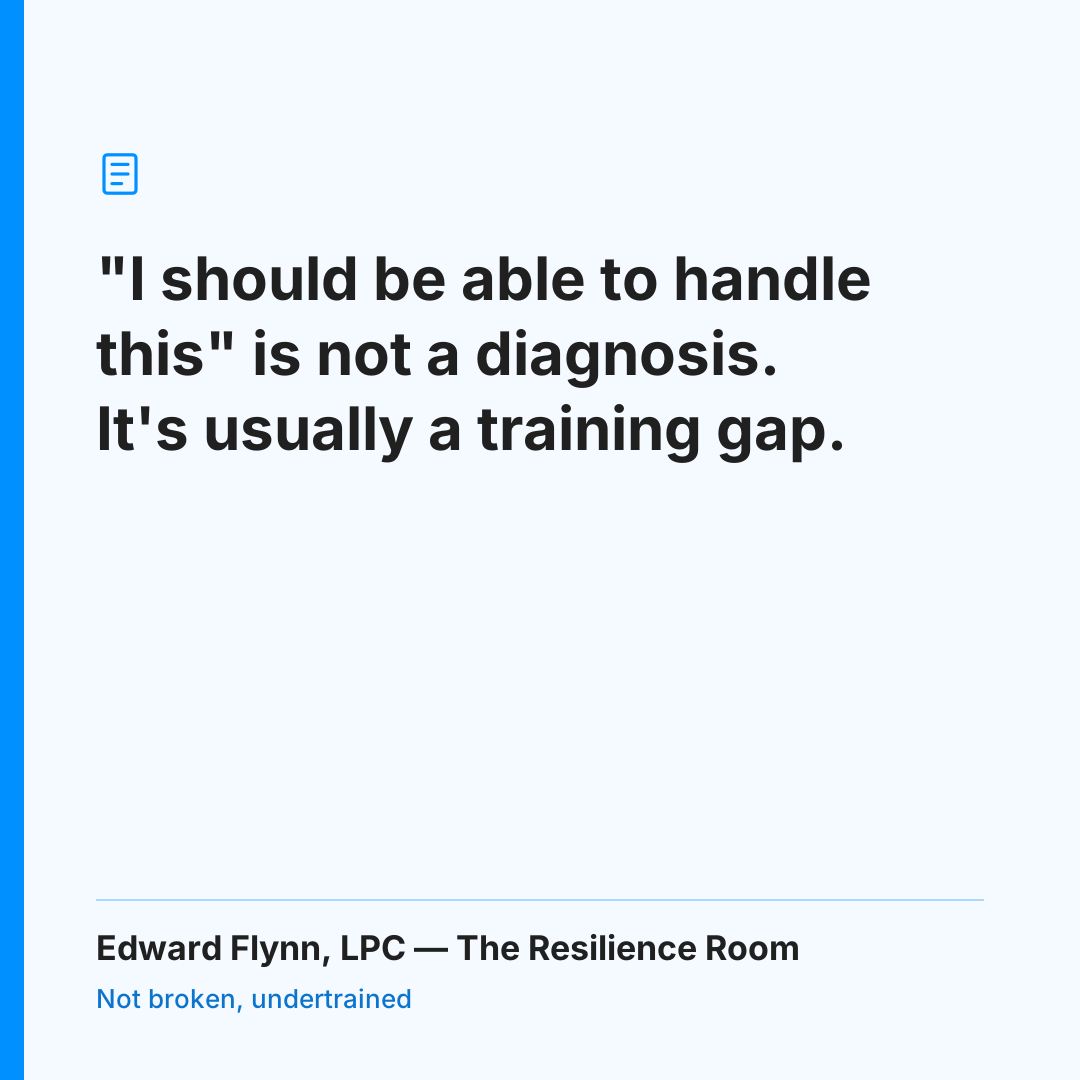
- Voice: plain, direct, training language: You Are Not Broken. You Are Undertrained.
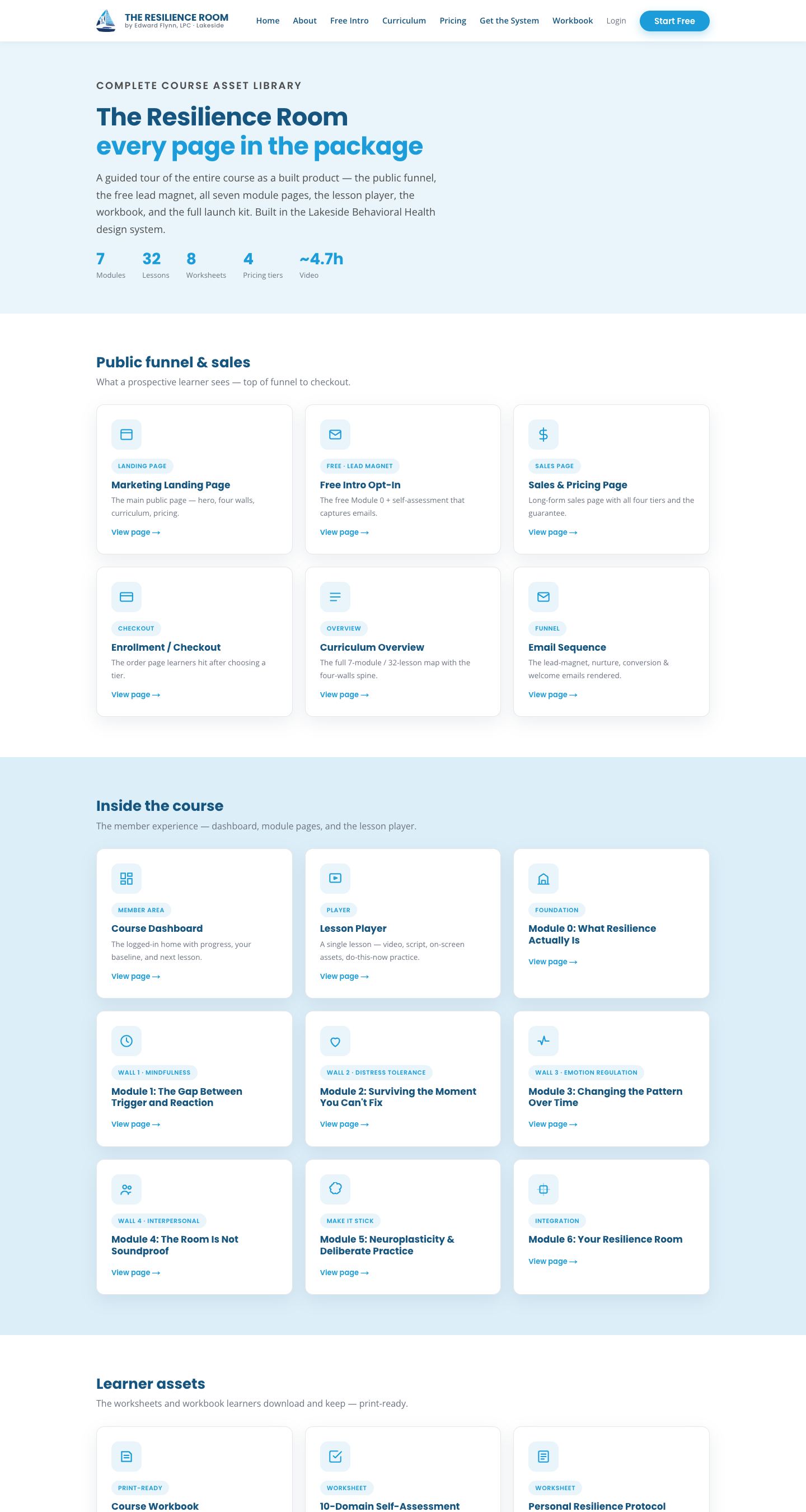
/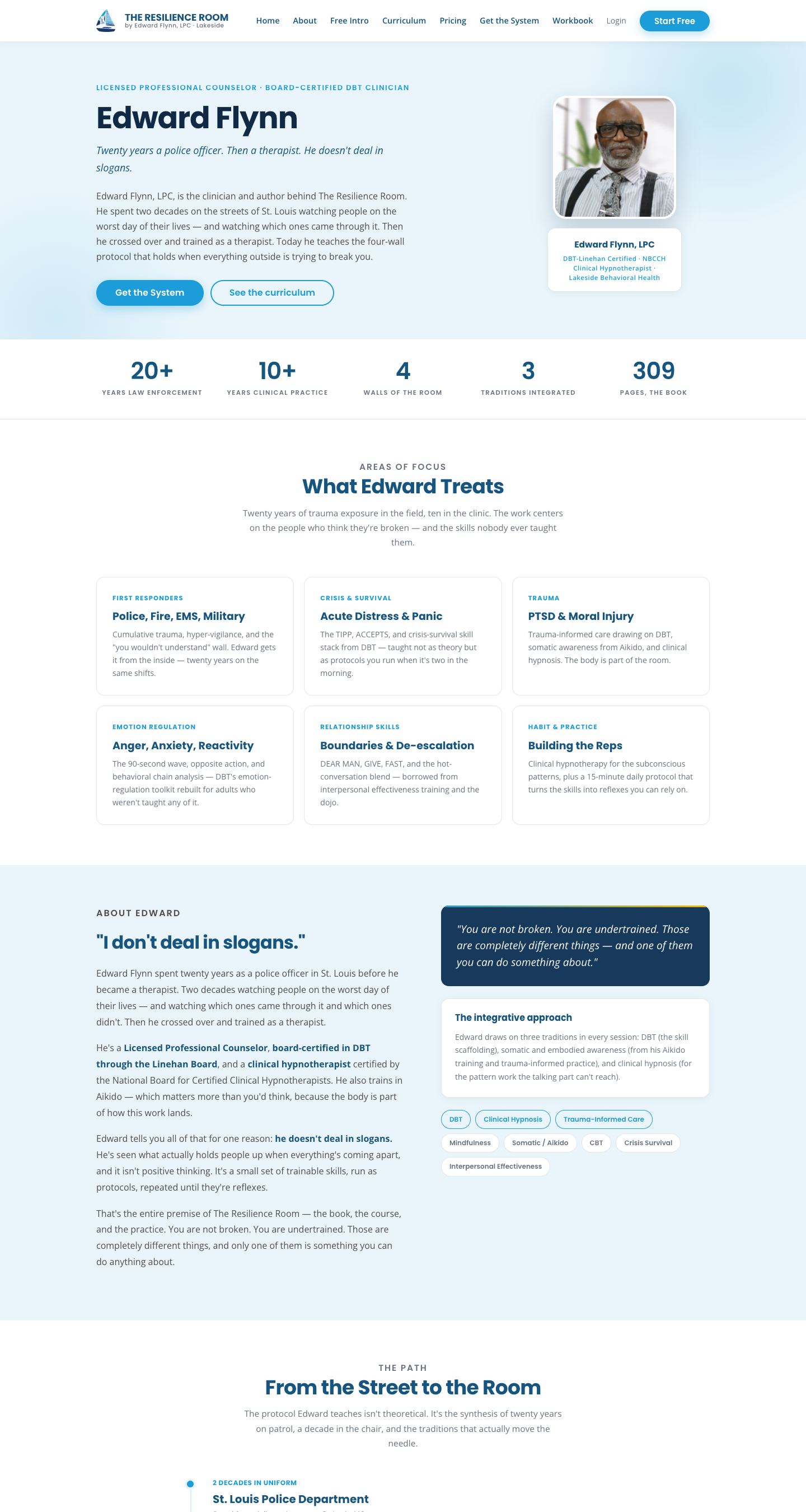
/about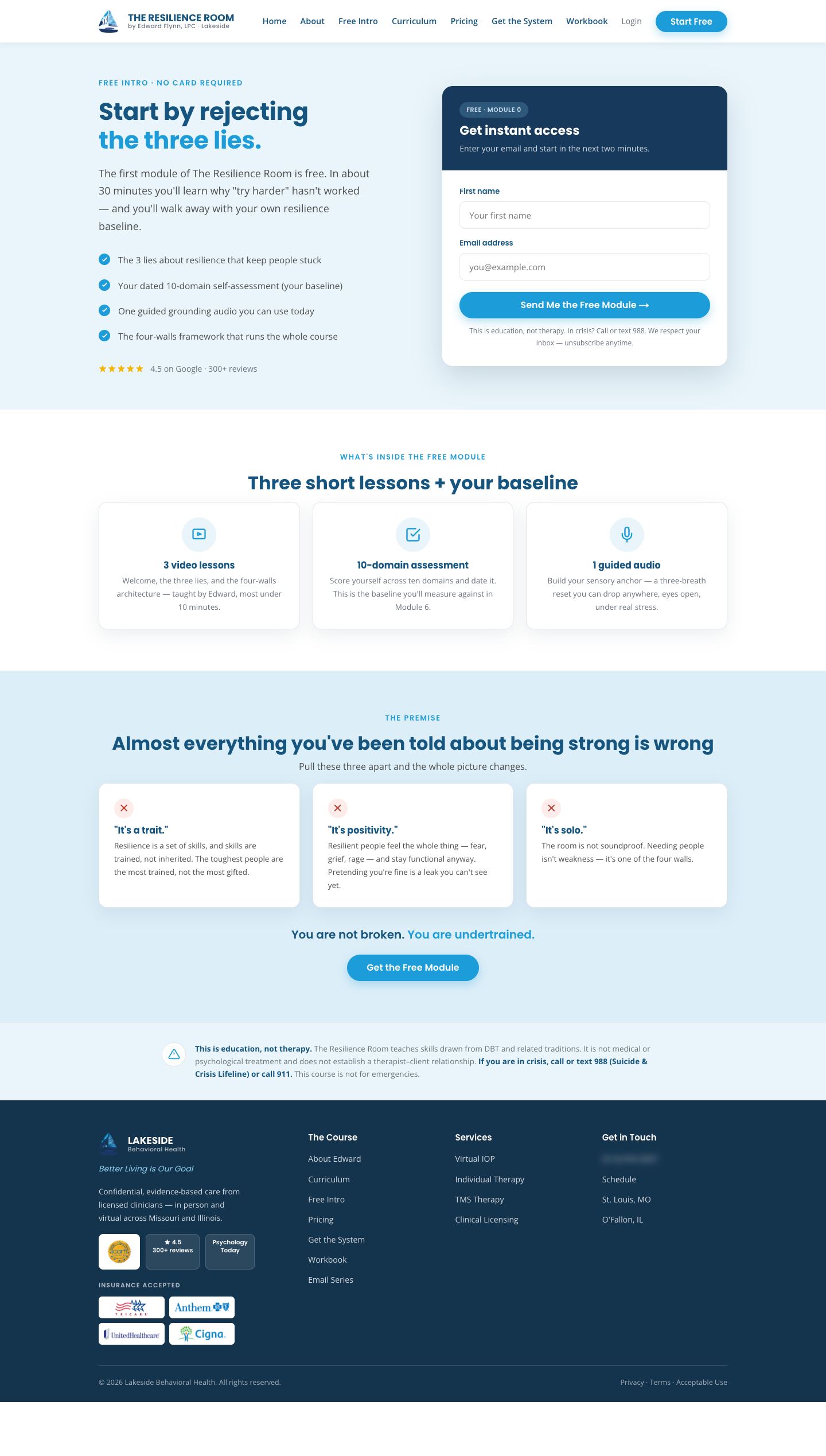
/lead-magnet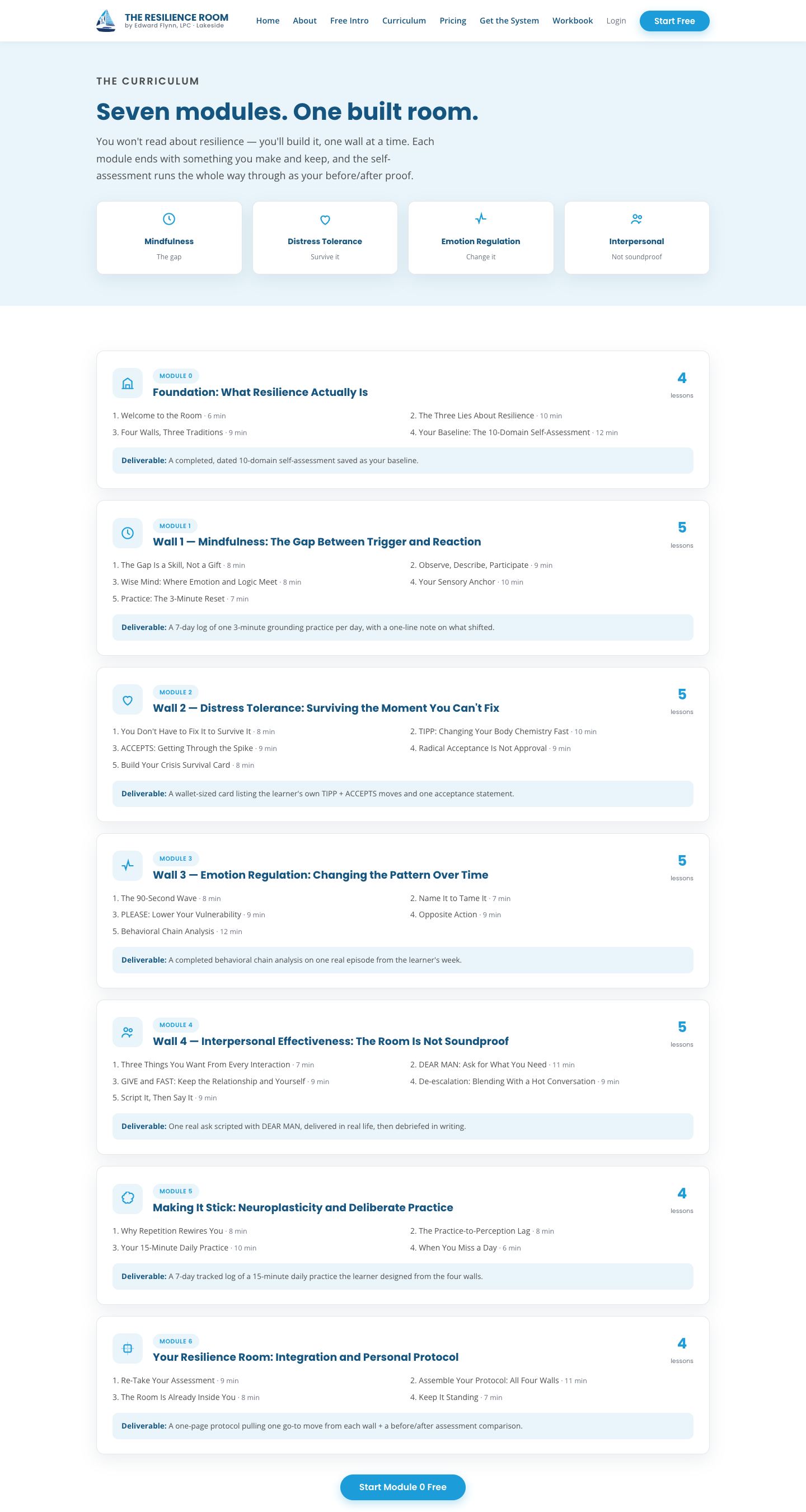
/course/curriculum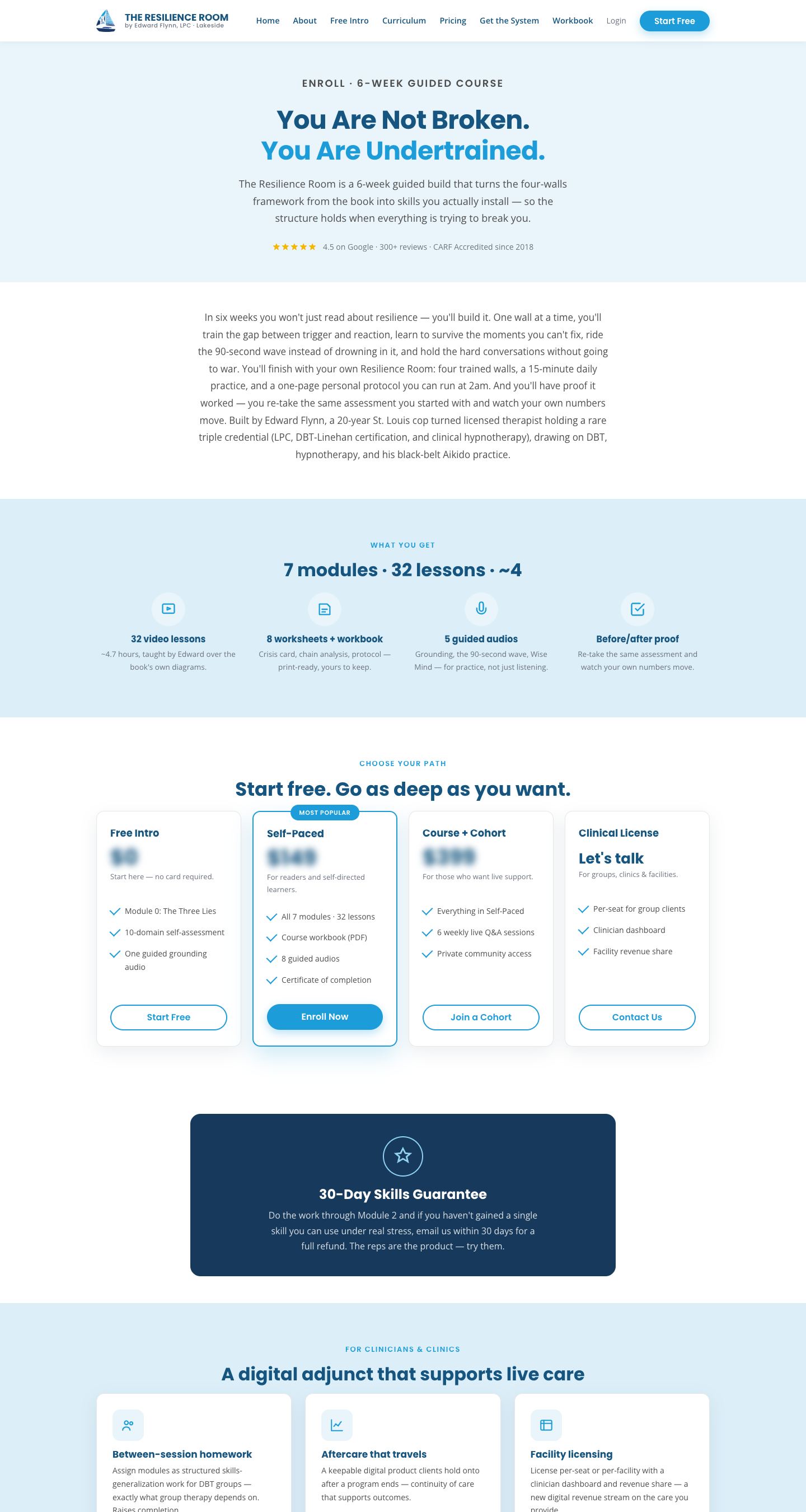
/sales
/get-the-system
/course/workbook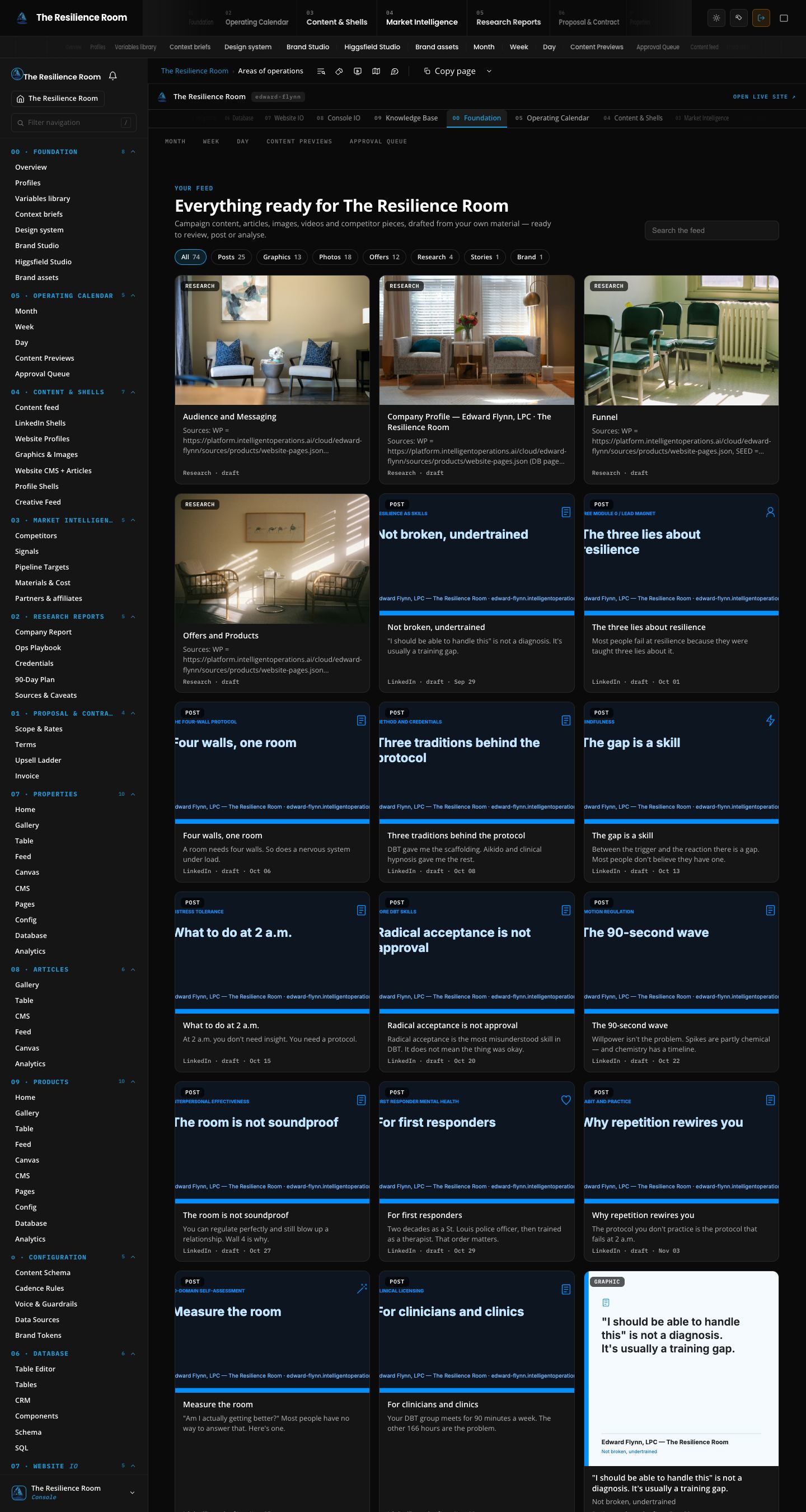
/tenant/edward-flynn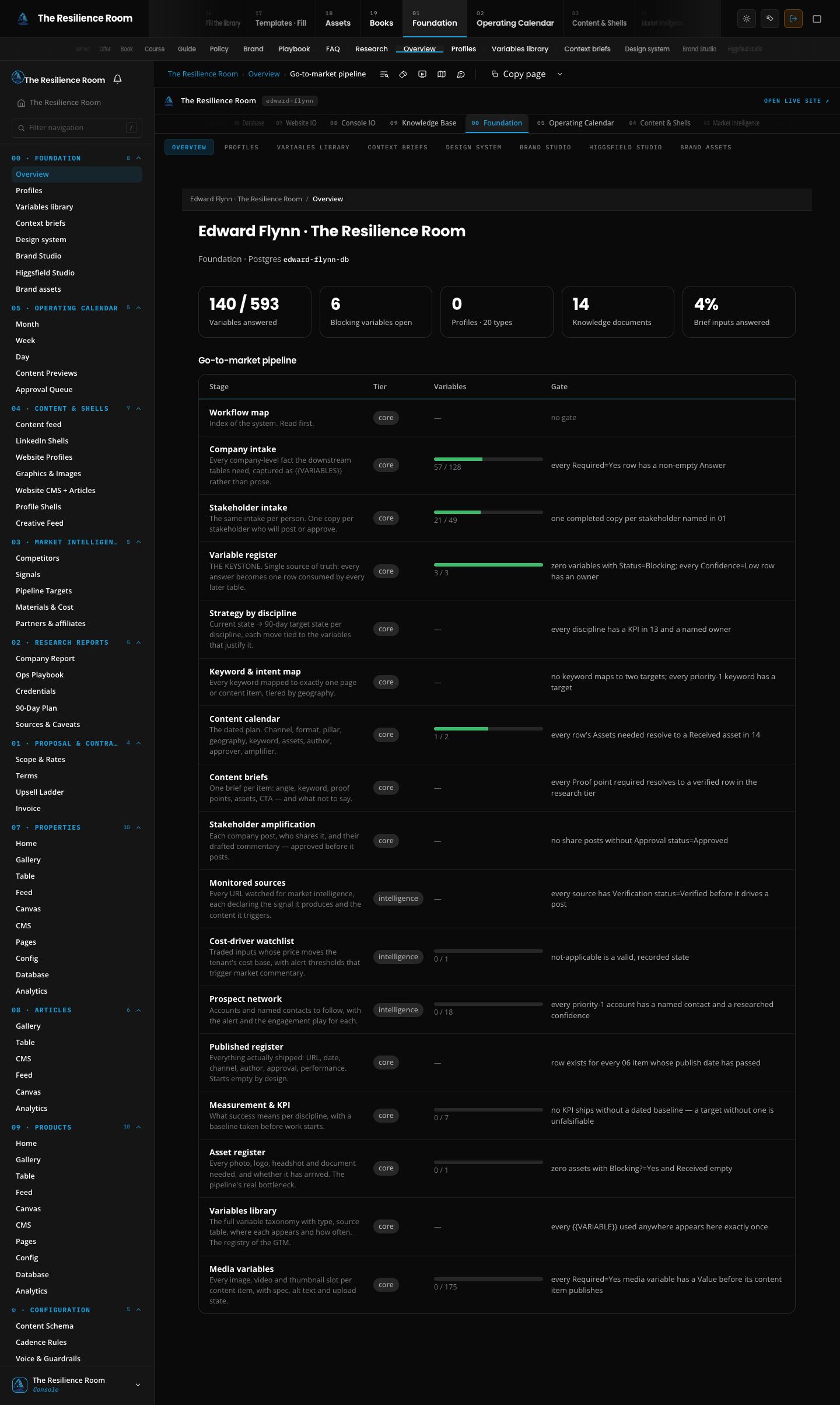
/tenant/edward-flynn/foundation/overview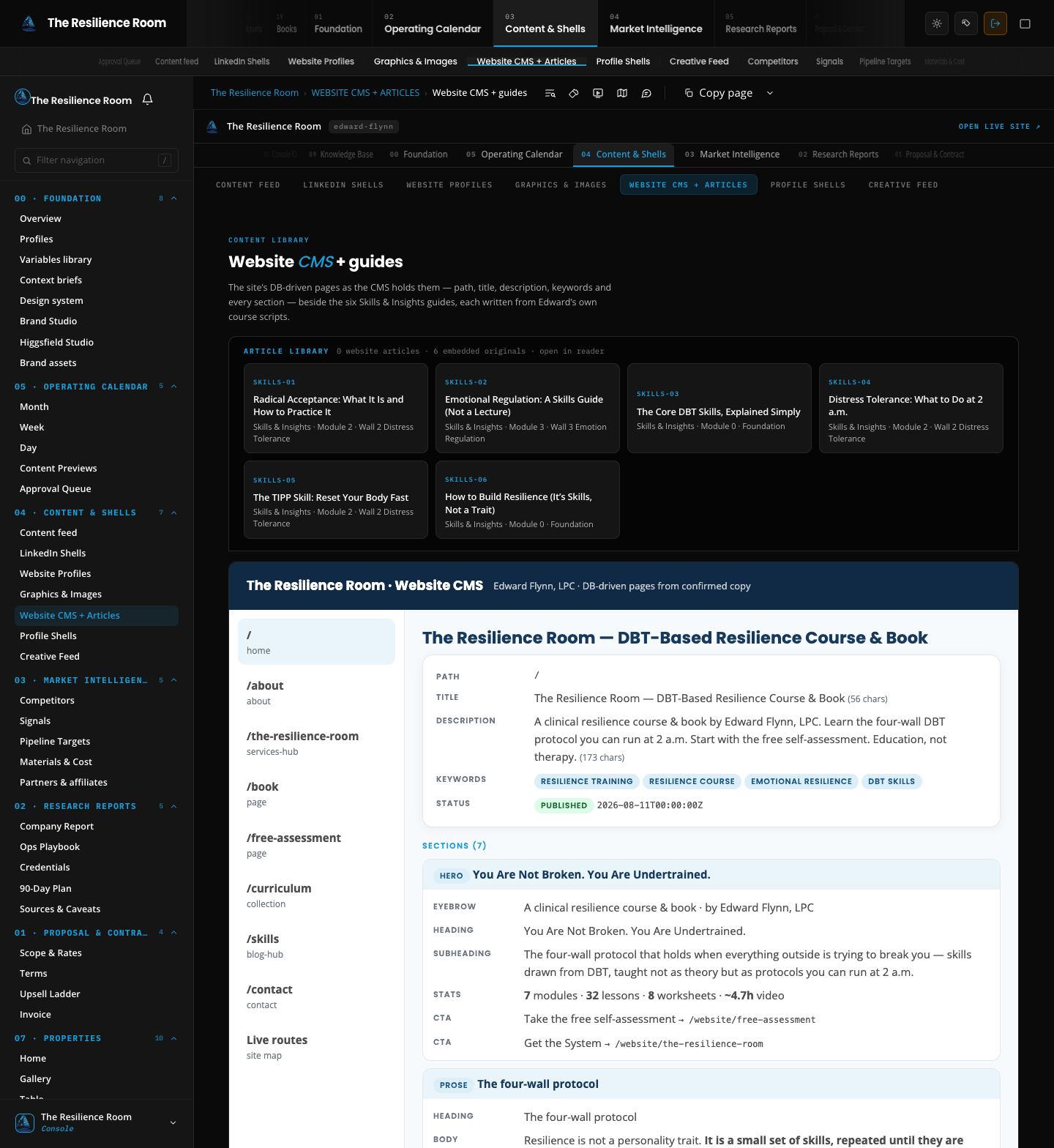
/tenant/edward-flynn/content/cms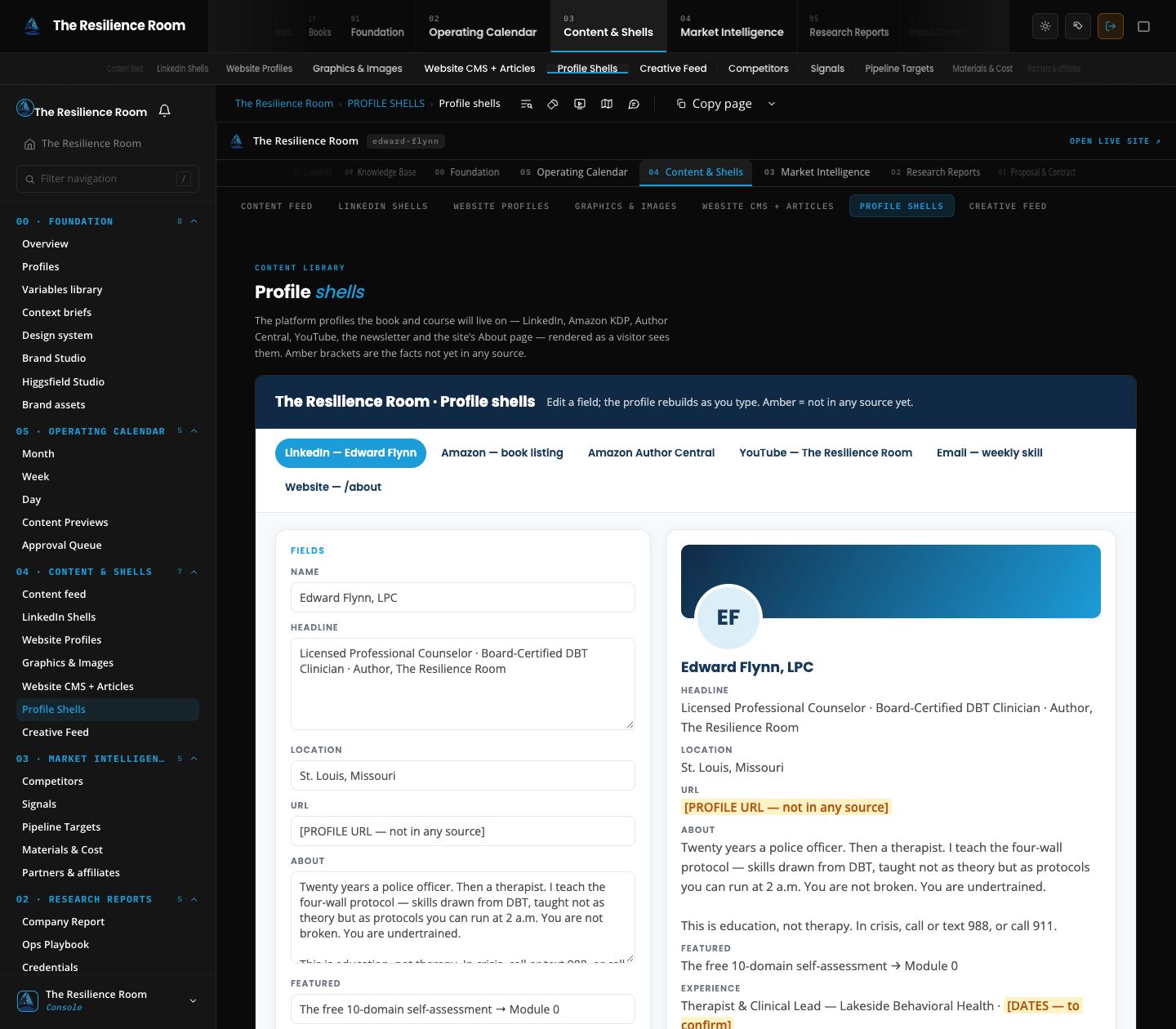
/tenant/edward-flynn/content/shells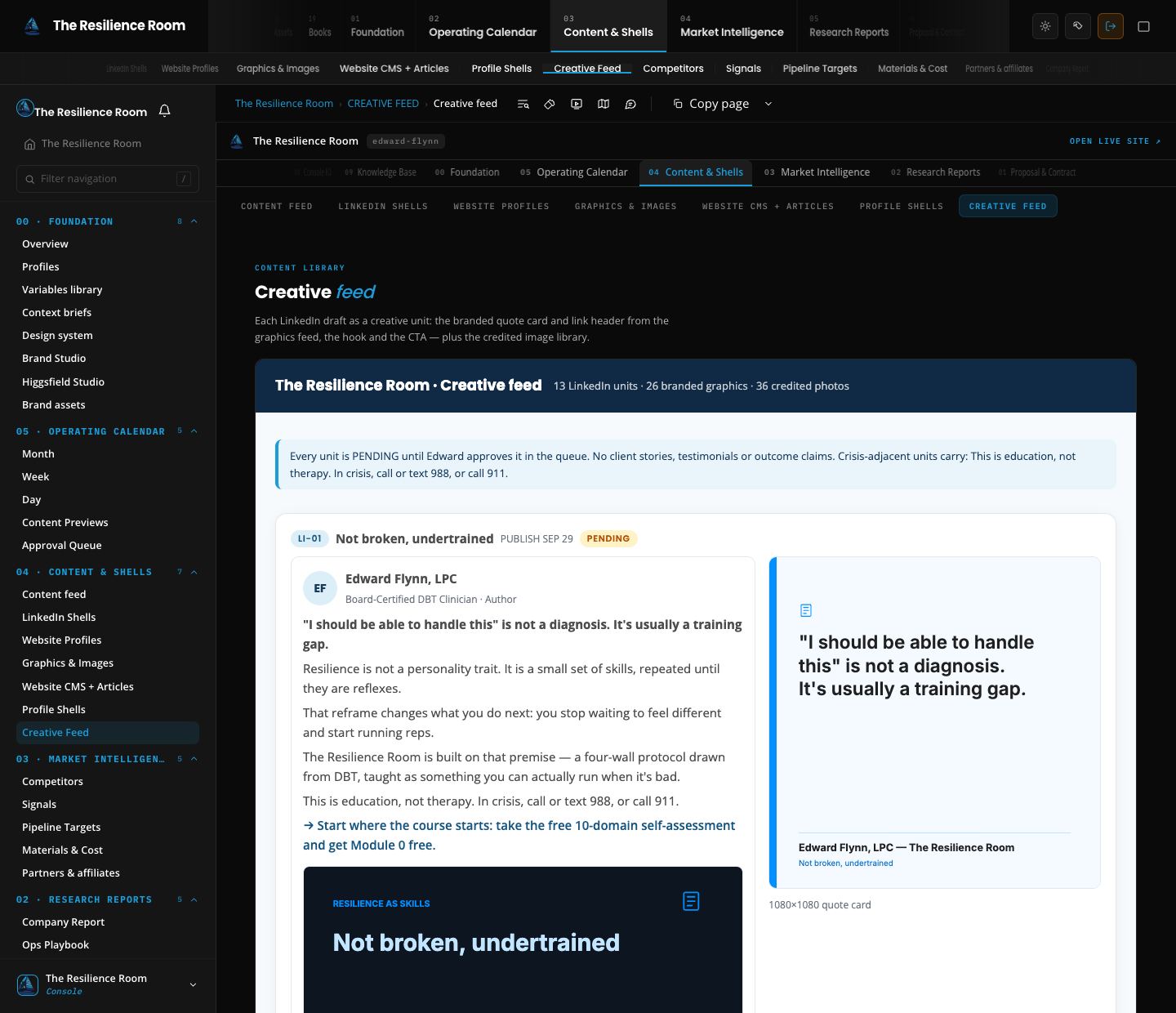
/tenant/edward-flynn/content/feed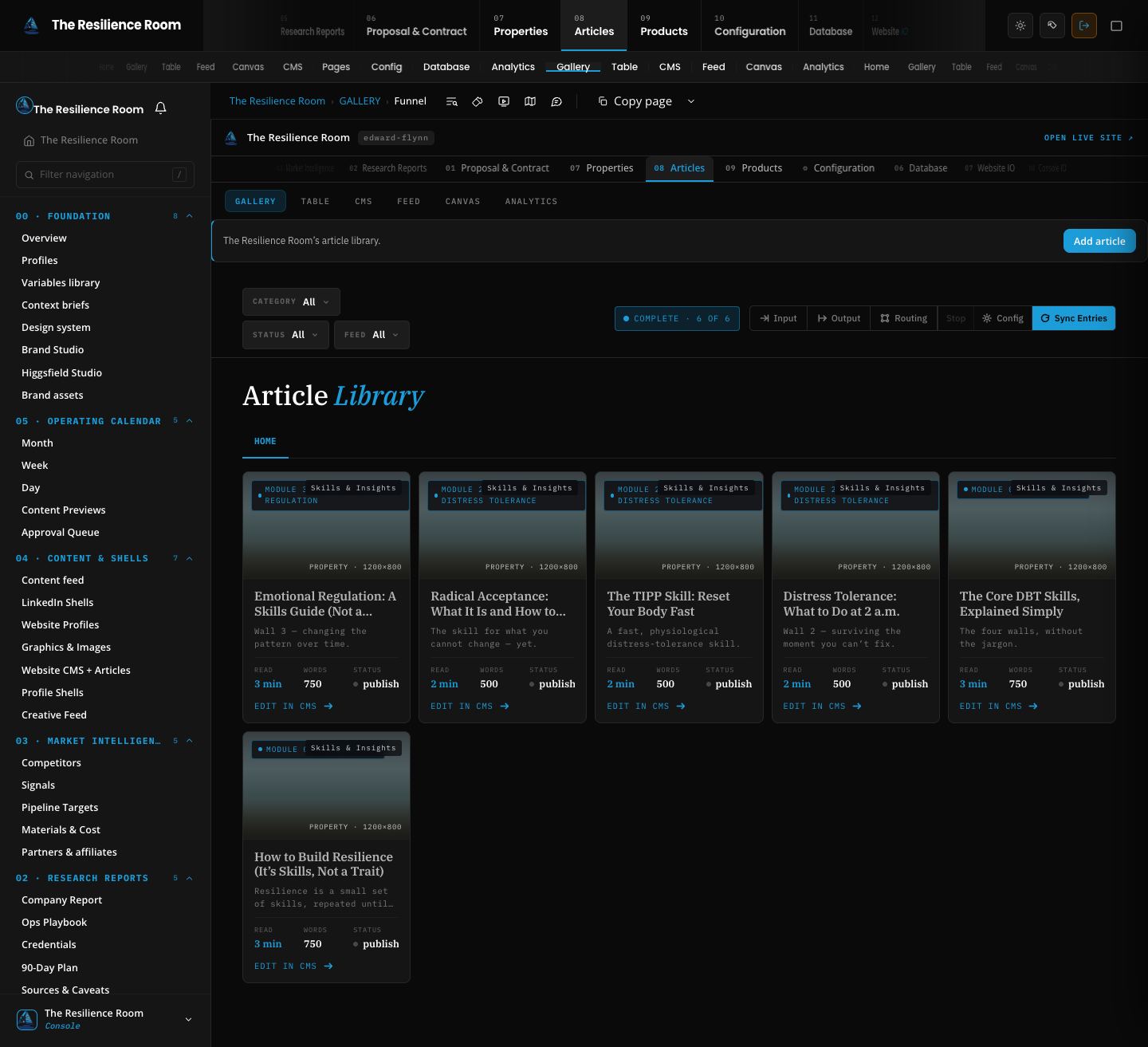
/tenant/edward-flynn/articles/gallery
/tenant/edward-flynn/products/table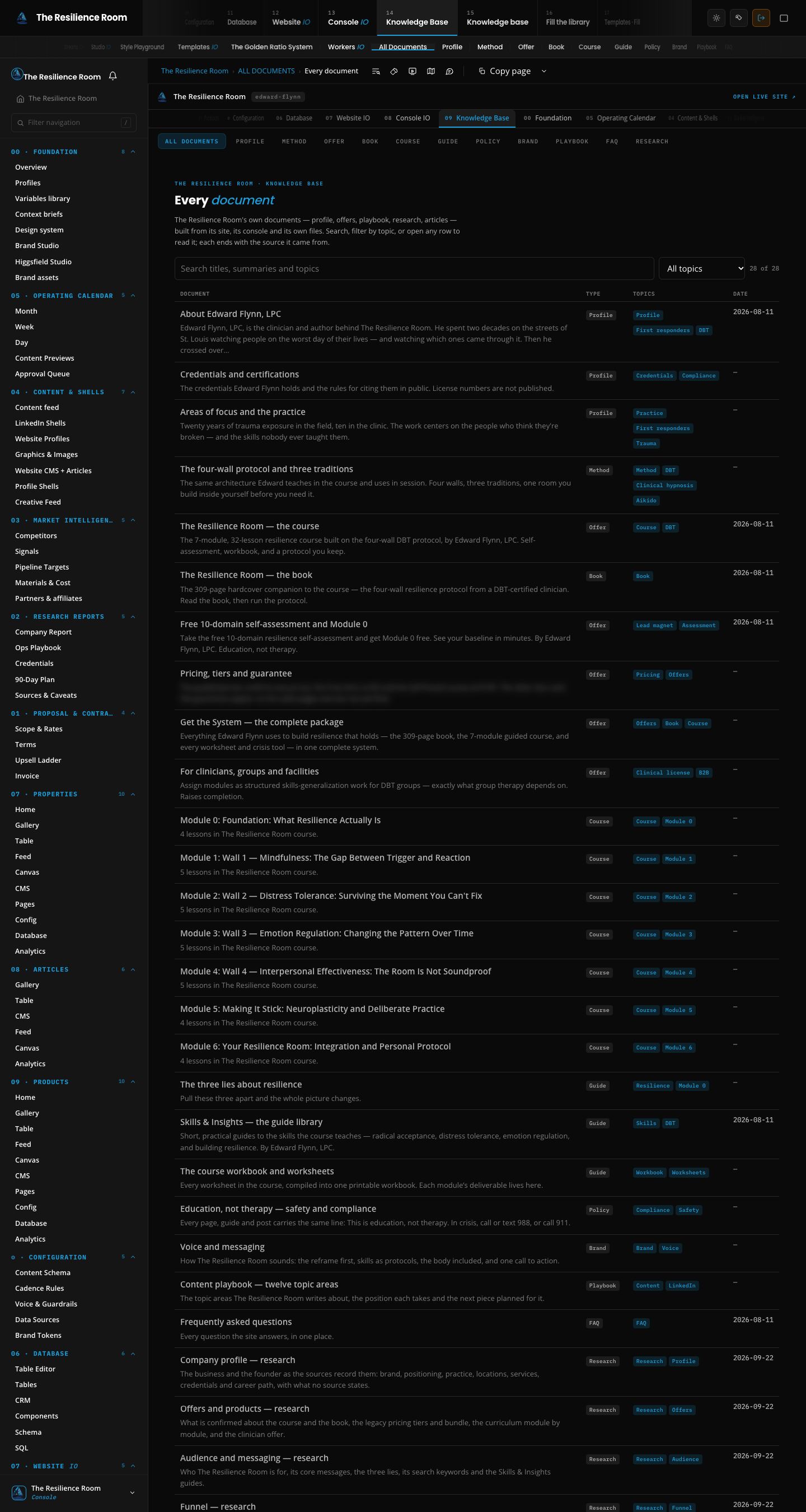
/tenant/edward-flynn/knowledge/all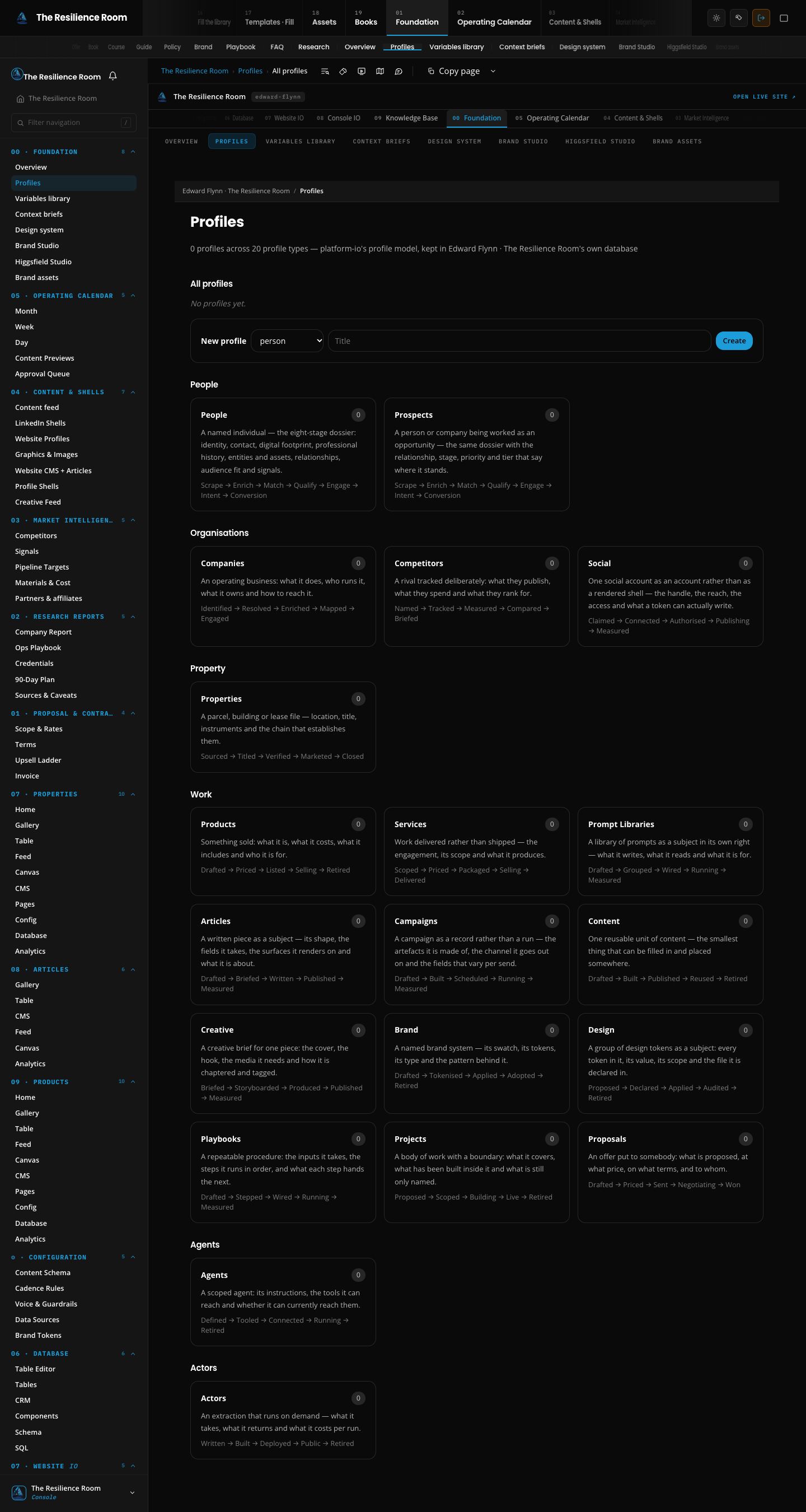
/tenant/edward-flynn/foundation/profiles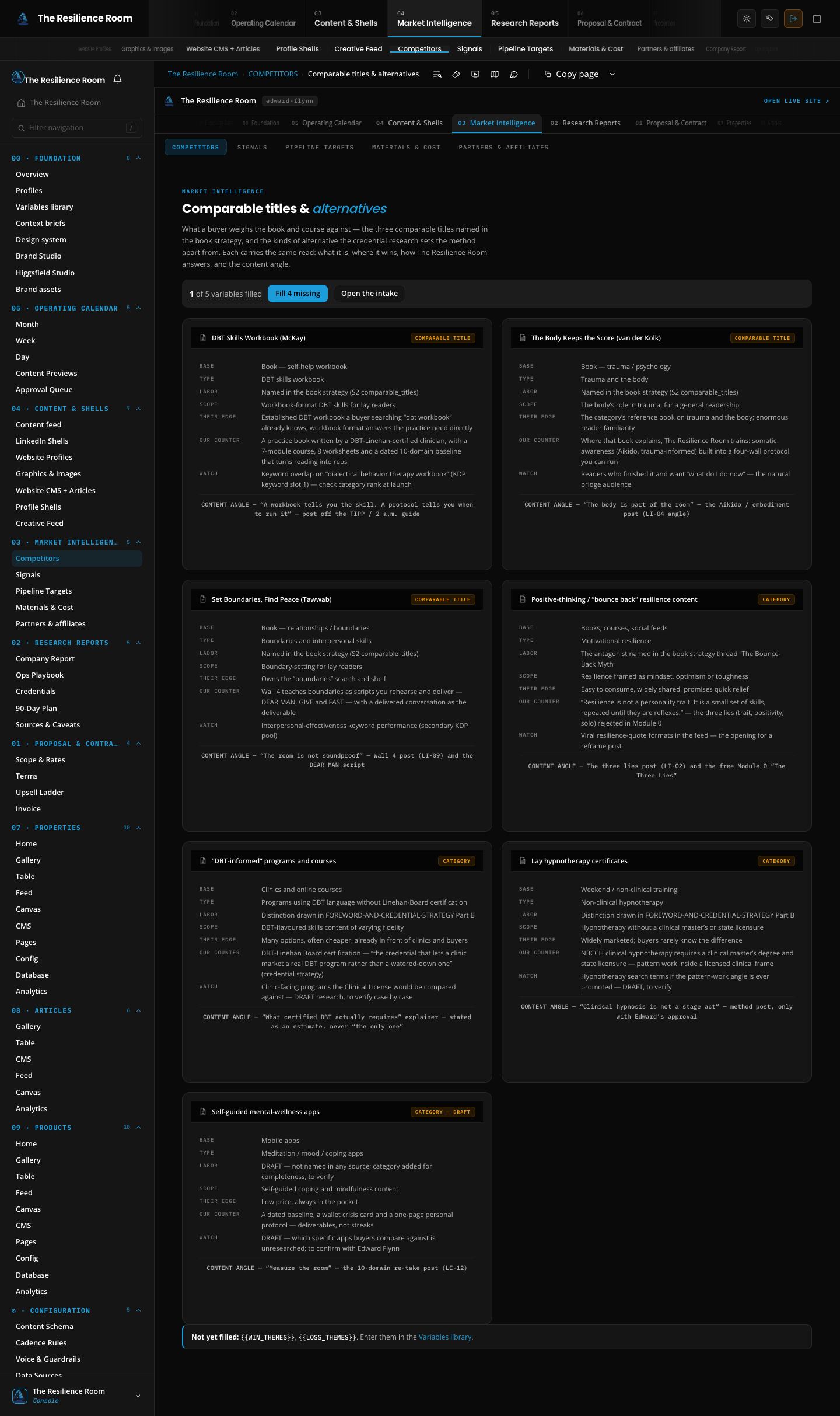
/tenant/edward-flynn/intel/competitors
/tenant/edward-flynn/database/tables
/tenant/edward-flynn/database/schema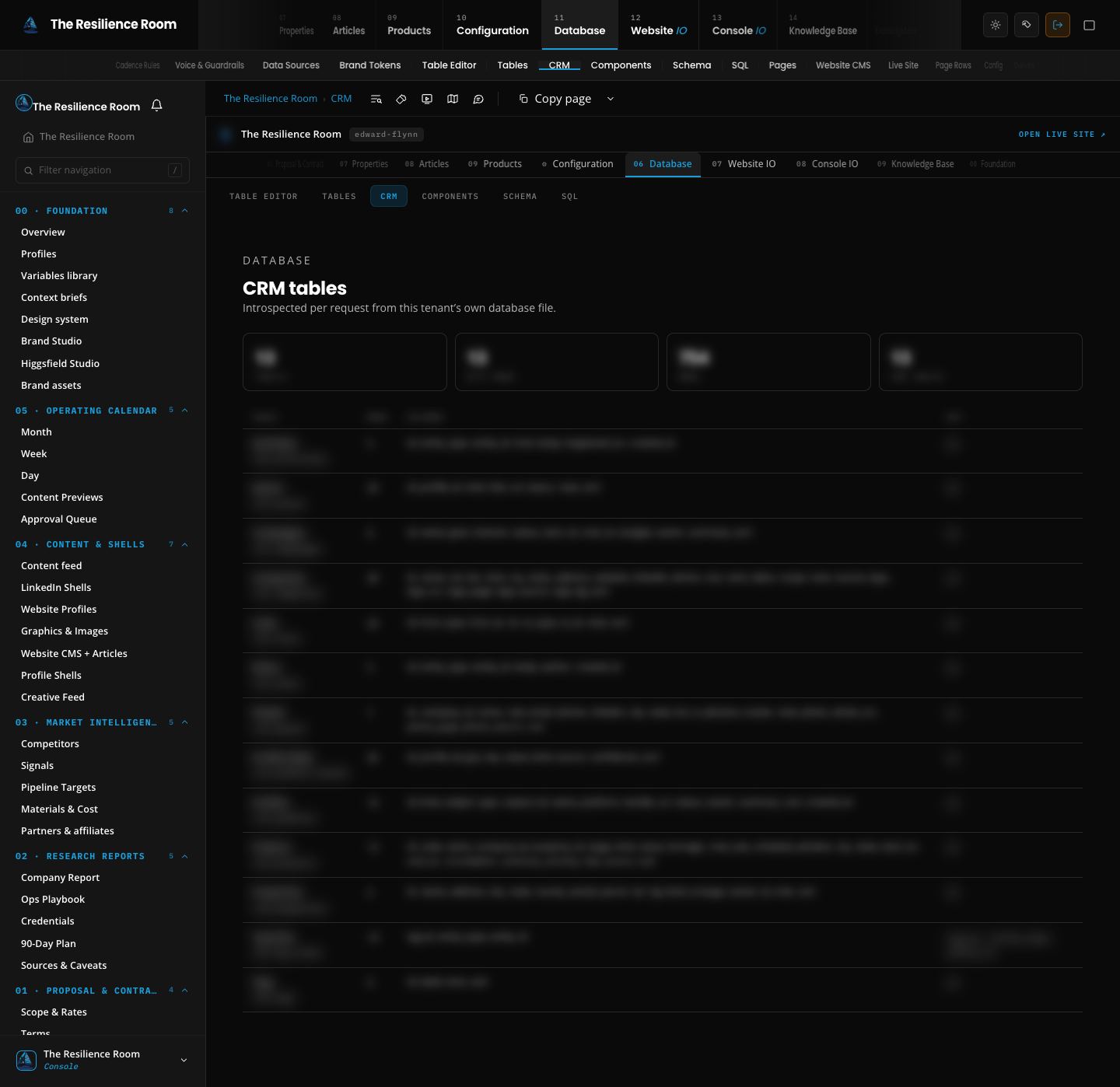
/tenant/edward-flynn/database/crm
/tenant/edward-flynn/intel/pipeline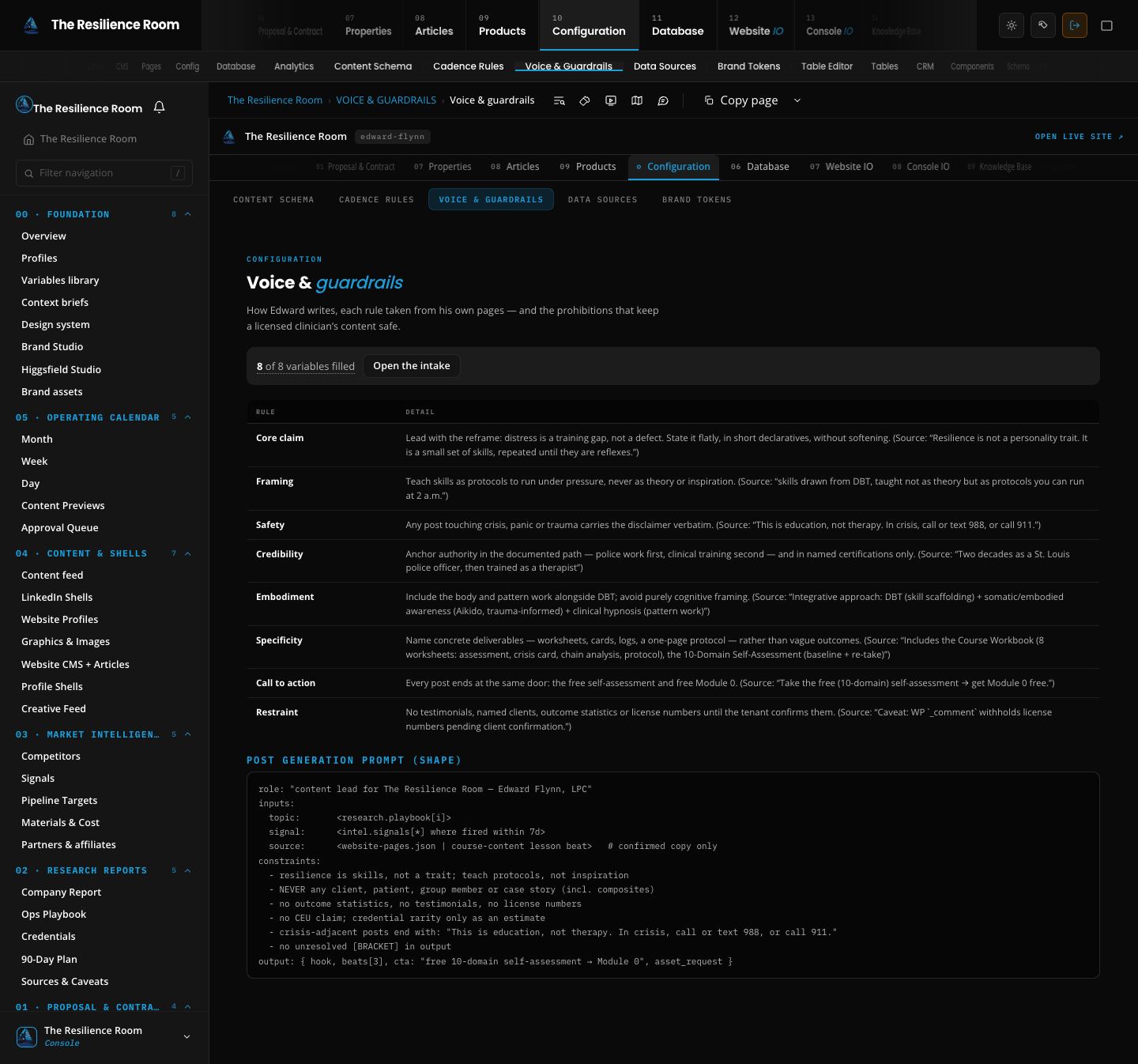
/tenant/edward-flynn/config/voice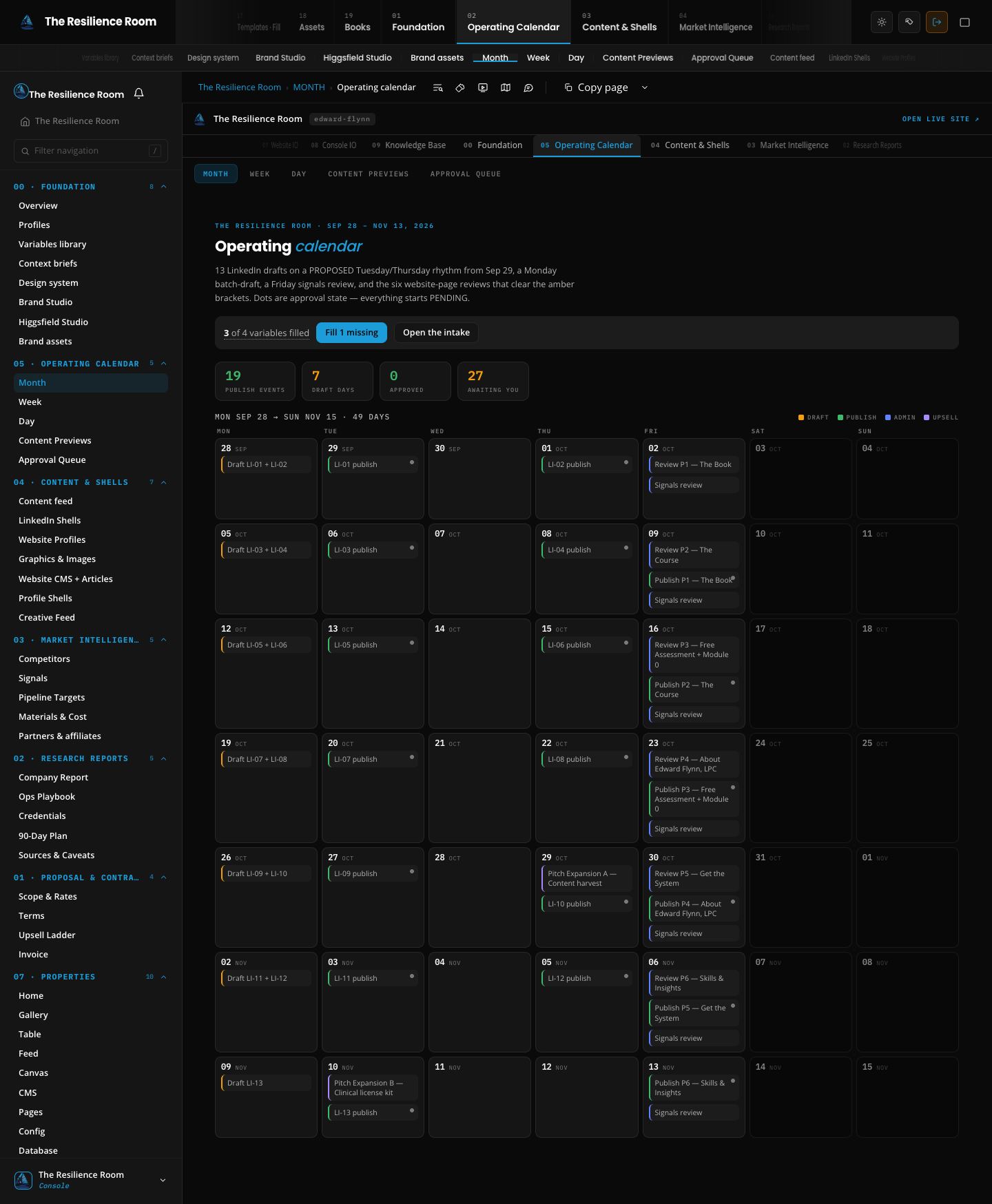
/tenant/edward-flynn/calendar/month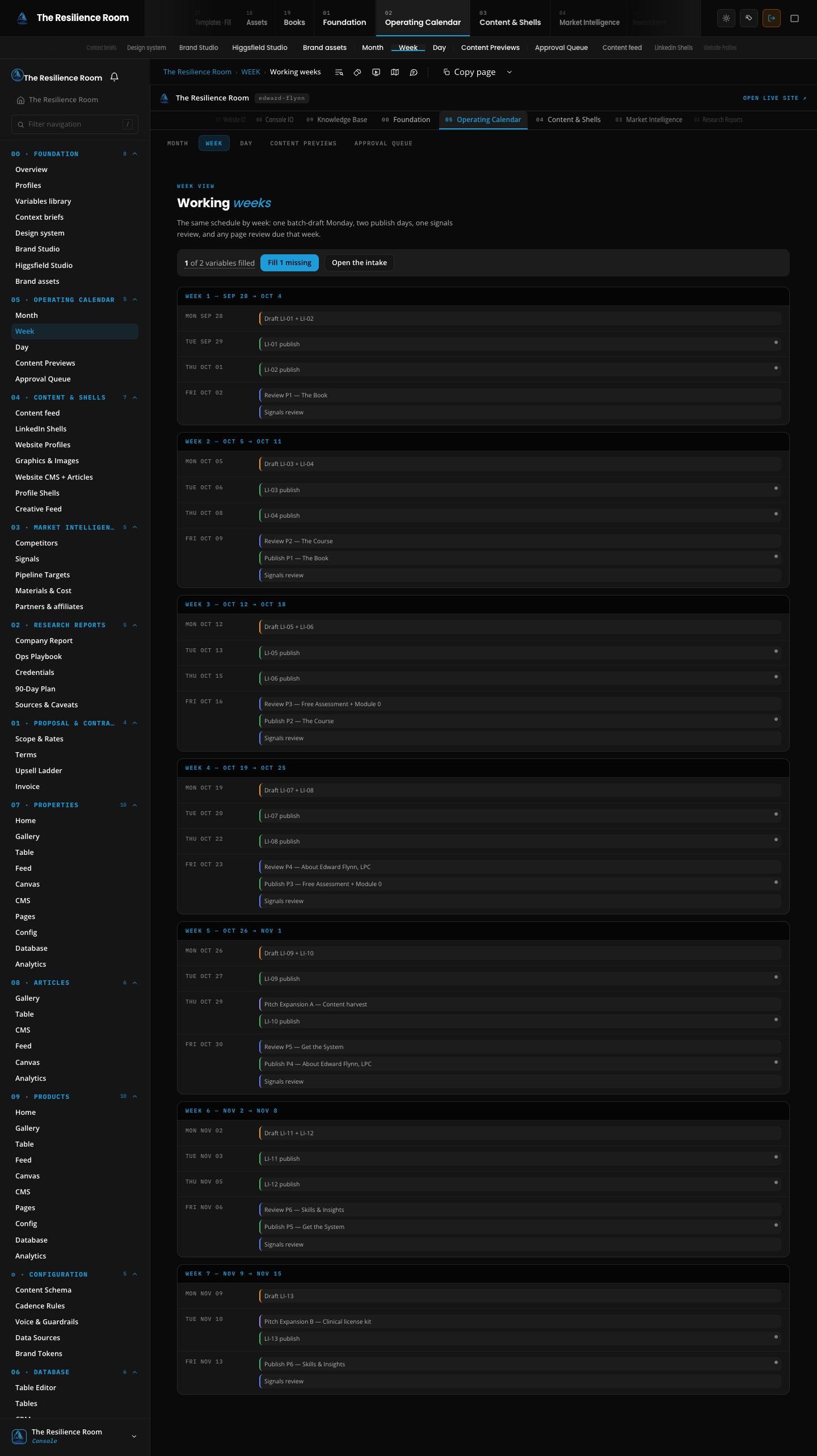
/tenant/edward-flynn/calendar/week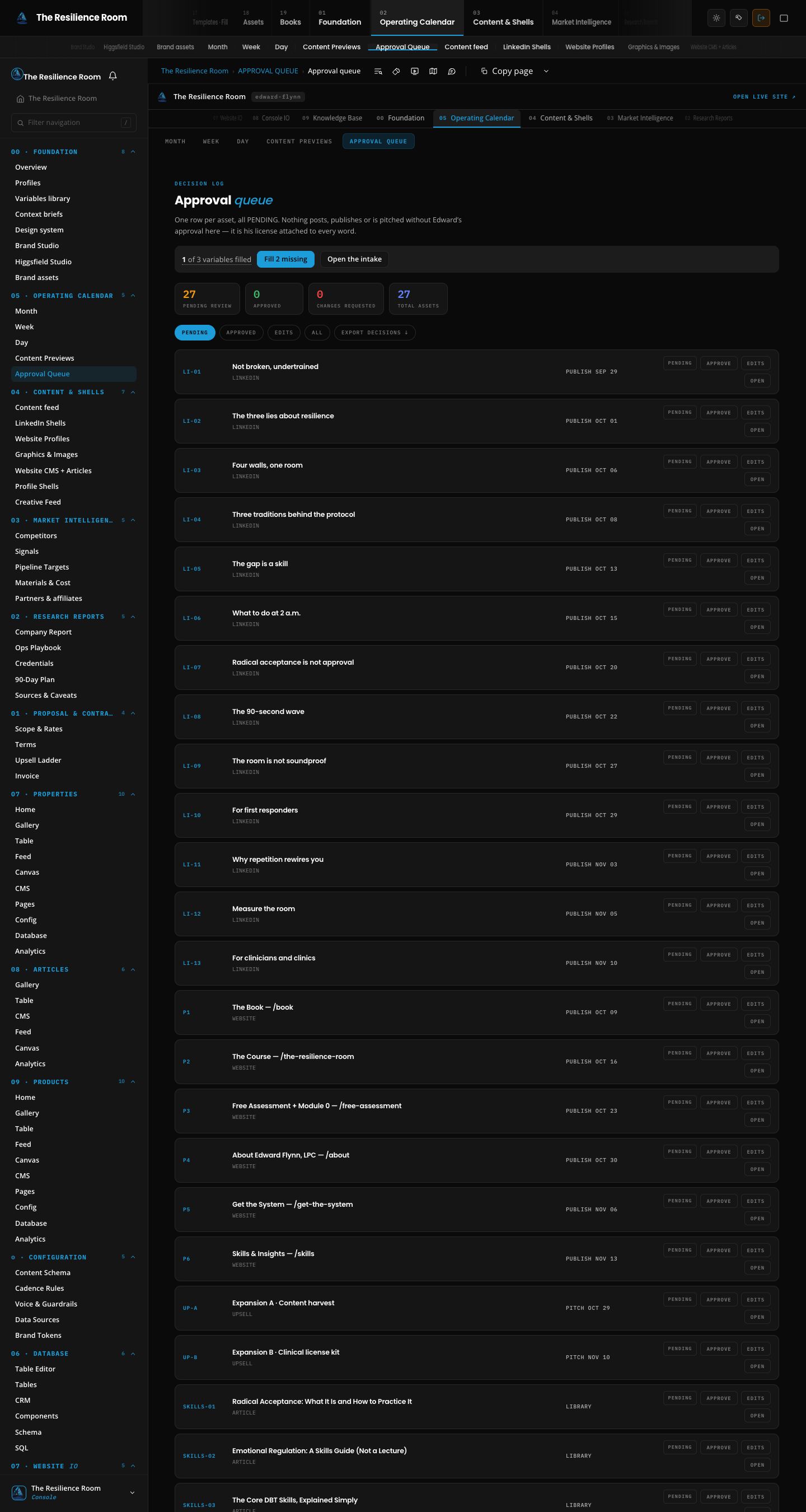
/tenant/edward-flynn/calendar/approvals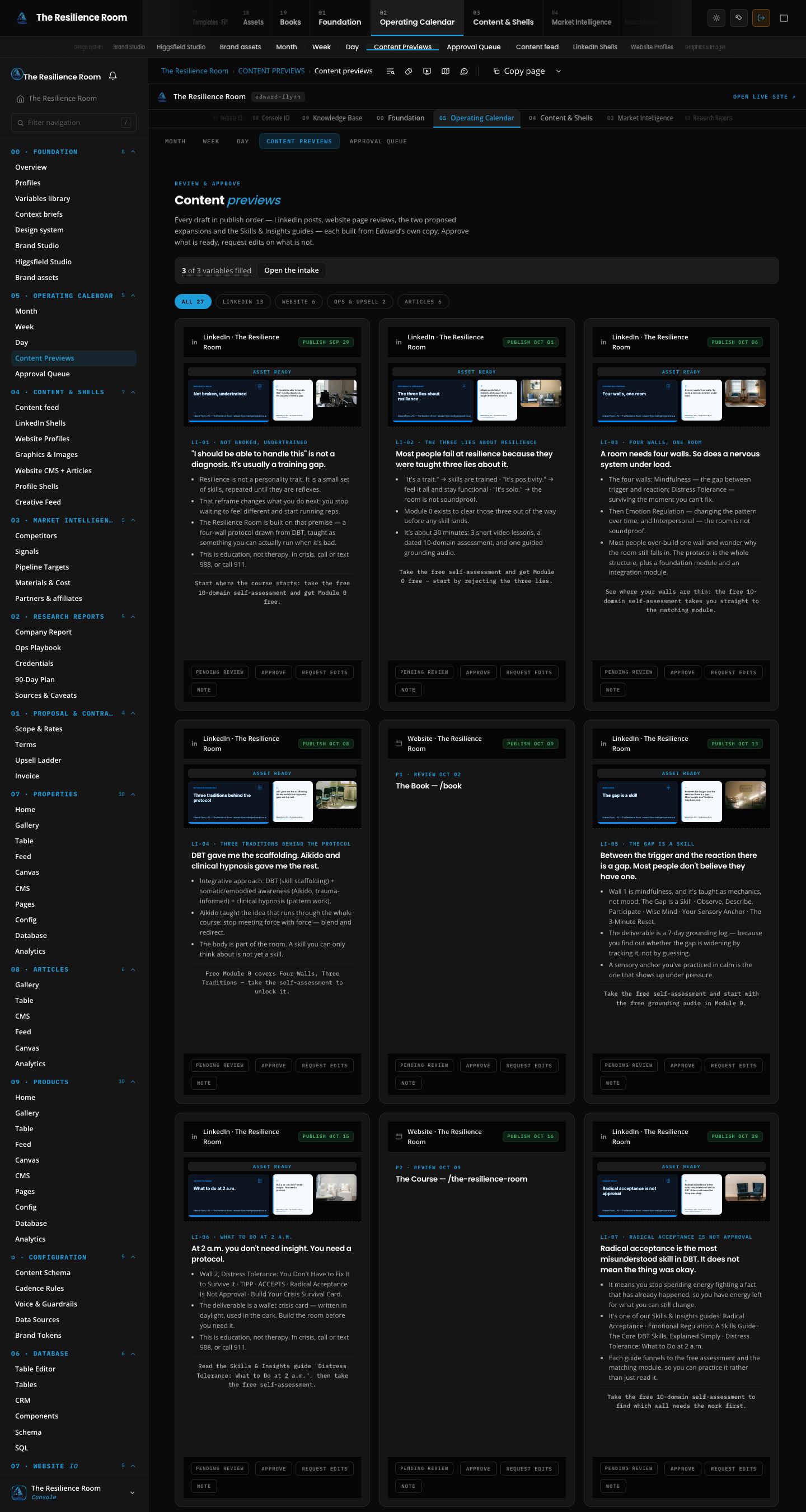
/tenant/edward-flynn/calendar/previews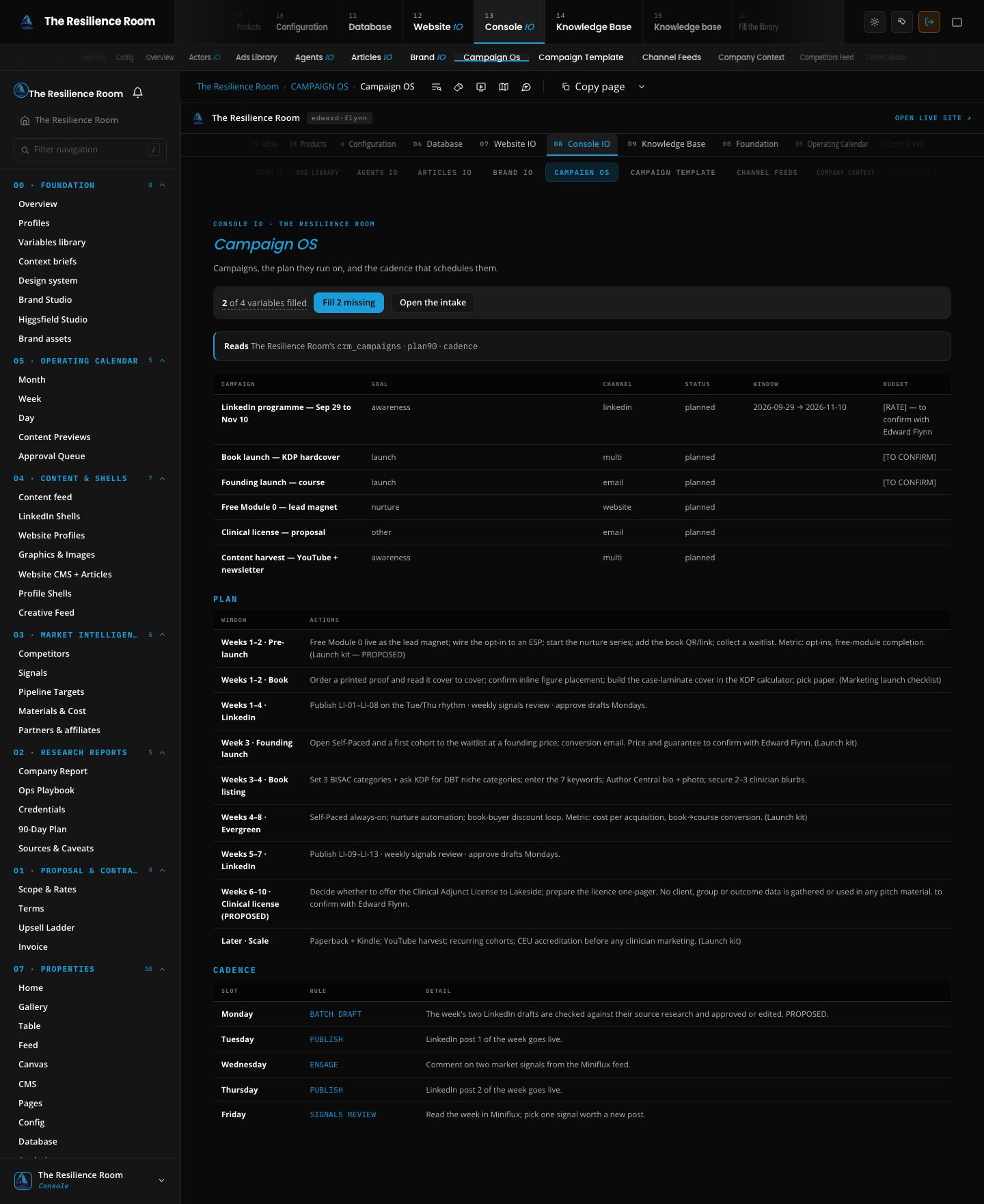
/tenant/edward-flynn/consoles/campaign-os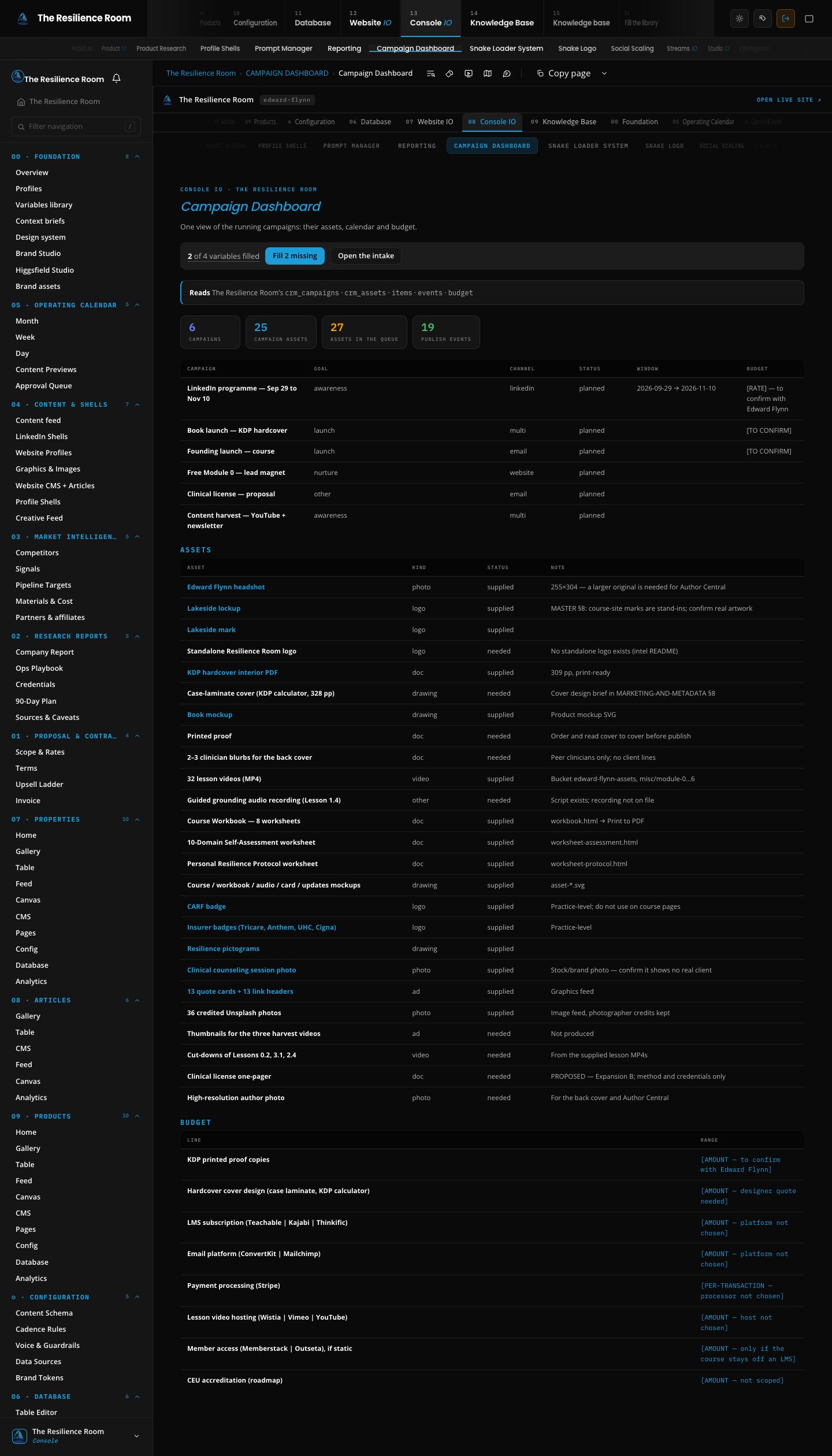
/tenant/edward-flynn/consoles/campaign-dashboard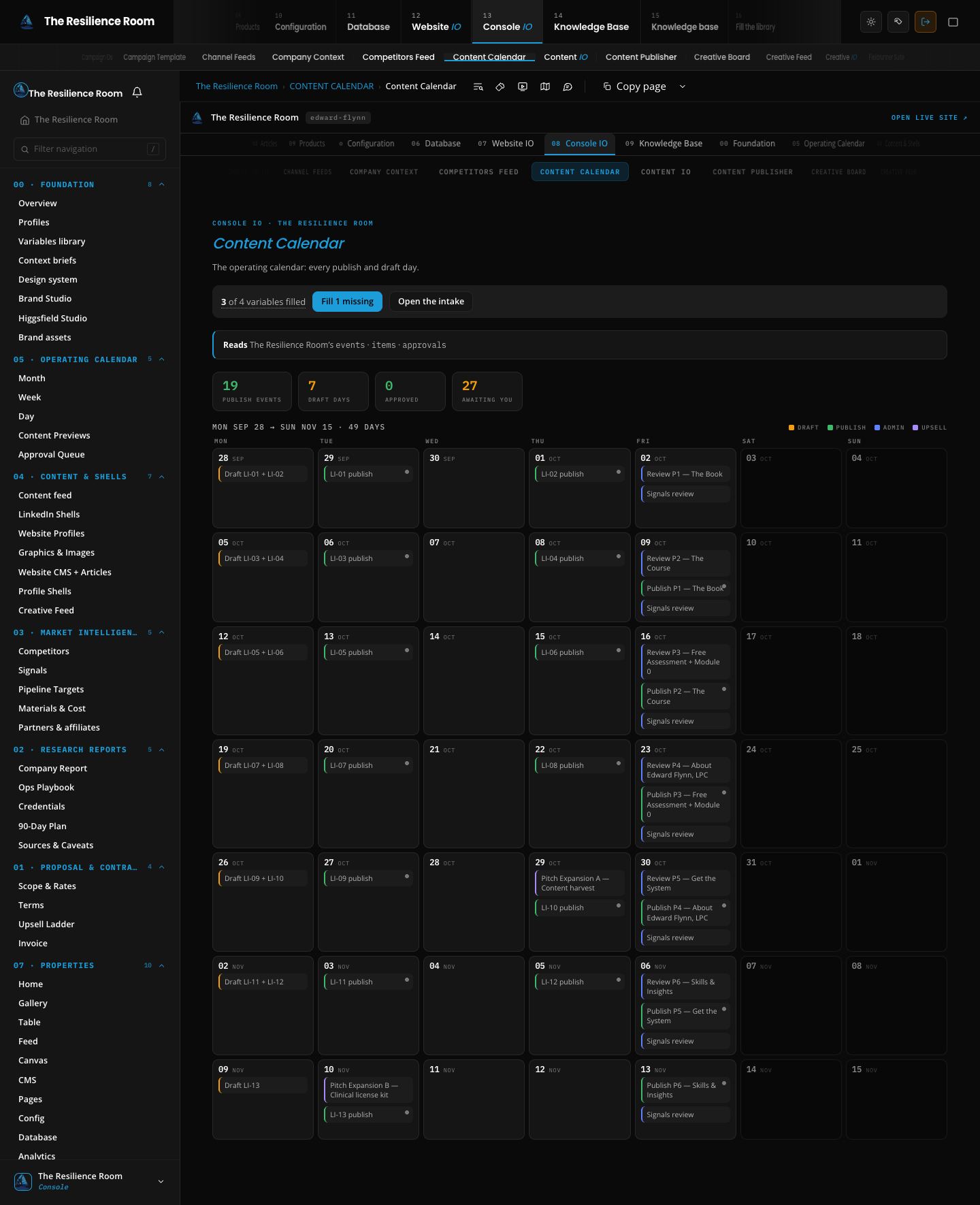
/tenant/edward-flynn/consoles/content-calendar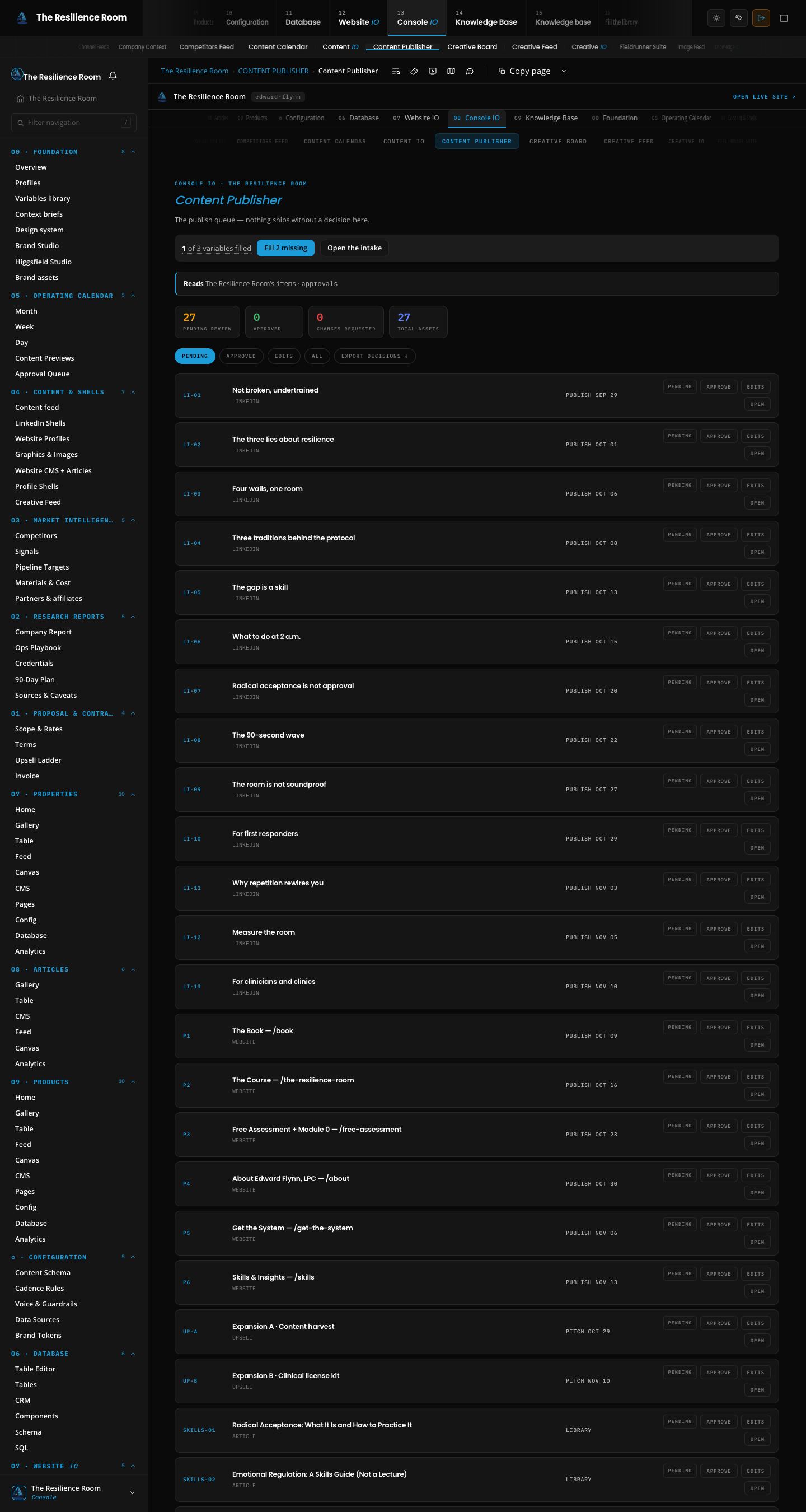
/tenant/edward-flynn/consoles/content-publisher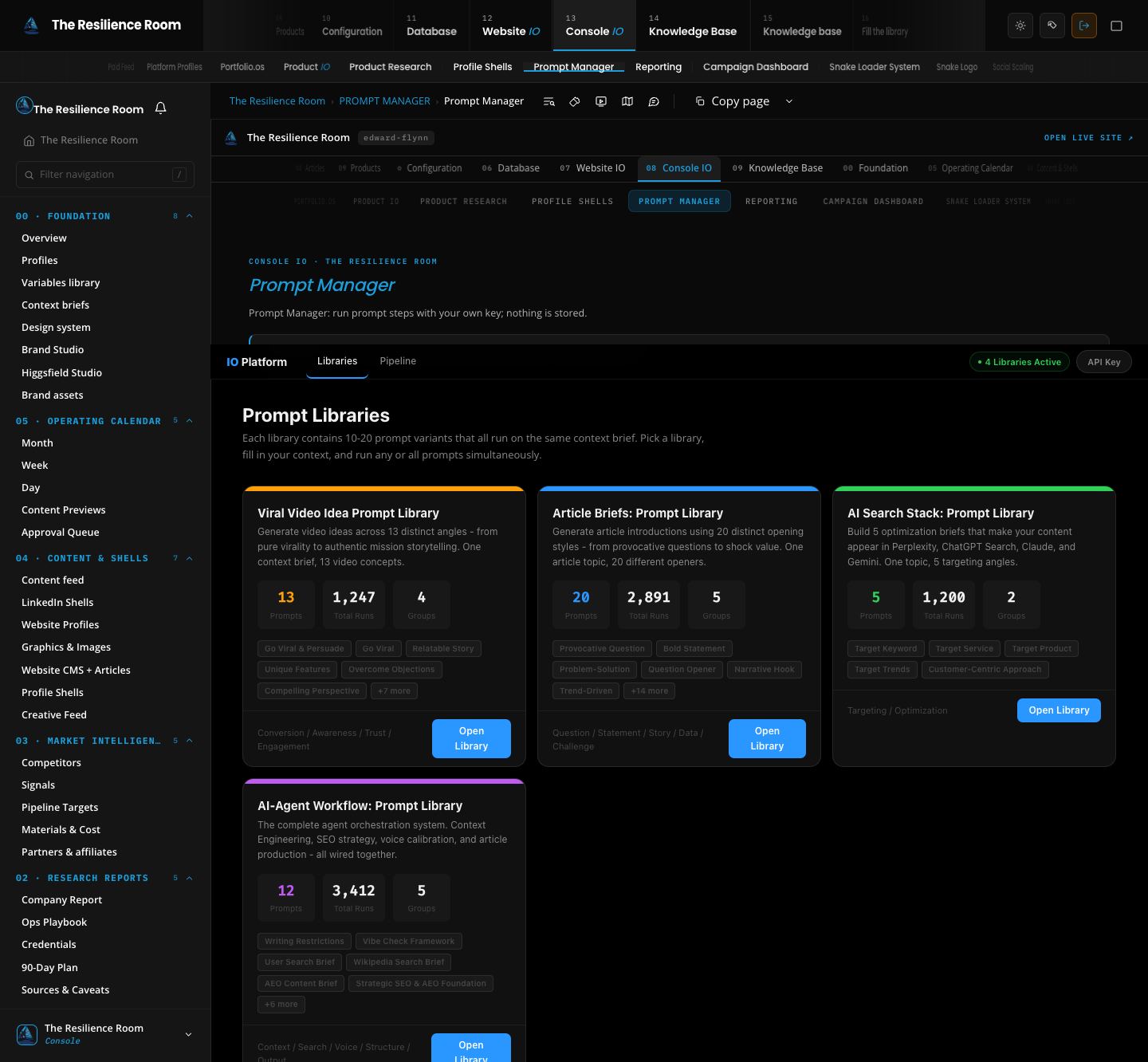
/tenant/edward-flynn/consoles/prompt-library-workflows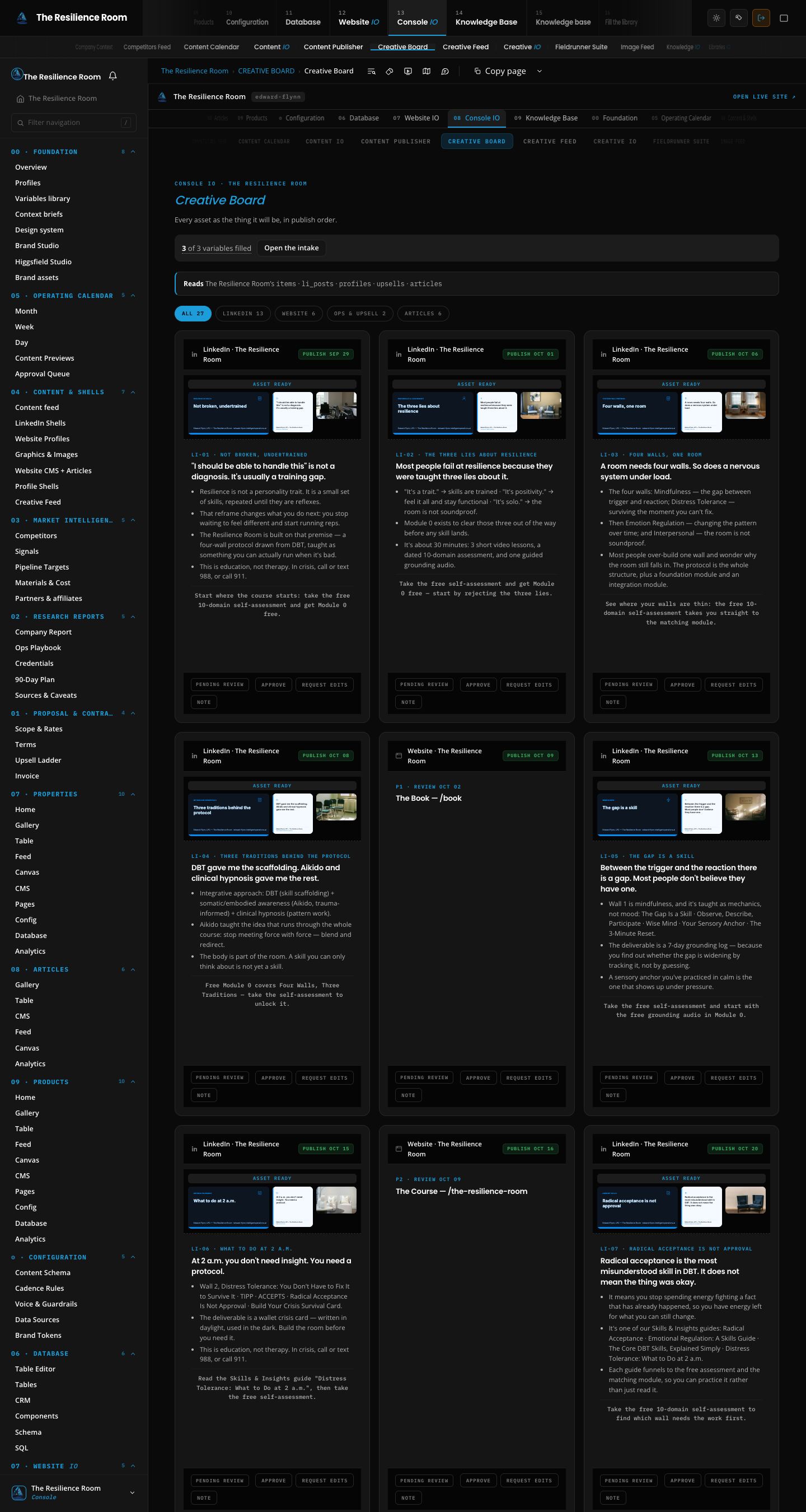
/tenant/edward-flynn/consoles/creative-board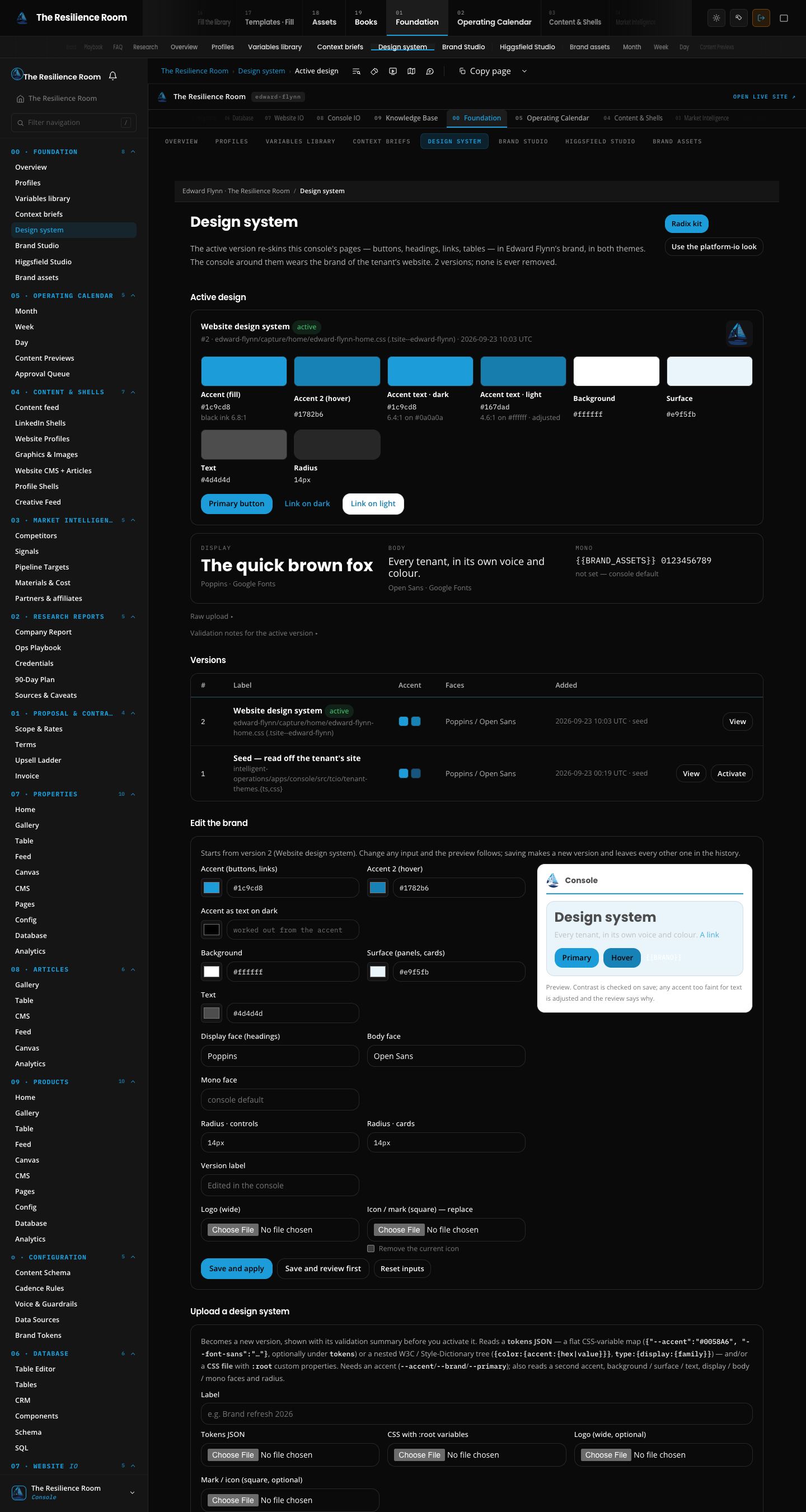
/tenant/edward-flynn/foundation/design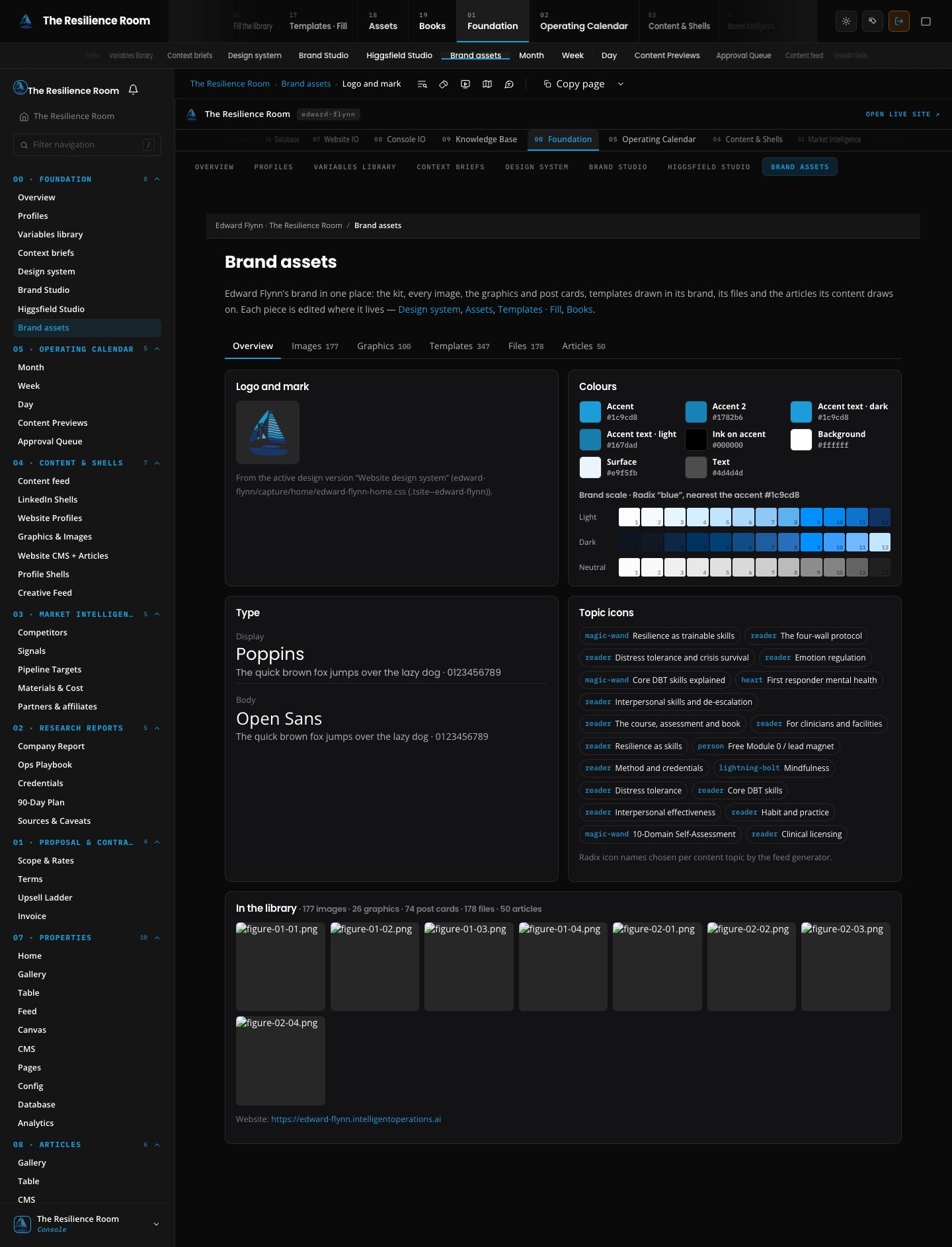
/tenant/edward-flynn/foundation/brand-assets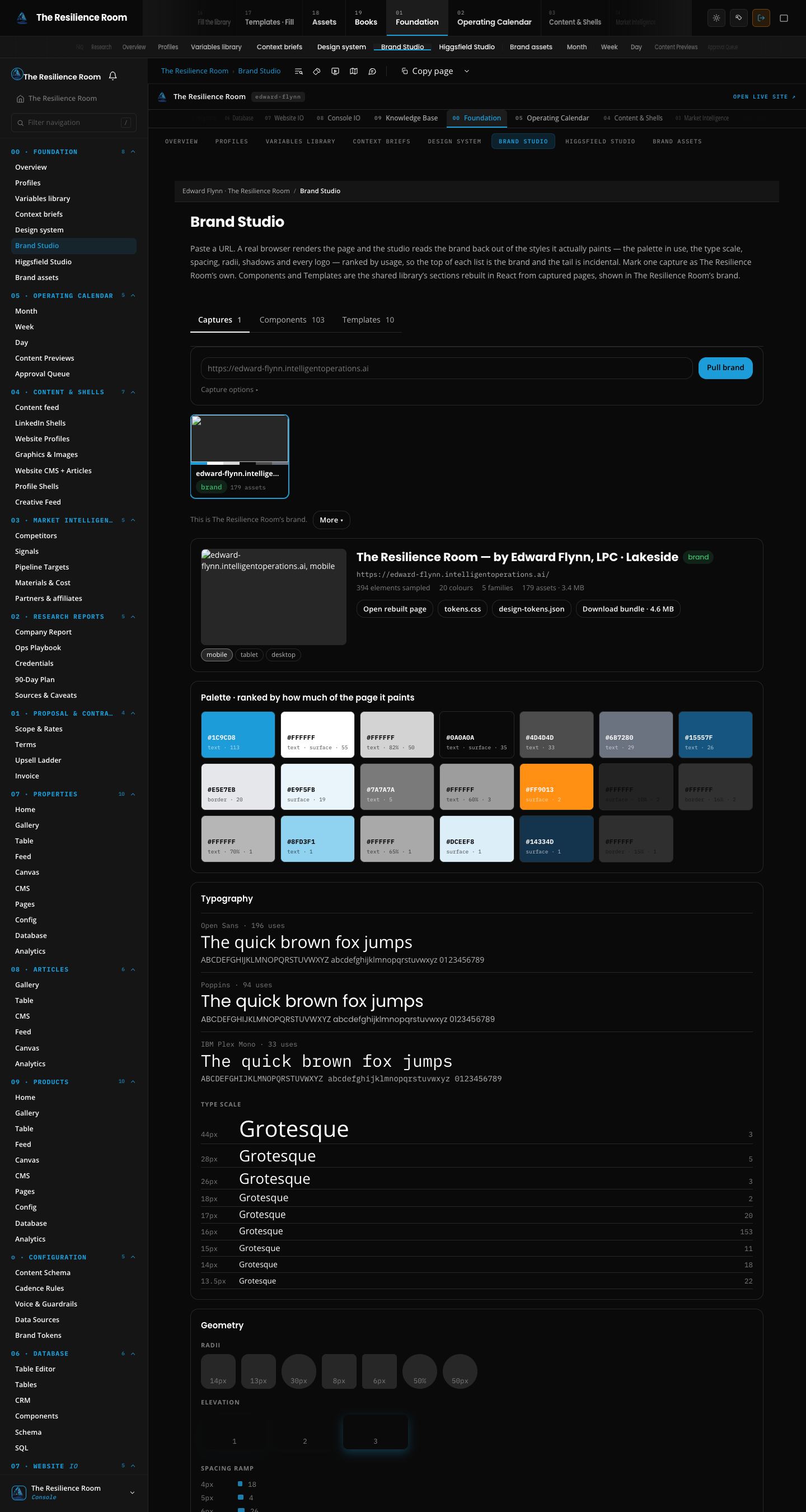
/tenant/edward-flynn/foundation/brand-studio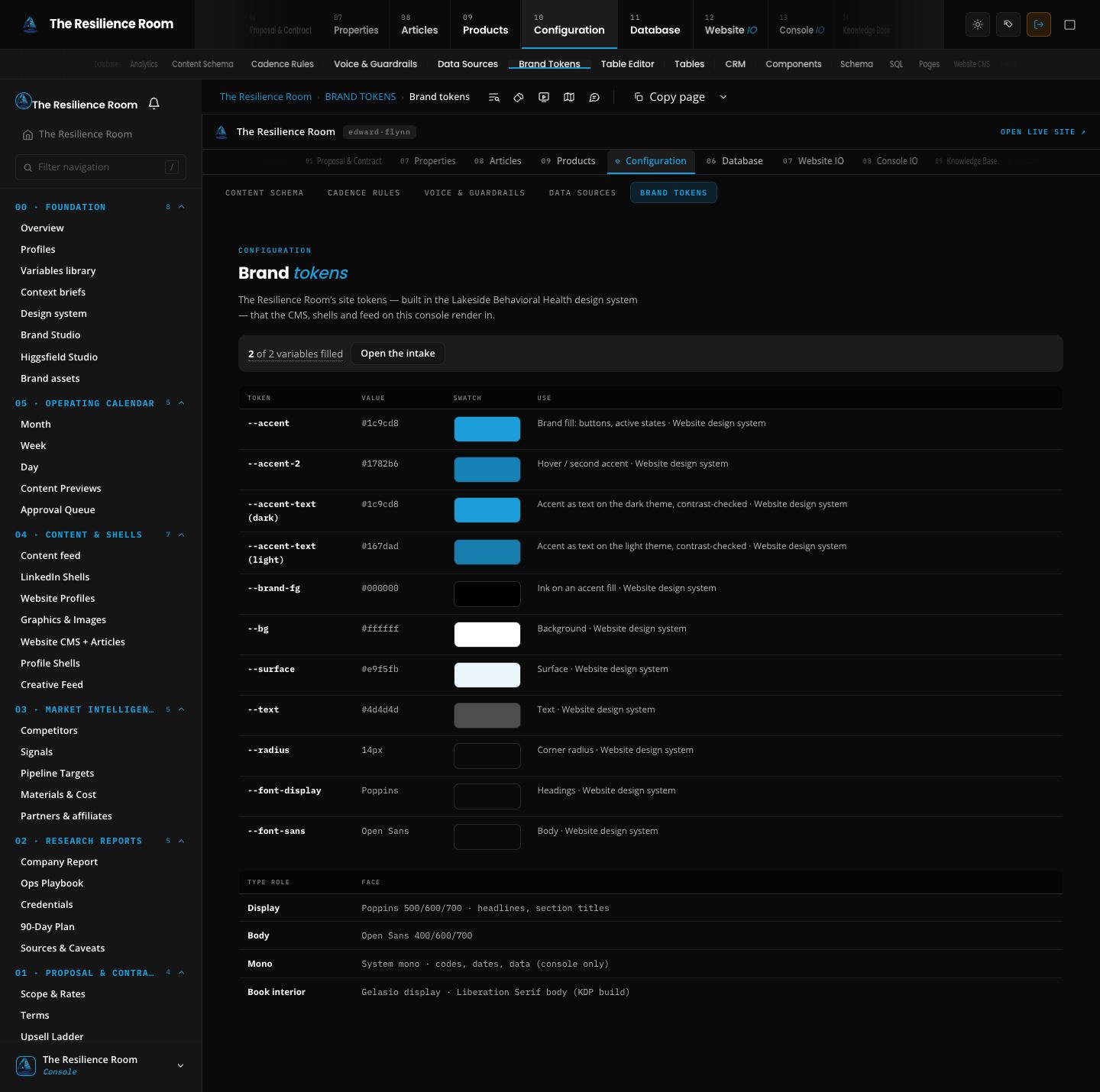
/tenant/edward-flynn/config/tokens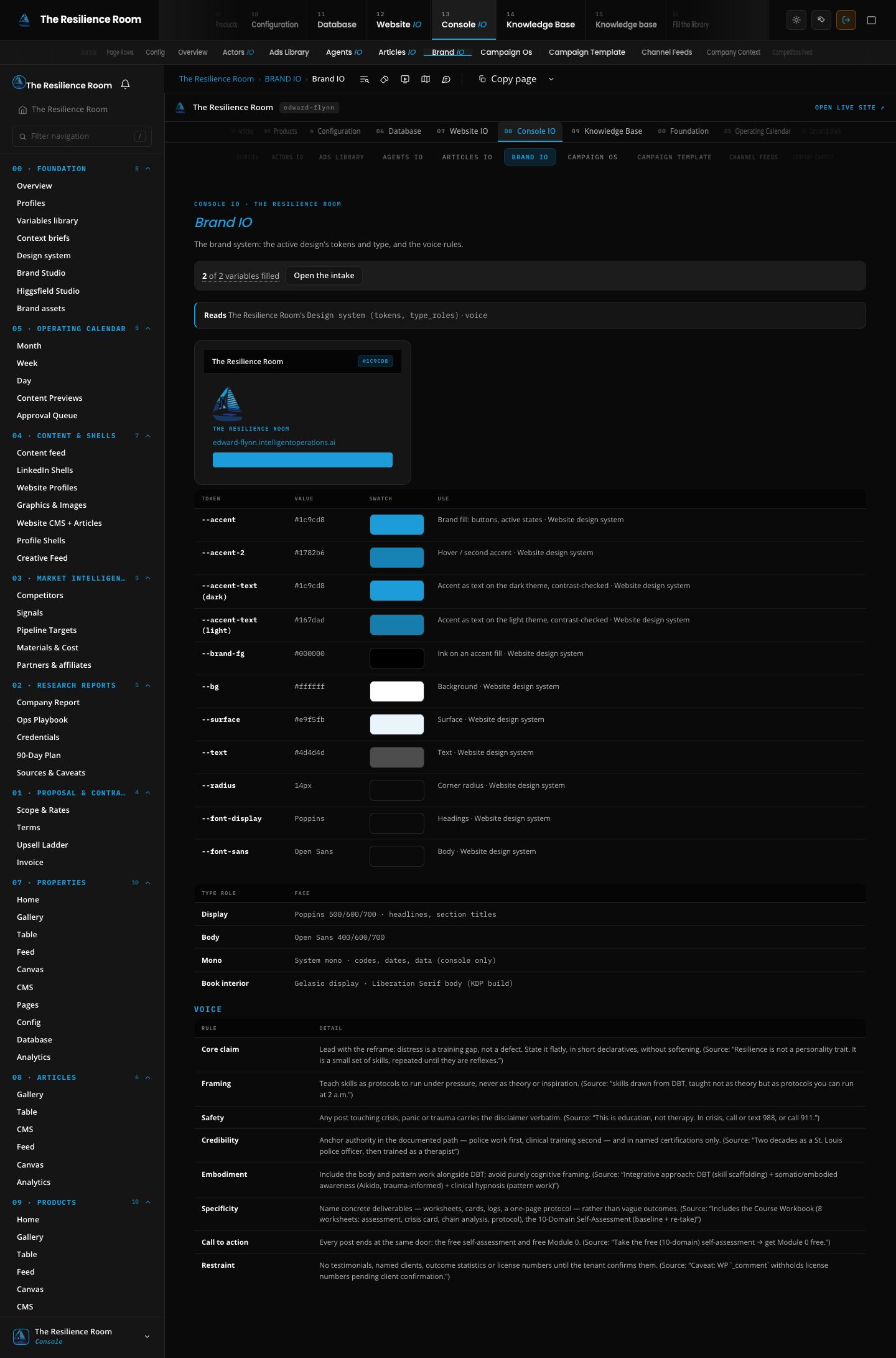
/tenant/edward-flynn/consoles/brand-io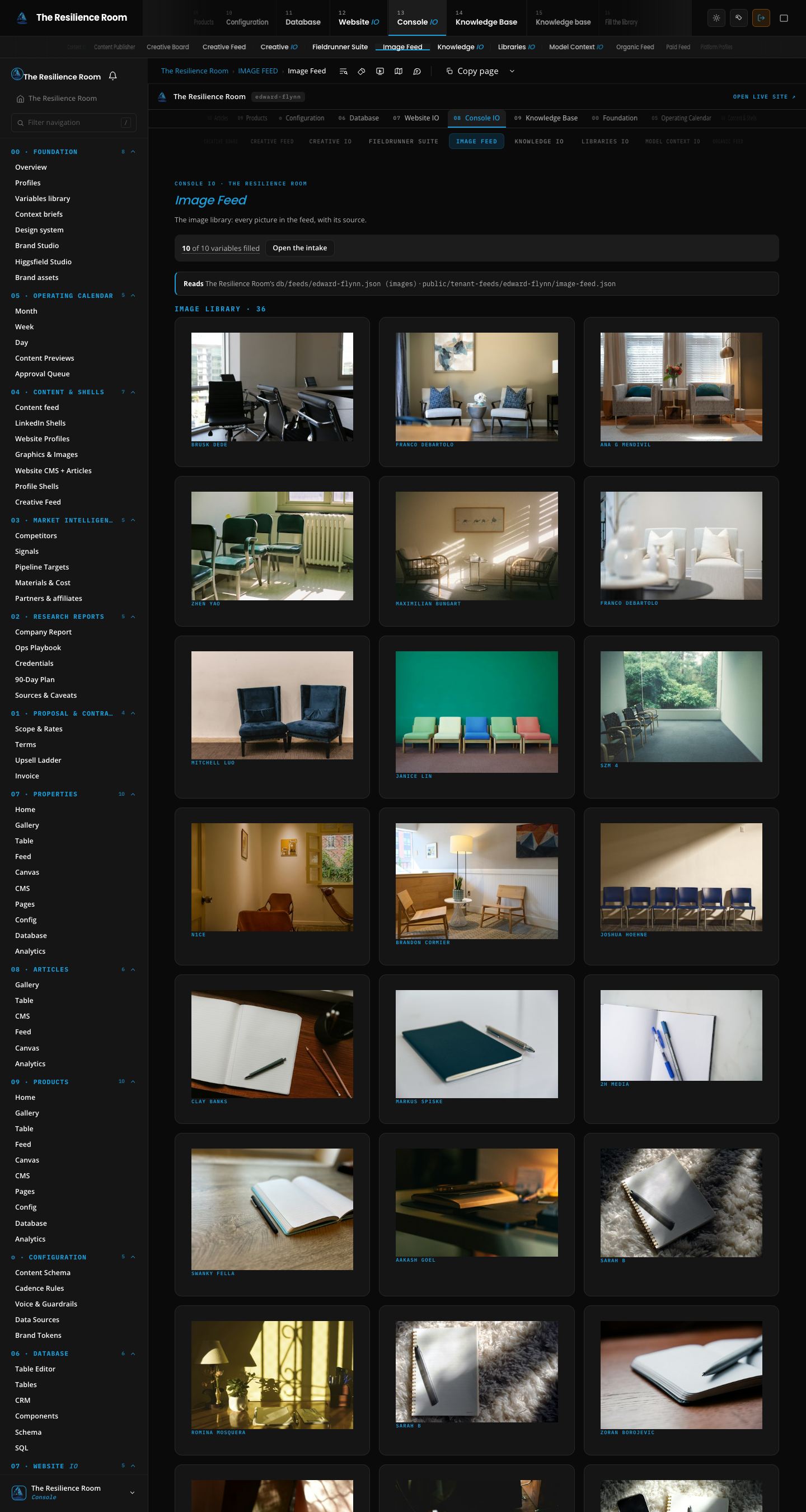
/tenant/edward-flynn/consoles/image-feed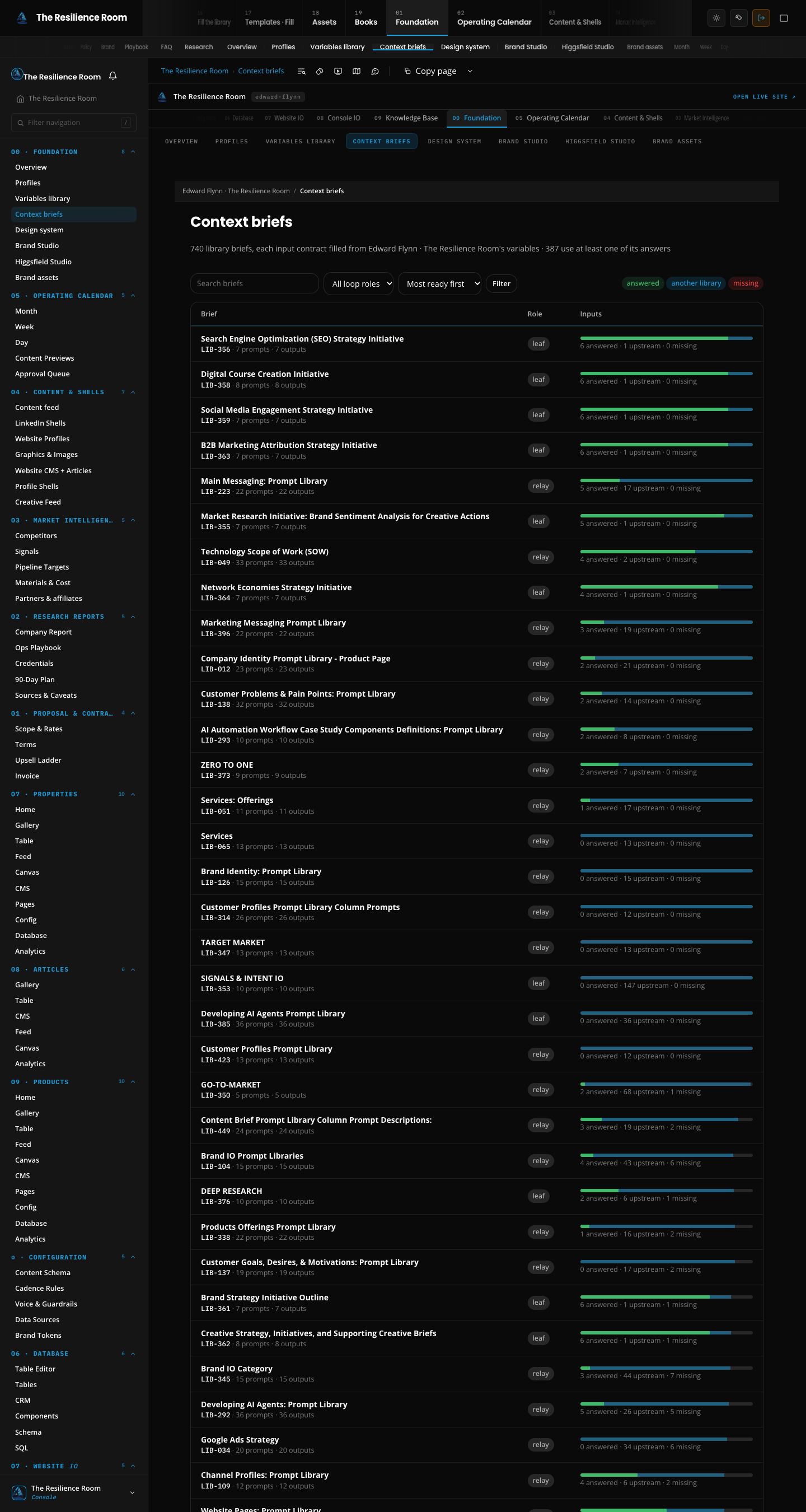
/tenant/edward-flynn/foundation/briefs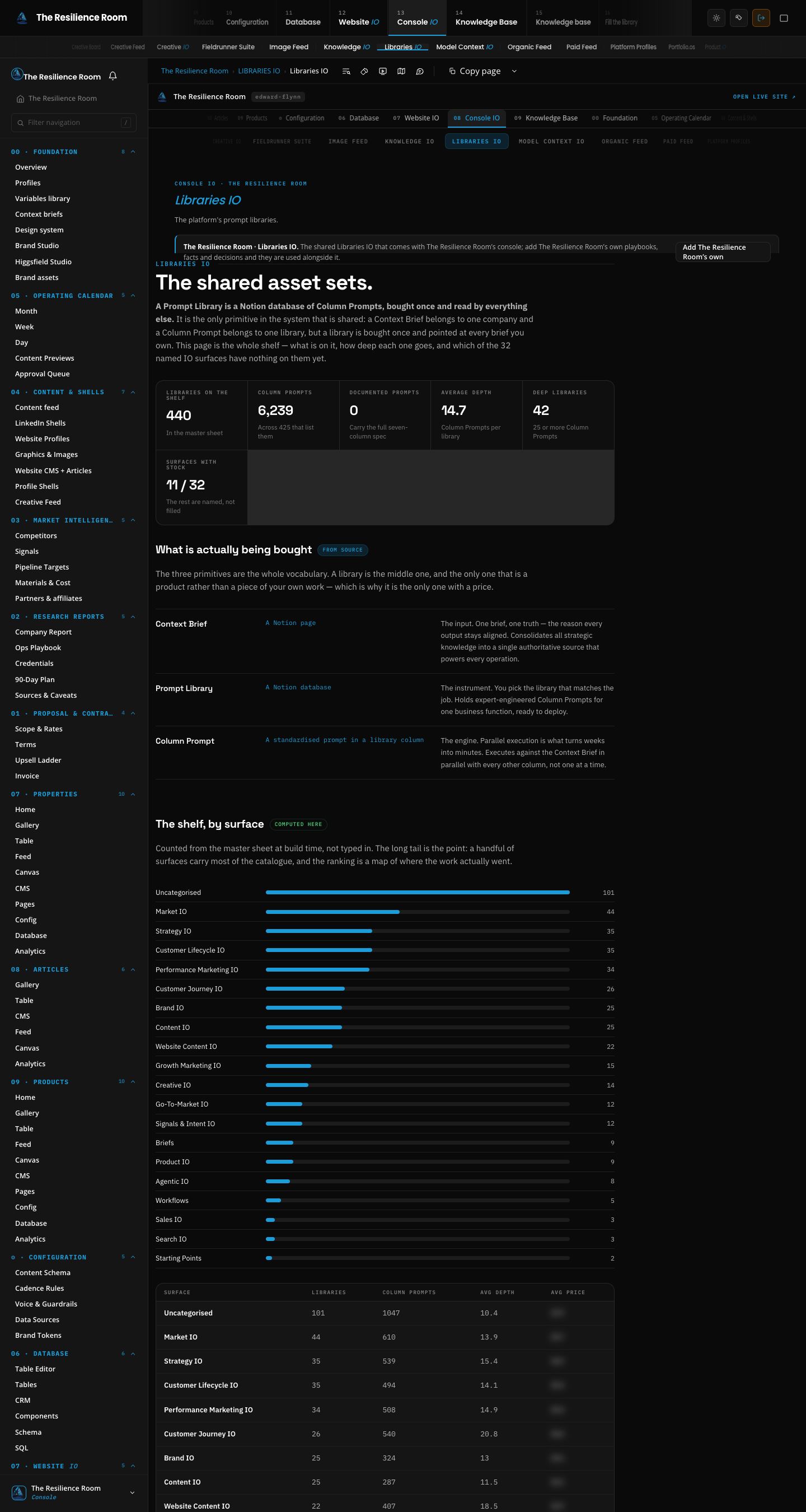
/tenant/edward-flynn/consoles/libraries-io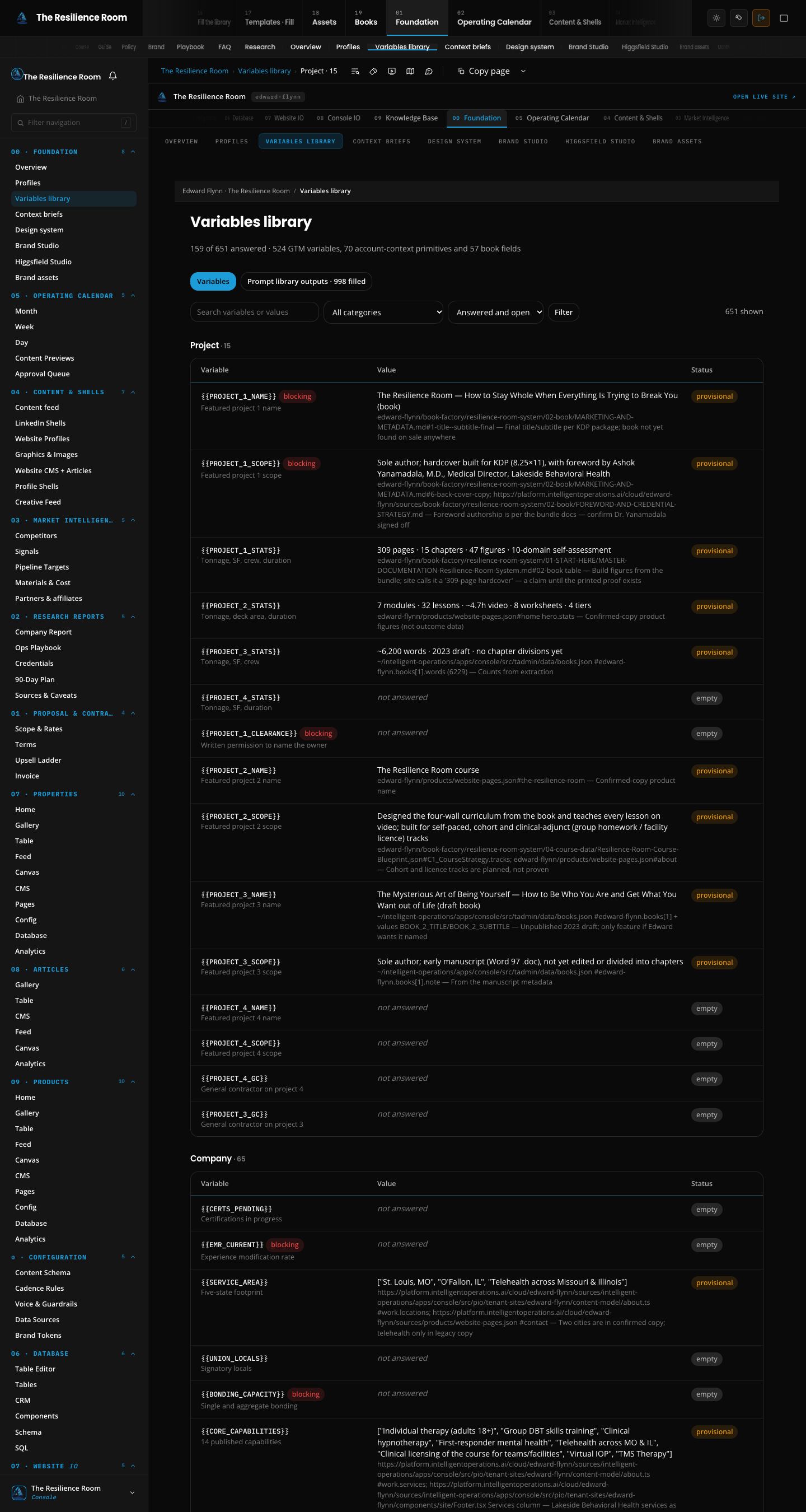
/tenant/edward-flynn/foundation/variables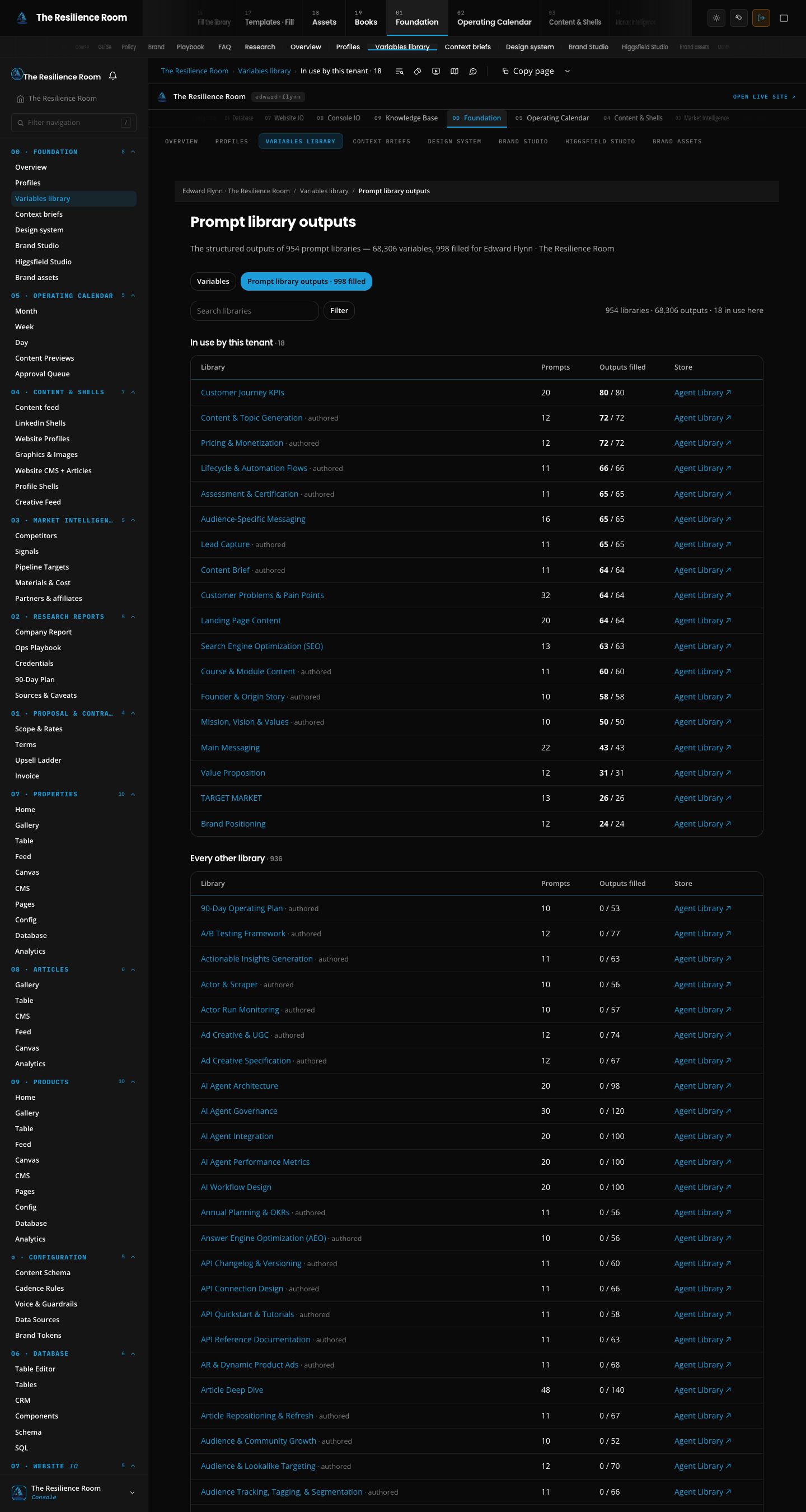
/tenant/edward-flynn/foundation/variables?tab=outputs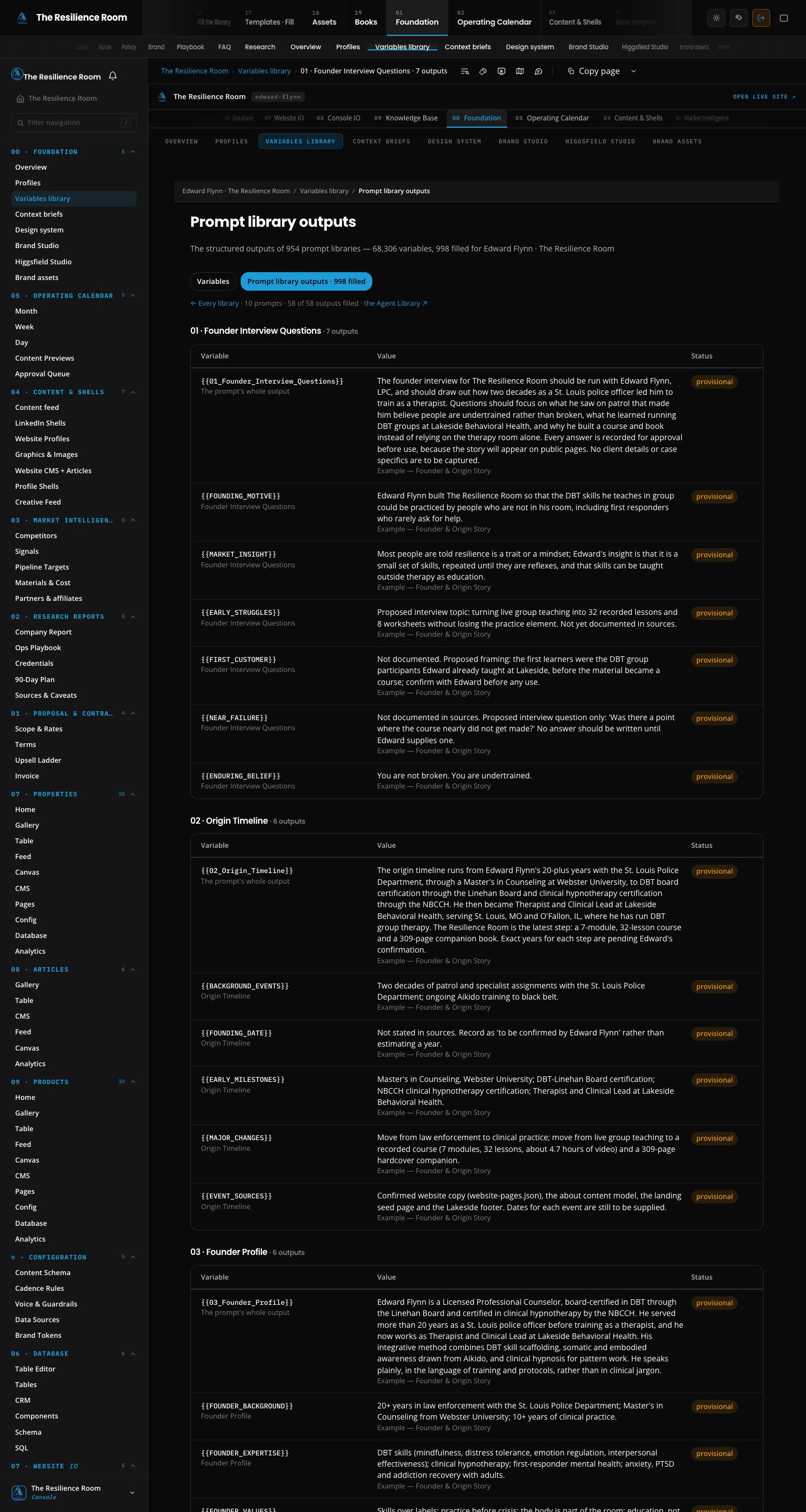
/tenant/edward-flynn/foundation/variables?tab=outputs&lib=founder-and-origin-story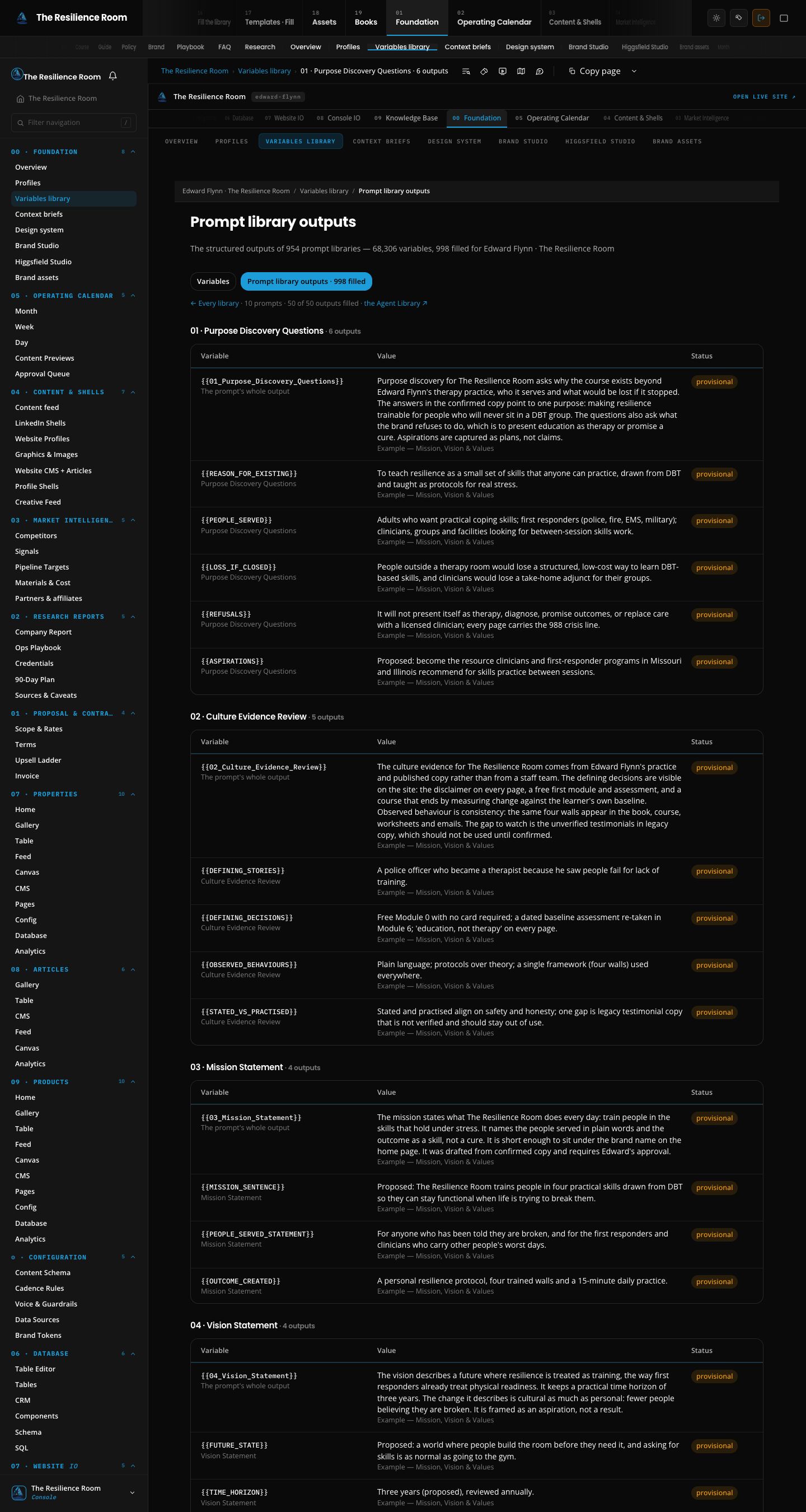
/tenant/edward-flynn/foundation/variables?tab=outputs&lib=mission-vision-and-values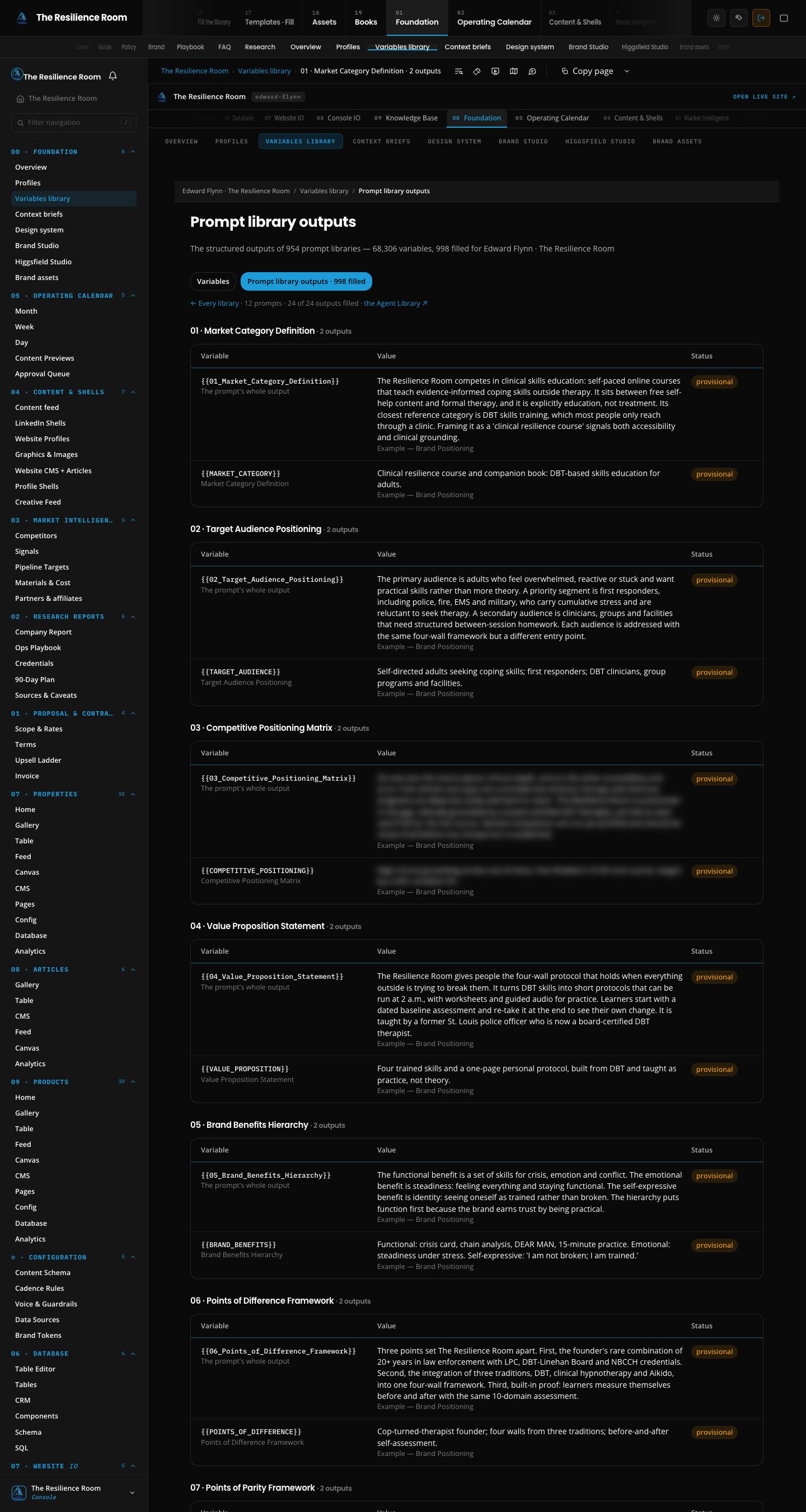
/tenant/edward-flynn/foundation/variables?tab=outputs&lib=brand-positioning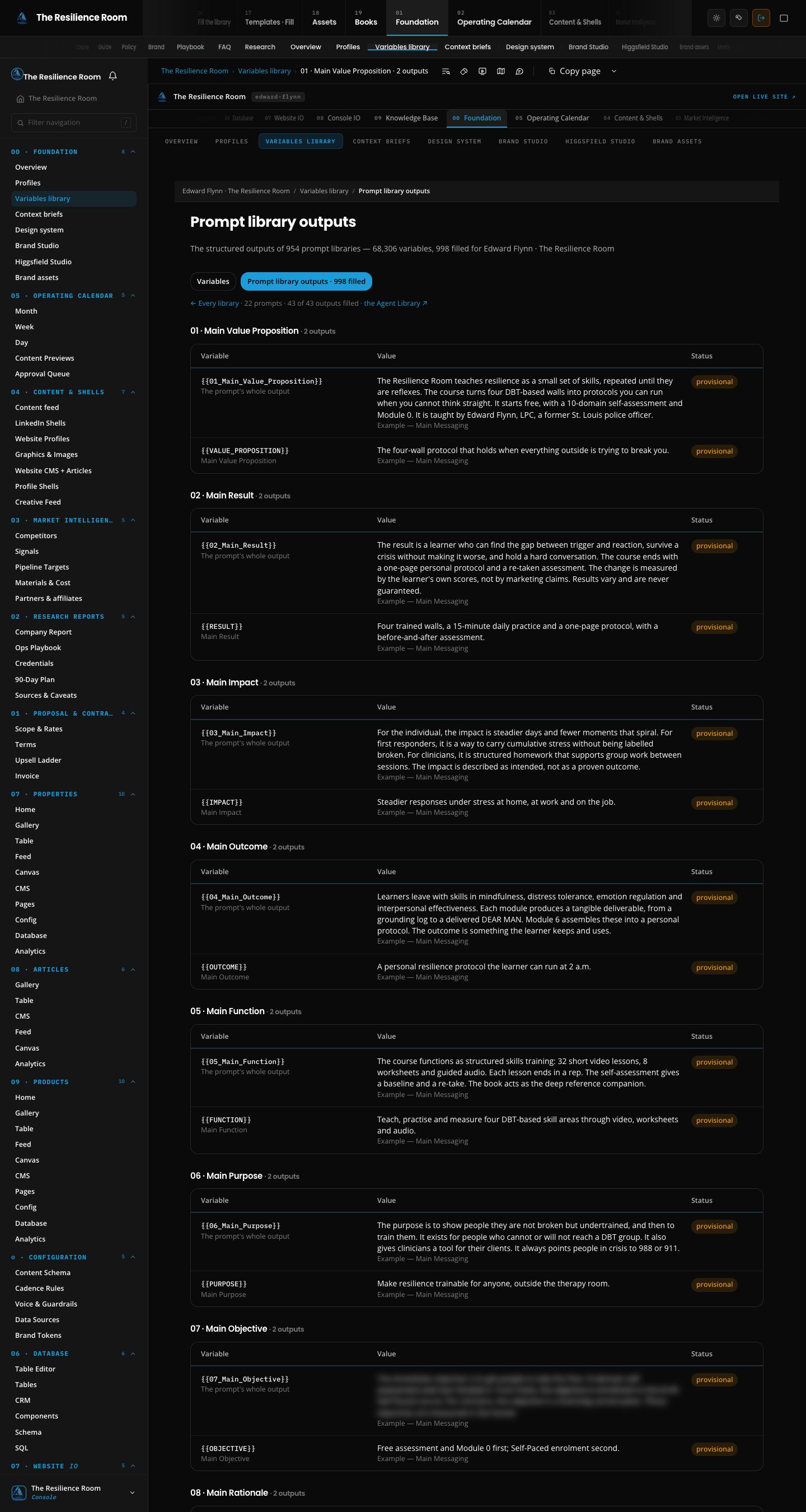
/tenant/edward-flynn/foundation/variables?tab=outputs&lib=main-messaging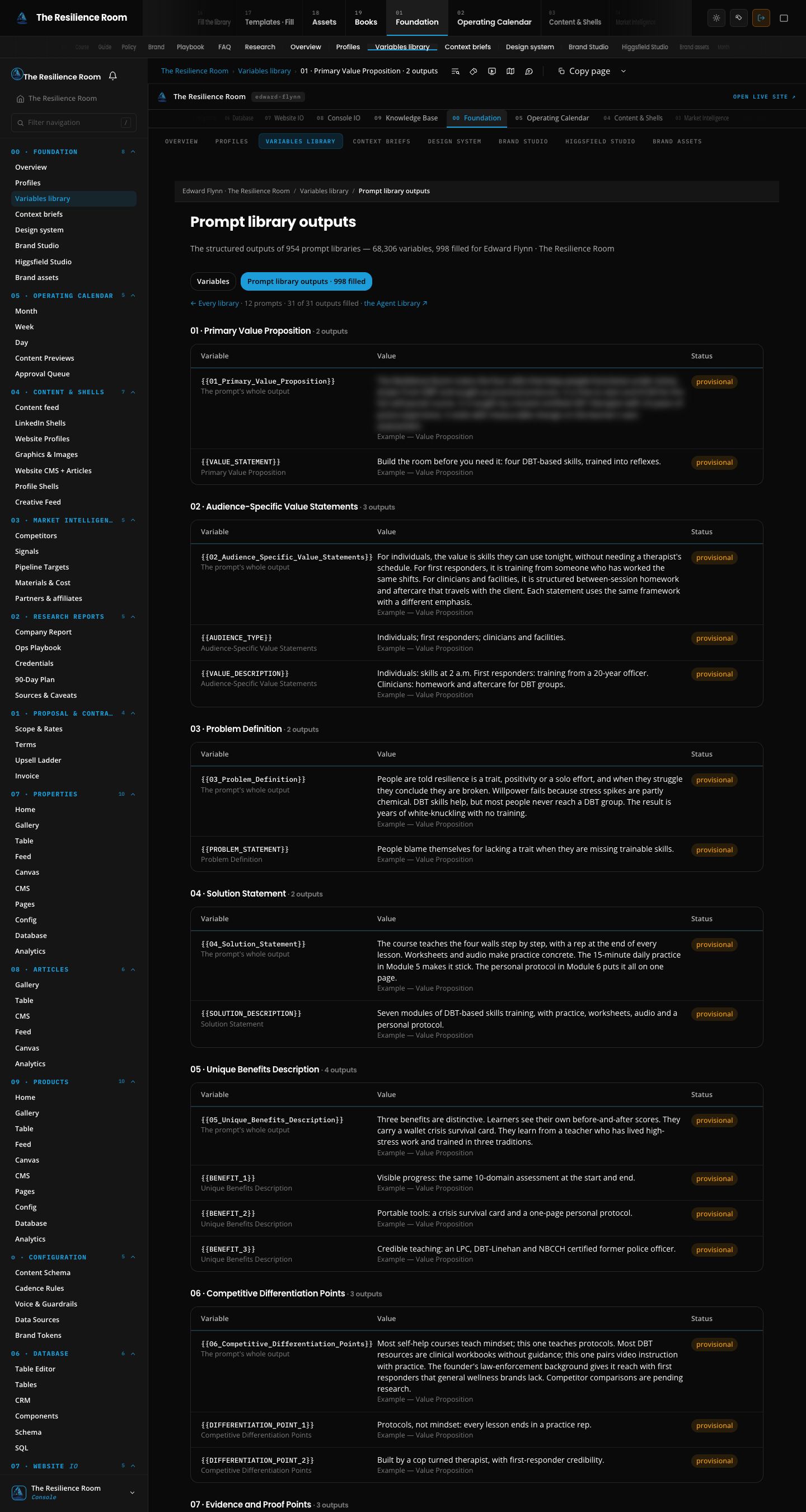
/tenant/edward-flynn/foundation/variables?tab=outputs&lib=value-proposition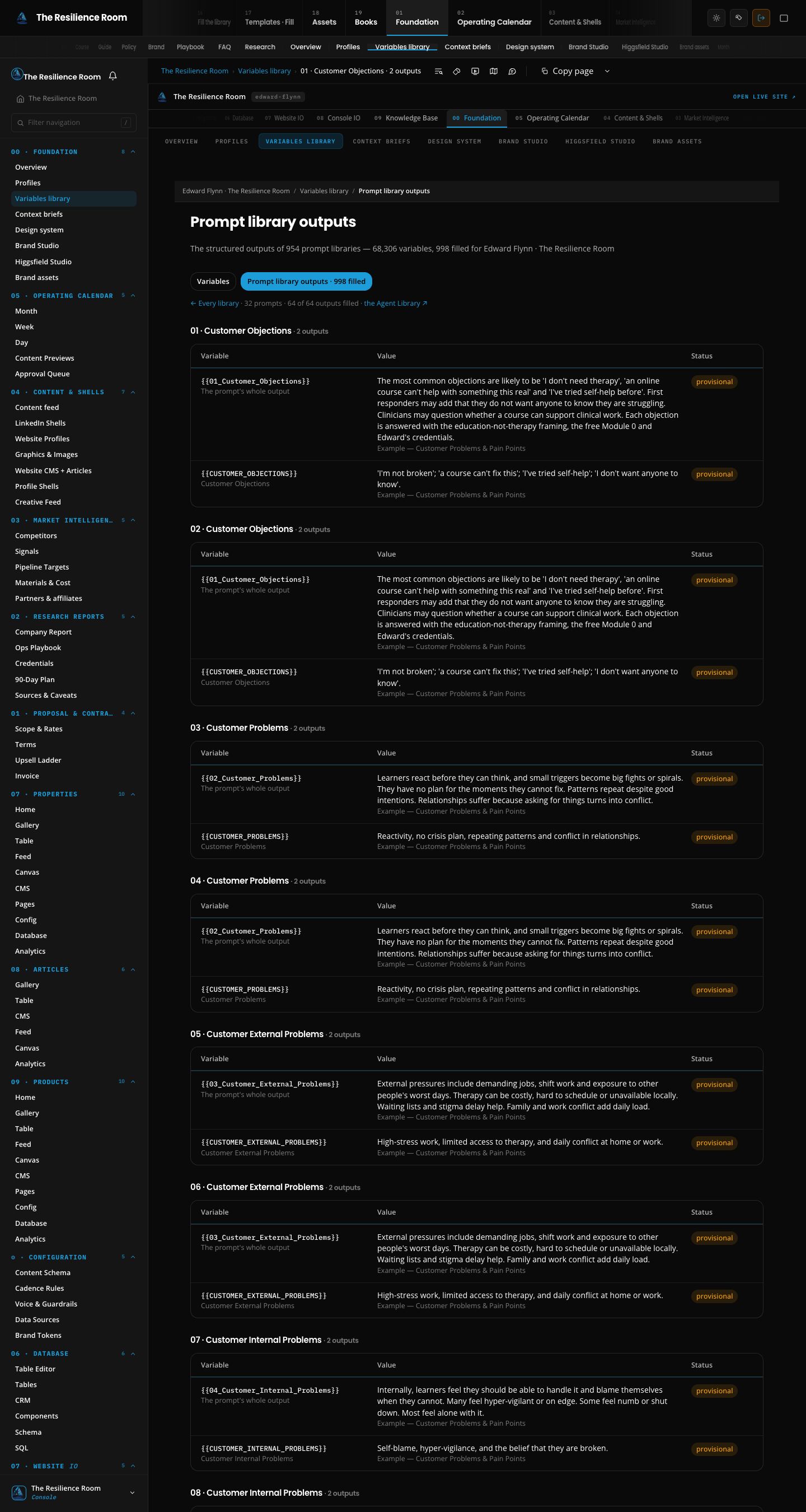
/tenant/edward-flynn/foundation/variables?tab=outputs&lib=customer-problems-and-pain-points-3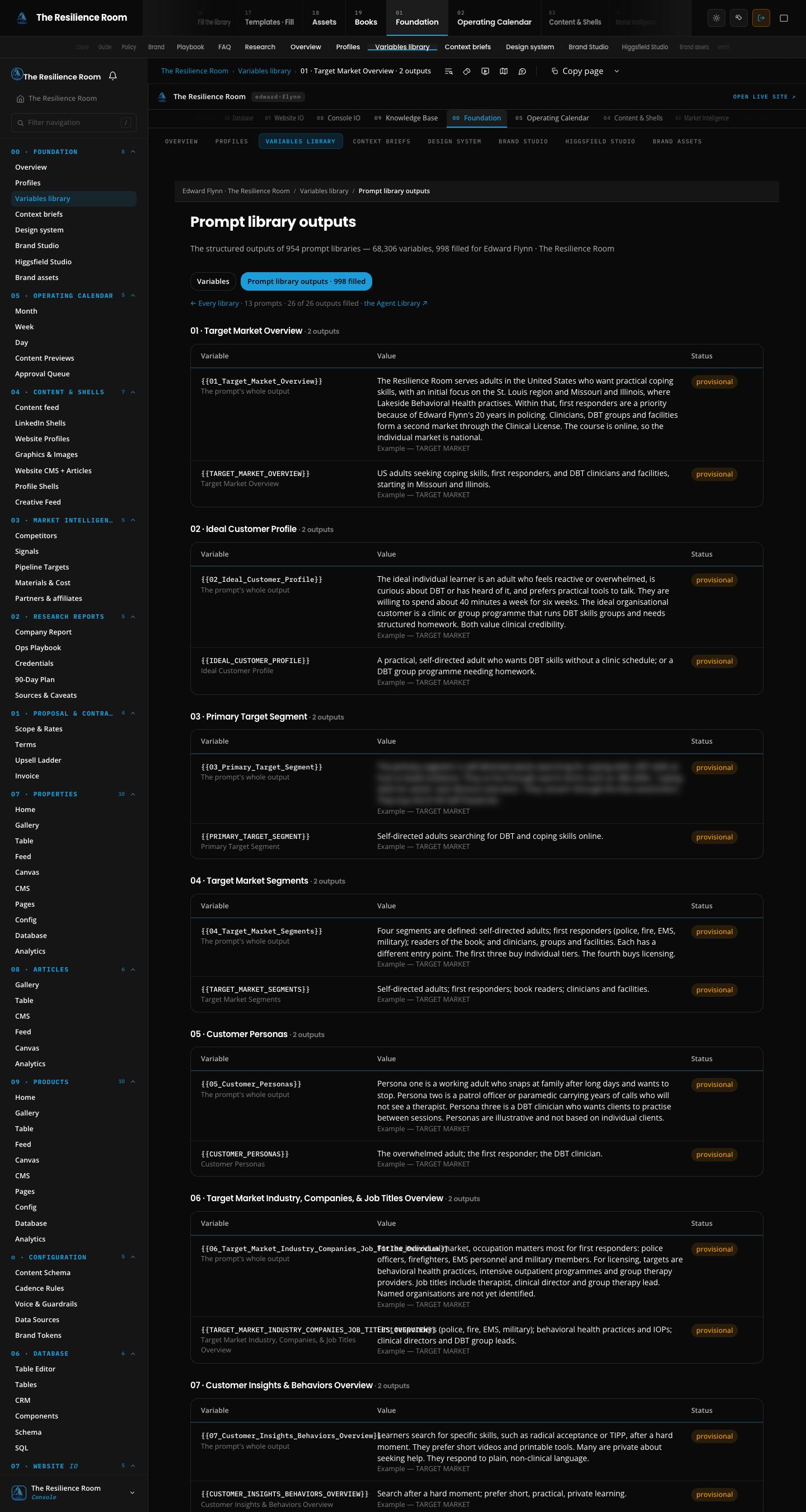
/tenant/edward-flynn/foundation/variables?tab=outputs&lib=target-market-2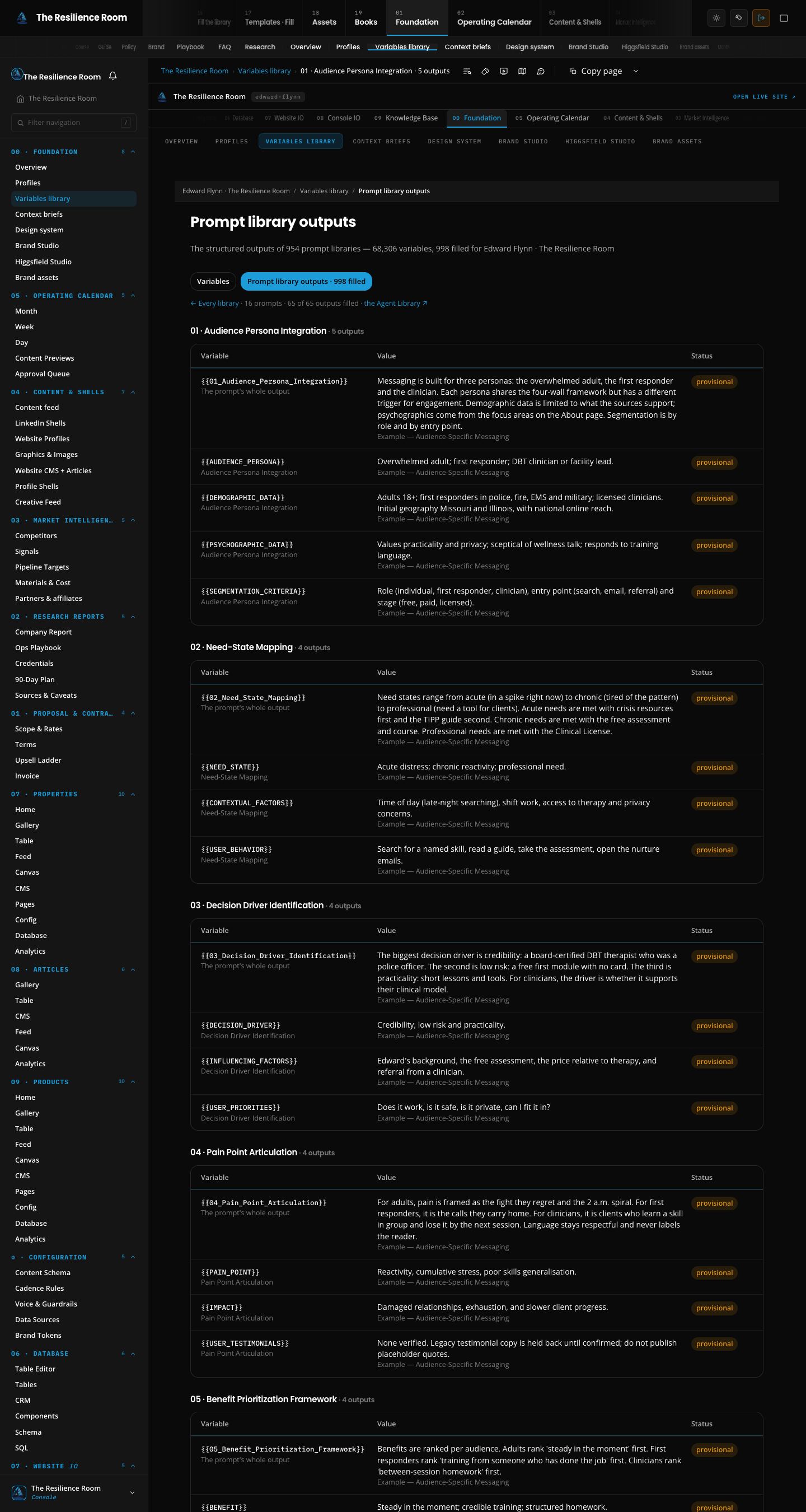
/tenant/edward-flynn/foundation/variables?tab=outputs&lib=audience-specific-messaging#1c9cd8


Edward Flynn's path from 20+ years as a St. Louis police officer to DBT-certified therapist is the brand's core credibility and needs one approved telling.
- Founder Interview Questions
- Origin Timeline
- Founder Profile
- Story Arc
- Story Truth Standards
- Signature Origin Story
- Short-Form Versions
- Founder Bio Set
- Story Resonance Review
- Story Deployment Map
The brand already runs on stated beliefs (not broken, undertrained; education, not therapy) that need to be written down as a mission and values.
- Purpose Discovery Questions
- Culture Evidence Review
- Mission Statement
- Vision Statement
- Core Values Set
- Value Behaviour Standards
- Values in Practice
- Public Mission Page Copy
- Alignment Check
- Rollout and Reinforcement Plan
The course sits between free self-help and formal therapy and needs a clear category and positioning statement.
- Market Category Definition
- Target Audience Positioning
- Competitive Positioning Matrix
- Value Proposition Statement
- Brand Benefits Hierarchy
- Points of Difference Framework
- Points of Parity Framework
- Brand Promise Statement
- Positioning Statement Structure
- Positioning Testing Framework
- Positioning Evolution Timeline
- Category Disruption Strategy
The site's confirmed copy (four walls, 'You Are Not Broken. You Are Undertrained.') needs one canonical set of messages for every page and email.
- Main Value Proposition
- Main Result
- Main Impact
- Main Outcome
- Main Function
- Main Purpose
- Main Objective
- Main Rationale
- Main Use Case
- Main Hook
- Main Jobs to Be Done
- Main User Story
- Main Benefit
- Main Feature
- One-liner
- Summary
- Description
- Overview
- Synopsis
- Excerpt
- Definition
- Explanation
The free-to-$149 offer and the before-and-after assessment need a value proposition that works for individuals, first responders and clinicians.
- Primary Value Proposition
- Audience-Specific Value Statements
- Problem Definition
- Solution Statement
- Unique Benefits Description
- Competitive Differentiation Points
- Evidence and Proof Points
- Value Quantification Framework
- Emotional Value Components
- Rational Value Components
- Value Delivery Timeline
- Value Proposition Testing Framework
The funnel and FAQ depend on naming the objections and pain points of people under stress without labelling them.
- Customer Objections
- Customer Objections
- Customer Problems
- Customer Problems
- Customer External Problems
- Customer External Problems
- Customer Internal Problems
- Customer Internal Problems
- Customer Philosophical Problems
- Customer Philosophical Problems
- Customer Pain Points
- Customer Pain Points
- Customer Internal Pain Points
- Customer Internal Pain Points
- Customer External Pain Points
- Customer External Pain Points
- Customer Philosophical Pain Points
- Customer Philosophical Pain Points
- Customer Dilemmas
- Customer Dilemmas
- Customer Barriers to Purchase
- Customer Barriers to Purchase
- Customer Roadblocks
- Customer Roadblocks
- Customer Sales Objections
- Customer Sales Objections
- Customer Buying Resistance
- Customer Buying Resistance
- Customer Hesitations
- Customer Hesitations
- Customer Concerns
- Customer Concerns
The brand serves three distinct segments (adults, first responders, clinicians) across Missouri, Illinois and online.
- Target Market Overview
- Ideal Customer Profile
- Primary Target Segment
- Target Market Segments
- Customer Personas
- Target Market Industry, Companies, & Job Titles Overview
- Customer Insights & Behaviors Overview
- Customer Goals, Desires, & Motivations Overview
- Customer Communication & Engagement Overview
- Customer Problems & Pain Points Overview
- Customer Personalities & Archetypes Overview
- Customer Transformation Overview
- Storybrand Script
First responders, self-directed adults and DBT clinicians each need the four-wall message in their own language.
- Audience Persona Integration
- Need-State Mapping
- Decision Driver Identification
- Pain Point Articulation
- Benefit Prioritization Framework
- Language Preference Adaptation
- Communication Style Matching
- Channel Preference Integration
- Content Format Optimization
- Messaging Sequence Strategy
- Objection Anticipation Framework
- Social Proof Customization
- Technical Depth Calibration
- Industry-Specific Terminology
- Cultural Relevance Adaptation
- Emotional Appeal Customization
Sets the free-to-paid ladder and the open price decisions for the Self-Paced course, cohort and clinic licence.
- Pricing Discovery Questions
- Customer Value Assessment
- Competitor Price Review
- Unit Economics Model
- Pricing Model Selection
- Price Point Recommendation
- Tier Structure Design
- Pricing Page Copy
- Discount and Promotion Rules
- Price Test Plan
- Pricing Rollout Announcement
- Revenue Performance Tracker
The 7-module, 32-lesson course is the core product and its objectives, sequence and lessons need a single design record.
- Learner Profile
- Needs and Gap Analysis
- Module Learning Objectives
- Module Sequence Map
- Lesson Outline
- Lesson Script
- Worked Examples and Practice
- Knowledge Check Questions
- Job Aid and Summary Sheet
- Content Quality Review
- Learning Effectiveness Metrics
The 10-domain self-assessment and certificate of completion are central to the course and need clear rules.
- Competency Inventory
- Learning Objective Alignment
- Certification Tier Model
- Assessment Blueprint
- Item Writing Guidelines
- Question Bank Draft
- Practical Assessment Rubric
- Passing Standard Setting
- Item Analysis Review
- Certification Policy
- Credential Award Communication
Plans which skills guides Edward publishes, scored and scheduled around the four walls and the free assessment.
- Content Discovery Questions
- Audience Question Mining
- Search Demand Review
- Competitor Content Gap Scan
- Topic Pillar Framework
- Topic Idea Generation
- Topic Scoring Model
- Topic Brief Template
- Angle and Hook Development
- Format and Channel Mapping
- Topic Pipeline Schedule
- Topic Performance Review
Turns each skills guide into a clear brief with reader, keyword, outline, evidence and assessment call to action.
- Brief Intake Questions
- Audience Reader Profile
- Objective And Success Measure
- Core Message And Angle
- Search Intent And Keyword Plan
- Content Outline
- Tone And Style Direction
- Sources And Evidence Plan
- Call To Action Design
- Brief Quality Checklist
- Distribution And Repurposing Notes
Search is the main discovery channel, built on the confirmed keyword set (dbt skills, distress tolerance, first responder mental health).
- Business Type
- Value Proposition
- Target Audience
- Call to Action (CTA)
- Content Format
- SEO Keywords
- Competitive Analysis
- Brand Messaging
- Content Goals
- User Engagement
- Content Distribution
- Feedback Loop
- Performance Metrics
The free Module 0 opt-in is the entry point for every page on the site.
- Conversion Goal Questions
- Lead Offer Inventory
- Lead Magnet Concept
- Form Field Strategy
- Capture Point Placement
- Form Copy And Labels
- Thank-You Page Content
- Lead Routing Rules
- Consent And Privacy Notice
- Form Test Plan
- Lead Quality Measures
The lead-magnet and pricing pages need section-by-section copy that stays inside confirmed facts.
- Hero Section Framework
- Value Proposition Structure
- Problem-Agitation-Solution Format
- Feature Section Framework
- Benefit Translation Structure
- Social Proof Integration Format
- Objection Handling Framework
- Technical Specifications Structure
- Pricing Table Format
- Process/Timeline Framework
- Risk Reversal Structure
- Guarantee Statement Format
- Urgency Creation Framework
- Call-to-Action Structure
- Form Optimization Format
- Trust Elements Framework
- FAQ Section Structure
- About Section Format
- Technical Requirements Framework
- Next Steps Guidance Structure
The six-email sequence (delivery, three nurture, conversion, welcome) needs flow rules, branching and measurement.
- Lifecycle Stage Map
- Data And Trigger Readiness
- Flow Portfolio
- Entry Exit And Suppression Rules
- Welcome Flow Sequence
- Abandonment Flow Sequences
- Post-Purchase And Retention Flows
- Win-Back And Sunset Flows
- Flow Personalisation And Branching
- Flow QA And Testing
- Flow Performance Measurement
No goals, KPIs or baselines exist yet, so the journey from search to Module 6 needs defined metrics and proposed targets.
- Storyboard
- Customer Sales Cycle: Timeline
- Channels
- Content Types
- Customer Actions
- Line of Interaction
- Selling Points/Value propositions
- Personal Weekly Schedule
- Business Conversion Events
- Conversion Tracking/Audience Building/Customer Tagging
- Customer Value/Lead Scoring
- KPI
- Website Visitor Goals
- Performance Metrics
- Exposure Metrics
- Targeting Metrics
- Engagement Metrics
- Experience Metrics
- Leads Metrics
- Conversion Metrics
{{01_Founder_Interview_Questions}}- The founder interview for The Resilience Room should be run with Edward Flynn, LPC, and should draw out how two decades as a St. Louis police officer led him to train as a therapist. Questions should focus on what he saw on patrol that made him believe people are undertrained rather than broken, what he learned running DBT groups at Lakeside Behavioral Health, and why he built a course and book instead of relying on the therapy room alone. Every answer is recorded for approval before use, because the story will appear on public pages. No client details or case specifics are to be captured.
{{FOUNDING_MOTIVE}}- Edward Flynn built The Resilience Room so that the DBT skills he teaches in group could be practiced by people who are not in his room, including first responders who rarely ask for help.
{{MARKET_INSIGHT}}- Most people are told resilience is a trait or a mindset; Edward's insight is that it is a small set of skills, repeated until they are reflexes, and that skills can be taught outside therapy as education.
{{EARLY_STRUGGLES}}- Proposed interview topic: turning live group teaching into 32 recorded lessons and 8 worksheets without losing the practice element. Not yet documented in sources.
{{FIRST_CUSTOMER}}- Not documented. Proposed framing: the first learners were the DBT group participants Edward already taught at Lakeside, before the material became a course; confirm with Edward before any use.
{{NEAR_FAILURE}}- Not documented in sources. Proposed interview question only: 'Was there a point where the course nearly did not get made?' No answer should be written until Edward supplies one.
{{ENDURING_BELIEF}}- You are not broken. You are undertrained.
{{02_Origin_Timeline}}- The origin timeline runs from Edward Flynn's 20-plus years with the St. Louis Police Department, through a Master's in Counseling at Webster University, to DBT board certification through the Linehan Board and clinical hypnotherapy certification through the NBCCH. He then became Therapist and Clinical Lead at Lakeside Behavioral Health, serving St. Louis, MO and O'Fallon, IL, where he has run DBT group therapy. The Resilience Room is the latest step: a 7-module, 32-lesson course and a 309-page companion book. Exact years for each step are pending Edward's confirmation.
{{BACKGROUND_EVENTS}}- Two decades of patrol and specialist assignments with the St. Louis Police Department; ongoing Aikido training to black belt.
{{FOUNDING_DATE}}- Not stated in sources. Record as 'to be confirmed by Edward Flynn' rather than estimating a year.
{{EARLY_MILESTONES}}- Master's in Counseling, Webster University; DBT-Linehan Board certification; NBCCH clinical hypnotherapy certification; Therapist and Clinical Lead at Lakeside Behavioral Health.
{{MAJOR_CHANGES}}- Move from law enforcement to clinical practice; move from live group teaching to a recorded course (7 modules, 32 lessons, about 4.7 hours of video) and a 309-page hardcover companion.
{{EVENT_SOURCES}}- Confirmed website copy (website-pages.json), the about content model, the landing seed page and the Lakeside footer. Dates for each event are still to be supplied.
{{03_Founder_Profile}}- Edward Flynn is a Licensed Professional Counselor, board-certified in DBT through the Linehan Board and certified in clinical hypnotherapy by the NBCCH. He served more than 20 years as a St. Louis police officer before training as a therapist, and he now works as Therapist and Clinical Lead at Lakeside Behavioral Health. His integrative method combines DBT skill scaffolding, somatic and embodied awareness drawn from Aikido, and clinical hypnosis for pattern work. He speaks plainly, in the language of training and protocols, rather than in clinical jargon.
{{FOUNDER_BACKGROUND}}- 20+ years in law enforcement with the St. Louis Police Department; Master's in Counseling from Webster University; 10+ years of clinical practice.
{{FOUNDER_EXPERTISE}}- DBT skills (mindfulness, distress tolerance, emotion regulation, interpersonal effectiveness); clinical hypnotherapy; first-responder mental health; anxiety, PTSD and addiction recovery with adults.
{{FOUNDER_VALUES}}- Skills over labels; practice before crisis; the body is part of the room; education, not therapy.
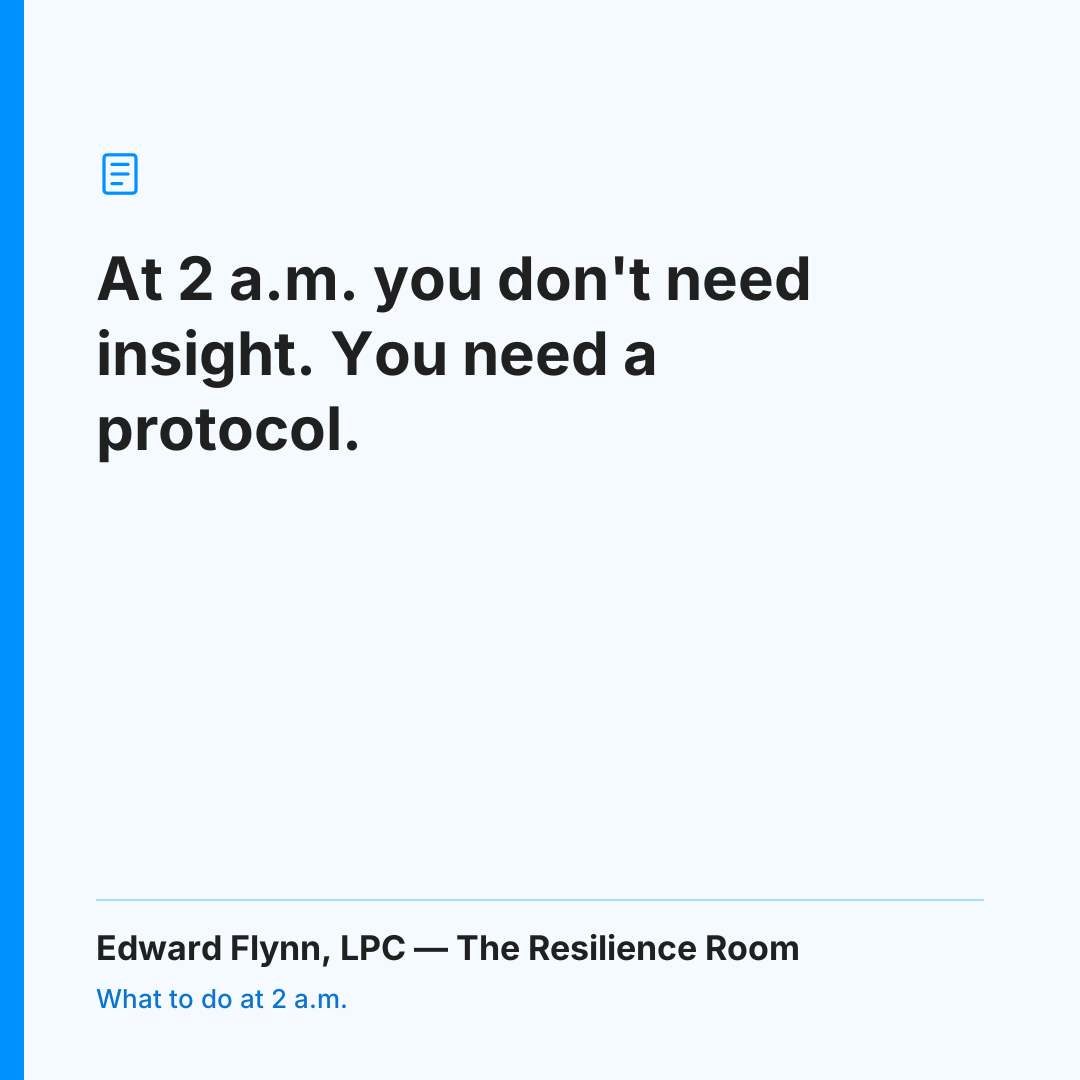
{{FOUNDER_VOICE}}- Direct, calm and practical, with the vocabulary of training: reps, protocols, the moment at 2 a.m. He never talks down to the reader and never promises a cure.
{{CUSTOMER_CONNECTION}}- Edward has lived the hyper-vigilance and cumulative stress that many first responders carry, which gives him credibility with police, fire, EMS and military audiences.
{{04_Story_Arc}}- Before, Edward spent two decades as a St. Louis police officer, watching capable people fall apart under stress they had never been trained for. He noticed that the people who held up were not tougher; they were better trained. He decided to become a therapist, earned DBT and hypnotherapy credentials, and began teaching skills in groups at Lakeside Behavioral Health. The turning point was seeing those skills work as protocols people could run on their own, which is why the course and book now exist.
{{WORLD_BEFORE}}- A police career in St. Louis where stress was constant and the only advice was to push through.
{{PROBLEM_NOTICED}}- People were being told they were weak or broken when what they lacked was training in a few specific skills.
{{DECISION_TO_ACT}}- Edward left law enforcement to train as a counselor, earning a Master's in Counseling and DBT and hypnotherapy certifications.
{{STRUGGLE}}- Proposed: translating clinical DBT into plain protocols that work outside a therapy room without overstating what education can do. To be confirmed in interview.
{{TURNING_POINT}}- Running DBT groups showed that the skills could be learned, practiced and measured, which led to a course built around a before-and-after self-assessment.
{{PRESENT_PURPOSE}}- To give anyone, and first responders in particular, a four-wall protocol they can practice before they need it.
{{05_Story_Truth_Standards}}- Every claim in the origin story must trace to confirmed copy or to Edward's own approved words. Dialogue is never invented, and no client or group member is described in a way that could identify them. Credentials are stated exactly as certified, and license numbers are withheld until Edward confirms them. The story is approved by Edward Flynn before any public use.
{{VERIFIABILITY_RULE}}- Only facts from confirmed website copy or Edward's written approval may appear; unconfirmed items are marked 'pending'.
{{DIALOGUE_RULE}}- No reconstructed quotes. Only lines Edward has written or approved, such as 'You are not broken. You are undertrained.'
{{CREDIT_RULE}}- DBT is credited to its tradition and the Linehan Board certification is named accurately; Lakeside Behavioral Health is credited as the practice.
{{EXAGGERATION_RULE}}- No outcome claims about recovery or cure; the course is described as skills education, not therapy.
{{APPROVAL_OWNER}}- Edward Flynn, LPC.
{{06_Signature_Origin_Story}}- For twenty years Edward Flynn wore a St. Louis police badge, and he saw the same thing again and again: good people breaking under pressure they had never been trained to carry. He came to believe they were not broken; they were undertrained. So he became a therapist, earned board certification in DBT and certification in clinical hypnotherapy, and began teaching skills in groups at Lakeside Behavioral Health. The Resilience Room is those skills, built into four walls you can practice before the moment you need them.
{{OPENING_SCENE}}- A patrol career in St. Louis, and the realisation that pressure finds everyone's level of training.
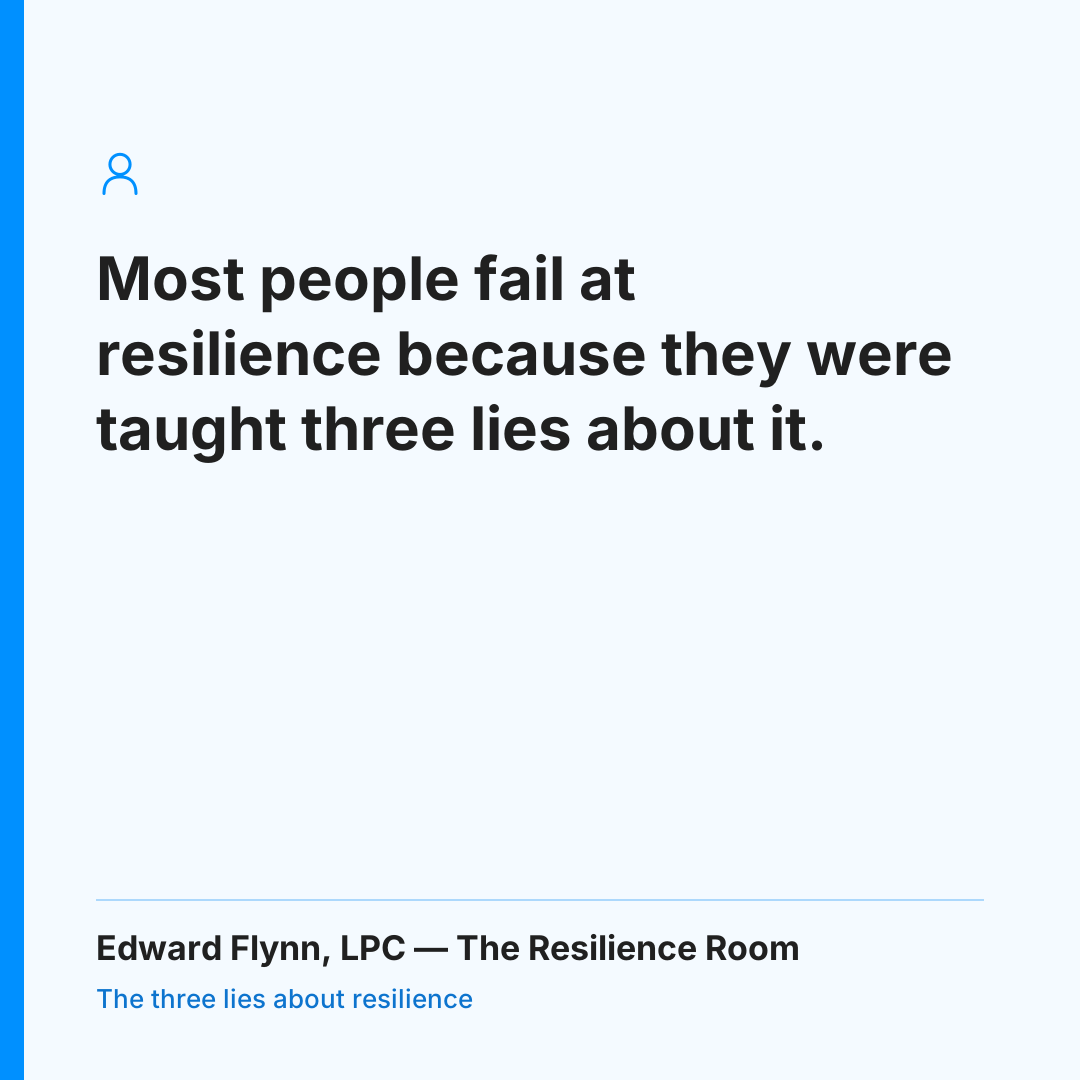
{{PROBLEM_SECTION}}- People are told resilience is a trait, a positive attitude, or something to handle alone, and each of those lies leaves them stuck.
{{STRUGGLE_SECTION}}- Edward retrained from officer to counselor and spent years teaching DBT skills in groups to adults dealing with anxiety, PTSD and recovery.
{{TURNING_POINT_SECTION}}- The skills worked best when taught as short protocols and practiced daily, which became the four-wall structure of the course.
{{PRESENT_DAY_SECTION}}- Today The Resilience Room offers a free Module 0 and self-assessment, a 7-module course and a 309-page companion book, always framed as education, not therapy.
{{07_Short_Form_Versions}}- The short versions keep one idea: a former St. Louis police officer turned licensed therapist teaches resilience as trainable skills. The one-sentence version is used in social bios and ad copy. The bio paragraph is used on the About page and in press. The spoken version is for podcasts and talks, and runs about 30 seconds.
{{ONE_SENTENCE_VERSION}}- After 20 years as a St. Louis police officer, Edward Flynn became a licensed therapist and built The Resilience Room to teach resilience as skills, not a trait.
{{BIO_PARAGRAPH}}- Edward Flynn, LPC, spent more than two decades with the St. Louis Police Department before training as a therapist. Board-certified in DBT and certified in clinical hypnotherapy, he is Therapist and Clinical Lead at Lakeside Behavioral Health and the creator of The Resilience Room.
{{SPOKEN_VERSION}}- I was a cop in St. Louis for twenty years. What I learned is that nobody rises to the occasion; you fall to your level of training. So I became a therapist, and now I teach the skills.
{{08_Founder_Bio_Set}}- The bio set gives Edward Flynn three lengths plus a headshot caption so every channel uses the same facts. All versions name his LPC license, DBT-Linehan Board certification, NBCCH hypnotherapy certification and law-enforcement background. None includes license numbers until he confirms them. The first-person version is reserved for the About page and email sign-offs.
{{THIRD_PERSON_SHORT}}- Edward Flynn, LPC, is a former St. Louis police officer, a board-certified DBT therapist and the creator of The Resilience Room.
{{THIRD_PERSON_LONG}}- Edward Flynn is a Licensed Professional Counselor, board-certified in DBT through the Linehan Board and certified in clinical hypnotherapy by the NBCCH. After more than 20 years with the St. Louis Police Department, he earned a Master's in Counseling from Webster University and now serves as Therapist and Clinical Lead at Lakeside Behavioral Health in St. Louis, MO and O'Fallon, IL. He created The Resilience Room, a clinical resilience course and 309-page book built on DBT, clinical hypnotherapy and Aikido.
{{FIRST_PERSON_PROFILE}}- I spent twenty years as a St. Louis police officer before I became a therapist. I teach resilience the way I was trained for the street: small skills, repeated until they hold under pressure.
{{HEADSHOT_CAPTION}}- Edward Flynn, LPC, Therapist and Clinical Lead, Lakeside Behavioral Health.
{{09_Story_Resonance_Review}}- The origin story should be reviewed with a small group of readers from each audience: first responders, adults seeking coping skills and clinicians. Reviewers are asked what they remember, whether the credentials feel credible and whether the value is clear. Proposed method: five short reader interviews per audience before the story goes on the home page. Findings are recorded as notes, not published as testimonials.
{{RECALLED_ELEMENTS}}- Target: readers recall 'police officer turned therapist' and 'not broken, undertrained' unprompted.
{{CREDIBILITY_FEEDBACK}}- Proposed check: whether the triple credential (LPC, DBT-Linehan, NBCCH) reads as reassuring or as jargon to non-clinical readers.
{{VALUE_CLARITY}}- Proposed check: can a reader say in one sentence what the course gives them (four trained skills and a personal protocol)?
{{REVISIONS}}- To be decided after review; likely candidates are shortening the credential list for social use and adding the free assessment CTA to every version.
{{10_Story_Deployment_Map}}- The signature story lives on the About page and in short form on the home page hero area. The bio set goes into press kits, podcast pitches and course platform profiles. A short version supports clinician and facility conversations about the Clinical License. Edward owns approval of every placement.
{{WEBSITE_PLACEMENT}}- About page (full story), home page (one-sentence version), book page (bio paragraph), lead-magnet page (short credential line).
{{PRESS_PLACEMENT}}- Proposed: media kit for first-responder and mental-health podcasts and St. Louis local press.
{{SALES_PLACEMENT}}- Pricing page promise section and Clinical License conversations with groups, clinics and facilities.
{{PROFILE_PLACEMENT}}- Course platform instructor profile, book jacket copy and any social profiles once URLs are confirmed.
{{PLACEMENT_OWNERS}}- Edward Flynn approves; Intelligent Operations maintains the copy in the tenant console.
{{01_Purpose_Discovery_Questions}}- Purpose discovery for The Resilience Room asks why the course exists beyond Edward Flynn's therapy practice, who it serves and what would be lost if it stopped. The answers in the confirmed copy point to one purpose: making resilience trainable for people who will never sit in a DBT group. The questions also ask what the brand refuses to do, which is to present education as therapy or promise a cure. Aspirations are captured as plans, not claims.
{{REASON_FOR_EXISTING}}- To teach resilience as a small set of skills that anyone can practice, drawn from DBT and taught as protocols for real stress.
{{PEOPLE_SERVED}}- Adults who want practical coping skills; first responders (police, fire, EMS, military); clinicians, groups and facilities looking for between-session skills work.
{{LOSS_IF_CLOSED}}- People outside a therapy room would lose a structured, low-cost way to learn DBT-based skills, and clinicians would lose a take-home adjunct for their groups.
{{REFUSALS}}- It will not present itself as therapy, diagnose, promise outcomes, or replace care with a licensed clinician; every page carries the 988 crisis line.
{{ASPIRATIONS}}- Proposed: become the resource clinicians and first-responder programs in Missouri and Illinois recommend for skills practice between sessions.
{{02_Culture_Evidence_Review}}- The culture evidence for The Resilience Room comes from Edward Flynn's practice and published copy rather than from a staff team. The defining decisions are visible on the site: the disclaimer on every page, a free first module and assessment, and a course that ends by measuring change against the learner's own baseline. Observed behaviour is consistency: the same four walls appear in the book, course, worksheets and emails. The gap to watch is the unverified testimonials in legacy copy, which should not be used until confirmed.
{{DEFINING_STORIES}}- A police officer who became a therapist because he saw people fail for lack of training.
{{DEFINING_DECISIONS}}- Free Module 0 with no card required; a dated baseline assessment re-taken in Module 6; 'education, not therapy' on every page.
{{OBSERVED_BEHAVIOURS}}- Plain language; protocols over theory; a single framework (four walls) used everywhere.
{{STATED_VS_PRACTISED}}- Stated and practised align on safety and honesty; one gap is legacy testimonial copy that is not verified and should stay out of use.
{{03_Mission_Statement}}- The mission states what The Resilience Room does every day: train people in the skills that hold under stress. It names the people served in plain words and the outcome as a skill, not a cure. It is short enough to sit under the brand name on the home page. It was drafted from confirmed copy and requires Edward's approval.
{{MISSION_SENTENCE}}- Proposed: The Resilience Room trains people in four practical skills drawn from DBT so they can stay functional when life is trying to break them.
{{PEOPLE_SERVED_STATEMENT}}- For anyone who has been told they are broken, and for the first responders and clinicians who carry other people's worst days.
{{OUTCOME_CREATED}}- A personal resilience protocol, four trained walls and a 15-minute daily practice.
{{04_Vision_Statement}}- The vision describes a future where resilience is treated as training, the way first responders already treat physical readiness. It keeps a practical time horizon of three years. The change it describes is cultural as much as personal: fewer people believing they are broken. It is framed as an aspiration, not a result.
{{FUTURE_STATE}}- Proposed: a world where people build the room before they need it, and asking for skills is as normal as going to the gym.
{{TIME_HORIZON}}- Three years (proposed), reviewed annually.
{{CHANGE_DESCRIBED}}- From 'resilience is a trait you have or lack' to 'resilience is a set of skills you practise'.
{{05_Core_Values_Set}}- Four core values mirror the four walls, which keeps the brand easy to remember. Each value has a one-line meaning and a tradeoff it settles. The set is deliberately small so it can guide real decisions about content, pricing and claims. Values are proposed from confirmed beliefs in Edward's copy.
{{VALUE_NAMES}}- Trained, not broken; Practise before crisis; Honest about limits; The room is not soundproof.
{{VALUE_MEANINGS}}- Trained, not broken: skills over labels. Practise before crisis: daily reps over motivation. Honest about limits: education, never therapy. The room is not soundproof: needing people is a strength.
{{TRADEOFFS_RESOLVED}}- Safety over conversion (the disclaimer stays even if it costs sign-ups); practice over content volume; accuracy over dramatic claims.
{{VALUE_COUNT}}- Four.
{{06_Value_Behaviour_Standards}}- Each value is tied to behaviours that can be checked in the copy, the course and the emails. Anti-behaviours are named so reviewers can reject drafts quickly. Example decisions show how the values have already shaped the offer. Edward Flynn owns the standards, with Intelligent Operations checking content against them before publishing.
{{VALUE_BEHAVIOURS}}- Every lesson ends in a rep; every page carries the 988 line; every claim traces to confirmed copy; every course path invites connection with others.
{{VALUE_ANTI_BEHAVIOURS}}- Calling readers broken or weak; promising healing or recovery; urgency tactics aimed at people in distress; invented testimonials.
{{EXAMPLE_DECISIONS}}- Making Module 0 free with no card; measuring progress with the learner's own re-taken assessment rather than external claims.
{{BEHAVIOUR_OWNERS}}- Edward Flynn (clinical accuracy and tone); Intelligent Operations (content QA in the console).
{{07_Values_in_Practice}}- In practice the values shape who delivers the material, how it is reviewed and how learners are treated. Because the brand is founder-led, hiring applies mainly to future cohort facilitators. Reviews check each asset against the four values before release. Customer-facing choices, such as refunds and crisis messaging, follow the honesty and safety values first.
{{HIRING_APPLICATION}}- Proposed: any cohort facilitator must hold a clinical license and agree to the education-not-therapy boundary.
{{REVIEW_APPLICATION}}- Each new lesson, email or page is checked for the disclaimer, claim accuracy and a practice step before publishing.
{{CUSTOMER_APPLICATION}}- Learners in distress are pointed to 988 or 911, never to a sales page.
{{DECISION_APPLICATION}}- When a marketing idea conflicts with safety or accuracy, it is dropped.
{{08_Public_Mission_Page_Copy}}- The public mission copy sits on the About page beneath Edward's story. It states the mission, the vision and the four values in plain language. Each value carries one real example from the course. The page ends with the free assessment call to action.
{{MISSION_COPY}}- The Resilience Room exists to train people in the skills that hold when everything outside is trying to break them.
{{VISION_COPY}}- We want resilience treated as training: something you build before you need it, not something you are born with.
{{VALUES_COPY}}- Trained, not broken. Practise before crisis. Honest about limits. The room is not soundproof.
{{VALUE_EXAMPLES}}- The free Module 0 baseline; the 15-minute daily practice in Module 5; the 988 line on every page; the DEAR MAN skill in Wall 4.
{{09_Alignment_Check}}- An alignment check twice a year asks whether the mission is remembered and the values are practised. For a founder-led brand the check is a review of assets and learner feedback rather than a staff survey. Scores are recorded as internal notes. Nothing here is published as a statistic.
{{MISSION_RECALL}}- Target: Edward and any collaborators can state the mission in one sentence without notes.
{{VALUES_PRACTISED_SCORE}}- Proposed internal rubric: each asset scored 1-5 against the four values; target an average of 4 or higher.
{{DECISION_CITATIONS}}- Proposed: record at least one decision per quarter that cites a value, such as keeping the disclaimer prominent.
{{CUSTOMER_ALIGNMENT}}- Proposed: optional learner survey after Module 6 asking whether the course felt honest and practical.
{{10_Rollout_and_Reinforcement_Plan}}- The rollout starts with Edward's sign-off, then updates the About page, course welcome and email footer. Because there is no staff team, the 'launch' is a content update across every asset. Onboarding for any future facilitator includes the values and the safety boundary. Recognition is built into the course through learner milestones.
{{LEADERSHIP_SIGNOFF}}- Edward Flynn, LPC.
{{STAFF_LAUNCH}}- Not applicable to a founder-led brand; proposed briefing for any Lakeside colleagues who recommend the course.
{{ONBOARDING_UPDATE}}- Add mission and values to the Welcome email and Module 0 lesson 'Welcome to the Room'.
{{PROCESS_CHANGES}}- Add a values check to the content QA step in the tenant console.
{{RECOGNITION_ROUTINE}}- Certificate of completion and a before-and-after assessment summary at the end of Module 6.
{{01_Market_Category_Definition}}- The Resilience Room competes in clinical skills education: self-paced online courses that teach evidence-informed coping skills outside therapy. It sits between free self-help content and formal therapy, and it is explicitly education, not treatment. Its closest reference category is DBT skills training, which most people only reach through a clinic. Framing it as a 'clinical resilience course' signals both accessibility and clinical grounding.
{{MARKET_CATEGORY}}- Clinical resilience course and companion book: DBT-based skills education for adults.
{{02_Target_Audience_Positioning}}- The primary audience is adults who feel overwhelmed, reactive or stuck and want practical skills rather than more theory. A priority segment is first responders, including police, fire, EMS and military, who carry cumulative stress and are reluctant to seek therapy. A secondary audience is clinicians, groups and facilities that need structured between-session homework. Each audience is addressed with the same four-wall framework but a different entry point.
{{TARGET_AUDIENCE}}- Self-directed adults seeking coping skills; first responders; DBT clinicians, group programs and facilities.
{{03_Competitive_Positioning_Matrix}}- On one axis the matrix places clinical depth, and on the other accessibility and price. Free articles and apps are accessible but shallow; therapy and intensive programs are deep but costly and hard to reach. The Resilience Room is positioned in the gap: clinically grounded by a board-certified DBT therapist, yet free to start and $149 for the full course. Named competitors are not yet profiled and should be researched before any comparison is published.
{{COMPETITIVE_POSITIONING}}- High clinical grounding at low cost of entry: free Module 0, $149 core course, taught by a DBT-certified LPC.
{{04_Value_Proposition_Statement}}- The Resilience Room gives people the four-wall protocol that holds when everything outside is trying to break them. It turns DBT skills into short protocols that can be run at 2 a.m., with worksheets and guided audio for practice. Learners start with a dated baseline assessment and re-take it at the end to see their own change. It is taught by a former St. Louis police officer who is now a board-certified DBT therapist.
{{VALUE_PROPOSITION}}- Four trained skills and a one-page personal protocol, built from DBT and taught as practice, not theory.
{{05_Brand_Benefits_Hierarchy}}- The functional benefit is a set of skills for crisis, emotion and conflict. The emotional benefit is steadiness: feeling everything and staying functional. The self-expressive benefit is identity: seeing oneself as trained rather than broken. The hierarchy puts function first because the brand earns trust by being practical.
{{BRAND_BENEFITS}}- Functional: crisis card, chain analysis, DEAR MAN, 15-minute practice. Emotional: steadiness under stress. Self-expressive: 'I am not broken; I am trained.'
{{06_Points_of_Difference_Framework}}- Three points set The Resilience Room apart. First, the founder's rare combination of 20+ years in law enforcement with LPC, DBT-Linehan Board and NBCCH credentials. Second, the integration of three traditions, DBT, clinical hypnotherapy and Aikido, into one four-wall framework. Third, built-in proof: learners measure themselves before and after with the same 10-domain assessment.
{{POINTS_OF_DIFFERENCE}}- Cop-turned-therapist founder; four walls from three traditions; before-and-after self-assessment.
{{07_Points_of_Parity_Framework}}- To be considered at all, the course must match what learners expect from any online course. That means video lessons, downloadable worksheets, self-paced access and a clear refund policy. It must also meet the safety expectations of the mental-health category, including crisis resources and a clear statement of what the product is not. The Resilience Room meets these with 32 lessons, 8 worksheets, guided audio and the 988 disclaimer.
{{POINTS_OF_PARITY}}- Video lessons, printable workbook, self-paced access, certificate, crisis resources, refund policy (legacy 30-day guarantee pending confirmation).
{{08_Brand_Promise_Statement}}- The brand promise is that the learner will leave with skills they can use under real stress, not just knowledge about resilience. It is phrased as a commitment to training, never as a promise of healing. The legacy guarantee supports it: do the work through Module 2, and if no usable skill was gained, request a refund within 30 days. The guarantee terms are pending Edward's confirmation before publication.
{{BRAND_PROMISE}}- You will build skills you can use at 2 a.m., one wall at a time.
{{09_Positioning_Statement_Structure}}- The positioning statement follows the classic structure: audience, need, category, benefit and reason to believe. It is used internally to judge every page, ad and email. It stays stable while campaigns change. The reason to believe rests only on confirmed credentials.
{{POSITIONING_STATEMENT}}- For adults and first responders who feel they are breaking under pressure, The Resilience Room is the clinical resilience course that trains four DBT-based skills into reflexes, because it is built by a 20-year police veteran who became a board-certified DBT therapist.
{{10_Positioning_Testing_Framework}}- Positioning is tested by comparing two framings in the free-assessment funnel: 'not broken, undertrained' against a plain skills framing. The measure is opt-in rate to Module 0 and completion of the baseline assessment. Short reader interviews add qualitative checks. No results exist yet; these are proposed tests.
{{POSITIONING_TESTING}}- Proposed: A/B test hero headlines on the lead-magnet page; target 500 visitors per variant before deciding.
{{11_Positioning_Evolution_Timeline}}- In the first phase the brand leads with the free assessment and the core course for individuals. In the second, it adds first-responder-specific entry content drawing on Edward's police background. In the third, it expands the Clinical License for groups and facilities. Timing is proposed, not committed.
{{POSITIONING_EVOLUTION}}- Phase 1 (now): individual learners; Phase 2 (proposed, next 6 months): first-responder track; Phase 3 (proposed, 12 months): clinical licensing.
{{12_Category_Disruption_Strategy}}- The disruption is to move DBT skills from the clinic into everyday training, the way fitness moved from rehabilitation to the gym. The message 'resilience is not a personality trait' challenges the category's usual mindset framing. The free baseline assessment lowers the barrier further. The strategy stays inside ethical limits: it complements therapy rather than competing with it.
{{CATEGORY_DISRUPTION}}- Reframe resilience from trait to training, and make DBT skills available outside the clinic as education.
{{01_Main_Value_Proposition}}- The Resilience Room teaches resilience as a small set of skills, repeated until they are reflexes. The course turns four DBT-based walls into protocols you can run when you cannot think straight. It starts free, with a 10-domain self-assessment and Module 0. It is taught by Edward Flynn, LPC, a former St. Louis police officer.
{{VALUE_PROPOSITION}}- The four-wall protocol that holds when everything outside is trying to break you.
{{02_Main_Result}}- The result is a learner who can find the gap between trigger and reaction, survive a crisis without making it worse, and hold a hard conversation. The course ends with a one-page personal protocol and a re-taken assessment. The change is measured by the learner's own scores, not by marketing claims. Results vary and are never guaranteed.
{{RESULT}}- Four trained walls, a 15-minute daily practice and a one-page protocol, with a before-and-after assessment.
{{03_Main_Impact}}- For the individual, the impact is steadier days and fewer moments that spiral. For first responders, it is a way to carry cumulative stress without being labelled broken. For clinicians, it is structured homework that supports group work between sessions. The impact is described as intended, not as a proven outcome.
{{IMPACT}}- Steadier responses under stress at home, at work and on the job.
{{04_Main_Outcome}}- Learners leave with skills in mindfulness, distress tolerance, emotion regulation and interpersonal effectiveness. Each module produces a tangible deliverable, from a grounding log to a delivered DEAR MAN. Module 6 assembles these into a personal protocol. The outcome is something the learner keeps and uses.
{{OUTCOME}}- A personal resilience protocol the learner can run at 2 a.m.
{{05_Main_Function}}- The course functions as structured skills training: 32 short video lessons, 8 worksheets and guided audio. Each lesson ends in a rep. The self-assessment gives a baseline and a re-take. The book acts as the deep reference companion.
{{FUNCTION}}- Teach, practise and measure four DBT-based skill areas through video, worksheets and audio.
{{06_Main_Purpose}}- The purpose is to show people they are not broken but undertrained, and then to train them. It exists for people who cannot or will not reach a DBT group. It also gives clinicians a tool for their clients. It always points people in crisis to 988 or 911.
{{PURPOSE}}- Make resilience trainable for anyone, outside the therapy room.
{{07_Main_Objective}}- The immediate objective is to get people to take the free 10-domain self-assessment and start Module 0. From there, the objective is enrolment in the $149 Self-Paced course. For clinicians, the objective is a licensing conversation. These objectives are measured in the funnel.
{{OBJECTIVE}}- Free assessment and Module 0 first; Self-Paced enrolment second.
{{08_Main_Rationale}}- Skills are trained, not inherited, and DBT offers a proven structure for teaching them. Most people never reach a DBT group because of cost, access or stigma. A short, practical course lowers all three barriers. Edward's background makes the message credible to people who distrust therapy talk.
{{RATIONALE}}- Resilience is a skill set; DBT teaches skill sets; a course makes them reachable.
{{09_Main_Use_Case}}- A first responder finishing a hard shift uses the 3-minute reset and sensory anchor instead of carrying the night home. An adult prone to panic uses TIPP and the crisis survival card during a spike. A partner uses DEAR MAN to ask for what they need without a fight. A DBT group assigns modules as homework between sessions.
{{10_Main_Hook}}- You are not broken. You are undertrained. That line reframes years of self-blame into something fixable. It is followed immediately by the free assessment, so the reader can see their baseline in minutes. The hook works across every audience.
{{HOOK}}- You Are Not Broken. You Are Undertrained.
{{11_Main_Jobs_to_Be_Done}}- When stress spikes, learners want a step they can take right now. When patterns repeat, they want to understand and change them. When relationships strain, they want to ask for things without going to war. Across all of it, they want proof that they are getting better.
{{JOBS_TO_BE_DONE}}- Survive the moment; change the pattern; hold the conversation; see the progress.
{{12_Main_User_Story}}- As someone who keeps reacting before I can think, I want short, practical skills I can use under pressure, so that I stay functional when things go wrong. I start with the free assessment and Module 0. I work one wall a week for about 40 minutes. At the end, I re-take the assessment and assemble my own protocol.
{{USER_STORY}}- As an overwhelmed adult, I want skills I can run at 2 a.m., so that I stop being run by my reactions.
{{13_Main_Benefit}}- The main benefit is steadiness: feeling everything and staying functional. It comes from practice rather than willpower. The learner gains tools for the moments they cannot fix and the patterns they want to change. The benefit extends to the people around them.
{{BENEFIT}}- Stay functional under stress, with skills that become reflexes.
{{14_Main_Feature}}- The signature feature is the four-wall framework: Mindfulness, Distress Tolerance, Emotion Regulation and Interpersonal Effectiveness. Around it sit 32 lessons, 8 worksheets, guided audio and the 10-domain assessment. The wallet crisis survival card is the most portable piece. Everything connects to the one-page protocol.
{{FEATURE}}- The four-wall framework, with a 10-domain before-and-after assessment.
{{15_One_liner}}- The Resilience Room is a clinical resilience course and book by Edward Flynn, LPC. It teaches four DBT-based skills as protocols you can use under real stress. It starts free. It is education, not therapy.
{{ONE_LINER}}- A clinical resilience course and book that trains four DBT skills into reflexes.
{{16_Summary}}- The Resilience Room is a 7-module, 32-lesson course with about 4.7 hours of video, 8 worksheets and guided audio, plus a 309-page hardcover companion. It is built on DBT, clinical hypnotherapy and Aikido. Learners start with a free Module 0 and a 10-domain self-assessment, then move through the four walls. It is taught by Edward Flynn, LPC, of Lakeside Behavioral Health.
{{SUMMARY}}- Seven modules, four walls, one personal protocol, taught by a DBT-certified former police officer.
{{17_Description}}- The Resilience Room is a self-paced course that treats resilience as training. Each of the four walls, Mindfulness, Distress Tolerance, Emotion Regulation and Interpersonal Effectiveness, is taught in short lessons that end in practice. Learners track their progress with the same 10-domain assessment at the start and end. A companion book provides the full reference.
{{DESCRIPTION}}- A self-paced DBT-based resilience course with worksheets, audio and a before-and-after assessment.
{{18_Overview}}- Module 0 sets the foundation and the baseline. Modules 1 to 4 each build one wall. Module 5 makes it stick with a 15-minute daily practice. Module 6 integrates everything into a personal protocol and a re-take of the assessment.
{{OVERVIEW}}- Foundation, four walls, practice, integration: seven modules in about six weeks at 40 minutes a week.
{{19_Synopsis}}- A former St. Louis police officer turned DBT therapist lays out why resilience is not a trait, not positivity and not something you do alone. He then teaches the four walls that hold under pressure. Each wall has a skill set and a real-world deliverable. The course ends with the learner's own room built and measured.
{{SYNOPSIS}}- Reject the three lies, build four walls, measure the change.
{{20_Excerpt}}- Resilience is not a personality trait. It is a small set of skills, repeated until they are reflexes. The protocol you don't practise is the protocol that fails at 2 a.m. So build the room before you need it.
{{EXCERPT}}- Resilience is not a personality trait. It is a small set of skills, repeated until they are reflexes.
{{21_Definition}}- In The Resilience Room, resilience means staying functional while feeling the full weight of a hard moment. It is made of four trainable walls. It is not the absence of fear or grief. It is built through daily practice.
{{DEFINITION}}- Resilience: a trained set of skills that keeps you functional under stress.
{{22_Explanation}}- The course works because it treats skills like physical training: short reps, repeated daily, measured over time. DBT supplies the skill scaffolding, Aikido the principle of blending with force instead of meeting it head-on, and clinical hypnosis the pattern work. The four walls give a simple structure to remember in a crisis. The assessment makes progress visible.
{{EXPLANATION}}- Short skills, daily reps and a before-and-after measure turn DBT into reflexes.
{{01_Primary_Value_Proposition}}- The Resilience Room trains the four skills that keep people functional under stress, drawn from DBT and taught as practical protocols. It is free to start and $149 for the full self-paced course. It is taught by a board-certified DBT therapist with 20 years of police experience. It ends with measurable change on the learner's own assessment.
{{VALUE_STATEMENT}}- Build the room before you need it: four DBT-based skills, trained into reflexes.
{{02_Audience_Specific_Value_Statements}}- For individuals, the value is skills they can use tonight, without needing a therapist's schedule. For first responders, it is training from someone who has worked the same shifts. For clinicians and facilities, it is structured between-session homework and aftercare that travels with the client. Each statement uses the same framework with a different emphasis.
{{AUDIENCE_TYPE}}- Individuals; first responders; clinicians and facilities.
{{VALUE_DESCRIPTION}}- Individuals: skills at 2 a.m. First responders: training from a 20-year officer. Clinicians: homework and aftercare for DBT groups.
{{03_Problem_Definition}}- People are told resilience is a trait, positivity or a solo effort, and when they struggle they conclude they are broken. Willpower fails because stress spikes are partly chemical. DBT skills help, but most people never reach a DBT group. The result is years of white-knuckling with no training.
{{PROBLEM_STATEMENT}}- People blame themselves for lacking a trait when they are missing trainable skills.
{{04_Solution_Statement}}- The course teaches the four walls step by step, with a rep at the end of every lesson. Worksheets and audio make practice concrete. The 15-minute daily practice in Module 5 makes it stick. The personal protocol in Module 6 puts it all on one page.
{{SOLUTION_DESCRIPTION}}- Seven modules of DBT-based skills training, with practice, worksheets, audio and a personal protocol.
{{05_Unique_Benefits_Description}}- Three benefits are distinctive. Learners see their own before-and-after scores. They carry a wallet crisis survival card. They learn from a teacher who has lived high-stress work and trained in three traditions.
{{BENEFIT_1}}- Visible progress: the same 10-domain assessment at the start and end.
{{BENEFIT_2}}- Portable tools: a crisis survival card and a one-page personal protocol.
{{BENEFIT_3}}- Credible teaching: an LPC, DBT-Linehan and NBCCH certified former police officer.
{{06_Competitive_Differentiation_Points}}- Most self-help courses teach mindset; this one teaches protocols. Most DBT resources are clinical workbooks without guidance; this one pairs video instruction with practice. The founder's law-enforcement background gives it reach with first responders that general wellness brands lack. Competitor comparisons are pending research.
{{DIFFERENTIATION_POINT_1}}- Protocols, not mindset: every lesson ends in a practice rep.
{{DIFFERENTIATION_POINT_2}}- Built by a cop turned therapist, with first-responder credibility.
{{07_Evidence_and_Proof_Points}}- Proof rests on confirmed credentials and product facts rather than testimonials. Edward holds an LPC, DBT-Linehan Board certification and NBCCH certification, with 20+ years in law enforcement and 10+ years in clinical practice. The course has 7 modules, 32 lessons, 8 worksheets and about 4.7 hours of video. Lakeside Behavioral Health has been CARF accredited since 2018.
{{EVIDENCE_TYPE}}- Credentials; product specification; practice accreditation (CARF, since 2018).
{{PROOF_POINT}}- Board-certified in DBT through the Linehan Board; 20+ years with the St. Louis Police Department.
{{08_Value_Quantification_Framework}}- Value is quantified through the learner's own assessment and through time invested. The assessment is scored 1 to 5 across 10 domains for a total out of 50. Time is about 40 minutes a week for six weeks. These are measures for the learner, not published outcome claims.
{{VALUE_METRIC_1}}- Change in 10-domain assessment score (out of 50), baseline to Module 6.
{{VALUE_METRIC_2}}- Days of 15-minute practice logged in the Module 5 tracker.
{{09_Emotional_Value_Components}}- The emotional value is relief from self-blame and a sense of control. Learners hear that they are undertrained, not broken. They gain confidence that they can handle the next hard moment. They feel less alone because the fourth wall is about people.
{{EMOTIONAL_BENEFIT}}- Relief from self-blame and confidence in the next hard moment.
{{10_Rational_Value_Components}}- The rational value is structure at a low price. The full course is $149, with a free first module. Lessons are short and self-paced. Every skill comes with a worksheet or tool.
{{RATIONAL_BENEFIT}}- Clinically grounded skills training for $149, self-paced, with tools to keep.
{{11_Value_Delivery_Timeline}}- Value starts in the first 30 minutes with Module 0 and the sensory anchor audio. Week one delivers the 3-minute reset and a grounding log. By Module 2 learners have a crisis survival card. By Module 6 they have a personal protocol and a re-taken assessment.
{{DELIVERY_PHASE}}- Day 1: baseline and grounding; Week 2-3: crisis card; Week 4-5: chain analysis and DEAR MAN; Week 6: protocol and re-take.
{{12_Value_Proposition_Testing_Framework}}- The value proposition is tested in the free funnel and the conversion email. Two headline framings are compared for opt-in rate, and two offer framings for Self-Paced enrolment. Qualitative checks come from optional learner surveys after Module 0. All tests are proposed; no results exist yet.
{{TESTING_METHOD}}- Proposed A/B tests on the lead-magnet headline and the Day 8 conversion email subject.
{{RESULTS_ANALYSIS}}- Proposed: compare opt-in and enrolment rates once each variant reaches a minimum sample, and keep the winner for 90 days before retesting.
{{01_Customer_Objections}}- The most common objections are likely to be 'I don't need therapy', 'an online course can't help with something this real' and 'I've tried self-help before'. First responders may add that they do not want anyone to know they are struggling. Clinicians may question whether a course can support clinical work. Each objection is answered with the education-not-therapy framing, the free Module 0 and Edward's credentials.
{{CUSTOMER_OBJECTIONS}}- 'I'm not broken'; 'a course can't fix this'; 'I've tried self-help'; 'I don't want anyone to know'.
{{02_Customer_Problems}}- Learners react before they can think, and small triggers become big fights or spirals. They have no plan for the moments they cannot fix. Patterns repeat despite good intentions. Relationships suffer because asking for things turns into conflict.
{{CUSTOMER_PROBLEMS}}- Reactivity, no crisis plan, repeating patterns and conflict in relationships.
{{03_Customer_External_Problems}}- External pressures include demanding jobs, shift work and exposure to other people's worst days. Therapy can be costly, hard to schedule or unavailable locally. Waiting lists and stigma delay help. Family and work conflict add daily load.
{{CUSTOMER_EXTERNAL_PROBLEMS}}- High-stress work, limited access to therapy, and daily conflict at home or work.
{{04_Customer_Internal_Problems}}- Internally, learners feel they should be able to handle it and blame themselves when they cannot. Many feel hyper-vigilant or on edge. Some feel numb or shut down. Most feel alone with it.
{{CUSTOMER_INTERNAL_PROBLEMS}}- Self-blame, hyper-vigilance, and the belief that they are broken.
{{05_Customer_Philosophical_Problems}}- It is wrong that people are told resilience is a trait they either have or lack. Nobody should be left to white-knuckle through stress without training. People who protect others deserve skills to protect themselves. Needing people should not be treated as weakness.
{{CUSTOMER_PHILOSOPHICAL_PROBLEMS}}- People deserve training, not labels.
{{06_Customer_Pain_Points}}- The sharpest pain is the 2 a.m. moment when nothing works and the learner feels out of control. Another is saying something in anger that damages a relationship. Another is noticing the same pattern again after promising it would change. These moments are the entry points for the course.
{{CUSTOMER_PAIN_POINTS}}- The 2 a.m. spiral; the argument they regret; the pattern that keeps coming back.
{{07_Customer_Internal_Pain_Points}}- Internal pain shows up as shame after an outburst and anxiety before hard conversations. It includes fear that something is permanently wrong. It includes exhaustion from staying on guard. It includes loneliness.
{{CUSTOMER_INTERNAL_PAIN_POINTS}}- Shame, anxiety, exhaustion and loneliness.
{{08_Customer_External_Pain_Points}}- External pain includes damaged relationships and trouble at work. For first responders it can include the cumulative weight of calls. It includes money and time spent on approaches that did not help. It includes lack of sleep.
{{CUSTOMER_EXTERNAL_PAIN_POINTS}}- Strained relationships, work problems, poor sleep and wasted effort on things that did not help.
{{09_Customer_Philosophical_Pain_Points}}- It hurts to be told to think positive when what is needed is a skill. It hurts to feel that asking for help is a failure. It hurts to believe strength means feeling nothing. The course names these as the three lies.
{{CUSTOMER_PHILOSOPHICAL_PAIN_POINTS}}- Being told strength is a trait, positivity or a solo act.
{{10_Customer_Dilemmas}}- Learners are torn between wanting help and not wanting to be seen as needing it. They weigh cost against uncertainty that a course will work. First responders weigh reputation against wellbeing. Clinicians weigh adding a tool against changing their existing programme.
{{CUSTOMER_DILEMMAS}}- Get help or stay private; spend money or keep coping alone.
{{11_Customer_Barriers_to_Purchase}}- Barriers include price, time, doubt that an online course can help and uncertainty about the difference between education and therapy. The free Module 0 addresses doubt and time. The $149 price addresses cost relative to therapy. Clear FAQ copy addresses the therapy question.
{{CUSTOMER_BARRIERS_TO_PURCHASE}}- Cost, time, doubt and confusion about course versus therapy.
{{12_Customer_Roadblocks}}- Learners may start and stall after Module 1. They may skip practice and only watch videos. They may hit a hard week and stop. Module 5 addresses this directly with 'When You Miss a Day'.
{{CUSTOMER_ROADBLOCKS}}- Stalling after early modules, skipping reps, dropping out after a hard week.
{{13_Customer_Sales_Objections}}- At the point of sale, learners ask whether they need to read the book first, how long it takes and what happens if it does not help. The answers are no, about six weeks at 40 minutes a week, and a refund under the legacy 30-day skills guarantee, pending confirmation. Clinicians ask about licensing terms, which are handled by a conversation.
{{CUSTOMER_SALES_OBJECTIONS}}- 'Do I need the book?'; 'How long?'; 'What if it doesn't help?'; 'Can my clinic license it?'
{{14_Customer_Buying_Resistance}}- Resistance is strongest in people who have tried many things and feel sceptical. It is also strong among first responders who distrust mental-health messaging. The antidote is plain language, a free first step and a teacher who has done the job. Pressure tactics would increase resistance and are not used.
{{CUSTOMER_BUYING_RESISTANCE}}- Scepticism from past attempts and distrust of wellness marketing.
{{15_Customer_Hesitations}}- Learners hesitate over privacy, whether the content will feel too clinical and whether they will finish. They may wonder if it is right for trauma. The site answers that it is education, not therapy, and points to Lakeside for clinical care. A free start reduces the stakes.
{{CUSTOMER_HESITATIONS}}- Privacy, fit for their situation, and whether they will finish.
{{16_Customer_Concerns}}- The main concern is safety: whether a course is appropriate for someone in real distress. The answer is that it is skills education with crisis resources on every page, and that anyone in crisis should call or text 988 or call 911. Other concerns are refund terms and access. Both are covered in the pricing FAQ.
{{CUSTOMER_CONCERNS}}- Safety in distress, refund terms and ongoing access.
{{01_Target_Market_Overview}}- The Resilience Room serves adults in the United States who want practical coping skills, with an initial focus on the St. Louis region and Missouri and Illinois, where Lakeside Behavioral Health practises. Within that, first responders are a priority because of Edward Flynn's 20 years in policing. Clinicians, DBT groups and facilities form a second market through the Clinical License. The course is online, so the individual market is national.
{{TARGET_MARKET_OVERVIEW}}- US adults seeking coping skills, first responders, and DBT clinicians and facilities, starting in Missouri and Illinois.
{{02_Ideal_Customer_Profile}}- The ideal individual learner is an adult who feels reactive or overwhelmed, is curious about DBT or has heard of it, and prefers practical tools to talk. They are willing to spend about 40 minutes a week for six weeks. The ideal organisational customer is a clinic or group programme that runs DBT skills groups and needs structured homework. Both value clinical credibility.
{{IDEAL_CUSTOMER_PROFILE}}- A practical, self-directed adult who wants DBT skills without a clinic schedule; or a DBT group programme needing homework.
{{03_Primary_Target_Segment}}- The primary segment is self-directed adults searching for coping skills, DBT skills or how to build resilience. They arrive through search terms such as 'dbt skills', 'coping skills for adults' and 'distress tolerance'. They convert through the free assessment. They buy the $149 Self-Paced tier.
{{PRIMARY_TARGET_SEGMENT}}- Self-directed adults searching for DBT and coping skills online.
{{04_Target_Market_Segments}}- Four segments are defined: self-directed adults; first responders (police, fire, EMS, military); readers of the book; and clinicians, groups and facilities. Each has a different entry point. The first three buy individual tiers. The fourth buys licensing.
{{TARGET_MARKET_SEGMENTS}}- Self-directed adults; first responders; book readers; clinicians and facilities.
{{05_Customer_Personas}}- Persona one is a working adult who snaps at family after long days and wants to stop. Persona two is a patrol officer or paramedic carrying years of calls who will not see a therapist. Persona three is a DBT clinician who wants clients to practise between sessions. Personas are illustrative and not based on individual clients.
{{CUSTOMER_PERSONAS}}- The overwhelmed adult; the first responder; the DBT clinician.
{{06_Target_Market_Industry_Companies_Job_Titles_Overview}}- For the individual market, occupation matters most for first responders: police officers, firefighters, EMS personnel and military members. For licensing, targets are behavioral health practices, intensive outpatient programmes and group therapy providers. Job titles include therapist, clinical director and group therapy lead. Named organisations are not yet identified.
{{TARGET_MARKET_INDUSTRY_COMPANIES_JOB_TITLES_OVERVIEW}}- First responders (police, fire, EMS, military); behavioral health practices and IOPs; clinical directors and DBT group leads.
{{07_Customer_Insights_Behaviors_Overview}}- Learners search for specific skills, such as radical acceptance or TIPP, after a hard moment. They prefer short videos and printable tools. Many are private about seeking help. They respond to plain, non-clinical language.
{{CUSTOMER_INSIGHTS_BEHAVIORS_OVERVIEW}}- Search after a hard moment; prefer short, practical, private learning.
{{08_Customer_Goals_Desires_Motivations_Overview}}- Learners want to feel in control, keep their relationships and do their jobs well. They want proof they are improving. First responders want to stay effective without being labelled. Clinicians want better skills generalisation for clients.
{{CUSTOMER_GOALS_DESIRES_MOTIVATIONS_OVERVIEW}}- Control, better relationships, visible progress and staying effective at work.
{{09_Customer_Communication_Engagement_Overview}}- Learners engage through search, email and short video. The six-email sequence after opt-in carries most of the relationship. Clinicians engage through direct conversation and professional referral. Social channels are not yet confirmed.
{{CUSTOMER_COMMUNICATION_ENGAGEMENT_OVERVIEW}}- Search, email sequence and video; direct contact for clinicians.
{{10_Customer_Problems_Pain_Points_Overview}}- The core problems are reactivity, lack of a crisis plan, repeating patterns and conflict. The deeper pain is the belief that they are broken. Access and cost block therapy for many. The course addresses each with a wall.
{{CUSTOMER_PROBLEMS_PAIN_POINTS_OVERVIEW}}- Reactivity, crisis without a plan, repeating patterns and the belief of being broken.
{{11_Customer_Personalities_Archetypes_Overview}}- The Protector carries others' worst days and neglects their own. The Reactor feels everything fast and regrets it later. The Sceptic has tried self-help and wants something practical. The Helper, usually a clinician, wants tools for clients.
{{CUSTOMER_PERSONALITIES_ARCHETYPES_OVERVIEW}}- The Protector, the Reactor, the Sceptic, the Helper.
{{12_Customer_Transformation_Overview}}- The learner moves from 'I am broken' to 'I am trained'. They move from reacting to choosing a response. They move from surviving alone to letting people into the room. The change is measured on their own assessment.
{{CUSTOMER_TRANSFORMATION_OVERVIEW}}- From broken to trained; from reaction to response; from alone to connected.
{{13_Storybrand_Script}}- The hero is an adult who keeps breaking under pressure and wants to stay steady. The villain is the belief that resilience is a trait. The guide is Edward Flynn, a former police officer turned DBT therapist, who offers a plan: take the free assessment, build four walls, run the protocol. Success is a personal room that holds; failure is another year of white-knuckling.
{{STORYBRAND_SCRIPT}}- You are not broken; you are undertrained. Take the free assessment, build the four walls, and run your protocol when it counts.
{{01_Audience_Persona_Integration}}- Messaging is built for three personas: the overwhelmed adult, the first responder and the clinician. Each persona shares the four-wall framework but has a different trigger for engagement. Demographic data is limited to what the sources support; psychographics come from the focus areas on the About page. Segmentation is by role and by entry point.
{{AUDIENCE_PERSONA}}- Overwhelmed adult; first responder; DBT clinician or facility lead.
{{DEMOGRAPHIC_DATA}}- Adults 18+; first responders in police, fire, EMS and military; licensed clinicians. Initial geography Missouri and Illinois, with national online reach.
{{PSYCHOGRAPHIC_DATA}}- Values practicality and privacy; sceptical of wellness talk; responds to training language.
{{SEGMENTATION_CRITERIA}}- Role (individual, first responder, clinician), entry point (search, email, referral) and stage (free, paid, licensed).
{{02_Need_State_Mapping}}- Need states range from acute (in a spike right now) to chronic (tired of the pattern) to professional (need a tool for clients). Acute needs are met with crisis resources first and the TIPP guide second. Chronic needs are met with the free assessment and course. Professional needs are met with the Clinical License.
{{NEED_STATE}}- Acute distress; chronic reactivity; professional need.
{{CONTEXTUAL_FACTORS}}- Time of day (late-night searching), shift work, access to therapy and privacy concerns.
{{USER_BEHAVIOR}}- Search for a named skill, read a guide, take the assessment, open the nurture emails.
{{03_Decision_Driver_Identification}}- The biggest decision driver is credibility: a board-certified DBT therapist who was a police officer. The second is low risk: a free first module with no card. The third is practicality: short lessons and tools. For clinicians, the driver is whether it supports their clinical model.
{{DECISION_DRIVER}}- Credibility, low risk and practicality.
{{INFLUENCING_FACTORS}}- Edward's background, the free assessment, the price relative to therapy, and referral from a clinician.
{{USER_PRIORITIES}}- Does it work, is it safe, is it private, can I fit it in?
{{04_Pain_Point_Articulation}}- For adults, pain is framed as the fight they regret and the 2 a.m. spiral. For first responders, it is the calls they carry home. For clinicians, it is clients who learn a skill in group and lose it by the next session. Language stays respectful and never labels the reader.
{{PAIN_POINT}}- Reactivity, cumulative stress, poor skills generalisation.
{{IMPACT}}- Damaged relationships, exhaustion, and slower client progress.
{{USER_TESTIMONIALS}}- None verified. Legacy testimonial copy is held back until confirmed; do not publish placeholder quotes.
{{05_Benefit_Prioritization_Framework}}- Benefits are ranked per audience. Adults rank 'steady in the moment' first. First responders rank 'training from someone who has done the job' first. Clinicians rank 'between-session homework' first.
{{BENEFIT}}- Steady in the moment; credible training; structured homework.
{{PRIORITY_LEVEL}}- High for each audience's first benefit; medium for the protocol and assessment; low for the certificate.
{{USER_RELEVANCE}}- Adults: daily steadiness. First responders: peer credibility. Clinicians: clinical fit.
{{06_Language_Preference_Adaptation}}- All audiences get plain English. First-responder copy uses training language: reps, protocols, readiness. Clinician copy uses DBT terms accurately, such as skills generalisation and chain analysis. Adult copy explains terms before using them.
{{LANGUAGE}}- American English, plain and direct.
{{TONE}}- Calm, direct and respectful; never alarmist.
{{FORMALITY_LEVEL}}- Conversational for individuals; professional for clinicians.
{{07_Communication_Style_Matching}}- Adults respond to short, warm explanations with a single action. First responders respond to directness and no fuss. Clinicians respond to structure and evidence. Style shifts, but the framework stays the same.
{{STYLE}}- Short and warm (adults); direct (first responders); structured (clinicians).
{{PREFERRED_FORMAT}}- Short video and email for individuals; one-page overview and call for clinicians.
{{EXAMPLES}}- Adult: 'Take three breaths. Name five things you can see.' First responder: 'You fall to your level of training.' Clinician: 'Assign Module 3 for chain analysis homework.'
{{08_Channel_Preference_Integration}}- Individuals are reached mainly by search and email. First responders may be reached through peer referral and first-responder-focused content. Clinicians are reached through direct outreach and Lakeside's professional network. Social channels are proposed once profiles are confirmed.
{{CHANNEL}}- Search (SEO skills guides), email sequence, direct outreach to clinics.
{{USAGE_FREQUENCY}}- Email every two days during the nurture sequence; weekly guides proposed.
{{ENGAGEMENT_TYPE}}- Read, take assessment, watch lesson, reply to email.
{{09_Content_Format_Optimization}}- Skills guides are written as short, scannable articles that end in the free assessment. Lessons are kept mostly under 10 minutes. Worksheets are print-ready. Clinician material is a single page.
{{FORMAT}}- Skills guide articles, short video lessons, printable worksheets, one-page clinician overview.
{{OPTIMIZATION_CRITERIA}}- Scannable, under 10 minutes, one clear action, mobile-friendly.
{{TARGET_AUDIENCE}}- Individuals and first responders (guides and lessons); clinicians (overview).
{{10_Messaging_Sequence_Strategy}}- The sequence runs from reframe to proof to offer. First comes 'not broken, undertrained'. Then a free baseline. Then three nurture ideas: Aikido, why willpower fails and a story. Then the conversion offer.
{{SEQUENCE}}- Reframe, baseline, nurture (Aikido, willpower, story), offer, welcome.
{{MESSAGE_TYPE}}- Educational first; promotional only on Day 8.
{{AUDIENCE_SEGMENT}}- Free Module 0 opt-ins.
{{11_Objection_Anticipation_Framework}}- Every objection has a prepared answer. 'Is this therapy?' is answered 'No, it is skills education; in crisis call or text 988.' 'Do I need the book?' is answered 'No, the course stands on its own.' 'What if it doesn't help?' is answered with the refund terms once confirmed.
{{OBJECTION}}- 'Is this therapy?'
{{ANTICIPATED_RESPONSE}}- No. It is skills education drawn from DBT, not a substitute for care with a licensed clinician.
{{SUPPORTING_EVIDENCE}}- Disclaimer on every page; FAQ copy; Edward's LPC and DBT certifications.
{{12_Social_Proof_Customization}}- Until testimonials are verified, social proof uses credentials and practice accreditation only. Lakeside Behavioral Health is CARF accredited since 2018. Proposed: collect consented, verified learner feedback after Module 6. No names or quotes are published without written consent.
{{TESTIMONIAL}}- None published yet; proposed collection after Module 6 with written consent.
{{CASE_STUDY}}- Proposed: an anonymised clinic case study once a Clinical License pilot runs.
{{ENDORSEMENT}}- Credentials: LPC; DBT-Linehan Board; NBCCH; CARF-accredited practice.
{{13_Technical_Depth_Calibration}}- Individual copy names DBT skills but explains them in one line. Clinician copy can reference DBT modules and skills generalisation directly. First-responder copy avoids clinical terms in headlines. Depth increases as the learner moves into the course.
{{TECHNICAL_DETAIL}}- TIPP, ACCEPTS, PLEASE, DEAR MAN, GIVE and FAST, chain analysis.
{{USER_LEVEL}}- Beginner (individuals); intermediate (book readers); expert (clinicians).
{{APPLICATION_CONTEXT}}- Guides and emails at beginner level; licensing material at expert level.
{{14_Industry_Specific_Terminology}}- A short glossary keeps terms consistent. Terms are defined the first time they appear. Acronyms are spelled out. The same definitions appear in the course and the book.
{{TERM}}- Distress Tolerance
{{DEFINITION}}- The skill of surviving a moment you cannot fix without making it worse.
{{USAGE_CONTEXT}}- Wall 2 lessons, the crisis survival card and the 'What to do at 2 a.m.' guide.
{{15_Cultural_Relevance_Adaptation}}- First-responder culture values competence, training and loyalty, so messages borrow its language. Clinical culture values evidence and ethics, so messages stay precise. Regional relevance comes from St. Louis and O'Fallon. Cultural references are never used to mock or stereotype.
{{CULTURAL_REFERENCE}}- 'You fall to your level of training' (first-responder training culture).
{{ADAPTATION_STRATEGY}}- Use training metaphors for first responders; clinical precision for clinicians; everyday examples for adults.
{{TARGET_AUDIENCE}}- Individuals and first responders (guides and lessons); clinicians (overview).
{{16_Emotional_Appeal_Customization}}- The appeal is hope grounded in effort, not fear. Adults are offered relief from self-blame. First responders are offered respect for what they carry. Clinicians are offered confidence in their clients' progress.
{{EMOTIONAL_APPEAL}}- Hope through training.
{{TARGET_EMOTION}}- Relief and quiet confidence.
{{USAGE_CONTEXT}}- Wall 2 lessons, the crisis survival card and the 'What to do at 2 a.m.' guide.
{{01_Pricing_Discovery_Questions}}- Pricing discovery for The Resilience Room starts from two confirmed prices, Free ($0) and Self-Paced ($149), and two legacy prices that still need Edward's confirmation, Course + Cohort ($399) and a quoted Clinical License. The open questions are what the book costs to produce, what the course costs to deliver, whether the 30-day guarantee is real, and what a clinic would pay per seat. Answers should come from Edward and the Lakeside Behavioral Health business office before any price is changed. Nothing on record shows prior price changes, so the current ladder is treated as the baseline.
{{DELIVERY_COSTS}}- Not on record. Proposed: list video hosting, email platform, payment processing fees, Edward's time for live Q&A, and any cohort moderation; Self-Paced has almost no per-learner cost once recorded.
{{CURRENT_PRICES}}- Free Intro $0; Self-Paced $149 (both confirmed in website copy). Course + Cohort $399 and Clinical License 'Let's talk' are legacy and unconfirmed. Book format and price are pending.
{{CUSTOMER_VALUE_STATEMENTS}}- "You Are Not Broken. You Are Undertrained." A learner gets 7 modules, 32 lessons, 8 worksheets and about 4.7 hours of video, plus a before-and-after assessment. No verified learner quotes are on record, so none are used.
{{COMPARISON_ALTERNATIVES}}- Private therapy sessions; other online DBT skills courses; self-help books including the companion book; free skills worksheets online; employee assistance programmes for first responders.
{{PRICE_CHANGE_HISTORY}}- None on record. The $399 cohort and Clinical License figures come from earlier copy and are treated as unconfirmed, not as past prices.
{{02_Customer_Value_Assessment}}- Learners value a clear, clinician-built way to train coping skills in private, at their own pace. The strongest value evidence is structural: a baseline assessment at the start and again at the end, a crisis card and a one-page protocol they keep. First responders value a teacher with 20+ years at the St. Louis Police Department who is also DBT board-certified. Measured value is not yet known because no completion or assessment-change data is on record.
{{CUSTOMER_OUTCOMES}}- Named skills used in the moment (TIPP, DEAR MAN, chain analysis, radical acceptance); a wallet crisis card; a one-page protocol; a lower score on the same 10-domain self-assessment. Outcomes are skills and self-measured change, not treatment claims.
{{PROBLEM_COST}}- Not quantified. Proposed framing: the cost of repeated 2 a.m. spirals, regretted arguments and carried stress is time, relationships and work, weighed against the price of a short run of private sessions.
{{VALUE_EVIDENCE}}- Edward's credentials (LPC, DBT board-certified, NBCCH hypnotherapist), 20+ years with the St. Louis Police Department, Lakeside CARF accreditation since 2018, and the course structure. Legacy testimonials are unverified and not used.
{{HIGH_VALUE_SEGMENTS}}- First responders (police, fire, EMS, military) who trust a peer teacher; clinicians who need between-session homework; clinics and facilities that want aftercare for discharged clients.
{{PERCEIVED_VERSUS_MEASURED_VALUE}}- Perceived value is high for credibility and privacy; measured value is unknown. Proposed: use assessment start and finish scores, module completion and optional opt-in feedback as the first measures, and publish none until they exist.
{{03_Competitor_Price_Review}}- No competitor prices are on record, so this review is a task, not a finding. Proposed: check five to eight online DBT and resilience courses, two or three first-responder wellness programmes, and local private-session rates in the St. Louis area, recording price, format and what is included. The working hypothesis is that $149 sits well below private therapy and in a normal range for a self-paced video course. Edward should confirm the comparison set before it is used in copy.
{{COMPETITOR_OFFERS}}- Not yet gathered. Proposed set: online DBT skills courses, first-responder resilience programmes, DBT workbooks and apps, and local private therapy.
{{COMPETITOR_PRICES}}- Not on record. Target: collect published prices only from public pages, with the date checked, and never quote a competitor figure that has not been verified.
{{PACKAGING_DIFFERENCES}}- The Resilience Room bundles a course, a workbook with 8 worksheets, guided audios and a certificate, with a companion book and a free entry module. Proposed: note which competitors charge separately for workbooks or certificates.
{{SUBSTITUTE_OPTIONS}}- Private therapy; peer support groups; meditation and sleep apps; YouTube DBT content; the book alone.
{{PRICE_POSITIONING_GAPS}}- Proposed gap: a serious, clinician-built DBT course for first responders at a price between a free video and a therapy session. The clinic and facility space has no stated price at all.
{{04_Unit_Economics_Model}}- Unit economics cannot be modelled with real figures yet because acquisition cost, hosting cost and conversion rates are not on record. The structure is simple: Self-Paced is a one-time $149 sale with near-zero delivery cost after recording, and Clinical License is per seat or per facility. Targets are proposed, not measured, and should be replaced once the funnel has tracking. The main unknown is how many free Module 0 users buy on the Day 8 email.
{{GROSS_MARGIN_TARGET}}- Target: a high gross margin on Self-Paced after payment fees and hosting; exact percentage to be set once costs are known.
{{ACQUISITION_COST}}- Not on record. The funnel is organic (skills guides, free Module 0, email sequence), so early cost is mostly Edward's time; no paid ad budget exists.
{{PAYBACK_PERIOD}}- Target: immediate on Self-Paced because it is prepaid; for clinic licences, payback after the first licensed term.
{{CUSTOMER_LIFETIME_VALUE}}- Proposed: $149 per individual plus any later book or licence purchase; repeat purchase is not expected, so LTV equals first purchase until a second product exists.
{{COST_ASSUMPTIONS}}- Proposed: payment processing fee, email platform, video hosting, domain and Edward's time for updates and support; all to be confirmed against real invoices.
{{05_Pricing_Model_Selection}}- The Resilience Room should keep a freemium ladder with one-time purchases: free Module 0 and assessment, then Self-Paced at $149. A subscription is rejected for individuals because a six-week course does not need recurring charges and learners may be under financial strain. Per-seat annual licensing is proposed only for clinics and facilities, pending confirmation. The value metric is access to the complete skill set, not minutes watched.
{{CANDIDATE_MODELS}}- Freemium plus one-time purchase; flat subscription; per-seat facility licence; cohort fee; pay-what-you-can.
{{VALUE_METRIC}}- Completed skill set: all 7 modules and 32 lessons, with workbook and certificate, for individuals; active client seat per programme cycle for clinics.
{{BILLING_FREQUENCY}}- One-time for individuals. Proposed: annual per facility for licences.
{{SELECTED_MODEL}}- Free Intro plus one-time Self-Paced at $149; Clinical License by quote.
{{REJECTED_MODEL_REASONS}}- Subscription: recurring charges fit poorly with a six-week course and vulnerable buyers. Pay-what-you-can: hard to sustain and unclear to clinics. Cohort-only: live sessions limit scale and the $399 price is unconfirmed.
{{06_Price_Point_Recommendation}}- Keep $149 for Self-Paced as the confirmed anchor and do not raise it until completion and feedback data exist. Treat the $399 Course + Cohort price as a proposal that Edward must confirm, and quote Clinical License per seat or facility after a call. The floor is the level that still covers payment fees, hosting and support time; the ceiling is set by what a short run of private sessions costs. Discounts stay narrow so the $149 price keeps its meaning.
{{PRICE_FLOOR}}- Proposed: no lower than $99 for Self-Paced so it still signals a clinician-built course; exact floor to be set after costs are confirmed.
{{PRICE_CEILING}}- Proposed: Self-Paced should stay below the price of a short block of private sessions; Edward to confirm the ceiling.
{{RECOMMENDED_PRICES}}- Free Intro $0; Self-Paced $149; Course + Cohort $399 (pending confirmation); Clinical License quoted per seat or facility.
{{PRICE_REASONING}}- $149 is confirmed in website copy, low enough for middle incomes and high enough to signal seriousness; the gap to $399 must be justified by live Q&A and community.
{{DISCOUNT_LIMITS}}- Proposed: no public discounts on Self-Paced; a first-responder or group arrangement only by Edward's approval and documented.
{{07_Tier_Structure_Design}}- The ladder has four tiers: Free Intro, Self-Paced, Course + Cohort and Clinical License. Free proves value with Module 0 and the assessment, Self-Paced delivers the full course and is marked most popular, and Cohort adds live Q&A and community. Clinical License serves clinicians and facilities through assigned modules and a dashboard. The Cohort and License tiers stay labelled pending until Edward confirms them.
{{TIER_NAMES}}- Free Intro; Self-Paced; Course + Cohort; Clinical License.
{{TIER_AUDIENCES}}- Free: anyone curious. Self-Paced: self-directed adults and first responders. Cohort: learners who want live support. Clinical License: clinicians, groups, clinics and facilities.
{{TIER_FEATURES}}- Free: Module 0, assessment, one audio. Self-Paced: 7 modules, 32 lessons, 8 worksheets, guided audios, certificate. Cohort: plus 6 live Q&A sessions and community. License: seats, dashboard, revenue share.
{{TIER_LIMITS}}- Free covers Module 0 only. Self-Paced has no live sessions. Cohort is time-bound. License seat counts are to be set in the quote.
{{UPGRADE_TRIGGERS}}- Finishing the baseline assessment; completing Module 0; reaching a worksheet that needs more practice; a clinician asking to assign the course to clients.
{{08_Pricing_Page_Copy}}- The pricing page leads with 'Start free' before any price, then shows Self-Paced as most popular at $149. Copy stays plain and training-oriented: what is included, how long it takes (about 40 minutes a week for six weeks), and what it is not. The education-not-therapy statement and the 988 crisis line appear on the page. No guarantee is promised until Edward confirms the 30-day terms.
{{PRICING_HEADLINE}}- Start free. Train the skills when you are ready.
{{TIER_DESCRIPTIONS}}- Free Intro: see your baseline and try the first lessons. Self-Paced: the full course, yours for good. Course + Cohort: the course with live Q&A. Clinical License: for clinics and groups; let's talk.
{{FEATURE_LABELS}}- 7 modules; 32 lessons; 8 worksheets; about 4.7 hours of video; guided audios; certificate of completion; wallet crisis card; one-page protocol.
{{GUARANTEE_STATEMENT}}- Proposed, pending confirmation: a 30-day guarantee on Self-Paced. Do not publish until Edward confirms terms and refund handling.
{{PRICING_CTA}}- Take the free 10-domain self-assessment and get Module 0 free.
{{09_Discount_and_Promotion_Rules}}- Discounts are rare and approved by Edward. The free Module 0 is the standing promotion, so paid discounts add little and risk cheapening a clinician-built course. Any group or first-responder arrangement is a documented exception. Promotions run around natural moments, such as a training-year start, never around crisis or awareness campaigns that could feel exploitative.
{{DISCOUNT_AUTHORITY}}- Edward Flynn approves every discount; no one else on record has authority.
{{MAXIMUM_DISCOUNT}}- Proposed: no more than 20 percent on Self-Paced, only for groups or agencies, and never stacked.
{{DISCOUNT_TRADE_OFFS}}- Proposed: group discounts in exchange for a named coordinator, a shared start date and an agreed number of seats.
{{PROMOTION_CALENDAR}}- Proposed: none at launch; consider a January new-year skills push and a first-responder agency outreach window after pricing is confirmed.
{{EXCEPTION_PROCESS}}- Email Edward with the request and reason; he approves in writing; the exception and reason are logged with the order.
{{10_Price_Test_Plan}}- No pricing test should run until tracking and a checkout exist, since none are on record. The first test, when ready, compares the current $149 with one alternative on new visitors only, and never on someone already in the course. The hypothesis is that Self-Paced conversion from the free module is not price-sensitive inside a narrow range. Success is judged on purchases per Module 0 completer, not on clicks.
{{TEST_HYPOTHESIS}}- Proposed: a modest price change on Self-Paced will not change Module 0 to purchase conversion enough to outweigh the revenue difference.
{{PRICE_VARIANTS}}- Proposed: $149 (control) against one nearby price chosen by Edward; Cohort tested only after it is confirmed.
{{TEST_AUDIENCE}}- New Module 0 completers who reach the Day 8 offer, split at random; existing learners and clinic prospects excluded.
{{TEST_DURATION}}- Proposed: long enough to reach a set number of Module 0 completers per variant; Target count to be set once the baseline is known.
{{DECISION_RULE}}- Proposed: adopt the variant only if revenue per Module 0 completer is higher and refund requests do not rise; otherwise keep $149.
{{11_Pricing_Rollout_Announcement}}- A pricing rollout should be announced in plain language by email to the list, with the new price, effective date and what stays free. Because the only confirmed paid price is $149, any announcement is about confirming the cohort and licence offers, not raising prices. Existing learners keep their access. The message repeats that Module 0 and the assessment remain free.
{{ANNOUNCEMENT_MESSAGE}}- Proposed: 'The Resilience Room now offers a live-support option and licences for clinics. The free Module 0 and the $149 Self-Paced course are unchanged.'
{{EFFECTIVE_DATE}}- Target: set by Edward once Cohort and License terms are confirmed.
{{GRANDFATHERING_TERMS}}- Proposed: anyone who bought Self-Paced keeps lifetime access and all future updates at no extra charge.
{{INTERNAL_BRIEFING}}- Edward and Lakeside staff who answer questions get the tier list, what is confirmed versus pending, the 988 and 911 wording, and who to forward clinic enquiries to.
{{LIKELY_OBJECTIONS}}- Why pay when there are free videos; is this therapy; does it work for first responders; can a clinic try it first; what if it does not help.
{{12_Revenue_Performance_Tracker}}- No revenue data is on record, so the tracker starts empty and is defined now. Each month it reports free Module 0 opt-ins, assessment completions, Self-Paced purchases, revenue per customer and refund requests. Targets are set after the first full month of tracking rather than guessed. It is reviewed on a fixed date so pricing decisions follow data.
{{TIER_CONVERSION_RATE}}- Not on record. Target: set after the first month; measure Module 0 completion to Self-Paced purchase.
{{AVERAGE_REVENUE_PER_CUSTOMER}}- Not on record. At a single $149 price the average equals $149 less any discounts and refunds.
{{CHURN_BY_PRICE}}- Not applicable to one-time purchases; track refund requests and module drop-off by tier instead.
{{DISCOUNT_RATE}}- Not on record. Target: near zero on Self-Paced; track every approved exception.
{{PRICING_REVIEW_DATE}}- Proposed: 90 days after the checkout is live, then twice a year.
{{01_Learner_Profile}}- The typical learner is an adult who wants practical coping skills and can give about 40 minutes a week. Many have heard of DBT but have never been in a skills group. A key subgroup is first responders, who value training language and privacy. Learners study alone, often on a phone, sometimes late at night.
{{LEARNER_ROLE}}- Self-directed adult learner; first responder; group client assigned by a clinician.
{{PRIOR_KNOWLEDGE}}- Little or no formal DBT; some may have read self-help or the companion book.
{{LEARNER_MOTIVATION}}- Stop reacting, survive hard moments and prove to themselves they are improving.
{{TIME_AVAILABLE}}- About 40 minutes a week over six weeks, plus a 15-minute daily practice from Module 5.
{{LEARNING_SETTING}}- Online, self-paced, on phone or laptop, at home.
{{02_Needs_and_Gap_Analysis}}- Learners currently react on impulse, lack a crisis plan and struggle to ask for what they need. The desired state is a trained pause, a crisis survival card, a way to ride emotion and a script for hard conversations. The gap is mostly a skills and practice gap, which training can close. Some needs, such as acute crisis or clinical conditions, require care beyond the course.
{{CURRENT_PERFORMANCE}}- Baseline measured on the 10-domain self-assessment, scored 1-5 per domain, out of 50.
{{DESIRED_PERFORMANCE}}- Learner can find the gap, tolerate distress, name and ride emotion, and ask without going to war.
{{GAP_CAUSES}}- No training, reliance on willpower, belief that resilience is a trait.
{{TRAINABLE_GAPS}}- Mindfulness, distress tolerance, emotion regulation, interpersonal effectiveness, daily practice.
{{NON_TRAINING_FIXES}}- Clinical care for crisis, trauma or diagnosis; referral to 988, 911 or a licensed clinician such as Lakeside Behavioral Health.
{{03_Module_Learning_Objectives}}- Each module has one observable objective tied to its deliverable. Module 1 learners log seven days of grounding; Module 2 learners build a wallet crisis card; Module 3 learners complete one real chain analysis. Module 4 learners deliver a DEAR MAN and debrief it. Modules 5 and 6 produce a 7-day practice log and a one-page protocol with a before-and-after comparison.
{{MODULE_OBJECTIVES}}- M0 baseline; M1 grounding log; M2 crisis card; M3 chain analysis; M4 delivered DEAR MAN; M5 7-day practice; M6 personal protocol and re-take.
{{OBSERVABLE_VERBS}}- Complete, log, build, analyse, deliver, track, assemble.
{{PERFORMANCE_CONDITIONS}}- In the learner's real life, over seven days, using the course worksheet.
{{PERFORMANCE_STANDARD}}- Deliverable completed in full and reviewed against the worksheet checklist.
{{04_Module_Sequence_Map}}- The sequence runs Module 0 Foundation, then the four walls in order, then practice and integration. Mindfulness comes first because the gap between trigger and reaction supports every other skill. Distress tolerance precedes emotion regulation because survival comes before change. Interpersonal effectiveness follows once the learner can regulate.
{{MODULE_ORDER}}- 0 Foundation; 1 Mindfulness; 2 Distress Tolerance; 3 Emotion Regulation; 4 Interpersonal Effectiveness; 5 Making It Stick; 6 Your Resilience Room.
{{MODULE_DEPENDENCIES}}- M0 baseline required for M6 re-take; M1 sensory anchor used in M2 crisis card; M2-M4 skills assembled in M6.
{{MODULE_DURATION}}- About 4.7 hours of video across 32 lessons; Module 0 about 37 minutes.
{{ENTRY_AND_SKIP_POINTS}}- All learners start at Module 0; clinicians may assign individual modules as homework.
{{05_Lesson_Outline}}- Each lesson follows the same pattern so learners know what to expect. It opens with a real moment, explains one skill, and shows it done. The learner practises once with guidance and then alone. It closes with one sentence to remember and the rep for the week.
{{LESSON_OPENING}}- A short scenario, for example a 2 a.m. spike.
{{EXPLANATION}}- One skill explained in plain language, such as TIPP.
{{DEMONSTRATION}}- Edward walks through the skill over the book's diagrams.
{{GUIDED_PRACTICE}}- Learner follows along with a guided audio or worksheet step.
{{INDEPENDENT_PRACTICE}}- Learner completes the rep on their own that week.
{{LESSON_SUMMARY}}- One line to remember and the next rep.
{{06_Lesson_Script}}- Lesson scripts are written for Edward's voice: short sentences, direct address and no jargon without definition. On-screen text mirrors the key steps. Visuals use the book's diagrams and the four-wall graphic. Each script names the learner action clearly at the end.
{{NARRATION}}- Example (TIPP): 'When the wave is too big to think through, you change your body first. Temperature, intense exercise, paced breathing, paired muscle relaxation.'
{{ON_SCREEN_TEXT}}- TIPP: Temperature; Intense exercise; Paced breathing; Paired muscle relaxation.
{{VISUAL_CUES}}- Four-wall diagram with Wall 2 highlighted; step list animated one line at a time.
{{LEARNER_ACTION_POINTS}}- Pick one TIPP step and add it to your crisis survival card.
{{07_Worked_Examples_and_Practice}}- Worked examples use everyday scenarios rather than client stories. A chain analysis example traces a regretted argument from trigger to consequence. The learner then completes their own. Feedback comes from a checklist on the worksheet.
{{PRACTICE_SCENARIO}}- An argument at home after a long shift.
{{WORKED_STEPS}}- Name the problem behaviour; find the trigger; list links (thoughts, feelings, body); note consequences; mark where a skill could break the chain.
{{PRACTICE_TASK}}- Complete one real chain analysis from the past week.
{{PRACTICE_FEEDBACK}}- Worksheet checklist: trigger named, at least three links, one intervention point chosen.
{{08_Knowledge_Check_Questions}}- Short knowledge checks follow each wall. Questions test recognition of skills and when to use them. Answers include feedback that explains why. Checks are low stakes and can be retaken.
{{CHECK_QUESTIONS}}- Example: 'You cannot fix the situation tonight and the urge to act is strong. Which wall applies?'
{{ANSWER_OPTIONS}}- A) Mindfulness; B) Distress Tolerance; C) Emotion Regulation; D) Interpersonal Effectiveness.
{{CORRECT_ANSWER}}- B) Distress Tolerance.
{{OPTION_FEEDBACK}}- Distress tolerance is for surviving moments you cannot fix without making them worse; regulation is for changing patterns over time.
{{09_Job_Aid_and_Summary_Sheet}}- The job aids are the crisis survival card and the one-page personal protocol. Both fit in a wallet or on a phone. They list the steps in order and the rule for choosing a skill. They include crisis resources.
{{KEY_STEPS}}- Find the gap; survive the moment; name and ride the wave; ask with DEAR MAN.
{{DECISION_RULES}}- If you cannot fix it now, use distress tolerance; if it keeps happening, use chain analysis; if you need something from someone, use DEAR MAN.
{{HELP_RESOURCES}}- In crisis, call or text 988, or call 911. For clinical care, Lakeside Behavioral Health, [phone on file].
{{10_Content_Quality_Review}}- Every lesson is reviewed for clinical accuracy by Edward Flynn before release. Objectives are checked against each deliverable. Accessibility checks cover captions, contrast and readable worksheets. Terminology is kept consistent with the book.
{{EXPERT_ACCURACY_CHECK}}- Edward Flynn, LPC, reviews each lesson for DBT accuracy.
{{OBJECTIVE_ALIGNMENT}}- Each lesson maps to one module deliverable.
{{ACCESSIBILITY_CHECK}}- Captions on all 32 videos (proposed); high-contrast worksheets; mobile-readable PDFs.
{{TERMINOLOGY_CONSISTENCY}}- Skill names and definitions match the 309-page book and glossary.
{{PILOT_FINDINGS}}- No pilot data recorded yet; proposed pilot with a small cohort before any public claims.
{{11_Learning_Effectiveness_Metrics}}- Effectiveness is measured at four levels. Reaction is a short post-module rating. Learning is knowledge-check scores. Behaviour is deliverable completion, and results are the change in the learner's 10-domain assessment.
{{REACTION_MEASURE}}- Proposed 1-5 rating after each module.
{{LEARNING_MEASURE}}- Knowledge check pass rate per wall.
{{BEHAVIOR_MEASURE}}- Deliverables completed (grounding log, crisis card, chain analysis, DEAR MAN, practice log).
{{RESULTS_MEASURE}}- Change in 10-domain score from Module 0 to Module 6, reported to the learner only.
{{DATA_SOURCES}}- Course platform completion data, worksheet submissions and assessment scores; platform to be confirmed.
{{01_Competency_Inventory}}- The competency inventory lists the skills the course trains and when they matter. Tasks include finding the gap under stress, surviving a crisis, riding an emotion and asking for something without conflict. Frequency ranges from daily (practice) to occasional (crisis). Criticality is highest for distress tolerance because failure can make a hard moment worse.
{{JOB_TASKS}}- Pause before reacting; use a crisis skill; name an emotion precisely; complete a chain analysis; deliver a DEAR MAN; practise daily.
{{KNOWLEDGE_AND_SKILLS}}- Wise Mind, TIPP, ACCEPTS, radical acceptance, PLEASE, opposite action, DEAR MAN, GIVE and FAST.
{{TASK_FREQUENCY}}- Daily: mindfulness and practice. Weekly: regulation. As needed: distress tolerance and interpersonal skills.
{{TASK_CRITICALITY}}- Highest: distress tolerance. High: emotion regulation. Medium: interpersonal and mindfulness.
{{FAILURE_CONSEQUENCES}}- Escalation of a crisis, damaged relationships, repeated patterns.
{{02_Learning_Objective_Alignment}}- Each module objective maps to one or more of the ten assessment domains. For example, Module 2 maps to 'survive a crisis without making it worse' and 'tolerate distress'. Cognitive levels move from recall in Module 0 to application and synthesis in Module 6. The main coverage gap is that behaviour is self-reported.
{{OBJECTIVE_LIST}}- Find the gap; stay present; survive a crisis; tolerate distress; name feelings; let emotion crest; ask without war; keep relationship and self-respect; practise daily; believe skills can be built.
{{COGNITIVE_LEVEL}}- Recall (M0), understand (M1), apply (M2-M4), evaluate (M5), synthesise (M6).
{{COMPETENCY_MATCH}}- Each of the ten domains is covered by at least one module deliverable.
{{ASSESSMENT_COVERAGE_GAPS}}- Self-report only; no observed performance. Proposed: optional clinician-observed rubric under the Clinical License.
{{03_Certification_Tier_Model}}- The certificate of completion is included in Self-Paced and above. It certifies completion of the course, not clinical competence or licensure. A proposed second tier would recognise cohort participation. No professional credential is offered.
{{CERTIFICATION_TIERS}}- Certificate of Completion (Self-Paced); proposed Cohort Completion (Course + Cohort).
{{COMPETENCIES_PER_TIER}}- Completion: all seven module deliverables submitted. Cohort: plus attendance at live Q&A sessions.
{{TIER_PREREQUISITES}}- Enrolment in the relevant tier and completion of Module 6.
{{ROLE_MAPPING}}- Individual learners and group clients; not a credential for clinicians.
{{04_Assessment_Blueprint}}- The core assessment is the 10-Domain Self-Assessment, taken in Module 0 and again in Module 6. Each domain is weighted equally and scored 1 to 5, for a total out of 50. Knowledge checks add short multiple-choice items per wall. The self-assessment takes about 12 minutes.
{{DOMAIN_WEIGHTS}}- Ten equal domains, 5 points each, total 50.
{{ITEM_TYPES}}- Likert self-rating (1-5); multiple-choice knowledge checks; worksheet deliverables.
{{ITEM_COUNT}}- 10 self-assessment items; proposed 4-5 knowledge-check items per wall.
{{COGNITIVE_DISTRIBUTION}}- Self-assessment is reflective; knowledge checks are about 60% application, 40% recall (proposed).
{{TIME_ALLOWED}}- About 12 minutes for the self-assessment; untimed knowledge checks.
{{05_Item_Writing_Guidelines}}- Items are written in plain language with one idea per stem. Distractors are the other walls or skills, never trick options. Answer keys are reviewed by Edward. Wording avoids stigma and clinical diagnosis language.
{{STEM_RULES}}- One situation, one question, second person, under 30 words.
{{DISTRACTOR_RULES}}- Use plausible alternative skills from the course; no 'all of the above'.
{{ANSWER_KEY_RULES}}- Single best answer with a one-sentence rationale.
{{WORDING_CLUE_RULES}}- Avoid length or grammar cues that give away the answer.
{{BIAS_REVIEW}}- Check scenarios for gender, cultural and occupational balance, including first-responder and non-first-responder examples.
{{06_Question_Bank_Draft}}- The draft bank starts with scenario items for each wall. Each item has four options, a correct answer and a rationale. Items are tagged to a module objective. The bank is a proposal for Edward's review.
{{ITEM_STEMS}}- 'You notice your jaw tighten before you speak. Which skill creates the gap?'
{{ANSWER_OPTIONS}}- A) Observe, Describe, Participate; B) DEAR MAN; C) PLEASE; D) Radical acceptance.
{{CORRECT_ANSWERS}}- A) Observe, Describe, Participate.
{{ANSWER_RATIONALES}}- Mindfulness skills notice the body signal and create the pause before reaction.
{{OBJECTIVE_TAGS}}- M1 / Domain: find the gap.
{{07_Practical_Assessment_Rubric}}- The practical assessment is the Module 6 personal protocol. It is scored on completeness, specificity and use of each wall. Performance levels run from emerging to ready. The critical criterion is that crisis resources are included.
{{PRACTICAL_TASK}}- Assemble a one-page Personal Resilience Protocol.
{{SCORED_CRITERIA}}- One skill per wall; personal triggers named; daily practice defined; crisis resources listed.
{{PERFORMANCE_LEVELS}}- Emerging; Developing; Ready.
{{SCORING_METHOD}}- Self-scored checklist; optional clinician review under Clinical License.
{{CRITICAL_CRITERIA}}- Crisis resources (988 and 911) must be on the protocol.
{{08_Passing_Standard_Setting}}- Because the certificate recognises completion, the standard is completion of all deliverables rather than a cut score. The minimally competent learner can name one skill per wall and when to use it. Knowledge checks use a proposed 80% mastery threshold with unlimited retakes. Edward sets and documents the standard.
{{MINIMALLY_COMPETENT_CANDIDATE}}- Can name and apply one skill per wall to a real situation.
{{EXPERT_PANEL}}- Edward Flynn, LPC; proposed second reviewer from Lakeside's DBT team.
{{ITEM_RATINGS}}- Proposed Angoff-style ratings for knowledge checks once the bank is final.
{{CUT_SCORE}}- Proposed 80% on knowledge checks; no cut score on the self-assessment.
{{STANDARD_DOCUMENTATION}}- Recorded in the course admin notes in the tenant console.
{{09_Item_Analysis_Review}}- Once enough learners complete the checks, items are reviewed for difficulty and discrimination. Distractors that nobody chooses are rewritten. Reliability is monitored informally given the low stakes. Actions are logged per item.
{{DIFFICULTY_INDEX}}- Target proportion correct between 0.5 and 0.9 per item.
{{DISCRIMINATION_INDEX}}- Target point-biserial of 0.2 or higher once sample allows.
{{DISTRACTOR_ANALYSIS}}- Flag any option chosen by fewer than 5% of learners.
{{FORM_RELIABILITY}}- Proposed internal-consistency check after 200 completions.
{{ITEM_ACTIONS}}- Keep, revise or retire; logged with date and reason.
{{10_Certification_Policy}}- Any enrolled Self-Paced or Cohort learner who completes all modules is eligible. Knowledge checks are delivered online and can be retaken. The certificate does not expire and does not need renewal because it recognises completion. It may be withdrawn only for misuse, such as presenting it as a clinical credential.
{{ELIGIBILITY}}- Enrolled in Self-Paced or above; all module deliverables completed.
{{EXAM_DELIVERY}}- Online, within the course platform.
{{RETAKE_POLICY}}- Unlimited retakes of knowledge checks.
{{VALIDITY_PERIOD}}- Does not expire.
{{RECERTIFICATION}}- Not required.
{{REVOCATION_GROUNDS}}- Misrepresenting the certificate as a clinical license or therapy qualification.
{{11_Credential_Award_Communication}}- The completion message congratulates the learner and shows their before-and-after assessment. The certificate text states exactly what it certifies. Sharing is optional and private by default. A not-yet-complete notice lists remaining deliverables without judgement.
{{PASS_NOTIFICATION}}- 'You built your room. Here is your certificate and your before-and-after baseline.'
{{BADGE_AND_CERTIFICATE_TEXT}}- Certificate of Completion: The Resilience Room, a clinical resilience course by Edward Flynn, LPC. This certifies completion of skills education and is not a clinical credential.
{{SHARING_INSTRUCTIONS}}- Download as PDF; sharing is optional and learner-controlled.
{{NOT_PASSED_NOTICE}}- 'You are close. Finish these deliverables to complete your room.' followed by the list.
{{VERIFICATION_LINK}}- Proposed: a unique certificate ID verified through the course platform; URL to be confirmed.
{{01_Content_Discovery_Questions}}- Content discovery for The Resilience Room asks what Edward wants articles to do: bring searchers to the free Module 0, prove his method and serve first responders and clinicians. The business is an online DBT-based resilience course and book, so topics must teach a single skill and end with the free self-assessment. Six skills guides already exist; the open questions are how often Edward can publish, who reviews clinical accuracy and which audience comes first. Every answer is checked against the education-not-therapy line.
{{BUSINESS_OFFER}}- Free Module 0 and 10-domain self-assessment; $149 Self-Paced course of 7 modules and 32 lessons; companion book; Clinical License for clinics and facilities.
{{AUDIENCE_QUESTIONS}}- How do I calm down at night; how do I stop reacting in arguments; what is DBT; what do first responders do with the stress they carry; can I use these skills with my clients.
{{EXISTING_CONTENT}}- Six confirmed skills guides, including 'Distress Tolerance: What to Do at 2 A.M.', the free Module 0 and a six-email sequence.
{{CONTENT_GOALS}}- Drive free assessment starts; build search visibility for named DBT skills; earn trust with first responders and clinicians. Numeric targets are not on record; Target: set after analytics are live.
{{PUBLISHING_CAPACITY}}- Proposed: one new skills guide per month, written from Edward's material and reviewed by him; no writing staff on record.
{{02_Audience_Question_Mining}}- The richest questions come from the people Edward already talks to: clients at Lakeside, first-responder peers, course learners and clinicians asking about groups. They ask in plain words about specific moments, like nights they cannot settle or conversations that went wrong. Sources must avoid identifying any client. The recurring objections are that this is just positive thinking and that skills do not work in a crisis.
{{CUSTOMER_QUESTIONS}}- What do I do at 2 a.m. when I cannot stop thinking; how do I say no without a fight; why do I keep repeating the same reaction; is DBT only for borderline personality disorder; how do I unwind after a hard shift.
{{QUESTION_SOURCES}}- Edward's practice themes (no client identifiers); first-responder peer conversations; course feedback; emails replying to the sequence; search autocomplete and forum questions.
{{AUDIENCE_LANGUAGE}}- 'Spiral', 'shut down', 'bring it home', 'cool down', 'tools not theory', 'train'. The brand says undertrained, not broken.
{{RECURRING_OBJECTIONS}}- It is just telling me to relax; I do not have time; I do not need therapy; will this work for my job; is it confidential.
{{BUYING_STAGE_QUESTIONS}}- Awareness: what is distress tolerance. Consideration: which skill fits my problem. Decision: is the full course worth $149 and is it safe to do alone.
{{03_Search_Demand_Review}}- Demand is reviewed from the confirmed keyword set: distress tolerance, dbt skills, coping skills for adults, radical acceptance, tipp skill and how to build resilience. No search volumes are on record, so they should be pulled from a keyword tool before scoring. Intent is mostly informational with a practical bent. Seasonality is proposed, for example higher interest in the new year, and should be checked.
{{CANDIDATE_SUBJECTS}}- Distress tolerance; TIPP skill; radical acceptance; DEAR MAN; chain analysis; building resilience as a first responder.
{{SEARCH_INTENT}}- Informational and how-to for most terms; 'coping skills for adults' mixes informational with service-seeking, so pages must state education, not therapy.
{{DEMAND_LEVEL}}- Not on record. Target: record monthly volume per term from a keyword tool before scoring.
{{COMPETING_PAGES}}- Large mental-health sites, therapy practice blogs and DBT workbook pages; not reviewed on record.
{{SEASONAL_PATTERNS}}- Proposed to check: new-year resolution interest, mental-health awareness months, and post-holiday stress.
{{04_Competitor_Content_Gap_Scan}}- A gap scan should compare the six guides against large health sites and DBT practices. The expected gap is content written in plain training language by a former police officer who is also a DBT-certified therapist. Coverage for first responders is likely thin and mostly generic. The scan has not been run, so the gaps below are hypotheses.
{{COMPETITOR_TOPICS}}- General coping skills lists, DBT explainers, anxiety tips and crisis resources; not yet catalogued.
{{COMPETITOR_FORMATS}}- Long listicles, clinical explainers, downloadable worksheets and videos; to be confirmed.
{{WEAK_COVERAGE_AREAS}}- Proposed: skills for first responders after a shift; step-by-step protocols people can use in the moment; skills taught through Aikido and hypnotherapy traditions.
{{UNCOVERED_TOPICS}}- Proposed: a first-responder unwind routine; DEAR MAN for shift-work family conflicts; TIPP for night-time spikes; the four walls explained in plain words.
{{EXPERTISE_ADVANTAGES}}- 20+ years with the St. Louis Police Department; LPC; DBT board-certified by the Linehan Board; NBCCH hypnotherapist; Aikido black belt.
{{05_Topic_Pillar_Framework}}- Content is organised around the four walls taught in the course: Mindfulness, Distress Tolerance, Emotion Regulation and Interpersonal Effectiveness. A fifth pillar, first-responder resilience, cuts across them for the main niche audience. Each pillar links to a matching module and ends with the free assessment. Clinician content is a later pillar for the Clinical License.
{{CONTENT_PILLARS}}- Mindfulness; Distress Tolerance; Emotion Regulation; Interpersonal Effectiveness; First-Responder Resilience.
{{PILLAR_PURPOSES}}- Teach one skill family each and lead to the matching module; the first-responder pillar builds trust with a niche audience.
{{LINKED_OFFERS}}- Free Module 0 and assessment for every pillar; Modules 1-4 for the four walls; Module 5 practice and Module 6 integration; Clinical License for the clinician pillar.
{{SUBTOPIC_AREAS}}- Mindfulness: sensory anchors. Distress Tolerance: TIPP, ACCEPTS. Emotion Regulation: opposite action, chain analysis. Interpersonal: DEAR MAN.
{{PILLAR_AUDIENCE_NEEDS}}- Practical steps in private, credible teaching, and language that does not pathologise.
{{06_Topic_Idea_Generation}}- Topic ideas come from the skills in the course, each paired with a named moment. Working titles name the skill and the situation, in the voice of 'Distress Tolerance: What to Do at 2 A.M.'. Ideas are drawn from learner questions and Edward's practice. Customer stories are used only with consent and no identifiers, so no stories are on record yet.
{{WORKING_TITLES}}- TIPP: Four Ways to Calm Your Body Fast; DEAR MAN: How to Ask for What You Need; Radical Acceptance Is Not Approval; Chain Analysis: Why You Keep Repeating It; The Three-Minute Reset After a Hard Call.
{{QUESTIONS_ANSWERED}}- What do I do in the moment; how do I stop repeating a reaction; what is acceptance really; how do I come down after a shift.
{{IDEA_SOURCES}}- Course modules and worksheets; learner replies; Edward's practice themes without client detail; search questions; first-responder peer conversations.
{{TOPIC_ANGLES}}- A former cop and DBT therapist explains the skill; train it like a physical skill; one rep today.
{{CUSTOMER_STORY_TOPICS}}- None on record. Target: learner stories only with written permission and identifying details removed; composite examples must be labelled as such.
{{07_Topic_Scoring_Model}}- Topics are scored on demand, fit to the four walls, link to a paid module, proof Edward can supply and effort to produce. Each criterion gets a 1 to 5 score and a weight, and topics above the threshold enter the pipeline. Demand scores stay provisional until keyword data is pulled. Safety review is a pass or fail gate outside the score.
{{SCORING_CRITERIA}}- Search demand; fit to a course module; first-responder relevance; Edward's proof; production effort; safety review (pass or fail).
{{CRITERIA_WEIGHTS}}- Proposed: demand 25; module fit 25; first-responder relevance 15; proof 20; effort 15.
{{DEMAND_SCORES}}- Provisional, 1 to 5: distress tolerance 4; tipp skill 3; radical acceptance 3; dbt skills 4; coping skills for adults 5. Replace with keyword data.
{{EFFORT_SCORES}}- Proposed: guides built from existing lesson material score 4 to 5 for low effort; new interviews or video score 2.
{{SELECTION_THRESHOLD}}- Proposed: produce any topic scoring at least 3.5 of 5 that passes the safety review.
{{08_Topic_Brief_Template}}- Each topic brief names the reader, the one question the piece answers and the angle in Edward's voice. It lists the evidence required from the course, the book or credentials, and never cites statistics that are not verified. It ends with the reader's next step, nearly always the free assessment. The education-not-therapy line and the 988 and 911 wording are required in every brief.
{{TOPIC_AUDIENCE}}- Adult with late-night distress and first responders after a shift.
{{CORE_QUESTION}}- What can I do at 2 a.m. when I cannot stop the spiral?
{{TOPIC_ANGLE}}- Distress tolerance is a trainable skill; start with TIPP and build a crisis card.
{{REQUIRED_EVIDENCE}}- Lesson material on TIPP and ACCEPTS; Edward's credentials; the wallet crisis card; no unverified statistics.
{{READER_NEXT_STEP}}- Take the free 10-domain self-assessment and get Module 0 free.
{{09_Angle_and_Hook_Development}}- Priority topics get alternative angles and an opening hook drawn from the course's own language. The differentiating viewpoint is 'You Are Not Broken. You Are Undertrained.' Proof comes from credentials and the course structure, not from invented results. Hooks stay calm and specific, and never dramatise crisis.
{{PRIORITY_TOPICS}}- Distress Tolerance at 2 A.M.; TIPP; DEAR MAN; Radical Acceptance; The Three-Minute Reset.
{{ALTERNATIVE_ANGLES}}- A cop's view of staying steady; train it like Aikido; the skill in one page; what to do before you need therapy.
{{OPENING_HOOKS}}- "It is 2 a.m. and your mind will not stop. Here is what to do in the next ten minutes." "You are not broken. You are undertrained."
{{PROOF_POINTS}}- 20+ years in the St. Louis Police Department; LPC; DBT board-certified; Lakeside CARF accreditation since 2018; 32 lessons and 8 worksheets.
{{DIFFERENTIATING_VIEWPOINT}}- Resilience is a small set of skills repeated until they are reflex, taught by someone who has used them on the job.
{{10_Format_and_Channel_Mapping}}- The main format is a website skills guide with steps, a crisis note and the assessment call to action. Guides are repurposed into emails in the six-email sequence, short lessons and a printable crisis card. Channels are the website first and email second; no social accounts are on record. Channel priority follows where owned traffic can be measured.
{{TOPIC_FORMATS}}- Skills guide article; email lesson; printable card; short audio for grounding.
{{PUBLISHING_CHANNELS}}- Website guides (SEO); email list; in-course resources. Social channels to be added when URLs exist.
{{REPURPOSING_PLAN}}- One guide becomes one email, one card or one-page protocol and one audio script; book chapters feed guide outlines.
{{FORMAT_RATIONALE}}- Guides meet searchers where they are and support the funnel; email nurtures opt-ins; cards give a practical takeaway.
{{CHANNEL_PRIORITY}}- 1 Website SEO; 2 Email; 3 in-course; 4 social, when accounts exist.
{{11_Topic_Pipeline_Schedule}}- The pipeline runs at one guide per month, starting with topics that score highest and lead to Module 1 to 4. Edward owns drafting and clinical review; a console editor prepares the page. Each piece has a draft deadline, a safety review step and a publication date. Dates are proposed, because no calendar is on record.
{{TOPIC_SEQUENCE}}- 1 TIPP; 2 DEAR MAN; 3 Radical Acceptance; 4 Chain Analysis; 5 First-Responder Reset; 6 Mindfulness Anchors.
{{TOPIC_OWNERS}}- Edward Flynn for content and clinical review; the IO console for formatting and publishing.
{{DRAFT_DEADLINES}}- Proposed: draft due on the 10th of each month.
{{REVIEW_STEPS}}- Edward reviews clinical accuracy; safety check for crisis language; editor checks links and call to action; Edward approves.
{{PUBLICATION_DATES}}- Proposed: the first week after approval, monthly; dates to be set by Edward.
{{12_Topic_Performance_Review}}- Each topic is reviewed for traffic, engagement and assessment starts once analytics are live. Neither analytics nor baselines are on record, so the first review sets them. Scores are compared with results to learn which criteria predict success. The next round picks topics from the winners and the most asked questions.
{{TOPIC_TRAFFIC}}- Not on record. Target: set baseline after the first 60 days of tracking.
{{TOPIC_ENGAGEMENT}}- Not on record. Proposed measures: scroll depth, time on page and email clicks.
{{TOPIC_LEADS}}- Not on record. Measure: assessment starts and Module 0 opt-ins attributed to each guide.
{{SCORE_VERSUS_RESULT}}- Proposed: compare each topic's predicted score with actual assessment starts and adjust criteria weights.
{{NEXT_ROUND_TOPICS}}- Proposed: the skills with the highest assessment starts plus the first-responder topics.
{{01_Brief_Intake_Questions}}- The intake asks why the piece exists, where it will appear and who must approve it. For The Resilience Room the example is the skills guide 'Distress Tolerance: What to Do at 2 A.M.'. Edward is both subject expert and approver, and he must sign off before anything is published. The deadline is proposed because no editorial calendar is on record.
{{CONTENT_PURPOSE}}- Teach one distress-tolerance protocol and move readers to the free assessment.
{{PUBLICATION_CHANNEL}}- Website skills guide; excerpt in the email sequence.
{{REQUESTER_AND_APPROVERS}}- Requested by the IO console content lead; approved by Edward Flynn, LPC.
{{DEADLINE}}- Proposed: draft within two weeks of assignment; publish after Edward's approval.
{{SUBJECT_EXPERT}}- Edward Flynn, LPC, DBT board-certified, NBCCH hypnotherapist.
{{02_Audience_Reader_Profile}}- The reader is an adult who has had a night when nothing helped, including first responders after a hard shift. They are searching privately and want steps, not theory. They know little about DBT. The main objection is whether a skill can work when they are overwhelmed.
{{READER_ROLE}}- Self-directed adult or first responder; clinicians as a secondary reader.
{{READER_KNOWLEDGE_LEVEL}}- Beginner: may know mindfulness or breathing but not DBT terms.
{{TRIGGERING_PROBLEM}}- Night-time spiral, distress after a hard call or shift, or a moment that felt out of control.
{{JOURNEY_STAGE}}- Awareness moving into consideration.
{{LIKELY_OBJECTION}}- I have tried calming down and it does not work; is this just positive thinking?
{{03_Objective_And_Success_Measure}}- The objective is to teach TIPP and ACCEPTS clearly enough to use tonight. The desired action is to take the free 10-domain self-assessment. Success is measured by assessment starts from the page. No baseline exists, so the first month sets it.
{{PRIMARY_OBJECTIVE}}- Teach a distress-tolerance protocol usable the same night.
{{DESIRED_ACTION}}- Take the free 10-domain self-assessment and get Module 0.
{{PRIMARY_METRIC}}- Assessment starts attributed to the guide.
{{BASELINE_AND_TARGET}}- No baseline on record. Target: set from the first 30 days, then aim to improve page-to-assessment rate.
{{MEASUREMENT_WINDOW}}- Proposed: 30 days after publish, then 90 days.
{{04_Core_Message_And_Angle}}- The core message is that you do not have to fix it to survive it. Distress tolerance is a trained skill. The angle is plain training language from a former police officer who is now a DBT-certified therapist. The gap is that most coverage is generic lists rather than steps.
{{CORE_MESSAGE}}- You don't have to fix it to survive it. Distress tolerance is a skill you can train, starting tonight.
{{DIFFERENTIATING_ANGLE}}- Taught like a training drill by someone who has used it on the job and in clinic.
{{SUPPORTING_POINTS}}- TIPP steps; ACCEPTS distractions; radical acceptance is not approval; build a crisis card; know when to call 988 or 911.
{{EXISTING_COVERAGE_GAP}}- Proposed: competing pages list tips without a protocol or crisis guidance; to be confirmed by a search review.
{{05_Search_Intent_And_Keyword_Plan}}- The primary keyword is 'distress tolerance' with supporting terms from the confirmed set. Intent is informational with a how-to angle. Keywords go in the title, first paragraph and one subheading. Search volumes are not on record.
{{PRIMARY_KEYWORD}}- distress tolerance
{{SECONDARY_KEYWORDS}}- dbt skills; coping skills for adults; radical acceptance; tipp skill; how to build resilience.
{{QUESTIONS_TO_ANSWER}}- What is distress tolerance; what do I do when I cannot sleep from stress; what is TIPP; is radical acceptance the same as giving up.
{{SEARCH_INTENT}}- Informational, how-to, with a safety check.
{{KEYWORD_PLACEMENT}}- Title; first 100 words; one H2; meta description; image alt text.
{{06_Content_Outline}}- The outline opens with the 2 a.m. moment and explains distress tolerance. It teaches TIPP, then ACCEPTS, then radical acceptance, and shows how to build a crisis card. It places crisis resources before the call to action. Targets are proposed.
{{WORKING_TITLE}}- Distress Tolerance: What to Do at 2 A.M.
{{HEADLINE_OPTIONS}}- Distress Tolerance: What to Do at 2 A.M.; When You Cannot Stop the Spiral: Four Steps; How to Calm Down Fast Without Fixing Anything.
{{SECTION_HEADINGS}}- The 2 a.m. moment; What distress tolerance is; TIPP step by step; ACCEPTS; Radical acceptance is not approval; Build your crisis card; If you are in crisis; Next step.
{{SECTION_PURPOSES}}- Recognise the reader; define the skill; teach steps; give options; correct a misunderstanding; give a takeaway; keep them safe; invite the assessment.
{{WORD_COUNT_TARGETS}}- Proposed: 1,200 to 1,600 words total; intro 150; TIPP 350; ACCEPTS 250; radical acceptance 200; crisis card 200; crisis and CTA 150.
{{07_Tone_And_Style_Direction}}- The tone is calm, direct and kind, in Edward's voice. Language is plain, with jargon defined on first use. The piece never promises outcomes and includes the education-not-therapy line. Paragraphs stay short.
{{TONE_DESCRIPTORS}}- Calm; direct; kind; practical; steady.
{{READING_LEVEL}}- Proposed: about grade 8.
{{POINT_OF_VIEW}}- Second person for instructions; first person for Edward's voice on guides.
{{PREFERRED_TERMS}}- Skills, train, reps, the four walls, undertrained; avoid 'cure', 'fix' and 'broken' except in the brand line.
{{FORMATTING_RULES}}- Short paragraphs under four lines; numbered steps; crisis note in its own block; one call to action.
{{08_Sources_And_Evidence_Plan}}- Evidence comes from the course, the book and Edward's credentials. The crisis line is always listed. No external statistics are cited unless verified. Edward reviews all clinical statements before publication.
{{REQUIRED_SOURCES}}- Course Module 2 lessons on TIPP and ACCEPTS; companion book chapter on the second wall; 988 Suicide and Crisis Lifeline.
{{EXPERT_QUOTES}}- Edward Flynn, to be recorded or written in his words; no other quoted experts planned.
{{INTERNAL_DATA}}- None on record; assessment and completion data to be used once tracking exists.
{{VERIFICATION_NEEDED}}- Skill steps against the course script; crisis wording; any claim about outcomes.
{{ASSET_REQUESTS}}- Crisis card image; TIPP step graphic; Edward's headshot; short grounding audio.
{{09_Call_To_Action_Design}}- The call to action sits after the crisis resources. It invites the reader to see their baseline with the free assessment. A second link goes to Module 2 for returning readers. The promise in the headline continues into the assessment page.
{{PRIMARY_CTA_TEXT}}- Take the free 10-domain self-assessment and get Module 0 free.
{{SECONDARY_CTA_TEXT}}- Continue with Module 2 in the Self-Paced course.
{{CTA_PLACEMENT}}- After the crisis section at the end; a light link near the TIPP steps.
{{CTA_DESTINATION}}- Assessment page with the Module 0 opt-in.
{{PROMISE_CONTINUITY}}- The article promises a usable skill tonight; the assessment page shows the baseline and Module 0 gives the first lessons.
{{10_Brief_Quality_Checklist}}- Before writing starts, the brief must name the reader, the question, the action and the approver. It must have the crisis wording, a keyword and verified evidence sources. Failed items block the assignment until fixed. Edward signs off.
{{BRIEF_CHECKS}}- Reader named; objective measurable; keyword chosen; outline complete; sources listed; crisis wording included; CTA set.
{{FAILED_ITEMS}}- Proposed at intake: baseline unknown; search volume unverified; publish date not set.
{{REQUIRED_FIXES}}- Record baseline after tracking; pull keyword volumes; Edward sets the publish date.
{{SIGN_OFF_OWNER}}- Edward Flynn, LPC.
{{11_Distribution_And_Repurposing_Notes}}- After publishing, the guide is added to the skills index and linked from related guides. It is excerpted in an email and turned into a card. Promotion is through owned channels only until social accounts exist. Performance is reviewed after 30 days.
{{PUBLISH_STEPS}}- Edward approves; add to the guides index; add schema and meta; link from Module 0 page; send the email excerpt.
{{INTERNAL_LINKS}}- TIPP guide; Module 2 page; free assessment; Module 0; companion book page.
{{PROMOTION_CHANNELS}}- Website; email sequence; in-course resources.
{{EXCERPT_CANDIDATES}}- "You don't have to fix it to survive it." The TIPP steps list; the crisis card summary.
{{PERFORMANCE_REVIEW_DATE}}- Proposed: 30 days after publish.
{{01_Business_Type}}- For search, The Resilience Room is an educational content site for DBT and resilience skills, attached to a clinician-led course. Its search presence is built on six skills guides that funnel to the free assessment. Local search matters because Edward practises at Lakeside Behavioral Health in St. Louis and O'Fallon. The output of this work is a keyword-mapped content plan.
{{DESCRIPTION}}- DBT-based resilience course and skills guides by Edward Flynn, LPC, St. Louis.
{{OUTPUT_FORMAT}}- Keyword-to-page map with title, meta description and target CTA per page.
{{02_Value_Proposition}}- SEO copy is generated through a database column prompt so every page carries the value proposition. The prompt writes a meta description that names the skill and the free assessment. Output is stored as text in the page record. Each description stays under 155 characters.
{{COLUMN_PROMPT_NAME}}- Meta Description
{{CUSTOM_INSTRUCTION}}- Write a meta description under 155 characters that names the skill, says it is taught by a DBT-certified therapist and invites the free assessment.
{{DATABASE_PROPERTY_TYPE}}- Text
{{OUTPUT_STRUCTURE}}- One sentence of benefit plus one short CTA.
{{03_Target_Audience}}- Search data for targeting comes from the confirmed keyword list on the website. Context is a searcher looking for a specific skill or for first-responder support. Anchor prompts are the six guide topics. Relevance is checked by matching each keyword to one page only.
{{DATA_SOURCE}}- Confirmed website keyword set (website-pages.json); Search Console once connected (proposed).
{{CONTEXT}}- Searchers seeking coping skills, DBT help, or first-responder mental health support.
{{ANCHOR_PROMPTS}}- Radical Acceptance; Emotional Regulation; Core DBT Skills; Distress Tolerance at 2 a.m.; The TIPP Skill; How to Build Resilience.
{{OUTPUT_RELEVANCE}}- One primary keyword per page to avoid cannibalisation.
{{04_Call_to_Action_CTA}}- The SEO workflow ends every page in the same CTA. When a new guide is published, the workflow adds the assessment block and internal links automatically. Output is a published page with its CTA and schema. The CTA wording is fixed.
{{WORKFLOW_NAME}}- Skills Guide Publish
{{PROCESS_STEPS}}- Draft guide; add keyword and meta; add 988 disclaimer; add assessment CTA; link to matching module; publish.
{{AUTO_TRIGGER}}- Guide status set to 'Ready' in the tenant console.
{{OUTPUT_RESULTS}}- Live guide with CTA, internal links and Article schema.
{{05_Content_Format}}- The creative concept is 'one skill, one page'. Each guide follows the same structure so readers and search engines recognise it. Brand guidelines use the Lakeside design system colours and Poppins and Open Sans. Assets include a four-wall diagram per guide.
{{CREATIVE_CONCEPT}}- One skill, one page, one rep.
{{CONTENT_STRUCTURE}}- Hook moment; what the skill is; steps; common mistakes; crisis line; CTA.
{{BRAND_GUIDELINES}}- Primary #1C9CD8, navy #16395C, gold #F6B600; Poppins headings, Open Sans body.
{{OUTPUT_ASSETS}}- Guide page, four-wall diagram, printable one-step card.
{{06_SEO_Keywords}}- The keyword campaign groups the confirmed terms by intent. Skill terms such as 'distress tolerance' and 'radical acceptance' go to guides. Course terms such as 'resilience course' and 'dbt workbook' go to the course and sales pages. Local and first-responder terms go to the About page and a proposed first-responder page.
{{CAMPAIGN_NAME}}- Four Walls Search Map
{{OPTIMIZATION_STRATEGY}}- Guides: dbt skills, distress tolerance, radical acceptance, emotional regulation. Course: resilience training, resilience course, dbt workbook. Local: dbt therapist st louis. Audience: first responder mental health, police officer mental health.
{{ANALYTICS_DATA}}- No baseline rankings or traffic on record; set up Search Console and analytics first.
{{OUTPUT_METRICS}}- Impressions, clicks and average position per keyword; assessment starts per guide.
{{07_Competitive_Analysis}}- Competitor content has not been researched yet. The growth opportunity is the first-responder and 'dbt therapist st louis' terms, where Edward's background is unusual. Tests compare guide formats. Scaling adds one guide per skill in the course.
{{GROWTH_OPPORTUNITY}}- First-responder and police mental health terms plus local St. Louis DBT searches.
{{TESTING_METHODS}}- Proposed: compare long-form versus short-form guides on assessment-start rate.
{{SCALING_STRATEGY}}- Add a guide for each named skill (DEAR MAN, PLEASE, Wise Mind, opposite action, chain analysis).
{{OUTPUT_FORECAST}}- No forecast; targets to be set after 90 days of baseline data.
{{08_Brand_Messaging}}- An SEO drafting agent keeps brand messaging consistent across guides. It is developed in phases: prompt design, test drafts, then live use with review. Deployment is through the tenant console. Every draft is reviewed by Edward before publishing.
{{AGENT_NAME}}- Resilience Room Guide Writer
{{DEVELOPMENT_PHASES}}- Prompt and voice rules; three test drafts; review loop; live use.
{{DEPLOYMENT_STRATEGY}}- Runs in the tenant console; drafts land in a review queue.
{{OUTPUT_ACTIONS}}- Draft guide, meta description, internal link suggestions.
{{09_Content_Goals}}- Content goals are read from search signals. Rising impressions without clicks signal a title problem. Clicks without assessment starts signal a CTA or content problem. Each signal maps to one action.
{{SIGNAL_TYPE}}- Impressions, click-through rate, assessment starts.
{{INTERPRETATION_METHOD}}- Monthly review of Search Console and funnel data per guide.
{{ACTION_PLAN}}- Low CTR: rewrite title and meta. Low starts: move CTA higher after crisis line and tighten the steps.
{{OUTPUT_DECISIONS}}- Keep, rewrite or merge each guide quarterly.
{{10_User_Engagement}}- The strategic initiative is to become the clearest plain-language DBT skills resource from a certified therapist. Market intelligence comes from search queries. Outcomes are guides that people finish and act on. Indicators are time on page and assessment starts.
{{STRATEGIC_INITIATIVE}}- Plain-language DBT skills library.
{{MARKET_INTELLIGENCE}}- Search Console queries and on-site search terms (proposed).
{{ACTIONABLE_OUTCOMES}}- Readers practise the skill and take the assessment.
{{OUTPUT_INDICATORS}}- Scroll depth, time on page, assessment start rate.
{{11_Content_Distribution}}- Guides are distributed through search, the nurture emails and clinician referrals. Each segment gets the guides most relevant to it. Retention comes from linking guides to modules. The experience should feel like a free taste of the course.
{{CUSTOMER_SEGMENT}}- Searchers new to DBT; free-module subscribers; clinicians.
{{ENGAGEMENT_STRATEGY}}- Link guides in nurture emails; send clinicians the guide list for clients.
{{RETENTION_METHODS}}- Each guide links to the next skill and the matching module.
{{OUTPUT_EXPERIENCE}}- A reader who arrives for one skill leaves with a baseline and a plan.
{{12_Feedback_Loop}}- Brand identity in search is kept consistent through the same titles, disclaimer and voice. Management is a quarterly content review. The brand evolves by adding first-responder content. Consistency is checked against the content brief template.
{{BRAND_IDENTITY}}- The Resilience Room by Edward Flynn, LPC, built in the Lakeside Behavioral Health design system.
{{MANAGEMENT_STRATEGY}}- Quarterly review of all guides for accuracy, rankings and CTA.
{{EVOLUTION_PLANS}}- Proposed: first-responder hub page and a guide per course skill.
{{OUTPUT_CONSISTENCY}}- Every page passes the brief checklist (title, keyword, disclaimer, CTA).
{{13_Performance_Metrics}}- Performance is measured by page type. Guides are judged on assessment starts. The course page is judged on enrolments. The user journey runs guide, assessment, Module 0, email, enrolment.
{{WEB_CONTENT_TYPE}}- Skills guide; course page; pricing page; lead-magnet page.
{{USER_JOURNEY}}- Search, guide, free assessment, Module 0, nurture emails, Self-Paced enrolment.
{{CONVERSION_OPTIMIZATION}}- Test CTA placement and headline on the top three guides once baseline data exists.
{{OUTPUT_CALL_TO_ACTION}}- Take the free 10-domain self-assessment and get Module 0 free.
{{01_Conversion_Goal_Questions}}- The main conversion goal is a free Module 0 opt-in with the self-assessment completed. A qualified lead is someone who has finished the baseline, because they have invested in the process. No lead volume data exists yet, so baselines must be set once tracking is live. Follow-up is automated through the six-email sequence.
{{QUALIFIED_LEAD_DEFINITION}}- Opted in and completed the 10-domain baseline assessment.
{{CURRENT_LEAD_VOLUME}}- Not on record; to be measured once the email platform and analytics are connected.
{{LEAD_SOURCES}}- Skills guides (search), the lead-magnet page, clinician referral; social channels to be confirmed.
{{SALES_FOLLOW_UP}}- Automated six-email sequence: delivery, three nurture emails, Day 8 conversion, welcome on purchase.
{{FIRST_INFORMATION_NEEDED}}- First name and email.
{{02_Lead_Offer_Inventory}}- The existing offer is the free Module 0 with the assessment and grounding audio. The six skills guides act as top-of-funnel offers. Potential new offers include a printable crisis card and a first-responder quick-start. The main gap is an offer for clinicians.
{{EXISTING_OFFERS}}- Free Module 0 (3 lessons, assessment, audio); six skills guides.
{{POTENTIAL_OFFERS}}- Proposed: printable crisis survival card; first-responder 3-minute reset audio; clinician overview PDF.
{{OFFER_STAGES}}- Awareness: guides. Consideration: Module 0. Decision: Self-Paced offer.
{{OFFER_INTENT}}- Guides for people searching a skill; Module 0 for people ready to try the approach.
{{OFFER_GAPS}}- No dedicated clinician or facility lead offer yet.
{{03_Lead_Magnet_Concept}}- The lead magnet is 'Start by rejecting the three lies', the free Module 0. It solves the problem of not knowing where to start and gives the learner a baseline. It takes about 30 minutes. The next step is Module 1 in the Self-Paced course.
{{MAGNET_TITLE}}- Start by Rejecting the Three Lies: Free Module 0.
{{MAGNET_PROBLEM}}- Why 'try harder' hasn't worked, and where you stand today.
{{MAGNET_FORMAT}}- 3 short video lessons, a dated 10-domain assessment and a guided grounding audio.
{{MAGNET_CONTENTS}}- The three lies; the four-walls framework; your baseline; your sensory anchor.
{{MAGNET_NEXT_STEP}}- Enrol in Self-Paced to unlock Module 1.
{{04_Form_Field_Strategy}}- The opt-in form asks for the minimum: first name and email. Optional fields are avoided to protect privacy. Role (for example first responder or clinician) can be asked later inside the assessment. New fields are added only when they change what the learner receives.
{{FORM_TYPES}}- Lead-magnet opt-in; clinician contact form (proposed).
{{REQUIRED_FORM_FIELDS}}- First name; email address.
{{OPTIONAL_FORM_FIELDS}}- None on the opt-in.
{{PROGRESSIVE_FIELDS}}- Proposed: 'Which best describes you?' (individual, first responder, clinician) after the assessment.
{{FIELD_ADDITION_RULE}}- Add a field only if it personalises content the learner will receive.
{{05_Capture_Point_Placement}}- Capture points appear wherever a reader is most ready. The header carries a 'Take the free assessment' button. Each skills guide has an in-page block after the crisis line. The lead-magnet page carries the main form.
{{HEADER_CAPTURE}}- Header button: 'Free Self-Assessment'.
{{IN_PAGE_CAPTURE}}- Assessment block at the end of every skills guide.
{{CONTENT_OFFER_PLACEMENTS}}- Home hero, About page close, book page, curriculum page.
{{INTERRUPTIVE_PROMPTS}}- None. Pop-ups are avoided for an audience that may be in distress.
{{LANDING_PAGE_CAPTURE}}- Lead-magnet page opt-in card: 'Get instant access'.
{{06_Form_Copy_And_Labels}}- The form copy is calm and short. The headline promises instant access. Labels are plain. The privacy line includes the crisis disclaimer.
{{FORM_HEADLINE}}- Get instant access.
{{VALUE_LINE}}- Enter your email and start in the next two minutes.
{{FIELD_LABELS}}- First name; Email address.
{{ERROR_MESSAGES}}- 'Please enter your first name.' 'Please enter a valid email address.'
{{BUTTON_LABEL}}- Send Me the Free Module
{{PRIVACY_LINE}}- This is education, not therapy. In crisis? Call or text 988. We respect your inbox; unsubscribe anytime.
{{07_Thank_You_Page_Content}}- The thank-you page confirms the email is on its way and tells the learner to take the assessment first. It links straight to Module 0. It repeats the crisis line. It sets the expectation of a few short emails over the next week.
{{CONFIRMATION_MESSAGE}}- Your free module is on its way.
{{EXPECTATION_SETTING}}- You will get a short email every couple of days for the next week.
{{OFFER_DELIVERY}}- Immediate link to Module 0 and the assessment, plus the delivery email.
{{NEXT_ACTION}}- Take the 10-domain assessment first, then watch 'Welcome to the Room'.
{{08_Lead_Routing_Rules}}- Every opt-in creates a contact record tagged 'module-0'. There is no sales team, so routing is automation-first. Clinician enquiries are routed to Edward. Scoring favours assessment completion and email engagement.
{{CRM_RECORD_STEP}}- Create contact with first name, email, source page and opt-in date; platform to be confirmed.
{{ENRICHMENT_STEP}}- None beyond the optional role question; no third-party enrichment.
{{QUALIFICATION_SCORING}}- Proposed: +10 assessment completed, +5 per nurture email opened, +15 clicked conversion offer.
{{ASSIGNMENT_RULES}}- Individuals stay in automation; clinician and facility enquiries go to Edward Flynn.
{{OWNER_NOTIFICATION}}- Email notification to Edward for any Clinical License enquiry.
{{09_Consent_And_Privacy_Notice}}- Consent wording is clear that the learner will receive the module and related emails. Marketing opt-in is part of the free offer and unsubscribe is always available. A privacy policy link is required on the form. Given the mental-health context, data is kept minimal.
{{CONSENT_WORDING}}- By signing up you agree to receive the free module and a short email series from The Resilience Room.
{{MARKETING_OPT_IN}}- Single opt-in tied to the free module; unsubscribe in every email.
{{PRIVACY_POLICY_LINK}}- Privacy policy page required; URL to be confirmed once the domain is set.
{{RETENTION_POLICY}}- Proposed: remove inactive contacts after 12 months without engagement.
{{CONSENT_RECORDING}}- Store timestamp, source page and form version with each contact.
{{10_Form_Test_Plan}}- Before launch, the form is tested end to end. Functional checks cover submission, validation and delivery. Tracking checks confirm the opt-in event fires. Tests after launch focus on headline and button copy.
{{FUNCTIONAL_CHECKS}}- Submit valid and invalid entries; confirm delivery email arrives; confirm Module 0 access.
{{TRACKING_CHECKS}}- Opt-in event and assessment-complete event recorded in analytics.
{{CONVERSION_TEST_BACKLOG}}- Headline wording; button copy; form placement on mobile.
{{TEST_HYPOTHESES}}- Proposed: 'Not broken, undertrained' headline lifts opt-ins versus a plain skills headline.
{{11_Lead_Quality_Measures}}- Lead quality is measured from opt-in through enrolment. No baselines exist yet, so first-quarter numbers become the baseline. Speed to contact is immediate because delivery is automated. Lead-to-opportunity means lead to Self-Paced purchase.
{{FORM_CONVERSION_RATE}}- Opt-ins divided by lead-magnet page visitors; target to be set after baseline.
{{LEAD_VOLUME_BY_SOURCE}}- Opt-ins by source page (guide, home, lead-magnet, referral).
{{QUALIFICATION_RATE}}- Share of opt-ins who complete the baseline assessment.
{{SPEED_TO_CONTACT}}- Immediate automated delivery email.
{{LEAD_TO_OPPORTUNITY_RATE}}- Share of opt-ins who purchase Self-Paced within 30 days.
{{01_Hero_Section_Framework}}- The hero leads with the brand's core line and a single call to action. The headline reframes the reader's struggle as a training gap. The subheadline explains the four-wall protocol and its DBT roots. The button goes straight to the free assessment.
{{HEADLINE}}- You Are Not Broken. You Are Undertrained.
{{SUBHEADLINE}}- The four-wall protocol that holds when everything outside is trying to break you: DBT skills taught as protocols you can run at 2 a.m.
{{BACKGROUND_IMAGE_URL}}- edward-flynn-assets bucket: img/clinical-counseling-session.jpg (served through the tenant cloud path).
{{CALL_TO_ACTION_TEXT}}- Take the Free Self-Assessment
{{02_Value_Proposition_Structure}}- The value section states the one idea the page must land: resilience is a set of skills. It supports that with the course structure and Edward's credentials. It keeps to two short lines. It sits directly under the hero.
{{VALUE_PROPOSITION}}- Resilience is not a personality trait. It is a small set of skills, repeated until they are reflexes.
{{SUPPORTING_STATEMENT}}- 7 modules, 32 lessons and 8 worksheets, taught by Edward Flynn, LPC, a 20-year St. Louis police veteran and board-certified DBT therapist.
{{03_Problem_Agitation_Solution_Format}}- The problem is that people are told resilience is a trait, positivity or a solo act. The agitation is the cost: years of white-knuckling, and the protocol that fails at 2 a.m. The solution is the four walls, trained one at a time. The section ends with the free assessment.
{{PROBLEM}}- You have been told strength is something you have or lack.
{{AGITATION}}- So when it breaks at 2 a.m., you blame yourself instead of your training.
{{SOLUTION}}- Build four trained walls, one skill at a time, and run your own protocol when it counts.
{{04_Feature_Section_Framework}}- Features are shown as four cards drawn from the pricing page. Each card names what is included and why it matters. Images use the product mockups from the asset bucket. Copy stays under 20 words per card.
{{FEATURE_TITLE}}- 32 video lessons; 8 worksheets and workbook; guided audios; before-and-after proof.
{{FEATURE_DESCRIPTION}}- About 4.7 hours taught over the book's diagrams; print-ready crisis card, chain analysis and protocol; audio for practice; re-take the same assessment and see your numbers move.
{{FEATURE_IMAGE_URL}}- edward-flynn-assets bucket: img/asset-course.svg, asset-workbook.svg, asset-audio.svg, asset-card.svg.
{{05_Benefit_Translation_Structure}}- Each feature is translated into what it changes for the learner. Lessons become a pause between trigger and reaction. Worksheets become a card in the wallet. The assessment becomes proof.
{{BENEFIT_TITLE}}- Find the gap; survive the moment; change the pattern; hold the conversation.
{{BENEFIT_DESCRIPTION}}- Wall by wall you train a pause before reacting, a plan for nights you cannot fix, a way to ride the 90-second wave, and a script for hard talks.
{{06_Social_Proof_Integration_Format}}- Social proof is limited to verified facts until learner testimonials are collected with consent. The section shows Edward's credentials and Lakeside Behavioral Health's CARF accreditation since 2018. Testimonial slots stay empty rather than filled with placeholders. The legacy unverified quotes are not used.
{{TESTIMONIAL}}- Reserved: no testimonial published until a verified, consented learner quote is supplied.
{{CUSTOMER_NAME}}- Reserved pending consent.
{{COMPANY_NAME}}- Lakeside Behavioral Health (practice, CARF accredited since 2018).
{{07_Objection_Handling_Framework}}- Objections are answered in a short FAQ block near the pricing table. The first answer is always the therapy question. Others cover time, the book and refunds. Answers use confirmed FAQ copy.
{{OBJECTION}}- Is this therapy?
{{RESPONSE}}- No. The Resilience Room is skills education drawn from DBT. It is not a substitute for care with a licensed clinician. If you are in crisis, call or text 988.
{{08_Technical_Specifications_Structure}}- The specification block lists what the learner gets in numbers. It is short and factual. It uses only confirmed counts. It sits beside the pricing table.
{{SPECIFICATION_TITLE}}- What's in the course
{{SPECIFICATION_DETAIL}}- 7 modules (0-6); 32 lessons; about 4.7 hours of video; 8 worksheets; 10-domain self-assessment with re-take; one-page Personal Resilience Protocol.
{{09_Pricing_Table_Format}}- The pricing table shows four tiers with Self-Paced highlighted. Only Free and $149 are confirmed; the Cohort and Clinical tiers are shown only after Edward confirms them. Each plan lists three or four features. Each plan has one button.
{{PLAN_NAME}}- Self-Paced (Most popular)
{{PLAN_PRICE}}- $149
{{PLAN_FEATURES}}- All 7 modules, 32 lessons; course workbook (PDF); guided audios; certificate of completion.
{{10_Process_Timeline_Framework}}- The process shows the learner's six-week path. Each step has one deliverable. The timeline assumes about 40 minutes a week. It ends with the re-taken assessment.
{{PROCESS_STEP}}- 1. Take the baseline; 2. Build the four walls; 3. Practise 15 minutes a day; 4. Assemble your protocol and re-take.
{{TIMELINE}}- About six weeks at 40 minutes a week; self-paced.
{{11_Risk_Reversal_Structure}}- Risk reversal is the free first module plus the legacy skills guarantee. The guarantee rewards doing the work rather than just watching. Terms must be confirmed by Edward before the section goes live. Until then, the free module carries the risk reversal alone.
{{GUARANTEE_TITLE}}- 30-Day Skills Guarantee (pending confirmation)
{{GUARANTEE_DETAILS}}- Do the work through Module 2. If you haven't gained a single skill you can use under real stress, email within 30 days for a full refund.
{{12_Guarantee_Statement_Format}}- The guarantee is stated in one line near the buy button. It names the duration and the condition. It avoids promising outcomes. It appears only after confirmation.
{{GUARANTEE_DURATION}}- 30 days from purchase (legacy terms, pending confirmation).
{{13_Urgency_Creation_Framework}}- Urgency is gentle and honest because the audience may be vulnerable. The legacy Day 8 email offered the reader price for 48 hours; that offer needs confirmation before use. No countdown timers or scarcity claims are used on the main page. The main urgency message is to build skills before the next hard moment.
{{URGENCY_MESSAGE}}- Build the room before you need it.
{{DEADLINE}}- No page deadline; the 48-hour reader-price window applies only in the Day 8 email, pending confirmation.
{{14_Call_to_Action_Structure}}- There is one primary CTA repeated through the page and one secondary CTA for buyers. The primary is the free assessment. The secondary is enrolment. Clinicians get a separate contact link.
{{CALL_TO_ACTION}}- Take the free 10-domain self-assessment and get Module 0 free.
{{15_Form_Optimization_Format}}- The page form collects only first name and email. Fields are large and mobile-friendly. Labels sit above fields. The button repeats the value.
{{FORM_FIELD_NAME}}- First name; Email address.
{{FORM_FIELD_TYPE}}- Text; email.
{{16_Trust_Elements_Framework}}- Trust elements are credentials, accreditation and safety messaging. Insurance logos belong to the Lakeside practice and are shown only in the footer context. The disclaimer is visible near every CTA. Badges come from the asset bucket.
{{TRUST_BADGE_URL}}- edward-flynn-assets bucket: img/carf-accredited.png.
{{TRUST_STATEMENT}}- Built by Edward Flynn, LPC, board-certified in DBT through the Linehan Board, at CARF-accredited Lakeside Behavioral Health. This is education, not therapy.
{{17_FAQ_Section_Structure}}- The FAQ covers five questions: therapy, time, the book, refunds and licensing. Answers are two sentences or fewer. Each ends with a next step where useful. The block sits above the final CTA.
{{QUESTION}}- How long does it take?
{{ANSWER}}- Most learners finish in about six weeks at 40 minutes a week. It is self-paced, and Self-Paced and above include lifetime access.
{{18_About_Section_Format}}- The About block introduces Edward in three sentences with his headshot. It names his police career, credentials and role at Lakeside. It links to the full About page. It ends with the free assessment CTA.
{{ABOUT_TITLE}}- Meet Edward Flynn, LPC
{{ABOUT_DESCRIPTION}}- Two decades as a St. Louis police officer, then a Master's in Counseling, DBT-Linehan Board and NBCCH certifications. Today he is Therapist and Clinical Lead at Lakeside Behavioral Health, and he built The Resilience Room to teach the skills outside the therapy room.
{{19_Technical_Requirements_Framework}}- Technical requirements are listed so learners know the course works on their device. Lessons stream as video. Worksheets are PDFs. Audio works offline once downloaded (proposed).
{{REQUIREMENT_TITLE}}- What you need
{{REQUIREMENT_DETAIL}}- A phone, tablet or computer with a modern browser and internet connection; a printer is optional for worksheets.
{{20_Next_Steps_Guidance_Structure}}- The page closes with three clear steps. Step one is the assessment. Step two is Module 0. Step three is enrolment when ready.
{{NEXT_STEP_TITLE}}- Start in the next two minutes
{{NEXT_STEP_DETAIL}}- Take the free 10-domain assessment, watch Module 0, and enrol in Self-Paced when you are ready to build the walls.
{{01_Lifecycle_Stage_Map}}- The lifecycle runs from visitor to subscriber, then assessed lead, customer, finisher and advocate. Each stage is entered by a specific behaviour. The key conversion event is the Self-Paced purchase. Stage durations follow the existing six-email sequence and the six-week course.
{{LIFECYCLE_STAGES}}- Visitor; subscriber (Module 0 opt-in); assessed lead; customer (Self-Paced); finisher (Module 6); advocate.
{{STAGE_ENTRY_BEHAVIOURS}}- Opt-in form submitted; baseline completed; purchase completed; Module 6 re-take completed.
{{CONVERSION_EVENT}}- Self-Paced purchase at $149.
{{STAGE_DURATIONS}}- Subscriber to offer: 8 days; customer to finisher: about 6 weeks.
{{02_Data_And_Trigger_Readiness}}- The flows need a small set of events from the course platform and checkout. None of the platforms are confirmed yet, which is the main blocking gap. Profile fields are kept minimal. Sync should be near real time so delivery emails arrive immediately.
{{AVAILABLE_EVENTS}}- Required: opt_in, assessment_completed, lesson_completed, purchase, module_completed, reassessment_completed.
{{PROFILE_FIELDS}}- First name, email, opt-in date, source, tier, current module, baseline score (private).
{{INTEGRATION_SYNC_TIMING}}- Real time for opt-in and purchase; hourly for lesson progress (proposed).
{{DATA_RELIABILITY}}- Unknown until platforms are chosen; test each event before launch.
{{BLOCKING_GAPS}}- No email platform, checkout processor or course platform confirmed in sources.
{{03_Flow_Portfolio}}- The portfolio starts with the existing opt-in to welcome sequence. Next priorities are a course progress nudge and a finisher flow. Abandonment and win-back flows follow once checkout is live. Clinical License flows are handled personally for now.
{{FLOW_LIST}}- Lead magnet delivery and nurture; conversion; welcome; course progress nudge; checkout abandon; finisher; win-back; sunset.
{{FLOW_STAGES}}- Subscriber (nurture, conversion); customer (welcome, progress); finisher (protocol follow-up); lapsed (win-back, sunset).
{{FLOW_PRIORITY}}- 1 Delivery and nurture; 2 Welcome; 3 Progress nudge; 4 Checkout abandon; 5 Finisher; 6 Win-back and sunset.
{{BLOCKED_FLOWS}}- Checkout abandon and progress nudge are blocked until checkout and course platform events exist.
{{04_Entry_Exit_And_Suppression_Rules}}- Each flow has a clear trigger, filter and exit. Purchasers exit the nurture flow immediately. No one receives more than one marketing email a day. Crisis-related replies are never answered with automation.
{{FLOW_TRIGGERS}}- opt_in starts nurture; purchase starts welcome; 7 days with no lesson starts progress nudge.
{{ENTRY_FILTERS}}- Exclude existing customers from nurture; exclude unsubscribed contacts from all flows.
{{EXIT_CONDITIONS}}- Purchase exits nurture; module_completed exits progress nudge; unsubscribe exits all.
{{REENTRY_LIMITS}}- Nurture once per contact; progress nudge at most once per module.
{{FLOW_PRIORITY_ORDER}}- Transactional (delivery, welcome) over marketing (nurture, conversion) over re-engagement.
{{FREQUENCY_CAP}}- One marketing email per day; three per week maximum.
{{05_Welcome_Flow_Sequence}}- The welcome flow is the existing opt-in sequence. It delivers the module immediately, then sends three nurture emails on Days 2, 4 and 6. The Day 8 email makes the Self-Paced offer. Purchasers branch into the 'You're in' welcome email.
{{WELCOME_EMAILS}}- Immediate: 'Your free module is inside'; Day 2: 'Stop meeting force with force'; Day 4: 'Why willpower fails'; Day 6: story email (subject pending review); Day 8: 'Your baseline is waiting to move'.
{{SEND_DELAYS}}- 0, 2, 4, 6 and 8 days after opt-in.
{{EMAIL_JOBS}}- Deliver and prompt the assessment; teach the Aikido idea; teach TIPP, ACCEPTS and the 90-second wave; tell a story; make the offer.
{{CONVERSION_ASK}}- Self-Paced at $149; the legacy 48-hour reader price and guarantee pending confirmation.
{{PURCHASE_BRANCH}}- On purchase: 'You're in. Here's your first rep.' with Module 1 unlocked.
{{06_Abandonment_Flow_Sequences}}- Abandonment flows are light-touch for this audience. Browse abandon is not used, to respect privacy. Checkout abandon sends one reminder and one FAQ email. No discounts are offered by default.
{{BROWSE_ABANDON_EMAILS}}- Not used, to respect learner privacy.
{{CART_ABANDON_EMAILS}}- Not applicable: single-product checkout, handled as checkout abandon.
{{CHECKOUT_ABANDON_EMAILS}}- Proposed: 4 hours: 'Your seat in the Room is saved'; 48 hours: answers to 'Is this therapy?' and 'How long does it take?'.
{{DYNAMIC_PRODUCT_BLOCKS}}- Tier summary block showing the plan left in checkout.
{{INCENTIVE_RULES}}- No discount incentives; the free module and guarantee (once confirmed) carry the reassurance.
{{07_Post_Purchase_And_Retention_Flows}}- Post-purchase emails keep learners practising. Each module completion triggers the next rep. After Module 6, finishers are offered the hardcover book and, once confirmed, cohort invites. Feedback requests come only after completion.
{{POST_PURCHASE_EMAILS}}- Welcome; Module 1 first rep; weekly progress; Module 5 'When you miss a day'; Module 6 re-take reminder.
{{CROSS_SELL_LOGIC}}- Finishers see the hardcover companion; Self-Paced finishers see the Cohort tier once confirmed.
{{REPLENISHMENT_TIMING}}- Not applicable; proposed quarterly 'keep it standing' practice reminder.
{{REVIEW_REQUEST_TIMING}}- Proposed: 7 days after Module 6, with a consent request for any quote.
{{LOYALTY_TRIGGERS}}- Certificate issued; before-and-after summary shared with the learner.
{{08_Win_Back_And_Sunset_Flows}}- Win-back targets subscribers who went quiet and customers who stopped mid-course. Messages focus on restarting practice, not guilt. Sunset removes contacts who do not engage. A preference option lets people choose fewer emails.
{{INACTIVITY_THRESHOLDS}}- Subscribers: 60 days without opens; customers: 21 days without a lesson.
{{WIN_BACK_EMAILS}}- 'One rep is enough to restart'; 'The 3-minute reset, again'.
{{SUNSET_EMAILS}}- 'Should we stop writing?' with a one-click stay option.
{{PREFERENCE_OPTION}}- Monthly only; course updates only; unsubscribe.
{{SUPPRESSION_ACTION}}- Suppress after sunset with no response for 14 days.
{{09_Flow_Personalisation_And_Branching}}- Branching is based on role and progress, never on assessment answers, which stay private. First responders receive examples from the job. Clinicians branch to a licensing email. Everyone else follows the default path.
{{CONDITIONAL_SPLITS}}- Role (individual, first responder, clinician); purchased or not; current module.
{{BRANCH_CONDITIONS}}- If role = clinician, send licensing overview on Day 3 instead of Day 8 offer.
{{DYNAMIC_CONTENT_BLOCKS}}- Role-specific example paragraph; next-module block.
{{DEFAULT_PATHS}}- Individual learner path.
{{PERSONALISATION_FIELDS}}- First name; current module; role.
{{10_Flow_QA_And_Testing}}- Every flow is tested before launch. Triggers and branches are checked with test contacts. Emails are checked on mobile and desktop. The 988 disclaimer and unsubscribe link are checked in every template.
{{TRIGGER_CHECKS}}- Test contact fires each trigger once and enters the correct flow.
{{BRANCH_CHECKS}}- Each role value routes to the right branch.
{{RENDER_CHECKS}}- Mobile and desktop rendering in major email clients; disclaimer visible.
{{EXIT_CHECKS}}- Purchase removes contact from nurture within minutes.
{{LINK_TRACKING_CHECKS}}- UTM parameters on every link; assessment and checkout links resolve.
{{11_Flow_Performance_Measurement}}- Flow performance is measured per email and per flow. No baseline data exists yet; targets are proposed. Complaint rate is watched closely given the sensitive topic. A holdout group is proposed once volume allows.
{{REVENUE_PER_RECIPIENT}}- Self-Paced revenue divided by nurture recipients; baseline to be set.
{{FLOW_CLICK_RATE}}- Target: 3% or higher click rate on nurture emails (proposed industry-typical starting point).
{{FLOW_CONVERSION_RATE}}- Share of nurture recipients who purchase within 14 days; baseline to be set.
{{UNSUBSCRIBE_RATE}}- Target: under 0.5% per email.
{{COMPLAINT_RATE}}- Target: under 0.1% per email.
{{HOLDOUT_LIFT}}- Proposed 10% holdout on the conversion email once the list exceeds 1,000 contacts.
{{01_Storyboard}}- The storyboard follows one learner from a late-night search to a finished protocol. They find a skills guide, take the free assessment and start Module 0. The emails teach three ideas and make one offer. They enrol, build the four walls and re-take the assessment.
{{STORYBOARD_DESCRIPTION}}- Search at 2 a.m.; skills guide; free assessment; Module 0; nurture emails; enrolment; four walls; protocol and re-take.
{{STORYBOARD_VISUALS}}- Four-wall diagram filling in wall by wall; assessment score before and after (illustrative, not real data).
{{STORYBOARD_OBJECTIVES}}- Show the path from first search to trained walls and identify where learners drop.
{{02_Customer_Sales_Cycle_Timeline}}- The individual sales cycle is short: from opt-in to offer is eight days. Most purchases are expected within 14 days of opt-in. The course then runs about six weeks. Clinical License cycles are longer and handled by conversation.
{{TIMELINE_START}}- First visit or opt-in.
{{TIMELINE_END}}- Module 6 re-take (individuals); signed license (clinics).
{{SALES_STAGES}}- Discover; assess; nurture; offer; enrol; complete.
{{03_Channels}}- Search is the main discovery channel through the skills guides. Email carries nurture and conversion. Referral from clinicians is the channel for groups and facilities. Social channels are proposed once profiles exist.
{{CHANNEL_TYPE}}- Organic search; email; clinician referral.
{{CHANNEL_DESCRIPTION}}- Search via six skills guides; email via the six-message sequence; referral via Lakeside and DBT colleagues.
{{CHANNEL_EFFICACY}}- Unknown; to be measured once analytics and email reporting are live.
{{04_Content_Types}}- Content types map to stages. Guides serve discovery. Module 0 and the assessment serve consideration. Emails and the pricing page serve decision.
{{CONTENT_TYPE_NAME}}- Skills guide; lead magnet; nurture email; sales page; lesson.
{{CONTENT_TYPE_FORMAT}}- Article; video and assessment; email; web page; video with worksheet.
{{CONTENT_TYPE_TARGET_AUDIENCE}}- Searchers; subscribers; prospects; customers.
{{05_Customer_Actions}}- Key actions are tracked as events. The first is opt-in, the second assessment completion. Purchase is the conversion. Module completion and re-take show value delivered.
{{ACTION_NAME}}- Opt in; complete baseline; purchase; complete module; re-take assessment.
{{ACTION_DESCRIPTION}}- Submits form; finishes 10-domain assessment; buys Self-Paced; finishes a module deliverable; completes Module 6 re-take.
{{ACTION_TRIGGER}}- Form submit; assessment submit; checkout success; module deliverable submitted; reassessment submitted.
{{06_Line_of_Interaction}}- Most interaction is digital and self-serve. The learner meets Edward through video and email. Clinicians interact with Edward directly. Live interaction exists only in the legacy Cohort tier, pending confirmation.
{{INTERACTION_TYPE}}- Self-serve digital; email; direct conversation for clinicians.
{{INTERACTION_LOCATION}}- Website, course platform, inbox.
{{INTERACTION_FREQUENCY}}- Every two days during nurture; weekly during the course.
{{07_Selling_Points_Value_propositions}}- Selling points are tuned per segment. Individuals hear 'skills you can use tonight'. First responders hear 'trained by someone who has done the job'. Clinicians hear 'between-session homework that raises completion'.
{{SELLING_POINT_NAME}}- Skills tonight; peer credibility; clinical adjunct.
{{VALUE_PROPOSITION_DESCRIPTION}}- DBT-based protocols with worksheets and audio; a 20-year police veteran turned DBT therapist; structured homework and aftercare.
{{TARGET_CUSTOMER_SEGMENT}}- Individuals; first responders; clinicians and facilities.
{{08_Personal_Weekly_Schedule}}- A suggested weekly rhythm helps learners finish. One 40-minute block covers the lessons. A daily 15-minute practice starts in Module 5. A weekly check-in reviews the worksheet.
{{SCHEDULE_DAY}}- Sunday (lessons); daily (practice); Friday (worksheet check).
{{SCHEDULE_TIME}}- Proposed: 40 minutes Sunday evening; 15 minutes each morning.
{{SCHEDULE_ACTIVITY}}- Watch the week's lessons; do the rep; complete the deliverable.
{{09_Business_Conversion_Events}}- Business conversion events are the moments that matter to revenue. They are opt-in, purchase and license enquiry. Each has one success metric. Targets are set after baseline.
{{EVENT_NAME}}- module0_optin; selfpaced_purchase; license_enquiry.
{{EVENT_DESCRIPTION}}- Free module opt-in; $149 purchase; clinic or facility contact.
{{EVENT_SUCCESS_METRIC}}- Opt-in rate; opt-in to purchase rate; enquiries per month.
{{10_Conversion_Tracking_Audience_Building_Customer_Tagging}}- Tracking uses analytics events on the site and tags in the email platform. Audiences are built by stage. Tags are applied on each key action. No sensitive assessment answers are stored as tags.
{{TRACKING_METHOD}}- Analytics events plus UTM-tagged email links; platform to be confirmed.
{{AUDIENCE_SEGMENT}}- Subscribers not purchased; customers in progress; finishers; clinicians.
{{TAGGING_CRITERIA}}- Tag on opt-in, purchase, module completion and role; never tag assessment answers.
{{11_Customer_Value_Lead_Scoring}}- Lead scoring is simple and behaviour-based. It favours assessment completion and email engagement. Value is calculated from tier price. Scores guide which offer a contact sees next.
{{LEAD_SCORE_CRITERIA}}- Assessment completed; nurture opens and clicks; pricing page visit.
{{VALUE_CALCULATION_METHOD}}- Tier price ($0 or $149 confirmed); license value quoted per facility.
{{SCORE_RANGE}}- 0-50; 30 or above receives the conversion email early (proposed).
{{12_KPI}}- The north-star KPI is learners who complete the Module 6 re-take, because that shows the course delivered. Supporting KPIs are opt-ins and purchases. Targets are proposed until baselines exist. KPIs are reviewed monthly.
{{KPI_NAME}}- Course finishers (Module 6 re-take completed).
{{KPI_DEFINITION}}- Number of paying learners who complete the re-take assessment in a month.
{{KPI_TARGET_VALUE}}- Target to be set after the first 90 days of data.
{{13_Website_Visitor_Goals}}- Visitors have one main goal: find a skill that helps now. The site's goal is to turn that into an assessment. Secondary goals are learning about Edward and seeing prices. Each goal has a metric.
{{GOAL_NAME}}- Start the free assessment.
{{GOAL_DESCRIPTION}}- Visitor clicks the assessment CTA and opts in.
{{GOAL_METRIC}}- Assessment starts per 100 visitors.
{{14_Performance_Metrics}}- Performance metrics cover the whole funnel. They include visitor-to-opt-in, opt-in-to-purchase and course completion. Each metric has a definition. Targets follow baseline.
{{METRIC_NAME}}- Opt-in to purchase rate.
{{METRIC_DEFINITION}}- Share of Module 0 subscribers who buy Self-Paced within 30 days.
{{METRIC_TARGET}}- Proposed starting target: 5%, reviewed after 90 days.
{{15_Exposure_Metrics}}- Exposure is mainly search visibility. It is measured in impressions for the confirmed keyword set. Local terms are tracked separately. Targets follow baseline.
{{EXPOSURE_METRIC_NAME}}- Search impressions.
{{EXPOSURE_METRIC_DEFINITION}}- Monthly Google Search Console impressions across the confirmed keyword set.
{{EXPOSURE_TARGET}}- Baseline in first 90 days, then grow quarter over quarter.
{{16_Targeting_Metrics}}- Targeting metrics check that the right people arrive. The key one is the share of visitors landing on skills guides from relevant queries. First-responder queries are tracked as a segment. Targets follow baseline.
{{TARGET_METRIC_NAME}}- Relevant query share.
{{TARGET_METRIC_DEFINITION}}- Share of search clicks from DBT, resilience and first-responder queries.
{{TARGET_METRIC_GOAL}}- Proposed: 80% or more of search clicks from target queries.
{{17_Engagement_Metrics}}- Engagement metrics show whether content is used. They include guide read depth, email clicks and lesson completion. Lesson completion matters most. Targets are proposed.
{{ENGAGEMENT_METRIC_NAME}}- Lesson completion rate.
{{ENGAGEMENT_METRIC_DEFINITION}}- Lessons completed divided by lessons started by paying learners.
{{ENGAGEMENT_TARGET}}- Proposed: 70% or higher.
{{18_Experience_Metrics}}- Experience metrics show whether the course feels useful and safe. A short rating after each module is proposed. Refund requests are tracked. Support replies are tracked for response time.
{{EXPERIENCE_METRIC_NAME}}- Module usefulness rating.
{{EXPERIENCE_METRIC_DEFINITION}}- Average 1-5 rating learners give after each module.
{{EXPERIENCE_TARGET}}- Proposed: 4.0 or higher.
{{19_Leads_Metrics}}- Lead metrics track the free funnel. Opt-ins and assessment completions are the core. Source is tracked for each. Targets follow baseline.
{{LEADS_METRIC_NAME}}- Qualified leads.
{{LEADS_METRIC_DEFINITION}}- Opt-ins who complete the baseline assessment in a month.
{{LEADS_TARGET}}- Baseline in first 90 days.
{{20_Conversion_Metrics}}- Conversion metrics measure purchases and licensing. The main one is opt-in to Self-Paced. A second tracks license enquiries to signed licenses. Targets are proposed and revisited quarterly.
{{CONVERSION_METRIC_NAME}}- Self-Paced conversion rate.
{{CONVERSION_METRIC_DEFINITION}}- Purchases divided by qualified leads in the same period.
{{CONVERSION_TARGET}}- Proposed: 8% of qualified leads, revisited after 90 days.
Screens were captured from Edward Flynn · The Resilience Room’s own site and tenant console on 2026-09-30, with personal data blurred. Variable values are the structured outputs of its prompt libraries, marked Provisional in its console until the client confirms them.